Research Article | | Peer-Reviewed

The Impact of South Sudan Petroleum Fiscal Regime on the Generation of Government Revenue

Received: 11 October 2026     Accepted: 22 October 2026     Published: 6 November 2026
Views:       Downloads:
Abstract

The petroleum fiscal system is a key component of economic dynamics because it controls how investors and host governments divide risks and rewards. South Sudan’s petroleum fiscal system remains the central determinant of the state’s economic viability. petroleum accounts for approximately 70% of government revenue and 95% of exports. Under the existing Exploration and Production Sharing Agreements (EPSAs), the Joint Operating Companies (JOCs) recover costs and profit oil at rates that leave the government with a diminished share of its own resource wealth. South Sudan pays Sudan approximately $11 per barrel in transit and processing fees. Following the Rapid Support Forces’ captured of the Heglig area in December 2025, a tripartite arrangement of transit fees became a burden to the government of South Sudan. Based on Monte Carlo simulations, the study proposed a revised fiscal framework that links the R-factor to production. In comparison to the current fiscal regime, the proposed model yields a large rise in average government take of 40% to 73.39%, excluding divorce and transit fees. The payback time shortens from the current 7 years to 6.81 years. Following the sensitivity analysis, the government's Net Present Value (NPV) is positively impacted by oil prices, whilst the discount rate has a negative impact. This study recommends the use of a R-factor to production in contrast to the progressive sliding scale that South Sudan has been using for the last ten years. With its more equitable distribution of risks and rewards, the proposed fiscal framework encourages win-win outcomes. The study offers major insights for scholars, financiers, and public policymakers in South Sudan who seek to enhance their petroleum-related fiscal framework for sustainable long-term growth and fair profits.

Published in Journal of Energy and Natural Resources (Volume 15, Issue 4)
DOI 10.11648/j.jenr.20261504.12
Page(s) 94-109
Creative Commons

This is an Open Access article, distributed under the terms of the Creative Commons Attribution 4.0 International License (http://creativecommons.org/licenses/by/4.0/), which permits unrestricted use, distribution and reproduction in any medium or format, provided the original work is properly cited.

Copyright

Copyright © The Author(s), 2026. Published by Science Publishing Group

Keywords

South Sudan, Petroleum, Fiscal Regime, Government Revenue, Cash Flow Model, Monte Carlo simulation

1. Introduction
Oil and gas exploration and production are complex processes that need sophisticated technology and capital resources. A single well costs millions of dollars to drill. The dilemma is exacerbated in developing nations-states such as South Sudan, which, although possess natural resources, lack the necessary capital, technological, and human resources to conduct exploration. To bridge the gap, rich International Oil Companies (IOCs) seek agreements with host Governments to perform exploration and production on behalf of the host country in exchange for payment. This agreement is the oil and gas fiscal agreement. It is described as the “structure that the governments of oil and gas producing countries utilize in administering, regulating, and dividing the profits that flow from the phases of production” . Accordingly, bonuses, royalties, corporate income taxes, and other specialized taxes are all included in this category.
The fiscal structure of a country is a significant deciding factor for international oil investors who wish to invest their resources into a petroleum project since it specifies how the host governments and potential investors will divide risks and profits. A clearly structured petroleum regime may attract international investors, but a non-profitable petroleum fiscal regime may repel them . The majority of governments take is between 40 percent to 85 percent of petroleum resource revenue. The global average government take is 64 percent, with Ireland having the lowest at 25 percent and Iraq having the highest at 85 percent .
Countries that produce oil generally use one of two primary petroleum fiscal systems throughout the course of their upstream terms. These agreements are production-sharing contracts (PSC) and concessionary. Additional contract types that exist but are rarely used are risk services contracts, non-risk services contracts, buy-backs, and joint ventures . Host government's decision on contract types and duration is influenced by several factors, including the petroleum area's geological potential and the quantity of recoverable oil and gas reserves.
Oil is the backbone of South Sudan’s economy. The African Development Bank (2026) reports that oil accounts for more than 80% of GDP, about 95% of exports, and between 70–80% of government budget revenues . The country produces approximately 100,000 barrels per day, with Dar Petroleum Operating Company (DPOC) contributing roughly 65% of total output . The JOCs receive 45 percent as cost cost and 30 percent of 55 percent profit oil under the current EPSA framework. In addition, the government pays the Sudanese government transit fees for pipeline usage. Following the Rapid Support Forces’ capture of the Heglig oilfield area in December 2025, a tripartite arrangement now diverts approximately $4 per barrel to the RSF, leaving $7 per barrel for the Sudanese government from the original $11 transit tariff . These obligations significantly erode the net fiscal benefit South Sudan derives from its own resources.
The fiscal strategy used by the government of South Sudan is the Exploration Production Sharing Agreement (EPSA), which was a fiscal structure employed by Sudan when both countries were one. Malaysia, Brunei, Gabon, Sudan, Angola, Equatorial Guinea, South Sudan, Nigeria, and other oil-producing nations have all signed production sharing agreements amongst others. This fiscal structure resulted from the various host governments replacing the previous concessionary terms used by IOCs following the revolution in the oil and gas sector . According to Allison Yas, 2010, the first production sharing contract was established in Indonesia in 1966 . Other countries have since followed suit, adopting this fiscal system for every clause in a contract pertaining to upstream field development. The PSC model’s clear advantages for the state government, according to , is the minimum risk involved. That is because the state government can benefit from its own natural resources without spending both time and money on them. The host nation-states in most cases lack the technology needed to locate and extract oil and gas, so it enlists the IOC’s help in providing the technology required to exploit its natural resources.
The objective of this study is to analyze the existing fiscal system and propose a new model that incorporates South Sudan's new status and global trends and evaluate the impacts of the proposed fiscal system on government revenue and investor profit by comparing it with the existing model. This is because the South Sudanese newly reconstituted transitional government is undoubtedly in transition and that it is crucial that it reforms the petroleum fiscal framework that it inherited from the Sudanese government prior to their separation. By building a new production-sharing arrangement model, this study may be able to help the government resolve some inconsistencies in the contract terms while also guaranteeing that the government will profit from its oil and gas by acting as an optimized fiscal instrument for a balanced and appropriate proportion.
The study is structured as follows: section 1 discusses the history of petroleum industry of South Sudan. Section 2 appraises the literature review. Section 3 discussions methodology. Section 4 discusses findings. Section 5 concludes and section 6 makes recommendations.
1.1. History of South Sudan’s Petroleum Industry
When the Republic of South Sudan got her independence in 2011, the two main basins, Melut and Muglad, were already operating under the agreements that had been done prior to the secession of South Sudan. The national parliament and cabinet met to discuss whether the pre-independence contracts should be canceled, renegotiated, or kept in place with the same contractors. They made the bold choice to adhere to the original contracts with a few modifications, particularly, to the clauses corresponding to the sovereign rights of an independent nation, but they kept the cost and gas formula of the original EPSAs that were agreed upon between the contractors and the Republic of Sudan in the middle of the 1990s and the beginning of the 2000s .
However, the history of commercial oil exploration in Sudan dates to 1975, when the American oil company Chevron was given a sizable concession in the Southern Sudanese provinces of Western Kordofan and Western Upper Nile. In 1979, Chevron made an oil discovery near Abu Jabra, al Sharaf, and on the border between Darfur and Kordofan. Later, they started to exploit the Muglad Basin, where they made significant discoveries in the Western Upper Nile, close to Bentiu, in what is now Block 1, as well as two massive oil fields, Unity and Heglig, both in the South . A 1,540-kilometer oil pipeline from the oilfields to a Red Sea marine export terminal was built by the Greater National Pioneer Operating Company (GNPOC), which started work on it in March 1997. At the beginning of 1998, contracts worth $1 billion were negotiated with suppliers in China, Malaysia, and Europe. In 1999, the pipeline started shipping barrels, with the first 600,000 being loaded onto a Shell ship .
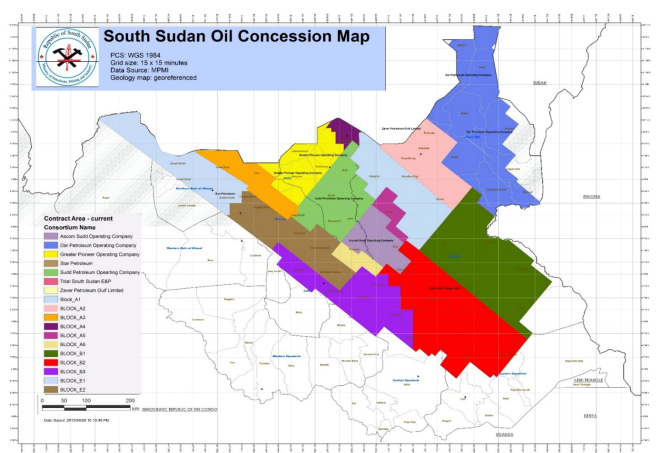
Figure 1 depicts the three operational oil blocks that currently underpin South Sudan’s production: Blocks 1/2/4 (operated by GPOC), Blocks 3/7 (operated by DPOC), and Block 5A (operated by SPOC). These blocks are in Upper Nile State and Unity State. South Sudan holds approximately 3.5 billion barrels of proven oil reserves, the third largest in sub-Saharan Africa . Current production ranges between 70,000 and 100,000 barrels per day, with approximately 8.5 million to 12.2 million barrels of production estimated between August and November 2026 .
[Source: Ministry of Petroleum].

Download: Download full-size image

Figure 1. South Sudan Concession Map.
Section 176 of the Constitution of the Republic of South Sudan gave permission for the establishment of the Nile Petroleum Corporation (NILEPET), the country's national oil company (NOC). This is also supported by section 13 of Petroleum Act, 2012 as amended. The national government has given this corporation the commercial authority to take part in the upstream, midstream, and downstream operations of the petroleum industry. This mandate has been carried out through the allocation of a small equity stake in each of the three producing blocks and the prime contractor status in each exploratory block on a carried forward interest basis.
With an estimated 3.5 billion barrels of reserves, South Sudan has the third-largest oil reserves in sub-Saharan Africa, behind Nigeria and Angola. The Ministry of Petroleum also estimates that almost 90% of South Sudan's oil and gas reserves remain untapped .
1.2. Mechanism of the EPSA
An Exploration and production-sharing agreement (EPSA) serves as the foundation of the current financial structure for South Sudan's oil industry. In accordance with this arrangement, the government contracts oil companies and pays them a fixed percentage of output following discovery . South Sudan's exploration, development, and production activities are carried out by foreign oil companies under Exploration and Production Sharing Contract (EPSC) governed by the Transitional Constitution of 2011 as amended . The two main laws governing the oil and gas industry in South Sudan are the Petroleum Act of 2012 and the Petroleum Revenue Management Act of 2013, among other laws. The Melut Basin and the Muglad Basin are the two primary producing basins. Other basins are still being explored.
The main tools of the current slide-scale fiscal framework, which was adopted from the PSC of Sudan, are bonuses, rents, and profit oil. The lack of royalties and taxes in the current South Sudanese fiscal system is quite shocking; instead, the government pays all taxes on behalf of the contractors using her own share of the country's crude oil. The contractors are also given the option to speed up cost recovery under this system if they meet certain cost benchmarks. The objective is to encourage more investments in South Sudan's upstream sector.
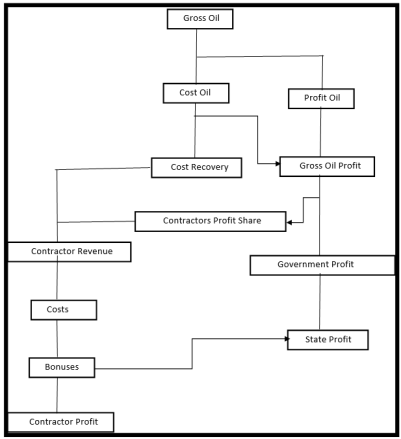
The distribution of income under the current EPSC between the South Sudanese government and the current contractors is shown in the figure below:
[Source: Self-contracted from the EPSC data].

Download: Download full-size image

Figure 2. Mechanism of the PSA fiscal regime.
2. Literature Review
2.1. Theoretical Framework: Concept of Economic Rent
The theory of economic rents serves as this study's foundation. The theory's main goal is to explain issues like who will benefit or bear the burden of the regulation, what kind of regulation is necessary, and how the regulation will affect the distribution of resources . In this study, economic rent is defined as the true value of a natural resource, which is the ratio between revenue generated through oil exploration and extraction expenses . To analyze petroleum resource projects, most international companies utilize cash flow models built on the premise of economic rent. This is due to the model’s simplicity, as its equations can calculate cash flow over the course of the entire project and show how profitable the project will be. Any production in this area is distributed among the three different groups, namely the landowners, the capitalists, and the laborers. Economic rent is determined by subtracting the value of production from the total of all production-related expenses. The value of production is the value of the crude oil and gas produced; the total cost includes exploration costs, production costs, and a preset rate of return on investment for the capital. The basic and practical idea of economic rent is agreed upon by the discounted cash flow model by incorporating it in the analysis of South Sudan’s petroleum fiscal regime in this study to determine how competitive it is.
2.2. Overview of Existing Literatures
Over the years, researchers, academics, and professionals have given close attention to the impact of fiscal systems and their associated factors on the economics of non-renewable resource exploitation. Petroleum fiscal systems affect not only investor and government decision-making, but also the method by which expenses are recovered and earnings are divided equitably . Moreover, researched on “the petroleum revenue sharing arrangement in South Sudan”, examined the distribution of net petroleum revenues to the states and localities that produce petroleum . The current South Sudan fiscal policy has provisions that discuss the producing states and communities that helps in understanding how these provisions have been implemented . The study concluded that the three percent (3%) and two percent (2%) shares of net petroleum revenues have not been fairly distributed to the communities and states that produce petroleum, respectively. Besides, the study also reveals that at the time of writing this article, the South Sudanese government owed the oil-producing communities millions of United States dollars that are yet to be paid as stipulated by the Petroleum Revenue Management Act, 2013.
On the other hand, a study on the proposed PSC fiscal regime for South Sudan’s oil market: a new model harmonizing contractor’s and government’s NPVs provide seminal findings . In this study, which looked at how PSC would perhaps impact contractor NPV and government take in South Sudan's fiscal system, a new model was proposed. Although their work broadened our perspective, they went further than usual to analyze the methods used, select very different assumptions, and propose a new model. This study also went far enough to ensure that it provided a sensitive analysis of potential outcomes should prices, reserves, and discount factors change. The findings demonstrate that PSC regimes have a considerable influence on project NPV, and a new PSC term is suggested to the South Sudanese government that will improve their NPV to 13.4% and that of the contractor to 0.434% over the current regime .
While Lino (2016) conducted research on “Oil and Gas Projects: A Decision Under Investment Risks in a Landlocked Country”, the risk of a rapidly deteriorating outcome for investment decisions in the oil and gas industry was thoroughly examined . To assess the project paths that carry more risk in the South Sudanese oil industry, Monte Carlo simulation was used to calculate and forecast cash flow and investment project net present values. The study found that transit costs influence project evaluation and reduce NPVs for all three sizes of oilfields used in the study. It was observed that the management of foreign exchange reserves affected the South Sudanese fiscal system. According to him, high transit costs influence the reserve because they result in lower revenues, which is obvious in the fluctuation of exchange rates.
Mian and Aramco (2010) researched on the “Designing Efficient Fiscal System”, the Government (Gtake) take has traditionally been estimated using Non-discounted Cash Flow (NCF), however Discounted Cash Flow has been recommended . Gtake and Contractor’s Rate of Return (ROR) are two economic instruments used to evaluate the profitability of a fiscal system. Gtake increases as reserves increase when calculated using undiscounted cash flow. For a fiscal regime to be equitable, it must have proper terms. analyzed the impact of Petroleum Fiscal Arrangements and Contractor Terms on Petroleum E&P Economics and Host Government Take. The following profitability measures were used for evaluating Gtake under any form of fiscal regime, Discounted Net Present Value, Discounted Internal Rate of Return, Discounted Return on Investment. The results of different financial terminology and their accompanying government activities in accordance with the Joint Venture Agreements or PSC were investigated using discounted Cash Flow. Ashikwei, B., and Ashitey, (2019) conducted research on Petroleum Sharing Agreements: An Economic Analysis . The 268 PSAs signed by 74 nations between 1966 and 1998 were studied . The contracts were evaluated considering global PSA trends throughout time, regions, exporting and importing countries, OPEC, and onshore terms and conditions. Every country that used PSC during the chosen period had a distinctive feature that set their various PSCs apart from one another. Geographical, political, or economic factors may be to blame for the variation.
A comparatively analyzed the Upstream Petroleum Fiscal Systems of three Petroleum Exporting Countries: Indonesia, Nigeria and Malaysia demonstrate interesting results . The research compares the different instruments of some of the leading oil and gas exporting countries in the world. The study concludes that every country, regardless of fiscal regime, has a distinct predicament that operators must address. On the other hand, the study on the topic “maximizing the value of government revenues from upstream petroleum arrangements under high oil prices presented scientific results .” The study explains the terms of the contracts used in production-sharing agreements, and how they support the government's goal of maximizing profits. The study concluded that many nations prefer the production sharing contract. The author also gave a compelling justification for why it is preferred. While study on the “effects of fiscal regime changes on investment climate of Malaysia’s marginal oil fields: Proposed model”, it employed the financial terms of a Production Sharing Contract (PSC) and carried out a sensitivity analysis with various prices and reserve levels . The study explains how the changes to the 2010 fiscal regime affected the environment for investments in marginal oilfields. The analysis is also crucial because it helps determine whether the 2010 changes to the fiscal regime were successful in achieving their goals. Tutdel, I. Y., Wang and Gbatu, (2017) conducted research on “the fiscal provisions on existing legal frameworks governing the oil sector in the Republic of South Sudan The legal framework of the PSCs, which currently governs the oil sector in the Republic of South Sudan, were extracted, examined, and analyzed in all their fiscal provisions. The study identifies some flaws in the EPSCs, such as the lack of royalties and taxes after examining the legal texts of the Transitional Constitution, the Petroleum Act, the exploration and production sharing agreement, the transitional agreements, and other pertinent documents related to the petroleum sector .
3. Methodology and Model Assumptions
The study employs quantitative research design utilizing investment appraisal indicators including Net Present Value (NPV), Profitability Index (PI), Payout Period (POP), Internal Rate of Return (IRR), and Front-Loaded Index (FLI). A 26-year cash flow analysis was conducted to simulate the investment climate under both existing and proposed fiscal regimes, consistent with methodologies employed in . The model analysis is simulation-based and does not purport to represent the actual fiscal situation in South Sudan, given persistent data opacity. The 26-year horizon was selected as a representative average for fields in the Muglad and Melut basins.
Capital expenditure (CAPEX) assumptions were informed by onshore cost benchmarks from Van Meurs’ Report . The average operating expenditure (OPEX) of $8 per barrel was derived from field data provided by Dar Petroleum Operating Company (DPOC) as of December 2022. Reserve estimates were based on developed reserves in Blocks 3 and 7. The initial daily production rate was assumed at 10,000 barrels, rising to a peak of 150,000 barrels per day for three years, followed by a 21-year decline. The total reserve generated by the model was 459.11 million barrels. Oil price assumptions were benchmark against Brent crude historical data.
4. The Findings
The findings of this study are discussed in various sections, including (1) briefly analysis of the fiscal tools used by South Sudan to generate revenue, (2) the performance of the current financial model, (3) the performance of the proposed model and (4) sensitive analysis of the suggested model.
4.1. Analysis of the Fiscal Tools Used by South Sudan to Generate Revenue
Like many other oil-producing nations, South Sudan has a few upstream fiscal instruments. These upstream tools have an impact on the overall revenues that the South Sudanese government and contractors receive. These tools include;
4.1.1. Royalties and Taxes
The existing South Sudan fiscal system exempts contractors from paying royalties and taxes. The government assumes responsibility for discharging all income taxes and other levies on behalf of contractors out of the government’s share of crude oil and gas. Several studies document that the government’s failure to operationalize the PRMA’s sovereign wealth funds has enabled pervasive off-budget spending. The PRMA stipulated that 25% of net petroleum revenues be directed into two sovereign wealth funds: the Oil Revenue Stabilization Account (15%) and the Future Generations Fund (10%). These funds were never operationalized, creating a fiscal vacuum filled by opaque, high-interest oil-backed loans .
4.1.2. Profit Oil Split
For oil and gas sharing with contractors, South Sudan as a nation adopts a sliding scale-based production sharing formula. The government owns and is entitled to the agreed portions that are due under South Sudan's PSC legislation on the entire amount of petroleum produced and saved from the Contract Area and not used in operations across the production period, including renewal.
4.1.3. Bonuses
A few front-end bonuses are paid to the Government at various project development stages according to the fiscal regimes in particular nations. South Sudan offers five distinct kinds of bonuses: signature bonuses, production bonuses, block bonuses, community bonuses, resumption/operational bonuses.
4.1.4. Rent
The contractor must pay annual surface rentals in advance for any areas covered by the Agreement. It's also essential to keep in mind that the contractor cannot recover the surface rentals from the cost of the oil. It is funded by contractor profit share, and the government does not refund it.
4.1.5. State Participation
Article 176 of the Constitution gave permission for the creation of the Nile Petroleum Corporation (NILEPET). This corporation has been granted permission by the national government to participate in the upstream, midstream, and downstream operations of the petroleum sector. Article 176 of the Constitution authorized the creation of NILEPET. Under the 2012 EPSA, South Sudan is entitled to 5% of GPOC, 8% of DPOC, and 8% of SPOC profit-sharing. NILEPETs participation is exercised through a carried-interest mechanism, whereby foreign oil companies bear NILEPET’s costs until commercial production begins. Following Petronas’ withdrawal from South Sudan in August 2024, NILEPET was set to assume ownership of Petronas’ assets in Blocks 3/7, 1/2/4, and 5A .
4.1.6. Cost Oil
South Sudan has adopted a lucrative cost oil formula that allots 45% to 50% of the total amount of crude oil or gas produced in the contract area each fiscal year to the contractor depending on the type of fields, in contrast to neighboring East African nations Kenya and Uganda where the cost of oil is capped at 40%. The blocks in South Sudan are all ring-fenced regarding cost oil issues, which is another crucial point to note.
4.1.7. Training and Research Fees
The licensee pays yearly fees for training and research. This amount is paid when a license is granted, then on each anniversary of that grant until the license is terminated. According to the license, the first exploration period costs USD 200,000 annually, the second and third exploration periods cost USD 200,000 annually, the development period costs USD 300,000 annually, and the corresponding production period costs USD 400,000 annually .
Licenses Fees: The license fee is what is paid when applying for petroleum license transfers or grant renewals. Other payments must be paid to get scientific reports, other pertinent documentation, permission for a reconnaissance operation, etc. The application or renewal of a reconnaissance permit, a license for petroleum exploration, and a license for petroleum production are among the fees that oil companies must pay to the South Sudanese government.
4.2. Performances of Existing and Proposed Model
The South Sudan oil and gas industry's economic viability has been examined in this study using a variety of common economic tools, including the Net Present Value (NPV), Profitability Index (PI), Payout Period (POP), Discounted Net Cash Flow Front Loading Index (FLI), Government take (Gtake), Contractor's take (CTake), and some decision rules .
4.2.1. Capital Decision Rules Budgeting
The models in this study compare and evaluate the existing and proposed approaches using the following profitability indicators.
Table 1. Profitability measures.

S/n

Measure of profitability

Accept If @ r*

Reject If @ r*

1

Net Present Value

>0

<0

2

Profitability Index

>1

<1

3

Payout Period

>0

<0

4

Front-Loaded Index

~0

~1

4.2.2. Performance of the Existing Fiscal Regime
The government's undiscounted net presence value for profitability following the project, as determined by the decision rules, is $MM 5,362.48. This value is higher than zero (NPV>0), indicating that the fiscal regime will generate additional value. The government's take is 40% when discounted at 10% discount rate.
Table 2. Profitability Index for Government in the Existing Model.

Government’s Profitability Index

Discounted Rate (%)

10%

Npv ($mm)

5,362.48

Discounted Gov Take (%)

40%

Table 3 below shows the contractor's profitability. The contractor's take is 60% of the NPV, or $8,045.32 in millions. This indicates that the fiscal system is effective and profitable because it generates a lot of interest from investments. The business is attractive to investors, as evidenced by the front-loading index of 0.67 and the payback period, which is 7.0 years.
Table 3. Profitability Index for Contractor in the Existing Model.

Profitability Index for Contractor

Discounted Rate

10%

Net Present Value (NPV $mm)

8,045.32

Discounted Contractor’s Take (%)

60%

Pop

7.00

Fli

0.67

4.2.3. Performance of South Sudan's Proposed Fiscal System
The government's NPV is $MM 8,807.38, which is greater than 0. This suggests that the government's investment has value beyond what was originally planned. incorporating both the discounted and undiscounted government take. Additionally, the discounted government take under the proposed regime is higher, 73.39% than the take under the current regime, which is 40%. As a result, the equity of the newly anticipated fiscal regime was achieved.
Table 4. Profitability Index for Government in the Proposed Model.

Profitability Index for Government

Discounted Rate

10%

Npv ($mm)

8,807.38

Discounted Gov’t Take

73.39%,

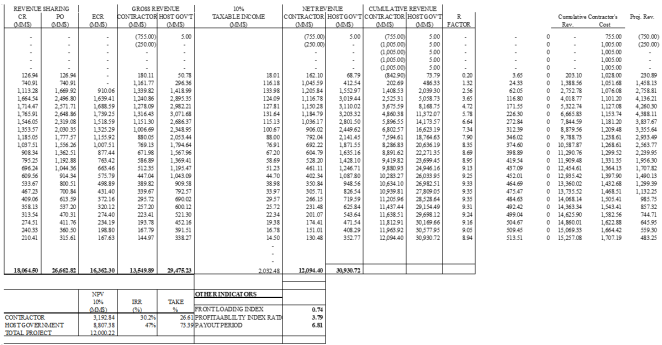
The efficiency of the suggested regime was taken into consideration when calculating the FLI. Since the FLI is 0.72, it is both greater than 0 and less than 1. Because of these values, the regime is very effective. The contractor's NPV, which comes from the same table and is $MM 3,192.84, is greater than zero when the viability of the contractor's portion of the investment is considered, indicating that the contractor's involvement in the project will add value. The calculated IRR, which evaluates the regime's efficacy, was 30.2%, exceeding the 10% assumption. This suggests that the investment is going well and that there is a return on every dollar invested in it given the current financial environment. A profitable investment is indicated by the Profitability Index (PI), which measures profitability, being greater than 1. It is currently 3.79. When compared to the 26 years of production, the Payout Period (POP) of 6.81 years is comparatively short. This suggests that the company funding the project will make money from it .
Table 5. Profitability Index for Contractor for the Proposed Model.

Profitability Index for Contractor

Discounted Rate (Npv $mm)

10%

Discounted Net Present Value

3,192.84

Discounted Cont Take

26.61

Pop

6.81

Fli

0.74

Pi

3.79

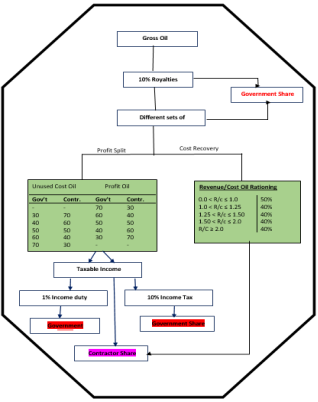
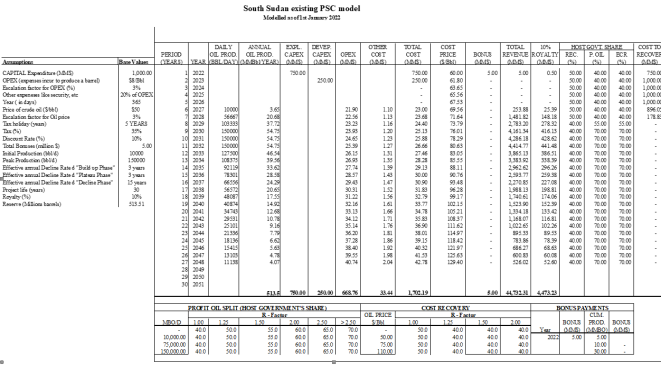
Summary of the South Sudanese government's proposed PSC model.
[Source: Authors’ self-constructed from the proposed model].

Download: Download full-size image

Figure 3. Summary of Proposed PSC model.
4.3. Model Simulation and Analysis
The simulation analysis in this section will help potential investors in comprehending South Sudan's fiscal structure and the potential returns on their investments. In the analysis of this economic model, @Risk was used. @Risk is a business-related piece of software used for risk exposure analysis in technical situations. To define uncertainties values, Monte Carlo simulation is used.
Three fundamental input variables were subjected to 10,000 simulation iterations, which were then applied to 4 profitability indicators. Triangular was the imposed distribution. Discount rate, oil price, and reserves are the fundamental inputs. The minimum values were 25% lower than the likely values, while the maximum values were 50% higher. This was done to provide the model with a broad range of values to run on. But to account for the volatility of the price of oil, the maximum and minimum values were halved from the likely price.
Table 6. Fundamental Input Variables Used in the Carlo Monte Simulation.

Input variables

Stochastic distribution

Min

Mean

Max

Reserves (MMBBLs)

Triangular

385

513

770

Discount Rate (%)

Triangular

5

10

15

Oil price ($/BBL)

Triangular

40

60

120

4.4. Monte Carlo Simulation Analysis of the Proposed Model
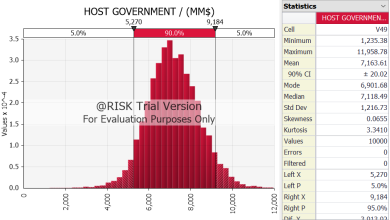
According to the probability, Figure 4 shows the level of confidence in the discounted Government takes. There is 5% chance that the discounted NPV will be less than 5270 MM$, and a 95% chance that the government will receive 9184 MM$, according to the probability.
Figure 4. Government Discounted Net Present Value (NPV).
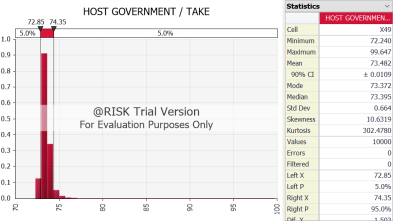
The discounted net present value stochastic modeling and its input effects for the government's share are shown in Figure 5. The stochastic analysis generates only positive results, increasing the investment's value. It demonstrates that there is a 5% chance that the net present value (NPV) will be less than 72.85% and a 95% chance that it will be less than or equal to 74.35%.
Figure 5. Stochastic Result for Government take.
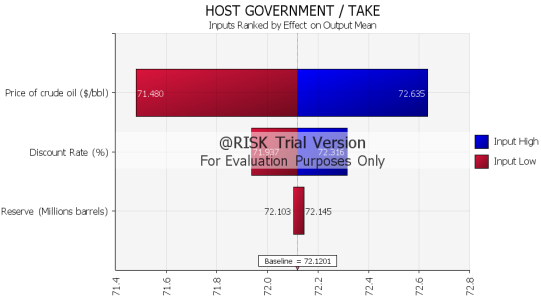
Figure 6 displays the discounted net present value probability modeling and its input effects for the government's shares. The recoverable reserve and oil price have a positive influence on the contractor's share's NPV, so raising them will raise NPV. Since the discount rate input variable varies, raising it would result in a decrease in NPV.
Figure 6. Stochastic Input Variables that Affects Government Take.
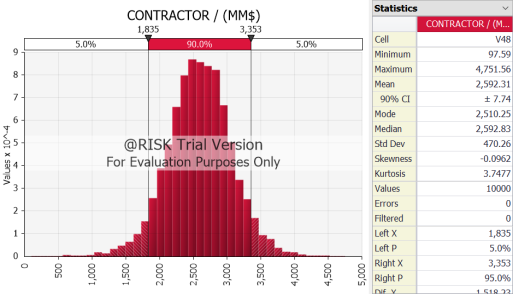
Figure 7 illustrates the NPV simulation results for the contractors' profit share. Both values are positive at 90% confidence, indicating that such a project will gain value. The NPV has a 5% chance of being less than $MM 1835 and a 95% chance of being less than or equal to $MM 3,353.
Figure 7. Contractor's Discounted NPV.
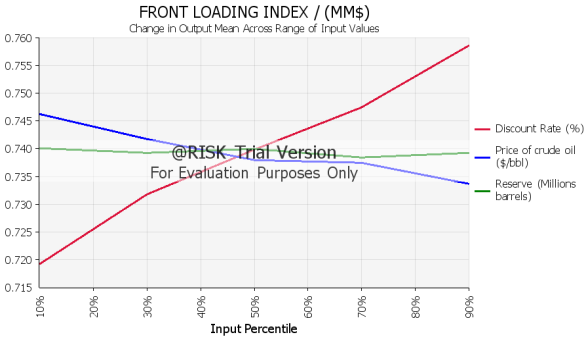
Figure 8 shows the stochastic outcome of how the various input variables impact the contractor's front-end loading index. The price of oil and reserve recoverability are the two variables that negatively affect FLI output. This suggests that the FLI will decrease, favoring the contractor, should the price of oil increase along with the number of recoverable reserves. On the other hand, because the discount rate is positively affecting the FLI, it will increase if it is raised.
Figure 8. The Impact of Stochastic Input Variables on FLI Output.
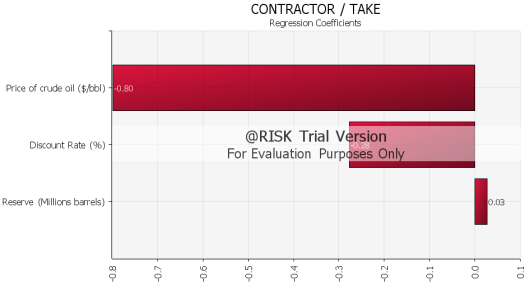
The discounted contractor takes and the input variables that affect its output are shown stochastically in Figure 9. The oil price and recoverable reserve are clearly having a positive impact on the contractor take, as shown in the figure below. As a result, it will increase if those input variables are increased.
Figure 9. Stochastic Input Factors that Impact the Output of the Discounted Contractor's Take.
5. Conclusions
This study discussed the current revenue-generating fiscal tools use by the government of South Sudanese. These include the government participation, profit oil split, rent per kilometre, bonuses, licenses fee, training and research fee. A new fiscal regime with a better government take was built after a successful review and assessment of the existing South Sudanese oil and gas industry's fiscal structure. The proposed fiscal regime increased the government take from an average of 40% to 73.39%, which is an increase of government NPV from $MM 3,782.44 to $MM 8,807.38. The proposed fiscal regime's attractiveness to investors was however marginally lower than the current fiscal regime. It was 0.74, while the current model's FLI is 0.67 all within the lawful FLI range of 0–1. Other profitability indicators looked at were the profitability index (PI) and payout period (POP), the PI was 3.79, which is higher than 1, indicating that the investment now has more value. The proposed fiscal system's payout period (POP) is 6.81 years while the existing fiscal system's is 7.0 years.
The proposed economic model was given a unique quality by the successful integration of stochastic simulation using @Risk to identify uncertainties and risks. Oil prices, reserves, and discount rates served as the stochastic inputs, they were tested against the government take, and the effects of each were evidently shown by stochastic analysis. It was observed that the government take was positively impacted by the oil price while negatively impacted by the discount rate.
6. Recommendations
1) The current fiscal structure of the oil and gas industry in South Sudan should be revised to include the payment of taxes and royalties.
2) Besides that, it's extremely important that foreign oil companies that want to invest in the oil industry participate in the bidding process. This guarantees that the South Sudanese government selects a company that will provide favorable terms in terms of the overall government take.
3) It is crucial to have provisions on recoverable and non-recoverable costs, such as bonuses, corporate social responsibility (CSR), and other expenses, that are both clearly written and even more clear. Inaccurate cost definitions could lead to a variety of misunderstandings when it comes to accounting, reporting, and auditing.
4) Further research is needed to design a model for a fiscal production sharing agreement regime for the development of oil and gas in South Sudan.
5) Further research can also test additional profitability indices, such as the Growth Rate of Return (GRR), Internal Rate of Return (IRR), and Adjusted Net Present Value (ANPV).
6) Future studies are strongly recommended to examine the sensitivity effects of CAPEX and OPEX on the net profitability of the government of South Sudan and potential contractors should any of the variables change.
7) Despite not being specifically modeled in the study due to their high level of uncertainty, pipeline (crude transport cost) costs are also important. Since South Sudan is a landlocked nation, if transport/pipeline tariffs are not carefully monitored and controlled, the final revenue split between IOCs and the host government may be significantly reduced. For political and economic reasons, it is crucial that the government of South Sudan hold a stake in such strategic assets over the long term.
Abbreviations

CPEEL

Centre for Petroleum, Energy, Economics and Law

EPSAS

Exploration and Production Sharing Agreements

JOCs

Joint Operating Companies

NPV

Net Present Value

PSC

Production Sharing Contract

GDP

Gross Domestic Product

NILEPET

Nile Petroleum Corporation

NOC

National Oil Company

EPSC

Exploration Production Sharing Contract

ROR

Rate of Return

NCF

Non-Discounted Cash Flow

PSA

Production Sharing Agreement

OPEC

Organization of Petroleum Exporting Countries

PI

Profitability Index

POP

Payout Period

IRR

Internal Rate of Return

FLI

Front-Loaded Index

DPOC

Dar Petroleum Operating Company

CAPEX

Capital Expenditure

PRMA

Petroleum Revenue Management Act

GPOC

Greater Pioneer Operating Company

SPOC

Sudd Petroleum Operating Company

ANPV

Adjusted Net Present Value

CSR

Corporate Social Responsibility

GRR

Growth Rate of Return

OPEX

Operating Expenditure

Author Contributions
Chol Stephen Jok: Conceptualization, Data curation, Investigation, Methodology, Project administration, Resources, Software, Supervision, Validation, Visualization, Writing – original draft, Writing – review & editing
Jacob Dut Chol Riak: Conceptualization, Data curation, Formal Analysis, Investigation, Methodology, Project administration, Resources, Software, Supervision, Validation, Visualization, Writing – original draft, Writing – review & editing
Conflicts of Interest
The authors declare no conflicts of interest.
Appendix
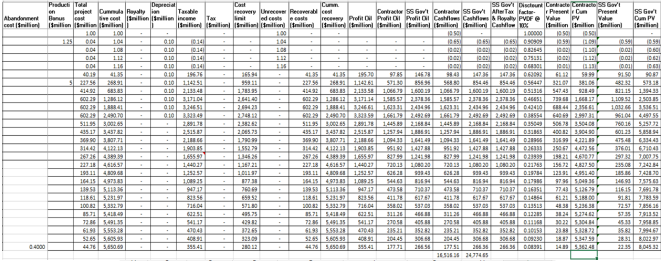
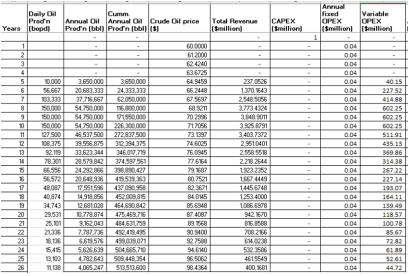
Appendix I: Overviews of South Sudan’s Existing Economic Model
Figure 10. Overviews of South Sudan’s Existing Economic Model.
Figure 11. Overviews of South Sudan’s Existing Economic Model.Overviews of South Sudan’s Existing Economic Model.
Figure 12. Overviews of South Sudan’s Existing Economic Model.Overviews of South Sudan’s Existing Economic Model.
Appendix II: Overview of Proposed Fiscal System
Figure 13. South Sudan existing PSC model.
Figure 14. South Sudan existing PSC model.
References
[1] African Development Bank. 2026. COUNTRY FOCUS REPORT 2026: SOUTH SUDAN: Mobilizing South Sudan’s Development Financing at Scale in a Fragmented World. Retrieved from
[2] Anyak, B. G. 2025. South Sudan’s Petroleum Revenue Mismanagement and the Emerging Debt Crisis: Policy Brief. Retrieved from
[3] Ashikwei, B., and Ashitey, D. 2019. FISCAL SYSTEM DESIGN AND ECONOMIC EVALUATION FOR PETROLEUM RESOURCE DEVELOPMENT IN GHANA.
[4] Azeez, R. O. 2018. Oil price volatility spillover effects on food prices in Nigeria.
[5] Babajide, N., Babajide, N. A., Ogunlade, C. A. B., and Oladimeji, S. T. D. 2014. Comparative Analysis of Upstream Petroleum Fiscal Systems of Three (3) Petroleum Exporting Countries: Indonesia, Nigeria and Malaysia Design, Development and Evaluation of Machine and equipment for biomaterials View project Sustainable Concrete View project Comparative Analysis of Upstream Petroleum Fiscal Systems of Three (3) Petroleum Exporting Countries: Indonesia, Nigeria and Malaysia. Article in International Journal of Sciences: Basic and Applied Research 15. 2: 99–115. Retrieved from
[6] Blake, A. J., and Roberts, M. C. 2006. Comparing petroleum fiscal regimes under oil price uncertainty. Resources Policy 31. 2: 95–105.
[7] Darlington Uche Onuoha, M., Opec Amaykway, M., Duan, M., Okafor Elochukwu, H., and Yang, P. 2018. A proposed PSC fiscal regime for South Sudan’s oil market: a new model harmonising contractor’s and government’s NPVs “A proposed PSC fiscal regime for South Sudan’s oil market: a new model harmonising contractor’s and government’s NPVs.” Int. J. Revenue Management (Vol. 10).
[8] David, A., and Tiitmamer, R. N. 2018. Special Report the Petroleum Revenue Sharing Arrangement in South Sudan 1.
[9] Dongkun, L., and Na, Y. 2010. Assessment of fiscal terms of international petroleum contracts.
[10] FDI-Intellgence. 2022. The promise of oil and gas in South Sudan | fDi Intelligence – Your source for foreign direct investment information - fDiIntelligence.com. Retrieved from
[11] Feng, Z., Zhang, S. B., and Gao, Y. 2014. On oil investment and production: A comparison of production sharing contracts and buyback contracts. Energy Economics 42: 395–402.
[12] Gaspar Ravagnani, A. T. F. S., Costa Lima, G. A., Barreto, C. E. A. G., Munerato, F. P., and Schiozer, D. J. 2012. Comparative Analysis of Optimal Oil Production Strategy Using Royalty & Tax and Production Sharing Petroleum Fiscal Models. Society of Petroleum Engineers - North Africa Technical Conference and Exhibition 2012, NATC 2012: Managing Hydrocarbon Resources in a Changing Environment 2: 857–864.
[13] Higgins, J. G. 1992. Fiscal Aspects of International Petroleum Agreements.
[14] IEO. (n.d.). International Energy Outlook 2021 - U.S. Energy Information Administration (EIA). Retrieved June 4, 2022, from
[15] Iledare, O. O. 2004. Analyzing the Impact of Petroleum Fiscal Arrangements and Contract Terms on Petroleum E&P Economics and the Host Government Take. Society of Petroleum Engineers (SPE).
[16] Jazeera, A. (n.d.). Talks under way to end Sudan conflict | News | Al Jazeera. Retrieved June 4, 2022, from
[17] Johnston, D. 2003. International exploration economics, risk, and contract analysis 401.
[18] Kaiser, M. J. 2007. Fiscal system analysis-concessionary systems. Energy 32. 11: 2135–2147.
[19] Kellas, G. K., and Hodgshon, S. 1994. Risk Sharing in Exploration and Production Contracts.
[20] Lino, A. 2016. Master’ s Thesis Oil and Gas Projects : A Decision Under Investment Risks in a Landlocked Ritsumeikan Asia Pacific University In Partial Fulfillment of the Requirements for the Degree of Master of Business Administration Table of Contents. September: 1–56.
[21] Manaf, N. A. A., Saad, N., Ishak, Z., and Mas’ud, A. 2014. Effects of Fiscal Regime Changes on Investment Climate of Malaysia’s Marginal Oil Fields: Proposed Model. Procedia - Social and Behavioral Sciences 164: 55–61.
[22] Meurs, P. van. 2008. Maximizing the value of government revenues from upstream petroleum arrangements under high oil prices. Van Meurs Corporation pp. 3-65. Retrieved from
[23] Mian, M. A., and Aramco, S. 2010. SPE 130127 Designing Efficient Fiscal Systems.
[24] Nakhle, C., and Lassourd, T. (n.d.), 2019. Assessing Tunisia’s Upstream Petroleum Fiscal Regime Towards Good Governance of the Oil and Gas Sector in the MENA View project. Retrieved from
[25] Office of the President - Republic of South Sudan. (n.d.). JUBA, July 8, 2026 – President of the Republic, H. E. Salva Kiir Mayardit, today received a briefing from the management of Dar Petroleum Operating Company (DPOC). Retrieved from
[26] Oilfield Africa Review, (n.d.), 2026. South Sudan Hydrocarbon Reforms to Unlock Reserves, Target New Investment Opportunities. Retrieved from
[27] Prall, H. 2012. A Review of “Petroleum Resources With Emphasis on Offshore Fields.” The Journal of Environmental Education 43. 2: 139–141.
[28] Putrohari, R. D. 2018. PSC term and condition and its implementation in South East Asia region.
[29] Rowland, C. (n.d.), 1980. Taxing North Sea oil profits in the UK Special needs and the effects of Mroleum Revenue Tax.
[30] South Sudan Ministry of Petroleum (SSMOP). 2024. Government of the Republic of South Sudan South Sudan Development Plan peace and prosperity for all. Government of the Republic of South Sudan South Sudan Development Plan Peace and Prosperity for All 1. August 2011: 71–99.
[31] Stigler, G. J. 1971. The Theory of Economic Regulation. The Bell Journal of Economics and Management Science 2. 1: 3.
[32] Sudan Tribune. (n.d.), 2024. Sudan oil entity takes over oilfields abandoned by PETRONAS. Retrieved from
[33] Tutdel, I. Y., Wang, Z., and Gbatu, A. P. 2017. The fiscal provisions on existing legal frameworks governing the oil sector in the Republic of South Sudan. International Journal of Revenue Management 10. 1: 1–14.
[34] Yas, H. 2010. Economic Evaluation of Petroluem Project. Journal of Petroleum Researches & Studies. 1: 37–42.
[35] Yúnez, A. I., and Chapa, F. F. 2017. Contratos de riesgo de petróleo, patrones de conducta y desempeño de empresas: análisis de panel de datos. Contaduria y Administracion 62. 5: 1538–1552.
[36] Mordor Intelligence Website, South Sudan oil and gas market - growth, trends, covid-19 impact, and forecasts (2023 - 2028):
[37] Sudan oil and Gas History: The Chevron Period: 1974-92:
[38] Proposed PSC Fiscal Regime for South Sudan's Oil Market: A New Model Harmonizing Contractor's and Government's NPVs”
[39] Sudantribune. (2021). Foreign firms to pay Sudan $14 per barrel as transit fees for South Sudan oil - Sudan Tribune.
[40] Alex Irwin-Hunt and Munyaradzi Makoni (October 31, 2022), The promise of oil and gas in South Sudan:
Cite This Article
  • APA Style

    Jok, C. S., Riak, J. D. C. (2026). The Impact of South Sudan Petroleum Fiscal Regime on the Generation of Government Revenue. Journal of Energy and Natural Resources, 15(4), 94-109. https://doi.org/10.11648/j.jenr.20261504.12

    Copy | Download

    ACS Style

    Jok, C. S.; Riak, J. D. C. The Impact of South Sudan Petroleum Fiscal Regime on the Generation of Government Revenue. J. Energy Nat. Resour. 2026, 15(4), 94-109. doi: 10.11648/j.jenr.20261504.12

    Copy | Download

    AMA Style

    Jok CS, Riak JDC. The Impact of South Sudan Petroleum Fiscal Regime on the Generation of Government Revenue. J Energy Nat Resour. 2026;15(4):94-109. doi: 10.11648/j.jenr.20261504.12

    Copy | Download

  • @article{10.11648/j.jenr.20261504.12,
      author = {Chol Stephen Jok and Jacob Dut Chol Riak},
      title = {The Impact of South Sudan Petroleum Fiscal Regime on the Generation of Government Revenue},
      journal = {Journal of Energy and Natural Resources},
      volume = {15},
      number = {4},
      pages = {94-109},
      doi = {10.11648/j.jenr.20261504.12},
      url = {https://doi.org/10.11648/j.jenr.20261504.12},
      eprint = {https://article.sciencepublishinggroup.com/pdf/10.11648.j.jenr.20261504.12},
      abstract = {The petroleum fiscal system is a key component of economic dynamics because it controls how investors and host governments divide risks and rewards. South Sudan’s petroleum fiscal system remains the central determinant of the state’s economic viability. petroleum accounts for approximately 70% of government revenue and 95% of exports. Under the existing Exploration and Production Sharing Agreements (EPSAs), the Joint Operating Companies (JOCs) recover costs and profit oil at rates that leave the government with a diminished share of its own resource wealth. South Sudan pays Sudan approximately $11 per barrel in transit and processing fees. Following the Rapid Support Forces’ captured of the Heglig area in December 2025, a tripartite arrangement of transit fees became a burden to the government of South Sudan. Based on Monte Carlo simulations, the study proposed a revised fiscal framework that links the R-factor to production. In comparison to the current fiscal regime, the proposed model yields a large rise in average government take of 40% to 73.39%, excluding divorce and transit fees. The payback time shortens from the current 7 years to 6.81 years. Following the sensitivity analysis, the government's Net Present Value (NPV) is positively impacted by oil prices, whilst the discount rate has a negative impact. This study recommends the use of a R-factor to production in contrast to the progressive sliding scale that South Sudan has been using for the last ten years. With its more equitable distribution of risks and rewards, the proposed fiscal framework encourages win-win outcomes. The study offers major insights for scholars, financiers, and public policymakers in South Sudan who seek to enhance their petroleum-related fiscal framework for sustainable long-term growth and fair profits.},
     year = {2026}
    }
    

    Copy | Download

  • TY  - JOUR
    T1  - The Impact of South Sudan Petroleum Fiscal Regime on the Generation of Government Revenue
    AU  - Chol Stephen Jok
    AU  - Jacob Dut Chol Riak
    Y1  - 2026/11/06
    PY  - 2026
    N1  - https://doi.org/10.11648/j.jenr.20261504.12
    DO  - 10.11648/j.jenr.20261504.12
    T2  - Journal of Energy and Natural Resources
    JF  - Journal of Energy and Natural Resources
    JO  - Journal of Energy and Natural Resources
    SP  - 94
    EP  - 109
    PB  - Science Publishing Group
    SN  - 2330-7404
    UR  - https://doi.org/10.11648/j.jenr.20261504.12
    AB  - The petroleum fiscal system is a key component of economic dynamics because it controls how investors and host governments divide risks and rewards. South Sudan’s petroleum fiscal system remains the central determinant of the state’s economic viability. petroleum accounts for approximately 70% of government revenue and 95% of exports. Under the existing Exploration and Production Sharing Agreements (EPSAs), the Joint Operating Companies (JOCs) recover costs and profit oil at rates that leave the government with a diminished share of its own resource wealth. South Sudan pays Sudan approximately $11 per barrel in transit and processing fees. Following the Rapid Support Forces’ captured of the Heglig area in December 2025, a tripartite arrangement of transit fees became a burden to the government of South Sudan. Based on Monte Carlo simulations, the study proposed a revised fiscal framework that links the R-factor to production. In comparison to the current fiscal regime, the proposed model yields a large rise in average government take of 40% to 73.39%, excluding divorce and transit fees. The payback time shortens from the current 7 years to 6.81 years. Following the sensitivity analysis, the government's Net Present Value (NPV) is positively impacted by oil prices, whilst the discount rate has a negative impact. This study recommends the use of a R-factor to production in contrast to the progressive sliding scale that South Sudan has been using for the last ten years. With its more equitable distribution of risks and rewards, the proposed fiscal framework encourages win-win outcomes. The study offers major insights for scholars, financiers, and public policymakers in South Sudan who seek to enhance their petroleum-related fiscal framework for sustainable long-term growth and fair profits.
    VL  - 15
    IS  - 4
    ER  - 

    Copy | Download

Author Information
  • Centre for Petroleum, Energy, Economics and Law (CPEEL), University of Ibadan, Ibadan, Nigeria

  • School of Social and Economic Studies, University of Juba, Juba, South Sudan
  • Abstract
  • Keywords
  • Document Sections

    1. 1. Introduction
    2. 2. Literature Review
    3. 3. Methodology and Model Assumptions
    4. 4. The Findings
    5. 5. Conclusions
    6. 6. Recommendations
    Show Full Outline
  • Abbreviations
  • Author Contributions
  • Conflicts of Interest
  • Appendix
  • References
  • Cite This Article
  • Author Information