Abstract
Precision agriculture has emerged as an essential approach for addressing global challenges related to food security, sustainable production, and the efficient management of natural resources. Among its most promising innovations, the smart hydroponic greenhouse distinguishes itself through its ability to precisely control the environmental factors that govern plant growth. This article examines the electronic architecture designed to regulate key parameters within a hydroponic greenhouse, including temperature, humidity, pH, electrical conductivity, and lighting. The system integrates a network of sensors, microcontrollers, and automated actuators that work together to monitor real-time conditions and apply corrective actions whenever deviations occur. Control algorithms interpret sensor data and adjust heating, cooling, ventilation, nutrient dosing, and illumination to maintain an optimal and stable environment for plant development. The proposed architecture emphasizes modularity, allowing components to be replaced or upgraded easily, and scalability, making it suitable for both small-scale and commercial installations. Experimental evaluations conducted on a prototype greenhouse revealed significant improvements in the stability of climatic and nutrient-related variables when compared with traditional cultivation methods. Temperature and humidity variations were substantially reduced, and nutrient solution parameters such as pH and electrical conductivity were maintained within tighter tolerances. These enhancements resulted in more consistent growing conditions, which are essential for improving plant health and maximizing yields. Overall, this study demonstrates that integrating intelligent monitoring and automated control into hydroponic systems can greatly enhance their performance. By ensuring precise and continuous regulation of environmental factors, smart hydroponic greenhouses represent a major step forward in modern agriculture and contribute meaningfully to the development of sustainable and efficient food production systems.
Keywords
Electronics, Hydroponic Greenhouse, Temperature, Humidity, Potential of Hydrogen, Electrical Conductivity, Microcontroller
1. Introduction
Technological advancement is driving a major transformation across various sectors, particularly in agriculture, through the integration of digital technologies and automation. This revolution is underpinned by the use of cyber-physical systems, which reduce reliance on human labor while enhancing the efficiency and precision of agricultural operations. The optimization of production costs and the improvement of crop quality are paving the way for a more modern and sustainable form of agriculture.
Hydroponics, a soilless cultivation method, stands out due to its numerous advantages, including efficient water resource management, optimal use of space, and precise control over environmental parameters. With advancements in Information and Communication Technology (ICT), the Internet of Things (IoT) and Artificial Intelligence (AI) are playing a crucial role in enhancing intelligent hydroponic systems. Recent advances in IoT, wireless sensor networks, and artificial intelligence have significantly improved the efficiency of precision agriculture and controlled-environment farming systems
| [1] | Wolfert, S., Ge, L., Verdouw, C., & Bogaardt, M.-J. (2017). Big Data in Smart Farming. Agricultural Systems, 153, 69-80.
https://doi.org/10.1016/j.agsy.2017.01.023 |
| [2] | Kim, Y., Evans, R. G., & Iversen, W. M. (2008). Remote sensing and control of an irrigation system using a distributed wireless sensor network. IEEE Transactions on Instrumentation and Measurement, 57(7), 1379-1387.
https://doi.org/10.1109/TIM.2008.917198 |
| [3] | Jawad, H. M., Nordin, R., Gharghan, S. K., Jawad, A. M., & Ismail, M. (2017). Energy-Efficient Wireless Sensor Networks for Precision Agriculture. Sensors, 17(8), 1781.
https://doi.org/10.3390/s17081781 |
| [4] | Ayaz, M., Ammad-Uddin, M., Sharif, Z., Mansour, A., & Aggoune, E.-H. M. (2019). Internet-of-Things (IoT)-Based Smart Agriculture. IEEE Access, 7, 129551-129583.
https://doi.org/10.1109/ACCESS.2019.2932602 |
[1-4]
.
This project focuses on the design and implementation of a smart hydroponic greenhouse that integrates IoT and AI. It aims to monitor and adjust in real-time critical environmental parameters such as temperature, humidity, potential of hydrogen (pH), electrical conductivity (EC), and light intensity to optimize plant growth. Furthermore, an artificial intelligence system is incorporated for the early detection of plant diseases through the analysis of images captured by a camera. An online platform will enable users to remotely monitor and control the entire system.
1.1. Problem Statement
In Madagascar, agriculture faces major challenges, including land degradation, climate change
| [5] | Food and Agriculture Organization of the United Nations (FAO). (2013). Climate-smart agriculture. |
[5]
, limited access to water and agricultural inputs, as well as the proliferation of diseases and pests that threaten crops. Increasing food demand necessitates innovative solutions to enhance productivity while optimizing available resources. Hydroponics presents a promising solution by enabling optimized production with reduced water consumption and precise nutrient control
| [6] | Resh, H. M. (2013). Hydroponic Food Production: A Definitive Guidebook for the Advanced Home Gardener and the Commercial Hydroponic Grower (7th ed.). CRC Press. |
[6]
.
However, the manual management of environmental parameters and the identification of diseases remain complex and prone to error. An automated system capable of monitoring and adjusting growth conditions, as well as detecting diseases, is essential to maximize yields and ensure crop health.
1.2. Project Objectives
The objectives of this project are as follows:
1) To design and develop a smart hydroponic greenhouse integrating IoT and AI for advanced monitoring and control of critical parameters.
2) To implement an online management system enabling users to remotely track growing conditions and adjust parameters.
3) To automate the adjustment of environmental parameters to optimize plant growth.
4) To integrate an AI-based plant disease detection system using a camera and an image analysis model for the early identification of infections.
1.3. Project Scope
This project involves developing a prototype of a smart hydroponic greenhouse based on sensors and actuators connected to an IoT platform. The main sensors used include:
1) DHT22 temperature and humidity sensor to ensure a stable climate.
2) pH sensor to monitor the acidity of the nutrient solution.
3) EC sensor to control nutrient concentration.
4) Light sensor to adjust artificial lighting.
5) Camera to detect plant diseases by analyzing leaf images.
The entire system is managed via an intuitive web platform, allowing users to monitor real-time data, adjust thresholds, and automate specific tasks.
1.4. Project Significance
The implementation of an AI-enhanced smart hydroponic greenhouse offers several advantages:
1) Resource optimization: Reduced water and input consumption through precise management,
2) Productivity improvement: Optimal growing conditions ensuring high yield and better-quality crops,
3) Advanced monitoring: Early disease detection via AI, thereby reducing agricultural losses. Deep learning techniques have demonstrated high performance in plant disease identification and crop monitoring through image analysis, making them suitable for greenhouse automation applications
| [7] | Mohanty, S. P., Hughes, D. P., & Salathé, M. (2016). Using Deep Learning for Image-Based Plant Disease Detection. Frontiers in Plant Science, 7, 1419.
https://doi.org/10.3389/fpls.2016.01419 |
| [8] | Too, E. C., Yujian, L., Njuki, S., & Yingchun, L. (2019). A comparative study of fine-tuning deep learning models for plant disease identification. Computers and Electronics in Agriculture, 161, 272-279.
https://doi.org/10.1016/j.compag.2018.03.032 |
| [9] | Singh, V., Misra, A. K. (2017). Detection of plant leaf diseases using image segmentation and soft computing techniques. Information Processing in Agriculture, 4(1), 41-49.
https://doi.org/10.1016/j.inpa.2016.10.005 |
| [10] | Li, L., Zhang, Q., & Huang, D. (2014). A review of imaging techniques for plant phenotyping. Sensors, 14(11), 20078-20111. https://doi.org/10.3390/s141120078 |
| [11] | Kamilaris, A., & Prenafeta-Boldú, F. X. (2018). Deep learning in agriculture: A survey. Computers and Electronics in Agriculture, 147, 70-90.
https://doi.org/10.1016/j.compag.2018.02.016 |
[7-11]
,
4) Accessibility and remote control: Real-time oversight and management capabilities.
1.5. Assumptions and Limitations
The main assumption of this project is that the integration of IoT and AI will enhance plant growth and reduce disease-related losses. However, certain limitations must be considered:
1) The IoT platform requires a stable internet connection,
2) The disease detection AI requires a well-trained model and high-quality images to be effective.
2. Methods
2.1. Hydroponic Greenhouse System
The hydroponic greenhouse is a controlled environment structure where plants are cultivated without soil, with nutrients supplied directly dissolved in water. This system enables optimized crop growth, water conservation, and enhanced resilience to environmental variations. Controlled-environment agriculture and vertical farming approaches further improve resource efficiency and crop productivity under limited land and water availability
| [12] | Shamshiri, R. R., Jones, J. W., Thorp, K. R., et al. (2018). Review of optimum temperature, humidity, and vapour pressure deficit for microclimate evaluation and control in greenhouse cultivation of tomato. International Agrophysics, 32(2), 287-302. https://doi.org/10.1515/intag-2017-0005 |
| [13] | Benke, K., & Tomkins, B. (2017). Future food-production systems: Vertical farming and controlled-environment agriculture. Sustainability, 9(4), 531.
https://doi.org/10.3390/su9040531 |
[12, 13]
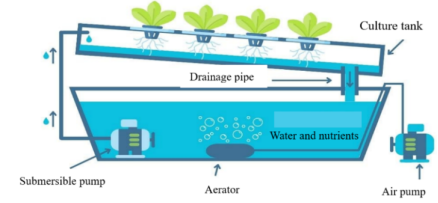
. Several hydroponic systems exist, including Nutrient Film Technique (NFT), Ebb and Flow, Deep Water Culture, and Aeroponics. The following
Figure 1 shows an example of a hydroponic system
| [14] | Jones, J. B. (2014). Complete Guide for Growing Plants Hydroponically. CRC Press. |
[14]
:
Figure 1. Type of hydroponic system.
2.2. Development Methodology
2.2.1. Parameter Analysis
Studying the physical behavior within the greenhouse enables precise control of the internal climate. The three key parameters defining the greenhouse climate are: temperature, air, and humidity.
Temperature is one of the most critical parameters in the greenhouse. Understanding heat exchange is essential as it determines the relationship between internal and external temperatures. The three modes of heat transfer convection, conduction, and radiation must all be considered in greenhouse design. To better evaluate heat transfer, we use the equation
(1) for convection heat flux and (
2) for conduction heat flux as follows:
(1)
1) h: The convective heat transfer coefficient is expressed in W m-2K-1
2) Rth: Convective Thermal Resistance
(2)
1) ℷ: Thermal conductivity of a material is expressed in W m-1 K-1
2) Rth: Conductive Thermal Resistance
Ventilation study is important for understanding the physical aspect of air exchange
| [15] | Kacira, M., Sase, S., & Okushima, L. (2004). "Optimization of vent configuration by evaluating greenhouse and plant canopy ventilation rates under wind-induced ventilation." Transactions of the ASAE, 47(6), 2059-2067.
https://doi.org/10.13031/2013.17803 |
[15]
. The normal external wind speed ranges from 4 to 6 m/s, while inside, the average speed is 0.3 to 0.5 m/s. According to a 1999 study by Day & Bailey, wind speeds exceeding 0.5 m/s can slow plant growth. To analyze air exchange, the following equation is applied
| [16] | Boulard, T., & Baille, A. (1995). Greenhouse natural ventilation: measurements and modelling. |
[16]
:
(3)
N: is expressed in h-1 (number of air volume renewals per hour).
To study the moisture content in air, two key formulas are used to calculate humidity levels: equation (
4) for relative humidity and equation (
5) for absolute humidity.
1) RH: Relative humidity
2) VP: Vapor pressure
3) SVPD: Saturation Vapor Pressure
1) AH: Absolute Humidity
2) g: Mass of water vapor
3) m3: unit volume of air
2.2.2. Block Diagrams
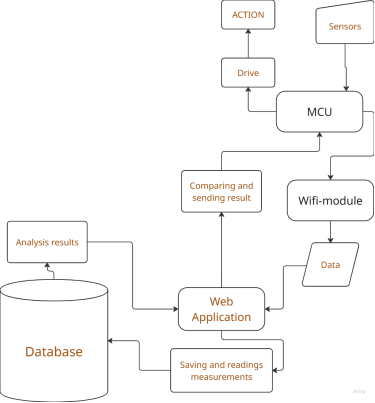
The design of this project is based on a well-defined architecture that integrates several interconnected modules to ensure optimal control of environmental conditions and early detection of plant diseases. The following
Figure 2 shows the system's block diagram, highlighting the main hardware and software components involved in its operation.
1) ATMEGA 328P and ESP8266: These two components play major roles in the project, as they handle all data processing from the sensors and transmit the data to the server computer
| [17] | Gutiérrez, J., Villa-Medina, J. F., Nieto-Garibay, A., & Porta-Gándara, M. Á. (2014). "Automated Irrigation System Using a Wireless Sensor Network and GPRS Module." IEEE Transactions on Instrumentation and Measurement, 63(1), 166-176. https://doi.org/10.1109/TIM.2013.2276487 |
[17]
.
2) DHT11 Sensor: This is a two-in-one sensor that measures both relative humidity and temperature. Widely used in climate control systems, it consists of a thermistor-based temperature sensor and a capacitive humidity sensor.
3) pH Meter: To measure the pH of the hydroponic solution, an analog pH meter was selected for its high measurement accuracy.
4) TDS Meter: This sensor measures the total dissolved solids concentration in a solution with high precision, which is crucial for assessing nutrient solution quality. The sensor is analog.
5) TSL2561 Light Sensor: This sensor plays a critical role in determining the light intensity received by plants. It measures this parameter through a phototransistor installed on its surface.
6) Fan and Heater: These two components regulate temperature and humidity inside the greenhouse.
7) Peristaltic Pumps: Four peristaltic pumps are installed in the greenhouse to maintain stable pH and TDS levels.
8) RGB LED Strip: This LED strip mimics the specific light spectra required during different plant growth stages.
9) LCD Screen: Liquid crystal display technology is used as the primary display interface, showing system data and parameters.
Figure 2. System's block diagrams.
The integration of wireless sensor networks and IoT communication technologies allows continuous monitoring, data acquisition, and remote control of greenhouse operations
| [2] | Kim, Y., Evans, R. G., & Iversen, W. M. (2008). Remote sensing and control of an irrigation system using a distributed wireless sensor network. IEEE Transactions on Instrumentation and Measurement, 57(7), 1379-1387.
https://doi.org/10.1109/TIM.2008.917198 |
| [3] | Jawad, H. M., Nordin, R., Gharghan, S. K., Jawad, A. M., & Ismail, M. (2017). Energy-Efficient Wireless Sensor Networks for Precision Agriculture. Sensors, 17(8), 1781.
https://doi.org/10.3390/s17081781 |
| [4] | Ayaz, M., Ammad-Uddin, M., Sharif, Z., Mansour, A., & Aggoune, E.-H. M. (2019). Internet-of-Things (IoT)-Based Smart Agriculture. IEEE Access, 7, 129551-129583.
https://doi.org/10.1109/ACCESS.2019.2932602 |
[2-4]
.
2.2.3. Implementation of the Electronic System
At the heart of the hydroponic greenhouse automation lies an electronic control system that continuously monitors environmental parameters and manages irrigation, lighting, and nutrient distribution. Imaging technologies and plant phenotyping methods provide valuable information for crop monitoring and can be integrated with artificial intelligence models for automated disease diagnosis
. This system ensures optimal growing conditions for plants. In this context, this section focuses on the design, integration, and control logic of the temperature sensing subsystem used for greenhouse climate regulation
| [18] | Ferentinos, K. P. (2018). Deep learning models for plant disease detection and diagnosis. Computers and Electronics in Agriculture, 145, 311-318. |
[18]
.
In this project, a DHT digital temperature and humidity sensor is employed due to its ease of integration with microcontroller-based platforms. Unlike conventional analog sensors, the DHT incorporates an internal temperature sensing element based on an NTC (Negative Temperature Coefficient) thermistor, allowing reliable and digitally processed temperature measurements.
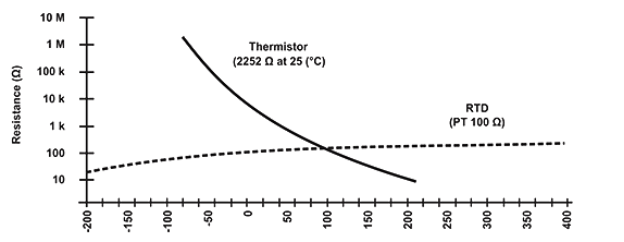
Most NTC thermistors operate effectively within a temperature range of approximately −55°C to 200°C, where they provide high measurement accuracy. The temperature sensitivity of an NTC thermistor is commonly expressed as the percentage change in resistance per degree Celsius or Kelvin. Depending on the semiconductor materials and manufacturing processes, typical sensitivity values range from −3% to −6% per °C, indicating a strong and predictable dependence of resistance on temperature.
As can be seen from the Figure, the NTC thermistors have a much steeper resistance-temperature slope compared to platinum alloy RTDs (Resistance Temperature Detector), which translates to better temperature sensitivity. Even so, RTDs remain the most accurate sensors with their accuracy being ±0.5% of the measured temperature, and they are useful in the temperature range between -200 and 800°C, a much wider range than that of NTC temperature sensors.
In the proposed system, the resistance variation of the NTC thermistor is first converted into a voltage signal using a voltage divider circuit. This analog voltage is then applied to one of the analog input channels of the ATmega microcontroller. The ATmega integrates a high-resolution analog-to-digital converter (ADC), typically 10-bit, which samples the input voltage and converts it into a corresponding digital value.
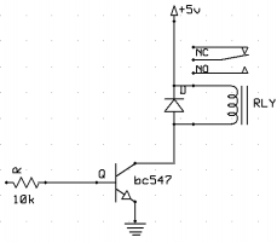
Figure 4. Amplification stage.
The output current provided by the microcontroller is limited to approximately 25 mA, which is insufficient to directly energize a relay coil. Therefore, a transistor-based amplification circuit is employed. In this configuration, a small base current supplied by the microcontroller output is used to control a larger current flowing from the external power supply through the collector-emitter path of the transistor. When the transistor is driven into saturation, it allows sufficient current to activate the relay coil. This arrangement ensures electrical isolation between the low-power control circuit and the high-current load, while enabling reliable and safe relay operation.
Figure 4 illustrates the schematic of the amplification stage.
2.2.4. General Operation
In summary, the sensors read the various parameters and transmit them to the PC, which checks if there are predefined parameter ranges for comparison. After verification, the PC sends these values to the microcontroller, which performs the actual comparison.
For instance, regarding temperature: the Microprocessor Control Unit (MCU) compares the reading to determine if it falls below the minimum threshold to activate the heater, or exceeds the maximum threshold to trigger the fan. If the temperature remains within the accepTable range, no action is taken
| [6] | Resh, H. M. (2013). Hydroponic Food Production: A Definitive Guidebook for the Advanced Home Gardener and the Commercial Hydroponic Grower (7th ed.). CRC Press. |
[6]
.
2.2.5. Website Modeling
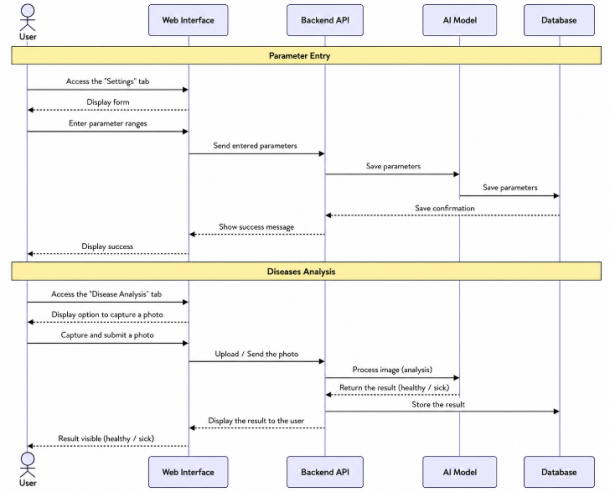
This diagram in the
Figure 5 aims to illustrate the functionality and usage of the interface created to monitor greenhouse parameters and detect plant diseases.
Figure 5. User's diagram.
3. Results
3.1. Temperature Parameters
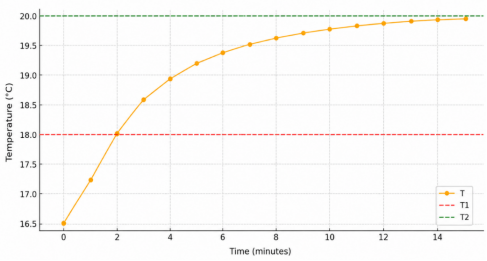
Figure 6. Temperature evolution after activation’s heater.
Taking temperature as an example, it is one of the most critical parameters for the proper development of hydroponic crops. In this experiment, the tested crop is tomatoes, whose ideal temperature range is between 18°C and 26°C. During a typical hour test, temperatures measured at different time points are illustrated in the
Figure 6.
According to this curve, the system's response time—that is, the time elapsed between temperature detection and actuator activation—is less than 5 seconds, ensuring rapid regulation. The curve indicates that the temperature reaches an average of 20°C within 15 minutes, demonstrating the effectiveness of the heating system. This exponential increase shows that the temperature rises gradually to avoid abrupt changes inside the greenhouse.
3.2. Water Parameters
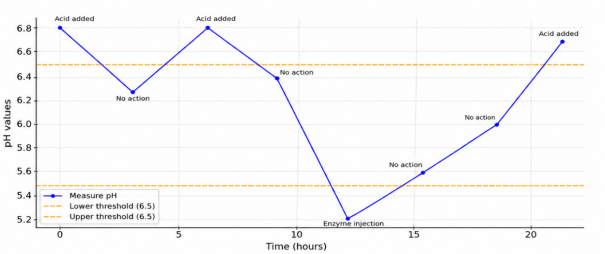
Two parameters need to be monitored and regulated in the water: pH and TDS. The regulation of these two parameters follows the same principle, as each requires two peristaltic pumps. Let’s examine the pH results, as this parameter directly influences the availability of mineral elements for the roots. For the tomato crop used in this study, the optimal pH range is between 5.5 and 6.5. Two peristaltic pumps are used: one to inject an acidic solution if the pH exceeds 6.5, and the other to inject a basic solution if the pH falls below 5.5.
Figure 7. PH evolution and adjustment action from the system.
According to the graph in the
Figure 7, the injections of acidic or basic solutions function perfectly with a satisfactory response time.
4. Discussion
The obtained results demonstrate that the embedded system is capable of autonomously maintaining parameters within their ideal range. The embedded algorithm effectively detects deviations from the set thresholds and activates the appropriate actuator. This system generally relies on simple relay-based control operating on an on-off logic. While this method is straightforward to implement and reliable in low-dynamic environments, it presents certain inherent limitations. For instance, in temperature regulation, occasional slight overshooting beyond the upper threshold is observed. This overshoot is attribuTable to the system's thermal inertia, combined with the fact that heating remains active until the threshold is exceeded, without progressive power modulation.
The integration of a Proportional-Integral-Derivative (PID) controller in future work would enable more precise regulation. By continuously responding to the error between the setpoint and measured value, the PID controller would limit overshoot, reduce stabilization time, and enhance the overall self-regulation capability of the system
| [20] | Astrom, K. J., & Murray, R. M. (2008). Feedback Systems: An Introduction for Scientists and Engineers. Princeton University Press. |
[20]
. Future developments may combine advanced control algorithms with machine learning and big-data analytics to achieve predictive greenhouse management and improved crop health assessment
| [1] | Wolfert, S., Ge, L., Verdouw, C., & Bogaardt, M.-J. (2017). Big Data in Smart Farming. Agricultural Systems, 153, 69-80.
https://doi.org/10.1016/j.agsy.2017.01.023 |
| [4] | Ayaz, M., Ammad-Uddin, M., Sharif, Z., Mansour, A., & Aggoune, E.-H. M. (2019). Internet-of-Things (IoT)-Based Smart Agriculture. IEEE Access, 7, 129551-129583.
https://doi.org/10.1109/ACCESS.2019.2932602 |
| [11] | Kamilaris, A., & Prenafeta-Boldú, F. X. (2018). Deep learning in agriculture: A survey. Computers and Electronics in Agriculture, 147, 70-90.
https://doi.org/10.1016/j.compag.2018.02.016 |
[1, 4, 11]
.
5. Conclusion
This project has successfully designed and implemented a smart hydroponic greenhouse system that effectively integrates IoT and AI technologies. The system demonstrates reliable performance in monitoring and controlling critical environmental parameters, maintaining optimal growing conditions for crops with response times under 5 seconds. The integration of automated actuators and AI-based disease detection provides a comprehensive solution for precision agriculture.
The results confirm the system's capability to maintain stable environmental conditions and effectively regulate key parameters like temperature and pH. While the current on-off control system proves functional, future improvements could incorporate PID controllers for enhanced precision. The project establishes a solid foundation for smart agricultural systems that optimize resource use while enabling remote monitoring and automated crop management.
This research contributes to sustainable agriculture by demonstrating how digital technologies can address challenges in resource-limited environments. The system provides a scalable framework for implementing precision farming techniques that can enhance food security while minimizing environmental impact.
Abbreviations
ADC | Analog to Digital Converter |
AH | Absolute Humidity |
AI | Artificial Intelligence |
DHT | Digital Temperature and Humidity |
EC | Electrical Conductivity |
ICT | Information and Communication Technology |
IoT | Internet of Things |
LED | Light Emitting Diode |
MCU | Microprocessor Control Unit |
NFT | Nutrient Film Technique |
NTC | Negative Temperature Coefficient |
pH | Potential of Hydrogen |
PID | Proportional-Integral-Derivative |
RGB | Red Green Blue |
RH | Relative Humidity |
Rth | Convective Thermal Resistance |
RTD | Resistance Temperature Detector |
SVP | Saturation Vapor Pressure |
TDS | Total Dissolved Solids |
VP | Vapor Pressure |
Author Contributions
Tsarona Mahefasoa Fehizoro Rakotonanahary: Conceptualization, Investigation, Methodology, Resources, Writing – original draft, Writing – review & editing
Paul Ezekel Ratianarivo: Project administration, Supervision, Validation
Data Availability Statement
The data is available from the corresponding author upon reasonable request.
Conflicts of Interest
The authors declare no conflicts of interest.
References
| [1] |
Wolfert, S., Ge, L., Verdouw, C., & Bogaardt, M.-J. (2017). Big Data in Smart Farming. Agricultural Systems, 153, 69-80.
https://doi.org/10.1016/j.agsy.2017.01.023
|
| [2] |
Kim, Y., Evans, R. G., & Iversen, W. M. (2008). Remote sensing and control of an irrigation system using a distributed wireless sensor network. IEEE Transactions on Instrumentation and Measurement, 57(7), 1379-1387.
https://doi.org/10.1109/TIM.2008.917198
|
| [3] |
Jawad, H. M., Nordin, R., Gharghan, S. K., Jawad, A. M., & Ismail, M. (2017). Energy-Efficient Wireless Sensor Networks for Precision Agriculture. Sensors, 17(8), 1781.
https://doi.org/10.3390/s17081781
|
| [4] |
Ayaz, M., Ammad-Uddin, M., Sharif, Z., Mansour, A., & Aggoune, E.-H. M. (2019). Internet-of-Things (IoT)-Based Smart Agriculture. IEEE Access, 7, 129551-129583.
https://doi.org/10.1109/ACCESS.2019.2932602
|
| [5] |
Food and Agriculture Organization of the United Nations (FAO). (2013). Climate-smart agriculture.
|
| [6] |
Resh, H. M. (2013). Hydroponic Food Production: A Definitive Guidebook for the Advanced Home Gardener and the Commercial Hydroponic Grower (7th ed.). CRC Press.
|
| [7] |
Mohanty, S. P., Hughes, D. P., & Salathé, M. (2016). Using Deep Learning for Image-Based Plant Disease Detection. Frontiers in Plant Science, 7, 1419.
https://doi.org/10.3389/fpls.2016.01419
|
| [8] |
Too, E. C., Yujian, L., Njuki, S., & Yingchun, L. (2019). A comparative study of fine-tuning deep learning models for plant disease identification. Computers and Electronics in Agriculture, 161, 272-279.
https://doi.org/10.1016/j.compag.2018.03.032
|
| [9] |
Singh, V., Misra, A. K. (2017). Detection of plant leaf diseases using image segmentation and soft computing techniques. Information Processing in Agriculture, 4(1), 41-49.
https://doi.org/10.1016/j.inpa.2016.10.005
|
| [10] |
Li, L., Zhang, Q., & Huang, D. (2014). A review of imaging techniques for plant phenotyping. Sensors, 14(11), 20078-20111.
https://doi.org/10.3390/s141120078
|
| [11] |
Kamilaris, A., & Prenafeta-Boldú, F. X. (2018). Deep learning in agriculture: A survey. Computers and Electronics in Agriculture, 147, 70-90.
https://doi.org/10.1016/j.compag.2018.02.016
|
| [12] |
Shamshiri, R. R., Jones, J. W., Thorp, K. R., et al. (2018). Review of optimum temperature, humidity, and vapour pressure deficit for microclimate evaluation and control in greenhouse cultivation of tomato. International Agrophysics, 32(2), 287-302.
https://doi.org/10.1515/intag-2017-0005
|
| [13] |
Benke, K., & Tomkins, B. (2017). Future food-production systems: Vertical farming and controlled-environment agriculture. Sustainability, 9(4), 531.
https://doi.org/10.3390/su9040531
|
| [14] |
Jones, J. B. (2014). Complete Guide for Growing Plants Hydroponically. CRC Press.
|
| [15] |
Kacira, M., Sase, S., & Okushima, L. (2004). "Optimization of vent configuration by evaluating greenhouse and plant canopy ventilation rates under wind-induced ventilation." Transactions of the ASAE, 47(6), 2059-2067.
https://doi.org/10.13031/2013.17803
|
| [16] |
Boulard, T., & Baille, A. (1995). Greenhouse natural ventilation: measurements and modelling.
|
| [17] |
Gutiérrez, J., Villa-Medina, J. F., Nieto-Garibay, A., & Porta-Gándara, M. Á. (2014). "Automated Irrigation System Using a Wireless Sensor Network and GPRS Module." IEEE Transactions on Instrumentation and Measurement, 63(1), 166-176.
https://doi.org/10.1109/TIM.2013.2276487
|
| [18] |
Ferentinos, K. P. (2018). Deep learning models for plant disease detection and diagnosis. Computers and Electronics in Agriculture, 145, 311-318.
|
| [19] |
Xiong, et al. (2018). Evaluation of calibration equations for NTC thermistor applied to high?precision temperature measurement, Measurement, Elsevier.
|
| [20] |
Astrom, K. J., & Murray, R. M. (2008). Feedback Systems: An Introduction for Scientists and Engineers. Princeton University Press.
|
Cite This Article
-
APA Style
Rakotonanahary, T. M. F., Ratianarivo, P. E. (2026). Smart Hydroponic Greenhouse with Plant Disease Detection. Journal of Electrical and Electronic Engineering, 14(3), 181-189. https://doi.org/10.11648/j.jeee.20261403.16
 Copy
|
Copy
|
 Download
ACS Style
Rakotonanahary, T. M. F.; Ratianarivo, P. E. Smart Hydroponic Greenhouse with Plant Disease Detection. J. Electr. Electron. Eng. 2026, 14(3), 181-189. doi: 10.11648/j.jeee.20261403.16
Copy
|
Download
AMA Style
Rakotonanahary TMF, Ratianarivo PE. Smart Hydroponic Greenhouse with Plant Disease Detection. J Electr Electron Eng. 2026;14(3):181-189. doi: 10.11648/j.jeee.20261403.16
Copy
|
Download
-
@article{10.11648/j.jeee.20261403.16,
  author = {Tsarona Mahefasoa Fehizoro Rakotonanahary and Paul Ezekel Ratianarivo},
  title = {Smart Hydroponic Greenhouse with Plant Disease Detection},
  journal = {Journal of Electrical and Electronic Engineering},
  volume = {14},
  number = {3},
  pages = {181-189},
  doi = {10.11648/j.jeee.20261403.16},
  url = {https://doi.org/10.11648/j.jeee.20261403.16},
  eprint = {https://article.sciencepublishinggroup.com/pdf/10.11648.j.jeee.20261403.16},
  abstract = {Precision agriculture has emerged as an essential approach for addressing global challenges related to food security, sustainable production, and the efficient management of natural resources. Among its most promising innovations, the smart hydroponic greenhouse distinguishes itself through its ability to precisely control the environmental factors that govern plant growth. This article examines the electronic architecture designed to regulate key parameters within a hydroponic greenhouse, including temperature, humidity, pH, electrical conductivity, and lighting. The system integrates a network of sensors, microcontrollers, and automated actuators that work together to monitor real-time conditions and apply corrective actions whenever deviations occur. Control algorithms interpret sensor data and adjust heating, cooling, ventilation, nutrient dosing, and illumination to maintain an optimal and stable environment for plant development. The proposed architecture emphasizes modularity, allowing components to be replaced or upgraded easily, and scalability, making it suitable for both small-scale and commercial installations. Experimental evaluations conducted on a prototype greenhouse revealed significant improvements in the stability of climatic and nutrient-related variables when compared with traditional cultivation methods. Temperature and humidity variations were substantially reduced, and nutrient solution parameters such as pH and electrical conductivity were maintained within tighter tolerances. These enhancements resulted in more consistent growing conditions, which are essential for improving plant health and maximizing yields. Overall, this study demonstrates that integrating intelligent monitoring and automated control into hydroponic systems can greatly enhance their performance. By ensuring precise and continuous regulation of environmental factors, smart hydroponic greenhouses represent a major step forward in modern agriculture and contribute meaningfully to the development of sustainable and efficient food production systems.},
 year = {2026}
}
Copy
|
Download
-
TY  - JOUR
T1  - Smart Hydroponic Greenhouse with Plant Disease Detection
AU  - Tsarona Mahefasoa Fehizoro Rakotonanahary
AU  - Paul Ezekel Ratianarivo
Y1  - 2026/06/30
PY  - 2026
N1  - https://doi.org/10.11648/j.jeee.20261403.16
DO  - 10.11648/j.jeee.20261403.16
T2  - Journal of Electrical and Electronic Engineering
JF  - Journal of Electrical and Electronic Engineering
JO  - Journal of Electrical and Electronic Engineering
SP  - 181
EP  - 189
PB  - Science Publishing Group
SN  - 2329-1605
UR  - https://doi.org/10.11648/j.jeee.20261403.16
AB  - Precision agriculture has emerged as an essential approach for addressing global challenges related to food security, sustainable production, and the efficient management of natural resources. Among its most promising innovations, the smart hydroponic greenhouse distinguishes itself through its ability to precisely control the environmental factors that govern plant growth. This article examines the electronic architecture designed to regulate key parameters within a hydroponic greenhouse, including temperature, humidity, pH, electrical conductivity, and lighting. The system integrates a network of sensors, microcontrollers, and automated actuators that work together to monitor real-time conditions and apply corrective actions whenever deviations occur. Control algorithms interpret sensor data and adjust heating, cooling, ventilation, nutrient dosing, and illumination to maintain an optimal and stable environment for plant development. The proposed architecture emphasizes modularity, allowing components to be replaced or upgraded easily, and scalability, making it suitable for both small-scale and commercial installations. Experimental evaluations conducted on a prototype greenhouse revealed significant improvements in the stability of climatic and nutrient-related variables when compared with traditional cultivation methods. Temperature and humidity variations were substantially reduced, and nutrient solution parameters such as pH and electrical conductivity were maintained within tighter tolerances. These enhancements resulted in more consistent growing conditions, which are essential for improving plant health and maximizing yields. Overall, this study demonstrates that integrating intelligent monitoring and automated control into hydroponic systems can greatly enhance their performance. By ensuring precise and continuous regulation of environmental factors, smart hydroponic greenhouses represent a major step forward in modern agriculture and contribute meaningfully to the development of sustainable and efficient food production systems.
VL  - 14
IS  - 3
ER  -
Copy
|
Download







 Share This Article
 Twitter
 Linked In
 Facebook