2. Related Work
Biamonte, J., Wittek, P., Pancotti, N., Rebentrost, P., Wiebe, N., & Lloyd, S. (2017)
| [4] | Biamonte, J., Wittek, P., Pancotti, N., Rebentrost, P., Wiebe, N., & Lloyd. Quantum machine learning. Nature, 2017, 549(7671), 195-202. https://doi.org/10.1038/nature23474 |
[4]
suggested a fundamental and broadly cited survey which maps the developing areas of quantum machine learning. The authors briefly explain the principles of entanglement, superposition as well as Hilbert spaces can accelerates machine learning problems. This work categorizes quantum machine learning into quantum enhanced procedures, quantum data processing as well as quantum counterparts of traditional models, highlights the procedures such as quantum linear system solvers, quantum kernel procedures, and quantum neural network. This article also briefly describes the practical challenges, data encoding bottlenecks and noise in quantum devices. The authors are also emphasizes the potentiality of hybrid quantum classical frameworks for attaining advantages with noisy intermediate scale quantum.
Havlíček, V., Córcoles, A. D., Temme, K., Harrow, A. W., Kandala, A., Chow, J. M., & Gambetta, J. M. (2019)
| [5] | Havlíček, V., Córcoles, A. D., Temme, K., Harrow, A. W., Kandala, A., Chow, J. M., & Gambetta, J. M. Supervised learning with quantum-enhanced feature spaces. Nature, 2019, 567(7747), 209-212.
https://doi.org/10.1038/s41586-019-0980-2 |
[5]
represents a substantial development in quantum machine learning by presenting quantum enhanced feature space for supervised categorization. The authors purposed parameterized quantum circuits to map data into high dimensional quantum states, enabled kernel relied classifiers to work on feature spaces which are hard to simulate. The feasibility of the proposed method is demonstrated on IBM quantum hardware which indicates that quantum kernels can be integrated along with SVM. This work mainly focuses on how designed quantum feature maps offers computational advantages and also establishes a foundational framework for quantum kernel procedure.
Farhi, E., & Neven, H. (2018)
introduced the concept of quantum neural networks on parameterized quantum circuits for ML problems. Here the authors’ method treated the quantum circuits with tunable parameters as learning prototypes capable of performing binary categorization. The authors clearly described how data can be encoded in quantum states as well as processed through several circuits where the parameters are optimized using gradient relied and gradient free procedures. The primary contribution of this work is the formulation of cost function which is evaluating on quantum devices, facilitating end to end training. This paper also explores the approaches to alleviate noise as well as qubit connectivity. The proposed work prompting the development of quantum classifiers, hybrid quantum frameworks as well as quantum perceptron.
Benedetti, M., Lloyd, E., Sack, S., & Fiorentini, M. (2019)
| [7] | Benedetti, M., Lloyd, E., Sack, S., & Fiorentini, M. Parameterized quantum circuits as machine learning models. Quantum science and technology, 2019, 4(4), 043001.
https://doi.org/10.1088/2058-9565/ab5944 |
[7]
delivered a thorough analysis of parameterized quantum circuits for ML converging on their training procedures, structures as well as advantages. In this work, the authors briefly summarized how parameterized quantum circuits act ad tunable function approximaters. Here they discussed the strategies of optimization including gradient relied as well as gradient free procedures and addresses noise sensitivity, hardware constraint and barren plateaus. The work also highlights the versatility of parameterized quantum circuits in hybrid quantum architecture.
Du, Y., Hsieh, M. H., Liu, T., & Tao, D. (2020)
| [8] | Du, Y., Hsieh, M. H., Liu, T., & Tao, D. (2020). Expressive power of parametrized quantum circuits. Physical Review Research, 2020, 2(3), 033125.
https://doi.org/10.1103/PhysRevResearch.2.033125 |
[8]
suggested the analysis of influence of parameterized quantum circuits and also explained why several quantum prototypes may outperform classical neural networks. The authors explain how several parameterized quantum circuits structures represent complex functions by entanglement and Hilbert spaces.
They compares the parameterized quantum circuits with traditional deep neural networks and highlights that quantum circuits gains advantages in capturing correlations where the traditional prototypes struggle to encode. This work also includes metrics including quantum entanglement entropy and I/O expressibility to evaluate circuit abilities. The architectural choices like depth, parameterization and connectivity are affected by circuit’s learning capability and susceptibility to barren plateaus are also discussed here.
Ostaszewski, M., Grant, E., & Benedetti, M. (2021)
described how architecture of parameterized quantum circuit influenced the trainability as well as performance. The authors introduced procedures for configuring circuit structure during training, allowing the prototype to grow in complexity only whenever required which helps mitigate issues such as barren plateaus, over parameterization and inefficient expressivity. The authors demonstrated that the optimized circuit structures can improve the efficiency of learning on NISQ hardware by balancing parameter count, depth as well as entanglement. This effort offers an organized structure for designing effective parameterized quantum circuits.
Zeng, Y., Wang, H., He, J., Huang, Q., & Chang, S. (2022)
| [10] | Zeng, Y., Wang, H., He, J., Huang, Q., & Chang, S. (2022). A multi-classification hybrid quantum neural network using an all-qubit multi-observable measurement strategy. Entropy, 2022, 24(3), 394-411. https://doi.org/10.3390/e24030394 |
[10]
designed a hybrid quantum neural network for multi-class categorization by addressing limitations in early quantum prototypes which focused on binary problems. The authors integrate parameterized quantum circuits with deep learning layers by enabling effective feature extraction as well as categorization across multiple categories. The work is evaluated on real world image data, demonstrating that quantum layers can improve the quality of representation by leveraging entanglement and high dimensional feature mapping. The accuracy is improved by merging quantum feature encoding with optimization. This work implemented multi-class quantum neural network like output encoding strategies as well as noise resilient training.
Hong, Y. Y., & Lopez, D. J. D. (2025)
represented a review of quantum machine learning in context of engineering as well as applied systems. The authors analysed the underpinnings, hardware necessities, and procedural structure requirements for QML progress. The main components of QML like representation of data, learning procedures, and feature extraction are focused in this work. According to this work, QML provides enhancement in efficiency, scalability as well as dealing with high dimensional and complex data set. HQNN and VQC demonstrated competitive outcomes in recommendation, categorization as well as optimization problems. QML has been applied in network security, smart grid, anomalies detection and medical imaging. The QML now stands at intersection of practical integration and technical advancement as per the authors of this work.
Kadir, A., Nugroho, L. E., Susanto, A., & Santosa, P. I. (2013)
| [12] | Kadir, A., Nugroho, L. E., Susanto, A., & Santosa, P. I. Leaf classification using shape, color, and texture features. arXiv preprint arXiv: 1401.4447, 2013, 1-23.
https://doi.org/10.48550/arXiv.1401.4447 |
[12]
suggested a structure for classification of leaf by considering color, texture as well as shape by demonstrating how multi-modal descriptors can increases the plant species categorization accuracy. The authors utilized Gabor filter and gray level co-occurrence matrices to characterize the texture, extract the vein structure and contours of leaf, color strategies from various channels. These different features are then merged and provided to the ML classifier like KNN, SVM as well as probabilistic prototypes. Through evaluations on benchmark leaf datasets, the work exhibits that fusing multiple feature categories yields substantially improved performance than relying on a single modality. The work highlights the significance of handcrafted feature engineering in pre-deep learning era plant categorization and establishes strong baselines that continue to influence research in plant phenotyping as well as agricultural informatics. Overall, this work suggests a robust and interpretable classical procedure that remains relevant for comparison with modern deep as well as quantum prototypes.
Kumar, N., Belhumeur, P. N., Biswas, A., Jacobs, D. W., Kress, W. J., Lopez, I. C., & Soares, J. V. (2012)
| [13] | Kumar, N., Belhumeur, P. N., Biswas, A., Jacobs, D. W., Kress, W. J., Lopez, I. C., & Soares, J. V. Leafsnap: A computer vision system for automatic plant species identification. In European conference on computer vision, Berlin, Heidelberg: Springer Berlin Heidelberg, 2012, 7573(2), 502-516.
https://doi.org/10.1007/978-3-642-33709-3_36 |
[13]
introduced LeafSnap for the identification of plant categories. The authors’ utilized images of high resolution leaf images, extracted shape relied features mainly curvature descriptors to empower correct category recognition. The authors have utilized 184 tree species from North Eastern US and got high performance by utilizing KNN classifiers and also highlighted the system’s usefulness for field and mobile applications. In this suggested work, the authors influenced research in plant categorization, creation of image data, and the incorporation of computer vision into bio-diversity educations.
Girinath, S., Neeraja, P., Kumar, M. S., Kalyani, S., Mamatha, B. L., & GruhaLakshmi, N. R. T. (2024)
| [14] | Girinath, S., Neeraja, P., Kumar, M. S., Kalyani, S., Mamatha, B. L., & GruhaLakshmi, N. R. T. Real-Time Identification of Medicinal Plants Using Deep Learning Techniques. In 2024 International Conference on Trends in Quantum Computing and Emerging Business Technologies (TQCEBT), IEEE, Bangaluru, karnataka, India, 2024, pp. 1-5.
https://doi.org/10.1109/TQCEBT59414.2024.10545142 |
[14]
provided a method which utilizes the plant’s leaves to recognize the species. The authors provided a new gathering of medicinal plant images that includes 1 and 10 several plant species types. CNN is utilized various distinguished characteristics like leaf form, texture and color to train the prototype as well as for automatically extracted the important information from plant images. MobileNetV3 and transfer learning procedures are employed on 12,000 images depicting 20 diverse plant species and the accuracy achieved is 93%, 8,500 images depicting 50 diverse plant species and the accuracy achieved is 90% and on 10.000 images depicting 38 diverse plant species and the accuracy achieved is 95% which depicted that the MobileNetV3 is available in various large, small as well as medium versions to lodge the abilities of a extensive range of strategies.
MediFlora-Net is an innovative deep learning frame designed by Uma, K. V., & Sarvika, P. (2025)
for correct identification of medicinal plants which integrates quantum techniques to improve precision. The framework combines vision transformers, convolutional neural networks and custom Med-Plant generative adversarial networks to process RGB as well as hyperspectral images. A quantum inspired feature extraction procedure is integrated into the model where quantum probabilistic feature mapping as well as entanglement relied representations are used to extract high order botanical features. The model suggested by authors addresses the misidentification risk by enabling robust handling of diverse imaging modalities and outperforming classical methods through hybrid ensembling with 99.52% accuracy.
Hajam, M. A., Arif, T., Khanday, A. M. U. D., & Neshat, M. (2023)
| [16] | Hajam, M. A., Arif, T., Khanday, A. M. U. D., & Neshat, M. An effective ensemble convolutional learning model with fine-tuning for medicinal plant leaf identification. Information, 2023, 14(11), 1-20. https://doi.org/10.3390/info14110618 |
[16]
introduced an ensemble deep learning procedure to identify medicinal plant leaves by utilizing fine tuning as well as transfer learning. The authors proposed hybrid models by merging DenseNet201, VGG16 and VGG19 to categorize 1500 leaf images of 30 medicinal categories and created 4 ensemble hybrids via weighted averaging and averaging to boost the performance. The VGG19 with DenseNet201 performed best out of all with 99.1% test accuracy, improving 7.43 over VGG19 and 5.8% over VGG16.
A robust image processing procedure with an artificial neural network was developed by Azadnia, R., & Kheiralipour, K. (2021)
| [17] | Azadnia, R., & Kheiralipour, K. Recognition of leaves of different medicinal plant species using a robust image processing algorithm and artificial neural networks classifier. Journal of Applied Research on Medicinal and Aromatic Plants, 2021, 25(1), 1-10. https://doi.org/10.1016/j.jarmap.2021.100327 |
[17]
for recognising 750 leaves from 6 medicinal plant species. Noise reduction, morphological feature extraction and edge detection were utilized for processing the image to extract more than 20 features such as histogram, perimeter, area and circularity from leaf surfaces. A multilayer perceptron ANN along with back propagation is utilized to classify the images after the extraction of features with an accuracy of 99.3%. The main drawback of this proposed work is, the authors have used uniform as well as small image data which may fail on several real world images where CNN automatically captures hierarchical features.
A multi attribute CNN model was suggested by Dalvi, P., Kalbande, D. R., Rathod, S. S., Dalvi, H., & Agarwal, A. (2024)
| [18] | Dalvi, P., Kalbande, D. R., Rathod, S. S., Dalvi, H., & Agarwal, A. Multi-Attribute Deep CNN-Based Approach for Detecting Medicinal Plants and their Use for Skin Diseases. IEEE Transactions on Artificial Intelligence, 2024, 6(3), 710-724.
https://doi.org/10.1109/TAI.2024.3491938 |
[18]
for detecting medicinal plants as well as connecting them to the treatment of skin diseases. The methodology employed a multi stage CNN for categorization followed by fine grained type identification by utilizing MobileNetv2, ResNetV2 and VGG16 with 98%, 100% and 97.1% accuracy respectively. The attribute analysis such as texture, shape of the leaves is integrated with disease mapping, targeting plants beneficial for skin disease like acne.
Widians, J. A., Wati, M., Puspitasari, N., Hairah, U., & Tjikoa, A. F. (2023)
| [19] | Widians, J. A., Wati, M., Puspitasari, N., Hairah, U., & Tjikoa, A. F. (2023, October). Texture-based Dipterocarpaceae trunk classification using two stage transfer learning of VGG16. In 2023 International Conference on Electrical Engineering and Informatics (ICEEI) IEEE, Bandung, Indonesia, 2023, pp. 1-4. https://doi.org/10.1109/ICEEI59426.2023.10346671 |
[19]
focused on Dipterocarpaceae tree trunks which could reached heights between 70 and 85. A two stage transfer learning procedure is proposed by utilizing VGG16. The pre trained VGG16 is fine-tuned by adjusting classification layer while keeping the feature layer constant in the first stage. In the second stage, the authors unfreeze the last 3 convolutional layers to adapt the model more specifically to Dipterocarpaceae trunk categorization. A total of 681 Dipterocarp species was collected. The suggested model attained approximately 97% accuracy but not able to identify additional species of Dipterocarpaceae due to the non-existence of species variation in this work.
Mangaoang, E. V. D., & Samaniego, J. M. (2023)
| [20] | Mangaoang, E. V. D., & Samaniego, J. M. Leaf-based Classification of Important Indigenous Tree Species by Different Feature Extraction Techniques and Selected Classification Algorithms. International Journal of Advanced Computer Science and Applications, 2023, 14(1), 1-9.
https://doi.org/10.14569/IJACSA.2023.0140104 |
[20]
recognized a set of discriminative leaf features as well as developed an effective classification procedure for recognition of indigenous tree categories. Leaf images are acquired by a scanner and divided into two subsets. The first subset was pre-processed, labelled as well as segmented for leaf shape, texture and color extraction. Classification was then accomplished with back propagation neural network, SVM and KNN. The second subset was remained unlabelled and was utilized for classification with CNN. The individual sets of leaf features created low accuracy of 51.3% using leaf color feature by SVM. With the color and texture feature used, back propagation neural network achieved 90.6% accuracy. With the color, shape, and texture features used, the KNN classifier exhibited 91.873% accuracy, and the SVM classifier displayed 89.873% accuracy. Meanwhile, the BP classifier displayed the best accuracy among the three with 93.47%.
Azadnia, R., Al-Amidi, M. M., Mohammadi, H., Cifci, M. A., Daryab, A., & Cavallo, E. (2022)
| [21] | Azadnia, R., Al-Amidi, M. M., Mohammadi, H., Cifci, M. A., Daryab, A., & Cavallo, E. An AI based approach for medicinal plant identification using deep CNN based on global average pooling. Agronomy, 2022, 12(11), 1-16.
https://doi.org/10.3390/agronomy12112723 |
[21]
proposed a vision relied system to recognise medicinal plants by an automatic CNN. The proposed model contains CNN block for feature extraction as well as classifier block for categorizing extracted features which includes global average pooling layer, a dense layer, dropout layer and a softmax layer. The outcomes has tested on 256*256, 128*128 and 64*64 pixels of images for leaf identification of 5 several medicinal plants with an accuracy of 99.4%, 99.3% and 99.6% respectively. Finally, the confusion matrix of 64*64 pixels attained the best performance with 99.6% accuracy.
Mienye, I. D., Swart, T. G., & Obaido, G. (2024)
| [22] | Mienye, I. D., Swart, T. G., & Obaido, G. (2024). Recurrent neural networks: A comprehensive review of architectures, variants, and applications. Information, 15(9), 517.
https://www.mdpi.com/2078-2489/15/9/517 |
[22]
presented a comprehensive review of Recurrent Neural Networks (RNNs), detailed their architectures, variants, and wide ranging applications. The author began by explaining the fundamental structure of standard RNNs as well as their suitability for sequential and time series data. However, they highlighted critical challenges like vanishing and exploding gradients, which hinder long term dependency learning. To overcome these limitations, te review discussed advanced variants like Long Short Term Memory (LSTM), Gradient Recurrent Unit (GRU). LSTMs incorporate memory cells and gating method to preserve long term data whereas GRUs provide efficient alternative with few parameters. It also further explored the bidirectional stack and stacked RNNs and hybrid models and attention mechanisms. The author also surveyed major application domains including natural language processing, healthcare and speech recognition. The review concluded that RNNs remain relevant, particularly in resource constrained environment and tasks requiring efficient sequential modeling.
Lee, S. H., Goëau, H., Bonnet, P., & Joly, A. (2020)
introduced an attention relied RNN for classifying plant disease from RGB images, outperforming traditional CNNs in generalization to unseen crops as well as domains. The model utilized RNNs to automatically locate infected regions and extract relevant features, addressing CNN limitations like focusing on irrelevant background. It demonstrated superior robustness through experiments on diverse plant categories and symptoms, with qualitative analysis showing precise attention on disease areas.
Xin, M., Ang, L. W., & Palaniappan, S. (2023)
proposed an improved data augmentation strategy by utilizing an enhanced Generative Adversarial Network (GAN) for plant disease categorization. The authors addressed the common challenges in agricultural image analysis, limited and imbalance data by generating high quality synthetic leaf images to enrich the training data. GAN is designed to produce realistic and diverse plant disease images thereby improving robustness and generalization capability of classification network. The augmented data is utilized to train model, resulting in improved classification accuracy compared to models trained on original data. Experimental result demonstrated that the proposed method effectively mitigates overfitting and increases feature learning.
No surviving research relates quantum models such as QNN, QCNN, parameterized quantum circuits as well as quantum kernel procedure regardless of prompt progression in quantum machine learning for medicinal plant leaf categorization. The current medicinal leaf categorization procedure rely on deep learning or hand crafted features where they face restriction with minor datasets, fine grained species differences, and real world variability. The literature of QML suggests advantages through high dimensional quantum feature embedding, hybrid quantum architecture and entanglement driven representational power, yet these competences remain unexplored for medicinal leaf categorization. There is a clear gap in emerging, assessment as well as benchmarking QML motivated models for multi class medicinal leaf categorization by utilizing NISQ-era quantum hardware.
The primary objectives of this work include;
1) Progress a dataset of medicinal plant leaves appropriate for categorization.
2) Design as well as implement quantum CNN for medicinal leaf categorization.
3) Implement a classical RNN for comparative performance assessment.
4) Analyze accuracy, computation time as well as efficiency of RNN vs. QNN.
5) Develop a user friendly user interface which can categorize medicinal leaves by uploading images as well as describe its usage.
3. Materials and Methods
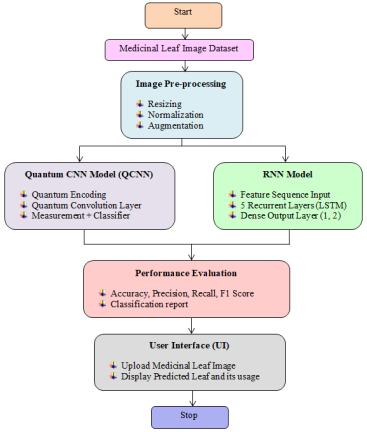
In the proposed work, a performance assessment of quantum CNN (QCNN) and RNN is projected with UI sustenance to categorize medicinal leaf categorization. The flow diagram of the entire suggested procedure is depicted in
Figure 1. The first step to achieve this work is the collection of medicinal leaves data which contains 30 categories of medicinal leaf images. All the images are resized, normalized as well as pre-processed before passed to QCNN and RNN. The evaluation performance of QCNN and RNN are compared to get the best model and at last a user interface is deliberated to categorize the medicinal leaf and exhibit its usage.
Figure 1. Proposed Model.
3.1. Collection of Medicinal Leaf
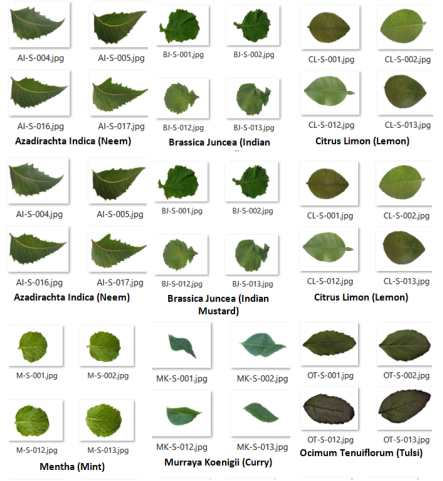
Thirty different categories of medicinal leaves images are collected from http://www.kaggle.com//medicinal-leaves as shown in
Figure 2. The dataset is then divided into train set and test set for model training. In the dataset total 1835 medicinal leaf images are there out of which the train size is 1468 and the test size is 367.
Figure 2. Medicinal Plant Leaves.
3.2. Image Pre-Processing
Models struggle with variations, noise as well as inconsistencies which degrade the performance. For model training as well as analysis image pre-processing is essential which transform raw and imperfect images into standardized and clean image. In this work as two models are utilized, so as per the requirements of the models images are pre-processed as below.
3.2.1. Image Pre-Processing for RNN
ImageDataGenerator class is employed to perform image augmentation as well as batch wise tensor generation throughout the model training. Pixel wise normalization is applied by utilizing rescaling of 1/255, transforming the original pixel intensity range from [0. 255] to [0, 1] by dividing every pixel by 255. This strategy stabilizes gradient updates, facilitate faster convergence as well as increases numerical stability by improving the overall training accuracy.
3.2.2. Image Pre-Processing for QCNN
During preprocess all images are resized to 300x300 pixels to ensure equal size as well as compatibility with QCNN. A structured directory (DIR) was specified for each image category, enabling systematic data organization and automated label assignment. The preprocessing function performs the following operations: (i) reads the image files from the specified directories, (ii) resizes each image to the predefined fixed size, (iii) assigns the corresponding class label (medicinal leaf type), and (iv) appends the processed images to the feature set X and their associated labels to the target set Z. This pipeline results in a structured and labeled training dataset, which is subsequently used for training the machine learning model.
3.3. QCNN and RNN
3.3.1. RNN
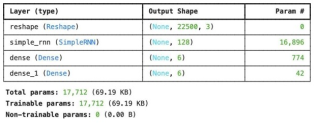
A sequential stack of layers for one input as well as one output is defined for the RNN model. The image of size 150*150 pixels with RGB color channel is utilized as input layer which is reshaped into a 2d sequence of shape 150*150,3 by in reshape layer. The proposed RNN consists of 128 hidden neurons, ReLu activation function for non-linearity, and 2 dense layers where leading dense layer connected with 6 units and ReLu activation for learn complex representation from the RNN’s output. The additional dense layer is the output layer where softmax activation function is utilized for prediction with maximum probability. The entire RNN model summary is depicted in
Figure 3. The prototype is compiled by utilizing the Adam optimizer, cross entropy loss as well as accuracy.
Figure 3. RNN Model Summary.
3.3.2. QCNN Model
A QCNN is a hybrid proposed model for image categorization where CNN performs extraction of features as well as dimensionality reduction while the quantum layer operates on reduced feature space for transformation of quantum features and nonlinear transformation. In the proposed QCNN, quantum circuit functions as a high expressivity classifier as well as decision making module for concluding prediction.
(i). Quantum-Convolutional Layer Implementation
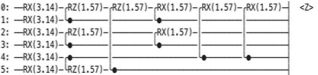
PennyLane is used in this work for implementation of quantum convolutional layer where 6 wires for quantum circuit and theta = np * pi / 2 are set for controlled rotations. RX rotation relied on flattened input is applied for each of 6 wires. The controlled rotation is applied among pairs of wires and quantum convolutional layer is applied to a single channel image as illustrated in
Figure 4.
Figure 4. Quantum circuit.
(ii). Medicinal leaf Image Processing with QCONV1 Application
For medicinal leaf image processing, w (width) = 256, scale percentage = 25% and step = 2 for the quantum convolutional is set and then the path to train folder is specified. As we have total 30 categories of medicinal leaf images sub folder, another path for the store processed image in thirty different sub folders is specified. All images with.png,.jpg, and,.jpeg extension are converted to.npz extension for processing as well as small or invalid images or already processed images which takes 0:00:23 sec for processing are skipped in the proposed model. The preprocessed medicinal leaf images were loaded for normalization, resizing and prepared for QCNN. The target dimensions were set to 300*300 pixels and the image dataset is converted into NumPy arrays. The resulted image tensor has a shape (1835, 300, 300, 3) while the corresponding label array has (1835) shape.
(iii). Data Augmentation and Image Data Generator
The Image Data Generator with augmentation parameter is defined with rotation range = 10 for smaller rotation for sensitive patterns, width_shift range = 0.1 for less aggressive horizontal shift, height_shift range = 0.1 for less aggressive vertical shift, Zoom range = 0.15, brightness range (0.8, 1.2) for regulate brightness as well as reduce zoom, channel shift range = 0.1 for slight intensity shift for lighting variation and fill mode = reflect for reflective padding for better natural results is set. After Image Data Generator, all the 30 medicinal leaf classes are distributed.
3.3.3. Fully Connected Layer Model for Multi-Class Classification
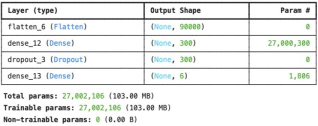
The proposed fully connected layer model consists of flatten layer through which an image is given as input, dense layer of 300 units or hidden layer, dropout=0.5 to prevent over fitting, activation=softmax and an output layer as illustrated in
Figure 5.
Figure 5. Fully Connected Layer summary.
3.3.4. Q-CNN Model for Medicinal Leaf Classification
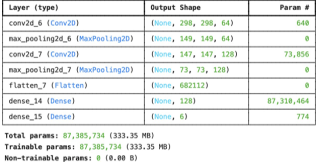
Conv2d_6 (Conv2D) is the first layer in the proposed QCNN which produced the output of shape (298, 298, 64) indicating 64 feature maps of size 298 * 298. This layer contains 640 trainable parameters, which are utilized to learn visual patterns from leaf images. The conv2d_6 layer is followed by max_pooling2d_6 (MaxPooling2D) which reduces the spatial dimensions to (149, 149, 64) thereby increasing the efficiency of processing. The second convolutional layer conv2d_7 (Conv2D) is designed to detect more complex features. It produces 128 feature map of size 147 * 147 with 73,856 trainable parameters. The max_pooling2d_7 (MaxPooling2D) further down samples the feature maps, producing an output of (73, 73, 128) to increase efficiency. The flatten_7 (Flatten) layer converted the 3D feature (73, 73, 128) into a 1D array for processing and created the output of the shape (682,112). The Dense_14 (Dense) layer served as fully connected layer where every input connects to every output with 128 neurons. At last the Dense_15 (Dense) layer performs categorization of medicinal leaf. The model summary is illustrated in
Figure 6.
Figure 6. Q-CNN for Medicinal Leaf Classification.
4. Results
This work proposes the medicinal leaf categorization as well as its usage through a local host user interface. In the first stage, RNN and QCNN models are deliberated and evaluation assessment of these models have done to get QCNN as the best model for leaf categorization. After getting the best model as the best model, in the second stage a local host user interface is designed with flask implementation.
4.1. Performance Evaluation of RNN
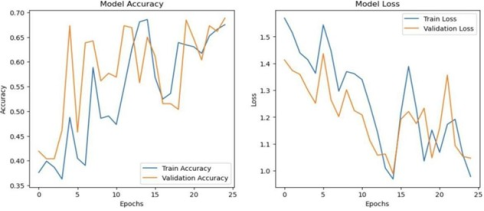
The RNN model exhibits 68% accuracy as well as 68% validation accuracy when trained with 32 batch size and 25 epochs. The training and validation curve as illustrated in
Figure 7 (left) show a consistent upward trend during initial epochs, indication effective learning. Although minor fluctuations are there, bot curves gradually converge toward the later epochs. The validation accuracy closely follows the training accuracy, suggesting that model generalizes reasonably well to unseen data. Both training and validation loss as depicted in
Figure 7 (right) decrease steadily over epochs, confirming stable optimization. The validation loss follows a similar downward pattern as the training loss, with only slight oscillation. Towards later epochs, both losses reach lower values and stabilize, indicating convergence of the model.
Figure 7. Accuracy and Loss of RNN.
The classification report of RNN depicted in
Figure 8 shows the 68% accuracy, macro avg precision 67%, recall 67%, f1 score 66% and weighted avg precision 70%, recall 68%, f1 score 68% which is less as compared to QCNN (Section 4.2).
Figure 8. Classification Report of RNN.
4.2. Performance Evaluation of QCNN
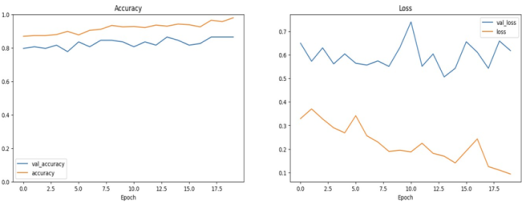
The QCNN model exhibits 96% accuracy as well as 86% validation accuracy when trained with 15 batch size and 20 epochs. The
Figure 9 shows the training and validation performance of QCNN across epochs, divided into two plots: accuracy (left) and loss (right). In
Figure 9 (left), the training accuracy increases while the validation accuracy also improves gradually. The model is learning effectively as both curves show an upward direction. The small but noticeable gap suggest moderate overfitting, meaning the model captures training patterns slightly better than unseen data. In
Figure 9 (right), training loss consistently decreases, showing proper convergence. Here, the validation loss fluctuates less but remains stable. The decreasing training loss confirms effective optimization.
Figure 9. Accuracy and Loss of QCNN.
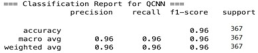
The classification report of QCNN depicted in
Figure 10 shows the 96% accuracy, macro avg precision 96%, recall 96%, f1 score 96% and weighted avg precision 96%, recall 96%, f1 score 96% which is better than RNN.
Figure 10. Classification Report of QCNN.
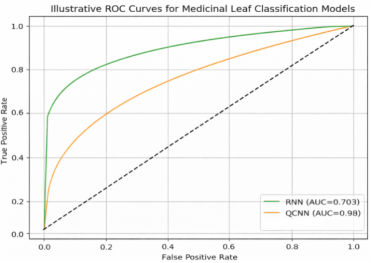
4.3. Comparing the Accuracies of QCNN and RNN Through ROC Curve
Figure 11 depicts the ROC curve of comparing the performance evaluation of QCNN as well as RNN for medicinal leaf categorization. The green colour line indicates AUC =0.989 for QCNN which is very close to the top left part indicating excellent categorization performance with low false positives and high sensitivity. The orange colour line indicates AUC=0.703 for RNN with high false positives for same true positive rate as compared to QCNN.
Figure 11. ROC Curve of QCNN and RNN.
The ROC curve clearly revealed that the QCNN significantly performs superior than RNN in medicinal leaf categorization. The higher AUC (0.989) confirms the superior discriminative categorization accuracy, making QCNN more appropriate for automated medicinal leaf categorization system.
4.4. User Interface for Medicinal Leaf Prediction and Usage
At last a user interface is designed using flask for interface, PyTorch for deep learning as well as PennyLane for adding the quantum layer which takes a medicinal leaf image as an input and predicts its category and usage as in
Figure 12.
Figure 12. User Interface for Medicinal Leaf Categorization.
The user interface provides a platform for users to input medicinal leaf image, visualize the medicinal leaf categorization, and interpret prediction along with its usage as illustrated in
Figure 13.
Figure 13. Prediction result of Medicinal Leaf Categorization.
5. Discussion
This work investigated a hybrid pipeline for medicinal leaf image categorization with QCNN, RNN as well as integrates the QCNN, the best one to a friendly interface for real world usage. There are no researches survived related to quantum models like QNN, QCNN, and quantum kernel and quantum circuits for medicinal leaf categorization.
A sequential RNN model is implemented for medicinal leaf categorization with 150*150 leaf image size, a input layer which is reshaped into a 2d sequence of shape 150*150, 3,128 hidden neurons, ReLu activation function, 2 dense layer connected with 6 units, and one additional dense layer with softmax activation function for prediction, which gave accuracy and validation accuracy same i.e. 68%. RNN also gave macro avg. precision 67%, recall 67%, f1 score 66% and weighted avg. precision 70%, recall 68%, f1 score 68%.
In QCNN, Conv2d_6 (Conv2D) is the first layer which produced the output of shape (298, 298, 64) indicating 64 feature maps of size 298 * 298. This layer contains 640 trainable parameters, which are utilized to learn visual patterns. Conv2d_6 layer is followed by max_pooling2d_6, reduced the spatial dimensions to (149, 149, 64). The conv2d_7 is designed to detect more complex features which produced 128 feature map of size 147 * 147 with 73,856 trainable parameters. The max_pooling2d_7 produced an output of (73, 73, and 128) to increase efficiency. The flatten_7 converted the 3D feature (73, 73, and 128) into a 1D array for processing and created the output of the shape (682,112). The Dense_14 (Dense) layer served as fully connected layer where every input connects to every output with 128 neurons. At last the Dense_15 (Dense) layer performs categorization of medicinal leaf. QCNN model exhibits 96% accuracy as well as 86% validation accuracy when trained with 15 batch size and 20 epochs. QCNN also gave macro avg precision 96%, recall 96%, f1 score 96% and weighted avg precision 96%, recall 96%, f1 score 96% which is better than RNN.
The total result is depicted in
Table 1.
Table 1. Comparison of RNN and QCNN.
Parameters | RNN | QCNN |
Accuracy | 68% | 96% |
Validation Accuracy | 68% | 86% |
Macro Avg. | Precision | 67% | 96% |
Recall | 67% | 96% |
F1 Score | 67% | 96% |
Weighted Avg. | Precision | 70% | 96% |
Recall | 68% | 96% |
F1 Score | 68% | 96% |
From
Table 1, it is observed that QCNN gave better performance with stability during training and have signified resilient learning as compared to RNN. Although the proposed QCNN achieved a high training accuracy of 96%, and a competitive validation accuracy of 86%, demonstrating its capability to effectively learn complex feature representation. The observed 10% difference among training and validation performance indicates opportunities for further enhancing the model’s generalization ability. This performance gap highlights the potential for optimization through the incorporation of regularization methods, architectural refinement, and data augmentation strategies. With these enhancements, QCNN can be further strengthened to achieve enhanced robustness as well as consistent performance on unseen data.
Finally, this work not only proposed QCNN to classify medicinal leaf images but also deployed an application oriented interface, which can categorize medicinal leaves by uploading images as well as describe its usage. Future work will emphasis on the development of hybrid quantum learning system, uniting QCNN with deep learning systems like LSTM, CNN and transformers to exploits both quantum inspired features representation and learning stability.











 Share This Article
 Twitter
 Linked In
 Facebook
 Copy
Copy Download