Abstract
Maintaining power quality in the power distribution network is a major concern due to the increasing penetration of nonlinear and complex equipment. Unified Power Quality Conditioners (UPQCs) have been widely used as effective compensating devices to mitigate voltage instability and current distortions. However, the major challenge lies in selecting the optimal location and rating of the UPQC in the distribution network. Proper placement of the UPQC significantly improves overall system efficiency by enhancing the voltage profile, reducing active power losses, and improving cost effectiveness. In this study, the Hunter-Prey Optimization (HPO) algorithm is employed to determine the optimal location and rating of the UPQC in the distribution network. The objective function combines active power loss, voltage deviation, and UPQC installation cost while satisfying network and control constraints. The proposed framework is evaluated on the IEEE 33-bus and IEEE 69-bus distribution systems. Simulation results demonstrate that the HPO algorithm efficiently identifies the optimal UPQC placement and rating, resulting in a significant reduction in active power losses of 60% for the IEEE 33-bus system and 93.5% for the IEEE 69-bus system, along with a notable improvement in voltage profiles compared to the system without UPQC.
Keywords
Unified Power Quality Conditioners, Voltage Profile, Active Power Loss, Hunter-Prey Optimization Algorithm, IEEE 33-bus, IEEE 69-bus
1. Introduction
In recent years, power quality has become a major concern in distribution networks, as disturbances such as voltage sags
| [1] | Tang, L., Han, Y., Yang, P., Wang, C., & Zalhaf, A. S. (2022). A review of voltage sag control measures and equipment in power systems. Energy Reports, 8, 207-216. |
[1]
and high-power losses
| [2] | Sadiq, E. H., & Antar, R. K. (2024). Minimizing power losses in distribution networks: A comprehensive review. Chinese Journal of Electrical Engineering, 10(4), 20-36. |
[2]
significantly affect overall system performance. These disturbances are majorly caused due to the rapid rise of the non-linear and dynamic loads such as modern electronic devices, industrial machinery and many more electrical power consuming components in the real-world applications. Conversely, the integration of the distributed generation systems such as solar
| [3] | Elomari, Y., Norouzi, M., Marín-Genescà, M., Fernández, A., & Boer, D. (2022). Integration of solar photovoltaic systems into power networks: A scientific evolution analysis. Sustainability, 14(15), 9249. |
| [4] | Bhatt, P. K. (2022). Solar Energy Integration and Potential Challenges in Distribution Network: A Comprehensive Review. Journal of Energy Research and Reviews, 42-65. |
[3, 4]
, wind
| [5] | Zietsman, M., Adefarati, T., Bansal, R. C., & Naidoo, R. (2022). Cost-benefit analysis of wind power integration in distribution networks. Journal of Energy in Southern Africa, 33(1), 21-39. |
[5]
has made the situation more complex by introducing additional challenges in the network
| [6] | Razmi, D., Lu, T., Papari, B., Akbari, E., Fathi, G., & Ghadamyari, M. (2023). An overview on power quality issues and control strategies for distribution networks with the presence of distributed generation resources. IEEE access, 11, 10308-10325. |
[6]
. Together, the combination of all the above-mentioned components has significantly introduced the issues in the power distribution network such as harmonic distortions, voltage imbalances and higher electrical power losses, making the entire distribution network less reliable and degrading the performance of the system.
In order to maintain the voltage in the network in a stable way, reduce the electrical power losses and deliver the electrical power efficiently by considering the challenging issues in the network. There is a need for the efficient compensation devices such as Unified Power Quality Conditioners (UPQC) to be installed in the network
| [7] | Qasim, A. Y., Tahir, F. R., & Alsammak, A. N. B. (2024). Improving Power Quality in Distribution Systems Using UPQC: An Overview. Journal European Journal of Automation, 57(2): 311-322. https://doi.org/10.18280/jesa.570201 |
| [8] | Dashtdar, M., Bajaj, M., Hosseinimoghadam, S. M. S., Sami, I., Choudhury, S., Rehman, A. U., & Goud, B. S. (2021). Improving voltage profile and reducing power losses based on reconfiguration and optimal placement of UPQC in the network by considering system reliability indices. International Transactions on Electrical Energy Systems, 31(11), e13120. |
[7, 8]
along with the intelligent optimization techniques. When these kinds of advanced devices and techniques are applied on the distribution network, this leads to the identity and minimize the disturbances in the power system and make sure that the network operates under a stable, smooth environment along with better efficiency.
The primary function of the Unified Power Quality Conditioner (UPQC) is to improve overall power quality in the distribution system. Its architecture mainly consists of the series and shunt compensators connected as a single unit in order to handle the multiple power quality issues at the same time. In detail, the series compensator primary function is to correct and control the voltage-related disturbances such as voltage variations
| [9] | Unnisa, F., Varma, N. M. K., Chandra, K. C., Jeevan, B., & Viswanath, S. N. R. S. (2024, August). Optimizing and Improving Unified Power Quality (UPQC) for Mitigation of Voltage Drop. In 2024 7th International Conference on Circuit Power and Computing Technologies (ICCPCT) (Vol. 1, pp. 1043-1048). IEEE. |
[9]
, flickers (i.e., frequency fluctuations) and swells (i.e., sudden increase) and making sure that the voltage supplied to consumers is within prescribed limits. Conversely, the shunt compensator mainly deals with the current related issues such as reducing the current harmonics
| [10] | Singh, M. K., & Saxena, V. (2021). Voltage conditioning and harmonic mitigation using UPQC: A review. Innovations in Cyber Physical Systems: Select Proceedings of ICICPS 2020, 523-534. |
[10]
that are caused by the dynamic and inductive loads and also balances the reactive power.
Even though UPQC has the better advantages, the major challenge lies in the optimal placing of the UPQC in the network and how its capacity is configured. If the UPQC is not placed at an optimal location and thus fails in its operation. This includes poor voltage regulation, not handling the harmonics efficiently and fails to improve the overall system performance.
The emergence of advanced optimization has solved the issue of selecting the suitable location for placing the UPQC in the network. Traditional optimization methods such as Particle Swarm Optimization (PSO), Genetic Algorithm (GA) have been commonly used to determine the suitable location to install the UPQCs in the power distribution network. Although these optimization methods offer notable advantages, they often suffer from limitations such as premature convergence and increased computational burden. This means instead of searching for the optimal location in the large distribution network, these optimization methods settle for the suboptimal solution and also involve the high computational and installation cost.
In order to address the issues that are caused in the traditional optimization methods, this study has introduced the Hunter-Prey Optimization (HPO) Algorithm and it is a recently developed bio-inspired metaheuristic technique. The main advantage of using this technique is because of its strong capabilities and dynamic balance between the exploration (i.e., searching for the new possibilities) and exploitation (i.e., refining good solutions). Because of these unique advantages, HPO is better suited for the optimal allocation and sizing of the UPQCs devices in the large and complex power distribution network.
In this study, in order to evaluate the optimization techniques for the distribution network, IEEE 33-bus and IEEE 69-bus have been effectively utilized. IEEE 33-bus system has the advantage of mimicking the medium-sized distributed radial network with moderate load density. Conversely, the IEEE 69-bus is used because of its complex network topology. By implementing the proposed Hunter-Prey optimization based UPQC allocation methods effectively on these two distributed systems such as IEEE 33-bus and IEEE 69-Bus has provided the key insights into how the optimization methods have performed, while also considering the how the annual cost has been minimized by the efficient loss reduction in the network.
2. Related Works
Many of the existing approaches have been effectively used to mitigate the issues that are raised due to the problem of selecting the optimal location to install the compensating devices in the distribution network to reduce the active power loss and enhance the voltage stability. Heuristic and Metaheuristic techniques such as Genetic Algorithm (GA)
| [11] | Soma, G. G. (2021). Optimal sizing and placement of capacitor banks in distribution networks using a genetic algorithm. Electricity, 2(2), 187-204. |
[11]
and Particle Swarm Optimization (PSO)
| [12] | Tahir, M. J., Rasheed, M. B., & Rahmat, M. K. (2022). Optimal placement of capacitors in radial distribution grids via enhanced modified particle swarm optimization. Energies, 15(7), 2452. |
| [13] | Ahmadi Kamarposhti, M., Ghandour, R., Abdel-Aty, M., Hafez, M., Alfiras, M., Alkhazaleh, S.,... & Solyman, A. (2025). Optimizing capacitor bank placement in distribution networks using a multi-objective particle swarm optimization approach for energy efficiency and cost reduction. Scientific Reports, 15(1), 12332. |
[12, 13]
have shown significant performance in the selection of proper installment of the capacitor banks and UPQC in the network. But the major drawback of these methods is Genetic Algorithm (GA) is able to take more convergence and PSO has the limitation to settle for the local optimal solution in highly nonlinear spaces. Some of the other algorithms also such as Differential Evaluation (DE)
| [16] | Kar, M. K., Kumar, S., Singh, A. K., & Panigrahi, S. (2023). Reactive power management by using a modified differential evolution algorithm. Optimal Control Applications and Methods, 44(2), 967-986. |
[16]
, Ant Colony Optimization (ACO) and Whale Optimization Algorithm (WOA)
| [14] | Zhang, J., Zhang, T., Zhang, G., Wang, D., & Kong, M. (2023). Using the whale optimization algorithm to solve the optimal reactive power dispatch problem. Processes, 11(5), 1513. |
| [15] | Baby, H., Jayakumar, J., Mathew, M., Hussien, M. G., & Kumar, N. M. (2025). Analysis of reactive power loadability and management of flexible alternating current transmission system devices in a distribution grid using whale optimization algorithm. IET Renewable Power Generation, 19(1), e12661. |
[14, 15]
have shown significant performance in applying the reactive power compensation but these algorithms have compromises between the exploitation and exploration efficiency.
This study using the Hunter-Prey Optimization (HPO) Algorithm has significant performance by efficiently balancing between the exploration and exploitation, allowing us to search for the global optimal even though the optimal solution is available. This research has used this algorithm to select the optimal location of the UPQC in the network and achieved the superior outcomes in terms of reducing the active power loss, voltage profile improvement and convergence speed.
3. Research Methodology
3.1. System Design and Modeling
In this study, the analysis of the proposed framework has been carried out using the two recognized benchmarked distribution systems such as IEEE 33-bus and IEEE 69-bus distribution systems. The main objective behind choosing these two systems, because majority of the studies and research has evaluated the performance of the new optimization and power quality improvement techniques. The entire modeling of these systems has been carried through the MATALAB/Simulink environment. Because this environment provides a flexible and reliable platform for simulating the real-world electrical network behavior.
In these models, each bus which is in the distribution system is defined by the significant parameters such as active power demand (P), reactive power demand (Q). In addition, the branch data consist of the electrical parameters such as the resistance (R), reactance (X) and line length (L). These parameters play an important role in influencing the voltage profile and the loss characteristics of the system.
Initially, the analysis of the power in the IEEE 33-bus and IEEE 69-bus system has been carried out without placing the UPQCs in the network. This kind of analysis is important in calculating the key parameters. Total active power loss, it means the power which has been wasted as a heat is the distribution network. Bus voltage magnitudes, it means the voltage which has been across each of the bus in the distribution network. Annual cost, it means the amount which has been involved for the installation, operation and maintenance cost of the UPQCs in the network in order to maintain the voltage and loss in safer limits.
In order to maintain the electrical power network, by installing the UPQCs at the suitable locations in the network, it could be achievable. Unified Power Quality Controllers (UPQCs) have mainly been developed by the integration of the shunt compensators and series compensators into a single unit. The proper balance and coordination between these two compensators allow the UPQCs to maintain the voltage and current profiles in the network at the stable levels.
The main objective of this optimized framework in this study is to minimize the total active power loss in the network, maintaining the voltage levels in the network at the acceptable limits and also keeping the installation and maintenance cost of the UPQCs as low as possible.
The function can be mathematically represented as below:
Where
= Active Power loss in the line
= Total Active Power Loss
(2)
Where,
= Voltage at the bus ‘i’
= Reference Voltage
, = Weighting Factors
= Total cost associated with the installation, operation and maintenance of the UPQC
In order to ensure the obtained solution has been technically and practically feasible some of the constraints need to be applied such as the balance in the power flow, the bus voltage magnitude has been maintained at the 5% of the nominal voltages and also reactive power injection by the UPQCs must not be exceeded. Together all these constraints have played a vital role in the voltage reliability and cost-effectiveness through the UPQC allocation in the network.
3.2. Hunter-Prey Optimization Framework for UPQC Allocation
This study uses the Hunter-Prey Optimization (HPO) algorithm in order to allocate the optimal allocation of the UPQC device in the distribution network. The HPO has the strong capabilities and the proper balance between the exploration and exploitation, which leads to the search efficiency and stable convergence performance.
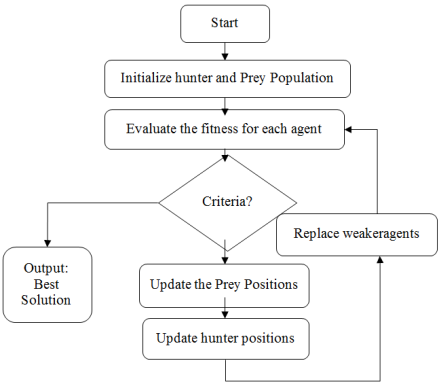
Initially, the HPO algorithm was able to generate the initial population and each of these represents the possible UPQC placement configuration and it is modeled as an agent, classified either hunter or prey. Then each of these agents has been further evaluated using the objective function ‘f’. The agents which have achieved the better score have been represented as the better solution. During each iteration, the prey agent moves away from the hunter agent on the basis of the probability factor. This kind of mechanism has helped in expanding the exploration of the search space. This means for UPQC allocation in the network, it helps examine the alternative best bus location and capacity settings.
Then the hunter agent is moved towards the prey agent by using the adaptive pursuit equations by considering the both current solution and the relative distance. This step further enhances precise tuning of the UPQC placement in the network with the better sizing. After each iteration, the position and function values of both the hunter and prey has been evaluated. The agent which has obtained the better values and it is replaced and highlights that it is the better solution. Then this solution is identified as the global best position and it represents the most effective UPQC allocation observed in the distribution network during the optimization cycle.
This kind of iteration has been continued until it reaches the convergence criteria satisfied. Then the solution which is identified has been considered as the global best position in order to place the UPQC devices at the bus location and rating of the device. Finally, the output has been used to update the power flow model for the performance evaluation such as reduction in the active power loss, voltage improvement and annual cost in the distribution network.
Table 1. Pseudocode of Hunter–Prey Optimization (HPO) for Optimal UPQC Allocation.
Step | Procedure |
Input | Npop, MaxIter, System data (bus, line), constraints, weighting factors (α, β) |
Output | Optimal UPQC location and rating, minimum fitness value |
1 | Randomly initialize hunter and prey populations |
2 | Assign random UPQC location and rating to each agent |
3 | Compute total active power loss (PLoss) |
4 | Compute annual UPQC cost (COST<sub>UPQC</sub>) |
5 | Evaluate objective function f |
6 | Identify initial best solution and fitness |
7 | For t = 1 to MaxIter For each prey agent Generate escape probability P<sub>e</sub> = rand() |
7.1 | If P<sub>e</sub> < 0.5, move randomly within bounds |
7.2 | Else, move away from nearest hunter |
7.3 | For each hunter agent |
7.4 | Identify nearest prey using distance and fitness |
7.5 | Update hunter position toward prey |
7.6 | Apply adaptive step scaling |
8 | Evaluate fitness of all agents |
9 | Replace weaker agents with improved solutions |
10 | Store best fitness for convergence |
End | Output final optimal UPQC allocation |
Figure 1. Flow diagram of HPO Algorithm for UPQC allocation and rating.
3.3. Power Flow and Sensitivity Analysis
Once the optimal location to install the UPQCs in the network has been identified through the Hunter-Prey Optimization (HPO) Algorithm. The power flow analysis has been carried out in order to know the performance of the network after installing the UPQCs in the network. This includes the detailed evaluation of the voltage magnitudes at each of the bus and it shows how the voltage values are being nearer to the nominal voltage values at each bus. The other one is analyzing the active power loss in the how effectively the UPQCs reduces the heat dissipation and improves the overall efficiency and reduction in the annual cost.
Based on the results, the proposed framework has shown significant performance on both the IEEE 33-bus and IEEE 69-bus systems and it reduces the active power loss (kW), maintains better voltage levels in the network and also reduces the annual cost ($). These findings highlight that the proposed framework in this study is effective and reliable for enhancing the overall system efficiency and stability of the power distribution network.
4. Results and Discussion
This section discusses the results obtained from the proposed framework, especially the simulation-based outcomes obtained using the MATLAB for the IEEE 33-bus and IEEE 69-bus systems under the two categories such as without UPQC and with UPQC.
4.1. IEEE 33-Bus System
4.1.1. System Operation Without UPQC
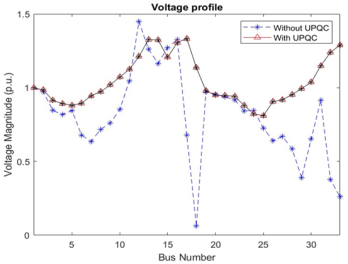
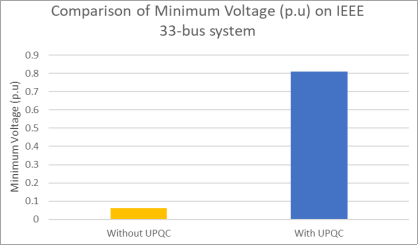
In this scenario, UPQCs are not installed in the distribution network. The network has significantly affected the voltage drops at the multiple buses in the network significantly at the far end of the feeder lines. This significant drop of the voltage in the distribution network is mainly because of the effect of the impedance and reactance in the network. But in this scenario, the minimum voltage is obtained at bus 18 of the voltage value of 0.062301 p.u and this voltage value shows that it is significantly outside the range of the nominal voltage and indicates poor voltage regulation.
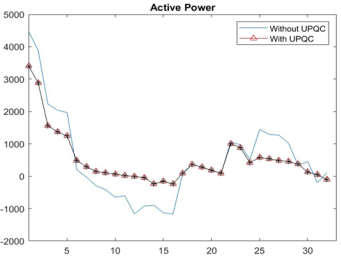
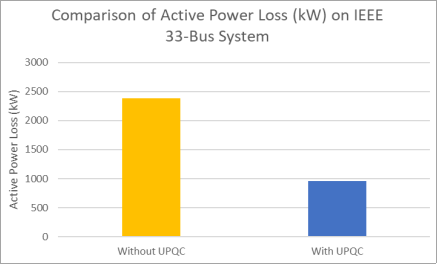
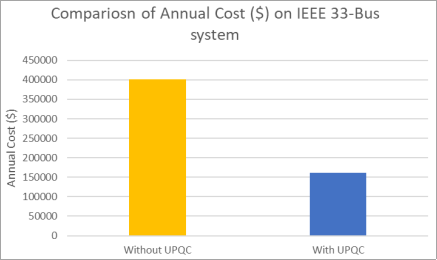
Conversely, the total active power loss is observed in a network of 2386.6614 kilo Watts (kW) and it suggests that it not only reduces the overall system efficiency but also increases the overall operating cost and leads to the overheating of the components in the network and observed annual cost of 400959.1086 $. Based on observing the results, it highlights the need of the compensation device such as UPQC in order to stabilize the voltage levels and reduce the active power loss in the network.
4.1.2. System Operation with UPQC (HPO Optimized Placement)
In this scenario, by applying the Hunter-Prey Optimization (HPO) algorithm in order to identify the suitable location for installing the UPQC in the distribution network. Once the UPQCs has been installed at the selected location, the system shows a significant improvement in its performance. The minimal voltage is achieved at the bus 25 of 0.81029 p.u, total active power loss of 961.1745 kW and annual cost of 161477.3222 $. When these values are compared with the distribution network without UPQC. Based on the observation of the results, the proposed framework in this study not only enhances the overall voltage stability at the buses but also reduces the total active power loss and minimizes the annual cost.
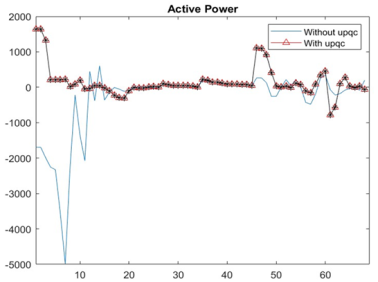
Figure 2 shows how the voltage profile has been varied across the IEEE 33-bus system under the two categories such as without UPQC and with UPQC.
Figure 2. Comparison of Voltage Profile (p.u) without UPQC and with UPQC.
Figure 3. Comparison of Active Power Loss (kW) without UPQC and with UPQC.
Figure 3 shows the active power loss (kW) across the IEEE 33-bus system considering the two scenarios such as without UPQC and with UPQC.
4.2. IEEE 69-Bus System
4.2.1. System Operation Without UPQC
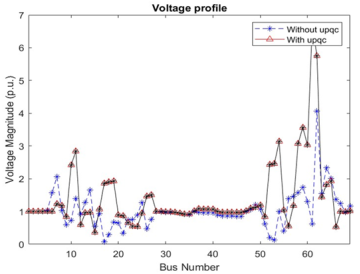
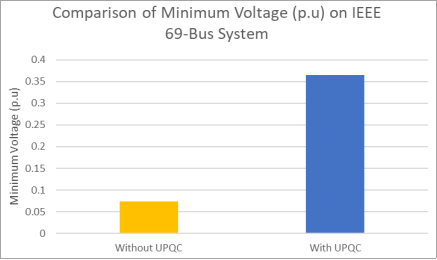
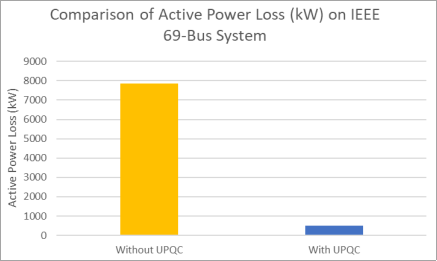
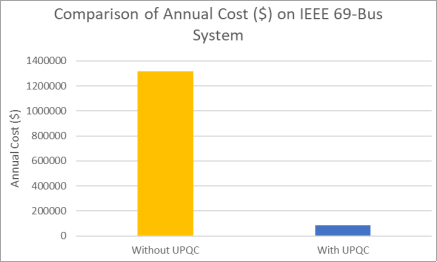
The performance of the IEEE 69-bus system has been evaluated without placing the UPQC in the distribution network. Because of the large distribution network size, it introduces the higher active power loss of 7844.0968 kW and minimal voltage is achieved at the bus 17 of 0.073138 p.u and annual cost of 1317808.2615 $.
4.2.2. System Operation With UPQC
After installing the UPQC at the most suitable location in the distribution network by using the HPO algorithm. There is significant reduction in the active power loss of 500.5584 kW and improved the voltage stability in the network and achieve the minimal voltage at the bus 15 of 0.36511 p.u with the annual cost of 84093.8133 $.
Figure 4 shows how the voltage profile has been varied across the IEEE 69-bus system under the two categories such as without UPQC and with UPQC.
Figure 4. Comparison of Voltage Profile (p.u) without UPQC and with UPQC.
Figure 5 shows the active power loss (kW) across the IEEE 33-bus system considering the two scenarios such as without UPQC and with UPQC.
Figure 5. Comparison of Active Power Loss (kW) without UPQC and with UPQC.
4.3. Performance Comparison
The performance of the proposed HPO-based UPQC allocation has been evaluated on the two distribution systems such as IEEE 33-bus and IEEE 69-bus systems. The below
Table 1 shows the results achieved:
Table 2. Performance of IEEE 33-Bus System.
System | Case | Minimum Voltage (p.u) | Active Power Loss (kW) | Annual Cost ($) |
IEEE 33-Bus | Without UPQC | 0.062301 | 2386.6614 | 400959.1086 |
IEEE 33-Bus | With UPQC | 0.81029 | 961.1745 | 161477.3222 |
Based on the observations in
Table 2, the minimum voltage level in the system has been improved after installing the UPQC in the network and active power loss has been significantly reduced to 961.175 kW.
Figure 6. Comparison of Minimum Voltage (p.u) on IEEE 33-bus system.
Figure 7. Comparison of Active Power Loss (kW) on IEEE 33-bus system.
Figure 8. Comparison of Annual Cost ($) on IEEE 33-bus system.
Table 3. Performance of IEEE 69-Bus System.
System | Case | Minimum Voltage (p.u) | Active Power Loss (kW) | Annual Cost ($) |
IEEE 69-Bus | Without UPQC | 0.073138 | 7844.0968 | 1317808.2615 |
IEEE 69-Bus | With UPQC | 0.36511 | 500.5584 | 84093.8133 |
Based on the observations in
Table 3, the minimum voltage level in the system has absolute improvement after installing the UPQC in the network and active power loss has been significantly reduced to 500.5584 kW.
Figure 9. Comparison of Minimum Voltage (p.u) on IEEE 69-bus system.
Figure 10. Comparison of Active Power Loss (kW) on IEEE 69-bus system.
Figure 11. Comparison of Annual Cost ($) on IEEE 69-bus system.
4.4. Convergence Analysis
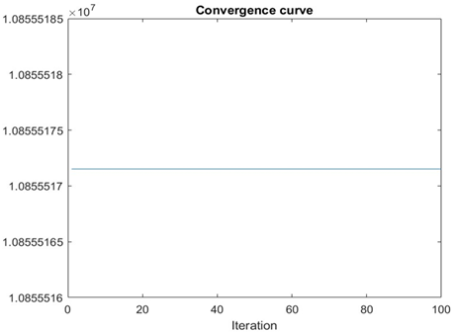
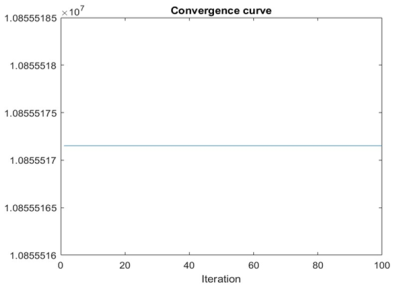
This section discusses how the proposed HPO based UPQC allocation convergence characteristics is able to show the steady reduction of the objective function over the successive iterations. The main objective of using the HPO instead of traditional approaches is because of its rapid convergence in the early stages because of the proper balance between the exploration and exploitation.
Figure 12. Convergence Curve of the HPO Based optimal UPQC allocation in the IEEE 33-Bus System.
From the
Figure 12, the convergence curve has stabilized nearly 1.0855
10
-7 and there are no significant deviations and shows that it has proper stability.
Table 4. Optimal UPQC Placement and corresponding rating of the UPQC in the IEEE 33-Bus System.
Bus Number | Size (kVAr) |
33 | 1.2000 |
8 | 1.2000 |
17 | 0.6158 |
From
Table 4, it suggests the optimal location of placing the UPQC in the network at the buses 33, 8 and 17 with respect to the rating of the UPQC device and it has been obtained through the HPO-based optimization, in order to reduce the active power loss and to maintain the proper voltage profile in the network.
Figure 13. Convergence Curve of the HPO Based optimal UPQC allocation in the IEEE 69-Bus System.
From the
Figure 13, the convergence curve has stabilized nearly 1.0855
10
-7 and there are no significant deviations and shows that it has proper stability.
Table 5. Optimal UPQC Placement and corresponding rating of the UPQC in the IEEE 33-Bus System.
Bus Number | Size (kVAr) |
50 | 1.1768 |
9 | 1.2000 |
48 | 1.2000 |
37 | 1.2000 |
From
Table 5, it suggests the optimal location of placing the UPQC in the network at the buses 50, 9, 48 and 37 with respect to the rating of the UPQC device and it has been obtained through the HPO-based optimization.
4.5. Comparative Analysis
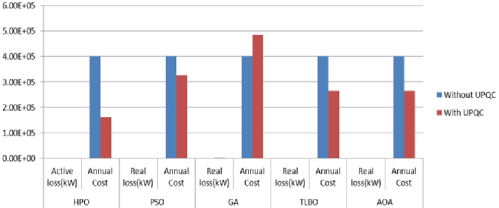
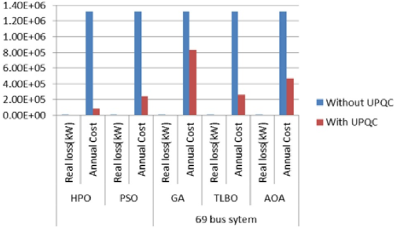
In order to effectively evaluate the performance of Hunter Prey Optimization (HPO) when subjected to application of installing the UPQC (Unified Power Quality Conditioner) for improving the power quality in the power distribution network. For the experimentation, this study has used the IEEE 33-bus and IEEE 69-bus systems. The performance of HPO has been compared with the other optimization methods such as PSO (Particle Swarm Optimization), GA (Genetic Algorithm), TLBO (Teaching Learning Based Optimization) and AOA (Arithmetic Optimization Algorithm) in terms of the active loss (kW) and Annual Cost. The major focus is on assessing how much active power loss (kW) and annual cost has occurred for the both stages such as without UPQC installment, with UPQC installment.
Figure 14. Comparison of the Active Loss (kW) and Annual Cost With and Without UPQC for the different optimization techniques in the 33-bus distribution system.
Figure 14 shows the 33-bus distribution system for all the optimization methods. When no UPQC is installed in the distribution system, the real active power loss (kW) and the annual cost is high. Then by using the optimization algorithms, placing the UPQC in the network and the active power loss (kW) has significantly dropped to lower values for all the algorithms and thus it leads to the considerable decrease in the annual cost. Among all the optimization algorithms, the HPO has shown superior performance and it highlighted that this algorithm has found the best and most suitable location to install and better sizing of the UPQC in the network. Conversely, even though the other methods like PSO (Particle Swarm Optimization), GA (Genetic Algorithm), TLBO (Teaching Learning Based Optimization) and AOA (Arithmetic Optimization Algorithm) also showed improvement, HPO results in the lower active power loss and annual cost after the UPQC allocation.
Figure 15 has represented the 69-bus distribution system. It also shows that without the UPQC installment in the network, the active loss (kW) and annual cost are significantly high in values. Once the UPQC is installed in the network by using the optimization techniques, the losses and annual cost in the network have significantly reduced to the lesser values. Based on the observations, the HPO has shown superior performance and outperformed all the other existing methods in this study like SO (Particle Swarm Optimization), GA (Genetic Algorithm), TLBO (Teaching Learning Based Optimization) and AOA (Arithmetic Optimization Algorithm).
Figure 15. Comparison of the Active Loss (kW) and Annual Cost With and Without UPQC for the different optimization techniques in the 69-bus distribution system.
5. Conclusion and Future Scope
This study presented a Hunter-Prey Optimization (HPO)-based framework for optimal placement and sizing of Unified Power Quality Conditioners in distribution networks. Simulation results on IEEE 33-bus and IEEE 69-bus systems demonstrate significant reductions in active power losses, improved voltage profiles, and reduced annual costs. The proposed method also exhibited fast and stable convergence compared to existing optimization techniques.
Even though the proposed HPO-based UPQC allocation has demonstrated superior performance, there are still some promising directions for future research and development in order to further improve the performance of the proposed framework in terms of robustness and applicability. Use hybrid metaheuristic approaches, in this study only HPO algorithm has been used instead of the hybrid approaches such as combining with some other approaches like Particle Swarm Optimization (PSO), Genetic Algorithms (GA).
The other future direction would be development of the adaptive UPQC control strategies by using the machine learning and artificial intelligence techniques. By effectively integrating the HPO with the data-driven optimization model, would provide the advantage of dynamically adjusting its parameters according to dynamic changing conditions.
The other promising direction is to bridge the gap between the simulation and real-world application, which means implementing on the microgrid platforms for knowing the practical insights because the real-world environments are extremely complex compared to simulation environments.
Abbreviations
UPQC | Unified Power Quality Conditioner |
HPO | Hunter-Prey Optimization |
PSO | Particle Swarm Optimization |
GA | Genetic Algorithm |
TLBO | Teaching Learning-Based Optimization |
AOA | Arithmetic Optimization Algorithm |
DE | Differential Evolution |
ACO | Ant Colony Optimization |
WOA | Whale Optimization Algorithm |
DG | Distributed Generation |
PV | Photovoltaic |
p.u | Per Unit |
kW | Kilowatt |
kVAr | Kilovolt-Ampere Reactive |
IEEE | Institute of Electrical and Electronics Engineers |
PLoss | Total Active Power Loss |
Pi | Active Power Loss of i-th Line |
Vi | Voltage at i-th Bus |
Vref | Reference Voltage |
α, β | Weighting Factors |
MATLAB | Matrix Laboratory |
O&M | Operation and Maintenance |
Conflicts of Interest
The authors declare that they have no known competing financial interests or personal relationships that could have appeared to influence the work reported in this paper.
References
| [1] |
Tang, L., Han, Y., Yang, P., Wang, C., & Zalhaf, A. S. (2022). A review of voltage sag control measures and equipment in power systems. Energy Reports, 8, 207-216.
|
| [2] |
Sadiq, E. H., & Antar, R. K. (2024). Minimizing power losses in distribution networks: A comprehensive review. Chinese Journal of Electrical Engineering, 10(4), 20-36.
|
| [3] |
Elomari, Y., Norouzi, M., Marín-Genescà, M., Fernández, A., & Boer, D. (2022). Integration of solar photovoltaic systems into power networks: A scientific evolution analysis. Sustainability, 14(15), 9249.
|
| [4] |
Bhatt, P. K. (2022). Solar Energy Integration and Potential Challenges in Distribution Network: A Comprehensive Review. Journal of Energy Research and Reviews, 42-65.
|
| [5] |
Zietsman, M., Adefarati, T., Bansal, R. C., & Naidoo, R. (2022). Cost-benefit analysis of wind power integration in distribution networks. Journal of Energy in Southern Africa, 33(1), 21-39.
|
| [6] |
Razmi, D., Lu, T., Papari, B., Akbari, E., Fathi, G., & Ghadamyari, M. (2023). An overview on power quality issues and control strategies for distribution networks with the presence of distributed generation resources. IEEE access, 11, 10308-10325.
|
| [7] |
Qasim, A. Y., Tahir, F. R., & Alsammak, A. N. B. (2024). Improving Power Quality in Distribution Systems Using UPQC: An Overview. Journal European Journal of Automation, 57(2): 311-322.
https://doi.org/10.18280/jesa.570201
|
| [8] |
Dashtdar, M., Bajaj, M., Hosseinimoghadam, S. M. S., Sami, I., Choudhury, S., Rehman, A. U., & Goud, B. S. (2021). Improving voltage profile and reducing power losses based on reconfiguration and optimal placement of UPQC in the network by considering system reliability indices. International Transactions on Electrical Energy Systems, 31(11), e13120.
|
| [9] |
Unnisa, F., Varma, N. M. K., Chandra, K. C., Jeevan, B., & Viswanath, S. N. R. S. (2024, August). Optimizing and Improving Unified Power Quality (UPQC) for Mitigation of Voltage Drop. In 2024 7th International Conference on Circuit Power and Computing Technologies (ICCPCT) (Vol. 1, pp. 1043-1048). IEEE.
|
| [10] |
Singh, M. K., & Saxena, V. (2021). Voltage conditioning and harmonic mitigation using UPQC: A review. Innovations in Cyber Physical Systems: Select Proceedings of ICICPS 2020, 523-534.
|
| [11] |
Soma, G. G. (2021). Optimal sizing and placement of capacitor banks in distribution networks using a genetic algorithm. Electricity, 2(2), 187-204.
|
| [12] |
Tahir, M. J., Rasheed, M. B., & Rahmat, M. K. (2022). Optimal placement of capacitors in radial distribution grids via enhanced modified particle swarm optimization. Energies, 15(7), 2452.
|
| [13] |
Ahmadi Kamarposhti, M., Ghandour, R., Abdel-Aty, M., Hafez, M., Alfiras, M., Alkhazaleh, S.,... & Solyman, A. (2025). Optimizing capacitor bank placement in distribution networks using a multi-objective particle swarm optimization approach for energy efficiency and cost reduction. Scientific Reports, 15(1), 12332.
|
| [14] |
Zhang, J., Zhang, T., Zhang, G., Wang, D., & Kong, M. (2023). Using the whale optimization algorithm to solve the optimal reactive power dispatch problem. Processes, 11(5), 1513.
|
| [15] |
Baby, H., Jayakumar, J., Mathew, M., Hussien, M. G., & Kumar, N. M. (2025). Analysis of reactive power loadability and management of flexible alternating current transmission system devices in a distribution grid using whale optimization algorithm. IET Renewable Power Generation, 19(1), e12661.
|
| [16] |
Kar, M. K., Kumar, S., Singh, A. K., & Panigrahi, S. (2023). Reactive power management by using a modified differential evolution algorithm. Optimal Control Applications and Methods, 44(2), 967-986.
|
Cite This Article
-
APA Style
Bansal, A. K., Singh, R. N. (2026). Hunter-Prey Optimization Framework for UPQC Allocation to Improve Efficiency and Voltage Reliability of Power Distribution Network. Journal of Electrical and Electronic Engineering, 14(1), 21-33. https://doi.org/10.11648/j.jeee.20261401.13
 Copy
|
Copy
|
 Download
ACS Style
Bansal, A. K.; Singh, R. N. Hunter-Prey Optimization Framework for UPQC Allocation to Improve Efficiency and Voltage Reliability of Power Distribution Network. J. Electr. Electron. Eng. 2026, 14(1), 21-33. doi: 10.11648/j.jeee.20261401.13
Copy
|
Download
AMA Style
Bansal AK, Singh RN. Hunter-Prey Optimization Framework for UPQC Allocation to Improve Efficiency and Voltage Reliability of Power Distribution Network. J Electr Electron Eng. 2026;14(1):21-33. doi: 10.11648/j.jeee.20261401.13
Copy
|
Download
-
@article{10.11648/j.jeee.20261401.13,
  author = {Akash Kumar Bansal and Ram Narayan Singh},
  title = {Hunter-Prey Optimization Framework for UPQC Allocation to Improve Efficiency and Voltage Reliability of Power Distribution Network},
  journal = {Journal of Electrical and Electronic Engineering},
  volume = {14},
  number = {1},
  pages = {21-33},
  doi = {10.11648/j.jeee.20261401.13},
  url = {https://doi.org/10.11648/j.jeee.20261401.13},
  eprint = {https://article.sciencepublishinggroup.com/pdf/10.11648.j.jeee.20261401.13},
  abstract = {Maintaining power quality in the power distribution network is a major concern due to the increasing penetration of nonlinear and complex equipment. Unified Power Quality Conditioners (UPQCs) have been widely used as effective compensating devices to mitigate voltage instability and current distortions. However, the major challenge lies in selecting the optimal location and rating of the UPQC in the distribution network. Proper placement of the UPQC significantly improves overall system efficiency by enhancing the voltage profile, reducing active power losses, and improving cost effectiveness. In this study, the Hunter-Prey Optimization (HPO) algorithm is employed to determine the optimal location and rating of the UPQC in the distribution network. The objective function combines active power loss, voltage deviation, and UPQC installation cost while satisfying network and control constraints. The proposed framework is evaluated on the IEEE 33-bus and IEEE 69-bus distribution systems. Simulation results demonstrate that the HPO algorithm efficiently identifies the optimal UPQC placement and rating, resulting in a significant reduction in active power losses of 60% for the IEEE 33-bus system and 93.5% for the IEEE 69-bus system, along with a notable improvement in voltage profiles compared to the system without UPQC.},
 year = {2026}
}
Copy
|
Download
-
TY  - JOUR
T1  - Hunter-Prey Optimization Framework for UPQC Allocation to Improve Efficiency and Voltage Reliability of Power Distribution Network
AU  - Akash Kumar Bansal
AU  - Ram Narayan Singh
Y1  - 2026/01/29
PY  - 2026
N1  - https://doi.org/10.11648/j.jeee.20261401.13
DO  - 10.11648/j.jeee.20261401.13
T2  - Journal of Electrical and Electronic Engineering
JF  - Journal of Electrical and Electronic Engineering
JO  - Journal of Electrical and Electronic Engineering
SP  - 21
EP  - 33
PB  - Science Publishing Group
SN  - 2329-1605
UR  - https://doi.org/10.11648/j.jeee.20261401.13
AB  - Maintaining power quality in the power distribution network is a major concern due to the increasing penetration of nonlinear and complex equipment. Unified Power Quality Conditioners (UPQCs) have been widely used as effective compensating devices to mitigate voltage instability and current distortions. However, the major challenge lies in selecting the optimal location and rating of the UPQC in the distribution network. Proper placement of the UPQC significantly improves overall system efficiency by enhancing the voltage profile, reducing active power losses, and improving cost effectiveness. In this study, the Hunter-Prey Optimization (HPO) algorithm is employed to determine the optimal location and rating of the UPQC in the distribution network. The objective function combines active power loss, voltage deviation, and UPQC installation cost while satisfying network and control constraints. The proposed framework is evaluated on the IEEE 33-bus and IEEE 69-bus distribution systems. Simulation results demonstrate that the HPO algorithm efficiently identifies the optimal UPQC placement and rating, resulting in a significant reduction in active power losses of 60% for the IEEE 33-bus system and 93.5% for the IEEE 69-bus system, along with a notable improvement in voltage profiles compared to the system without UPQC.
VL  - 14
IS  - 1
ER  -
Copy
|
Download





 Share This Article
 Twitter
 Linked In
 Facebook