
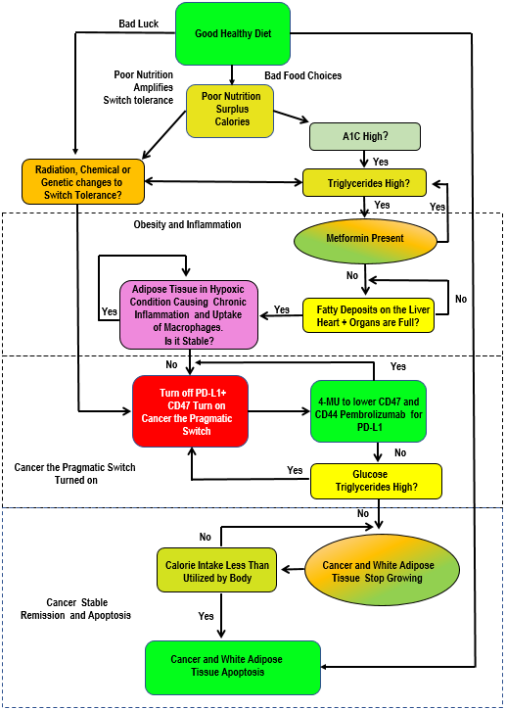
Many cancers are glucose-dependent and have a higher rate of glycolysis, as described by the Warburg effect. Reducing the amount of free glucose will starve cancers. Medications that control blood glucose levels, including Metformin, change the intestinal biome by increasing desirable commensal bacteria, causing a drop in A1C. With the drop in glucose, many cancers can modulate metabolism to lipids, so a low-carbohydrate diet will keep the cancer from growing. Cancer can mask the immune system, turning off PD-L1 (Programmed Death Ligand-1) and increasing the expression of CD47, the “do not eat me protein". CD47, a protein overexpressed on many cancer cells to prevent macrophages attacks. CD47 does this by binding to Signal Regulatory Protein Alpha (SIRPα) on macrophages. 4-Methylumbelliferone (4-MU) will limit the amount of masked CD47. 4-MU also has other benefits. It will protect the integrity of the B cells but also promotes insulin secretion to help cope with the degradation of B-cell function due to immune destruction. This might offset the side effects of Pembrolizumab (Keytruda), a therapeutic monoclonal antibody which targets and activates PD-1 on immune cells. PD-1 is a molecule that is found on killer T Cells and natural killer cells, which target any cell that does not display the MHC-2 cell surface molecule. These two changes, PD-L1 activation and CD-47 limitation, make cancer visible and vulnerable to Natural Killer cells, Killer T Cells, and macrophages. Pembrolizumab (Keytruda) can have toxic side effects, including a spike in blood sugar, which can damage B Cells, type 1 diabetes, and pancreatitis, though these are considered rare side effects. In Theory, Metformin and 4-MU will inhibit this occurrence with an improvement in gut bacteria and increasing insulin, and therefore lowering the risk to the pancreas and protecting B cells.
| Published in | Journal of Cancer Treatment and Research (Volume 14, Issue 1) |
| DOI | 10.11648/j.jctr.20261401.14 |
| Page(s) | 43-52 |
| Creative Commons |
This is an Open Access article, distributed under the terms of the Creative Commons Attribution 4.0 International License (http://creativecommons.org/licenses/by/4.0/), which permits unrestricted use, distribution and reproduction in any medium or format, provided the original work is properly cited. |
| Copyright |
Copyright © The Author(s), 2026. Published by Science Publishing Group |
Cancer, Cancer Pragmatic Switch, Cancer Adipose Tissue, Cancer Adipose Tissue Bloom, Adipose Tissue and Cancer Tumorigenesis, Cancer Stem Cell and Adipose Tissue
4-MU | 4-Methylumbelliferone |
A1C | A Measure of Blood Sugar (or HbA1c) |
PD-1 | Programmed Death-1- Immune Checkpoint for the T-Cell |
PD-L1 | Programmed Death Ligand 1- Found on the Surface of cells |
CD-44 | Receptor For Hyaluronic Acid |
CD-47 | Prevent the Macrophages from Destroying the Cell |
| [1] | Claras, J Cancer—A Pragmatic Switch to Combat Metabolic Syndrome? Oncol Rev., 15 February 2023. |
| [2] | Pibuel, M. A., Poodts, D., Sias, S. A. et al. 4-Methylumbelliferone enhances the effects of chemotherapy on both temozolomide-sensitive and resistant glioblastoma cells. Sci Rep 13, 9356 (2023). |
| [3] | Zhang, W.; Yang, S.; Yu, X.; Zhu, S.; Wang, X.; Sun, F.; Liang, S.; Wang, X.; Zhao, G.; Gao, B. Beneficial Actions of 4-Methylumbelliferone in Type 1 Diabetes by Promoting β Cell Renewal and Inhibiting Dedifferentiation. Biomedicines 2024, 12, 2790. |
| [4] | Dzienis M, Cundom J, Fuentes CS, Spreafico A, Nordlinger M, Pastor AV, Alesi E, Neki A, Fung AS, Figueiredo Lima IP, Oppelt P, da Cunha Junior GF, Burtness B, Franke FA, Tseng JE, Joshi A, McCarthy J, Swaby R, Sidi Y, Gumuscu B, Naicker N, de Castro G Jr. Pembrolizumab Plus Carboplatin and Paclitaxel as First-Line Therapy for Recurrent/Metastatic Head and Neck Squamous Cell Carcinoma (KEYNOTE-B10): A Single-Arm Phase IV Trial. J Clin Oncol. 2024 Sep 1; 42(25): 2989-2999. |
| [5] | John Claras. (2023). Does Cancer Have a Benefit? - Your Immune System Might Think So. Biomed J Sci & Tech Res 53(3). BJSTR. MS. ID.008406. |
| [6] | Pibuel MA, Díaz M, Molinari Y, Poodts D, Silvestroff L, Lompardía SL, Franco P, Hajos SE. 4-Methylumbelliferone as a potent and selective antitumor drug on a glioblastoma model. Glycobiology. 2021 Jan 9; 31(1): 29-43. |
| [7] | Nagy N, Kaber G, Johnson PY, Gebe JA, Preisinger A, Falk BA, Sunkari VG, Gooden MD, Vernon RB, Bogdani M, Kuipers HF, Day AJ, Campbell DJ, Wight TN, Bollyky PL. Inhibition of hyaluronan synthesis restores immune tolerance during autoimmune insulitis. J Clin Invest. 2015 Oct 1; 125(10): 3928-40. |
| [8] | Gong Z, Aragaki AK, Chlebowski RT, Manson JE, Rohan TE, Chen C, Vitolins MZ, Tinker LF, LeBlanc ES, Kuller LH, Hou L, LaMonte MJ, Luo J, Wactawski-Wende J. Diabetes, metformin and incidence of and death from invasive cancer in postmenopausal women: Results from the women's health initiative. Int J Cancer. 2016 Apr 15; 138(8): 1915-27. |
| [9] | Rosell-Díaz, Marisel, et all Metformin-induced changes in the gut microbiome and plasma metabolome are associated with cognition in men Metabolism VL 157 155941 2024 2024/08/01/ 0026-0495 |
| [10] | Vitale Daiana L., Icardi Antonella, Rosales Paolo, Spinelli Fiorella M., Sevic Ina, Alaniz Laura D. Targeting the Tumor Extracellular Matrix by the Natural Molecule 4-Methylumbelliferone: A Complementary and Alternative Cancer Therapeutic Strategy Frontiers in Oncology, Volume 11 - 2021 2021. |
| [11] | Jenkins DJA, Wong JMW, Kendall CWC, et al. The Effect of a Plant-Based Low-Carbohydrate (“Eco-Atkins”) Diet on Body Weight and Blood Lipid Concentrations in Hyperlipidemic Subjects. Arch Intern Med. 2009; 169(11): 1046-1054. |
| [12] | John Claras, (2024), Is Cancer the Overflow of the Adipose Tissue? Clinical Reviews and Case Reports, 3(6); |
| [13] | Yan, T., Wang, K., Li, J. et al. Suppression of the hyaluronic acid pathway induces M1 macrophages polarization via STAT1 in glioblastoma. Cell Death Discov. 8, 193 (2022). |
| [14] | Chen, C., Zhao, S., Karnad, A. et al. The biology and role of CD44 in cancer progression: therapeutic implications. J Hematol Oncol 11, 64 (2018). |
| [15] | Mazurek M, Litak J, Kamieniak P, Kulesza B, Jonak K, Baj J, Grochowski C. Metformin as Potential Therapy for High-Grade Glioma. Cancers (Basel). 2020 Jan 15; 12(1): 210. |
| [16] |
Uchakina ON, Ban H, Hostetler BJ, McKallip RJ. Inhibition of hyaluronic acid formation sensitizes chronic myelogenous leukemia to treatment with doxorubicin. Glycobiology. 2016 Nov; 26(11): 1171-1179.
https://doi.org/10.1093/glycob/cww064 Epub 2016 Jun 3. |
| [17] | 2025 Merck & Co., Inc., Rahway, NJ, USA and its affiliates: Keytruda side effects |
| [18] | Yates TJ, Lopez LE, Lokeshwar SD, Ortiz N, Kallifatidis G, Jordan A, Hoye K, Altman N, Lokeshwar VB. Dietary supplement 4-methylumbelliferone: an effective chemopreventive and therapeutic agent for prostate cancer. J Natl Cancer Inst. 2015 Apr 13; 107(7): djv085. |
| [19] | Zhang, W.; Yang, S.; Yu, X.; Zhu, S.; Wang, X.; Sun, F.; Liang, S.; Wang, X.; Zhao, G.; Gao, B. Beneficial Actions of 4-Methylumbelliferone in Type 1 Diabetes by Promoting β Cell Renewal and Inhibiting Dedifferentiation. Biomedicines 2024, 12, 2790. |
| [20] | Prehm P. Curcumin analogue identified as hyaluronan export inhibitor by virtual docking to the ABC transporter MRP5. Food Chem Toxicol. 2013 Dec; 62: 76-81. |
| [21] | Nagase H, Kudo D, Suto A, Yoshida E, Suto S, Negishi M, et al. 4-Methylumbelliferone Suppresses Hyaluronan Synthesis and Tumor Progression in SCID Mice Intra-Abdominally Inoculated With Pancreatic Cancer Cells. Pancreas (2017) 46(2): 190-7. |
| [22] | Cosmin Stan M, Paul D. Diabetes and Cancer: A Twisted Bond. Oncol Rev. 2024 May 21; 18: 1354549. |
| [23] | Tamura R, Yokoyama Y, Yoshida H, Imaizumi T, Mi zunuma H. 4-Methylumbelliferone Inhibits Ovarian Cancer Growth by Suppressing Thymidine Phosphorylase Expression. J Ovarian Res (2014) 7(1): 1-8. |
| [24] | Heffler M, M. Golubovskaya V, Conroy J, Liu S, Wang D, G. Cance W, et al. FAK and HAS Inhibition Synergistically Decrease Colon Cancer Cell Viability and Affect Expression of Critical Genes. Anticancer Agents Med Chem (2013) 13(4): 584-94. |
| [25] | Nakazawa H, Yoshihara S, Kudo D, Morohashi H, Kakizaki I, Kon A, et al. 4-Methylumbelliferone, a Hyaluronan Synthase Suppressor, Enhances the Anticancer Activity of Gemcitabine in Human Pancreatic Cancer Cells. Cancer Chemother Pharmacol (2006) 57(2): 165-70. |
| [26] | Sato N, Cheng XB, Kohi S, Koga A, Hirata K. Targeting Hyaluronan for the Treatment of Pancreatic Ductal Adenocarcinoma. Acta Pharm Sin B (2016) 6(2): 101-5. |
| [27] | Chaudhry GE, Akim A, Naveed Zafar M, Safdar N, Sung YY, Muhammad TST. Understanding Hyaluronan Receptor (CD44) Interaction, HA-CD44 Activated Potential Targets in Cancer Therapeutics. Adv Pharm Bull. 2021 May; 11(3): 426-438. |
| [28] | Kubo, Hidemasa MD, PhD; Ohgi, Katsuhisa MD; Otsuka, Shimpei MD, PhD; Okawa, Yuta MD†; Ashida, Ryo MD, PhD; Yamada, Mihoko MD, PhD; Kato, Yoshiyasu MD, PhD; Dei, Hideyuki MD; Uesaka, Katsuhiko MD, PhD; Notsu, Akifumi PhD; Sugiura, Teiichi MD, PhD. Impact of Perioperative Hemoglobin A1C Levels on Survival Outcomes of Patients With Pancreatic Cancer: A Retrospective Study. Annals of Surgery Open 6(3): p e597, September 2025. | |
| [29] | A Augustin, Ryan C. etal 2023 Frontiers in Oncology tumor micreoenvironment (TME), Melanoma, checkpoint blockade, Oxidative phoshorylation, Tumor infiltrating lymphocyte, Progression-free survival R |
| [30] | Kim HS, Presti JC Jr, Aronson WJ, Terris MK, Kane CJ, Amling CL, Freedland SJ. Glycemic control and prostate cancer progression: results from the SEARCH database. Prostate. 2010 Oct 1; 70(14): 1540-6. |
| [31] | Rodríguez MM, Fiore E, Bayo J, Atorrasagasti C, García M, Onorato A, Domínguez L, Malvicini M, Mazzolini G. 4Mu Decreases CD47 Expression on Hepatic Cancer Stem Cells and Primes a Potent Antitumor T Cell Response Induced by Interleukin-12. Mol Ther. 2018 Dec 5; 26(12): 2738-2750. |
| [32] | Ferroni P, Formica V, Della-Morte D, Lucchetti J, Spila A, D'Alessandro R, Riondino S, Guadagni F, Roselli M. Prognostic value of glycated hemoglobin in colorectal cancer. World J Gastroenterol. 2016 Dec 7; 22(45): 9984-9993. |
| [33] | Pembrolizumab/placebo plus paclitaxel with or without bevacizumab for platinum-resistant recurrent ovarian cancer (MK-3475-B96/KEYNOTE-B96/ENGOT-ov65). ClinicalTrials.gov. Updated March 7, 2025. Accessed May 15, 2025. |
| [34] | Merck announces phase 3 KEYNOTE-B96 trial met primary end point of progression-free survival (PFS) in patients with platinum-resistant recurrent ovarian cancer whose tumors expressed PD-L1 and in all comers. News release. Merck. May 15, 2025. Accessed May 15, 2025. |
| [35] | Xu H, Niu M, Yuan X, Wu K, Liu A. CD44 as a tumor biomarker and therapeutic target. Exp Hematol Oncol. 2020 Dec 10; 9(1): 36. |
| [36] | Li, William W. Eat to Beat Disease: The New Science of How Your Body Can Heal Itself. Grand Central Publishing, 201936. |
| [37] |
1998-2025 Mayo Foundation for Medical Education and Research (MFMER). All rights reserved
https://www.mayoclinic.org/drugs-supplements/metformin-oral-route/description/drg-20067074 |
| [38] | Štěpánková K, Mareková D, Kubášová K, Sedláček R, Turnovcová K, Vacková I, Kubinová Š, Makovický P, Petrovičová M, Kwok JCF, Jendelová P, Machová Urdzíková L. 4-Methylumbeliferone Treatment at a Dose of 1.2 g/kg/Day Is Safe for Long-Term Usage in Rats. Int J Mol Sci. 2023 Feb 14; 24(4): 3799. |
| [39] | Weng, Xiong; Jiang, Hao; Walker, David J; Zhou, Houjiang; Deletion of CD44 promotes adipogenesis by regulating PPARγ and cell cycle-related pathways. The Journal of endocrinology, 30 Jun 2024, Vol. 262, Issue 1. |
| [40] | Chen, Dongjiang Efficacy and safety of adjuvant TTFields plus pembrolizumab and temozolomide in newly diagnosed glioblastoma: A phase 2 study Cell Press Journal ArticleVolume 6, Issue 9100708 September 12, 2025 |
| [41] | Fusco, M.; Picón, C. R.; Diaz, M. A.; Bayo, J.; Arriola Benitez, P. C.; Piccioni, F.; Gómez, N.; Stinco, M.; Martínez Martinez, J.; Minatta, J. N.; et al. 4-Methylumbelliferone Modulates CAIX to Mitigate Hypoxia-Driven Dysregulation and Enhance PD-1 Immunotherapy in Lung Cancer. Int. J. Mol. Sci. 2025, 26, 10427. |
| [42] | Merk, KEYNOTE-189 January 16, 2018 KEYTRUDA is First PD1 Inhibitor in Combination to Show Overall Survival in NSCLC. |
| [43] | Merck KEYNOTE-641 February 28, 2023Provides Update on Phase 3 Trials KEYNOTE-641 and KEYNOTE-789 |
| [44] | Nagy N, Czepiel KS, Kaber G, Stefanovski D, Hargil A, Pennetzdorfer N, Targ R, Reghupaty SC, Wight TN, Vernon RB, Hull-Meichle RL, Marshall P, Medina CO, Martinez H, Kalinowski A, Paladini RD, Garantziotis S, Knowles JW, Bollyky PL. Hymecromone Promotes Longevity and Insulin Sensitivity in Mice. Cells. 2024 Oct 18; 13(20): 1727. |
| [45] | Kulesa, PM, Kasemeier-Kulesa, JC, Teddy, JM, Margaryan, NV, Seftor, EA, et al. (2006). Reprogramming Metastatic Melanoma Cells to Assume a Neural Crest Cell-like Phenotype in an Embryonic Microenvironment. Proc Natl Acad Sci U S A 103(10): 3752-3757. |
| [46] | Seki, T., Yang, Y., Sun, X. et al. Brown-fat-mediated tumor suppression by cold-altered global metabolism. Nature 608, 421-428 (2022). |
| [47] | American Cancer Society, Inc. “What is lung Cancer?” 2025. |
| [48] |
Kong M, Lim YJ. Chronic hyperglycemia is an adverse prognostic factor for locoregional recurrence-free survival in small cell lung cancer patients treated with radical radiotherapy. Thorac Cancer. 2022 Sep; 13(18): 2633-2640.
https://doi.org/10.1111/1759-7714.14601 Epub 2022 Aug 4. |
APA Style
Claras, J. (2026). The Cancer Cocktail a Possible Treatment for Some Cancers. Journal of Cancer Treatment and Research, 14(1), 43-52. https://doi.org/10.11648/j.jctr.20261401.14
ACS Style
Claras, J. The Cancer Cocktail a Possible Treatment for Some Cancers. J. Cancer Treat. Res. 2026, 14(1), 43-52. doi: 10.11648/j.jctr.20261401.14
@article{10.11648/j.jctr.20261401.14,
  author = {John Claras},
  title = {The Cancer Cocktail a Possible Treatment for Some Cancers},
  journal = {Journal of Cancer Treatment and Research},
  volume = {14},
  number = {1},
  pages = {43-52},
  doi = {10.11648/j.jctr.20261401.14},
  url = {https://doi.org/10.11648/j.jctr.20261401.14},
  eprint = {https://article.sciencepublishinggroup.com/pdf/10.11648.j.jctr.20261401.14},
  abstract = {Many cancers are glucose-dependent and have a higher rate of glycolysis, as described by the Warburg effect. Reducing the amount of free glucose will starve cancers. Medications that control blood glucose levels, including Metformin, change the intestinal biome by increasing desirable commensal bacteria, causing a drop in A1C. With the drop in glucose, many cancers can modulate metabolism to lipids, so a low-carbohydrate diet will keep the cancer from growing. Cancer can mask the immune system, turning off PD-L1 (Programmed Death Ligand-1) and increasing the expression of CD47, the “do not eat me protein". CD47, a protein overexpressed on many cancer cells to prevent macrophages attacks. CD47 does this by binding to Signal Regulatory Protein Alpha (SIRPα) on macrophages. 4-Methylumbelliferone (4-MU) will limit the amount of masked CD47. 4-MU also has other benefits. It will protect the integrity of the B cells but also promotes insulin secretion to help cope with the degradation of B-cell function due to immune destruction. This might offset the side effects of Pembrolizumab (Keytruda), a therapeutic monoclonal antibody which targets and activates PD-1 on immune cells. PD-1 is a molecule that is found on killer T Cells and natural killer cells, which target any cell that does not display the MHC-2 cell surface molecule. These two changes, PD-L1 activation and CD-47 limitation, make cancer visible and vulnerable to Natural Killer cells, Killer T Cells, and macrophages. Pembrolizumab (Keytruda) can have toxic side effects, including a spike in blood sugar, which can damage B Cells, type 1 diabetes, and pancreatitis, though these are considered rare side effects. In Theory, Metformin and 4-MU will inhibit this occurrence with an improvement in gut bacteria and increasing insulin, and therefore lowering the risk to the pancreas and protecting B cells.},
 year = {2026}
}
TY  - JOUR
T1  - The Cancer Cocktail a Possible Treatment for Some Cancers
AU  - John Claras
Y1  - 2026/03/30
PY  - 2026
N1  - https://doi.org/10.11648/j.jctr.20261401.14
DO  - 10.11648/j.jctr.20261401.14
T2  - Journal of Cancer Treatment and Research
JF  - Journal of Cancer Treatment and Research
JO  - Journal of Cancer Treatment and Research
SP  - 43
EP  - 52
PB  - Science Publishing Group
SN  - 2376-7790
UR  - https://doi.org/10.11648/j.jctr.20261401.14
AB  - Many cancers are glucose-dependent and have a higher rate of glycolysis, as described by the Warburg effect. Reducing the amount of free glucose will starve cancers. Medications that control blood glucose levels, including Metformin, change the intestinal biome by increasing desirable commensal bacteria, causing a drop in A1C. With the drop in glucose, many cancers can modulate metabolism to lipids, so a low-carbohydrate diet will keep the cancer from growing. Cancer can mask the immune system, turning off PD-L1 (Programmed Death Ligand-1) and increasing the expression of CD47, the “do not eat me protein". CD47, a protein overexpressed on many cancer cells to prevent macrophages attacks. CD47 does this by binding to Signal Regulatory Protein Alpha (SIRPα) on macrophages. 4-Methylumbelliferone (4-MU) will limit the amount of masked CD47. 4-MU also has other benefits. It will protect the integrity of the B cells but also promotes insulin secretion to help cope with the degradation of B-cell function due to immune destruction. This might offset the side effects of Pembrolizumab (Keytruda), a therapeutic monoclonal antibody which targets and activates PD-1 on immune cells. PD-1 is a molecule that is found on killer T Cells and natural killer cells, which target any cell that does not display the MHC-2 cell surface molecule. These two changes, PD-L1 activation and CD-47 limitation, make cancer visible and vulnerable to Natural Killer cells, Killer T Cells, and macrophages. Pembrolizumab (Keytruda) can have toxic side effects, including a spike in blood sugar, which can damage B Cells, type 1 diabetes, and pancreatitis, though these are considered rare side effects. In Theory, Metformin and 4-MU will inhibit this occurrence with an improvement in gut bacteria and increasing insulin, and therefore lowering the risk to the pancreas and protecting B cells.
VL  - 14
IS  - 1
ER  -
Independent Researcher, Sunnyvale Ca, United States
Biography: John Claras Independent Researcher Sunnyvale, CA The original concept of “the Pragmatic Switch” was proposed in 2011 at a youth soccer game. The blog describing the initial concept appeared in 2016. This is the 4rd in a series of papers to define the cancer model and now offer a possible treatment.

Information


 Share This Article
 Twitter
 Linked In
 Facebook
 Copy
Copy Download