4. Findings
4.1. Intergenerational Capability Integration and Business Model Innovation: Cross-case Evidence
Cross-case analysis identified three configurations of intergenerational capability integration: integrated intergenerational capability orchestration, emerging intergenerational integration, and separated generational capability utilization. These configurations capture differences in how generational expertise, decision-making authority, and organizational resources were coordinated, corresponding to variation in business model innovation (BMI).
Across the cases, incumbent generations (G1) contributed experiential knowledge, stakeholder relationships, strategic judgment, organizational legitimacy, and resource-orchestration expertise. Successor generations (G2) contributed digital capabilities, external knowledge, opportunity recognition, and experimentation. However, these complementary contributions did not automatically translate into innovation. Their organizational value depended on reciprocal learning, meaningful successor participation, incumbent openness to change, shared innovation priorities, and governance arrangements that connected knowledge exchange with strategic decisions and implementation. External specialists could broaden the available knowledge base when their expertise was integrated with internal capabilities and organizational activities.
The cross-case findings distinguish three configurations. Integrated intergenerational capability orchestration involved coordinated generational contributions, meaningful successor participation, and incumbent support for resource mobilization and implementation. This configuration was associated with more extensive business model renewal, including changes to value propositions, digital delivery channels, customer relationships, and service offerings. Emerging intergenerational integration involved partial coordination or incomplete delegation, with innovation more often reflected in incremental improvements, such as digitizing existing processes or enhancing customer interactions. Separated generational capability utilization involved limited integration of generational contributions into shared strategic decisions, constraining the translation of technological initiatives into broader business model redesign.
Five interrelated conditions were prominent across the analysis: successor participation and access to external expertise; a shared innovation vision; incumbent openness to change; governance arrangements supporting innovation; and reciprocal learning. These conditions were interconnected rather than independent. Successor participation introduced new market perspectives and technological expertise, while external specialists supplemented internal knowledge where necessary. A shared innovation vision helped reconcile renewal with incumbent concerns about continuity. Incumbent openness and delegated decision-making influenced whether emerging ideas gained access to resources and implementation authority. Reciprocal learning connected G1’s contextual understanding of customers, suppliers, and organizational constraints with G2’s externally acquired knowledge and opportunity-oriented perspectives.
Taken together, the findings suggest that intergenerational capability integration links generational complementarity with coordinated innovation implementation. Its contribution to BMI depends on whether differentiated expertise is incorporated into strategic decisions, supported by resource commitments, and translated into substantive changes in how the firm creates, delivers, and captures value. The three configurations therefore represent differing patterns of integration rather than inevitable stages of succession: firms may combine generational capabilities extensively, partially, or weakly, depending on their collaboration and governance arrangements.
Table 1 presents the second-order themes underpinning the study’s explanation of intergenerational capability integration and business model innovation (BMI) in family firms. It distinguishes generational capabilities, knowledge-integration and governance mechanisms, complementary external expertise, and business model renewal. This structure clarifies how the empirical themes connect to the proposed theoretical argument without conflating enabling conditions, organizational processes, and innovation outcomes.
Table 1. Second-order Themes and Their Analytical Roles in Intergenerational Capability Integration.
Second-order theme | Empirical meaning | Analytical role |
Successor participation and autonomy | G2 receives responsibility and participates in strategic and innovation decisions. | Enabling condition |
Successor opportunity exploration | G2 identifies opportunities and introduces external knowledge, market insights, or technological expertise. | Successor capability |
Incumbent resource orchestration | G1 mobilizes resources, evaluates risks, coordinates stakeholders, and supports implementation. | Incumbent capability |
Intergenerational interaction and knowledge integration | G1 and G2 exchange perspectives, reconcile interpretations, and combine expertise in innovation initiatives. | Integration mechanism |
Collaborative governance | Generations coordinate decision rights, responsibilities, resource commitments, and implementation. | Governance mechanism |
External expertise mobilization | Non-family specialists contribute relevant knowledge and skills to innovation initiatives. | Complementary capability source |
Business model renewal | The firm implements changes to its value proposition, customer relationships, channels, or value-creation, delivery, and capture activities. | Innovation outcome |
Note. This table presents a proposed analytical structure rather than a verified Gioia data structure. Themes should be retained, refined, or removed according to the coded interview evidence. A complete Gioia data structure should additionally report informant-centered first-order concepts and the aggregate dimensions developed from second-order themes.
The framework identifies successor participation and autonomy as an enabling condition for opportunity exploration, while successors’ market insights, technological expertise, and external knowledge represent a distinctive capability contribution. Incumbents complement these capabilities through resource orchestration, risk assessment, stakeholder coordination, and implementation support.
These generational contributions become organizationally consequential through intergenerational interaction and knowledge integration, which enable the reconciliation of perspectives and the combination of expertise. Collaborative governance supports this process by coordinating decision rights, responsibilities, resource commitments, and implementation. External expertise provides an additional source of complementary capabilities when incorporated into innovation initiatives.
Business model renewal represents the potential organizational outcome, evidenced by substantive changes in value propositions, customer relationships, channels, or value-creation, delivery, and capture activities. The analytical distinction is therefore between the capabilities that generate innovation potential, the integration and governance mechanisms that mobilize those capabilities, and the resulting changes in the business model. This distinction supports a process-based explanation of BMI while allowing empirical analysis to identify enabling, constraining, and alternative patterns across cases.
Theoretical Interpretation and Cross-Case Findings
The findings extend the dynamic capabilities perspective by explaining how intergenerational capability integration supports business model innovation (BMI) in family firms. Successors (G2) contribute opportunity recognition, digital expertise, and external learning; incumbent generations (G1) contribute strategic judgment, resource orchestration, and implementation; and non-family professionals provide complementary specialized knowledge. These contributions create innovation potential, but their value depends on whether they are integrated into organizational decision-making, resource allocation, and implementation.
Intergenerational Capability Integration and New Value Creation
Evidence from the five family-owned publishing firms suggests that BMI depends not simply on generational succession or technological adoption, but on the coordination of differentiated capabilities. G2 identifies emerging customer needs, explores digital solutions, and develops alternative distribution channels and services. Non-family professionals broaden the firm’s knowledge base, while G1 evaluates opportunities, mobilizes resources, manages risks, and coordinates stakeholders. Through these complementary contributions, firms can translate external knowledge and emerging opportunities into new value propositions and changes in value creation and delivery.
Intergenerational collaboration connects these capabilities to organizational renewal. Reciprocal knowledge exchange, shared innovation priorities, successor participation, and joint decision-making help reconcile established practices with new opportunities. Incumbent support can facilitate implementation by providing resources, legitimacy, and organizational experience, while successor expertise can renew the strategic value of established capabilities. External expertise contributes most effectively when incorporated into this collaborative process.
The extent of integration distinguishes more substantive BMI from incremental improvement. When generational contributions and specialist knowledge inform strategic decisions and implementation, firms are better positioned to develop new services, digital channels, and customer relationships, alongside broader changes to their business models. When successor autonomy is restricted, knowledge exchange is weak, or governance remains highly centralized, innovation may remain fragmented or limited to operational digitization.
Theoretically, these findings distinguish capability complementarity—the potential value of different generational contributions—from intergenerational capability integration, the process through which those contributions are coordinated and mobilized for renewal. They also refine succession research by showing that successor involvement does not automatically produce innovation. Rather, business model renewal depends on how effectively opportunity exploration, specialized knowledge, strategic judgment, and resource orchestration are connected to organizational action. This offers a process-based explanation of how family firms can pursue renewal while retaining valuable organizational knowledge and relationships.
4.2. Findings: Intergenerational Capability Integration and Business Model Innovation
Cross-case analysis of five family-owned publishing firms identified three configurations of intergenerational capability integration: integrated capability orchestration, emerging capability integration, and fragmented generational coexistence. These configurations reflected differences in how incumbent-generation (G1) experience, successor-generation (G2) innovation capabilities, and external professional expertise were coordinated and translated into business model innovation (BMI).
- Enabling Conditions and Capability Integration
Three conditions distinguished the configurations. First, shared innovation priorities helped reconcile G1’s emphasis on continuity with G2’s pursuit of digital development and emerging market opportunities. Where renewal aligned with the firm’s strategic direction, successors could introduce change without framing it as a rejection of established practices. Persistent differences in generational priorities made coordinated action more difficult.
Second, reciprocal knowledge exchange connected complementary expertise. G1 contributed industry experience, stakeholder relationships, and contextual judgment; G2 introduced digital capabilities, external knowledge, and insights into changing customer needs. Non-family professionals provided additional specialist expertise. These contributions became strategically relevant when generations combined and applied their knowledge through joint problem-solving and organizational decisions.
Third, successor participation and collaborative governance influenced whether new opportunities progressed beyond initial ideas. Where G1 supported experimentation, delegated responsibility, and mobilized resources, G2 had greater scope to contribute to strategic initiatives. Where decision-making remained centralized and successor involvement was largely operational, innovation tended to be more incremental.
Across the cases, capability integration involved three interrelated processes: opportunity exploration, resource orchestration, and reciprocal knowledge integration. G2 primarily contributed opportunity recognition and experimentation; G1 supported strategic evaluation, resource mobilization, risk management, and stakeholder coordination; and external professionals complemented these capabilities. The configurations differed in how effectively these contributions were connected to joint decisions and implementation.
Integrated capability orchestration involved coordinated generational contributions and stronger alignment between innovation initiatives and strategic decisions. Emerging capability integration involved developing collaboration but more limited incorporation of successor capabilities into strategic renewal. Fragmented generational coexistence involved differentiated capabilities that were not consistently integrated into shared decisions or resource allocation. These configurations represent cross-case patterns, not predetermined developmental stages.
- Business Model Innovation Outcomes
The cases included initiatives involving online sales, digital publishing, technology-enabled customer communication, and changes in customer engagement. However, the analysis distinguishes technology adoption from substantive BMI. Digital initiatives constituted broader business model renewal when they changed how firms created, delivered, or captured value, rather than merely improving existing operations.
Integrated capability orchestration was associated with more substantive renewal, emerging integration with more incremental innovation, and fragmented coexistence with more limited strategic change. These patterns suggest that successor presence and technological investment alone do not explain variation in BMI; the integration of generational and professional capabilities provides a more process-oriented explanation.
- Theoretical Contribution
The findings identify intergenerational capability integration as a potential microfoundation of business model innovation in family firms. The construct explains how generationally distributed expertise can be coordinated and mobilized to connect opportunity exploration with organizational implementation. It extends succession-centred explanations by shifting attention from who enters the firm to how complementary capabilities influence strategic decisions and business model renewal. It also specifies how intergenerational interaction may contribute to sensing, seizing, and reconfiguring within the dynamic capabilities perspective.
The contribution is contingent rather than deterministic: generational complementarity creates potential, but its implications depend on knowledge integration, governance, successor participation, and resource mobilization. The strength of these interpretations should be demonstrated through case-specific interview evidence, including similarities, differences, and exceptions across the five firms.
4.3. Cross-case Configurations of Intergenerational Capability Integration and Business Model Innovation
The cross-case analysis distinguishes three configurations based on how generational capabilities, external expertise, governance, and resources are coordinated. These configurations represent analytical patterns rather than predetermined developmental stages.
Table 2 presents a cross-case analytical framework for distinguishing three configurations of intergenerational capability integration in family firms: integrated capability orchestration, partial capability integration, and fragmented generational involvement. The configurations are differentiated by successor participation, incumbent involvement, knowledge integration, governance, external expertise, and resource mobilization. They provide an interpretive basis for examining how different patterns of capability coordination are associated with varying degrees of business model innovation (BMI).
Table 2. Cross-case Configurations of Intergenerational Capability Integration and Business Model Innovation.
Analytical dimension | Integrated capability orchestration | Partial capability integration | Fragmented generational involvement |
G2 involvement | Participates in strategic decisions and leads innovation initiatives. | Initiates innovation but has limited strategic autonomy. | Has limited strategic influence and mainly performs operational tasks. |
G1 role | Mentors successors and orchestrates resources to support implementation. | Provides selective support while retaining substantial decision authority. | Retains centralized control and prioritizes established practices. |
Knowledge integration | Combines experiential, technological, and external knowledge in strategic decisions. | Exchanges knowledge selectively, with incomplete strategic integration. | Knowledge remains fragmented or flows predominantly in one direction. |
Governance | Shared priorities, reciprocal trust, and joint decision-making support coordination. | Cooperation exists, but restricted autonomy or unresolved differences constrain coordination. | Weak communication and limited joint decision-making impede collaboration. |
External expertise | Specialist knowledge informs innovation and implementation. | Expertise is used selectively, often for specific technical tasks. | Expertise is limited or disconnected from strategic decisions. |
Resource mobilization | Resources are aligned with innovation opportunities. | Resources support bounded or incremental initiatives. | Resource commitments to renewal are limited or constrained. |
BMI outcomes | Associated with broader changes in value propositions, channels, and value creation or delivery. | Associated primarily with incremental or localized changes. | Associated with limited renewal or technology adoption disconnected from broader business model change. |
Configuration logic | Complementary capabilities are coordinated and mobilized across generations. | Capabilities are partly integrated but constrained by governance or resource allocation. | Generational capabilities coexist without effective integration. |
Source: Authors’ analytical synthesis of the cross-case analysis. Confirm the classification and associated outcomes against evidence from each firm before submission.
The framework distinguishes three configurations according to the extent to which generationally distributed capabilities are integrated into organizational decisions and implementation. Integrated capability orchestration involves active successor participation, incumbent support, reciprocal knowledge integration, collaborative governance, and resources aligned with innovation opportunities. This configuration is associated with the potential for broader business model renewal across value propositions, channels, and value creation or delivery.
Partial capability integration reflects selective knowledge exchange and cooperation alongside restricted successor autonomy, incomplete strategic coordination, or bounded resource commitments. Innovation under this configuration is more likely to remain incremental or localized. Fragmented generational involvement occurs when centralized control, limited communication, disconnected external expertise, and constrained resource mobilization prevent complementary capabilities from being effectively combined. In such circumstances, technology adoption or isolated initiatives may not translate into substantive business model change.
Overall, the framework conceptualizes BMI as a potential outcome of intergenerational capability integration rather than generational diversity alone. The three configurations are analytical patterns, not predetermined stages or statistically validated categories. Their empirical interpretation should therefore remain grounded in cross-case evidence, including variation and contradictory instances.
Cross-case Interpretation
Integrated Capability Orchestration
This configuration involves the coordinated mobilization of G2’s technological expertise, external knowledge, and market-oriented ideas alongside G1’s strategic judgment, organizational experience, resource allocation, and stakeholder coordination. External professionals can strengthen the process when their expertise informs strategic decisions and implementation. The defining feature is not generational participation alone, but the connection of complementary capabilities through shared priorities, successor involvement, and joint decision-making. This configuration is associated with more substantive BMI.
Partial Capability Integration
In this configuration, G2 initiates technological or market-oriented changes and G1 provides selective support, but decision authority, resource commitments, or organizational routines remain only partly responsive to innovation opportunities. Consequently, initiatives may produce incremental improvements without substantially changing the firm’s value proposition or wider value creation and delivery arrangements. Partial integration highlights the distinction between identifying opportunities and mobilizing organizational capabilities to implement business model change.
Fragmented Generational Involvement
Here, G1 and G2 capabilities remain weakly connected. Centralized authority, limited successor autonomy, weak communication, or insufficient integration of external expertise may prevent new ideas from influencing strategic decisions and resource allocation. Innovation may consequently remain limited or disconnected from broader business model renewal. The central constraint is not necessarily the absence of useful knowledge, but the inability to coordinate and mobilize available capabilities.
4.4. Cross-case Synthesis and Theoretical Implications
The comparison yields three insights. First, generational complementarity creates potential, whereas capability integration connects that potential to organizational action. Successor innovation capabilities depend on incumbent support, resources, and coordination, while incumbent experience contributes to renewal when mobilized toward emerging opportunities.
Second, governance conditions the integration process. Shared priorities, reciprocal knowledge exchange, successor participation, and joint decision-making can facilitate coordination. Restricted autonomy and fragmented communication can obstruct it. Governance therefore helps explain when generational differences become a resource for renewal rather than a source of fragmentation.
Third, variation in capability integration helps explain differences in BMI. Integrated orchestration is associated with broader business model renewal, partial integration with incremental change, and fragmented involvement with more limited adaptation. These are empirically grounded patterns, not universal predictions or sequential stages. Their explanatory value depends on demonstrating how the proposed mechanisms operate across the individual firms.
4.5. Proposed Framework: Intergenerational Capability Integration and Business Model Innovation in Family Firms
Building on the dynamic capabilities perspective,
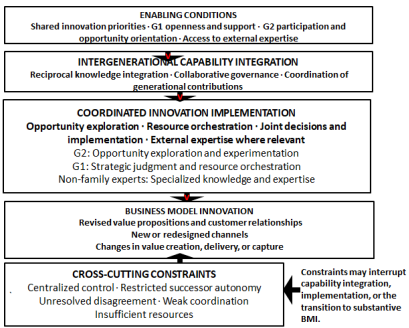
Figure 1 conceptualizes intergenerational capability integration as a potential microfoundation of business model innovation (BMI). The framework explains how family firms coordinate incumbent-generation (G1) experience and resource-orchestration capabilities with successor-generation (G2) opportunity exploration, technological expertise, and external knowledge. Non-family specialists can further broaden the firm’s knowledge base. Knowledge integration and collaborative governance connect these complementary contributions to strategic decisions, resource commitments, and implementation, helping firms reconcile organizational continuity with business model renewal.
The framework proposes that capability complementarity alone does not ensure innovation. Successor participation and autonomy create opportunities for new ideas to influence strategic decisions, while incumbent experience and resource orchestration help translate initiatives into feasible action. Reciprocal knowledge exchange and collaborative governance enable these contributions to be coordinated. When effectively integrated, they can support substantive changes in value propositions, customer relationships, channels, and value creation, delivery, or capture activities.
The framework extends the dynamic capabilities perspective by specifying how generationally distributed capabilities may contribute to sensing, seizing, and reconfiguring. It also qualifies succession-based explanations of innovation: successor entry does not automatically produce renewal, and incumbent influence is neither inherently enabling nor constraining. Its implications depend on whether governance and resource allocation facilitate experimentation and implementation or reinforce centralized control. Restricted successor autonomy, weak interaction, and resource constraints may interrupt the integration process. The model therefore presents a contingent process explanation rather than a linear or automatic relationship.
Figure 1. Intergenerational Capability Integration: An Integrated Process Model of Business Model Innovation in Family Firms.
Figure note. The model illustrates how enabling conditions facilitate the integration of generationally distributed capabilities. Reciprocal knowledge integration and collaborative governance connect opportunity exploration with coordinated implementation and potential business model renewal. Incumbent experience, successor innovation capabilities, and external expertise contribute through their coordination rather than their mere coexistence. Governance constraints and resource limitations may interrupt this process. BMI requires meaningful changes in how the firm creates, delivers, or captures value, rather than technology adoption alone.
Enabling conditions, including successor participation, generational openness, shared innovation priorities, and supportive governance, facilitate the integration of generationally distributed capabilities. Knowledge integration and collaborative governance connect successor opportunity exploration, incumbent resource orchestration, and external expertise to coordinated implementation and potential BMI. Restricted autonomy, fragmented interaction, and resource constraints may disrupt this process. BMI is distinguished from technology adoption by the extent to which initiatives produce substantive changes in how the firm creates, delivers, or captures value.
The model conceptualizes intergenerational capability integration as the process connecting enabling conditions with coordinated innovation implementation and potential BMI. Reciprocal knowledge integration and collaborative governance help coordinate generational contributions, while resource orchestration and external expertise can support implementation. Cross-cutting constraints may interrupt this process. Generational roles are not fixed, and integration does not guarantee BMI; the outcome depends on whether initiatives produce substantive changes to the firm's business model.
To clarify how generationally distributed expertise contributes to business model innovation (BMI),
Table 3 distinguishes the principal contributions of successor-generation (G2) members, incumbent-generation (G1) members, and non-family specialists from the integration processes through which their capabilities may support business model renewal. It highlights the distinction between possessing complementary expertise and mobilizing it through reciprocal knowledge exchange, collaborative governance, joint decision-making, and coordinated implementation.
Table 3. Generational Contributions and Intergenerational Capability Integration in Family-firm Business Model Innovation.
Actor | Principal contributions | Potential BMI implications |
Successor generation (G2) | Opportunity exploration, technological expertise, external knowledge, customer engagement | New value propositions, channels, customer relationships, and innovation initiatives |
Incumbent generation (G1) | Strategic judgment, resource mobilization, risk management, stakeholder relationships, implementation coordination | Resource-backed innovation, activity reconfiguration, and alignment with existing operations |
Non-family specialists | Complementary technical, market, and professional expertise | Initiatives requiring capabilities unavailable internally |
Intergenerational integration | Reciprocal knowledge exchange, collaborative governance, joint decisions, coordination of contributions | Translation of complementary capabilities into coordinated implementation and potential business model renewal |
The table illustrates the complementary roles of G2 successors, G1 incumbents, and non-family specialists in supporting BMI. Successors contribute opportunity exploration, technological expertise, external knowledge, and customer engagement, potentially enabling new value propositions, channels, and customer relationships. Incumbents contribute strategic judgment, resource mobilization, risk management, stakeholder relationships, and implementation coordination, helping connect innovation initiatives with organizational resources and existing operations. Non-family specialists provide complementary technical, market, and professional expertise where internal capabilities are insufficient.
The central analytical element is intergenerational capability integration, which connects these differentiated contributions through reciprocal knowledge exchange, collaborative governance, joint decision-making, and coordinated implementation. The framework therefore suggests that generational complementarity creates innovation potential, but its conversion into substantive business model renewal depends on how capabilities are integrated and mobilized. These relationships are contingent rather than deterministic: complementary expertise may remain underutilized when governance restricts participation, resources are not committed, or innovation initiatives fail to influence organizational activities.
Summary of Findings and Framework Extension
The cross-case analysis can be summarized around three connected insights.
First, enabling conditions create opportunities for integration but are not sufficient for BMI. Shared innovation priorities, intergenerational openness, supportive governance, and access to complementary expertise can facilitate coordination. Their significance depends on whether they enable knowledge exchange, joint decisions, and implementation.
Second, capability integration connects differentiated contributions with organizational action. G2's opportunity exploration can broaden the firm's strategic options, while G1's managerial orchestration can connect emerging initiatives with resources, organizational experience, and stakeholder relationships. Non-family specialists may extend the firm's capabilities when their expertise is incorporated into strategic decisions. Reciprocal knowledge integration and collaborative governance coordinate these contributions.
Third, the relationship between integration and BMI is contingent. Generational diversity and external knowledge can remain underutilized when successor autonomy is restricted, disagreement remains unresolved, or resources are unavailable. Conversely, complementary contributions may support more substantive renewal when they are coordinated and translated into implementation. Technology adoption alone is insufficient evidence of BMI unless it accompanies meaningful changes in the firm's value creation, delivery, or capture arrangements.
4.6. Theoretical Contribution: Intergenerational Capability Integration as a Microfoundation of Business Model Innovation
This study advances a process-based explanation of how family firms mobilize generationally distributed capabilities for business model innovation (BMI). It distinguishes generational complementarity, which represents the potential value of differentiated expertise, from intergenerational capability integration, through which that expertise is exchanged, coordinated, and mobilized for organizational renewal.
Incumbents contribute experiential knowledge, strategic judgment, stakeholder relationships, and resource-orchestration capabilities, whereas successors contribute technological expertise, external knowledge, and emerging market perspectives. Non-family specialists can extend these capabilities. However, their coexistence does not guarantee innovation; their contribution depends on reciprocal learning, joint decision-making, resource commitment, and implementation.
The framework further explains how intergenerational integration may underpin dynamic capabilities by connecting opportunity sensing, strategic and resource commitments, and the reconfiguration of business activities. These activities need not be performed exclusively by either generation or follow a strictly sequential process. Rather, their innovation potential depends on how differentiated expertise is coordinated and translated into organizational action.
Finally, incumbent influence is conditional rather than inherently enabling or constraining. Centralized control and restricted successor autonomy may impede renewal, whereas incumbent experience and resource mobilization can support experimentation and implementation. Similarly, external expertise contributes when embedded in strategic decisions rather than isolated from organizational processes. Business model renewal therefore depends not simply on generational diversity or replacement, but on the governance and integration of complementary capabilities. By conceptualizing intergenerational capability integration as a potential microfoundation of BMI, the study clarifies how generational differences can become organizationally consequential, while recognizing that renewal remains contingent on governance arrangements, resource availability, and substantive implementation.
4.7. Theoretical Propositions
The study develops three theoretical propositions explaining how intergenerational capability integration shapes business model innovation (BMI) in family firms. The propositions focus on the complementarity of generational capabilities, the governance conditions that enable or constrain their integration, and the role of external specialist expertise in translating knowledge into organizational renewal.
Proposition 1: Intergenerational capability integration. Business model innovation is more likely to emerge when successors’ opportunity-exploration capabilities and external knowledge are integrated with incumbents’ experiential knowledge and resource-orchestration capabilities through reciprocal knowledge exchange and coordinated decision-making.
Proposition 2: Governance constraints on capability integration. The contribution of intergenerational capability integration to business model innovation is constrained when centralized incumbent control limits successor participation or when new knowledge fails to translate into resource commitments and coordinated implementation.
Proposition 3: Integration of external expertise. External specialist expertise strengthens the contribution of intergenerational capability integration to business model innovation when it is incorporated into joint intergenerational decision-making and coordinated implementation rather than remaining disconnected from organizational processes.
These propositions guide theoretical development and cross-case analysis. They are assessed against supporting, qualifying, and contradictory empirical evidence rather than treated as statistically tested hypotheses. Together, they explain how the complementarity of generational capabilities, the governance of decision-making, and the organizational integration of external expertise shape the potential for substantive business model renewal.
4.8. Cross-case Analysis: Intergenerational Capability Integration and Business Model Innovation
Table 4 presents a comparative framework for examining how different configurations of intergenerational capability integration are associated with business model innovation (BMI) in family firms. It differentiates integrated capability orchestration, partial capability integration, and fragmented generational involvement across successor participation, incumbent leadership, knowledge integration, governance, external expertise, and resource mobilization. These dimensions provide a basis for identifying cross-case patterns and explaining variation in the extent of business model renewal.
Table 4. Cross-case comparison of intergenerational capability configurations.
Analytical dimension | Case 1: Integrated capability orchestration | Case 2: Partial capability integration | Case 3: Fragmented generational involvement |
G2 involvement | Actively participates in strategic decisions and leads innovation initiatives. | Initiates technological or market changes but has limited strategic autonomy. | Has limited influence over strategic decisions or participates mainly in operational tasks. |
G1 managerial role | Acts as mentor and resource orchestrator, supporting experimentation and implementation. | Provides resources and approval but retains substantial decision-making control. | Maintains centralized authority and prioritizes established practices. |
Knowledge integration | G1’s experiential knowledge is combined with G2’s technological and external knowledge. | Knowledge is exchanged selectively, with incomplete integration into strategy. | Knowledge remains fragmented or flows predominantly in one direction. |
Intergenerational governance | Shared priorities, reciprocal trust, and joint decision-making support coordination. | Cooperation exists, but unresolved differences constrain autonomy and coordination. | Weak communication, low trust, or generational conflict restrict collaboration. |
External expertise | Non-family professionals contribute specialized expertise to innovation and implementation. | External expertise is accessed selectively or used mainly for technical tasks. | Limited access to, or integration of, external professional expertise. |
Resource mobilization | G1 aligns financial, organizational, and relational resources with innovation opportunities. | Resources are committed cautiously and often to bounded initiatives. | Limited resource commitment or reluctance to support initiatives proposed by G2. |
Business model innovation | Potential for broader changes to value propositions, channels, and value creation or delivery. | Predominantly incremental or localized business model changes. | Limited renewal; technological initiatives may remain disconnected from the established business model. |
Overall configuration | Complementary capabilities are coordinated across generations. | Capabilities are partly combined but constrained by incomplete delegation or governance. | Generational capabilities coexist without effective integration. |
Source: Authors’ analytical synthesis of the proposed cross-case framework.
The comparison identifies three configurations distinguished by the extent to which complementary generational capabilities are coordinated and mobilized. Integrated capability orchestration combines active successor participation, incumbent mentoring and resource mobilization, reciprocal knowledge integration, collaborative governance, and external expertise. This configuration is associated with the potential for broader business model renewal.
Partial capability integration involves selective knowledge exchange and cooperation, but restricted successor autonomy, incomplete strategic coordination, or cautious resource commitments may limit innovation to incremental or localized changes. Fragmented generational involvement is characterized by centralized authority, weak knowledge exchange, limited collaboration, and insufficient support for successor initiatives. Under these conditions, technological improvements may remain disconnected from substantive business model change.
The framework’s central implication is that generational diversity alone does not explain differences in BMI. Rather, the extent to which complementary capabilities are integrated through governance, knowledge exchange, and resource mobilization helps explain their potential contribution to renewal. These configurations should be interpreted as analytical patterns grounded in cross-case evidence, not as predetermined stages or causal outcomes.
-Cross-case Interpretation
Case 1: Integrated capability orchestration
The first configuration represents a pattern in which intergenerational capability integration is relatively strong. G2 contributes technological expertise, external knowledge, and market-oriented ideas, while G1 supports their implementation through strategic judgment, resource mobilization, risk management, and established stakeholder relationships. Non-family professionals may strengthen this configuration by supplying specialized expertise unavailable within the family.
The defining feature is not simply that both generations participate, but that their contributions are coordinated through shared priorities, meaningful successor involvement, and joint decisions. This configuration provides a plausible explanation for more substantive BMI because technological and market opportunities can be connected to organizational resources and changes in the firm’s value creation and delivery arrangements.
Case 2: Partial capability integration
The second configuration reflects an intermediate pattern. G2 introduces new ideas or digital initiatives, and G1 recognizes some of their potential and provides selective support. However, strategic authority remains concentrated in G1, or the generations differ in their willingness to commit resources and change established routines.
Consequently, innovation may proceed through incremental adjustments rather than comprehensive business model redesign. New technologies or channels can be introduced without corresponding changes to the firm’s wider activities, value proposition, or delivery arrangements. This configuration highlights the distinction between innovation initiation and organizational reconfiguration: generating an idea is not equivalent to integrating it into the business model.
Case 3: Fragmented generational involvement
The third configuration represents a pattern in which the capabilities of G1 and G2 remain weakly connected. G1 may prioritize continuity and established routines, while G2 has limited autonomy, insufficient preparation, or restricted access to strategic decisions. Limited communication and inadequate external expertise can further constrain the development and implementation of innovation initiatives.
Under these conditions, the firm may struggle to translate technological opportunities into business model renewal. The central problem is not necessarily the absence of innovative ideas or valuable incumbent experience; rather, the governance arrangements do not effectively connect those resources. This pattern therefore suggests that generational participation alone is insufficient when the coordination of capabilities remains weak.
4.9. Success and Failure Mechanisms of Intergenerational Business Model Innovation
Table 5 synthesizes the enabling and constraining mechanisms through which intergenerational capability integration shapes business model innovation (BMI) in family firms. It compares successor capabilities, incumbent managerial contributions, knowledge integration, intergenerational collaboration, and external expertise to explain why innovation initiatives may lead to substantive business model renewal in some firms but remain limited or unimplemented in others.
Table 5. Enabling and Constraining Mechanisms of Intergenerational Business Model Innovation.
Dimension | Success mechanisms enabling BMI | Failure mechanisms constraining BMI |
G2 involvement and innovation capabilities | Early involvement and successor preparation; technological expertise; entrepreneurial initiative; external knowledge acquisition; opportunity recognition; customer-oriented innovation. | Delayed involvement; passive successor participation; inadequate preparation; limited technological expertise; weak external orientation and opportunity seeking. |
G1 managerial capabilities and organizational readiness | Resource mobilization; strategic judgment; risk governance; stakeholder coordination; support for G2 initiatives; openness to change; innovation-supportive structures. | Excessive control; paternalistic leadership; path dependency; risk aversion; resistance to successor ideas; inadequate resource commitment. |
Intergenerational knowledge integration | Combining G1’s experiential and tacit knowledge with G2’s technological and external knowledge; reciprocal knowledge exchange; dialogue; integration of internal and external expertise. | Weak communication; one-way knowledge transfer; limited trust; failure to connect established expertise with new technological and market knowledge. |
Intergenerational collaboration and value co-creation | Shared innovation vision; mutual trust; joint problem-solving; collaborative decisions; constructive conflict resolution; coordinated commitment to business renewal. | Conflicting priorities; limited acceptance of G2 capabilities; weak communication; unresolved tensions; fragmented strategic decisions. |
Non-family professionals and external expertise | Access to specialized technological knowledge; professionalization of innovation; collaboration with external experts; support for experimentation and business model redesign. | Limited access to external expertise; dependence on family resources; insufficient specialized capabilities; restricted external knowledge networks. |
Business model innovation outcomes | Development of new value propositions, services, and digital channels; adaptation of value creation and delivery; coordinated implementation; responsiveness to customer and market changes. | Ideas that remain unimplemented; isolated technological improvements; limited customer adaptation; failure to redesign business activities; persistence of established business models. |
The table highlights that BMI depends not simply on the presence of complementary generational capabilities but on their effective integration and organizational mobilization. Successor involvement contributes technological expertise, entrepreneurial initiative, and opportunity recognition, while incumbents provide strategic judgment, resource mobilization, and implementation support. Reciprocal knowledge exchange and collaborative decision-making connect these contributions, while non-family professionals can extend the firm’s innovation capabilities.
Conversely, delayed successor involvement, centralized incumbent control, weak communication, unresolved generational tensions, and inadequate resource commitments can disrupt this integration. Limited access to external expertise may further constrain the translation of innovation opportunities into organizational change. These mechanisms help explain why technological improvements or promising ideas do not necessarily produce substantive BMI.
Overall, the comparison positions intergenerational capability integration as the process linking complementary expertise to potential business model renewal, while recognizing that its contribution depends on governance, resource allocation, and implementation.
4.10. Cross-case Empirical Testing Framework
Table 6 provides a structured approach to assessing the three theoretical propositions across the empirical cases. Each proposition is examined through comparable evidence concerning generational capabilities, governance arrangements, knowledge integration, resource mobilization, external expertise, and business model outcomes. The framework distinguishes supporting patterns from contradictory or disconfirming evidence, enabling systematic cross-case comparison without assuming that the proposed relationships hold uniformly across firms.
Table 6. Cross-case Assessment of Theoretical Propositions on Intergenerational Capability Integration and Business Model Innovation.
Proposition | Evidence to compare across cases | Supporting pattern | Contradictory or disconfirming pattern | Assessment based on evidence |
P1: Intergenerational capability integration | G1 experiential knowledge and resource-orchestration capabilities; G2 opportunity exploration and external knowledge; reciprocal exchange, joint decisions, and implementation outcomes. | Complementary generational capabilities are integrated and mobilized through coordinated decision-making, accompanying substantive BMI. | Strong integration occurs without substantive BMI, or BMI emerges despite limited intergenerational integration. | Supported |
P2: Governance constraints on capability integration | Incumbent control, successor autonomy, delegation, trust, resource commitments, and the translation of innovation initiatives into implementation. | Restricted successor participation or insufficient resource commitment constrains BMI, whereas appropriate delegation and incumbent support facilitate implementation. | Renewal proceeds despite centralized control or limited incumbent support, or supportive governance fails to translate innovation initiatives into implementation. | partially supported |
P3: Integration of external expertise | Non-family specialists’ participation, the incorporation of their knowledge into intergenerational decisions, and its contribution to business model redesign and implementation. | External expertise strengthens the contribution of intergenerational integration when incorporated into joint decisions and coordinated implementation. | External expertise remains disconnected from strategic decisions or has no discernible contribution to BMI; alternatively, substantive BMI occurs without external specialists. | Supported |
The framework evaluates P1 by examining whether reciprocal integration of incumbent and successor capabilities is associated with substantive business model renewal. P2 assesses how governance arrangements, successor autonomy, and resource commitments enable or constrain the translation of innovation initiatives into implementation. P3 examines whether external specialist expertise contributes to BMI when embedded in intergenerational decision-making and coordinated action.
5. Discussion
The findings suggest that business model innovation (BMI) in family firms depends not simply on succession or generational diversity, but on how complementary capabilities are integrated into strategic decisions and implementation. Incumbent generations (G1) contribute experiential knowledge, strategic judgment, stakeholder relationships, and resource orchestration, whereas successor generations (G2) contribute technological expertise, external knowledge, and opportunity exploration. Non-family specialists can extend this capability base through complementary professional expertise. These contributions become consequential when coordinated through reciprocal knowledge integration, collaborative governance, and resource mobilization.
-Intergenerational Capability Integration and Collaborative Governance
The findings extend succession research by conceptualizing generational transition as a potential source of capability renewal rather than merely a transfer of ownership or managerial authority. Successors can broaden the firm's opportunity set through technological expertise, customer insights, and external knowledge, but these resources do not automatically influence strategic decisions or produce business model change. Their contribution depends on meaningful participation, incumbent support, and access to implementation resources.
The concept of intergenerational capability integration distinguishes the potential value of generational complementarity from the organizational processes through which complementary expertise is coordinated and mobilized. Reciprocal knowledge exchange, joint problem-solving, and collaborative governance enable generations to interpret different perspectives, negotiate priorities, and connect emerging opportunities with organizational resources. Shared innovation priorities, clear responsibilities, and constructive dialogue may facilitate this process, whereas centralized authority, restricted successor autonomy, and unresolved disagreement may leave capabilities fragmented.
This distinction helps explain why firms with access to similar generational expertise may follow different innovation trajectories. Generational diversity provides potential; integration connects that potential with coordinated action. Incumbent influence is consequently conditional rather than inherently enabling or constraining. G1 can reinforce established arrangements when authority restricts successor participation, but can also facilitate renewal through strategic judgment, risk assessment, resource allocation, and stakeholder coordination. Similarly, successor participation expands the potential for exploration but does not guarantee innovation without organizational support.
The findings also extend the application of the Dynamic Capabilities View (DCV) to family firms. Activities associated with sensing, seizing, and transforming may be distributed across generations: actors identify opportunities, evaluate alternatives, mobilize resources, and reconfigure established activities according to their expertise and responsibilities. These activities are not exclusive to either generation and need not follow a rigid sequence. The contribution of intergenerational capability integration is to explain how distributed expertise may be coordinated across these activities, rather than attributing dynamic capability development to a single generational actor.
- External Knowledge Integration and Substantive Business Model Renewal
The findings further distinguish access to knowledge from its integration into organizational action. Successors and non-family specialists can introduce technological, professional, and market expertise, but these inputs become consequential when interpreted alongside incumbent experience and incorporated into strategic decisions and implementation. External expertise that remains disconnected from intergenerational deliberation may expand the firm's information base without producing wider organizational change.
This interpretation also clarifies the relationship between knowledge integration and BMI. The Knowledge-Based View (KBV) emphasizes the importance of combining distributed expertise, while the DCV directs attention to how knowledge informs coordinated action and organizational reconfiguration. Their connection provides a process-based explanation of how intergenerational interaction may translate diverse knowledge into business model renewal.
Importantly, BMI must be distinguished from technology adoption or isolated operational improvement. Introducing digital tools or online sales channels does not, by itself, establish business model innovation. More substantive renewal involves implemented changes to value propositions, customer relationships, channels, or the activities through which the firm creates, delivers, or captures value. The analytical focus is therefore on whether integrated capabilities lead to changes in the business model, rather than simply generating ideas or initiating projects.
Where complementary capabilities and external expertise are coordinated with resources and implementation, firms may be better positioned to pursue substantive renewal. Where contributions remain fragmented or initiatives fail to secure organizational support, change may remain incremental or disconnected from the wider business model. These patterns suggest that integration is a potential mechanism of BMI, not a guarantee of a particular innovation outcome.
- Theoretical Contributions: Reframing Generational Diversity and Family-firm Innovation
This study makes three related contributions. First, it positions intergenerational capability integration as a process mechanism connecting generationally distributed expertise with coordinated implementation and potential BMI. This advances explanations centered on succession or generational diversity by identifying how complementary capabilities can be coordinated, evaluated, and mobilized for organizational renewal.
Second, the study develops a conditional account of generational influence. Incumbents may constrain renewal when centralized authority restricts successor participation, but they can also enable innovation through resource orchestration, strategic judgment, and stakeholder coordination. Successors may broaden opportunity exploration, but their contribution depends on whether new knowledge can influence decisions and obtain implementation support. The relevant distinction is therefore not between conservative incumbents and innovative successors, but between organizational arrangements that fragment capabilities and those that enable their integration.
Third, the study clarifies the complementary roles of knowledge integration, governance, and external expertise. New knowledge becomes consequential when interpreted alongside established organizational knowledge and connected to strategic decisions, resource commitments, and implementation. This process links the KBV's emphasis on distributed expertise with the DCV's concern with coordinated action and organizational reconfiguration.
Taken together, the findings offer a process-based interpretation of the family-firm innovation paradox. Long-term orientation, accumulated experience, and family relationships do not necessarily promote or inhibit renewal; their implications depend on how they interact with successor participation, external knowledge, governance, and resource mobilization. Intergenerational differences are neither inherently dysfunctional nor automatically productive. Their innovation potential depends on how effectively they are coordinated and translated into substantive business model changes.
5.1. Managerial Implications
The findings suggest that business model innovation (BMI) in family firms depends not simply on generational diversity, but on how complementary capabilities are integrated into strategic decisions and implementation. Three managerial priorities follow.
First, strengthen successor participation and accountability. Family firms should provide successors with opportunities to develop market and technological expertise, participate in strategic decisions, and lead defined innovation initiatives. Meaningful decision rights should be matched with clear responsibilities and access to implementation resources. Progress should be evaluated not merely through ideas or technology adoption, but through implemented changes to value propositions, customer relationships, channels, and value creation, delivery, or capture.
Second, reposition incumbent leadership as an enabler of renewal. Incumbents can contribute strategic judgment, risk assessment, resource allocation, and stakeholder coordination. Staged delegation, transparent investment criteria, and proportionate oversight can preserve accountability while allowing successors to experiment. The objective is not to eliminate incumbent control, but to prevent it from unnecessarily restricting successor participation and organizational learning.
Third, institutionalize intergenerational collaboration and external knowledge integration. Joint strategy meetings, cross-generational innovation teams, and regular business model reviews can help generations reconcile perspectives, allocate resources, and coordinate implementation. However, routines create value only when their repeated enactment improves knowledge integration and collective action. Non-family specialists should likewise be involved where relevant, with their expertise incorporated into strategic decisions rather than isolated from implementation.
5.2. Limitations and Future Research
This study draws on a qualitative cross-case analysis of five family-owned publishing firms. Its findings provide contextually grounded analytical insights rather than statistically generalizable or universally causal relationships. Industry characteristics, firm histories, and governance arrangements may influence how intergenerational capabilities are integrated and translated into business model change.
Future research could use longitudinal designs to examine how integration develops as successors gain experience and innovation initiatives progress from exploration to implementation. Comparative studies could investigate how decision rights, incumbent authority, and successor autonomy shape these processes across industries and institutional environments. Further work could also distinguish access to external expertise from its effective integration into strategic decisions and develop validated measures of capability complementarity, integration, and BMI. Such research should distinguish integration from its antecedents, such as successor participation and incumbent openness, and its outcomes, such as implemented business model change.





 Share This Article
 Twitter
 Linked In
 Facebook

 Copy
 Download