Research Article | | Peer-Reviewed

Lime Stabilization Effects on Geomechanical Properties of Kombe Mbanga Soils Road Subgrade (Cameroon)

Received: 13 June 2026     Accepted: 1 July 2026     Published: 24 July 2026
Views:       Downloads:
Abstract

Road infrastructure in Cameroon experiences rapid deterioration due to intense seasonal rainfall, high temperatures, and the predominance of weak lateritic soils in tropical environments. These unfavorable conditions reduce pavement performance, increase maintenance costs, and hinder sustainable transportation development, particularly on rural road networks. Soil stabilization using locally available materials has emerged as a cost-effective strategy for improving the engineering properties of these problematic soils. This study evaluates the effectiveness of locally sourced quicklime in enhancing the geotechnical characteristics of lateritic soils collected from the Kombe-Mbanga area in Cameroon and assesses its suitability for road subgrade applications. Ten representative soil samples were collected and characterized through laboratory testing, including particle size distribution, Atterberg limits, Modified Proctor compaction, California Bearing Ratio (CBR), and direct shear strength tests. The tests were performed before and after quicklime stabilization to quantify changes in the soils' mechanical behavior. In addition, statistical analyses were conducted to investigate the relationships between key geotechnical parameters and bearing capacity. The results demonstrate substantial improvements following stabilization. The average CBR increased from 9.04 to 45.08, indicating a significant enhancement in load-bearing capacity. Cohesion increased from 27 to 57 kPa, while the internal friction angle improved from 30° to 57°, reflecting greater shear strength and stability. Statistical analysis further revealed a strong negative correlation between the plasticity index and CBR (r = −0.67), confirming that high plasticity and fine particle content are the primary factors responsible for the poor engineering performance of the untreated soils. These findings demonstrate that locally available quicklime provides a simple, economical, and effective stabilization technique capable of transforming weak tropical lateritic soils into suitable road subgrade materials. The study offers practical guidance for the rehabilitation and construction of durable rural roads in Cameroon and other tropical regions with similar geotechnical and climatic conditions.

Published in International Journal of Transportation Engineering and Technology (Volume 12, Issue 3)
DOI 10.11648/j.ijtet.20261203.11
Page(s) 84-97
Creative Commons

This is an Open Access article, distributed under the terms of the Creative Commons Attribution 4.0 International License (http://creativecommons.org/licenses/by/4.0/), which permits unrestricted use, distribution and reproduction in any medium or format, provided the original work is properly cited.

Copyright

Copyright © The Author(s), 2026. Published by Science Publishing Group

Keywords

Kombe-Mbanga, Geomechanical Parameters, Lateritic Soil, Lime Stabilization, Subgrade, Statictical Correlation

1. Introduction
Road infrastructure in tropical regions rests, quite literally, on soil. The mechanical properties of that soil, particularly bearing capacity, determine whether a subgrade holds or fails under load . In Cameroon, as across much of sub-Saharan Africa, the soils engineers work with are predominantly lateritic. They are widespread, they are familiar, and a significant proportion of them are problematic: heavy weathering produces high plasticity, low bearing capacity, and a susceptibility to swelling and shrinkage that makes them poorly suited to road subgrade applications without treatment .
Stabilization is therefore not optional. Cement remains the default binder, fast-acting, durable, and readily available, but it has two well-documented weaknesses: it performs poorly on highly plastic clays, and its CO2 footprint is increasingly difficult to justify when alternatives exist . Pozzolanic materials such as fly ash have been studied as partial substitutes , and bio-based stabilizers using enzymes, bacteria, or biopolymers have attracted research interest . Neither category has demonstrated consistent reliability under tropical field conditions.
Lime behaves differently on clayey laterites. Cation exchange begins within hours of mixing, reducing plasticity and improving workability; pozzolanic reactions follow over days and weeks, progressively building strength . The effect is well documented. Studies conducted in tropical environments have recorded consistent gains in CBR and shear strength after lime treatment . Prior fieldwork at Kombe-Mbanga confirmed those gains under local conditions . Subsequent work showed that lime treatment increases compressive strength and durability in unsaturated soils , that combining lime with natural fibers can push performance further , and that lime outperforms mechanical stabilization methods on tropical laterites when the two are compared directly .
Knowing that lime works is useful. Knowing how to quantify its effect quickly and cheaply is more useful still. The California Bearing Ratio is the standard subgrade quality metric in road engineering, but direct CBR testing is time-consuming and expensive, which limits its application on large or resource-constrained projects. Several groups have proposed predictive models that estimate CBR from parameters that are faster to measure: cohesion, internal friction angle, and plasticity indices .
Standard multivariate correlations predict CBR adequately for homogeneous soils, but their reliability drops for tropical laterites, which show high structural variability and physicochemical properties that shift with moisture and weathering history. Machine learning approaches have attempted to fill that gap. One study built a CBR and compressibility prediction model for lime-stabilized laterites using machine learning combined with Pchip data augmentation, with results that held for tropical applications . Another proposed a hybrid model for metakaolin-treated laterites, showing that combining laboratory measurements with statistical modeling improves prediction accuracy . A third found that neural networks and classical linear correlations perform comparably on stabilized soils , a finding that is less conclusive than it sounds, since neither approach in that study was calibrated specifically for lime-treated tropical laterites.
That is precisely the gap this study addresses. Predictive CBR models validated for lime-stabilized tropical laterites are scarce, and the ones that exist were not built on soils from this region. Engineers working on rural road rehabilitation in Cameroon have no locally grounded reference tool: they either run full CBR campaigns or rely on correlations developed elsewhere and hope they transfer.
This study addresses that directly through three connected objectives: characterizing the physical and mechanical properties of Kombe-Mbanga lateritic soils, quantifying the effect of lime treatment on their behavior, and establishing statistically validated correlations between physical and mechanical parameters. The novelty lies not in any single element but in their combination: site-specific characterization, controlled lime treatment, and locally calibrated correlations developed together for a soil type and climate that existing models do not adequately cover.
2. Study Area
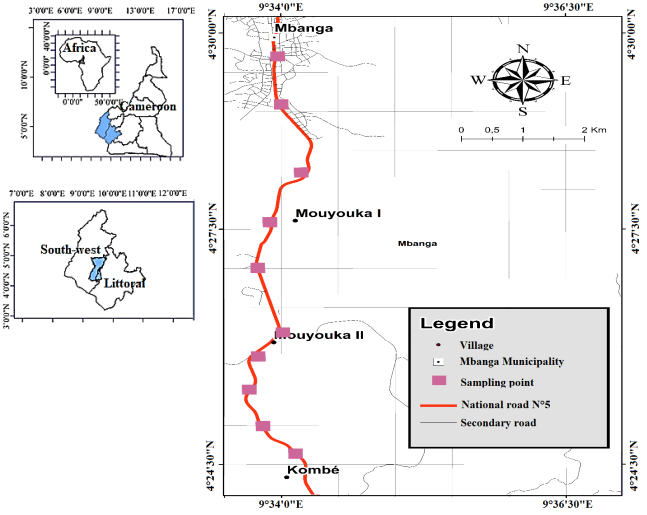
The Kombe-Mbanga site is in the municipality of Mbanga, in the Moungo subdivision, on the border between the Littoral and South-West regions of Cameroon (Figure 1). The study covered a 7 km section of National Road No. 5, a major route between these two regions. The study area lies between longitudes 9°10'E and 9°50'E and latitudes 4°10'N and 5°00'N. Mbanga is approximately 70 km from Nkongsamba and 65 km from Douala. The municipality covers 544 km2, includes 19 localities, and has a population of around 35,415. Neighboring localities include Njombea-Penja and Mombo to the north, Dibombari to the south, Bonalea to the east, and Meme (Kumba) to the west.
The climate is equatorial (Guinea type), with two wet seasons and two dry seasons. Temperatures range between 22°C and 34°C, rarely falling below 20°C. Annual rainfall is 2,500 - 3,000 mm .
The site was selected for three reasons: visible and widespread pavement deterioration (potholes, ruts, cracks) indicating subgrade failure; accessibility for safe field sampling; and an undisturbed natural soil profile with no prior stabilization or regrading, so that the analyses would reflect actual in-situ geotechnical conditions.
3. Materials and Methods
3.1. Soil Sampling and Materials Description
Soil samples were collected from hand-dug excavation pits using picks, shovels, and crowbars. Three criteria guided site selection:
Wells were positioned approximately 5 m from the road edge to capture material representative of the subgrade while avoiding the density changes induced by direct traffic loading. The site was kept clear of residential and developed areas to limit anthropogenic disturbance. Extraction depth was held between 0.5 and 1.5 m, targeting the upper subsoil layer where organic content is negligible and surface weathering effects are limited.
Both disturbed and undisturbed samples were collected following standard geotechnical protocols to ensure representativeness across the test program.
Full mineralogical characterization was not carried out in this study. The mineralogy of lateritic soils from the Cameroonian Littoral is already well established in the regional literature: kaolinite and iron oxides are the dominant constituents, a finding confirmed across multiple independent studies . Reproducing that characterization here would add length without advancing the objectives of this work.
Natural soil was oven-dried at 105 ± 5°C before any testing or mixing. Unstabilized samples were compacted directly at optimum moisture content using the modified Proctor mold, then soaked for 96 hours prior to CBR testing.
For stabilized samples, a 4% quicklime dosage was selected based on preliminary tests and published work on comparable tropical laterites, which consistently identify the 3-6% range as the zone where cation exchange and pozzolanic reactions produce measurable strength gain without excess lime remaining unreacted in the matrix . Within that range, 4% represents a realistic field dosage, high enough to drive meaningful plasticity reduction and CBR improvement, low enough to remain economically viable for rural road construction in Cameroon. Higher dosages were not tested in this phase; their effect is identified as a variable worth exploring in follow-up work.
Figure 1. Localization map of the study site and sampling points.
The lime used is a commercial quicklime in common use in Cameroon, with a CaO content above 90%. The required lime mass was calculated as 4% of the dry soil mass. Dry components were mixed mechanically for approximately five minutes. Distilled water was then added gradually to reach optimum moisture content, followed by five to ten minutes of additional mixing to ensure even distribution.
The wet mixture was compacted in the modified Proctor mold at OPM (Optimum Moisture) before being placed in sealed containers for curing. Curing lasted 14 days at 25 ± 2°C under relative the maximum dry density (MDD) were measured with the modified Proctor test (NF P 94-093).
3.2. Laboratory Testing
3.2.1. Physical Characterization
Particle size distribution was determined by dry sieving for particles larger than 80 µm (NF P 94-056) and hydrometer sedimentation for particles smaller than 80 µm (NF P 94-057).
Atterberg limits were measured using the Casagrande apparatus for the liquid limit and the rolling thread method for the plastic limit, per NF P 94-051. The plasticity index was derived from Equation (1).
PI=LL-PL(1)
Compaction characteristics at optimum moisture content and maximum dry density, were determined by the modified Proctor test (NF P 94-093).
3.2.2. Mechanical Characterization
The California Bearing Ratio (CBR) test measures penetration resistance on samples compacted at OPM and soaked for 96 hours (NF P 94-078). CBR was calculated at 2.5 mm and 5.0 mm penetration depths, using Equations (2) and (3), and compared against reference forces for crushed gravel (13.5 kN and 19.93 kN, respectively). The higher value was retained for each sample.
CBR2.5=P2.513.5×100(2)
CBR5.0=P5.019.93×100(3)
Shear strength parameters cohesion (c) and friction angle (φ) were determined by direct shear tests (NF P 94-071) at three normal stress levels (100, 200, and 300 kPa). The Mohr-Coulomb failure envelope was derived graphically using Equation (4).
τ=c+σtanφ(4)
3.3. Statistical Analysis
The statistical approach was designed around two real constraints: a small sample size (n = 10 for natural soils) and the structural interdependence typical of geotechnical variables, where fine particle content, plasticity, and strength indices tend to move together . The goal was to identify reliable trends, not to overextract from limited data.
Univariate descriptive statistics (mean, standard deviation, minimum, maximum, and quartiles) characterize central tendency and dispersion across the dataset.
Bivariate relationships were assessed using Spearman's rank correlation coefficient. This choice was driven by two factors: several variables showed non-normal distributions, confirmed by Shapiro-Wilk tests (p < 0.05), and the relationships between geotechnical parameters are often monotonic without being strictly linear. Spearman's method requires no normality assumption and handles outliers without distortion, properties that make it well suited to small geotechnical datasets . Conclusions about soil vulnerability and stabilization effectiveness rest on clear descriptive differences between natural and treated properties, not on extrapolated correlations.
4. Results and Discussion
4.1. Physical Parameters
As illustrated in Table 1, the physical parameters and major geotechnical indices of the soils under investigation are presented. These include grain size distribution, natural moisture content, and Atterberg limits. The statistical summary presented in Table 2, in conjunction with Figures 2 and 3, offers a comprehensive overview of the data, encompassing minimum, maximum, and average values, standard deviations, and quartiles.
A thorough analysis of the particle size distribution of the sampled foundation soils reveals a high degree of similarity with the results reported by in the same geographical area. This observation reflects a regional soil formation process characterised by significant weathering of the original materials in a tropical climate . This process induces partial dissolution of silica and bases, while concentrating iron and aluminium oxides and clay minerals. This chemical reaction has been shown to result in a substantial decrease in the size of gravel grains, accompanied by a considerable increase in the number of fine particles in suspension.
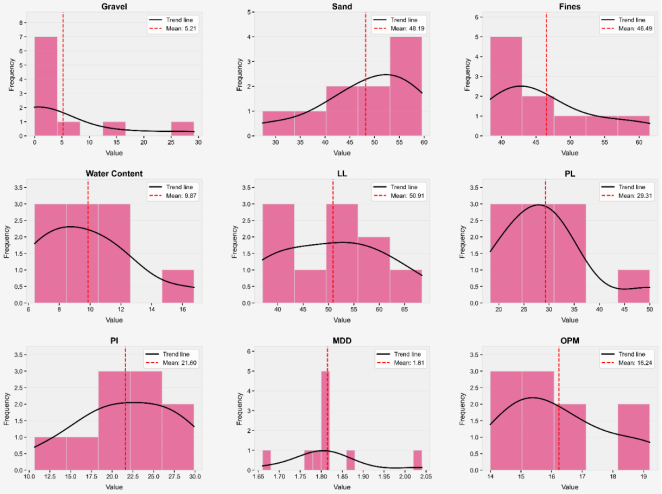
These properties differ significantly from the ideal structure expected for road foundations in tropical areas. This hypothesis is supported by the results presented in Table 2, which provides a statistical summary of the data. This discrepancy is indicative of a disparity between the theoretical data and the empirical observations. In fact, the percentage of gravel is not only very low (average = 5.21%), but also reflects high variability (standard deviation = 9.43) and strong positive asymmetry (skewness = 1.70). This observation suggests that the distribution of gravel along the studied section is uneven and irregular, indicating an inhomogeneous distribution of lateritization remains rather than a regular soil characteristic.
This uneven distribution of gravel has been shown to compromise the particle adjustment process, which is essential for the bearing capacity of soils . The latter produces varied areas where a uniform base was expected. Conversely, the fine fraction exhibits both abundance and constancy (mean = 46.50%, SD = 7.07), thus establishing itself as the predominant component of the soil. As previously stated in reference works , the composition of these fines primarily consists of kaolinite and illite, along with iron and aluminium oxides, which are indicative of lateritic profiles. This property is attributable to the substantial specific surface area imparted by these minerals to the material under consideration. The sand fraction was found to be the predominant granular element (mean = 48.19%, SD = 9.31), and its distribution among the different samples was relatively uniform.
The results of the Shapiro-Wilk normality tests revealed that the amount of gravel followed a highly non-normal distribution (p < 0.05, skewness = 1.70), while the plastic limit (PL) also showed significant skewness (skewness = 1.20) (see Figure 3). The utilization of Spearman's non-parametric correlation analysis is explained by this diversity, as it is more resistant to outlier values and appropriate for small samples.
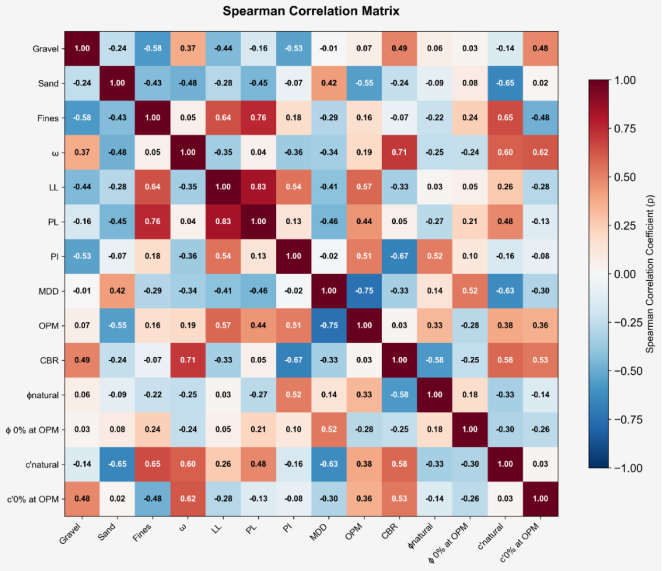
The data presented in Figure 2 reveal an absence of a significant correlation between the sand and fine fractions (ρ = -0.43, p = 0.215). However, a moderate inverse correlation between gravel and fines was observed (ρ = -0.58, p = 0.082), indicating a relative substitution relationship: areas with high gravel content are less rich in fines, while heavily weathered areas dominated by fines have eroded or fragmented the gravel particles . This trade-off, in combination with deformation, serves to limit the soil's capacity to concurrently activate the mechanisms of resistance through friction (gravel) and adhesion (fines) . A positive correlation, whose significance is close to the statistical threshold, was observed between natural moisture and the liquidity limit (ρ = 0.60; p = 0.067). This observation thus validates the hypothesis of an affinity between soil and water, a hypothesis that has already been highlighted in previous research on Yaoundé laterites . It is important to note that moderate increases in moisture, which are common in coastal areas, can lead to a significant decrease in soil strength, causing it to become plastic and malleable .
Furthermore, the fine particle content demonstrated a substantial positive correlation with the liquidity limit (ρ = 0.64, p = 0.048) and the plasticity limit (ρ = 0.76, p = 0.011). The findings, derived from samples representative of the population under study, provide quantitative evidence that the clay fraction exerts a significant influence on the plastic behaviour of the soil. The elevated values of the liquid limit (LL = 50.91) and plasticity index (PI = 21.6) categorise this soil as a highly plastic material.
A significant finding of this study is the substantial negative correlation between the plasticity index and the CBR (ρ = -0.67, p = 0.033), which provides substantial statistical evidence: the higher the plasticity index, the lower the soil strength.
Thus, an increase in PI results in an increase in absorbed water and a decrease in effective stresses under load. This dynamic results in a decrease in internal friction and an increase in the generation of pore pressures. Consequently, the soil undergoes a transition from a friction-based sliding behaviour to a viscous deformation. The presence of a high percentage of fine particles, with an average of 46.5%, which is still above the 35% limit recommended by practical guidelines , combined with a high plasticity index and the correlations identified, confirms that this natural soil is not suitable for the installation of flexible pavements.
This issue is widely recognised in the region. As demonstrated in previous research , lime stabilisation has been shown to be both effective and a viable solution. The application of lime exerts a direct impact on the electrochemical bonds of clay minerals, resulting in a sustained reduction in the liquidity limit and plasticity index. Furthermore, it has been demonstrated to reduce sensitivity to moisture, which is the primary factor in the observed failures on pavements.
Table 1. Physical parameters.

Samples

Gravel (%)

Sand (%)

Fines (%)

Natural ω%

LL%

PL%

PI

P1

0

57.7

42.3

6.54

55.2

27.14

28.06

P2

0.05

59.53

40.37

9.19

45

22.42

22.58

P3

0

54.91

45.09

6.4

52.27

26.31

25.96

P4

0

38.46

61.54

9.18

61.5

31.64

29.86

P5

6.23

52

41.77

6.85

37.6

22.17

15.43

P6

29.2

27.37

42.33

11.33

59.5

33.74

25.76

P7

0

43.82

56.18

16.74

51

30.38

20.62

P8

16.4

45.13

38.37

12.24

37

18.33

18.67

P9

0.19

53.59

46.41

11.7

41.66

31

10.66

P10

0.04

49.37

50.59

8.54

68.4

50

18.4

Table 2. Univariate statistical data analysis of physicals parameters.

count

mean

SD

min

25%

50%

75%

max

skewness

kurtosis

Gravel

10

5.21

9.43

0.00

0.00

0.05

4.72

29.20

1.70

1.45

Sand

10

48.19

9.31

27.37

44.15

50.69

54.58

59.53

-0.90

0.00

Fines

10

46.50

7.07

38.37

41.90

43.71

49.55

61.54

0.95

-0.31

ω

10

9.87

3.05

6.40

7.27

9.19

11.61

16.74

0.83

0.02

LL

10

50.91

10.02

37.00

42.50

51.64

58.43

68.40

0.12

-1.12

PL

10

29.31

8.31

18.33

23.39

28.76

31.48

50.00

1.20

1.27

PI

10

21.60

5.70

10.66

18.47

21.60

25.91

29.86

-0.33

-0.82

SD: Standard deviation; min: minimum value; 25%: First; 50%: Median); 75%: Third Quartile; max: maximum value
Figure 2. Bivariate statistical analysis: heatmap of Pearson correlation between physical and mechanical data.
4.2. Soil Classification
The GTR [Guide des Terrassements Routiers (French Road Earthworks Guide)] system and the AASHTO classification both indicate that the soils of Kombe-Mbanga are categorised as poor-quality foundation materials. The majority of these materials are classified as categories A2-A3 (GTR) and group A-7 (AASHTO), indicating their unsuitability for use in road construction. This categorization is closely associated with their high concentration of fine particles (>35%), high plasticity (average plasticity index = 21.6), and low intrinsic bearing capacity . These observations are consistent with geotechnical recommendations, which stipulate that this type of soil often requires corrective action, either through extraction and replacement or chemical stabilization . The observations collected in this study corroborate the results of regional research conducted on comparable lateritic soils. This research underscores the necessity for lime treatment to curtail plasticity and regulate moisture sensitivity .
4.3. Mechanical Properties
4.3.1. Natural Soil Parameters
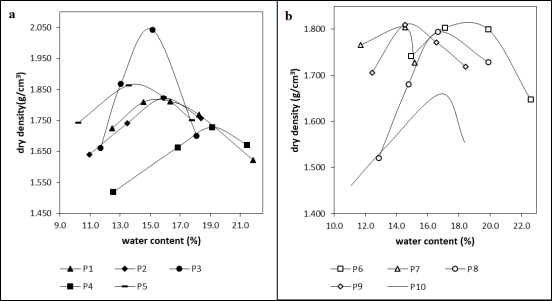
The maximum dry density and optimum moisture content for compaction were determined using modified Proctor tests for all samples. As recorded in Table 3 and illustrated in Figure 4, the maximum dry density (MDD) and optimum moisture content (OPM) values are presented, along with the results of the CBR tests, internal friction angle (φ) and cohesion (c). The statistical summary presented in Table 4 offers a comprehensive overview of the parameters under consideration, including minimum, maximum, and average values, standard deviations, and quartiles.
(i). Compaction Characteristics and CBR
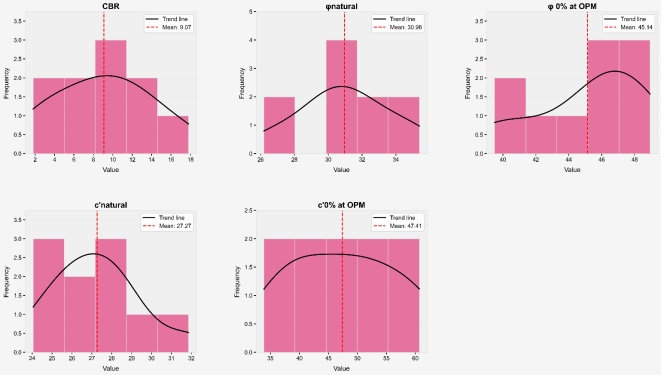
The findings indicate that the mechanical parameters (CBR, φ, and c) demonstrate a near-normal distribution (p > 0.05), whilst the MDD evinces slight asymmetry (skewness = 1.03) (see Figure 5). The results of the modified Proctor test indicate that the optimal moisture content range falls between 14.0% and 19.2% (with an average value of 16.2%), whilst the maximum dry density recorded ranges from 1.66 g/cm3 to 2.04 g/cm3 (with an average value of 1.82 g/cm3). This low density is indicative of the substantial presence of fine particles (average = 46.5%). The findings of the correlation analysis between MDD and OPM demonstrate a substantial negative relationship (ρ = -0.75, p = 0.013). This finding serves to validate the fundamental postulate of soil mechanics, namely that the cohesion of clay particles imposes limitations on their capacity for reorganization and compaction during the compaction process. Consequently, this increased cohesion necessitates an escalation in water requirements, the purpose of which is to facilitate adequate lubrication .
CBR tests, conducted under extreme conditions of 96-hour immersion, reveal minimal resistance of the natural soil. The findings emphasise the variability of the lateritic soils of Kombe-Mbanga, which exhibit a significantly lower bearing strength compared to analogous laterites in Cameroon. By way of comparison, cites values of 21 to 31% for heavy laterites in the west, while reports resistances of 31 to 68% in the south. It is imperative to stabilise the local material in order to ensure equivalent performance. This observation indicates that the observed resistance is predominantly attributable to the clay matrix, which exhibits sensitivity to moisture, as opposed to being attributed to friction between grains. In soils of adequate quality, a clear dissociation is often observed between CBR and shear parameters. Indeed, as demonstrated in study , CBR is more influenced by moisture and compaction level than by the friction component of shear strength.
(ii). Shear Strength Parameters
The analysis of soil samples indicated that the mean values for internal friction angles (φ, natural) and cohesion (c, natural) were comparatively low. The angle of internal friction was found to have an average value of 30.2° (ranging from 26.2° to 35.4°), while the cohesion averaged 27.3 kPa (ranging from 24.1 to 31.9 kPa). However, samples that underwent a reconstitution and compaction process at optimum moisture content (OPM) demonstrated significantly higher performance, with an average angle of 45.1° (39.5° - 48.9°) and an average cohesion of 47.4 kPa (33.9 - 60.7 kPa). The present research demonstrates the potential resilience of soil, which, in its natural state, is underutilised.
Table 3. Mechanical parameters of natural samples.

Samples

MDD (g/cm3)

OPM (%)

CBR

φnatural

φ 0% at OPM

c natural

c 0% at OPM

P1

1.81

15.4

1.8

30.28

44.9

24.05

48.98

P2

1.81

16

8.48

34.32

45.93

25.52

59.39

P3

2.04

15

7.09

30.55

48.51

26.34

38.22

P4

1.76

19.2

2.66

35.38

46.88

28.35

39.82

P5

1.86

14

5.24

32.38

46.69

25.39

33.87

P6

1.81

18.8

10.07

32.21

47.15

26.82

55.3

P7

1.81

15.2

10.67

29.91

42.95

31.86

47.64

P8

1.78

17

17.8

30.47

39.5

28.14

60.67

P9

1.81

14.8

13.95

26.2

48.94

27.46

50.08

P10

1.66

17

12.99

27.88

39.93

28.79

40.11

Figure 3. Histograms of physical parameter.
Table 4. Univariate statistical data analysis of mechanical parameters of natural samples.

count

mean

std

min

25%

50%

75%

max

skewness

kurtosis

CBR

10

9.08

4.81

1.80

5.70

9.28

12.41

17.80

0.12

-0.89

φnatural

10

30.96

2.62

26.20

30.00

30.51

32.34

35.38

-0.05

-0.61

φ 0% at OPM

10

45.14

3.16

39.50

43.44

46.31

47.08

48.94

-0.70

-0.85

c natural

10

27.27

2.08

24.05

25.73

27.14

28.30

31.86

0.62

0.09

c 0% at OPM

10

47.41

8.77

33.87

39.89

48.31

54.00

60.67

0.07

-1.27

MDD

10

1,82

0,09

1,66

1,79

1,81

1,81

2,04

1,03

1,80

OPM

10

16,24

1,64

14,00

15,05

15,70

17,00

19,20

0,58

-0,88

SD: Standard deviation; min: minimum value; 25%: First; 50%: Median); 75%: Third Quartile; max: maximum value
This discrepancy in performance can be attributed to the fundamental differences between the natural state and the compacted state in the laboratory. In a natural condition, soil is characterised by certain inherent imperfections, including voids, root channels, cracks, and variations in density. These elements result in the formation of areas where stresses intensify and planes of failure . Within the confines of a laboratory setting, the compaction process serves to eradicate these imperfections, culminating in the formation of a dense, homogeneous matrix. The matrix in question has been demonstrated to promote particle aggregation and significantly enhance cohesion. The relationship between compaction energy and water content is confirmed by the significant negative correlation between maximum dry density (MDD) and optimum moisture content (OPM) (ρ = -0.75, p = 0.013).
These results have immediate implications for pavement performance. The strength values measured in situ are significantly lower than those obtained after adequate compaction, which corroborates observations of road deterioration despite the potential quality of the soil. Furthermore, the significant positive correlation between fine particle content and natural cohesion (ρ = +0.65, p = 0.042) demonstrates that the clay fraction is the primary source of strength in its natural state. However, this same proportion is also responsible for high plasticity and sensitivity to moisture, creating a paradox: the component that provides strength is also the one that makes the soil vulnerable in the long term. This duality illustrates that mechanical compaction alone is not sufficient to guarantee enduring improvement; chemical stabilisation, such as lime treatment, is also required to effect permanent alteration to the clay structure.
4.3.2. Stabilized Soil Parameters
(i). Compaction Characteristics and Bearing Capacity
The compaction characteristics and bearing capacity of the material under investigation are the primary factors to be considered. As a part of this study, an analysis was conducted on a set of five stabilized samples, each containing 4% lime, as shown in Table 5. Numerous factors motivate the selection of this dosage. The study was grounded in the research of , which established that a proportion of at least 2% was sufficient for improving the soils of Kombe-Mbanga, while 4% provided the ideal hydro-mechanical benefits. Consequently, this option allows for a rigorous and methodical analysis, while avoiding the dispersion of results across several dosages.
The approach adopted is indicative of a practical, pragmatic stance, aligned with the fundamental requirements of the project. The findings of the study can be immediately applied by engineers responsible for the rehabilitation.
Figure 4. Modified Proctor curves of natural samples. a) samples 1-5; b) samples 6-10.
Figure 5. Histograms of mechanical parameters.
Table 5. Mechanical parameters of lime-stabilized samples.

Samples

MDD (g/cm3) 4%

OPM (%) 4%

CBR 4% (95% OPM)

φ (°) 4%

c (kPa) 4%

P1

1.85

16.2

41.8

55.73

54.23

P3

2.2

19.8

65.3

61

56.59

P5

1.9

17.2

28.9

59.02

51.73

P8

1.79

18

47.6

48.98

71.91

P10

1.72

17.2

41.8

59.76

50.69

Maximum

2.2

19.8

65.3

61

71.91

Minimum

1.72

16.2

28.9

48.98

50.69

Average

1.892

17.68

45.08

56.245

56.37

The findings of the study indicate a substantial enhancement in the geotechnical properties of the soil. The maximum dry density (MDD) exhibited an increase from 1.82 g/cm3 to 1.89 g/cm3 (+3.8%), while the optimum moisture content (OPM) demonstrated an increase from 16.2% to 17.7% (+9.3%). These modifications are marked by a significant transformation in soil composition, brought about by cation exchange and flocculation processes . The aforementioned processes are conducive to the development of a more permeable texture, which requires a greater quantity of water to ensure slippage, while concomitantly enabling more efficient compaction.
The most significant enhancements observed pertain to an augmented degree of resistance. Furthermore, the average bearing capacity (CBR) exhibited a substantial increase, rising from 9.08 to 45.1. The performance under consideration is all the more remarkable when viewed in the context of the percentages reported for untreated lateritic gravels in western Cameroon (21-31%) . Indeed, when measured against the performance of naturally more resistant materials in the south (31-68%) , the performance under consideration is shown to be equal.
Furthermore, a substantial enhancement in shear values was observed, accompanied by an increase in the internal friction angle (φ) from 30.2° to 57.0° and a concomitant increase in cohesion (c′) from 27.3 kPa to 57.0 kPa. This observed progression can be attributed to the synergistic action of multiple processes. Pozzolanic reactions result in the formation of cementitious bonds (C-S-H and C-A-H), which serve to enhance cohesion . Conversely, the process of flocculation and aggregation of clay particles gives rise to a more granular texture, which in turn leads to an increase in internal friction . This disproportionate increase in strength relative to density can be attributed to the effect of lime on plasticity, a characteristic closely related to low CBR values. A correlation coefficient of -0.67 and a p-value of 0.033 were found to demonstrate a close relationship between the two variables. It has been demonstrated that the alteration of the plasticity of materials is a prerequisite for the induction of cementitious bonds. This modification involves the transformation of the initial strength process, which was based on wet cohesion, into a durable cementation process. Important variability was observed (CBR: 28.9-65.3; φ: 49.0-61.0°), attributable to the initial soil composition and the concentration of silica and alumina. However, the results obtained were consistently higher than natural performance, even for the lowest values. Once stabilisation is achieved, the lowest CBR is 62% higher than the highest CBR of natural soils. The findings of this study indicate that the application of lime has a long-term impact and can be regarded as a sustainable approach to enhance the quality of local soils.
(ii). Shear Strength Parameters
The findings of the investigation conducted on samples that had been subjected to treatment with 4% lime are outlined. Firstly, it was evident that the internal friction angle (φ) exhibited significant values ranging from 49.0° to 61.0° (average = 57.0°). Secondly, the cohesion (c) demonstrated variability from 50.7 to 71.9 kPa (average = 57.0 kPa). These increases are indicative of the stabilisation of shear parameters, suggesting a dual reinforcement of the latter. The findings of this study indicate a substantial positive correlation between CBR and cohesion (ρ = +0.90, p = 0.037). This observation suggests that cementation by pozzolanic materials is the predominant factor in the strength of stabilised soils. In addition, particle reorganization contributes to increased friction.
The presence of fine particles is significant in this regard, as it creates an environment conducive to physicochemical interactions. The hypothesis of a correlation between increased cohesion and interactions between lime and aluminosilicate minerals in the soil is formulated. This hypothesis posits that the cementitious gels (C-S-H and C-A-H) produced are the result of these interactions and that these gels play a role in the unification of particles at the microscopic scale. This theory is corroborated by previous research, including . Concurrently, the cation exchange process and flocculation facilitate the amalgamation of clay particles into larger aggregates. This phase consequently results in an enhancement of the texture, manifested by the development of granular structures that facilitate friction between particles .
This soil transformation is a gradual process that occurs in two distinct stages, whereby a plastic soil, characterised by cohesion and friction, is transformed into a matrix that is both cemented and granular. Once the parameters have been stabilised, the shear strength measurements can satisfy the necessary mechanical criteria for ensuring the durability of the foundation layers in a flexible pavement system. The analysis indicates that the soil in Kombe-Mbanga, which has been treated, falls within the compliance zone as defined by the AASHTO and GTR standards. The data, supported by significant correlations, underscores the inseparable relationship between shear parameters, cohesion (c), and internal friction angle (φ) on the one hand, and CBR on the other. CBR values below 15 are correlated with low cohesion and a low contact angle, while values above 30 are associated with an increase in both parameters. Cohesion is a pivotal concept in the field of soil mechanics. This phenomenon signifies the inherent strength of the soil, attributable to the formation of electrochemical bonds and effective cementation. Conversely, the internal friction angle is a measure of the soil's capacity to resist shear forces. This resistance is achieved through interlocking and friction between particles, thereby demonstrating the importance of cohesion in soil analysis. It has been demonstrated that low soil cohesion can result in a reduction in its resistance to tensile and shear forces. This phenomenon can lead to deformation and instability of the soil when subjected to traffic. The consequences of this instability can manifest themselves in the form of cracks and surface irregularities. Consequently, a reduced contact angle, or "φ", has been demonstrated to diminish resistance to slippage, thereby promoting shear failure, rutting, and lateral movement.
The rectification of these deficiencies enables the stabilisation of the material with calcium oxide, thereby resulting in the formation of a composite structure that is both more compact and possesses an enhanced capacity to withstand external forces over an extended period. These adjustments have a direct effect on the failure processes observed on site, namely, rutting, cracking, and moisture-related weakening. This approach provides a sustainable solution for the restoration of road foundations in tropical lateritic environments.
5. Study Limitations and Future Research Directions
Despite the encouraging outcomes observed, it is important to note that the conclusions of this study are based on a relatively small number of stabilized samples (n = 5). This limitation inherent in the study design limits the statistical significance of the correlations that were observed. It is also important to note that the resistance of soils to weathering and extreme climatic conditions was not assessed, even though moisture content and plasticity are strongly correlated with bearing capacity (CBR vs. PI: ρ = -0.67). In light of these findings, future research endeavors must incorporate more extensive and varied sampling methodologies to accurately capture the inherent variability of Kombe-Mbanga lateritic soils. In addition, conducting absorption tests with and without load would serve to validate the effectiveness of stabilization under actual tropical conditions. In summary, implementing long-term monitoring programs for pilot sections would substantiate the durability of the observed enhancements. Furthermore, it has the potential to refine the predictive models linking plasticity, cohesion, and CBR. These results would then pave the way for more robust practical recommendations for road rehabilitation in tropical environments.
6. Conclusion
The study involved an in-depth analysis of the fundamental geotechnical characteristics of the foundation soils at Kombe Mbanga. This analysis enabled the identification of the primary factors contributing to their degradation and the assessment of the efficacy of lime treatment on these soils. The natural soils were found to be of a lower quality than the established standard. The samples are distinguished by a high proportion of fine particles (>35%), a considerable plasticity index (>20%), and an extremely low bearing capacity (average CBR = 9.04). The GTR and AASHTO classifications assign these soils a "poor" rating, thereby confirming their inadequacy for utilisation as a road foundation layer, necessitating the implementation of corrective measures.
The application of a 4% quicklime treatment resulted in a radical transformation of these characteristics. The geotechnical characteristics exhibited a substantial enhancement, as evidenced by the average CBR value of 45.08, the cohesion value of 57.49 kPa, and the internal friction angle of 57.63°. The observed benefits can be attributed to complementary processes, namely pozzolanic reactions. These reactions resulted in the formation of cementitious bonds, thereby enhancing cohesion. Furthermore, cation exchange and flocculation have resulted in the restructuring of the clay matrix. This process has resulted in the attainment of a more granular texture, thereby increasing the internal friction. The validity of these improvements is substantiated by substantial statistical correlations between CBR, cohesion, and friction angle. The findings of these studies underscore the efficacy of lime stabilization as a sustainable and innovative solution for lateritic soils exhibiting signs of degradation in Kombe-Mbanga.
This method is a specific approach that suggests the use of a validated and reproducible protocol. The objective of this protocol is to enhance the performance of road foundations, reduce maintenance costs, and prolong the lifespan of infrastructure in the Littoral region and other tropical regions characterised by soils with analogous characteristics.
Abbreviations

AASHTO

American Association of State Highway and Transportation Officials

C-A-H

Calcium Aluminate Hydrate

C-S-H

Calcium Silicate Hydrate

CaO

Calcium Oxide

CBR

California Bearing Ratio

CO2

Carbon Dioxide

c

Cohesion

GTR

Guide Des Terrassements Routiers (French Road Earthworks Guide)

LL

Liquid Limit

MDD

Maximum Dry Density

NF

Norme Française (French Standard)

OMC

Optimum Moisture Content

PI

Plasticity Index

PL

Plastic Limit

SD

Standard Deviation

φ

Internal Friction Angle

ω

Natural Moisture Content

ρ

Spearman's Rank Correlation Coefficient

Acknowledgments
The authors would like to thank Institut Universitaire de la Côte (IUC, Douala-Cameroon) and its Research Center for Innovation and Entrepreneurship Teams (PRIE), the laboratory of IUC, for their assistance in the studies that led to the completion of this work. They also express their gratitude to the anonymous reviewers for their constructive remarks.
Author Contributions
Guimezap Kenou Willy Chance: Conceptualization, Data curation, Formal Analysis, Investigation, Methodology, Project administration, Resources, Software, Supervision, Validation, Visualization, Writing – original draft, Writing – review & editing
Nie Noumsi Thierry Constant: Formal Analysis, Investigation, Methodology, Software, Visualization, Writing – review & editing
Taypondou Darman Japhet: Data curation, Formal Analysis, Investigation, Methodology, Software, Visualization, Writing – original draft, Writing – review & editing
Asmaou Daoua Youssoufa Yasmine: Data curation, Formal Analysis, Investigation, Methodology, Software, Visualization, Writing – review & editing
Conflicts of Interest
The authors declare no conflicts of interest.
References
[1] Das, B. M., & Sobhan, K. (2018). Principles of geotechnical engineering (9e éd.). Cengage Learning.
[2] Ngapgue, F., Kenou, W. C. G., Tchouata, J. H. K., Tatapzia, V. W. K., & Mbakop, Y. M. (2020). Geotechnical identification and classification of soils as flexible pavement subgrade of the section Fongo Tongo-Melong. Journal of Geoscience and Environmental Protection, 8(11), 183-200.
[3] Gidigasu, M. (Éd.). (2012). Laterite soil engineering: Pedogenesis and engineering principles (Vol. 9). Elsevier.
[4] Hwalla, J., El-Hassan, H., Assaad, J. J., & El-Maaddawy, T. (2023). Performance of cementitious and slag-fly ash blended geopolymer screed composites: A comparative study. Case Studies in Construction Materials, 18, Article e02037.
[5] Nwonu, D. C., & Ikeagwuani, C. C. (2021). Evaluating the effect of agro-based admixture on lime-treated expansive soil for subgrade material. International Journal of Pavement Engineering, 22(12), 1541-1555.
[6] Soldo, A., Miletić, M., & Auad, M. L. (2020). Biopolymers as a sustainable solution for the enhancement of soil mechanical properties. Scientific Reports, 10(1), Article 267.
[7] Achal, V., Mukherjee, A., & Reddy, M. S. (2011). Microbial concrete: A way to enhance the durability of building structures. Journal of Materials in Civil Engineering, 23(6), 730-734.
[8] Al-Rawas, A. A., Hago, A. W., & Al-Sarmi, H. (2005). Effect of lime, cement and Sarooj (artificial pozzolan) on the swelling potential of an expansive soil from Oman. Building and Environment, 40(5), 681-687.
[9] Akula, P., & Little, D. N. (2020). Analytical tests to evaluate pozzolanic reaction in lime stabilized soils. MethodsX, 7, Article 100928.
[10] Ghanizadeh, A. R., Salehi, M., & Jalali, F. (2023). Investigating the effect of lime stabilization of subgrade on the fatigue & rutting lives of flexible pavements using the nonlinear mechanistic-empirical analysis. Geotechnical and Geological Engineering, 41(2), 1287-1307.
[11] Saldanha, R. B., Da Rocha, C. G., Caicedo, A. M. L., & Consoli, N. C. (2021). Technical and environmental performance of eggshell lime for soil stabilization. Construction and Building Materials, 298, Article 123648.
[12] Kenou, G. W. C., Bahel, B., Manefouet Kentsa, B. I., Taypondou, D. J., & Akana Nguimdo, L. (2025). Hydromechanical properties of subgrade soil and effects of quicklime-stabilization: Case of Kombe-Mbanga road in Cameroon. Discover Civil Engineering, 2, Article 130.
[13] Abdul Wahab, N., A Rashid, A. S., Horpibulsuk, S., et al. (2025). Mechanical behaviour of cement and lime-stabilised laterite subgrade at various matric suctions. Transportation Infrastructure Geotechnology, 12(4).
[14] Tamassoki, S., Nik Daud, N. N., Jakarni, F. M., Mohd Kusin, F., Rashid, A. S. A., & Roshan, M. J. (2022). Performance evaluation of lateritic subgrade soil treated with lime and coir fibre-activated carbon. Applied Sciences, 12(16), Article 8279.
[15] Greg, M., & Tanko, B. (2025). A comparative study on the stabilization of lateritic soil using lime and mechanical methods for road construction. Taraba Journal of Engineering and Technology (TAJET), 5(1), 52-56.
[16] Ghaderi, A., Abbaszadeh Shahri, A., & Larsson, S. (2019). An artificial neural network based model to predict spatial soil type distribution using piezocone penetration test data (CPTu). Bulletin of Engineering Geology and the Environment, 78, 4579-4588.
[17] Haruna, S. I., Ritchey, E., Mosley, C., & Ku, S. (2023). Effects of cover crops on soil hydraulic properties during commodity crop growing season. Soil Use and Management, 39(1), 218-231.
[18] Patel, M. A., & Patel, H. S. (2012). A review on effects of stabilizing agents for stabilization of weak soil. Civil and Environmental Research, 2(6), 1-7.
[19] Ozioko, H. O., & Eze, E. E. (2025). Predictive modeling of Cbr and compressibility in lime stabilized lateritic soil using machine learning and Pchip data augmentation. Discover Civil Engineering, 2.
[20] Attah, I. C., Agunwamba, J. C., Etim, R. K., & Ogarekpe, N. M. (2019). Modelling and predicting of CBR values of lateritic soil treated with metakaolin for road material. ARPN Journal of Engineering and Applied Sciences, 14(20), 3609-3618.
[21] Tado, N., Medhajit, S., & Pal, D. (2025). Forecasting California bearing ratio (CBR) of soil using machine learning algorithms: A review. Research on Engineering Structures and Materials.
[22] WorldClim/CRU TS v4.09. (2025, 22 octobre). Comprehensive Climate Report - Mbanga (Cameroon), 1970-2024. StatsClimat. statsclimat.com
[23] Weather and Climate. (2026, 22 février). Mbanga, Littoral, CM Climate Zone, Monthly Averages, Historical Weather Data. Weather and Climate - The Global Historical Weather and Climate Data. weatherandclimate.com
[24] Ngon, G. F. N., et al. (2012). Geological study of sedimentary clayey materials of the Bomkoul area in the Douala region (Douala sub-basin, Cameroon) for the ceramic industry. Comptes Rendus Geoscience, 344(6-7), 366-376.
[25] Oumla, K. O., et al. (2022). Physicochemical and mineralogical characterization of clay materials in the Douala coastal sedimentary sub-basin (Cameroon, Central Africa). Journal of Geosciences and Geomatics, 10, 126-138.
[26] Lemougna, P. N., Melo, U. F. C., Kamseu, E., & Tchamba, A. B. (2011). Laterite based stabilized products for sustainable building applications in tropical countries: Review and prospects for the case of Cameroon. Sustainability, 3(1), 293-305.
[27] Ching, J., & Phoon, K. K. (2015). Constructing multivariate distributions for soil parameters. Dans Risk and Reliability in Geotechnical Engineering (p. 3-76). CRC Press.
[28] Guimapi, N. T., Tematio, P., Tiomo, I. F., Happi, F. D., Fotso, A. K., & Tchaptchet, C. W. T. (2023). Redistribution and fractionation of trace and rare earth elements during weathering and lateritization of orthogneiss in Ndokayo (Bétaré-Oya Gold District, South East Cameroon). Geoderma Regional, 32, e00601.].
[29] Phoon, K. K., & Kulhawy, F. H. (1999). Evaluation of geotechnical property variability. Canadian Geotechnical Journal, 36(4), 625-639.
[30] Gauthier, T. D. (2001). Detecting trends using Spearman's rank correlation coefficient. Environmental Forensics, 2(4), 359-362.
[31] Razali, N. M., & Wah, Y. B. (2011). Power comparisons of Shapiro-Wilk, Kolmogorov-Smirnov, Lilliefors and Anderson-Darling tests. Journal of Statistical Modeling and Analytics, 2(1), 21-33.
[32] Terzaghi, K., Peck, R. B., & Mesri, G. (1996). Soil mechanics in engineering practice (3e éd.). John Wiley & Sons.
[33] Ngo’o Ze, A., et al. (2025). Enhancement of geotechnical properties of lateritic gravels from metamorphic rocks in Cameroon with quicklime to improve road construction material quality. Discover Civil Engineering, 2(1).
[34] Bishweka, C., Manjia, M. B., Ngapgue, F., Nana, U. J. M. P., & Pettang, C. (2021). Contribution to the characterization of lateritic soils for the manufacture of compressed stabilized earth bricks. Open Journal of Civil Engineering, 11(4), 411-426.
[35] CEBTP. (1984). Guide pratique de dimensionnement des chaussées pour les pays tropicaux. Ministère de la coopération de la république française.
[36] Kenou, W. C. G., Tatapzia, V. W. K., & Manefouet, B. I. (2024). Contribution to the characterization of laterites developed on granitic rock in Mbanga (Littoral-Cameroon): Significance in the sustainable pavements design. Journal of Geoscience and Environmental Protection, 12(3), 181-191.
[37] Foko Tamba, C., Kengni, L., Tematio, P., Manefouet, B. I., & Kenfack, J. V. (2022). Assessment of lateritic gravelled materials for use in road pavements in Cameroon. Geotechnical and Geological Engineering, 40(8), 4195-4215.
[38] Onana, V. L., et al. (2017). Geological identification, geotechnical and mechanical characterization of charnockite-derived lateritic gravels from Southern Cameroon for road construction purposes. Transportation Geotechnics, 10, 35-46.
[39] Black, W. P. M. (1962). A method of estimating the California bearing ratio of cohesive soils from plasticity data. Géotechnique, 12(4), 271-282.
[40] Leroueil, S., & Vaughan, P. R. (2009). The general and congruent effects of structure in natural soils and weak rocks. Dans Selected Papers on Geotechnical Engineering by PR Vaughan (p. 235-256). Thomas Telford Publishing.
[41] Bell, F. G. (1989). Lime stabilization of clay soils. Bulletin of the International Association of Engineering Geology, 39(1), 67-74.
[42] Little, D. N. (1995). Handbook for stabilization of pavement subgrades and base courses with lime. National Lime Association.
Cite This Article
  • APA Style

    Chance, G. K. W., Constant, N. N. T., Japhet, T. D., Yasmine, A. D. Y. (2026). Lime Stabilization Effects on Geomechanical Properties of Kombe Mbanga Soils Road Subgrade (Cameroon). International Journal of Transportation Engineering and Technology, 12(3), 84-97. https://doi.org/10.11648/j.ijtet.20261203.11

    Copy | Download

    ACS Style

    Chance, G. K. W.; Constant, N. N. T.; Japhet, T. D.; Yasmine, A. D. Y. Lime Stabilization Effects on Geomechanical Properties of Kombe Mbanga Soils Road Subgrade (Cameroon). Int. J. Transp. Eng. Technol. 2026, 12(3), 84-97. doi: 10.11648/j.ijtet.20261203.11

    Copy | Download

    AMA Style

    Chance GKW, Constant NNT, Japhet TD, Yasmine ADY. Lime Stabilization Effects on Geomechanical Properties of Kombe Mbanga Soils Road Subgrade (Cameroon). Int J Transp Eng Technol. 2026;12(3):84-97. doi: 10.11648/j.ijtet.20261203.11

    Copy | Download

  • @article{10.11648/j.ijtet.20261203.11,
      author = {Guimezap Kenou Willy Chance and Nie Noumsi Thierry Constant and Taypondou Darman Japhet and Asmaou Daoua Youssoufa Yasmine},
      title = {Lime Stabilization Effects on Geomechanical Properties of Kombe Mbanga Soils Road Subgrade (Cameroon)},
      journal = {International Journal of Transportation Engineering and Technology},
      volume = {12},
      number = {3},
      pages = {84-97},
      doi = {10.11648/j.ijtet.20261203.11},
      url = {https://doi.org/10.11648/j.ijtet.20261203.11},
      eprint = {https://article.sciencepublishinggroup.com/pdf/10.11648.j.ijtet.20261203.11},
      abstract = {Road infrastructure in Cameroon experiences rapid deterioration due to intense seasonal rainfall, high temperatures, and the predominance of weak lateritic soils in tropical environments. These unfavorable conditions reduce pavement performance, increase maintenance costs, and hinder sustainable transportation development, particularly on rural road networks. Soil stabilization using locally available materials has emerged as a cost-effective strategy for improving the engineering properties of these problematic soils. This study evaluates the effectiveness of locally sourced quicklime in enhancing the geotechnical characteristics of lateritic soils collected from the Kombe-Mbanga area in Cameroon and assesses its suitability for road subgrade applications. Ten representative soil samples were collected and characterized through laboratory testing, including particle size distribution, Atterberg limits, Modified Proctor compaction, California Bearing Ratio (CBR), and direct shear strength tests. The tests were performed before and after quicklime stabilization to quantify changes in the soils' mechanical behavior. In addition, statistical analyses were conducted to investigate the relationships between key geotechnical parameters and bearing capacity. The results demonstrate substantial improvements following stabilization. The average CBR increased from 9.04 to 45.08, indicating a significant enhancement in load-bearing capacity. Cohesion increased from 27 to 57 kPa, while the internal friction angle improved from 30° to 57°, reflecting greater shear strength and stability. Statistical analysis further revealed a strong negative correlation between the plasticity index and CBR (r = −0.67), confirming that high plasticity and fine particle content are the primary factors responsible for the poor engineering performance of the untreated soils. These findings demonstrate that locally available quicklime provides a simple, economical, and effective stabilization technique capable of transforming weak tropical lateritic soils into suitable road subgrade materials. The study offers practical guidance for the rehabilitation and construction of durable rural roads in Cameroon and other tropical regions with similar geotechnical and climatic conditions.},
     year = {2026}
    }
    

    Copy | Download

  • TY  - JOUR
    T1  - Lime Stabilization Effects on Geomechanical Properties of Kombe Mbanga Soils Road Subgrade (Cameroon)
    AU  - Guimezap Kenou Willy Chance
    AU  - Nie Noumsi Thierry Constant
    AU  - Taypondou Darman Japhet
    AU  - Asmaou Daoua Youssoufa Yasmine
    Y1  - 2026/07/24
    PY  - 2026
    N1  - https://doi.org/10.11648/j.ijtet.20261203.11
    DO  - 10.11648/j.ijtet.20261203.11
    T2  - International Journal of Transportation Engineering and Technology
    JF  - International Journal of Transportation Engineering and Technology
    JO  - International Journal of Transportation Engineering and Technology
    SP  - 84
    EP  - 97
    PB  - Science Publishing Group
    SN  - 2575-1751
    UR  - https://doi.org/10.11648/j.ijtet.20261203.11
    AB  - Road infrastructure in Cameroon experiences rapid deterioration due to intense seasonal rainfall, high temperatures, and the predominance of weak lateritic soils in tropical environments. These unfavorable conditions reduce pavement performance, increase maintenance costs, and hinder sustainable transportation development, particularly on rural road networks. Soil stabilization using locally available materials has emerged as a cost-effective strategy for improving the engineering properties of these problematic soils. This study evaluates the effectiveness of locally sourced quicklime in enhancing the geotechnical characteristics of lateritic soils collected from the Kombe-Mbanga area in Cameroon and assesses its suitability for road subgrade applications. Ten representative soil samples were collected and characterized through laboratory testing, including particle size distribution, Atterberg limits, Modified Proctor compaction, California Bearing Ratio (CBR), and direct shear strength tests. The tests were performed before and after quicklime stabilization to quantify changes in the soils' mechanical behavior. In addition, statistical analyses were conducted to investigate the relationships between key geotechnical parameters and bearing capacity. The results demonstrate substantial improvements following stabilization. The average CBR increased from 9.04 to 45.08, indicating a significant enhancement in load-bearing capacity. Cohesion increased from 27 to 57 kPa, while the internal friction angle improved from 30° to 57°, reflecting greater shear strength and stability. Statistical analysis further revealed a strong negative correlation between the plasticity index and CBR (r = −0.67), confirming that high plasticity and fine particle content are the primary factors responsible for the poor engineering performance of the untreated soils. These findings demonstrate that locally available quicklime provides a simple, economical, and effective stabilization technique capable of transforming weak tropical lateritic soils into suitable road subgrade materials. The study offers practical guidance for the rehabilitation and construction of durable rural roads in Cameroon and other tropical regions with similar geotechnical and climatic conditions.
    VL  - 12
    IS  - 3
    ER  - 

    Copy | Download

Author Information
  • School of Engineering and Applied Sciences, Institut Universitaire de la Cote, Douala, Cameroon

  • Civil Engineering Department, Research Unity of Industrial Systems and Engineering Environment (URISIE), Fotso Victor University Institute of Technology, University of Dschang, Dschang, Cameroon

  • Department of Civil Engineering, National Advanced School of Public Works, Yaounde, Cameroon
  • School of Engineering and Applied Sciences, Institut Universitaire de la Cote, Douala, Cameroon