Research Article | | Peer-Reviewed

Impacts of Livestock Improvement Projects on the Subjective Well-Being of Agro-Pastoral Households in Kenya's Lower Eastern Arid and Semi-Arid Lands

Received: 20 July 2026     Accepted: 30 July 2026     Published: 2 September 2026
Views:       Downloads:
Abstract

Livestock production remains the primary source of livelihood in the arid and semi-arid lands (ASALs) of Kenya’s lower eastern region. Despite sustained investments by governments and non-governmental organizations, the economic returns from livestock development projects have remained modest, and poverty levels persist. This study evaluated the impact of a Livestock Improvement Project (LIP) on the subjective wellbeing of agro-pastoral households in Mwala Sub-County, Machakos County. Specifically, the study assessed household subjective wellbeing and examined its contributions to livestock performance, access to agricultural credit, capacity building in livestock management, and participation in collective action. A cross-sectional study was conducted to collect household information using a structured questionnaire. A sample of 285 households was selected through stratified random sampling from 1,100 project beneficiaries organized into 45 farmer groups. Data were collected using a structured questionnaire and analyzed using descriptive and inferential statistics at a 95% confidence level (p ≤ 0.05). Household subjective wellbeing was relatively high (M = 7.3, SD = 1.2) on a 10-point scale (1=low and 10 high). Regression results indicated that subjective wellbeing was positively and significantly influenced by livestock performance (β = 0.944, p < 0.001), access to agricultural credit (β = 0.748, p < 0.001), capacity building (β = 0.878, p < 0.001), and participation in collective action (β = 0.834, p < 0.001). The study concludes that the LIP had a positive impact on household wellbeing and recommends that future livestock interventions in ASALs integrate capacity building, access to credit, and collective action to enhance sustainable livelihood outcomes. The study contributes to livestock development literature by applying the subjective wellbeing perspective to project impact evaluation.

Published in International Journal of Natural Resource Ecology and Management (Volume 11, Issue 3)
DOI 10.11648/j.ijnrem.20261103.13
Page(s) 123-142
Creative Commons

This is an Open Access article, distributed under the terms of the Creative Commons Attribution 4.0 International License (http://creativecommons.org/licenses/by/4.0/), which permits unrestricted use, distribution and reproduction in any medium or format, provided the original work is properly cited.

Copyright

Copyright © The Author(s), 2026. Published by Science Publishing Group

Keywords

Livestock Performance, Agricultural Credit, Capacity Building, Collective Action, Sustainable Rural Livelihoods, Kenya

1. Introduction
Arid and semi-arid lands (ASALs) constitute approximately 89% of Kenya’s total land area and are characterized by low and highly variable rainfall, high evapotranspiration, and recurrent droughts. Arid zones typically receive 150-550 mm of annual rainfall, while semi-arid zones receive 550-850 mm, with a moisture index below 50% . Rainfall variability in these regions is pronounced and increasingly influenced by climate change, resulting in frequent droughts that undermine natural resource availability and agricultural productivity . Kenya recently experienced a prolonged and severe drought between 2014 and 2022, with substantial impacts on livelihoods, food security, and livestock systems .
Despite these constraints, ASALs support approximately 36% of Kenya’s population and host nearly 70% of the national livetock herd . Livestock production remains the dominant livelihood strategy in these regions, particularly within mixed crop-livestock (agro-pastoral) systems practiced by the majority of rural households, including those in Machakos County . Pastoral and agro-pastoral systems are widely recognized as ecologically adaptive and socio-culturally embedded livelihood strategies capable of sustaining wellbeing in dryland environments .
However, livestock production in Kenya’s ASALs continues to face persistent social, economic, and environmental challenges, including limited access to improved genetics, inadequate feeds and nutrition, high disease burden, weak market linkages, financial exclusion, human-wildlife conflict, and increasing climate variability . In response, government agencies and development partners have implemented livestock improvement projects aimed at enhancing productivity, strengthening resilience, and reducing rural poverty . Despite sustained investments, evidence suggests that improvements in livestock performance and household welfare have remained uneven, raising questions about the effectiveness and sustainability of these interventions.
Existing evaluations of livestock development projects have largely emphasized economic and production-based outcomes, with limited attention to broader social impacts. In particular, subjective wellbeing, an increasingly important indicator within sustainability science, has rarely been applied to assess livestock project outcomes in ASAL contexts . This study addresses this gap by examining the impact of a Livestock Improvement Project on the subjective wellbeing of agro-pastoral households in the semi-arid areas of Mwala Sub-County, Machakos County. Specifically, the study quantifies the contributions of livestock performance, access to agricultural credit, capacity building, and participation in collective action to household subjective wellbeing, thereby offering a more holistic assessment of livestock development interventions in dryland systems.
2. Literature Review
2.1. Subjective Wellbeing of the Households in a Livestock Improvement Project
Wellbeing is widely recognized as a multidimensional concept that can be measured both subjectively and objectively. Subjective wellbeing refers to individuals’ self-reported perceptions of their quality of life, encompassing feelings of satisfaction, happiness, and psychological functioning . The OECD’s multidimensional framework identifies eleven domains of wellbeing, including income and wealth, housing, health, knowledge and skills, environmental quality, safety, social connections, civic engagement, work-life balance, and subjective wellness. These dimensions provide a comprehensive lens through which household wellbeing can be assessed .
Subjective wellbeing is typically measured using self-report instruments, such as satisfaction scales ranging from 0 (“not at all satisfied”) to 10 (“completely satisfied”), which capture individuals’ evaluations of their lives . While subjective measures lack external reference points, they are valuable for capturing personal experiences and inequalities across groups.
The concept of subjective wellbeing has been applied both as a predictor of outcomes and as an outcome in its own right. Stone and Krueger , highlight its use in diverse contexts, including gender differences, the impact of public spaces, effects of industrial closures, natural disasters, and workplace conditions. More recently, subjective wellbeing has been integrated into sustainability and policy evaluations, enabling policymakers to better understand how interventions affect people’s lives .
In Kenya, subjective wellbeing has been used to evaluate social protection programs. For instance, unconditional cash transfer schemes demonstrated positive impacts on household satisfaction and resilience . Similarly, livestock diversification strategies have been shown to improve resilience and wellbeing outcomes under climate risks, underscoring the importance of integrating subjective wellbeing into agricultural development assessments (Ngigi et al., 2021). Beyond Africa, Gao et al. examined the socio-economic and wellbeing impacts of coal power phaseout in China, illustrating how subjective wellbeing can capture the broader consequences of environmental and economic transitions .
Overall, subjective wellbeing provides a critical dimension for evaluating livestock improvement projects. By incorporating self-reported measures of satisfaction and life quality, researchers and policymakers can better assess the holistic impacts of interventions on household welfare, resilience, and sustainability.
2.2. Farmer Participation in Collective Action Initiatives Related to Livestock Improvement
Collective action has long been recognized as a critical institutional mechanism for coordinating individual efforts toward shared goals. Collective Action has been defined as an “action taken by a group (either directly or on its behalf through an organisation) in pursuit of members’ perceived shared interests” . Contemporary definitions emphasize that collective action involves group-based decisions and activities undertaken to advance members’ common interests, often through formal or informal organizations . Within agricultural systems, collective action initiatives (CAIs) are particularly important for smallholder households, as they enable resource pooling, knowledge sharing, and joint problem-solving to enhance social and economic wellbeing .
Maindi et al. while working with households in Muranga county in Kenya identified two typologies of collective action initiatives namely, efficiency and livelihood that were highly distinct in their level of formalization, membership composition, nature and scope of coordination, level of social capital, level of social networking and internal governance mechanisms.
Collective Action Initiatives have been shown to enhance access to communal grazing resources and an improvement to the condition of the land and the grazing resources. Gebremedhin et al. concluded that collective action was found to be effective in managing communal grazing lands in crop-livestock mixed systems in northern Ethiopia. These communal grazing lands are important livestock feed resources, but end up being degraded due to lack of management. CA in the form of restricted grazing of the lands using restrictions and regulations was found to contribute to more sustainable use of the resources and alleviation of feed shortage, when compared to privatisation or government instituted control of the communal grazing area. Call and Jagger working in communal grazing lands in Uganda realized that collective action enhanced strong social bonds among the livestock keepers, success in access to the grazing resources and an improvement in the land condition.
Recent studies highlight the diverse benefits of collective action in livestock systems. Participation in farmer groups and cooperatives has been shown to improve access to markets, credit, and extension services, thereby enhancing productivity and resilience and technical efficiency . In Kenya, collective engagement in livestock-related activities such as milk marketing, breeding, and water resource management has strengthened household economic performance and livelihood security . Beyond economic outcomes, collective action fosters social capital, trust, and community cohesion, which are strongly associated with higher subjective wellbeing .
Farmer participation levels significantly influence the magnitude of benefits derived from collective action. Higher engagement is linked to improved group performance, greater individual returns, and enhanced adaptive capacity to climate variability . Self-help groups and cooperatives also serve as platforms for empowerment, particularly among women and marginalized households, by expanding opportunities for entrepreneurship and social inclusion .
Collective action further contributes to sustainable resource management. Evidence from pastoral communities in Ethiopia demonstrates that collective governance of grazing lands improves livestock productivity, reduces degradation, and enhances household wellbeing . Similarly, farmer organizations across sub-Saharan Africa have been instrumental in promoting climate adaptation strategies and improving marketing performance through collective bulking and stronger external linkages .
Overall, the literature underscores that collective action initiatives are vital for livestock improvement projects. By integrating economic, social, and environmental dimensions, CAIs enhance household resilience, productivity, and subjective wellbeing, making them indispensable for sustainable livestock development in agro-pastoral systems.
2.3. Agency Contribution to the Performance of Livestock Projects in Machakos County Kenya
Livestock development in Machakos County has benefited from the strategic involvement of both governmental and non-governmental agencies, whose contributions span financial investment, technical assistance, capacity building, and policy support. These agencies have played a pivotal role in enhancing livestock productivity, market access, and household resilience in semi-arid regions.
International organizations such as the International Livestock Research Institute (ILRI), the Food and Agriculture Organization (FAO), the United States Agency for International Development (USAID), and the International Fund for Agricultural Development (IFAD) have supported livestock initiatives in Kenya through research, innovation platforms, and farmer training programs . ILRI’s work in Kenya includes projects such as MoreMilk and MaziwaPlus, which aim to improve dairy productivity and antibiotic stewardship among smallholder farmers . FAO has promoted Farmer Field Schools (FFS) as a participatory training approach to build farmer capacity in livestock management, with recent guidelines tailored for East Africa .
In Machakos County, USAID’s Kenya Semi-Arid Livestock Enhancement Support (K-SALES) project, implemented by Land O’Lakes, focused on improving livestock competitiveness, productivity, and market integration. The project supported farmer training, input access, and value chain development, with documented improvements in livestock health and household income .
The Swedish International Development Cooperation Agency (SIDA) has contributed through its support of the Agricultural Sector Development Support Programme (ASDSP II), which aims to commercialize agriculture and strengthen value chains at the county level. ASDSP II has been implemented in collaboration with Kenya’s Ministry of Agriculture and all 47 county governments, including Machakos, with a focus on livestock, dairy, and poultry value chains .
Governmental agencies, particularly the State Department for Livestock Development, have provided strategic direction through national policies and research agendas. The Kenya National Livestock Research Agenda (2025-2035) outlines priorities for improving animal health, genetics, and market systems, emphasizing the role of livestock in food security and economic growth .
Despite these contributions, challenges remain. Coordination gaps, limited access to finance, and weak monitoring systems continue to hinder project performance. Strengthening multi-agency collaboration, enhancing participatory planning, and investing in localized capacity building are essential for improving the effectiveness and sustainability of livestock development interventions in Machakos County.
2.4. Conceptual Framework
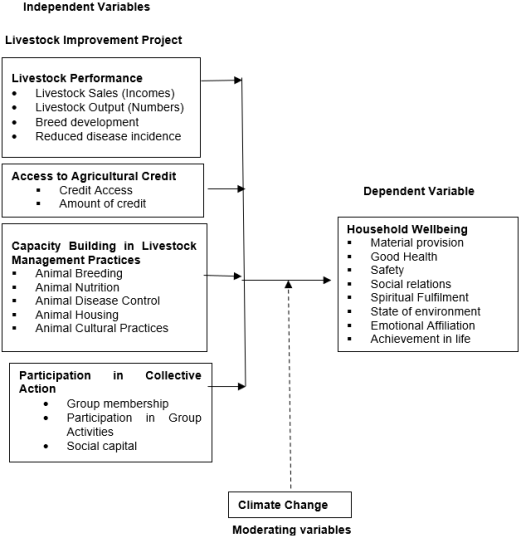
Conceptual framework is a graphical representation of the direct contribution of the independent variable to the dependent variable. The dependent variable for this study was subjective wellbeing of the households participating in livestock improvement project. Four independent variables related to livestock improvement were used, they included: (i) performance of livestock production, (ii) access to agricultural credit, (iii) farmers’ capacity building, (iv) farmers participation in collective action. The direct relationship between the independent variables and dependent variable can be affected by moderating variables, these are factors not included in this relationship but can influence the relationship, these include government policies, climatic factors among others. The variables and their hypothesized relationships are described in Figure 1.
Figure 1. Conceptual framework for analysing the contribution of livestock improvement project on the wellbeing of the households in Machakos County.
3. Materials and Methods
3.1. Research Design
This study employed a descriptive research design, which is appropriate for systematically describing population characteristics and examining relationships among variables without experimental manipulation . The design facilitated the assessment of livestock-related interventions within agro-pastoral households participating in a livestock improvement project.
3.2. Study Area
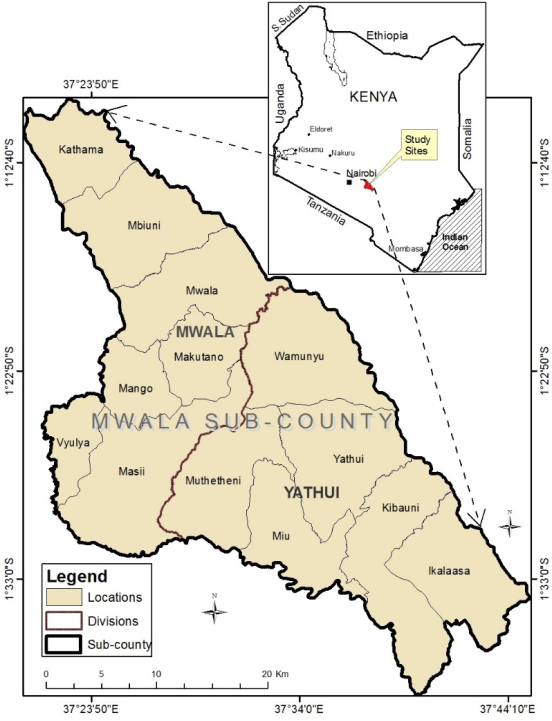
The study was conducted in Mwala Sub-county (Figure 2), one of the eight sub-counties of Machakos County in Kenya’s lower eastern region . The area has experienced rapid population growth, resulting in declining average farm sizes. Small-scale farms average approximately 0.756 ha, while large-scale farms average about 10 ha .
Figure 2. Map of Mwala Sub-County Showing the Study Area and Sub-divisions.
Mwala Sub-county is characterized by a semi-arid climate, with temperatures ranging from 18°C to 29°C and a bimodal rainfall regime. Annual rainfall varies between 500 mm and 1,250 mm, with long rains occurring from March to May and short rains from October to December . The dry season extends from June to September, with June being the driest month. Approximately 84% of Machakos County falls within arid and semi-arid agro-ecological zones, making agricultural production highly vulnerable to climate variability .
3.3. Agricultural Context
Agriculture is the primary economic activity in Machakos County, with livestock production constituting the dominant subsector . The prevailing farming system is agro-pastoralism, which integrates crop cultivation with livestock rearing . Crop and livestock production play a central role in household food security, employment creation, and socio-economic wellbeing in the region .
3.4. Target Population and Sampling Frame
The target population comprised agro-pastoral households located in the arid and semi-arid areas of Mwala Sub- County that engage in small-scale livestock farming alongside crop production. According to the 2019 national census, the sub-county had approximately 163,000 residents living in 35,503 households .
The sampling frame consisted of 1,100 households that had benefited from a livestock improvement project and were registered members of 45 livestock farmer groups. Each group comprised approximately 24 farmers, all of whom identified livestock production as their primary enterprise.
3.5. Sample Size and Sampling Procedure
The required sample size was determined using the formula proposed by Krejcie and Morgan (1970) and cited by Gichohi and Kathuri (2023). Based on the sampling frame of 1,100 households, a sample size of 285 respondents was obtained. The sample was proportionally allocated across the 45 farmer groups (strata), and respondents were selected using simple random sampling to ensure representativeness.
3.6. Data Collection and Analysis
Data were collected using a structured questionnaire administered to sampled households. The instrument captured quantitative information on household characteristics, livestock practices, and participation in the livestock improvement project.
3.6.1. Variable Development and Description
The variables were operationalized as multi-indicator indices. The indicators are shown in the conceptual framework (Figure 2). The household heads rated the indicators on a 10-point scale, where 1 corresponded to the lowest rating and 10 to the highest rating. The scores for each indicator were summed up to create an index . The constructed indices (interval data) were evaluated for their reliability and validity using the Cronbach’s alpha . The indices met their minimum threshold for reliability and validity as they exceeded the recommended threshold of (α = 0.7), indicating a high level of internal consistency.
3.6.2. Descriptive and Inferential Analysis
Data analysis was conducted using descriptive and inferential statistical techniques in IBM SPSS (Version 26). The index descriptive analysis included: means, standard error of the mean, mode, median, standard deviation, mode, t-test, and chi-square. The inferential statistics used included: ANOVA, simple or bivariate linear regression was used to determine the existing relationships between the independent and dependent variables using the Beta statistics.
4. Results
4.1. Demographic Characteristics of the Households Participating in the Livestock Improvement Project
The demographic characteristics of the households participating in the Livestock Improvement Project in Mwala Sub-County are presented (Table 1).
The majority of household heads were male (89.1%) and married (84.9%), while 10.9% were widowed and 4.2% were single (n = 285). The mean age of participants was 45.2 years (SD = 12.0; range: 26-67), with most respondents aged 41-50 years (28.1%). Educational attainment was predominantly secondary (41.1%) or college level (29.1%), with fewer respondents reporting primary or university education. Household size ranged from two to nine members, with four-member households being most common (24.6%).
Table 1. Descriptive Statistics for the Demographic Characteristics of the Project Participants.

Demographic Characteristics

Frequency

Percent

Gender

Male

254

89.1

Female

31

10.9

Marital Status

Married

242

84.9

Widow

31

10.9

Single

12

4.2

Age Categories (yrs.)

20-30

43

15.1

31-40

66

23.2

41-50

80

28.1

51-60

55

19.3

Above 61

41

14.4

Level of Formal Education

Primary 'Lower"

6

2.1

Primary "Upper"

62

21.8

Secondary

117

41.1

College

83

29.1

University Degree

17

6.0

Household Number

2.00

22

7.7

3.00

56

19.6

4.00

70

24.6

5.00

48

16.8

6.00

28

9.8

7.00

29

10.2

8.00

26

9.1

9.00

6

2.1

n=285
4.2. Size of Land Owned by Households
Land ownership among project households is summarized (Table 2).
Table 2. Size of Land Owned by the Households.

Size in Ha. (Acres)

Frequency

Percent

.404 (1.00)

68

23.9

.809 (2.00)

55

19.3

1.21 (3.00)

57

20.0

1.618 (4.00)

29

10.2

2.02 (5.00)

22

7.7

2.42 (6.00)

25

8.8

2.83 (7.00)

19

6.7

3.23 (8.00)

10

3.5

Total

285

100.0

Mean 1.33±.04, Median 1.21, Mode .404, Std. Dev .829, Min .404, Max 3.23
Most households (63.2%) owned land below the mean, indicating generally small landholdings. The most common land size was 0.404 ha (23.9%), while only 3.5% owned 3.23 ha. These findings are consistent with county-level averages (Machakos County Government, 2018).
4.3. Livestock Ownership Characteristics of Study Participants
Table 3 summarizes Livestock ownership patterns among households participating in the Livestock Improvement. Data on animal ownership were obtained through participant self-reports and cross-validated with project records.
Table 3. Descriptive Statistics for the Number of Animals Owned by Households Participating in the Livestock Improvement Project.

Numbers (Categories)

Frequency

Percent

Poultry

1-10

27

9.5

11-20

73

25.6

21-30

69

24.2

31-40

45

15.8

41-50

30

10.5

51-60

26

9.1

Above 61

15

5.3

Sheep

0

85

29.8

1-10

116

40.7

11-20

56

19.6

21-30

28

9.8

Goats

1-10

85

29.8

11-20

101

35.4

21-30

68

23.9

41-50

31

10.9

Cattle

1-10

231

81.1

11-20

28

9.8

21-30

26

9.1

n=285
Poultry and small ruminants constituted the dominant livestock assets among participating households, while cattle ownership was comparatively limited in both prevalence and herd size, underscoring the importance of small livestock in household livelihood strategies.
Poultry ownership was widespread, with most households keeping 11-30 birds (49.8%). Mean flock size was 33 birds (SE = 1.2; SD = 20), with sizes ranging from 10 to 100. Sheep ownership was limited, with 29.8% of the households owning none and most owners keeping 1-10 sheep. The mean sheep flock size was 6.9 (SE = 0.42; SD = 7). Goat ownership was more common, with most households owning 11-30 goats; the mean herd size was 18.3 (SE = 0.66; SD = 11). Cattle ownership was generally low, with 81.1% of the households owning between 1-10 animals and a mean herd size of 8.3 (SE = 0.43; SD = 7.4).
4.4. Subjective Wellbeing of the Households Participating in the Livestock Improvement Project
Subjective wellbeing was the primary outcome variable and was assessed among households participating in the Livestock Improvement Project (LIP) in Mwala Sub-County, Machakos County. Wellbeing was measured using a composite index constructed from self-reported assessments of perceived project-related benefits.
Household heads rated each of the 30 indicators on an 11-point scale (0-10), where higher scores indicated greater perceived assistance attributable to the LIP. Indicator scores were summed to generate a household-level subjective wellbeing index. Descriptive statistics for the domains are reported (Table 4).
Table 4. Descriptive Statistics for the Domains of the Subjective Wellbeing Index of the Households Participating in Livestock Improvement Project.

Domains

Mean

SD

Minimum

Maximum

Standard of Living

7.62

.118

1.0

10

Access to Good Health

7.07

.186

1.50

10

Safety of the Households

7.34

.209

1.00

10

Social relations

7.98

.217

1.00

10

Spiritual Affiliations

6.15

.830

1.00

10

Environment

6.88

.371

4.75

10

Emotions and affiliations

7.93

.581

5.80

10

Life Achievements

6.25

.988

4.18

10

Subjective Wellbeing

7.28

.120

3.78

9.69

Cronbach’s alpha was (α=.899).
The scores for the subjective wellbeing index ranged from 3.78 to 9.69, with a mean of 7.28 (SD = 1.20), a median of 7.25, and a mode of 9.06. Most households (84.9%) reported scores above 6.01, indicating generally high wellbeing. The index was classified into five categories: Very Low (1-2), Low (2.01-4), Medium (4.01-6), High (6.01-8), and Very High (8.01-10) 5 and a chi-square test for equality of categories was undertaken (Table 5).
Table 5. Chi-square Test for the Equality of the Categories for the Subjective Wellbeing Scale of the Households.

Categories

Levels

Observed N

Expected N

Residual

1-2

Very Low

-

-

-

χ2=168.29

2.01-4

Low

1

71.3

-70.2

df=3

4.01-6

Medium

42

71.3

-29.2

p=.001

6.01-8

High

146

71.3

74.8

8.01-10

Very High

96

71.3

24.8

Total

285

Mean 7.28±.07, Median 7.25, Mode 9.06, Std. Dev 1.20, Min 3.78, Max 9.69
Chi-square analysis revealed significant differences among categories (χ2 = 168.29, df = 3, p < 0.001), with the High category (6.01-8) observed significantly more frequently than expected. These results suggest that the majority of participants perceived their household wellbeing to be predominantly within the high range.
Gender Differences in Subjective Wellbeing of the Participating Households
Subjective wellbeing scores were compared between male (n = 254) and female (n = 31) respondents. Mean wellbeing was 7.28 for males and 7.29 for females, with a mean difference of -0.007. An independent-samples t-test indicated that this difference was not statistically significant (t = -0.029, df = 283, p = 0.977), demonstrating that gender was not associated with variation in perceived household wellbeing among the project participants (Table 6).
Table 6. Mean Subjective Wellbeing for Male and Female Respondents.

Gender

n

Mean

Mean difference

t

df

p

Male

254

7.2866

-.00659

-.029

283

.977

Female

31

7.2932

4.5. Contribution of Livestock Performance to the Subjective Wellbeing of Agro-pastoral Households
4.5.1. Livestock Performance Within the Livestock Improvement Project
Livestock performance, defined as project-related improvements in livestock value and productivity, was assessed using an eight-indicator composite index rated by household heads on a five-point scale (1 = very low, 5 = very high). Indicators included animal sales, herd size, herd loss reduction, breed improvement, milk production, multiple births, and herd quality (Table 7).
Table 7. Mean Scores for the Indicators of the Livestock Performance Index.

Livestock Performance Measure

Level of Measure

Mean

SD

1

level of increase in animal sales

2.29

1.00

2

level of increase in herd numbers

2.73

1.01

3

level of decrease in herd loss reduction

2.92

1.24

4

level of breed improvement (grade animal)

3.48

1.27

5

level of increase in milk production

3.51

1.07

6

level of increase in animal numbers

3.49

1.22

7

level of increase in multiple births

2.46

1.06

8

Level of increase in herd quality

2.63

1.29

Index of livestock performance measures

2.94

.822

Mean 2.94±.06, Median 3, Mode 2, Std. Dev .822, Minimum 1 Maximum 5
The overall livestock performance index mean of 2.94 (SD = 0.82; Cronbach’s α = 0.789).
4.5.2. Contribution of Livestock Performance to Household Subjective Wellbeing
The effect of livestock performance on household subjective wellbeing was examined using simple linear regression. Livestock performance was the independent variable, and subjective wellbeing was the dependent variable.
The results (Table 8) showed a significant positive relationship (β = 0.944, t = 48.03, p < 0.001), with the model explaining 89% of the variance in wellbeing (R2 = 0.89; F(1, 284) = 2306.8, p < 0.001). These findings indicate that higher livestock performance was strongly associated with increased subjective wellbeing among households participating in the Livestock Improvement Project, underscoring the contribution of livestock productivity improvements to household socioeconomic outcomes.
Table 8. Regression Coefficients for Livestock Performance and the Subjective Wellbeing of the Households.

Unstandardized Coefficients

Standardized Coefficients

t

p

B

Std. Error

Beta

(Constant)

4.353

.066

66.437

.001

Performance measure

1.030

.021

.944

48.030

.001

(F (1, 284) = 2306.8, p<.001).
R square 89%
4.6. Contribution of Access to Agricultural Credit to the Subjective Wellbeing of Agro-Pastoral Households
4.6.1. Access to Agricultural Credit by Households Participating in the Livestock Improvement Project
Access to agricultural credit, the independent variable in this study, was defined as the positive contribution of credit access to livestock production among households participating in the Livestock Improvement Project (LIP). The variable was operationalized as a composite index comprising six indicators (Table 9).
Table 9. Mean Scores for the Indicators of the Access to Agricultural Credit Index.

No

Access to Agricultural Credit

Assessed Level

Mean

SD

1

Amount of credit acquired from LIP (category)

3.31

.789

2

Enhanced purchase of breeding animals

2.63

1.30

3

Enhanced water development and access for animals

2.77

.666

4

Enhanced acquisition of animal inputs (feed, pasture)

2.54

.987

5

Enhanced disease control (vaccines, drugs)

3.12

1.22

6

Building for animal and hay barn

2.11

.890

Index of Access to Agricultural Credit contribution

2.70

1.09

Mean 2.70±.06, Median 3, Mode 2, Std. Dev. 1.09, Minimum 1, Maximum 5
4.6.2. Contribution of Access to Agricultural Credit to Household Subjective Wellbeing
The effect of access to agricultural credit on household subjective wellbeing was assessed using simple linear regression. Access to credit served as the independent variable, and subjective wellbeing as the dependent variable.
The results (Table 10) indicated a significant positive relationship (β = 0.748, t = 18.94, p < 0.001), with the model explaining 55.7% of the variance in wellbeing (R2 = 0.557; F(1, 284) = 358.5, p < 0.001). These findings demonstrate that higher access to agricultural credit is positively associated with improved subjective wellbeing among agro-pastoral households participating in the Livestock Improvement Project.
Table 10. Regression Coefficients for Access to Agricultural Credit and the Subjective Wellbeing of the Households.

Unstandardized Coefficients

Standardized Coefficients

t

p

B

Std. Error

Beta

(Constant)

5.059

.127

39.861

.001

Credit

.823

.043

.748

18.935

.001

(F (1, 284) = 358.5, p<.001).
R2 value of .557
4.7. Contribution of Capacity Building to the Subjective Wellbeing of Agro-pastoral Households
The fourth objective of this study looked at the relationship between capacity building (independent variable) and subjective wellbeing (dependent variable) of the agro-pastoralists involved in the livestock improvement project.
4.7.1. Capacity Building Among Project Households
Capacity building was assessed as a composite index reflecting project-related improvements in livestock management knowledge and skills across nine indicators (Table 11). Household heads rated each indicator on a five-point scale (1 = very low, 5 = very high).
Table 11. Mean Scores for the Indicators of Capacity Building Index.

Level of Capacity Building

Mean

SD

1

Feeds and Feeding (types, supplements, minerals, mixing)

3.11

.765

2

Pasture Management (rotation, fodder conservation)

2.01

.664

3

Animal Breeding (selection, mating system,

3.80

.764

4

Disease Control (vaccines, deworm, tick control)

2.21

.741

5

Marketing of Animals

2.85

.804

6

Animal Housing and Facilities (types, safety)

2.08

.769

7

Dairy Management (milking, feeding, selection)

2.70

.695

8

Husbandry Practices (raring young, foot care,

2.38

.201

9

Records and Planning

3.22.

.

Index of Capacity Building

2.76

1.16

Mean 2.76±.06, Median 3, Mode 2, Std. Dev 1.16, Minimum 1, Maximum 5
The overall capacity-building index had a mean of 2.76 (SD = 1.16). Internal consistency was acceptable (Cronbach’s α = 0.755).
4.7.2. Contribution of Capacity Building to Subjective Wellbeing of the Households
The relationship between capacity building and household subjective wellbeing was assessed using simple linear regression (Table 12).
Capacity building was a significant positive predictor of wellbeing (β = 0.878, t = 30.82, p < 0.001), explaining 77.0% of the variance in subjective wellbeing (R2 = 0.770; F(1, 284) = 949.79, p < 0.001). These results indicate that enhanced capacity building was strongly associated with improved subjective wellbeing among agro-pastoral households participating in the Livestock Improvement Project.
Table 12. Regression Coefficients for Capacity Building and the Subjective Wellbeing of the Households.

Unstandardized Coefficients

Standardized Coefficients

t

p

B

Std. Error

Beta

(Constant)

4.770

.089

53.863

.001

Capacity Building

.909

.029

.878

30.819

.001

(F (1, 284) = 949.79, p<.001).
R2 value of .770;
4.8. Contribution of Famer Collective Action on the Subjective Wellbeing of the Households
4.8.1. Collective Action Among Project Households
Collective action was assessed as a composite index capturing household participation in eleven group-based activities related to the Livestock Improvement Project (Table 13). Household heads rated the contribution of each activity to household wellbeing on a five-point scale (1 = very low; 5 = very high). Descriptive statistics for the composite index are presented (Table 13).
Table 13. Mean Scores for the Indicators of Collective Action Index.

Collective action activities involved in

Level of Participation

Mean

SD

1

Conservation of fodder

3.61

.800

2

Disease control

2.97

.674

3

Marketing of animals

2.01

.777

4

Animal feeding

2.88

.333

5

Water development

2.14

.281

6

Breeding Management

2.66

.896

7

Exchange of breeding animals

3.01

.934

8

Meetings /Training

2.55

.567

9

Buildings/housing of animals

2.79

.373

10

Payment of group dues

2.79

.489

11

Marketing of Milk

2.01

.381

Collective Action Index

2.95

1.01

Mean 2.95±.06, Median 3, Mode 2, Std. Dev. 1.01, Minimum 1, Maximum 5
The overall collective action index had a mean of 2.95 (SD = 1.01), indicating moderate engagement. Internal consistency of the index was acceptable, as indicated by Cronbach’s alpha (.887).
4.8.2. Contribution of Collective Action to the Subjective Wellbeing of the Households Involved in Livestock Improvement Project
The relationship between collective action and household subjective wellbeing was assessed using bivariate linear regression (Table 14).
Table 14. Regression Coefficients for Collective Action and the Subjective Wellbeing of the Households.

Unstandardized Coefficients

Standardized Coefficients

t

p

B

Std. Error

Beta

(Constant)

4.359

.122

35.837

.001

Collective action

.991

.039

.834

25.444

.001

(F (1, 284) = 647.37, p<.001).
R2 value of .695;
Collective action was a significant positive predictor of wellbeing (β = 0.834, t = 25.44, p < 0.001), explaining 69.5% of the variance in subjective wellbeing (R2 = 0.695; F(1, 284) = 647.37, p < 0.001). These results demonstrate that increased participation in collective action activities was strongly associated with improved subjective wellbeing among households involved in the Livestock Improvement Project.
5. Discussion
5.1. Subjective Wellbeing of Agro-pastoral Households Participating in Livestock Improvement Project
This study found that agro-pastoral households participating in the Livestock Improvement Project (LIP) in Mwala Sub-County reported relatively high levels of subjective wellbeing across multiple dimensions. This aligns with multidimensional frameworks of wellbeing, which conceptualize wellbeing as encompassing material living standards, health, safety, social relations, psychological functioning, and environmental control rather than income alone . High wellbeing among participants suggests that the project generated benefits extending beyond livestock productivity to broader livelihood and psychosocial outcomes.
Disease control interventions implemented under the LIP likely contributed substantially to improved wellbeing. Reduced livestock mortality and morbidity enhance income stability and food availability while lowering uncertainty and stress associated with production risks. Similar evidence from Ghana demonstrates that disease-induced livestock losses negatively affect farmers’ physical and psychological wellbeing, with improved veterinary services identified as a critical pathway for enhancing wellbeing and food security among livestock-dependent households . These findings reinforce the role of animal health interventions as both economic and wellbeing-enhancing mechanisms.
The institutional and policy context within which livestock improvement initiatives operate also influences farmer wellbeing. Supportive agricultural policies can strengthen resilience and productivity, while poorly aligned regulations may impose administrative and psychological burdens. Evidence from Kenya’s agricultural policy reforms highlights that subsidy management and financing frameworks must balance productivity goals with farmer welfare to avoid unintended stress and exclusion .
Technology adoption promoted through livestock development projects further contributes to enhanced wellbeing by increasing productivity, income, and food security. Empirical research in Kenya shows that farmers who adopt agricultural innovations, including ICT-based tools, report higher subjective wellbeing, largely mediated by improvements in income and reduced production risks . These findings are consistent with the observed wellbeing outcomes among LIP participants, suggesting that technology-enabled productivity gains translate into improved life satisfaction.
Farm-level conditions, including access to advisory services, community engagement, and working environments, play a critical role in shaping farmers’ wellbeing. Supportive extension services, social capital, and favorable working conditions have been shown to enhance job satisfaction and emotional wellbeing among farming households . Collectively, the findings indicate that livestock improvement projects are most effective in enhancing subjective wellbeing when they integrate technical, institutional, and social support components.
5.2. Contribution of Livestock Performance to Subjective Wellbeing of Agro-Pastoral Households
This study found a statistically significant and positive relationship between livestock performance and the subjective wellbeing of agro-pastoral households participating in the Livestock Improvement Project in Mwala Sub-County. Improved livestock performance, reflected in higher productivity, improved herd quality, and reduced losses, appears to enhance wellbeing by strengthening household income, food security, and psychosocial stability.
Livestock constitute a central livelihood asset for agro-pastoral households, providing income, food, and a buffer against economic shocks. Improved performance increases marketable surplus and asset values, which contributes to greater financial security and reduced vulnerability . In sub-Saharan Africa, livestock production remains a major contributor to agricultural value added and rural livelihoods . Recent analyses of Kenya’s livestock sector highlight its contribution of approximately 42% to agricultural GDP and 12% to national GDP, underscoring its importance for household welfare and national development . Similarly, value chain studies emphasize that livestock production remains a cornerstone of rural livelihoods, particularly in pastoral and agro-pastoral systems .
Income derived from livestock sales is commonly allocated to essential needs such as food, education, and healthcare, which are closely linked to subjective wellbeing. Beyond economic effects, livestock ownership and improved performance also enhance social status and perceived security, contributing positively to psychological wellbeing and life satisfaction . Evidence from sub-Saharan Africa suggests that livestock production contributes significantly to household resilience and multidimensional wellbeing, with benefits extending beyond productivity gains alone .
Collectively, these findings suggest that livestock improvement interventions generate multidimensional wellbeing benefits that encompass economic, social, and psychological domains. By enhancing livestock performance, projects such as the LIP not only improve household income and food security but also strengthen psychosocial stability and social capital, thereby contributing to sustainable wellbeing outcomes in agro-pastoral communities.
5.3. Contribution of Access to Agricultural Credit to Subjective Wellbeing of the Households
This study demonstrates that access to agricultural credit contributes positively and significantly to the subjective wellbeing of agro-pastoral households participating in the Livestock Improvement Project in Mwala Sub-County. Enhanced access to credit strengthens households’ ability to invest in livestock production, thereby improving livelihood security and perceived quality of life.
Livestock improvement initiatives typically require both technical and non-technical investments, including improved breeds, animal health services, feed, housing, and water infrastructure. Financial constraints often limit smallholder participation in such interventions, particularly in agro-pastoral systems . Access to agricultural credit reduces these constraints by enabling households to adopt productivity-enhancing practices and manage production risks more effectively.
Empirical evidence supports the role of credit in facilitating the adoption of improved livestock management practices. Ogali et al. found that access to credit significantly increased adoption of improved indigenous poultry management in Kenya, resulting in higher productivity and income. These outcomes are closely associated with improved subjective wellbeing through enhanced food security, income stability, and reduced financial stress.
More broadly, livestock development in sub-Saharan Africa remains constrained by underinvestment despite its central role in rural livelihoods. Institutional arrangements such as agricultural cooperatives and credit associations improve household wellbeing by expanding access to finance, supporting entrepreneurship, and strengthening social and economic resilience . Collectively, these mechanisms underscore the importance of inclusive financial services in enhancing both material and psychosocial dimensions of wellbeing among agro-pastoral households.
5.4. Contribution of Capacity Building to Subjective Wellbeing of the Households
This study demonstrates that capacity building has a significant and positive influence on the subjective wellbeing of agro-pastoral households participating in the Livestock Improvement Project in Mwala Sub-County. Capacity-building interventions facilitated the transfer of livestock management knowledge, skills, and technologies, enabling households to improve animal performance and productivity. These gains are closely associated with enhanced household income, food security, and reduced production-related risks, all of which contribute to higher levels of subjective wellbeing.
Capacity building strengthens human capital, a critical factor in sustainable livestock development and rural livelihoods. Training in animal health, feeding, breeding, and farm management improves farmers’ technical competence and decision-making capacity, thereby increasing productivity and fostering psychological wellbeing through greater confidence and reduced stress. Such outcomes extend beyond economic benefits to include improved life satisfaction and social stability among participating households.
Evidence from sub-Saharan Africa supports these findings. Ogali et al. reported that training in improved indigenous poultry management significantly increased productivity and livelihood outcomes among Kenyan smallholder farmers. Similarly, Coppock et al. found that participatory capacity-building approaches among pastoral communities in Ethiopia improved livestock productivity and household wellbeing. More recently, Sow et al. demonstrated that training livestock champions in animal health, nutrition, and genetics in Mali enhanced small ruminant productivity and strengthened community resilience. Similarly, participatory training approaches have been shown to improve both technical outcomes and psychosocial wellbeing by empowering farmers with knowledge and collective problem-solving skills .
Overall, the results highlight the importance of integrating capacity-building components into livestock improvement programs to achieve sustained productivity gains and improvements in both the economic and psychosocial dimensions of household wellbeing.
5.5. Contribution of Collective Action to Subjective Wellbeing of the Households
This study found that collective action significantly and positively influenced the subjective wellbeing of the households participating in the livestock improvement project in Mwala Sub-County. Participation in group-based livestock management activities enhanced both economic outcomes and social cohesion, thereby improving household wellbeing. These findings align with evidence that collective action initiatives among smallholders improve income stability, social capital, and overall wellbeing .
In Kenya, collective engagement in livestock-related activities—such as milk marketing, breeding, access to agricultural information, and water development—has been shown to improve household economic performance and livelihood security . Cooperative participation further strengthens entrepreneurship, access to financial services, and social standing, which are key contributors to wellbeing . Beyond economic gains, collective action enhances social relationships and community participation, which are strongly associated with higher subjective wellbeing .
The extent of farmer participation in collective action influences the magnitude of benefits realized. Higher engagement levels are associated with improved group performance, greater individual returns, and better living conditions . Participatory self-help groups, particularly among resource-poor households and women, have emerged as effective mechanisms for empowerment and human development .
Collective action also plays a critical role in improving livestock management and resource sustainability. Empirical evidence from pastoral groups in Ethiopia and northern Kenya shows that collective governance of grazing resources improved livestock productivity, risk management, and household wellbeing . Furthermore, participation in farmer groups enhances access to markets, credit, training, and improved technologies, strengthening household resilience and wellbeing .
Overall, these findings underscore the importance of integrating collective action mechanisms into livestock improvement programs to achieve sustained productivity gains and improvements in both the economic and psychosocial dimensions of household wellbeing.
6. Conclusion
This study demonstrates the usefulness of subjective wellbeing (SWB) as an indicator for assessing the social and sustainability impacts of livestock improvement projects in arid and semi-arid lands (ASALs). Evidence from agro-pastoral households in Mwala Sub-County indicates that the Livestock Improvement Project (LIP) significantly enhanced household wellbeing. Livestock performance, access to agricultural credit, capacity building, and participation in collective action all exerted positive and statistically significant effects on subjective wellbeing.
The results highlight the importance of integrated livestock development approaches that extend beyond productivity gains. Access to credit enables investment in livestock inputs, capacity building strengthens technical and managerial skills, and collective action improves market access, reduces transaction costs, and enhances social capital. Together, these elements contribute to more sustainable livelihood outcomes.
From a sustainability perspective, livestock interventions in ASALs should prioritize financial inclusion, farmer training, and group-based participation to enhance resilience and long-term wellbeing. Methodologically, the study contributes to the literature by validating subjective wellbeing as a complementary metric for evaluating livestock development interventions.
Abbreviations

ASALs

Arid and Semi-Arid Lands

ASDSP

Agricultural Sector Development Support Programme

CA

Collective Action

CAI

Collective Action Initiatives

FAO

Food and Agriculture Organization

FFS

Farmer Field Schools

IBM

International Business Machines

ILRI

International Livestock Research Institute

IFAD

International Fund for Agricultural Development

K-SALES

Kenya Semi-Arid Livestock Enhancement Support project

LIP

Livestock Improvement Project

OECD

Organization for Economic Co-operation and Development,

SIDA

Swedish International Development Cooperation Agency

SPSS

Statistical Package for the Social Sciences

SWB

Subjective Well-being

USAID

United States Agency for International Development

Author Contributions
Caroline Nzisa Ndunda: Conceptualization, Data curation, Formal Analysis, Investigation, Project administration, Writing – original draft
Elizabeth Mumbi Ndunda: Funding acquisition, Methodology, Resources, Writing – review & editing
Stephen Wanyonyi Luketero: Supervision, Writing – review & editing
Mark Ndunda Mutinda: Software, Supervision, Visualization, Validation, Writing – review & editing
Conflicts of Interest
The authors declare no conflicts of interest.
References
[1] Food and Agriculture Organization [FAO]. Agro-ecological zoning guidelines. Rome; FAO. 1996.
[2] Akuja, T. E., Kandagor, J. J. Climate smart agriculture in Kenya’s ASALs: Gaps and barriers in policy development and implementation. African Journal of Climate Change and Resource Sustainability. 2024; 3(1). 3034.
[3] Kew, S. F., Philip. S. Y., Hauser, M., Hobbins, M., Wanders, N., van Oldenborgh, G. J., van der Wiel, K., Veldkamp, T. I. E., Kimutai, J., Funk, C., Otto. F. E. L. Impact of precipitation and increasing temperatures on drought trends in eastern Africa. Earth Syst. Dynam. 2021; 12: 17-35,
[4] Kim, M., Sung, K. Impacts of climate change variability on livestock health in arid and semi-arid lands. Journal of Climate and Animal Health. 2021; 12(3), 45-59.
[5] Mohamed, A. Adaptive strategies to climate change in ASAL pastoral communities of Northern Kenya. Global Scientific Journal. 2025; 13(2): 1-21.
[6] Nicholson, S. E. Climate and climatic variability of rainfall over eastern Africa, Review of Geophysics. 2017; 55: 590-635.
[7] Schilling, J., Werland, L. Facing old and new risks in arid environments: The case of pastoral communities in Northern Kenya. PLOS. 2023; Clim 2(7): e0000251.
[8] Kimutai, J., New, M., Wolski, P., Otto, F. Attribution of the human influence on heavy rainfall associated with flooding events during the 2012, 2016, and 2018 March-April-May seasons in Kenya. Weather and Climate Extremes. 2022; 38: 100529.
[9] Nyamai, D. M. K., Amwata, D. A., Kilungo, J. K. Impacts of climate variability and change on integrated crop-livestock farming systems in Machakos County, Kenya. Journal of Biodiversity and Environmental Sciences. 2024; 25(1), 128-142. International Network for Natural Sciences.
[10] Uhe, P., Philip, S., Kew, S., Shah, K., Kimutai, J., Mwangi, E., van Oldenborgh, G. J., Singh, R., Arrighi, J., Jjemba, E., Cullen, H. and Otto, F. Attributing drivers of the 2016 Kenyan drought. Int. J. Climatol. 2018; 38: e554-e568.
[11] Republic of Kenya [ROK]. Sessional Paper No 3 of 2020 on The Livestock Policy. Ministry of Agriculture, Livestock, Fisheries, and Cooperative development. Nairobi: Government Printer: 2020.
[12] Amwata, D. A. Situational analysis study for the agriculture sector in Kenya. CCAFS Report. Wageningen, the Netherlands: CGIAR Research Program on Climate Change, Agriculture and Food Security. (CCAFS). 2020.
[13] Thornton, P. K. Livestock production: recent trends, future prospects. Philosophical Transactions of the Royal Society B: Biological Sciences. 2010; 365 (1554), 2853-2867.
[14] World Food Programme [WFP]. Pastoral and agropastoral production systems in the arid and semi-arid areas: Field practitioners guide. Nairobi: WFP. 2018. kilimo.go.ke
[15] Ali, A. G., Paul, S. N., Musembi, A. K., Misuko, N. W. Project Strategic Alignment and Performance of Livestock Value Chain Projects in Northern Frontier Counties of Kenya. Scientia. Technology, Science and Society. 2026; 3(1): 65-76.
[16] Government of Kenya [GoK]. Agricultural Sector Development Support Programme (ASDSP) Volume 1 Household Baseline Survey Report. Machakos County. Ministry of Agriculture, Livestock and Fisheries Hill Plaza, 6th Floor, P. O. Box 30028-00100 Nairobi. 2014.
[17] Bahta, S., Wanyoike, F., Kirui, L., Mensah, C., Enahoro, D. Livestock sector transformation in Kenya: Current state and projections for the future. CGIAR. 2019. CGSpace.
[18] OECD. “Subjective well-being measurement: Current practice and new frontiers”, OECD Papers on Well-being and Inequalities, No. 17. Paris: OECD Publishing; 2023.
[19] OECD. OECD Guidelines on Measuring Subjective Well-being, Paris: OECD Publishing; 2013.
[20] Mahoney, J. Measuring subjective wellbeing: Advances in survey methodology. Social Indicators Research. 2023; 167(2), 451-470.
[21] Stone, A. A., Krueger, A. B. Understanding subjective wellbeing. Science. 2018; 359(6370). 34-35.
[22] Ngigi, M. W., Mueller, U., Birner, R. Livestock diversification for improved resilience and welfare outcomes under climate risks in Kenya. European Journal of Development Research. 2021; 33(6), 1625-1648.
[23] Haushofer, J., Reisinger, J., Shapiro, J. Subjective wellbeing effects of unconditional cash transfers in Kenya. World Development. 2020; 129, 104929.
[24] Gao, S., Zhou, P., Zhang, H., Yang, S. Evaluating socio-economic and subjective well-being impacts of coal power phaseout in China. Nature Communications. 2025; 16: (1): 2025.
[25] EUROSTAT. "Analytical report on subjective wellbeing", Eurostat Statistical Working Papers. 2016.
[26] Meinzen-Dick, D., DiGregorio, M., McCarthy, N. Methods for studying collective action in rural development, Agricultural Systems. 2004; 82 (3): 197-214.
[27] Lupi, C., Giannoccaro, G., Roselli, L. Collective action and smallholder wellbeing: Evidence from farmer cooperatives. Agriculture. 2021; 11(6): 512.
[28] Bosc, P. Empowering through collective action. IFAD: 29 IFAD research series. 2018.
[29] Missiame, M., Kuwornu, J. K. M., Osei-Asare, Y. B. Farmer-based organizations and livestock productivity in Ghana: Gendered perspectives. Journal of Rural Studies. 2023; 97, 45-56.
[30] Maindi, C. N., Nyarindo, W. N., Ndirangu, S. N., Isaboke, H. N. Collective action typologies and their implications for policy targeting: The case of smallholder households from the central region of Kenya. Journal of Agriculture and Food Research. 2024; 18: 101288.
[31] Gebremedhin, B., Pender, J., Tesfay, G. Collective action for grazing land management in crop-livestock mixed systems in the highlands of northern Ethiopia. Agricultural Systems. 2004; 82 (3): 273-290.
[32] Call, M., Jagger, P. Social capital, collective action, and communal grazing lands in Uganda. International Journal of the Commons. 2017; 11(2): 854-876.
[33] Ochieng, J., Owuor, G., Bebe, B. O. Collective marketing and performance of smallholder livestock farmers in Kenya. Agricultural and Food Economics. 2023; 11(1): 12.
[34] Missiame, A., Akrong, R., Appiah-Kubi, G. D. Collective action and farm efficiency of male- and female-headed farm households in Ghana. Cogent Social Sciences. 2023; 9(2): 1-15.
[35] Muchemi, J., Ngugi, J. Cooperative participation and household resilience in Kenyan livestock systems. African Journal of Agricultural and Resource Economics. 2024; 19(2): 145-160.
[36] Schaffhauser-Linzatti, M., Balk, B. Agricultural cooperatives and credit associations: Enhancing resilience and wellbeing in rural communities. Sustainability. 2021; 13(14): 7812.
[37] Jabbar, M. A., Tessema, Y., Nigussie, H. Collective action and climate change adaptation among smallholder farmers in Ethiopia. Climate and Development. 2023; 15(6): 543-556.
[38] Bariya, M. K., Meena, B. S., Singh, R. Self-help groups as instruments of human development and women empowerment in rural areas. Journal of Rural Development. 2023; 42(1): 45-60.
[39] Coppock, D. L., Desta, S., Tezera, S. Collective action and pastoral risk management in Ethiopia: Implications for resilience and wellbeing. Pastoralism. 2022; 12(1): 18.
[40] Ouma, E., Rao, E., Abdulai, A. Farmer groups, collective action, and agricultural productivity in sub-Saharan Africa. Food Policy. 2019; 83: 48-61.
[41] ILRI. Farmer field school in Sub Saharan Africa. Kenya: ILRI. 2010.
[42] Food and Agriculture Organization. (FAO). Farmer Field Schools: Guidelines for livestock-focused training in East Africa. Rome: FAO. 2023.
[43] International Livestock Research Institute [ILRI]. MoreMilk and MaziwaPlus project summaries. Kenya, Nairobi: ILRI. 2025.
[44] Food and Agricultural Organization [FAO]. Land use statistics and indicators 2000-2021. Global, regional and country trends. FAOSTAT Analytical Briefs Series No. 71. Rome: FAO. 2023.
[45] United States Agency for International Development [USAID]. Land O’Lakes K-SALES project final report. USAID. 2022.
[46] Kahiu, I. G. The impact of Farmer Field School on livestock production: The case of Land O’Lakes/USDA K-SALES project in Machakos County [Master’s thesis, United States International University Africa]. 2016.
[47] Agricultural Sector Development Support Programme (ASDSP). ASDSP II overview and implementation strategy. Ministry of Agriculture, Livestock, Fisheries and Cooperatives. 2025.
[48] Government of Kenya [GOK]. Kenya livestock improvement strategy. Nairobi: Ministry of Agriculture. 2014.
[49] Ministry of Agriculture & Livestock Development [MALD]. Kenya National Livestock Research Agenda 2025-2035. Government of Kenya. 2025.
[50] Gichohi, P., Kathuri, N. J. Introduction to Educational Research. A practical guide. Nairobi: Episilon Publishers. 2025.
[51] Cronbach, L. J., Shavelson, R. J. My Current Thoughts on Coefficient Alpha and Successor Procedures. Educational and Psychometric Measurements. 2004; 64 (3) 391-418.
[52] Republic of Kenya [ROK]. Machakos County Integrated Development Plan II-2018-2022. 2018.
[53] Republic of Kenya [ROK]. Agricultural Sector Transformation and Growth Strategy, 2019-2029, Ministry of Agriculture, Livestock, Fisheries and Irrigation, Nairobi. 2019.
[54] Kenya National Bureau of Statistics [KNBS]. The Kenya Population and Housing Census, vol. IV, Distribution of Population distribution by Socio-Economic Characteristics. 2019.
[55] Kavoi, M. M., Hoag, D. L., Pritchett, J. Measurement of economic efficiency for smallholder dairy cattle in the marginal zones of Kenya. Journal of Development and Agricultural Economics. 2010; 2(4): 122-137.
[56] Krejcie, R. V., Morgan, D. W. Determining sample size for research activities. Educational and Psychological Measurement. 1970; 30(3): 607-610.
[57] Babbie, E. R. The practice of social research. 15th Edition. Cengage. 2020.
[58] Isaac, D. M., Amwata, D. A., & Kilungo, J. K. (2024). Multidimensional wellbeing in agro-pastoral households of Machakos County, Kenya. African Journal of Sustainability Science. 2024; 6(2), 112-128.
[59] McGillivray, M. Human well-being: issues, concepts and measures. In Human well-being: concept and measurement. Edited by: McGillivray M. Basingstoke: Palgrave Macmillan; 2007: 1-23.
[60] Nuvey, F. S., Aikins, M., Anto, F. Livestock disease burden and farmer wellbeing in Ghana: Implications for veterinary service delivery. Frontiers in Veterinary Science. 2023; 10: 112-124.
[61] AGRA. Building resilience of smallholder farmers by strengthening market systems and enabling policy environment in Kenya. Alliance for a Green Revolution in Africa. 2023.
[62] Manzi, H., Gweyi-Onyango, J. P. Agro-ecological Lower Midland Zones IV and V in Kenya Using GIS and Remote Sensing for Climate-Smart Crop Management. In: Oguge, N., Ayal, D., Adeleke, L., da Silva, I. (eds) African Handbook of Climate Change Adaptation. Springer, Cham. 2021.
[63] Whitaker, S. H. The impact of government policies and regulations on the subjective well-being of farmers in two rural mountain areas of Italy. Agriculture and Human Values.2024; 41: 1791-1809.
[64] Awuor, F. M., Rambim, D. A. Adoption of ICT-in-agriculture innovations by smallholder farmers in Kenya. Technology and Investment. 2022; 13(3): 92-103.
[65] Liu, Y., Chen, M., Yu, J., Wang, X. Being a happy farmer: Technology adoption and subjective well-being. Journal of Economic Behavior & Organization. 2024; 221: 385-405,
[66] Nyairo, N. M., Pfeiffer, L., Spaulding, A., Russell, M. Farmers’ attitudes and perceptions of adoption of agricultural innovations in Kenya: A mixed methods analysis. Journal of Agriculture and Rural Development in the Tropics and Subtropics. 2022; 123(1): 147-160.
[67] Herrera Sabillón, J., Amwata, D. A., Kilungo, J. K. Social capital and wellbeing among farming households in semi-arid Kenya. Journal of Rural Studies. 2022; 95: 45-56.
[68] Herrero, M., Grace, D., Njuki, J., Johnson, N., Enahoro, D., Silvestri, S., Rufino, M. C. The roles of livestock in developing countries. Animal. 2013; 7(1): 3-18.
[69] Ehui, S., Benin, S., Williams, T., Meijer, S. Food security in sub-Saharan Africa to 2020. Socio-economics and Policy Research Working Paper 49. ILRI (International Livestock Research Institute), Nairobi, Kenya. 60 Pp. 2002.
[70] Ministry of Agriculture & Livestock Development. Policy framework for sustainable financing and subsidy management in agriculture. Nairobi: Government of Kenya. 2025.
[71] FAO. The future of livestock in Kenya. Opportunities and challenges in the face of uncertainty. Rome: FAO. 56 pp. 2019.
[72] Mihindo, N., Juster, K., Maina, A., Manduna, C., Hansen-Kuhn, K. Kenya livestock sector: Value chain analysis, trade impacts and recent trends. Institute for Agriculture and Trade Policy (IATP) & Biodiversity and Biosafety Association of Kenya (BIBA-K).2025.
[73] Abay, K. A., Jensen, N. D. Does livestock ownership affect household food security and nutrition? Evidence from sub-Saharan Africa. Food Policy. 2020; 95: 101-113.
[74] Collishaw, A., Janzen, S., Mullally, C., Camilli, H. A review of livestock development interventions’ impacts on household welfare in low- and middle-income countries. Global Food Security. 2023; 38: 100704.
[75] Mengesha Erdaw, M. Contribution, prospects and trends of livestock production in sub-Saharan Africa: A review. International Journal of Agricultural Sustainability. 2023; 21(1): 2247776.
[76] Balehegn, M., Duncan, A. J., Tadesse, T. Financing sustainable livestock systems in Africa: Opportunities and challenges. Frontiers in Sustainable Food Systems. 2021; 5: 678901.
[77] Ogali, C., Bett, H., Ochieng, J., Ouma, E. Determinants of adoption of improved indigenous poultry management practices in Kenya. Tropical Animal Health and Production. 2022; 54(5): 304.
[78] Coppock, D. L., Desta, S., Tezera, S., Gebru, G. Capacity building helps pastoral women transform impoverished communities in Ethiopia. Science. 2011; 334(6061): 1394-1398.
[79] Sow, A., Traoré, A., Diallo, M., & Coulibaly, M. Building livestock champions: Capacity development for small ruminant productivity in Mali. Sustainability. 2024; 16(2): 1125.
[80] Lupi, F., Bonaiuti, M., Del Giudice, T. Collective action initiatives and smallholder wellbeing: Evidence from agri-food systems. Journal of Rural Studies. 2021; 82: 188-198.
[81] Kariuki, G., Place, F. Initiatives for rural development through collective action: The case of household participation in group activities in Kenya. CAPRi Working Paper No. 43. IFPRI. 2006.
[82] Muchemi, M. K., Ngugi, K. Stakeholder participation and project performance in community development projects in Kenya. International Journal of Project Management. 2024; 42(1): 102-114.
[83] Lamu, A. N., Olsen, J. A. The role of social relations in subjective wellbeing. Social Indicators Research. 2016; 128: 135-159.
[84] Shivanand, S., Sunanda, T. Social participation and subjective wellbeing: Evidence from rural households. Journal of Happiness Studies. 2022; 23: 2891-2910.
[85] Fischer, E., Qaim, M. Smallholder farmers and collective action: What determines the intensity of participation? World Development. 2014; 64: 804-818.
[86] Ramotra, K. C., Divate, S. B. Collective action and improvement in living standards of farmers. Indian Journal of Agricultural Economics. 2018; 73(3): 389-402.
[87] Bariya, R., Patel, M., & Parmar, V. Role of self-help groups in women empowerment and rural development: Evidence from India. Sustainability. 2023; 15(12): 9876.
[88] Coppock, D. L., Desta, S. Collective action, pastoral risk management, and human wellbeing in northern Kenya. Ecology and Society. 2013; 18(3): 1-15.
[89] Ouma, E., Abdulai, A. Contributions of social capital to technology adoption in smallholder livestock systems. Agricultural Economics. 2009; 40(3): 335-344.
Cite This Article
  • APA Style

    Ndunda, C. N., Ndunda, E. M., Luketero, S. W., Mutinda, M. N. (2026). Impacts of Livestock Improvement Projects on the Subjective Well-Being of Agro-Pastoral Households in Kenya's Lower Eastern Arid and Semi-Arid Lands. International Journal of Natural Resource Ecology and Management, 11(3), 123-142. https://doi.org/10.11648/j.ijnrem.20261103.13

    Copy | Download

    ACS Style

    Ndunda, C. N.; Ndunda, E. M.; Luketero, S. W.; Mutinda, M. N. Impacts of Livestock Improvement Projects on the Subjective Well-Being of Agro-Pastoral Households in Kenya's Lower Eastern Arid and Semi-Arid Lands. Int. J. Nat. Resour. Ecol. Manag. 2026, 11(3), 123-142. doi: 10.11648/j.ijnrem.20261103.13

    Copy | Download

    AMA Style

    Ndunda CN, Ndunda EM, Luketero SW, Mutinda MN. Impacts of Livestock Improvement Projects on the Subjective Well-Being of Agro-Pastoral Households in Kenya's Lower Eastern Arid and Semi-Arid Lands. Int J Nat Resour Ecol Manag. 2026;11(3):123-142. doi: 10.11648/j.ijnrem.20261103.13

    Copy | Download

  • @article{10.11648/j.ijnrem.20261103.13,
      author = {Caroline Nzisa Ndunda and Elizabeth Mumbi Ndunda and Stephen Wanyonyi Luketero and Mark Ndunda Mutinda},
      title = {Impacts of Livestock Improvement Projects on the Subjective Well-Being of Agro-Pastoral Households in Kenya's Lower Eastern Arid and Semi-Arid Lands},
      journal = {International Journal of Natural Resource Ecology and Management},
      volume = {11},
      number = {3},
      pages = {123-142},
      doi = {10.11648/j.ijnrem.20261103.13},
      url = {https://doi.org/10.11648/j.ijnrem.20261103.13},
      eprint = {https://article.sciencepublishinggroup.com/pdf/10.11648.j.ijnrem.20261103.13},
      abstract = {Livestock production remains the primary source of livelihood in the arid and semi-arid lands (ASALs) of Kenya’s lower eastern region. Despite sustained investments by governments and non-governmental organizations, the economic returns from livestock development projects have remained modest, and poverty levels persist. This study evaluated the impact of a Livestock Improvement Project (LIP) on the subjective wellbeing of agro-pastoral households in Mwala Sub-County, Machakos County. Specifically, the study assessed household subjective wellbeing and examined its contributions to livestock performance, access to agricultural credit, capacity building in livestock management, and participation in collective action. A cross-sectional study was conducted to collect household information using a structured questionnaire. A sample of 285 households was selected through stratified random sampling from 1,100 project beneficiaries organized into 45 farmer groups. Data were collected using a structured questionnaire and analyzed using descriptive and inferential statistics at a 95% confidence level (p ≤ 0.05). Household subjective wellbeing was relatively high (M = 7.3, SD = 1.2) on a 10-point scale (1=low and 10 high). Regression results indicated that subjective wellbeing was positively and significantly influenced by livestock performance (β = 0.944, p < 0.001), access to agricultural credit (β = 0.748, p < 0.001), capacity building (β = 0.878, p < 0.001), and participation in collective action (β = 0.834, p < 0.001). The study concludes that the LIP had a positive impact on household wellbeing and recommends that future livestock interventions in ASALs integrate capacity building, access to credit, and collective action to enhance sustainable livelihood outcomes. The study contributes to livestock development literature by applying the subjective wellbeing perspective to project impact evaluation.},
     year = {2026}
    }
    

    Copy | Download

  • TY  - JOUR
    T1  - Impacts of Livestock Improvement Projects on the Subjective Well-Being of Agro-Pastoral Households in Kenya's Lower Eastern Arid and Semi-Arid Lands
    AU  - Caroline Nzisa Ndunda
    AU  - Elizabeth Mumbi Ndunda
    AU  - Stephen Wanyonyi Luketero
    AU  - Mark Ndunda Mutinda
    Y1  - 2026/09/02
    PY  - 2026
    N1  - https://doi.org/10.11648/j.ijnrem.20261103.13
    DO  - 10.11648/j.ijnrem.20261103.13
    T2  - International Journal of Natural Resource Ecology and Management
    JF  - International Journal of Natural Resource Ecology and Management
    JO  - International Journal of Natural Resource Ecology and Management
    SP  - 123
    EP  - 142
    PB  - Science Publishing Group
    SN  - 2575-3061
    UR  - https://doi.org/10.11648/j.ijnrem.20261103.13
    AB  - Livestock production remains the primary source of livelihood in the arid and semi-arid lands (ASALs) of Kenya’s lower eastern region. Despite sustained investments by governments and non-governmental organizations, the economic returns from livestock development projects have remained modest, and poverty levels persist. This study evaluated the impact of a Livestock Improvement Project (LIP) on the subjective wellbeing of agro-pastoral households in Mwala Sub-County, Machakos County. Specifically, the study assessed household subjective wellbeing and examined its contributions to livestock performance, access to agricultural credit, capacity building in livestock management, and participation in collective action. A cross-sectional study was conducted to collect household information using a structured questionnaire. A sample of 285 households was selected through stratified random sampling from 1,100 project beneficiaries organized into 45 farmer groups. Data were collected using a structured questionnaire and analyzed using descriptive and inferential statistics at a 95% confidence level (p ≤ 0.05). Household subjective wellbeing was relatively high (M = 7.3, SD = 1.2) on a 10-point scale (1=low and 10 high). Regression results indicated that subjective wellbeing was positively and significantly influenced by livestock performance (β = 0.944, p < 0.001), access to agricultural credit (β = 0.748, p < 0.001), capacity building (β = 0.878, p < 0.001), and participation in collective action (β = 0.834, p < 0.001). The study concludes that the LIP had a positive impact on household wellbeing and recommends that future livestock interventions in ASALs integrate capacity building, access to credit, and collective action to enhance sustainable livelihood outcomes. The study contributes to livestock development literature by applying the subjective wellbeing perspective to project impact evaluation.
    VL  - 11
    IS  - 3
    ER  - 

    Copy | Download

Author Information
  • Department of Business, University of Nairobi, Nairobi, Kenya

  • Department of Sociology, Egerton University, Njoro, Kenya

  • School of Continuing and Distance Education, University of Nairobi, Nairobi, Kenya

  • Department of Environment and Natural Resources Management, Africa Nazarene University, Nairobi, Kenya

  • Abstract
  • Keywords
  • Document Sections

    1. 1. Introduction
    2. 2. Literature Review
    3. 3. Materials and Methods
    4. 4. Results
    5. 5. Discussion
    6. 6. Conclusion
    Show Full Outline
  • Abbreviations
  • Author Contributions
  • Conflicts of Interest
  • References
  • Cite This Article
  • Author Information