Research Article | | Peer-Reviewed

Institutional Factors and Forest Degradation in Most Fragile States: A Review with Particular Emphasis on Somalia

Received: 20 April 2026     Accepted: 28 April 2026     Published: 13 May 2026
Views:       Downloads:
Abstract

Forest degradation led by human activities has diminished the capacity of the forest to deliver goods and services, making it less productive and resilient. Hence, the purpose of this study was to examine the influence of institutional factors on forest degradation in the most fragile states, with a particular emphasis on Somalia. Specifically, the paper examined the influence of land tenure insecurity, lack of environmental policy and law enforcement, and weak governance on forest degradation in Somalia. The methodology used for this paper was a systematic literature review, where information on forest degradation and factors contributing to the forest degradation in North America, South America, South Asia, and Africa was utilized through journals and institutional publications. Based on the literature reviewed, the forest sector in Somalia has severely degraded, and the sector is rapidly depleting. The findings indicated that weak governance, land tenure insecurity, and lack of environmental policy and law enforcement are the major factors causing forest degradation in Somalia. The study also revealed that the forest degradation resulting from these institutional factors has contributed to biodiversity loss, climate change, and decline in agricultural production. To address these issues, this review study recommends that the federal government of Somalia should strengthen environmental governance bodies such as the Ministry of Environment and Climate Change and the Ministry of Livestock, Forestry, and Range by building the capacity of staff, increasing funding for these institutions, and enhancing coordination among these agencies. Additionally, the government should establish national land policy, protected areas, national systems for the management and conservation of the protected areas, environmental and forest laws, and environmental law enforcement agencies to control overexploitation and illegal logging activities and reduce pressure on the country’s forests and wildlife.

Published in International Journal of Natural Resource Ecology and Management (Volume 11, Issue 2)
DOI 10.11648/j.ijnrem.20261102.12
Page(s) 96-103
Creative Commons

This is an Open Access article, distributed under the terms of the Creative Commons Attribution 4.0 International License (http://creativecommons.org/licenses/by/4.0/), which permits unrestricted use, distribution and reproduction in any medium or format, provided the original work is properly cited.

Copyright

Copyright © The Author(s), 2026. Published by Science Publishing Group

Keywords

Forest Degradation, Land Tenure Insecurity, Weak Governance, Lack of Environmental Policy, Law Enforcement

1. Introduction
The forest sector is one of the main sectors that contribute to the economic growth of the countries. It is a source of food and water for animals and humans and hosts birds, insects, and wild animals. For instance, through wildlife tourism, countries around the world generate billions of dollars that enable them to create jobs, improve the economy, empower communities, and invest in environmental and biodiversity protection. Wildlife tourism has a substantial economic impact on the global economy and accounts for 3.9% of the global travel and tourism sector, producing about $343.6 billion every year and supporting 21.8 million jobs around the world . Moreover, forest conservation and management are crucial for environmental sustainability, and it is a key strategy for human and economic development. The contributions of the forests, such as the welfare of the community, biodiversity conservation, and improvement of soil health in farming areas, are significant for sustainability, and forestry has a strong impact on the economic and social transformation of a nation .
Nonetheless, human activities have negatively influenced the forest sector and caused forest degradation, leading to a decline in its development and contribution. Forest degradation is a short- or long-term damage to the forest led by human activities such as breaking up of the forest areas, fire, and excessive logging, while the trees lost and ecological quality diminished do not completely alter the land cover . Desolately, forest degradation led by humans diminishes the capacity of the forest to deliver goods and services, making it less productive and resilient. The human-induced impacts became a global threat and caused forest degradation, which led to poor human health and welfare, loss of species, and climate change . The growing population has adversely impacted the forests and posed pressure on their functionality. Conversion of forests into unsustainable forms of land use severely weakened their ecological functions and caused hazards such as loss of animal and plant life, soil infertility, and floods . Furthermore, drivers such as poor management of forests, urbanization, population growth, industry, and land use change for farming are the leading causes of forest degradation .
The forest degradation became a threat to the social, economic, and environmental development of many developed and developing countries. According to , in Canada, forest degradation is causing significant problems for wildlife, leading to species decline, particularly bird species, and long-term loss of habitat. In Brazil, noted that human disturbance activities such as extraction and selective logging degraded the Amazon forest, leading to fragmentation and loss of biomass, and the degradation has impacted a larger area than the deforestation. In addition, states that forest degradation in India is driven by a combination of direct and indirect factors, including climate change, invasive species, selective logging, expansion of agricultural land, rapid population growth, ineffective forest management and administration, intensive mining, and forest fire.
In Africa, several studies have investigated the causes and impacts of forest degradation on livelihoods and the environment. For example, in Rwanda, heavy reliance on biomass energy sources, causing biodiversity loss, air pollution, and forest degradation . Construction of homes using forest products and biomass for cooking in response to rapid urban growth, driven by population pressure, also contributed to forest degradation in Rwanda . Besides, forest degradation in Kenya has become a critical environmental issue, and that has accelerated biodiversity loss and threatened livelihoods. As reported by , forest degradation has negatively affected the population of arthropods living in the lower layer of the forest and harmed the insect-eating birds that rely on these arthropods for food. Additionally, this forest issue affected the livelihoods and well-being of local communities and increased hardship. In Uganda, asserts that human activities such as infrastructure development, settlement expansion, livestock grazing, and industrialization have degraded 80.8% of the forest and have negatively impacted the productivity and livelihoods of local communities. In his study of forest degradation and livelihoods of the community in Ghana, found that the forest degradation, resulting from illegal logging, chainsaw cutting, unauthorized mining, and clearance of forest for farming activities, has led to crop failure, decline in local community income, soil erosion, and lessened agricultural production. The human driving factors, especially poverty, not only contributed to forest degradation but also caused scarcity of land suitable for farming activities, widespread joblessness in rural communities, and insufficient productive forest resources in Tanzania .
Despite these challenges, the above-mentioned countries have managed this environmental problem using their environmental and forest laws and policies that enforce forest protection and restoration initiatives to promote sustainable forest management. Reforestation programs, implementation of policies and laws, community-led conservation, and expansion of protected areas are the conservation strategies that these countries are currently using to preserve the forest and mitigate degradation. Through these efforts, forest restoration has improved, the planting of billions of trees has been achieved, and unsustainable harvesting of trees has been reduced.
In contrast, the case is different in most fragile states, where extensive forest loss occurs and forests are illegally cleared for charcoal production, firewood, construction materials, agriculture expansion, and overgrazing. As documented by , forest degradation in conflict-affected communities is driven by poor enforcement of environmental laws, demand for timber, expansion of farmlands, and unlawful logging. Prolonged conflicts have weakened the institutions designed to protect states’ natural resources, making forests vulnerable to illegal exploitation. In fragile states, wars smashed the environmental and forest laws enforcement institutions and led to severe forest degradation due to extreme overexploitation of forest resources by war profiteers, fighters, and citizens .
In Sudan, the unsustainable activities, including expansion of land for farming, limbing and felling of trees, overgrazing by animals, infrastructure development, and charcoal production, have caused severe forest degradation and biodiversity loss . Similarly, in South Sudan, uncontrolled exploitation and illegal logging, charcoal, and timber have led to great loss to the country, and forest degradation has reduced the species of some trees and wild animals. The government policies for forest protection are ineffective and failed to manage this environmental disaster. The extended conflict in South Sudan has negatively degraded the country’s forest resources, and urgent action of forest restoration and law enforcement to combat this massive degradation is needed . In the same way, the prolonged war that took more than a decade in Syria brutally degraded the country’s forests and caused widespread destruction . Likewise, noted that increased dependence on firewood, decline in household incomes, and increased unemployment have caused forest degradation in Syria.
Somalia leads the most fragile states in the world. The insecurity, violent conflicts, and weak governance have damaged the country’s development, disrupted livelihoods, and caused long-term instability and poverty. In addition to that, environmental problems such as deforestation, forest and land degradation, climate change, and poor environmental governance have also resulted in severe food insecurity, biodiversity loss, and a decline in local productivity. The country's natural resources, including forests and wildlife, are not protected and face significant and massive threats from illegal exploitation led by the communities and traders. For instance, the forest sector, which is supposed to be a habitat and peaceful place for wildlife, has been neglected for decades and loses hundreds of thousands of trees each year. The endless conflict that has continued for three and a half decades has deteriorated institutions intended to conserve the country’s natural resources, leaving the forests exposed to illegal exploitation. Weak governance, lack of environmental policies and law enforcement, and insecure land tenure have played a significant role in forest degradation and facilitated forests being exploited unsustainably, such as illegal logging and charcoal and firewood production, leading to rapid depletion of forest ecosystems. As a consequence, this illicit tree cutting has triggered biodiversity loss, a decline in agricultural productivity, and climate change.
Source: Global Forest Watch, (2024)

Download: Download full-size image

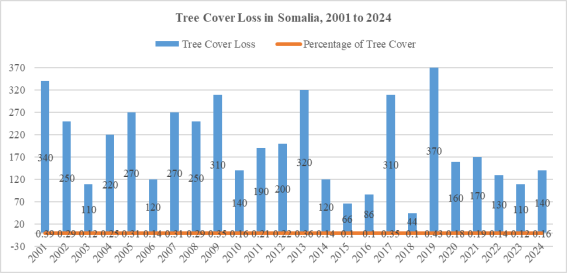
Figure 1. Annual tree cover loss in Somalia, 2001-2024.
Somalia is facing severe forest decline, and the forest sector is being destroyed at an alarming rate. Between 2000 and 2017, a large area of trees was devastated in Somalia, and approximately 686,000 hectares of forests were cleared, representing an annual loss of approximately 6% of all trees lost documented across Africa. As the statistics show, during this period, the country had lost 205,000,000 trees, and this massive tree damage has negatively impacted the environment, producing about 5,000,000 tons of CO2 into the atmosphere . Further, did an analysis on forest cover change in Somalia and found that the country has lost nearly 23% forest cover, and extensive production of charcoal, which is among the lead drivers, has exacerbated the land degradation. From 2001 to 2024, Somalia lost 4.7K ha of tree cover (Figure 1), and 85.2% of this loss occurred in the country as a result of permanent agricultural expansion. Logging and shifting cultivation in Somalia impact the environment and contribute significantly to forest degradation .
Although the forest is a crucial sector in Somalia, literature progress on factors contributing to forest degradation is growing. A limited number of literature reviews have recorded the impacts of forest degradation. investigated forest degradation caused by an increase of charcoal production, while explored forest landscape and rangeland restoration. These studies focused on impacts of charcoal production and overgrazing on forest degradation, as well as on rangeland and forest restoration, but had not addressed institutional factors that affect forest degradation. Therefore, this study aimed to fill this knowledge gap by examining the influence of institutional factors on forest degradation and the impact of degraded forests in Somalia. The objectives of this paper are to:
1. Investigate the influence of weak governance on forest degradation in Somalia.
2. Examine the influence of land tenure insecurity on forest degradation in Somalia.
3. Assess the influence of lack of environmental policy and law enforcement on forest degradation in Somalia.
2. Materials and Methods
The study employs a narrative literature review methodology. Specifically, the study examines the influence of institutional factors on forest degradation in Somalia, focusing on weak governance, land tenure insecurity, and lack of environmental policy and law enforcement. The systematic review research approach is designed to assess and organize empirical research studies that align with predetermined inclusion criteria to provide responses to specific research questions . Data on forest degradation and factors causing forest degradation in North America, South America, South Asia, and Africa were sourced through journals, and institutional publications. A total of 50 published articles were reviewed as indicated in the reference section. It was sourced from various individual articles and institutional reports, including World Tourism Trafficking Council (WTTC), Convention on Biological Diversity (CBD), Global Forest Watch (GFW), Emission Index, Intergovernmental Authority on Development (IGAD), United Nation Environmental Program (UNEP), United Nations Convention to Combat Desertification (UNCCD), Environment, Climate, Conflict, and Peace (ECCP), and Rift Valley Institute (RVI).
3. Results
Institutional Factors and Forest Degradation
3.1. Weak Governance
Weak governance is an issue that contributes to forest degradation and illicit natural resource exploitation. It has accelerated natural resource and environmental decline and menaced long-term development, environmental sustainability, and natural resource conservation. Weak governance poses substantial risk to sustainable development, particularly in ecosystems and in countryside settings that are economically and socially valuable . The inquiry conducted by on understanding the forest degradation and its drivers revealed that weak governance is a critical factor that causes forest degradation. Weak governance diverts policies to personal gain and motivates illegal allowances and illicit logging to forest degradation even in areas that are supposed to be protected .
Weak governance has been associated with a high rate of forest degradation in Somalia. For that reason, reveals that Somalia’s weak governance has worsened the environmental issues, including floods, droughts, and land degradation that the country faces, and impeded the country’s capacity to deliver basic social services, execute effective climate adaptation strategies, and handle climate change threats. As well, noted that due to the weak governance, the illegal harvesting of trees and charcoal trade in Somalia have increased. This situation has intensified the instability of the country and hampered efforts to accomplish sustainable development.
3.2. Land Tenure Insecurity
Land tenure insecurity is a threat that influences the environment and causes forest degradation and ecosystem destruction. Land tenure insecurity has severely impacted the forest and raised tree extraction by 23% . The issue facilitated actors to access and control land and massive clearance of trees, leading to forest degradation and loss of plant and animal species.
Research carried out by investigated the relationship between land tenure insecurity and forest conservation. The result of the study indicated that land tenure insecurity is among factors that contribute to illegal acquisition of vast areas of land and promote environmental degradation and unsustainable exploitation of natural resources. Consequently, argues that insecure land tenure has a direct and significant link with forest degradation, as it contributes to unsustainable tree logging, bush clearance for human settlement, and heavy reliance on fuelwood for energy.
The land tenure system in Somalia had severely impacted the civil war that destroyed the country. Due to that, the system became complicated and unclear. This has led to the emergence of community-based tenure systems, which have increased the land conflicts. Under these systems of land ownership, the person can get or control land through different ways such as the person's social identity, inheritance, buying, clearing land, gifts, and allocation by village leaders . This land tenure issue has spoiled the environment and contributed to forest and land degradation, conflict, land grabbing, motivating illicit tree cutting, and posing a significant risk to biodiversity. To add to this, explains that the faulty land tenure system has allowed powerful individuals to acquire large-scale land and take control of the marginalized groups’ land in southern Somalia, causing conflict among communities and making them poorer. In their investigation on a framework for national assessment of land degradation in the drylands with a focus on Somalia, noted that community-based land tenure systems that are widely practiced in Somalia are the main motivators that provoke uncontrolled tree cutting, which leads to land degradation in the country. Therefore, in his exploratory research study of the formation of a national land policy for land management and administration in Somalia, urges the government of Somalia to develop a national land policy that manages the land and defines tenure forms for community, public, and private entities. This reduces the instability and unsustainable use of the land and contributes to the development of the country.
3.3. Lack of Environmental Policy and Law Enforcement
The absence of environmental policy and law enforcement becomes a big challenge to the environment and remains a major driver of forest degradation. It enables excessive forest clearing, illegal logging, and overexploitation of forest resources to persist without accountability. This environmental damage has created excessive pressure on forest habitat and caused loss of biodiversity and degradation of ecosystems. According to , when the policy is lacking, people often overexploit the environmental resources for personal gain. The lack of law enforcement has negatively affected the forest and driven approximately 68% of illegal logging .
Somalia does not possess environmental policy, forest law, or law enforcement that protects the natural resources. This condition has caused the country’s forests to be depleted unsustainably, leading to environmental damage and biodiversity loss. The lack of environmental policy and execution of regulation in Somalia became a barrier to the environment and caused severe overexploitation of natural resources .
Based on evidence from , overexploitation of forests has been confirmed to be a leading cause of land degradation in Somalia. The lack of environmental policies and law enforcement has promoted cutting down trees and caused the decline in the quality of the land. To mitigate this environmental problem, suggests establishing basic environmental law that governs and coordinates Somalia’s environment and should be approved by the federal government of Somalia and its member states.
4. Impacts of Forest Degradation in Somalia
4.1. Biodiversity Loss
Cutting trees became a serious threat that disrupts habitats and devastates the biodiversity of Somalia. A study by noted that cutting down Terminalia prunioides, Acacia bussei, Prosopis juliflora, Acacia senegal, Acacia tortilis, and Acacia nilotica trees for charcoal production in Somalia has damaged the environment and caused biodiversity loss. Illegal logging and charcoal production in Somalia have reduced plant species such as the acacia tree and contributed to severe forest degradation . This forest harm has encouraged unlawful poaching and wildlife trade, and forests become more accessible to hunters, leading to the population loss and disappearance of some species. Cheetahs, elephants, antelopes, and giraffes, for example, are the most wildlife animals decimated and poached for years. In their report of the National Biodiversity Strategy and Action Plan of Somalia, highlighted that poaching has endangered Somalia’s wildlife animals, especially larger mammals, and has become a recurring issue. The researchers further identified that antelopes are hunted for meat, while species such as cheetahs are seized alive and illegally transported to Gulf countries for sale. From the study by , the vital ecosystems of Somalia have severely degraded, and heartless overexploitation has threatened the wildlife species. Bird species, including the bulo burti boubou and the Somalia thrush, and 14 of the country's 22 antelope species are critically threatened and are at risk of extinction. Astoundingly, the species of wild ass, which once numbered thousands, has declined greatly and become a few dozen, whereas the black rhino, elephant, lion, and Swayne’s hartebeest have vanished from most of the nation.
4.2. Decline in Agricultural Productivity
Forest degradation has negatively affected the agricultural sector in Somalia and interrupted ecosystem services that help farming methods. It has caused water stress, soil infertility, pests and disease outbreaks, and extreme heat and led to crop failure and food insecurity. The sector has become underperforming and contributes only minimally to the country’s overall production. This has increased the food insecurity and hunger across the country and disappointed farmers and pushed them to stop farming. The disappearance of Somalia's tree cover, resulting from illegal logging and charcoal production, has promoted droughts and soil erosion, leading to a decline in agricultural production and an increase in surface runoff .
4.3. Climate Change
The degradation of forests in Somalia has gloomily increased climate change by plummeting the nation's natural capacity to absorb CO2. This degradation has increased greenhouse gas emissions, raised temperature across the country, and messed up rainfall patterns, contributing to more frequent floods and droughts, human and animal health issues, and air pollution that undermines the country’s progress towards sustainable development. Moreover, the country is one of the largest emitters and contributes to global warming. For instance, in terms of greenhouse gas emissions in 2021, Somalia was ranked as the world’s 110th largest producer. Cutting down trees and changing natural ecosystems play a significant role in carbon production and have a negative influence on Somalia’s emissions. This issue has shot up the CO2 and CH₄ production level by 17.4 million tonnes. The country has released 25.8 million tonnes of CO2e, and its emissions have increased at a compound annual growth rate of 0.16% . The study on trends and threats for environmental and natural resources challenges of Somalia, conducted by , notes that the nation’s natural resources are being greatly degraded and strained. It was identified that charcoal production, timber, firewood, and unregulated farming activities put a heavy burden on the forests and destroyed trees, resulting in increased CO2 emissions and air pollution.
5. Discussion
The paper investigated the key drivers of forest degradation in Somalia, with particular focus on institutional and policy-related factors. Specifically, the discussion focused on how weak governance, land tenure insecurity, and the lack of environmental policy and law enforcement influence forest degradation. Based on the literature reviewed, the forest sector in Somalia has severely degraded, and the sector is rapidly depleting. More importantly, the findings indicated that weak governance, land tenure insecurity, and lack of environmental policy and law enforcement are the major factors causing forest degradation in Somalia. The study also revealed that the forest degradation resulted from these institutional factors and has contributed to biodiversity loss, climate change, and decline in agricultural production.
6. Conclusions
Weak governance, land tenure insecurity, and lack of environmental policy and law enforcement promoted overuse of forest resources and caused forest degradation in Somalia. These institutional gaps have formed situations that enable illegal exploitation of forests to continue. To address these issues, this review study recommends that the federal government of Somalia should strengthen environmental governance bodies such as the Ministry of Environment and Climate Change and the Ministry of Livestock, Forestry, and Range by building the capacity of staff for environmental law enforcement, monitoring of natural resources, forest management, and environmental conservation; increasing funding for these institutions; and enhancing coordination among these agencies. Additionally, the government should establish environmental and forest laws and environmental law enforcement agencies to control overexploitation and illegal logging activities. Developing national land policy, establishing protected areas, and formulating national systems for the management and conservation of the protected areas can also significantly decrease pressure on the country’s forests and wildlife. Finally, executing of these measures would significantly mitigate forest degradation and promote sustainable forest management and conservation in Somalia.
Abbreviations

WTTC

World Tourism Trafficking Council

CBD

Convention on Biological Diversity

GFW

Global Forest Watch

IGAD

Intergovernmental Authority on Development

UNEP

United Nation Environmental Program

UNCCD

United Nations Convention to Combat Desertification

ECCP

Environment, Climate, Conflict, and Peace

RVI

Rift Valley Institute

CO2

Carbon Dioxide

Author Contributions
Bashir Ahmed Abshir: Conceptualization, Data curation, Formal Analysis, Funding acquisition, Investigation, Methodology, Project administration, Resources, Software, Supervision, Validation, Visualization, Writing – original draft, Writing – review & editing
Conflicts of Interest
The author declares no conflicts of interest.
References
[1] Aldakhil, M., Abdullateef, S., Mahmoud, F., Alhasan, A., Lakmes, A., & Watmough, G. (2023). A primary evaluation of Syrian forest damage since 2011: a case study of Alhamam and Alboz forest sites. iForest-Biogeosciences and Forestry, 16(3), 144-154.
[2] Ali, A., & Liaqat, N. (2025). Somalia’s climate fragility trap: Practical pathways for policy action.
[3] Baafi, J. N. E. (2023). The Effect of Forest Degradation on the Livelihoods of the Local Community: The Case of Boti Falls and Volta River Block II Forest Reserves in the Yilo-Krobo Municipality (Master Thesis, University of Ghana).
[4] Betts, M. G., Yang, Z., Hadley, A. S., Smith, A. C., Rousseau, J. S., Northrup, J. M., & Gerber, B. D. (2022). Forest degradation drives widespread avian habitat and population declines. Nature Ecology & Evolution, 6(6), 709-719.
[5] Convention on Biological Diversity. (2021). Biodiversity in Somalia. Available from
[6] Daiyoub, A., Saura-Mas, S., & Maarouf, Y. (2024). The impact of war on forest logging: Changes in logging practices in Syrian rural communities. Trees, Forests and People, 18, 100668.
[7] Dahir, I. M. S (2023). Fueling the Flames: How Armed Conflicts and Climate Change Shape the Charcoal Trade in Somalia.
[8] Dubow, Abdirahman Zeila; Hart, Tracy; Collier, John Bryant; De Fontaubert, Charlotte; Million, Julien Marie Francois; Thalheimer, Lisa (2020). Somalia - Country Environmental Analysis: Diagnostic Study on Trends and Threats for Environmental and Natural Resources Challenges (English). Washington, D. C.: World Bank Group.
[9] Dubow, A. Z. (2022). Somalia needs its trees to restore landscapes and livelihoods. World Bank Blogs.
[10] Enoguanbhor, E. A., Chukwurah, G. O., Enoguanbhor, E. C., Isimah, M. O., Kosun, A. E. O., Ewurum, N. I., & Albrecht, E. (2024). Underlying Anthropogenic Driving Factors of Forest Landscape Degradation in the Kilimanjaro World Heritage Site, Tanzania Using Survey-based Data. Nature Environment and Pollution Technology, 23(2), 1115-1122. iginal Research Paper
[11] Eufemia, L., Bonatti, M., Sieber, S., Schröter, B., & Lana, M. A. (2020). Mechanisms of weak governance in grasslands and wetlands of South America. Sustainability, 12(17), 7214.
[12] Emission Index. (2024), Greenhouse Gas Emissions in Somalia. Available from
[13] ECCP. (2022). Environmental Peacebuilding in Somalia: Civil society responses to environmental conflict. Available from
[14] Grima, N., & Singh, S. J. (2019). How the end of armed conflicts influence forest cover and subsequently ecosystem services provision? An analysis of four case studies in biodiversity hotspots. Land Use Policy, 81, 267-275.
[15] GFW. (2024). Somalia Deforestation Rate and Statistics. Available from
[16] Hassan, B. A. (2026). Policy Brief: Somalia in Action–Forest Landscape and Rangeland Restoration through Reforestation and Natural Regeneration Driving National Climate Resilience. Journal of Sustainable Development, 19(2).
[17] Havugimana, R., Mupenzi, C., Lwanga, T. C., & Erineste, N. (2021). Assessing the impact of urban growth on the forest degradation in Musanze District. International Journal of Environmental & Agriculture Research (IJOEAR), 2, 16-20.
[18] Harwell, E. (2010). Forests in fragile and conflict-affected states. Washington, DC: Program on Forests (PROFOR).
[19] IGAD. (2018). Somalia- Land Governance Country Profile. Available from
[20] Kalogiannidis, S., Kalfas, D., Loizou, E., & Chatzitheodoridis, F. (2022). Forestry bioeconomy contribution on socioeconomic development: Evidence from Greece. Land, 11(12), 2139.
[21] Kullane, M. A., Abdi-Soojeede, M. I., & Farah, A. M. (2022). Impacts of charcoal production on environment and species preference in Yaqshid District Mogadishu, Somalia. Journal of Agriculture and Ecology Research International, 23(5), 65-74.
[22] Kumar, R., Kumar, A., & Saikia, P. (2022). Deforestation and forests degradation impacts on the environment. In Environmental degradation: Challenges and strategies for mitigation (pp. 19-46). Cham: Springer International Publishing. Punia, H., & Jakhar, S. (2022). Conceptualizing different forest degradation drivers with special reference to India. Int J Environ Climate Change, 12(11), 3184-3200.
[23] Kung’u, G. N., Cousseau, L., Githiru, M., Habel, J. C., Kinyanjui, M., Matheka, K.,... & Apfelbeck, B. (2023). Anthropogenic activities affect forest structure and arthropod abundance in a Kenyan biodiversity hotspot. Biodiversity and Conservation, 32(10), 3255-3282.
[24] Matricardi, E. A. T., Skole, D. L., Costa, O. B., Pedlowski, M. A., Samek, J. H., & Miguel, E. P. (2020). Long-term forest degradation surpasses deforestation in the Brazilian Amazon. Science, 369(6509), 1378-1382.
[25] Mwanani, R. (2022). Assessing the Effects of Forest Degradation on Smallholder Farmers Agricultural Production in Lwebitakuli Sub County, Sembabule District, Uganda (Doctoral dissertation, Ndejje University).
[26] Mwangi, J. (2017). A Synopsis For Formulation Of National Land Policy To Guide The Management And Adminstration Of Land: A Case For Somalia. International Journal of Innovative Research and Advanced Studies (IJIRAS) Volume, 4.
[27] Moreira-Dantas, I. R., & Söder, M. (2022). Global deforestation revisited: The role of weak institutions. Land Use Policy, 122, 106383.
[28] Musei, S. K., Nyaga, J. M., & Dubow, A. Z. (2021). Remote Sensing Based Quantification of Forest Cover Change in Somalia for the Period 2000 to 2019. In Deserts and Desertification. IntechOpen.
[29] Olokeogun, O. S. (2022). Understanding the drivers of forest degradation. In Forest Dynamics and Conservation: Science, Innovations and Policies (pp. 35-51). Singapore: Springer Nature Singapore.
[30] Omuto, C. T., Balint, Z., & Alim, M. S. (2014). A framework for national assessment of land degradation in the drylands: a case study of Somalia. Land degradation & development, 25(2), 105-119.
[31] Obeka, B. M., Wacker, E., Shauri, H., & de Vries, W. T. (2024). Influence of land ownership security on land use changes in Mwatate Sub-County, Taita Taveta County, Kenya. Tropical Conservation Science, 17, 19400829241247798.
[32] Punia, H., & Jakhar, S. (2022). Conceptualizing different forest degradation drivers with special reference to India. Int J Environ Climate Change, 12(11), 3184-3200.
[33] Rembold, F., Bolognesi, M., Vrieling, A., & Gadain, H. (2013, November). MAPPING FOREST DEGRADATION CAUSED BY THE RECENT INCREASE OF CHARCOAL PRODUCTION IN SOUTHERN SOMALIA. In Global Geospatial Conference 2013: The joint GSDI 14 World Conference and AfricaGIS 2013 Conference (p. 1)
[34] RVI. (2021). Land Conflict in Somalia. Available from
[35] Sobko, G., Aparov, A. M., Kovalenko, N., Frantsuz, A. Y., & Yermakova, H. (2023). Socio-legal problems of environment criminal-legal protection, regarding illegal deforestation. Review of Economics and Finance, 21(1), 246-258.
[36] Stavropoulos, S., Wall, R., & Xu, Y. (2018). Environmental regulations and industrial competitiveness: evidence from China. Applied Economics, 50(12), 1378-1394.
[37] Snyder, H. (2019). Literature review as a research methodology: An overview and guidelines. Journal of business research, 104, 333-339.
[38] Suratman, M. N., Abd Latif, Z., De Oliveira, G., Brunsell, N., Shimabukuro, Y., & Dos Santos, C. A. C. (Eds.). (2020). Forest Degradation Around the World. BoD–Books on Demand.
[39] Sulieman, H. M. (2018). Exploring drivers of forest degradation and fragmentation in Sudan: The case of Erawashda forest and its surrounding community. Science of the total environment, 621, 895-904.
[40] Souza Jr, C., Tenneson, K., Dilger, J., Wespestad, C., & Bullock, E. (2023). Forest degradation and deforestation. In Cloud-Based Remote Sensing with Google Earth Engine: Fundamentals and Applications (pp. 1061-1091). Cham: Springer International Publishing.
[41] Uwizeyimana, V., Mutert, M., Mbonigaba, T., Niyonshuti, A., Nkurikiye, J. B., Nsabuwera, V.,... & Muys, B. (2024). Assessment of the efficiency of improved cooking stoves and their impact in reducing forest degradation and contaminant emissions in Eastern Rwanda. Energy for Sustainable Development, 80, 101442
[42] Ullah, S., & Gadain, H. (2016). National biodiversity strategy and action plan (NBSAP) of Somalia.
[43] UNEP. (2024). Community forestry. Available from
[44] UNEP. (2022). Somalia attempts to revive lands blighted by deforestation. Available from
[45] UNCCD. (2020). Land Degradation Neutrality Target Setting Process in Somalia. Available from
[46] Venier, L., Cooke, B., McIntire, E., Brandt, J. P., McKenney, D., Stralberg, D.,... & Stinson, G. (2025). Measuring and responding to forest degradation in Canada: an operational framework. Environmental Reviews, 33, 1-31.
[47] Von der Mühlen, M., Aylwin, J., Kausel, T., & Fuders, F. (2020). Land tenure insecurity and forest conservation in Chile: The case of the Mapuche Huilliche Indigenous communities in the coastal range rainforests of Mapu Lahual. In Ecological Economic and Socio Ecological Strategies for Forest Conservation: A Transdisciplinary Approach Focused on Chile and Brazil (pp. 127-157). Cham: Springer International Publishing.
[48] Walker, S., Alix-García, J., Bartlett, A., & Calder, A. (2025). Land tenure security and deforestation: Evidence from a framed field experiment in Uganda. Journal of Environmental Economics and Management, 131, 103137.
[49] WTTC. (2019), The Economic Impact of Global Wildlife Tourism. Available from
[50] Yasin, E. H., Siddig, A. A., Deiab, E. E., Kornel, C., Hasoba, A., & Osman, A. (2023). Forest Degradation in Dryland Ecosystems of Sudan: Review of the Causes, Consequences, Assessment Methods, and Potential Solutions. Mitigating Global Climate Change-Enhancing Adaptation, Evaluation, and Restoration of Mountain Ecosystems.
Cite This Article
  • APA Style

    Abshir, B. A. (2026). Institutional Factors and Forest Degradation in Most Fragile States: A Review with Particular Emphasis on Somalia. International Journal of Natural Resource Ecology and Management, 11(2), 96-103. https://doi.org/10.11648/j.ijnrem.20261102.12

    Copy | Download

    ACS Style

    Abshir, B. A. Institutional Factors and Forest Degradation in Most Fragile States: A Review with Particular Emphasis on Somalia. Int. J. Nat. Resour. Ecol. Manag. 2026, 11(2), 96-103. doi: 10.11648/j.ijnrem.20261102.12

    Copy | Download

    AMA Style

    Abshir BA. Institutional Factors and Forest Degradation in Most Fragile States: A Review with Particular Emphasis on Somalia. Int J Nat Resour Ecol Manag. 2026;11(2):96-103. doi: 10.11648/j.ijnrem.20261102.12

    Copy | Download

  • @article{10.11648/j.ijnrem.20261102.12,
      author = {Bashir Ahmed Abshir},
      title = {Institutional Factors and Forest Degradation in Most Fragile States: A Review with Particular Emphasis on Somalia},
      journal = {International Journal of Natural Resource Ecology and Management},
      volume = {11},
      number = {2},
      pages = {96-103},
      doi = {10.11648/j.ijnrem.20261102.12},
      url = {https://doi.org/10.11648/j.ijnrem.20261102.12},
      eprint = {https://article.sciencepublishinggroup.com/pdf/10.11648.j.ijnrem.20261102.12},
      abstract = {Forest degradation led by human activities has diminished the capacity of the forest to deliver goods and services, making it less productive and resilient. Hence, the purpose of this study was to examine the influence of institutional factors on forest degradation in the most fragile states, with a particular emphasis on Somalia. Specifically, the paper examined the influence of land tenure insecurity, lack of environmental policy and law enforcement, and weak governance on forest degradation in Somalia. The methodology used for this paper was a systematic literature review, where information on forest degradation and factors contributing to the forest degradation in North America, South America, South Asia, and Africa was utilized through journals and institutional publications. Based on the literature reviewed, the forest sector in Somalia has severely degraded, and the sector is rapidly depleting. The findings indicated that weak governance, land tenure insecurity, and lack of environmental policy and law enforcement are the major factors causing forest degradation in Somalia. The study also revealed that the forest degradation resulting from these institutional factors has contributed to biodiversity loss, climate change, and decline in agricultural production. To address these issues, this review study recommends that the federal government of Somalia should strengthen environmental governance bodies such as the Ministry of Environment and Climate Change and the Ministry of Livestock, Forestry, and Range by building the capacity of staff, increasing funding for these institutions, and enhancing coordination among these agencies. Additionally, the government should establish national land policy, protected areas, national systems for the management and conservation of the protected areas, environmental and forest laws, and environmental law enforcement agencies to control overexploitation and illegal logging activities and reduce pressure on the country’s forests and wildlife.},
     year = {2026}
    }
    

    Copy | Download

  • TY  - JOUR
    T1  - Institutional Factors and Forest Degradation in Most Fragile States: A Review with Particular Emphasis on Somalia
    AU  - Bashir Ahmed Abshir
    Y1  - 2026/05/13
    PY  - 2026
    N1  - https://doi.org/10.11648/j.ijnrem.20261102.12
    DO  - 10.11648/j.ijnrem.20261102.12
    T2  - International Journal of Natural Resource Ecology and Management
    JF  - International Journal of Natural Resource Ecology and Management
    JO  - International Journal of Natural Resource Ecology and Management
    SP  - 96
    EP  - 103
    PB  - Science Publishing Group
    SN  - 2575-3061
    UR  - https://doi.org/10.11648/j.ijnrem.20261102.12
    AB  - Forest degradation led by human activities has diminished the capacity of the forest to deliver goods and services, making it less productive and resilient. Hence, the purpose of this study was to examine the influence of institutional factors on forest degradation in the most fragile states, with a particular emphasis on Somalia. Specifically, the paper examined the influence of land tenure insecurity, lack of environmental policy and law enforcement, and weak governance on forest degradation in Somalia. The methodology used for this paper was a systematic literature review, where information on forest degradation and factors contributing to the forest degradation in North America, South America, South Asia, and Africa was utilized through journals and institutional publications. Based on the literature reviewed, the forest sector in Somalia has severely degraded, and the sector is rapidly depleting. The findings indicated that weak governance, land tenure insecurity, and lack of environmental policy and law enforcement are the major factors causing forest degradation in Somalia. The study also revealed that the forest degradation resulting from these institutional factors has contributed to biodiversity loss, climate change, and decline in agricultural production. To address these issues, this review study recommends that the federal government of Somalia should strengthen environmental governance bodies such as the Ministry of Environment and Climate Change and the Ministry of Livestock, Forestry, and Range by building the capacity of staff, increasing funding for these institutions, and enhancing coordination among these agencies. Additionally, the government should establish national land policy, protected areas, national systems for the management and conservation of the protected areas, environmental and forest laws, and environmental law enforcement agencies to control overexploitation and illegal logging activities and reduce pressure on the country’s forests and wildlife.
    VL  - 11
    IS  - 2
    ER  - 

    Copy | Download

Author Information
  • Research Department, Buff Research and Climate Change Action, Mogadishu, Somalia

    Biography: Bashir Ahmed Abshir holds a Master of Arts in Project Planning and Management from the University of Nairobi, Kenya, and a Bachelor of Arts in Business Administration from SIMAD University, Somalia. Currently, Mr. Bashir is a CEO and lead researcher of Buff Research and Climate Change Action (BRCCA), in Mogadishu, Somalia. He also works as a Research Consultant at the African Institute for Development Policy, Malawi, and participating in the Africa Integrity Indicators Research Project. He led EU-RFSS and Work Bank SCRP climate resilience and adaptation projects and assisted vulnerable communities by improving their capacity to cope with climate change impacts. Bashir authored and published several articles on education and community development in international journals. His research interests are environmental sustainability, climate change, wildlife and forest conservation, education, sustainable project planning and management, and agritechnology and food systems.