Abstract
Background: Excess weight and behaviors related to physical activity, electronic screen use, and dietary habits are interrelated dimensions of youth health. Objective: To determine whether excess weight was associated with physical activity frequency, electronic screen time, and meal regularity among Costa Rican students aged 10 to 15. Method: A cross-sectional study was conducted with 900 students from 15 schools in Montes de Oca, Costa Rica. Excess weight—defined as overweight or obesity—was classified according to the World Health Organization's body mass index-for-age reference criteria. Prevalence, bivariate associations, and adjusted odds ratios were estimated using binary logistic regression. Results: The prevalence of excess weight was 37.8%. Skipping breakfast was associated with a higher likelihood of excess weight after adjusting for sex, age, socioeconomic status, nationality, family structure, skipping dinner, physical activity, and electronic screen time (adjusted OR: 1.67; 95% CI: 1.11-2.51). Engaging in physical activity three or more days a week was associated with a lower likelihood of excess weight (adjusted OR: 0.75; 95% CI: 0.56-0.99). Electronic screen time of two or more hours per day did not show an independent association. Conclusions: In this school-based sample, excess weight was associated with skipping breakfast and a lower weekly frequency of physical activity. Due to the cross-sectional design, the findings should be interpreted as simultaneous associations rather than causal or temporal relationships.
Keywords
Students, Costa Rica, Overweight, Obesity, Physical Activity, Screen Time, Skipping Breakfast, School Health
1. Introduction
The 10-to-15-year age range includes significant biological and social transitions. Growth, pubertal maturation, and changes in body composition occur alongside increasing autonomy in food choices, leisure activities, and screen use. Consequently, nutritional status in this age group is determined by biological processes, dietary habits, physical activity, sedentary behavior, family, school, and socioeconomic conditions
| [1] | Arafa, A., Yasui, Y., Kokubo, Y., Kato, Y., Matsumoto, C., Teramoto, M., Nosaka, S., and Kogirima, M. Lifestyle behaviors of childhood and adolescence, contributing factors, health consequences, and potential interventions. American Journal of Lifestyle Medicine. 2024.
https://doi.org/10.1177/15598276241245941 |
| [2] | Blyth, F., Haycraft, E., Peral-Suarez, A., and Pearson, N. Tracking and changes in the clustering of physical activity, sedentary behavior, diet, and sleep across childhood and adolescence, a systematic review. Obesity Reviews. 2025, 26(7), e13909. https://doi.org/10.1111/obr.13909 |
[1, 2]
.
Excess weight during childhood and adolescence is epidemiologically significant, as it can coexist with cardiometabolic abnormalities and be associated with obesity later in life. Its assessment requires age- and sex-adjusted reference values, given that body mass index (BMI) varies during growth. The World Health Organization reference for the 5-to-19-year-old population defines overweight as a BMI-for-age value exceeding one standard deviation, and obesity as a value exceeding two standard deviations
. In Costa Rica, national BMI and waist circumference percentiles have provided relevant local evidence for characterizing growth, adiposity, and central fat distribution in children and adolescents
| [4] | Núñez-Rivas, H. P., Holst-Schumacher, I., Campos-Saborío, N., and López-López, E. Percentiles of body mass index and waist circumference for Costa Rican children and adolescents. Nutrición Hospitalaria. 2022, 39(6), 1228-1236.
https://doi.org/10.20960/nh.04130 |
[4]
.
Physical activity is linked to energy balance, cardiorespiratory fitness, musculoskeletal function, and metabolic regulation. Its observed association with excess weight depends on frequency, duration, intensity, the measurement method, and the coexistence of other behaviors. Physical activity and sedentary behavior are not reciprocal constructs, as a student can accumulate physical activity at specific times while simultaneously maintaining prolonged exposure to electronic screens
| [5] | Nagata, J. M., Smith, N., Alsamman, S., Lee, C. M., Dooley, E. E., Kiss, O., Ganson, K. T., Wing, D., Baker, F. C., and Gabriel, K. P. Association of physical activity and screen time with body mass index among US adolescents. JAMA Network Open. 2023, 6(2), e2255466. https://doi.org/10.1001/jamanetworkopen.2022.55466 |
[5]
.
Increasingly, research examines co-occurring patterns of physical activity, sedentary behavior, and diet, rather than isolated exposures. A systematic review revealed that less favorable behavioral profiles were associated with greater adiposity and other adverse health indicators, although definitions and distributions varied across studies
| [6] | Alosaimi, N., Sherar, L. B., Griffiths, P., and Pearson, N. Clustering of diet, physical activity and sedentary behaviour and related physical and mental health outcomes, a systematic review. BMC Public Health. 2023, 23, 1572.
https://doi.org/10.1186/s12889-023-16372-6 |
[6]
.
Electronic screen time is a specific form of sedentary behavior that may be linked to adiposity due to the displacement of physical activity, food consumption while using these devices, and exposure to food advertising. While a meta-analysis estimated a positive association between categories of high electronic screen time and overweight or obesity, although with high heterogeneity across studies
| [7] | Haghjoo, P., Siri, G., Soleimani, E., Farhangi, M. A., and Alesaeidi, S. Screen time increases overweight and obesity risk among adolescents, a systematic review and dose-response meta-analysis. BMC Primary Care. 2022, 23, 161.
https://doi.org/10.1186/s12875-022-01761-4 |
[7]
, other investigations have found associations between screen time and less healthy dietary habits, but not necessarily with overweight or obesity
| [8] | Myszkowska-Ryciak, J., Harton, A., Lange, E., Laskowski, W., Wawrzyniak, A., Hamułka, J., and Gajewska, D. Reduced screen time is associated with healthy dietary behaviors but not body weight status among Polish adolescents. Nutrients. 2020, 12(5), 1323. https://doi.org/10.3390/nu12051323 |
| [9] | Rocka, A., Jasielska, F., Madras, D., Krawiec, P., and Pac-Kożuchowska, E. The impact of digital screen time on dietary habits and physical activity in children and adolescents. Nutrients. 2022, 14(14), 2985. https://doi.org/10.3390/nu14142985 |
[8, 9]
. This variability suggests that the significance of screen time depends on the context, the type of exposure, and the behaviors with which it co-occurs.
Meal regularity and timing can reflect family organization, school schedules, sleep patterns, and opportunities for food access. From this perspective, skipping breakfast should not be interpreted solely as an isolated dietary habit, but rather as a potential indicator of broader daily routines. Although various studies have described an association between skipping breakfast and excess weight in children and adolescents, the prevalence of non-experimental designs, the possibility of reverse causality, and inconsistent intervention results limit a direct causal interpretation
| [10] | Wang, K., Niu, Y., Lu, Z., Duo, B., Effah, C. Y., and Guan, L. The effect of breakfast on childhood obesity, a systematic review and meta-analysis. Frontiers in Nutrition. 2023, 10, 1222536. https://doi.org/10.3389/fnut.2023.1222536 |
| [11] | Ricotti, R., Caputo, M., Monzani, A., Pigni, S., Antoniotti, V., Bellone, S., and Prodam, F. Breakfast skipping, weight, cardiometabolic risk, and nutrition quality in children and adolescents, a systematic review of randomized controlled and intervention longitudinal trials. Nutrients. 2021, 13(10), 3331. https://doi.org/10.3390/nu13103331 |
[10, 11]
.
Overall, nutritional status among students aged 10 to 15 should be examined in relation to coexisting dietary practices, physical activity, and sedentary behavior within family and school contexts. Costa Rican evidence evaluating these behaviors simultaneously remains limited. The research question was: is there an independent association between excess weight and the frequency of physical activity, time spent in front of electronic screens, and meal regularity among students aged 10 to 15? Consequently, this study aimed to estimate the prevalence of excess weight and evaluate its adjusted associations with these behaviors.
2. Materials and Methods
2.1. Study Design and Setting
A cross-section observational study was conducted using individual-level data collected as part of the project "Early detection and understanding of the genesis of type 2 diabetes mellitus and its comorbidities in children and adolescents with excess body weight." Students with and without excess weight were included in this analysis to assess the association between nutritional status and specific behavioral variables.
Data collection was conducted between August 2023 and December 2024 at 15 day-session educational institutions in Montes de Oca, San José province, Costa Rica. Eleven primary schools and four secondary schools participated, comprising public, state-subsidized, and private institutions. The presentation of methodological aspects followed the STROBE recommendations for cross-sectional observational studies
| [12] | von Elm, E., Altman, D. G., Egger, M., Pocock, S. J., Gøtzsche, P. C., and Vandenbroucke, J. P. The Strengthening the Reporting of Observational Studies in Epidemiology statement, guidelines for reporting observational studies. PLoS Medicine. 2007, 4(10), e296.
https://doi.org/10.1371/journal.pmed.0040296 |
[12]
.
2.2. Sample Design and Participants
The study sample consisted of 900 students aged 10 to 15 from participating schools in Montes de Oca, Costa Rica. No separate a priori sample-size calculation was performed for this secondary analysis; all participants from the original fieldwork who met the present eligibility criteria and had the required data were included. Inclusion criteria were age 10 to 15 years, enrollment at a participating school, written informed consent from a parent or legal guardian, student assent when applicable, and available data on nutritional status, sociodemographic characteristics, physical activity, screen time, and dietary habits. Participants outside the age range, without consent or assent when required, or without the variables needed for the analysis were excluded. The final sample included 423 male and 477 female students.
Behavior data was collected with a structured self-report questionnaire administered during the original project fieldwork. The instrument included items on weekly physical activity frequency and usual duration, daily electronic screen time, breakfast and dinner consumption, meal regularity, and food intake between main meals.
2.3. Anthropometric Measurements and Nutritional Status
Anthropometric measurements were performed in accordance with the Costa Rican Social Security Fund's institutional procedures for nutritional care and the national standard for the use of anthropometric charts for the nutritional assessment of the population aged 0 to 19; these standards aim to standardize body measurements and facilitate the collection of comparable data for nutritional classification
| [13] | Costa Rican Social Security Fund, Medical Management, Department for Health Services Development. Manual of procedures for nutrition services in health areas. Available from: https://www.binasss.sa.cr/protocolos/manualnutricion.pdf (accessed 13 August 2026). |
| [14] | Ministry of Health of Costa Rica. National standard for the use of anthropometric charts for nutritional assessment from 0 to 19 years. Available from: https://surl.li/wosveo (accessed 13 August 2026). |
[13, 14]
.
Height was measured using a portable SECA 213 stadiometer. Body weight and body composition were measured using a TANITA bioelectrical impedance device. Waist circumference was measured with a horizontal tape measure at the midpoint between the last rib and the upper edge of the hip bone, without compressing the skin. BMI was calculated by dividing weight in kilograms by height in square meters.
Nutritional status was classified using the World Health Organization’s age- and sex-specific BMI-for-age reference for the 5-to-19-year-old population
. For the primary analysis, overweight and obesity were grouped into the "excess weight" category. Body fat percentage, lean mass, and waist circumference were used to characterize the groups but were not included as predictors in the multivariate model due to their close conceptual and statistical relationship with the outcome variable.
2.4. Physical Activity and Electronic Screen Time
Physical activity was assessed using questions regarding the number of days per week spent on physical or sports activities and their usual duration. For the primary analysis, students engaging in physical activity three or more days a week were classified as active, while those falling below this threshold were classified as insufficiently active. This variable was used in the logistic regression model due to its parsimony and was not interpreted as indicating adherence to international recommendations, as it did not require a minimum duration of 60 minutes or include a measure of intensity.
The criterion of engaging in at least 60 minutes of daily physical activity was also examined. Furthermore, an integrated classification was developed by combining weekly physical activity frequency, usual duration, and screen time into four mutually exclusive operational profiles: highly active, active with screen-related risk, moderately sedentary, and sedentary. This classification was used in descriptive and bivariate analyses and was not considered a validated scale or a direct measure of adherence to international recommendations.
For the independent analysis, screen time was dichotomized into less than two hours or two or more hours per day. This dichotomization facilitates interpretation but reduces information regarding continuous exposure and limited the examination of dose-response or non-linear relationships.
2.5. Dietary Habits
Information was collected regarding habitual breakfast and dinner consumption, the total number of daily eating occasions, and food intake between main meals. A value of 1 was assigned when the student reported skipping breakfast, and a value of 0 when they reported eating breakfast; skipping dinner was coded in an analogous manner. These variables represented meal regularity and temporal organization, not diet quality, nutrient intake, or the composition of foods consumed.
2.6. Covariates and Statistical Analysis
Sex, age, socioeconomic status, nationality, and family structure were considered potential confounders based on epidemiological plausibility. Sex was coded as female versus male. Age was grouped into three categories: 10 years or younger, over 10 to 13 years, and over 13 years. Nationality was dichotomized into Costa Rican versus other nationalities, and family structure into nuclear family versus other structures.
Socioeconomic status was assessed using a score based on household goods and services. A specific score was assigned to each reported good or service to distinguish between socioeconomic strata, and the total score was used to classify participants into low, medium, or high socioeconomic status. Scores of 0 to 4 were classified as low; 5 to 10 as medium; and those above 10 as high. For the multivariate analysis, this variable was dichotomized into high socioeconomic status versus low or medium status.
Data processing and analysis were performed using IBM SPSS Statistics, version 29.0. Frequencies and percentages were used for categorical variables and means and standard deviations for quantitative variables. Bivariate associations were evaluated using Pearson's chi-square tests, and comparisons of quantitative variables were conducted using parametric or non-parametric tests, as appropriate.
A binary logistic regression model was fitted with excess weight as the outcome variable. The model simultaneously included sex, age group, socioeconomic status, nationality, family structure, skipping breakfast, skipping dinner, physical activity (dichotomous variable), and electronic screen time. Estimates were expressed as adjusted odds ratios with 95% confidence intervals.
A secondary logistic regression analysis used the dichotomous physical activity classification as the outcome. An additional exploratory model examined interaction between sex and age group. Statistical significance was set at 0.05. These analyses were explicitly treated as secondary or exploratory and were not used to redefine the primary research question.
2.7. Ethical Considerations
The protocol was approved by the Scientific Ethics Committees of both the Costa Rican Institute for Research and Education in Nutrition and Health (IC-2023-01) and the University of Costa Rica (VI-4333-2019). Participation required written informed consent from the mother, father, or legal guardian, as well as informed assent from students aged 12 or older, when applicable, in accordance with national regulations governing biomedical research involving human subjects in Costa Rica, including Biomedical Research Regulatory Law No. 9234 and its regulations
.
The information was managed using identification codes and used exclusively for scientific purposes, preserving the confidentiality of the participants.
3. Results
The sample included 900 students aged 10 to 15, with a mean age of 12.1 ± 1.7 years; 53.0% were female and 47.0% were male. A total of 560 participants (62.2%) were classified as not having excess weight, while 340 (37.8%) presented excess weight. The prevalence of excess weight was similar among male and female students (38.3% and 37.3%, respectively).
Anthropometric and body composition characteristics according to nutritional status are presented in
Table 1. Students with excess weight exhibited higher mean values for BMI, waist circumference, body fat percentage, and lean mass than those with no excess weight.
Table 1. Anthropometric and body composition characteristics according to nutritional status.
Variable | No excess weight (mean ± SD) | Excess weight (mean ± SD) | p Value |
Age, years | 12.02 ± 1.67 | 12.10 ± 1.72 | 0.475 |
BMI, kg/m2 | 17.68 ± 2.29 | 24.37 ± 3.62 | <0.001 |
Waist circumference, cm | 67.97 ± 6.79 | 83.19 ± 8.90 | <0.001 |
Body fat percentage,% | 16.97 ± 6.12 | 29.52 ± 7.15 | <0.001 |
Lean mass, kg | 32.58 ± 7.42 | 39.44 ± 8.36 | <0.001 |
3.1. Sociodemographic Factors
No statistically significant associations were observed between excess weight and sex, nationality, socioeconomic status, or family structure. Although high socioeconomic status showed a lower descriptive prevalence of excess weight, the difference did not reach statistical significance (
Table 2).
Table 2. Sociodemographic characteristics according to nutritional status.
Variable | Category | No excess weight (n,%) | Excess weight (n,%) | p Value |
Sex | Male | 261 (61.7) | 162 (38.3) | 0.762 |
Female | 299 (62.7) | 178 (37.3) |
Nationality | Costa Rican | 513 (61.8) | 317 (38.2) | 0.370 |
Other nationality | 47 (67.1) | 23 (32.9) |
Socioeconomic level | Low | 123 (60.6) | 80 (39.4) | 0.224 |
Middle | 363 (61.4) | 228 (38.6) |
High | 74 (69.8) | 32 (30.2) |
Family structure | Nuclear | 254 (62.0) | 156 (38.0) | 0.942 |
Matriarchal | 136 (63.0) | 80 (37.0) |
Patriarchal | 11 (68.8) | 5 (31.3) |
Extended | 159 (61.6) | 99 (38.4) |
3.2. Physical Activity and Screen Time
Weekly physical activity frequency was significantly associated with excess weight: 35.2% among active students and 42.0% among non-active students (p = 0.041). Conversely, the criterion of engaging in at least 60 minutes of daily physical activity was not associated with excess weight (p=0.390;
Table 3).
Table 3. Physical activity according to nutritional status.
Variable | Category | No excess weight (n,%) | Excess weight (n,%) | p Value |
Physical activity ≥ 3 days per week | Active | 361 (64.8) | 196 (35.2) | 0.041 |
Insufficiently active | 199 (58.0) | 144 (42.0) |
Physical activity ≥ 60 min per day | Active | 323 (61.1) | 206 (38.9) | 0.390 |
Insufficiently active | 237 (63.9) | 134 (36.1) |
Screen time was not associated with excess weight in the bivariate analysis. Excess weight prevalence was 40.3% among students reporting at least two hours per day and 36.0% among those reporting less than two hours per day (p = 0.189). The integrated activity and screen-time classification was also not associated with excess weight (p = 0.300;
Table 4).
Table 4. Electronic Screen time and integrated classification according to nutritional status.
Variable | Category | No excess weight (n,%) | Excess weight (n,%) | p Value |
Screen time | Less than 2 hours/day | 333 (64.0) | 187 (36.0) | 0.189 |
2 or more hours/day | 227 (59.7) | 153 (40.3) |
Integrated classification | Highly active | 141 (65.0) | 76 (35.0) | 0.300 |
Active with screen-related risk | 222 (64.0) | 125 (36.0) |
Moderately sedentary | 150 (57.5) | 111 (42.5) |
Sedentary | 47 (62.7) | 28 (37.3) |
3.3. Dietary Habits
Dietary habits according to nutritional status are shown in
Table 5. The total number of foods consumed, daily eating occasions, food intake between meals, lunch, snacks, intake before breakfast and dinner were not associated with excess weight.
Breakfast was the only dietary indicator associated with nutritional status. Students who ate breakfast showed an excess weight prevalence of 36.2%, compared to 48.6% among those who did not (p = 0.012). Skipping dinner habit was not statistically significant (p = 0.095).
Table 5. Dietary habits according to nutritional status.
Variable | Category | No excess weight (n,%) or (mean ± SD) | Excess weight (n,%) or (mean ± SD) | p Value |
Total number of foods consumed | Continuous | 12.38 ± 4.40 | 12.48 ± 4.39 | 0.748 |
Number of eating occasions | Continuous | 4.06 ± 1.09 | 3.94 ± 1.06 | 0.107 |
Intake before breakfast | Yes | 21 (72.4) | 8 (27.6) | 0.250 |
No | 539 (61.9) | 332 (38.1) |
Breakfast | Yes | 503 (63.8) | 286 (36.2) | 0.012 |
No | 57 (51.4) | 54 (48.6) |
Snack between breakfast and lunch | Yes | 306 (62.7) | 182 (37.3) | 0.745 |
No | 254 (61.7) | 158 (38.3) |
Lunch | Yes | 519 (62.3) | 314 (37.7) | 0.857 |
No | 41 (61.2) | 26 (38.8) |
Snack between lunch and afternoon | Yes | 68 (64.2) | 38 (35.8) | 0.663 |
No | 492 (62.0) | 302 (38.0) |
Afternoon snack | Yes | 252 (62.5) | 151 (37.5) | 0.863 |
No | 308 (62.0) | 189 (38.0) |
Snack between afternoon and dinner | Yes | 64 (59.8) | 43 (40.2) | 0.584 |
No | 496 (62.5) | 297 (37.5) |
Dinner | Yes | 493 (63.3) | 286 (36.7) | 0.095 |
No | 67 (55.4) | 54 (44.6) |
Intake after dinner | Yes | 48 (60.0) | 32 (40.0) | 0.668 |
No | 512 (62.4) | 308 (37.6) |
3.4. Multivariate Analysis
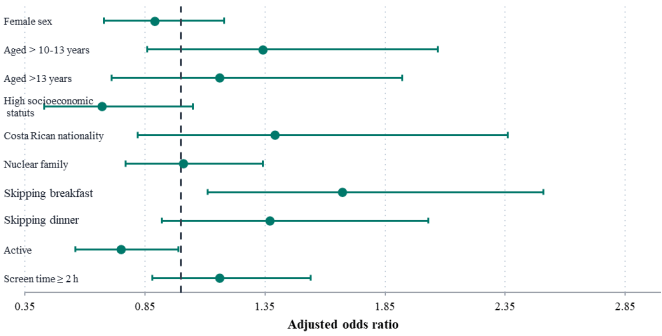
The adjusted model is presented in
Table 6 and
Figure 1. Skipping breakfast was associated with higher likelihood of excess weight after adjustment for sex, age, socioeconomic status, nationality, family structure, skipping dinner, physical activity, and screen time (adjusted OR 1.67; 95% CI 1.11 to 2.51; p = 0.014). Activity on three or more days per week was associated with lower likelihood of excess weight (adjusted OR 0.75; 95% CI 0.56 to 0.99; p = 0.043). No other covariates reached statistical significance. The model included all 900 observations and had limited explanatory power (McFadden pseudo-R-squared = 0.017).
Table 6. Adjusted logistic regression model for excess weight.
Variable | Adjusted OR | 95% CI | p Value |
Female sex versus male | 0.89 | 0.68 to 1.18 | 0.425 |
Older than 10 to 13 years versus 10 years or younger | 1.34 | 0.86 to 2.07 | 0.195 |
Older than 13 years versus 10 years or younger | 1.16 | 0.71 to 1.92 | 0.548 |
High socioeconomic status versus low or middle | 0.67 | 0.43 to 1.05 | 0.081 |
Costa Rican nationality versus other nationalities | 1.39 | 0.82 to 2.36 | 0.216 |
Nuclear family versus other structures | 1.01 | 0.77 to 1.34 | 0.927 |
Skipping breakfast versus eating breakfast | 1.67 | 1.11 to 2.51 | 0.014 |
Skipping dinner versus eating dinner | 1.37 | 0.92 to 2.03 | 0.122 |
Active versus insufficiently active | 0.75 | 0.56 to 0.99 | 0.043 |
Screen time ≥ 2 hours versus < 2 hours | 1.16 | 0.88 to 1.54 | 0.300 |
Figure 1. Adjusted odds ratios for excess weight participants.
Note: Estimates correspond to the multivariate logistic regression model with excess weight as the outcome. Points represent adjusted odds ratios, and horizontal lines represent 95% confidence intervals. The vertical line indicates the null value of OR = 1.0. OR: odds ratio; CI: confidence interval.
In the secondary model, where dichotomous physical activity served as the outcome variable, excess weight and female sex were associated with a lower likelihood of being classified as active. High socioeconomic status showed an estimate consistent with a higher likelihood of engaging in physical activity, although this did not reach statistical significance. In the exploratory model that included the interaction between sex and age group, no statistical evidence of such an interaction was observed. Selected estimates from these models are presented in
Table 7.
Table 7. Selected estimates from the secondary and exploratory models.
Model and variable | Adjusted OR | 95% CI | p Value |
Excess weight versus no excess weight | 0.74 | 0.56 to 0.99 | 0.040 |
Female sex versus male | 0.49 | 0.37 to 0.65 | <0.001 |
Age older than 10 to 13 years versus 10 years or younger | 1.17 | 0.76 to 1.79 | 0.475 |
Age older than 13 years versus 10 years or younger | 1.19 | 0.73 to 1.94 | 0.486 |
High socioeconomic status versus low or middle | 1.52 | 0.96 to 2.39 | 0.071 |
Costa Rican nationality versus other nationalities | 1.46 | 0.88 to 2.41 | 0.139 |
Nuclear family versus other structures | 1.06 | 0.80 to 1.40 | 0.707 |
Screen time ≥ 2 hours versus < 2 hours | 0.89 | 0.67 to 1.18 | 0.425 |
Interaction: female sex and age >10 to 13 years | 1.02 | 0.42 to 2.45 | 0.971 |
Interaction: female sex and age >13 years | 1.82 | 0.68 to 4.92 | 0.235 |
4. Discussion
This study found excess weight in 37.8% of Costa Rican students aged 10 to 15. Engaging in physical activity three or more days per week was associated with lower likelihood of excess weight; screen time was not independently associated; and skipping breakfast was associated with a higher likelihood of excess weight. These findings are consistent with the multifactorial nature of excess weight and with evidence that physical activity, sedentary behavior, diet, and other health habits coexist in complex patterns
| [1] | Arafa, A., Yasui, Y., Kokubo, Y., Kato, Y., Matsumoto, C., Teramoto, M., Nosaka, S., and Kogirima, M. Lifestyle behaviors of childhood and adolescence, contributing factors, health consequences, and potential interventions. American Journal of Lifestyle Medicine. 2024.
https://doi.org/10.1177/15598276241245941 |
| [2] | Blyth, F., Haycraft, E., Peral-Suarez, A., and Pearson, N. Tracking and changes in the clustering of physical activity, sedentary behavior, diet, and sleep across childhood and adolescence, a systematic review. Obesity Reviews. 2025, 26(7), e13909. https://doi.org/10.1111/obr.13909 |
| [6] | Alosaimi, N., Sherar, L. B., Griffiths, P., and Pearson, N. Clustering of diet, physical activity and sedentary behaviour and related physical and mental health outcomes, a systematic review. BMC Public Health. 2023, 23, 1572.
https://doi.org/10.1186/s12889-023-16372-6 |
[1, 2, 6]
.
The prevalence of excess weight observed in this study highlights a significant burden for the participating schools. Costa Rican studies have reported similar high prevalences of overweight and obesity in school-age populations, including 34.2% among students aged 9 to 13 in Heredia and approximately 34% among students aged 6 to 12 in the 2016 School Weight and Height Census
| [17] | Herrera-Monge, M. F., Alvarez Bogantes, C., Sanchez Urena, B., Herrera-Gonzalez, E., Villalobos Viquez, G., and Vargas Tenorio, J. Analysis of overweight and obesity, physical activity levels, and self-esteem in children in the second cycle of primary school in central Heredia, Costa Rica. Population and Health in Mesoamerica. 2019, 17(1).
https://doi.org/10.15517/psm.v17i1.35323 |
[17]
. These statistics should be interpreted with caution due to differences regarding the period, geographic area, age groups, study design, and selection procedures. National BMI and waist-circumference percentiles provide complementary context for interpreting adiposity among Costa Rican students
| [4] | Núñez-Rivas, H. P., Holst-Schumacher, I., Campos-Saborío, N., and López-López, E. Percentiles of body mass index and waist circumference for Costa Rican children and adolescents. Nutrición Hospitalaria. 2022, 39(6), 1228-1236.
https://doi.org/10.20960/nh.04130 |
[4]
.
Skipping breakfast was the principal dietary finding. Its association with higher likelihood of excess weight is consistent with reviews reported in children
| [10] | Wang, K., Niu, Y., Lu, Z., Duo, B., Effah, C. Y., and Guan, L. The effect of breakfast on childhood obesity, a systematic review and meta-analysis. Frontiers in Nutrition. 2023, 10, 1222536. https://doi.org/10.3389/fnut.2023.1222536 |
[10]
. However, evidence from low- and middle-income countries rated the certainty of evidence regarding the link between skipping breakfast and overweight or obesity as very uncertain, primarily due to the predominance of cross-sectional studies and methodological heterogeneity
| [18] | Fischer, J. A. J., Thomas, J., Ierodiakonou, D., van Zutphen-Küffer, K. G., and Garcia-Larsen, V. Breakfast habits, anthropometry, and nutrition-related outcomes in adolescents from low- and middle-income countries, a systematic review and meta-analysis. Campbell Systematic Reviews. 2025, 21(2), e70039. https://doi.org/10.1002/cl2.70039 |
[18]
. The adjusted odds ratio (OR) should not be interpreted as a prevalence ratio or relative risk, particularly because excess weight prevalence was 37.8%. Furthermore, the cross-sectional design of the study does not allow for determining whether skipping breakfast preceded excess weight, whether it reflected attempts at weight control, or whether both conditions shared unmeasured determinants. Intervention evidence also shows small or inconsistent effects on body weight
| [11] | Ricotti, R., Caputo, M., Monzani, A., Pigni, S., Antoniotti, V., Bellone, S., and Prodam, F. Breakfast skipping, weight, cardiometabolic risk, and nutrition quality in children and adolescents, a systematic review of randomized controlled and intervention longitudinal trials. Nutrients. 2021, 13(10), 3331. https://doi.org/10.3390/nu13103331 |
[11]
.
Unlike the findings regarding breakfast, skipping dinner was not statistically associated with excess weight, although the adjusted OR was greater than one. This difference suggests that the various meals should not be considered equivalent exposures, as their significance may vary depending on school schedules, family organization, food availability, sleep patterns, and daily energy distribution. Furthermore, the relatively small number of students who skipped breakfast or dinner may have limited the precision of the estimates. Overall, these results support the need to study meal regularity as part of the daily organization of habits, rather than as isolated rules in which skipping any main meal carries the same biological or social significance. Following the dietary results, the physical activity association also requires an operational interpretation rather than a causal one.
Engaging in physical activity three or more days a week was associated with a lower likelihood of being overweight. This finding aligns with longitudinal and experimental evidence linking higher levels of physical activity to more favorable adiposity indicators in children and adolescents
| [19] | Georgoulis, M., Grapsa, I., Arnaoutis, G., Bountziouka, V., Karachaliou, A., Saltaouras, G., Bathrellou, E., Yannakoulia, M., Dimitrakopoulos, G., and Kontogianni, M. D. Association between physical activity and indicators of overweight or obesity and metabolically unhealthy obesity risk in children and adolescents, a systematic review of prospective epidemiological studies and randomized controlled trials in Western countries. Obesity Reviews. 2026, 27(1), e70014.
https://doi.org/10.1111/obr.70014 |
[19]
. It is also consistent with evidence from Costa Rica regarding the biopsychosocial factors associated with active or sedentary lifestyles in this population, reinforcing the need to view physical activity as a behavior influenced by family, school, and social environments, rather than merely as an individual choice
| [20] | Núñez-Rivas, H. P., Holst-Schumacher, I., Guzmán-Padilla, S., Roselló-Araya, M., and Campos-Saborío, N. Biopsychosocial factors associated with active or sedentary lifestyles of children and adolescents in Costa Rica. Advances in Physical Education. 2020, 10(4), 476-491.
https://doi.org/10.4236/ape.2020.104037 |
[20]
. However, the observed magnitude was moderate and close to the conventional threshold for statistical significance. Furthermore, the variable used reflects weekly frequency rather than adherence to international recommendations, as it did not simultaneously account for duration and intensity. Consequently, the result should be interpreted as an association specific to the operational definition employed.
The lack of an association regarding the criterion of at least 60 minutes of physical activity per day and the integrated classification does not necessarily contradict the association observed with weekly frequency. Physical activity is multidimensional behavior, and its relationship with adiposity may vary depending on intensity, daily accumulation, context, seasonality, and measurement precision. The review by Georgoulis et al.
| [19] | Georgoulis, M., Grapsa, I., Arnaoutis, G., Bountziouka, V., Karachaliou, A., Saltaouras, G., Bathrellou, E., Yannakoulia, M., Dimitrakopoulos, G., and Kontogianni, M. D. Association between physical activity and indicators of overweight or obesity and metabolically unhealthy obesity risk in children and adolescents, a systematic review of prospective epidemiological studies and randomized controlled trials in Western countries. Obesity Reviews. 2026, 27(1), e70014.
https://doi.org/10.1111/obr.70014 |
[19]
demonstrated that findings are more consistent when specific exposures and objective measurements are used, although prospective evidence remains heterogeneous and susceptible to confounding factors. Furthermore, the integrated classification used in this study was operational in nature and may have grouped heterogeneous exposures into a single category, thereby reducing the ability to detect gradients of association.
Screen time of two or more hours per day was not significantly associated with excess weight after adjustment. This result is consistent with studies linking screen time to less favorable dietary habits without showing an independent association with nutritional status
| [8] | Myszkowska-Ryciak, J., Harton, A., Lange, E., Laskowski, W., Wawrzyniak, A., Hamułka, J., and Gajewska, D. Reduced screen time is associated with healthy dietary behaviors but not body weight status among Polish adolescents. Nutrients. 2020, 12(5), 1323. https://doi.org/10.3390/nu12051323 |
| [9] | Rocka, A., Jasielska, F., Madras, D., Krawiec, P., and Pac-Kożuchowska, E. The impact of digital screen time on dietary habits and physical activity in children and adolescents. Nutrients. 2022, 14(14), 2985. https://doi.org/10.3390/nu14142985 |
[8, 9]
, as well as with a meta-analysis that found no significant association between screen time and the likelihood of central obesity, although waist circumference was greater in groups with higher exposure
| [21] | Ghasemirad, M., Ketabi, L., Fayyazishishavan, E., Hojati, A., Hosseinzadeh Maleki, Z., Gerami, M. H., Moradzadeh, M., Ortiz Fernandez, J. H., and Akhavan-Sigari, R. The association between screen use and central obesity among children and adolescents, a systematic review and meta-analysis. Journal of Health, Population and Nutrition. 2023, 42, 51.
https://doi.org/10.1186/s41043-023-00391-5 |
[21]
. However, it contrasts with meta-analyses reporting positive associations between higher screen time categories and overweight or obesity
| [7] | Haghjoo, P., Siri, G., Soleimani, E., Farhangi, M. A., and Alesaeidi, S. Screen time increases overweight and obesity risk among adolescents, a systematic review and dose-response meta-analysis. BMC Primary Care. 2022, 23, 161.
https://doi.org/10.1186/s12875-022-01761-4 |
| [22] | Byun, D., Kim, Y., Jang, H., and Oh, H. Screen time and obesity prevalence in adolescents, an isotemporal substitution analysis. BMC Public Health. 2024, 24, 3130.
https://doi.org/10.1186/s12889-024-20639-x |
[7, 22]
. These discrepancies could be explained by differences in measurement, cut-off points, age, context, screen content, and the activities displaced by sedentary time.
The absence of an independent association does not imply that screen time is irrelevant to health. Screen use may be linked to eating while viewing content, exposure to food advertising, poorer diet quality, the displacement of physical activity, and sleep disturbances. Therefore, physical activity should not be conceptualized as an automatic offset for sedentary time, nor should it be assumed that reducing screen time guarantees enough movement
| [2] | Blyth, F., Haycraft, E., Peral-Suarez, A., and Pearson, N. Tracking and changes in the clustering of physical activity, sedentary behavior, diet, and sleep across childhood and adolescence, a systematic review. Obesity Reviews. 2025, 26(7), e13909. https://doi.org/10.1111/obr.13909 |
| [9] | Rocka, A., Jasielska, F., Madras, D., Krawiec, P., and Pac-Kożuchowska, E. The impact of digital screen time on dietary habits and physical activity in children and adolescents. Nutrients. 2022, 14(14), 2985. https://doi.org/10.3390/nu14142985 |
[2, 9]
.
The secondary model showed that students with excess weight were less likely to be classified as active and that female sex was associated with lower physical activity. These results should be interpreted with caution, as the relationship between adiposity and physical activity could be bidirectional. Lower activity levels might contribute to excess weight, but excess weight can also hinder participation in certain forms of physical activity due to physical, social, or stigma-related barriers. The exploratory model yielded no statistical evidence of an interaction between sex and age group; however, the wide confidence intervals make it inappropriate to interpret this result as indicating equivalence between the subgroups.
Sociodemographic variables did not reach statistical significance in the adjusted model. High socioeconomic status showed an estimate consistent with a lower probability of excess weight, but the confidence interval included the null value. Literature on behavioral clustering indicates that socioeconomic position may be related to patterns of physical activity, sedentary behavior, diet, and sleep, although the direction of these associations varies depending on the context and developmental stage
| [2] | Blyth, F., Haycraft, E., Peral-Suarez, A., and Pearson, N. Tracking and changes in the clustering of physical activity, sedentary behavior, diet, and sleep across childhood and adolescence, a systematic review. Obesity Reviews. 2025, 26(7), e13909. https://doi.org/10.1111/obr.13909 |
| [6] | Alosaimi, N., Sherar, L. B., Griffiths, P., and Pearson, N. Clustering of diet, physical activity and sedentary behaviour and related physical and mental health outcomes, a systematic review. BMC Public Health. 2023, 23, 1572.
https://doi.org/10.1186/s12889-023-16372-6 |
[2, 6]
. The dichotomization of socioeconomic status and the small size of some nationality categories may have attenuated the differences. Therefore, the lack of statistical significance should not be interpreted as an absence of social inequalities, but rather as insufficient evidence to demonstrate them given the available variables and subgroup sizes.
The explaining power of the models was low, indicating that the measured variables captured only a limited proportion of individual variability in excess weight. Variables not included in the study, such as energy intake, overall diet quality, sleep, pubertal maturation, mental health, family history, school food environments, and structural opportunities for physical activity may con-found or modify the observed associations.
4.1. Strengths and Limitations
The study’s strengths include its sample size, inclusion of primary and secondary school students, standardized anthropometric measurements, and simultaneous adjustment for sociodemographic, dietary, and behavioral variables. World Health Organization age- and sex-specific standards supported appropriate BMI classification during growth. Separating physical activity from screen time avoided treating these behaviors as reciprocal, while excluding anthropometric indicators closely linked to the outcome reduced conceptual circularity. Primary, secondary, and exploratory models were clearly distinguished so that supplementary analyses did not change the main interpretation.
The study also has limitations. The cross-sectional design precludes the establishment of temporal and causal relationships and leaves open the possibility of reverse causality. Physical activity, screen time, and meal regularity were assessed via self-report; consequently, the data may be subject to recall errors, social desirability bias, and classification errors. Dichotomizing physical activity and screen time facilitated interpretation but resulted in a loss of information and may have masked dose-response associations or non-linear relationships. Furthermore, the analysis was conducted on the available sample; therefore, the generalization of the results should be limited to populations with characteristics comparable to those of the participating schools.
4.2. Implications for School Health
The findings support a school health response focused on environments and multiple behaviors, rather than placing individual responsibility for weight on students. Breakfast can serve as a practical point of intervention, but available evidence does not justify limiting prevention efforts to simply recommending its consumption. Nutritional quality, access, scheduling, sleep, family support, and school conditions must also be considered. At the same time, schools can expand opportunities for daily movement, making it safe and enjoyable for the children, alongside balanced strategies for electronic screen use.
Multicomponent school-based programs can be particularly relevant when they integrate nutrition, physical activity, sleep, electronic screen use, and aspects of the school environment
| [23] | Hassan, M. A., McDonough, D. J., Ryu, S., Zhou, W., Oginni, J., and Gao, Z. Comparative effectiveness of school-based obesity prevention programs for children and adolescents, a systematic review and network meta-analysis. Frontiers in Public Health. 2024, 12, 1504279.
https://doi.org/10.3389/fpubh.2024.1504279 |
| [24] | Nikooyeh, B., Yari, Z., Hariri, Z., Baghdadi, G., Yazdani, H., Motlagh, M. E., and Neyestani, T. R. Which school-based interventions work better to combat obesity in children, a network meta-analysis. Systematic Reviews. 2025, 14, 125.
https://doi.org/10.1186/s13643-025-02871-7 |
[23, 24]
. Consequently, the implications of the present study should be understood as a basis for designing and evaluating contextualized interventions, rather than as evidence of the efficacy of a specific intervention.
5. Conclusions
Near 37.8% of Costa Rican students aged 10 to 15 studied in this sample had excess weight. The research question was answered by two adjusted associations: skipping breakfast was associated with higher likelihood of excess weight, whereas physical activity on three or more days per week was associated with lower likelihood of excess weight. Screen time was not independently associated with excess weight. These cross-sectional findings of the study do not establish causality or temporal order. These observations support the need for longitudinal studies, objective measures of physical activity, and more detailed assessment of screen exposure, sleep, dietary quality, pubertal maturation, and school and family environments. School health politics should evaluate multicomponent, non-stigmatizing strategies that support regular eating routines, opportunities for movement, and balanced screen use.
Abbreviations
AIC | Akaike Information Criterion |
BMI | Body Mass Index |
CI | Confidence Interval |
OR | Odds Ratio |
SD | Standard Deviation |
SPSS | Statistical Package for Social Sciences |
STROBE | Strengthening the Reporting of Observational Studies in Epidemiology |
WHO | World Health Organization |
Acknowledgments
The authors thank the students who participated in the study, as well as their mothers, fathers, or legal guardians for authorizing and supporting their participation. They also thank the principals and staff of the participating schools for facilitating the coordination and execution of the fieldwork. Furthermore, the collaboration of students from the Hispanoamerican University and the University of Costa Rica is acknowledged for their operational support in data collection activities and other logistical processes of the study.
Author Contributions
Marlene Roselló-Araya: Conceptualization, Data curation, Formal Analysis, Investigation, Methodology, Project administration, Writing – original draft, Writing – review & editing
Hilda Patricia Núñez-Rivas: Conceptualization, Formal Analysis, Investigation, Methodology, Supervision, Writing – original draft, Writing – review & editing
Ileana Holst-Schumacher: Formal Analysis, Methodology, Supervision, Validation, Writing – review & editing
Funding
The study was conducted with institutional resources from the University of Costa Rica and the Costa Rican Institute of Research and Education on Nutrition and Health (INCIENSA).
Data Availability Statement
The data supporting the outcome of this research is not available to the public because of institutional confidentiality requirements. Reasonable requests may be considered by the corresponding author and the institutions involved, with previous approval of the Ethics Committees.
Conflicts of Interest
The authors declare no conflicts of interest.
References
| [1] |
Arafa, A., Yasui, Y., Kokubo, Y., Kato, Y., Matsumoto, C., Teramoto, M., Nosaka, S., and Kogirima, M. Lifestyle behaviors of childhood and adolescence, contributing factors, health consequences, and potential interventions. American Journal of Lifestyle Medicine. 2024.
https://doi.org/10.1177/15598276241245941
|
| [2] |
Blyth, F., Haycraft, E., Peral-Suarez, A., and Pearson, N. Tracking and changes in the clustering of physical activity, sedentary behavior, diet, and sleep across childhood and adolescence, a systematic review. Obesity Reviews. 2025, 26(7), e13909.
https://doi.org/10.1111/obr.13909
|
| [3] |
World Health Organization. Growth reference data for 5 to 19 years: BMI-for-age. 2007. Available from:
https://www.who.int/tools/growth-reference-data-for-5to19-years/indicators/bmi-for-age
(accessed 13 August 2026).
|
| [4] |
Núñez-Rivas, H. P., Holst-Schumacher, I., Campos-Saborío, N., and López-López, E. Percentiles of body mass index and waist circumference for Costa Rican children and adolescents. Nutrición Hospitalaria. 2022, 39(6), 1228-1236.
https://doi.org/10.20960/nh.04130
|
| [5] |
Nagata, J. M., Smith, N., Alsamman, S., Lee, C. M., Dooley, E. E., Kiss, O., Ganson, K. T., Wing, D., Baker, F. C., and Gabriel, K. P. Association of physical activity and screen time with body mass index among US adolescents. JAMA Network Open. 2023, 6(2), e2255466.
https://doi.org/10.1001/jamanetworkopen.2022.55466
|
| [6] |
Alosaimi, N., Sherar, L. B., Griffiths, P., and Pearson, N. Clustering of diet, physical activity and sedentary behaviour and related physical and mental health outcomes, a systematic review. BMC Public Health. 2023, 23, 1572.
https://doi.org/10.1186/s12889-023-16372-6
|
| [7] |
Haghjoo, P., Siri, G., Soleimani, E., Farhangi, M. A., and Alesaeidi, S. Screen time increases overweight and obesity risk among adolescents, a systematic review and dose-response meta-analysis. BMC Primary Care. 2022, 23, 161.
https://doi.org/10.1186/s12875-022-01761-4
|
| [8] |
Myszkowska-Ryciak, J., Harton, A., Lange, E., Laskowski, W., Wawrzyniak, A., Hamułka, J., and Gajewska, D. Reduced screen time is associated with healthy dietary behaviors but not body weight status among Polish adolescents. Nutrients. 2020, 12(5), 1323.
https://doi.org/10.3390/nu12051323
|
| [9] |
Rocka, A., Jasielska, F., Madras, D., Krawiec, P., and Pac-Kożuchowska, E. The impact of digital screen time on dietary habits and physical activity in children and adolescents. Nutrients. 2022, 14(14), 2985.
https://doi.org/10.3390/nu14142985
|
| [10] |
Wang, K., Niu, Y., Lu, Z., Duo, B., Effah, C. Y., and Guan, L. The effect of breakfast on childhood obesity, a systematic review and meta-analysis. Frontiers in Nutrition. 2023, 10, 1222536.
https://doi.org/10.3389/fnut.2023.1222536
|
| [11] |
Ricotti, R., Caputo, M., Monzani, A., Pigni, S., Antoniotti, V., Bellone, S., and Prodam, F. Breakfast skipping, weight, cardiometabolic risk, and nutrition quality in children and adolescents, a systematic review of randomized controlled and intervention longitudinal trials. Nutrients. 2021, 13(10), 3331.
https://doi.org/10.3390/nu13103331
|
| [12] |
von Elm, E., Altman, D. G., Egger, M., Pocock, S. J., Gøtzsche, P. C., and Vandenbroucke, J. P. The Strengthening the Reporting of Observational Studies in Epidemiology statement, guidelines for reporting observational studies. PLoS Medicine. 2007, 4(10), e296.
https://doi.org/10.1371/journal.pmed.0040296
|
| [13] |
Costa Rican Social Security Fund, Medical Management, Department for Health Services Development. Manual of procedures for nutrition services in health areas. Available from:
https://www.binasss.sa.cr/protocolos/manualnutricion.pdf
(accessed 13 August 2026).
|
| [14] |
Ministry of Health of Costa Rica. National standard for the use of anthropometric charts for nutritional assessment from 0 to 19 years. Available from:
https://surl.li/wosveo
(accessed 13 August 2026).
|
| [15] |
Legislative Assembly of the Republic of Costa Rica. Biomedical Research Regulatory Law, Law No. 9234. Available from:
https://www.mep.go.cr/sites/default/files/2022-07/ley-9234-regulacionn-investigacion-biomedica.pdf
(accessed 13 August 2026).
|
| [16] |
Executive Power of the Republic of Costa Rica. Regulations to the Biomedical Research Regulatory Law, Executive Decree No. 39061-S. Official Paper La Gaceta No. 138. 17 July 2015. Available from:
https://cec.ucr.ac.cr/sites/default/files/documents/reglamento_de_la_ley_9234_-_ley_reguladora_de_investigacion_biomedica.pdf
(accessed 13 August 2026).
|
| [17] |
Herrera-Monge, M. F., Alvarez Bogantes, C., Sanchez Urena, B., Herrera-Gonzalez, E., Villalobos Viquez, G., and Vargas Tenorio, J. Analysis of overweight and obesity, physical activity levels, and self-esteem in children in the second cycle of primary school in central Heredia, Costa Rica. Population and Health in Mesoamerica. 2019, 17(1).
https://doi.org/10.15517/psm.v17i1.35323
|
| [18] |
Fischer, J. A. J., Thomas, J., Ierodiakonou, D., van Zutphen-Küffer, K. G., and Garcia-Larsen, V. Breakfast habits, anthropometry, and nutrition-related outcomes in adolescents from low- and middle-income countries, a systematic review and meta-analysis. Campbell Systematic Reviews. 2025, 21(2), e70039.
https://doi.org/10.1002/cl2.70039
|
| [19] |
Georgoulis, M., Grapsa, I., Arnaoutis, G., Bountziouka, V., Karachaliou, A., Saltaouras, G., Bathrellou, E., Yannakoulia, M., Dimitrakopoulos, G., and Kontogianni, M. D. Association between physical activity and indicators of overweight or obesity and metabolically unhealthy obesity risk in children and adolescents, a systematic review of prospective epidemiological studies and randomized controlled trials in Western countries. Obesity Reviews. 2026, 27(1), e70014.
https://doi.org/10.1111/obr.70014
|
| [20] |
Núñez-Rivas, H. P., Holst-Schumacher, I., Guzmán-Padilla, S., Roselló-Araya, M., and Campos-Saborío, N. Biopsychosocial factors associated with active or sedentary lifestyles of children and adolescents in Costa Rica. Advances in Physical Education. 2020, 10(4), 476-491.
https://doi.org/10.4236/ape.2020.104037
|
| [21] |
Ghasemirad, M., Ketabi, L., Fayyazishishavan, E., Hojati, A., Hosseinzadeh Maleki, Z., Gerami, M. H., Moradzadeh, M., Ortiz Fernandez, J. H., and Akhavan-Sigari, R. The association between screen use and central obesity among children and adolescents, a systematic review and meta-analysis. Journal of Health, Population and Nutrition. 2023, 42, 51.
https://doi.org/10.1186/s41043-023-00391-5
|
| [22] |
Byun, D., Kim, Y., Jang, H., and Oh, H. Screen time and obesity prevalence in adolescents, an isotemporal substitution analysis. BMC Public Health. 2024, 24, 3130.
https://doi.org/10.1186/s12889-024-20639-x
|
| [23] |
Hassan, M. A., McDonough, D. J., Ryu, S., Zhou, W., Oginni, J., and Gao, Z. Comparative effectiveness of school-based obesity prevention programs for children and adolescents, a systematic review and network meta-analysis. Frontiers in Public Health. 2024, 12, 1504279.
https://doi.org/10.3389/fpubh.2024.1504279
|
| [24] |
Nikooyeh, B., Yari, Z., Hariri, Z., Baghdadi, G., Yazdani, H., Motlagh, M. E., and Neyestani, T. R. Which school-based interventions work better to combat obesity in children, a network meta-analysis. Systematic Reviews. 2025, 14, 125.
https://doi.org/10.1186/s13643-025-02871-7
|
Cite This Article
-
APA Style
Roselló-Araya, M., Núñez-Rivas, H. P., Holst-Schumacher, I. (2026). Excess Weight and Its Association with Physical Activity, Electronic Screen Time, and Meal Regularity Among Costa Rican Students Aged 10 to 15. International Journal of Nutrition and Food Sciences, 15(5), 199-210. https://doi.org/10.11648/j.ijnfs.20261505.13
 Copy
|
Copy
|
 Download
ACS Style
Roselló-Araya, M.; Núñez-Rivas, H. P.; Holst-Schumacher, I. Excess Weight and Its Association with Physical Activity, Electronic Screen Time, and Meal Regularity Among Costa Rican Students Aged 10 to 15. Int. J. Nutr. Food Sci. 2026, 15(5), 199-210. doi: 10.11648/j.ijnfs.20261505.13
Copy
|
Download
AMA Style
Roselló-Araya M, Núñez-Rivas HP, Holst-Schumacher I. Excess Weight and Its Association with Physical Activity, Electronic Screen Time, and Meal Regularity Among Costa Rican Students Aged 10 to 15. Int J Nutr Food Sci. 2026;15(5):199-210. doi: 10.11648/j.ijnfs.20261505.13
Copy
|
Download
-
@article{10.11648/j.ijnfs.20261505.13,
  author = {Marlene Roselló-Araya and Hilda Patricia Núñez-Rivas and Ileana Holst-Schumacher},
  title = {Excess Weight and Its Association with Physical Activity, Electronic Screen Time, and Meal Regularity Among Costa Rican Students Aged 10 to 15},
  journal = {International Journal of Nutrition and Food Sciences},
  volume = {15},
  number = {5},
  pages = {199-210},
  doi = {10.11648/j.ijnfs.20261505.13},
  url = {https://doi.org/10.11648/j.ijnfs.20261505.13},
  eprint = {https://article.sciencepublishinggroup.com/pdf/10.11648.j.ijnfs.20261505.13},
  abstract = {Background: Excess weight and behaviors related to physical activity, electronic screen use, and dietary habits are interrelated dimensions of youth health. Objective: To determine whether excess weight was associated with physical activity frequency, electronic screen time, and meal regularity among Costa Rican students aged 10 to 15. Method: A cross-sectional study was conducted with 900 students from 15 schools in Montes de Oca, Costa Rica. Excess weight—defined as overweight or obesity—was classified according to the World Health Organization's body mass index-for-age reference criteria. Prevalence, bivariate associations, and adjusted odds ratios were estimated using binary logistic regression. Results: The prevalence of excess weight was 37.8%. Skipping breakfast was associated with a higher likelihood of excess weight after adjusting for sex, age, socioeconomic status, nationality, family structure, skipping dinner, physical activity, and electronic screen time (adjusted OR: 1.67; 95% CI: 1.11-2.51). Engaging in physical activity three or more days a week was associated with a lower likelihood of excess weight (adjusted OR: 0.75; 95% CI: 0.56-0.99). Electronic screen time of two or more hours per day did not show an independent association. Conclusions: In this school-based sample, excess weight was associated with skipping breakfast and a lower weekly frequency of physical activity. Due to the cross-sectional design, the findings should be interpreted as simultaneous associations rather than causal or temporal relationships.},
 year = {2026}
}
Copy
|
Download
-
TY  - JOUR
T1  - Excess Weight and Its Association with Physical Activity, Electronic Screen Time, and Meal Regularity Among Costa Rican Students Aged 10 to 15
AU  - Marlene Roselló-Araya
AU  - Hilda Patricia Núñez-Rivas
AU  - Ileana Holst-Schumacher
Y1  - 2026/09/18
PY  - 2026
N1  - https://doi.org/10.11648/j.ijnfs.20261505.13
DO  - 10.11648/j.ijnfs.20261505.13
T2  - International Journal of Nutrition and Food Sciences
JF  - International Journal of Nutrition and Food Sciences
JO  - International Journal of Nutrition and Food Sciences
SP  - 199
EP  - 210
PB  - Science Publishing Group
SN  - 2327-2716
UR  - https://doi.org/10.11648/j.ijnfs.20261505.13
AB  - Background: Excess weight and behaviors related to physical activity, electronic screen use, and dietary habits are interrelated dimensions of youth health. Objective: To determine whether excess weight was associated with physical activity frequency, electronic screen time, and meal regularity among Costa Rican students aged 10 to 15. Method: A cross-sectional study was conducted with 900 students from 15 schools in Montes de Oca, Costa Rica. Excess weight—defined as overweight or obesity—was classified according to the World Health Organization's body mass index-for-age reference criteria. Prevalence, bivariate associations, and adjusted odds ratios were estimated using binary logistic regression. Results: The prevalence of excess weight was 37.8%. Skipping breakfast was associated with a higher likelihood of excess weight after adjusting for sex, age, socioeconomic status, nationality, family structure, skipping dinner, physical activity, and electronic screen time (adjusted OR: 1.67; 95% CI: 1.11-2.51). Engaging in physical activity three or more days a week was associated with a lower likelihood of excess weight (adjusted OR: 0.75; 95% CI: 0.56-0.99). Electronic screen time of two or more hours per day did not show an independent association. Conclusions: In this school-based sample, excess weight was associated with skipping breakfast and a lower weekly frequency of physical activity. Due to the cross-sectional design, the findings should be interpreted as simultaneous associations rather than causal or temporal relationships.
VL  - 15
IS  - 5
ER  -
Copy
|
Download





 Share This Article
 Twitter
 Linked In
 Facebook