
 ,
Amadou Sidibe,
Abdoulaye Tall,
Moussa Camara,
Abdourahmane Diallo,
Abdoul Kadri Diallo,
Saliou Bolarinwa Ogou
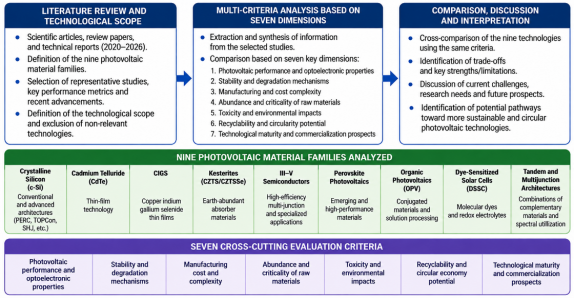
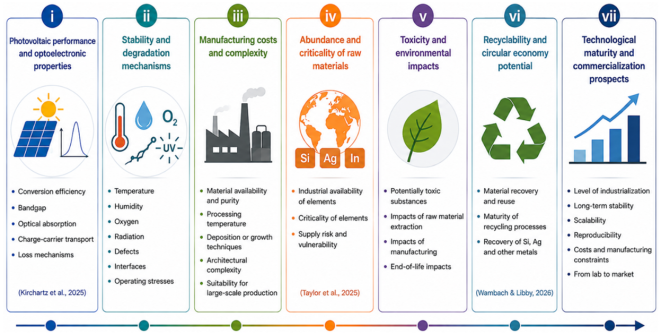
The increasing diversification of photovoltaic technologies generates more and more questions about their performance, dependability and sustainability. This review is centered on a comparative overview of nine families of photovoltaic technologies: crystalline silicon (c-Si), CdTe, CIGS, kesterites (CZTS/CZTSSe), III-V semiconductors, perovskites, organic photovoltaics (OPV), dye-sensitized solar cells (DSSC) and tandem architectures. The study takes a qualitative approach based on seven criteria, including photovoltaic performance and optoelectronic qualities, stability, manufacturing costs and complexity, resource availability and criticality, toxicity and environmental implications, recyclability, and technological maturity. The comparison demonstrates that c-Si presents the best compromise between performance, stability and industrial maturity, whereas III–V and tandem technologies are known for their high efficiencies but suffer from cost, manufacturing or stability issues. Emerging technologies have the potential to complement each other, but their implementation is still limited by technological and industrial challenges. This cross-cutting approach further emphasizes the connection of these criteria, in particular between stability, resource use and sustainability. It also states that performance data acquired under different testing conditions may not always allow a straight comparison between technologies. These results emphasize the need for a holistic study of the trade-offs among performance, dependability, material limitations, and environmental impact to guide future developments of solar technology.
| Published in | International Journal of Materials Science and Applications (Volume 15, Issue 5) |
| DOI | 10.11648/j.ijmsa.20261505.11 |
| Page(s) | 163-174 |
| Creative Commons |
This is an Open Access article, distributed under the terms of the Creative Commons Attribution 4.0 International License (http://creativecommons.org/licenses/by/4.0/), which permits unrestricted use, distribution and reproduction in any medium or format, provided the original work is properly cited. |
| Copyright |
Copyright © The Author(s), 2026. Published by Science Publishing Group |
Photovoltaics Materials, Photovoltaic Technologies, Multi-criteria Analysis, Stability, Critical Resources, Circularity, Sustainability
Technology | Performance | Stability | Manufacturing / Cost | Technological Maturity | Key References |
|---|---|---|---|---|---|
c-Si | Very high | Very high | Highly competitive | Very high | [4, 6, 22] |
CdTe | High | High | Competitive | High | [25, 26, 29] |
CIGS | High | High | Relatively complex | High / Intermediate | [31-34] |
CZTS/CZTSSe | Intermediate | Requires further improvement | Potentially favorable | Emerging | [38, 42, 46] |
III–V | Exceptional | Very high | Very expensive | High, specialized markets | [52-54] |
Perovskites | Very high | Requires further improvement | High potential | Pre-industrial | [56, 58] |
OPV | High | Needs improvement | Potential for printing-based manufacturing | Pre-commercial | [65, 71, 72] |
DSSC | Moderate under sunlight** | Intermediate | Potentially simple | Niche applications | [73, 75, 87] |
Perovskite/Si tandem | Exceptional | Requires further improvement | More complex | Approaching industrialization | [56, 58] |
Technology | Material Resources | Environmental Considerations | Recyclability | Key References |
|---|---|---|---|---|
c-Si | Abundant Si; Ag/In supply requires monitoring | Relatively favorable | Highly advanced | [4, 6, 22] |
CdTe | Te supply constraints | Cd-related concerns require management | Advanced | [25, 26, 29, 30] |
CIGS | In/Ga supply constraints | Possible use of CdS | High potential | [31, 32, 36, 37] |
CZTS/CZTSSe | More abundant Zn/Sn | Potentially favorable | Limited development | [38, 42, 46, 48, 51] |
III–V | Ga/In supply constraints | As-related concerns depending on architecture | Limited; substrate reuse is possible | [52-55] |
Perovskites | Low absorber material requirements | Pb-related concerns require management | Under development | [3, 91, 92] |
OPV | Relatively favorable | Solvent use and synthesis processes must be considered | Poorly documented / limited development | [14, 65, 66, 71] |
DSSC | Ru/Pt depending on architecture | Variable | Limited development | [75] |
Perovskite/Si tandem | Abundant Si; Pb and contact materials require monitoring | Pb-related concerns depending on composition | Emerging | [56, 57, 80, 88] |
ACV / LCA | Life Cycle Assessment |
BHJ | Bulk Heterojunction |
c-Si | Crystalline Silicon |
CIGS | Copper Indium Gallium Selenide |
CZTS | Copper Zinc Tin Sulfide |
CZTSe | Copper Zinc Tin Selenide |
CZTSSe | Copper Zinc Tin Sulfur Selenide |
DSSC | Dye-Sensitized Solar Cell |
ELO | Epitaxial Lift-Off |
HJT | Heterojunction Technology |
LeTID | Light and Elevated Temperature-Induced Degradation |
LID | Light-Induced Degradation |
MBE | Molecular Beam Epitaxy |
MOCVD | Metal-Organic Chemical Vapor Deposition |
MOVPE | Metal-Organic Vapor Phase Epitaxy |
NFA | Non-Fullerene Acceptor |
NFREA | Non-Fused Ring Electron Acceptor |
OPV | Organic Photovoltaics |
PERC | Passivated Emitter and Rear Cell |
PID | Potential-Induced Degradation |
PSC | Perovskite Solar Cell |
PV | Photovoltaic |
SHJ | Silicon Heterojunction |
TOPCon | Tunnel Oxide Passivated Contact |
| [1] | A. O. Ali et al., « Advancements in photovoltaic technology: A comprehensive review of recent advances and future prospects », Energy Conversion and Management: X, vol. 26, p. 100952, avr. 2025, |
| [2] | D. Intal et A. Ebong, « Thin-Film Solar Photovoltaics: Trends and Future Directions », in 2024 IEEE 21st International Conference on Smart Communities: Improving Quality of Life using AI, Robotics and IoT (HONET), Doha, Qatar: IEEE, déc. 2024, p. 135‑142. |
| [3] | A. Machín et F. Márquez, « Advancements in Photovoltaic Cell Materials: Silicon, Organic, and Perovskite Solar Cells », Materials, vol. 17, no 5, p. 1165, mars 2024, |
| [4] | A. M. Oni, A. S. M. Mohsin, Md. M. Rahman, et M. B. Hossain Bhuian, « A comprehensive evaluation of solar cell technologies, associated loss mechanisms, and efficiency enhancement strategies for photovoltaic cells », Energy Reports, vol. 11, p. 3345‑3366, juin 2024, |
| [5] | M. Cellura, L. Q. Luu, F. Guarino, et S. Longo, « A review on life cycle environmental impacts of emerging solar cells », Science of The Total Environment, vol. 908, p. 168019, janv. 2024, |
| [6] | N. Taylor, K. Teodor, C. Anatoli, et S. Carrara, Deep dive on critical raw materials for solar photovoltaics in the EU. LU: Publications Office, 2025. |
| [7] | H. Akram Cheema, S. Ilyas, H. Kang, et H. Kim, « Comprehensive review of the global trends and future perspectives for recycling of decommissioned photovoltaic panels », Waste Management, vol. 174, p. 187‑202, febr 2024, |
| [8] | K. Komoto et al., « Status of PV Module Recycling in IEA PVPS Task 12 Countries », IEA Photovoltaic Power Systems Programme, 2025. |
| [9] | T. Kirchartz, G. Yan, Y. Yuan, B. K. Patel, D. Cahen, et P. K. Nayak, « The state of the art in photovoltaic materials and device research », Nat Rev Mater, vol. 10, no 5, p. 335‑354, mars 2025, |
| [10] | Y. H. Sim, M. J. Yun, L. Fauzan, H. Choi, D. Y. Lee, et S. I. Cha, « Design strategies for energy-harvesting photovoltaics in diverse environments », iScience, vol. 28, no 9, p. 113312, sept. 2025, |
| [11] | K. Wambach et C. Libby, « Advances in Photovoltaic Module Recycling: Third Update to Empirical Life Cycle Inventory Data », International Energy Agency Photovoltaic Power Systems Programme, 2026. |
| [12] | C. Ballif, F.-J. Haug, M. Boccard, P. J. Verlinden, et G. Hahn, « Status and perspectives of crystalline silicon photovoltaics in research and industry », Nat Rev Mater, vol. 7, no 8, p. 597‑616, mars 2022, |
| [13] | H. Lin et al., « Silicon heterojunction solar cells with up to 26.81% efficiency achieved by electrically optimized nanocrystalline-silicon hole contact layers », Nat Energy, vol. 8, no 8, p. 789‑799, mai 2023, |
| [14] | G. Wang et al., « 27.09%-efficiency silicon heterojunction back contact solar cell and going beyond », Nat Commun, vol. 15, no 1, p. 8931, oct. 2024, |
| [15] | L. Ning, L. Song, et J. Zhang, « Research progress of light and elevated temperature-induced degradation in silicon solar cells: A review », Journal of Alloys and Compounds, vol. 912, p. 165120, aug. 2022, |
| [16] | A. Diggs et al., « Hydrogen-induced degradation dynamics in silicon heterojunction solar cells via machine learning », Commun Mater, vol. 4, no 1, p. 24, avr. 2023, |
| [17] | C. Sen et al., « Accelerated damp-heat testing at the cell-level of bifacial silicon HJT, PERC and TOPCon solar cells using sodium chloride », Solar Energy Materials and Solar Cells, vol. 262, p. 112554, oct. 2023, |
| [18] | C. Sen et al., « Buyer aware: Three new failure modes in TOPCon modules absent from PERC technology », Solar Energy Materials and Solar Cells, vol. 272, p. 112877, aug. 2024, |
| [19] | S. Tepner et A. Lorenz, « Printing technologies for silicon solar cell metallization: A comprehensive review », Progress in Photovoltaics, vol. 31, no 6, p. 557‑590, juin 2023, |
| [20] | C. Xu, O. Isabella, et M. R. Vogt, « Future material demand for global silicon-based PV modules under net-zero emissions target until 2050 », Resources, Conservation and Recycling, vol. 210, p. 107824, nov. 2024, |
| [21] | M. Fan, Z. Yu, W. Ma, et L. Li, « Life Cycle Assessment of Crystalline Silicon Wafers for Photovoltaic Power Generation », Silicon, vol. 13, no 9, p. 3177‑3189, sept. 2021, |
| [22] | S. Preet et S. T. Smith, « A comprehensive review on the recycling technology of silicon based photovoltaic solar panels: Challenges and future outlook », Journal of Cleaner Production, vol. 448, p. 141661, avr. 2024, |
| [23] | J. Lee, N. Duffy, et J. Allen, « A Review of End‐of‐Life Silicon Solar Photovoltaic Modules and the Potential for Electrochemical Recycling », Adv Energy and Sustain Res, vol. 6, no 2, p. 2400254, febr. 2025, |
| [24] | Z. Xie et al., « 27%-efficiency silicon heterojunction cell with 98.6% cell-to-module ratio driving new momentum towards the 29.4% limit », Nat Commun, vol. 16, no 1, p. 9421, oct. 2025, |
| [25] | V. Fthenakis, C. Athias, A. Blumenthal, A. Kulur, J. Magliozzo, et D. Ng, « Sustainability evaluation of CdTe PV: An update », Renewable and Sustainable Energy Reviews, vol. 123, p. 109776, mai 2020, |
| [26] | M. A. Scarpulla et al., « CdTe-based thin film photovoltaics: Recent advances, current challenges and future prospects », Solar Energy Materials and Solar Cells, vol. 255, p. 112289, juin 2023, |
| [27] | J. Kettle et al., « Review of technology specific degradation in crystalline silicon, cadmium telluride, copper indium gallium selenide, dye sensitised, organic and perovskite solar cells in photovoltaic modules: Understanding how reliability improvements in mature technologies can enhance emerging technologies », Progress in Photovoltaics, vol. 30, no 12, p. 1365‑1392, déc. 2022, |
| [28] | V. Narayanan et R. Ks, « CdTe Photovoltaics in Superstrate Geometry–Back-Contact Materials: A Review », ACS Appl. Energy Mater., vol. 6, no 17, p. 8644‑8659, sept. 2023, |
| [29] | N. T. Nassar, H. Kim, M. Frenzel, M. S. Moats, et S. M. Hayes, « Global tellurium supply potential from electrolytic copper refining », Resources, Conservation and Recycling, vol. 184, p. 106434, sept. 2022, |
| [30] | D. Ravikumar et al., « Environmentally improved CdTe photovoltaic recycling through novel technologies and facility location strategies », Progress in Photovoltaics, vol. 28, no 9, p. 887‑898, sept. 2020, |
| [31] | N. H. Suhaimi et al., « Chronological progress in enhancing CIGS solar cell performance through window layer development: Fundamentals, synthesis, optimization », Surfaces and Interfaces, vol. 54, p. 105145, nov. 2024, |
| [32] | J. Keller et al., « High-concentration silver alloying and steep back-contact gallium grading enabling copper indium gallium selenide solar cell with 23.6% efficiency », Nat Energy, vol. 9, no 4, p. 467‑478, febr. 2024, |
| [33] | P. Yilmaz et al., « In‐depth analysis of potential‐induced degradation in a commercial CIGS PV module », Progress in Photovoltaics, vol. 31, no 6, p. 627‑636, juin 2023, |
| [34] | P. Yilmaz, J. Schmitz, et M. Theelen, « Potential induced degradation of CIGS PV systems: A literature review », Renewable and Sustainable Energy Reviews, vol. 154, p. 111819, febr. 2022, |
| [35] | C. Zhang et al., « High efficiency CIGS solar cells on flexible stainless steel substrate with SiO2 diffusion barrier layer », Solar Energy, vol. 230, p. 1033‑1039, déc. 2021, |
| [36] | D. Teng et al., « Advances in the Recovery of Critical Rare Dispersed Metals (Gallium, Germanium, Indium) from Urban Mineral Resources », ACS Omega, vol. 10, no 1, p. 76‑92, janv. 2025, |
| [37] | D. Hu, B. Ma, X. Li, Y. Lv, Y. Chen, et C. Wang, « Innovative and sustainable separation and recovery of valuable metals in spent CIGS materials », Journal of Cleaner Production, vol. 350, p. 131426, mai 2022, |
| [38] | H. Li, S. Liu, X. Wu, S. Yao, X. Hu, et Y. Chen, « Advances in the device design and printing technology for eco-friendly organic photovoltaics », Energy Environ. Sci., vol. 16, no 1, p. 76‑88, 2023, |
| [39] | X. Liu et al., « Over 28% efficiency perovskite/Cu (InGa) Se2 tandem solar cells: highly efficient sub-cells and their bandgap matching », Energy Environ. Sci., vol. 16, no 11, p. 5029‑5042, 2023, |
| [40] | A. Saeed, L. Wang, et Q. Miao, « High‐Performance Perovskite‐Based Tandem Solar Cells: Recent Advancement, Challenges, and Steps toward Industrialization », Solar RRL, vol. 8, no 17, p. 2400172, sept. 2024, |
| [41] | M. He et al., « Kesterite Solar Cells: Insights into Current Strategies and Challenges », Advanced Science, vol. 8, no 9, p. 2004313, mai 2021, |
| [42] | X. Xu et al., « Controlling Selenization Equilibrium Enables High-Quality Kesterite Absorbers for Efficient Solar Cells », Nat Commun, vol. 14, no 1, p. 6650, oct. 2023, |
| [43] | A. Wang, M. He, M. A. Green, K. Sun, et X. Hao, « A Critical Review on the Progress of Kesterite Solar Cells: Current Strategies and Insights », Advanced Energy Materials, vol. 13, no 2, p. 2203046, janv. 2023, |
| [44] | M. I. Hossain, Y. Putthisigamany, A. Zekri, Y. Tong, P. Chelvanathan, et B. Aissa, « Exploring degradation mechanisms in CZTSSe solar cells for harsh environmental conditions », Solar Energy, vol. 298, p. 113699, sept. 2025, |
| [45] | F. Martinho et al., « Persistent Double-Layer Formation in Kesterite Solar Cells: A Critical Review », ACS Appl. Mater. Interfaces, vol. 12, no 35, p. 39405‑39424, sept. 2020, |
| [46] | J. Shi et al., « Multinary alloying for facilitated cation exchange and suppressed defect formation in kesterite solar cells with above 14% certified efficiency », Nat Energy, mai 2024, |
| [47] | J. Fu et al., « A critical review of solution-process engineering for kesterite thin-film solar cells: current strategies and prospects », J. Mater. Chem. A, vol. 12, no 2, p. 545‑566, 2024, |
| [48] | C. Xiang et al., « Solution-processed kesterite solar module with 10.1% certified efficiency », Nat Energy, vol. 10, no 11, p. 1315‑1322, sept. 2025, |
| [49] | N. Ahmad et al., « Cadmium‐Free Kesterite Thin‐Film Solar Cells with High Efficiency Approaching 12% », Advanced Science, vol. 10, no 26, p. 2302869, sept. 2023, |
| [50] | G. Tseberlidis, C. Gobbo, V. Trifiletti, V. Di Palma, et S. Binetti, « Cd-free kesterite solar cells: State-of-the-art and perspectives », Sustainable Materials and Technologies, vol. 41, p. e01003, sept. 2024, |
| [51] | A. Maalouf, T. Okoroafor, S. Gahr, K. Ernits, D. Meissner, et S. Resalati, « Environmental performance of Kesterite monograin module production in comparison to thin-film technology », Solar Energy Materials and Solar Cells, vol. 251, p. 112161, mars 2023, |
| [52] | R. Verduci et al., « Solar Energy in Space Applications: Review and Technology Perspectives », Advanced Energy Materials, vol. 12, no 29, p. 2200125, aug. 2022, |
| [53] | M. A. Green et al., « Solar cell efficiency tables (Version 61) », Progress in Photovoltaics, vol. 31, no 1, p. 3‑16, janv. 2023, |
| [54] | J. S. Mangum et al., « High‐Efficiency Solar Cells Grown on Spalled Germanium for Substrate Reuse without Polishing », Advanced Energy Materials, vol. 12, no 29, p. 2201332, august. 2022, |
| [55] | A. N. Neumann et al., « Solar Cell Performance after Exfoliation Using Sonic Liftoff », Solar RRL, vol. 9, no 15, p. 2500049,aug. 2025, |
| [56] | L. Duan et al., « Stability challenges for the commercialization of perovskite–silicon tandem solar cells », Nat Rev Mater, vol. 8, no 4, p. 261‑281, janv. 2023, |
| [57] | C. Yang et al., « Achievements, challenges, and future prospects for industrialization of perovskite solar cells », Light Sci Appl, vol. 13, no 1, p. 227, sept. 2024, |
| [58] | S. Baumann et al., « Stability and reliability of perovskite containing solar cells and modules: degradation mechanisms and mitigation strategies », Energy Environ. Sci., vol. 17, no 20, p. 7566‑7599, 2024, |
| [59] | G. S. Han et al., « Cutting‐Edge Studies Toward Commercialization of Large Area Solution‐Processed Perovskite Solar Cells », Adv Materials Technologies, vol. 8, no 20, p. 2201387, oct. 2023, |
| [60] | T. Le et al., « Perovskite Solar Module: Promise and Challenges in Efficiency, Meta‐Stability, and Operational Lifetime », Adv Elect Materials, vol. 9, no 10, p. 2300093, oct. 2023, |
| [61] | C. Zhang et N.-G. Park, « Materials and methods for cost-effective fabrication of perovskite photovoltaic devices », Commun Mater, vol. 5, no 1, p. 194, sept. 2024, |
| [62] | A. D. Khan et al., « Advancements in the stability, protection and lead-free strategies of perovskite solar cells: a critical review », Environ. Sci.: Adv., vol. 3, no 7, p. 1004‑1029, 2024, |
| [63] | S. H. Lee, H. J. Kim, J.-H. Kim, G. Y. Park, S.-K. Kim, et S.-M. Lee, « Rational strategy for power doubling of monolithic multijunction III-V photovoltaics by accommodating attachable scattering waveguides », Light Sci Appl, vol. 13, no 1, p. 261, sept. 2024, |
| [64] | F. Qi, Y. Li, F. R. Lin, et A. K. ‐Y. Jen, « Recent Progress of Oligomeric Non‐Fullerene Acceptors for Efficient and Stable Organic Solar Cells », ChemSusChem, vol. 17, no 13, p. e202301559, juill. 2024, |
| [65] | Y. Guo, D. Li, Y. Gao, et C. Li, « Recent Progress on Stability of Organic Solar Cells Based on Non-Fullerene Acceptors », Acta Physico-Chimica Sinica, vol. 40, no 6, p. 2306050, juin 2024, |
| [66] | E. D. Papkovskaya, D. O. Balakirev, J. Min, et Y. N. Luponosov, « Toward commercially viable non-fullerene organic solar cells: a critical review of recent developments in high-performance non-fused ring electron acceptors », Materials Today Energy, vol. 43, p. 101591, juill. 2024, |
| [67] | X. Du et al., « Revealing processing stability landscape of organic solar cells with automated research platforms and machine learning », InfoMat, vol. 6, no 7, p. e12554, juill. 2024, |
| [68] | J. Liu et al., « Perovskite/silicon tandem solar cells with bilayer interface passivation », Nature, vol. 635, no 8039, p. 596‑603, nov. 2024, |
| [69] | B. Paci et al., « Semitransparent Organic Photovoltaic Devices: Interface/Bulk Properties and Stability Issues », Nanomaterials, vol. 14, no 3, p. 269, janv. 2024, |
| [70] | W. Song, Q. Ye, Z. Chen, J. Ge, L. Xie, et Z. Ge, « Advances in Stretchable Organic Photovoltaics: Flexible Transparent Electrodes and Deformable Active Layer Design », Advanced Materials, vol. 36, no 37, p. 2311170, sept. 2024, |
| [71] | Q. Wu, S. Ding, A. Sun, et Y. Xia, « Recent progress on non-fullerene acceptor materials for organic solar cells », Materials Today Chemistry, vol. 41, p. 102290, oct. 2024, |
| [72] | L. Zhu et al., « Progress of organic photovoltaics towards 20% efficiency », Nat Rev Electr Eng, vol. 1, no 9, p. 581‑596, aug. 2024, |
| [73] | B. K. Korir, J. K. Kibet, et S. M. Ngari, « A review on the current status of dye‐sensitized solar cells: Toward sustainable energy », Energy Science & Engineering, vol. 12, no 8, p. 3188‑3226, aug. 2024, |
| [74] | N. Kumar, S. Choudhury, A. Mahajan, et V. Saxena, « Enhanced efficiency of dye-sensitized solar cells via controlled thickness of the WO3 Langmuir–Blodgett blocking layer in the Debye length regime », Mater. Adv., vol. 5, no 19, p. 7659‑7670, 2024, |
| [75] | R. Sasikumar, S. Thirumalaisamy, B. Kim, et B. Hwang, « Dye-sensitized solar cells: Insights and research divergence towards alternatives », Renewable and Sustainable Energy Reviews, vol. 199, p. 114549, juill. 2024, |
| [76] | C. Coppola et al., « A combined ML and DFT strategy for the prediction of dye candidates for indoor DSSCs », npj Comput Mater, vol. 11, no 1, p. 28, febr. 2025, |
| [77] | S. M. Meethal et al., « Asymmetric dual species copper (II / I) electrolyte dye-sensitized solar cells with 35.6% efficiency under indoor light », J. Mater. Chem. A, vol. 12, no 2, p. 1081‑1093, 2024, |
| [78] | C. L. Boldrini et al., « Top-ranked efficiency under indoor light of DSSCs enabled by iodide-based DES-like solvent electrolyte », Sustainable Energy Fuels, vol. 8, no 3, p. 504‑515, 2024, |
| [79] | A. Ibrayeva, Z. Imanbekova, U. Abibulla, Y. Tashenov, B. Baptayev, et M. P. Balanay, « Enhancing the stability and efficiency of dye-sensitized solar cells with MIL-125 metal-organic framework as an electrolyte additive », Sci Rep, vol. 15, no 1, p. 5883, febr. 2025, |
| [80] | S. A. U. Hasan, M. A. Zahid, S. Park, et J. Yi, « Stability Challenges for a Highly Efficient Perovskite/Silicon Tandem Solar Cell: A Review », Solar RRL, vol. 8, no 6, p. 2300967, mars 2024, |
| [81] | N. Mittal et al., « Next-generation sensitizers for dye sensitizer solar cells: Molecular engineering, performance metrics, and photostability », Solar Compass, vol. 18, p. 100161, juin 2026, |
| [82] | S. S. Malhotra, M. Ahmed, M. K. Gupta, et A. Ansari, « Metal-free and natural dye-sensitized solar cells: recent advancements and future perspectives », Sustainable Energy Fuels, vol. 8, no 18, p. 4127‑4163, 2024, |
| [83] | W. Vallejo, M. Lerma, et C. Díaz-Uribe, « Dye sensitized solar cells: Meta-analysis of effect sensitizer-type on photovoltaic efficiency », Heliyon, vol. 11, no 1, p. e41092, janv. 2025, |
| [84] | A. Błaszczyk, K. Joachimiak-Lechman, S. Sady, T. Tański, M. Szindler, et A. Drygała, « Environmental performance of dye-sensitized solar cells based on natural dyes », Solar Energy, vol. 215, p. 346‑355, febr. 2021, |
| [85] | G. Salerno, N. Manfredi, A. Abbotto, et O. Bettucci, « Sustainable Electrolyte Media in Dye-Sensitized Solar Cells: From Water-Based to Deep Eutectic Solvents and Biopolymeric Approaches », Molecules, vol. 31, no 12, p. 2037, juin 2026, |
| [86] | H. Michaels et al., « Dye-sensitized solar cells under ambient light powering machine learning: towards autonomous smart sensors for the internet of things », Chem. Sci., vol. 11, no 11, p. 2895‑2906, 2020, |
| [87] | I. O. Abdulsalami, I. A. Omobhude, B. A. Abdulsalami, M. Younas, B. Semire, et I. A. Bello, « Dye-sensitized solar cells: a systematic review of progress, challenges, and future perspectives », Discov. Chem., vol. 3, no 1, p. 87, febr. 2026, |
| [88] | Z. Ying, X. Yang, X. Wang, et J. Ye, « Towards the 10‐Year Milestone of Monolithic Perovskite/Silicon Tandem Solar Cells », Advanced Materials, vol. 36, no 37, p. 2311501, sept. 2024, |
| [89] | K. O. Brinkmann et al., « Perovskite–organic tandem solar cells », Nat Rev Mater, vol. 9, no 3, p. 202‑217, janv. 2024, |
| [90] | P. Procel et al., « Opto-electrical modelling and roadmap for 2T monolithic Perovskite/CIGS tandem solar cells », Solar Energy Materials and Solar Cells, vol. 274, p. 112975, aug. 2024, |
| [91] | A. A. Ugochukwu et al., « Recent enhancement in photovoltaic cell efficiency performance, stability, and cost reduction: a review », Solar Energy, vol. 300, p. 113853, nov. 2025, |
| [92] | K. J. Prince et al., « Sustainability pathways for perovskite photovoltaics », Nat. Mater., vol. 24, no 1, p. 22‑33, janv. 2025, |
| [93] | W. Akram, X. Li, S. Ahmed, Z. Ouyang, et G. Li, « A review of life cycle assessment and sustainability analysis of perovskite/Si tandem solar cells », RSC Sustainability, vol. 3, no 1, p. 21‑36, 2025, |
| [94] | P. S. Silveira Camargo, P. A. Petroli, R. Andrade De Souza, F. S. Kerpen, et H. M. Veit, « CdTe photovoltaic technology: An overview of waste generation, recycling, and raw material demand », Current Opinion in Green and Sustainable Chemistry, vol. 47, p. 100904, juin 2024, |
APA Style
Traore, M., Sidibe, A., Tall, A., Camara, M., Diallo, A., et al. (2026). Multi-Criteria Comparative Review of Photovoltaic Materials and Technologies: Performance, Stability, Resources, Circularity, and Technological Maturity. International Journal of Materials Science and Applications, 15(5), 163-174. https://doi.org/10.11648/j.ijmsa.20261505.11
ACS Style
Traore, M.; Sidibe, A.; Tall, A.; Camara, M.; Diallo, A., et al. Multi-Criteria Comparative Review of Photovoltaic Materials and Technologies: Performance, Stability, Resources, Circularity, and Technological Maturity. Int. J. Mater. Sci. Appl. 2026, 15(5), 163-174. doi: 10.11648/j.ijmsa.20261505.11
AMA Style
Traore M, Sidibe A, Tall A, Camara M, Diallo A, et al. Multi-Criteria Comparative Review of Photovoltaic Materials and Technologies: Performance, Stability, Resources, Circularity, and Technological Maturity. Int J Mater Sci Appl. 2026;15(5):163-174. doi: 10.11648/j.ijmsa.20261505.11
@article{10.11648/j.ijmsa.20261505.11,
  author = {Mamadou Traore and Amadou Sidibe and Abdoulaye Tall and Moussa Camara and Abdourahmane Diallo and Abdoul Kadri Diallo and Saliou Bolarinwa Ogou},
  title = {Multi-Criteria Comparative Review of Photovoltaic Materials and Technologies: Performance, Stability, Resources, Circularity, and Technological Maturity},
  journal = {International Journal of Materials Science and Applications},
  volume = {15},
  number = {5},
  pages = {163-174},
  doi = {10.11648/j.ijmsa.20261505.11},
  url = {https://doi.org/10.11648/j.ijmsa.20261505.11},
  eprint = {https://article.sciencepublishinggroup.com/pdf/10.11648.j.ijmsa.20261505.11},
  abstract = {The increasing diversification of photovoltaic technologies generates more and more questions about their performance, dependability and sustainability. This review is centered on a comparative overview of nine families of photovoltaic technologies: crystalline silicon (c-Si), CdTe, CIGS, kesterites (CZTS/CZTSSe), III-V semiconductors, perovskites, organic photovoltaics (OPV), dye-sensitized solar cells (DSSC) and tandem architectures. The study takes a qualitative approach based on seven criteria, including photovoltaic performance and optoelectronic qualities, stability, manufacturing costs and complexity, resource availability and criticality, toxicity and environmental implications, recyclability, and technological maturity. The comparison demonstrates that c-Si presents the best compromise between performance, stability and industrial maturity, whereas III–V and tandem technologies are known for their high efficiencies but suffer from cost, manufacturing or stability issues. Emerging technologies have the potential to complement each other, but their implementation is still limited by technological and industrial challenges. This cross-cutting approach further emphasizes the connection of these criteria, in particular between stability, resource use and sustainability. It also states that performance data acquired under different testing conditions may not always allow a straight comparison between technologies. These results emphasize the need for a holistic study of the trade-offs among performance, dependability, material limitations, and environmental impact to guide future developments of solar technology.},
 year = {2026}
}
TY  - JOUR
T1  - Multi-Criteria Comparative Review of Photovoltaic Materials and Technologies: Performance, Stability, Resources, Circularity, and Technological Maturity
AU  - Mamadou Traore
AU  - Amadou Sidibe
AU  - Abdoulaye Tall
AU  - Moussa Camara
AU  - Abdourahmane Diallo
AU  - Abdoul Kadri Diallo
AU  - Saliou Bolarinwa Ogou
Y1  - 2026/11/16
PY  - 2026
N1  - https://doi.org/10.11648/j.ijmsa.20261505.11
DO  - 10.11648/j.ijmsa.20261505.11
T2  - International Journal of Materials Science and Applications
JF  - International Journal of Materials Science and Applications
JO  - International Journal of Materials Science and Applications
SP  - 163
EP  - 174
PB  - Science Publishing Group
SN  - 2327-2643
UR  - https://doi.org/10.11648/j.ijmsa.20261505.11
AB  - The increasing diversification of photovoltaic technologies generates more and more questions about their performance, dependability and sustainability. This review is centered on a comparative overview of nine families of photovoltaic technologies: crystalline silicon (c-Si), CdTe, CIGS, kesterites (CZTS/CZTSSe), III-V semiconductors, perovskites, organic photovoltaics (OPV), dye-sensitized solar cells (DSSC) and tandem architectures. The study takes a qualitative approach based on seven criteria, including photovoltaic performance and optoelectronic qualities, stability, manufacturing costs and complexity, resource availability and criticality, toxicity and environmental implications, recyclability, and technological maturity. The comparison demonstrates that c-Si presents the best compromise between performance, stability and industrial maturity, whereas III–V and tandem technologies are known for their high efficiencies but suffer from cost, manufacturing or stability issues. Emerging technologies have the potential to complement each other, but their implementation is still limited by technological and industrial challenges. This cross-cutting approach further emphasizes the connection of these criteria, in particular between stability, resource use and sustainability. It also states that performance data acquired under different testing conditions may not always allow a straight comparison between technologies. These results emphasize the need for a holistic study of the trade-offs among performance, dependability, material limitations, and environmental impact to guide future developments of solar technology.
VL  - 15
IS  - 5
ER  -
Departement of Physics, University of Julius Nyerere of Kankan, Kankan, Guinea
Departement of Physics, University of Julius Nyerere of Kankan, Kankan, Guinea
Faculty of Sciences, Gamal Abdel Nasser University of Conakry, Conakry, Guinea
Faculty of Sciences, Gamal Abdel Nasser University of Conakry, Conakry, Guinea
Department of Mechanical Design and Manufacturing, Higher Institute of Technology of Mamou, Mamou, Guinea;Department of Energy, Higher Institute of Technology of Mamou, Mamou, Guinea
Department of Energy, Higher Institute of Technology of Mamou, Mamou, Guinea
Departement of Physics, University of Julius Nyerere of Kankan, Kankan, Guinea

Information


 Share This Article
 Twitter
 Linked In
 Facebook

 Copy
 Download