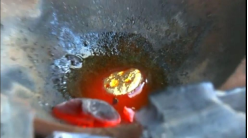
Abstract
The Asosa Zone in Ethiopia, which is part of the Neoproterozoic Arabian-Nubian Shield, is rich in metallogenic minerals, particularly gold. The Asosa Zone is the cornerstone of Ethiopia's rural economy, which employs thousands of households. Gold recovery methods have evolved over the centuries, with ancient methods being mechanical and based on density differences. The borax method is a safer and more environmentally friendly alternative technique for artisanal and small scale gold mining (ASGM) in gold recovery. The borax method is cost-effective and energy-efficient for artisanal and small-scale gold extraction. The implementation of the Borax method faces challenges such as lack of awareness, technical knowledge, policy enforcement, and limitations, and requires technical upgrades, education, investment, and cultural resistance. Sustainable practices can be achieved through technical innovation, community engagement, policy reform, and stakeholder engagement in the implementation of the borax method of gold extraction. The assessment study was conducted in Ura Woreda, Asosa Zone, western Ethiopia, with a focus on artisanal gold production. The Agusha Kebele site is known for its significant Au deposits. Gold mining and processing are widely practiced by local small-scale miners, with women and youth actively participating in the Ura Woreda, Asosa Zone, making mining a significant source of income. This fieldwork assessment utilized various resources and equipment for gold mining, including borax chemicals, detergents, magnets, sodium chloride (NaCl), oxy-acetylene torch, clay pots, charcoal, water, generators, fuel, hammers, shovels, iron bars, and traditional ventilation. These tools enhance the separation efficiency, remove impurities and ferromagnetic metals, and protect gold during melting. The borax method is a multistep process that involves crushing and grinding ore rock into fine particles to release valuable gold minerals, sluicing or panning, washing, and adding sodium chloride, detergent, and magnets. The concentrated gold-bearing material was mixed with borax powder and heated to high temperature for smelting and refining. A charcoal-fueled furnace, built with heat-resistant bricks, uses charcoal as the primary fuel and is a cost-effective, sustainable, and locally accessible gold smelting solution in small-scale mining operations in rural areas. Ethiopia has diverse mineral resources that support the production of borax and related compounds. A field study evaluated the technical feasibility, efficiency, and environmental suitability of the borax method.
Keywords
ASGM, Asosa Zone, Ura Woreda, Ethiopia, Sustainable Mining, Borax Method, Gold Recovery, Charcoal-fueled Furnace
1. Introduction
1.1. Background
The Asosa Zone is part of the Ethiopian Precambrian basement complex and forms a significant part of the Neoproterozoic Arabian-Nubian Shield (NANS), which endow metallogenic minerals, particularly gold
| [1] | Bullock, L. and Morgan, O., 2018, Map of General Geology of the region of known gold occurrence south of Asosa in the Benishangul-Gumuz state of Ethiopia. |
| [2] | Bullock, L. and Morgan, O. (2018). The Asosa region of western Ethiopia: A golden exploration opportunity. Geology Today, 34(1), 31–36. |
| [3] | T. M. & Stern, R. J. 2011, Late Cryogenian–Ediacaran history of the Arabian–Nubian Shield: a review of depositional, plutonic, structural, and tectonic events in the closing stages of the northern East African Orogen. |
[1-3]
. The geology of the Asosa Zone encompasses high-grade metamorphic lithologies, including garnet-bearing gneisses, amphibolite schists, and migmatites and granulite facies that were invaded by syn-to post-tectonic periods of crustal stabilization
| [4] | Asrat, A., Barbey, P., and Gleizes, G., 2001, The Precambrian Geology of Ethiopia: a review. Africa Geoscience Review, 8, 271-288. |
| [5] | Geological Map of Ethiopia, Edited in 1972,
https://www.exploratorium.edu/evidence/images/geomap-large.jpg |
| [6] | Temesgen Oljira, Olugbenga Akindeji Okunlola, Akinade Shadrach Olatunji, Dereje Ayalew, Bekele Ayele Bedada, 2022, Petrogenesis of the Neoproterozoic rocks of Megele area, Asosa, Western Ethiopia, Earth Sciences Research Journal, 26(2): 157–172. |
| [7] | Natnael Wondera. 2017, Petrogenesis of Granitoid Rocks of Assosa Area, Western Ethiopia. Unpublished MSc Thesis, Addis Ababa University, Addis Ababa, Ethiopia, 65 pp. |
[4-7]
. This collision contributes to hydrothermal conduit formation, which is essential for gold mineralization
| [8] | Bullock, L. A. and Morgan, O. J., 2015, A New Occurrence of Gold-Bearing Graphite in the Assosa Region, Benishangul-Gumuz State, western Ethiopia. Journal of Earth Science and Engineering, 5: 417–435. |
| [9] | Alam, T. A., Monsef, M. A. E. and Grosch, E. 2021, Shear-zone hosted gold mineralization of the Arabian–Nubian Shield: devolatilization processes across the greenschist–amphibolite-facies transition. Geological Society, London, Special Publications, 478(1), 241–262. |
| [10] | Zhao, K., Yao, H., Wang, J., Ghebretnsae, G. F., Xiang, W. and Xiong, Y. Q. 2019, Genesis of the Koka Gold Deposit in Northwest Eritrea, NE Africa: Constraints from Fluid Inclusions andC–H–O–S Isotopes. Minerals, 9(4), 201. |
| [13] | Solomon Tadesse, 1999, Geology and Gold Mineralization in the Pan-African Rocks of the Adola Area, Southern Ethiopia. |
[8-10, 13]
. Gold-bearing quartz veins widespread in the region were formed during post-collisional extension (∼600–550 Ma), which occurred during a period of regional uplift and decompression melting according to geochronological studies dating the last magmatic activity to 636 Ma
| [7] | Natnael Wondera. 2017, Petrogenesis of Granitoid Rocks of Assosa Area, Western Ethiopia. Unpublished MSc Thesis, Addis Ababa University, Addis Ababa, Ethiopia, 65 pp. |
| [11] | Wahed, M. A. E., Zoheir, B., Pour, A. B. and Kamh, S. 2021, Shear-Related Gold Ores in the Wadi Hodein Shear Belt, South Eastern Desert of Egypt: Analysis of Remote Sensing, Field and Structural Data. Minerals, 11(5), 474. |
| [12] | Allen, A. & Tadesse, G. 2003, Geological setting and tectonic subdivision of the Neoproterozoic orogenic belt of Tuludimtu, western Ethiopia. |
| [13] | Solomon Tadesse, 1999, Geology and Gold Mineralization in the Pan-African Rocks of the Adola Area, Southern Ethiopia. |
[7, 11-13]
.
Artisanal and Small-Scale Gold Mining (ASGM) is the cornerstone of Ethiopia’s rural economy, employing thousands of households. The Asosa Zone of the Benishangul Gumuz region is known for its abundant gold deposits, and ASGM remains critical to the local community to generate income
| [7] | Natnael Wondera. 2017, Petrogenesis of Granitoid Rocks of Assosa Area, Western Ethiopia. Unpublished MSc Thesis, Addis Ababa University, Addis Ababa, Ethiopia, 65 pp. |
| [14] | Abebe Bedassa. 2014, Geology, Geochemistry & Genesis of Gold Mineralization in Ashashire Prospect, Benishangul-Gumuz Region, Western Ethiopia. Unpublished MSc Thesis, Addis Ababa University, Addis Ababa, Ethiopia, 70 pp. |
[7, 14]
. Since ancient times, gold recovery methods have undergone numerous changes over centuries through technological advancements, considering environmental and economic cases
| [15] | Benzu Gold mining Plc. 2013, Independent technical report of Dul-Menghe and Agusha Liecense, Benshangul Gumuz region, Ethiopia. Unpublished technical report. |
| [16] | Alim Gül, Olgaç Kangal, Ayhan A. Sirkeci, and Güven Önal, 2010, Beneficiation of the gold bearing ore by gravity and flotation. |
[15, 16]
. Gold recovery methods in ancient times were fundamentally mechanical processes, namely panning and sluicing, which depended on the density differences between gold and other gangue materials in the ore
| [18] | Hinton, J. J., Veiga, M. M. and Veiga, A. T. C. 2003, Clean artisanal gold mining: A utopian approach? Journal of Cleaner Production, 11(2), 99-115. |
[18]
.
Artisanal and Small-Scale Gold Mining (ASGM) are the largest anthropogenic contributors to toxic and hazardous chemical pollution on Earth
| [19] | Peter Wiltje Uitterdijk Appel, Leoncio Degay Na-Oy, 2014, Mercury-Free Gold Extraction Using Borax for Small-Scale Gold Miners. http://dx.doi.org/10.4236/jep.2014.5605 |
| [20] | Hilson, G. and Pardie, S. 2006, Mercury: An agent of poverty in Ghana’s small-scale goldmining sector? Resources Policy, 31(2), 106–116. |
[19, 20]
. Artisanal and small-scale gold mining (ASGM) reliance on toxic and hazardous chemicals for gold extraction can pose severe environmental contamination, such as soil, water, and air, and health risks, including ecosystem contamination, neurological damage, and chronic diseases
| [13] | Solomon Tadesse, 1999, Geology and Gold Mineralization in the Pan-African Rocks of the Adola Area, Southern Ethiopia. |
| [18] | Hinton, J. J., Veiga, M. M. and Veiga, A. T. C. 2003, Clean artisanal gold mining: A utopian approach? Journal of Cleaner Production, 11(2), 99-115. |
| [19] | Peter Wiltje Uitterdijk Appel, Leoncio Degay Na-Oy, 2014, Mercury-Free Gold Extraction Using Borax for Small-Scale Gold Miners. http://dx.doi.org/10.4236/jep.2014.5605 |
| [20] | Hilson, G. and Pardie, S. 2006, Mercury: An agent of poverty in Ghana’s small-scale goldmining sector? Resources Policy, 31(2), 106–116. |
| [21] | Hindersah, R., Risamasu, R., Kalay, A. M., Dewi, T. and Makatita, I. 2018, Mercury contamination in soil, tailing and plants on agricultural fields near closed gold mine in Buru Island, Maluku. Journal of Degraded and Mining Lands Management, 5(2), 1027–1034. |
[13, 18-21]
. However, the process of borax extraction has proved to extract up to twice as much gold without the need for toxic chemicals. The method has been successfully tested in the Philippines, Indonesia, Tanzania, Bolivia, and Zimbabwe
| [18] | Hinton, J. J., Veiga, M. M. and Veiga, A. T. C. 2003, Clean artisanal gold mining: A utopian approach? Journal of Cleaner Production, 11(2), 99-115. |
[18]
.
Borax is an innovative gold extraction method as a safer and more environmentally friendly alternative for artisanal and small-scale gold mining (ASGM). Borax is a non-toxic, safe, and environmentally friendly chemical with cost-effectiveness and better gold recovery yields
| [18] | Hinton, J. J., Veiga, M. M. and Veiga, A. T. C. 2003, Clean artisanal gold mining: A utopian approach? Journal of Cleaner Production, 11(2), 99-115. |
[18]
. This technique depends on the chemical properties of borax Na
2B
3O
3·10H
2O (sodium tetraborate decahydrate), a naturally occurring mineral, to separate gold from ore effectively without the use of toxic chemicals
| [21] | Hindersah, R., Risamasu, R., Kalay, A. M., Dewi, T. and Makatita, I. 2018, Mercury contamination in soil, tailing and plants on agricultural fields near closed gold mine in Buru Island, Maluku. Journal of Degraded and Mining Lands Management, 5(2), 1027–1034. |
[21]
. The main objective of this fieldwork assessment was to investigate borax as a gold recovery method and evaluates its technical and economic viability. The experimental assessment took place in the Benishangul-Gumuz region, specifically in the Asosa Zone, Ura Woreda, with collaboration experts from Asosa University, the regional mineral resource development office, Ura Woreda, and Fethih Mining Group production site labor workers.
1.2. Location and Accessibility of the Study Area
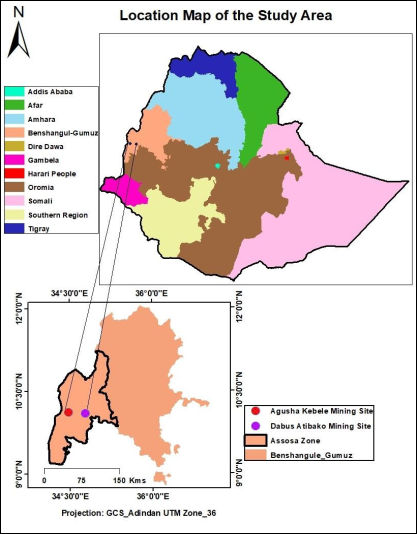
The assessment study was conducted in the Ura Woreda of the Asosa Zone of the Benishangul-Gumuz region of western Ethiopia. The Benishangul-Gumuz National Regional State (BGNRS) is situated 667 km west of Addis Ababa. It can be reached from Addis Ababa via the Addis Ababa-Ambo-Gedo-Nekemte-Gimbi-Nedjo-Mendi-Asosa asphalt road or by direct flight from Addis Ababa International Airport to Asosa Hidase Airport. The artisanal mining operation site where the assessment study was conducted is located in Ura Woreda, Asosa Zone, approximately 50 km from Asosa town, and is accessible through a dry-weather gravel road to the northwest, behind Asoa University (
Figure 1). The assessment site was chosen for this trial based on the willingness of the Benishangul Gumuz Region Mineral Resource Development Office.
Ura Woreda, a part of the Asosa Zone, is well known for its widespread artisanal method of gold production. From Ura Woreda of the Asosa Zone, the Agusha Kebele area site was selected because it has a significant gold deposits, particularly quartz-vein-hosted primary ores and alluvial placer gold deposits. Agusha Kebele (36P Zone, 0661770 E, 1119449 N; Elevation: 1,228 meters) stands out because of its rough topography and significant rock outcrops. It is a key location for ASGM activity operations because of its dominant gold occurrences associated with quartz veins and hydrothermal solution formation environments.
The inhabitants of Assosa Zone rely predominantly on gold mining in a small and artisanal manner for survival, and in many cases, it forms a significant source of livelihood for many family heads, most prominently in rural areas with poor agricultural potential
. Generally, the Asosa zone is characterized by a tropical wet period extending between June and September and a period of dry weather extending between October and May. The climate characterizes mining operations, specifically placer mining, in its high dependency on water availability during wet times
| [12] | Allen, A. & Tadesse, G. 2003, Geological setting and tectonic subdivision of the Neoproterozoic orogenic belt of Tuludimtu, western Ethiopia. |
| [23] | United Nations Environment Programme (UNEP). 2013, Minamata Convention on Mercury: Text and annexes. Geneva: UNEP. |
[12, 23]
.
Figure 1. Location Map of Study Area.
1.3. Global Successful Experimental Trial of Borax Method Gold Production
Despite their widespread use for gold extraction, toxic chemicals have considerable consequences that accelerate environmental degradation, posing danger to both miners and surrounding communities
| [24] | United States Environmental Protection Agency (US EPA), 2022, Health effects of exposures to mercury. Retrieved from https://www.epa.gov/mercury/health-effects-exposures-mercury |
| [39] | Assefa, G. 2008, "Potential of Soda Lakes in the Ethiopian Rift Valley for Industrial Use." Addis Ababa University Repository. |
[24, 39]
. Under the United Nations (UN), the United Nations Industrial Development Organization (UNIDO) and the United Nations Environment Program (UNEP) department/unit have formulated and developed programs that promote mercury-free gold mining through new technology promotion and training miners in safer working techniques
| [15] | Benzu Gold mining Plc. 2013, Independent technical report of Dul-Menghe and Agusha Liecense, Benshangul Gumuz region, Ethiopia. Unpublished technical report. |
| [21] | Hindersah, R., Risamasu, R., Kalay, A. M., Dewi, T. and Makatita, I. 2018, Mercury contamination in soil, tailing and plants on agricultural fields near closed gold mine in Buru Island, Maluku. Journal of Degraded and Mining Lands Management, 5(2), 1027–1034. |
| [25] | Veiga, M. M., Angeloci, G., Hitch, M. and Velasquez-López, P. C. 2014, Processing centres in artisanal gold mining. Journal of Cleaner Production, 64, 535–544. |
| [26] | Netsanet Zeleke, Admassu Tesso and Amsalu Bedemo. 2024, Impacts of mining projects on food security of households in Ethiopia: Empirical evidence from Benishangul-Gumuz Region. Frontiers in Sustainable Food Systems, Food Sys.,. 8: 1481827. |
| [27] | Sewagegn Yenesew, 2020, Determination of genesis of orogenic gold and sulfide prospects at Ashashire Western Ethiopia. |
| [28] | Birhanu Bekele. 2022, Assessing the effects of gold mining on environment: A case study of Shekiso district, Guji zone, Ethiopia. Heliyon, 8, e11882. |
| [29] | Appel, P. W. U. and Na-Oy, L. D. 2014, Mercury-free gold extraction using borax for small-scale gold miners. Journal of Environmental Protection, 5(5), 493–499. |
[15, 21, 25-29]
.
As a case study, the borax method has been successfully implemented in various countries around the world, as a safer and more efficient alternative method in artisanal and small-scale gold mining (ASGM), indicating possible mercury-free gold recovery and can be expanded to national contexts
| [25] | Veiga, M. M., Angeloci, G., Hitch, M. and Velasquez-López, P. C. 2014, Processing centres in artisanal gold mining. Journal of Cleaner Production, 64, 535–544. |
| [26] | Netsanet Zeleke, Admassu Tesso and Amsalu Bedemo. 2024, Impacts of mining projects on food security of households in Ethiopia: Empirical evidence from Benishangul-Gumuz Region. Frontiers in Sustainable Food Systems, Food Sys.,. 8: 1481827. |
| [27] | Sewagegn Yenesew, 2020, Determination of genesis of orogenic gold and sulfide prospects at Ashashire Western Ethiopia. |
| [28] | Birhanu Bekele. 2022, Assessing the effects of gold mining on environment: A case study of Shekiso district, Guji zone, Ethiopia. Heliyon, 8, e11882. |
| [29] | Appel, P. W. U. and Na-Oy, L. D. 2014, Mercury-free gold extraction using borax for small-scale gold miners. Journal of Environmental Protection, 5(5), 493–499. |
[25-29]
. The utilization of borax for artisanal and small-scale gold mining (ASGM) is responsible for the reduced melting points of gold-bearing minerals, thus increasing extraction from contaminants while substantially reducing associated health and environmental risks. Countries such as Mongolia Philippines, Tanzania and Zimbabwe have successfully utilized borax to record greater recovery efficiency levels
| [25] | Veiga, M. M., Angeloci, G., Hitch, M. and Velasquez-López, P. C. 2014, Processing centres in artisanal gold mining. Journal of Cleaner Production, 64, 535–544. |
| [26] | Netsanet Zeleke, Admassu Tesso and Amsalu Bedemo. 2024, Impacts of mining projects on food security of households in Ethiopia: Empirical evidence from Benishangul-Gumuz Region. Frontiers in Sustainable Food Systems, Food Sys.,. 8: 1481827. |
| [27] | Sewagegn Yenesew, 2020, Determination of genesis of orogenic gold and sulfide prospects at Ashashire Western Ethiopia. |
| [28] | Birhanu Bekele. 2022, Assessing the effects of gold mining on environment: A case study of Shekiso district, Guji zone, Ethiopia. Heliyon, 8, e11882. |
| [30] | Appel, P. W. U., & Na-Oy, L. D. 2012, The borax method of gold extraction for small-scale miners. Journal of Health and Pollution, 2(3), 5–10. |
[25-28, 30]
https://www.pureearth.org/project/asgm-borax-training-and-ngo-capacity-building/]. Notable successful case studies of experimental trials by country are described below.
Philippines (Benguet Province): In the Benguet area north of Manila, miners have used the borax method for over 30 years. This technique has led to increased gold recovery rates and significantly reduced the use of mercury in the area, benefiting both miners and the environment
| [25] | Veiga, M. M., Angeloci, G., Hitch, M. and Velasquez-López, P. C. 2014, Processing centres in artisanal gold mining. Journal of Cleaner Production, 64, 535–544. |
| [26] | Netsanet Zeleke, Admassu Tesso and Amsalu Bedemo. 2024, Impacts of mining projects on food security of households in Ethiopia: Empirical evidence from Benishangul-Gumuz Region. Frontiers in Sustainable Food Systems, Food Sys.,. 8: 1481827. |
| [27] | Sewagegn Yenesew, 2020, Determination of genesis of orogenic gold and sulfide prospects at Ashashire Western Ethiopia. |
| [28] | Birhanu Bekele. 2022, Assessing the effects of gold mining on environment: A case study of Shekiso district, Guji zone, Ethiopia. Heliyon, 8, e11882. |
[25-28]
.
Tanzania: The Geological Survey of Denmark and Greenland (GEUS) introduced the borax method to small-scale miners in Tanzania. Field tests have demonstrated that borax could recover up to twice as much gold as traditional mercury amalgamation processes, leading to its adoption in certain mining communities
| [28] | Birhanu Bekele. 2022, Assessing the effects of gold mining on environment: A case study of Shekiso district, Guji zone, Ethiopia. Heliyon, 8, e11882. |
| [29] | Appel, P. W. U. and Na-Oy, L. D. 2014, Mercury-free gold extraction using borax for small-scale gold miners. Journal of Environmental Protection, 5(5), 493–499. |
[28, 29].
Zimbabwe: A field project in Kadoma, Zimbabwe tested the local conditions for introducing the borax method. The project confirmed that local conditions were appropriate for mercury-free gold mining, and the optimization and comprehensive introduction of the borax method in the Kadoma gold mining region were recommended to eliminate the use of mercury
| [25] | Veiga, M. M., Angeloci, G., Hitch, M. and Velasquez-López, P. C. 2014, Processing centres in artisanal gold mining. Journal of Cleaner Production, 64, 535–544. |
| [27] | Sewagegn Yenesew, 2020, Determination of genesis of orogenic gold and sulfide prospects at Ashashire Western Ethiopia. |
| [30] | Appel, P. W. U., & Na-Oy, L. D. 2012, The borax method of gold extraction for small-scale miners. Journal of Health and Pollution, 2(3), 5–10. |
[25, 27, 30]
. These case studies highlight the potential of the borax method to improve gold recovery rates while mitigating the health and environmental risks associated with the use of toxic hazardous chemicals in Artisanal and Small-Scale Gold Mining (ASGM)
| [30] | Appel, P. W. U., & Na-Oy, L. D. 2012, The borax method of gold extraction for small-scale miners. Journal of Health and Pollution, 2(3), 5–10. |
[30]
.
1.4. Gold Mining and Processing Status in the Ura Woreda of Asosa Zone
Gold mining and processing have been extensively practiced by local small-scale miners
| [31] | Appel, P. W. U., & Na-Oy, L. D. 2014, Mercury-free gold mining technologies: Possibilities for adoption in the Guianas. Journal of Cleaner Production, 41, 1–9. |
[31]
. The participation and involvement of women and youth in this activity were active and verified evidence. Artisanal and Small-Scale Gold Miners (ASGMs) in Ura Woreda work on both primary and placer deposits. Primary deposits are found in quartz veins and hydrothermal structures, and the extraction of this deposit involves mining, crushing, milling, sluicing, panning, and smelting.
There are health and safety concerns, such as a lack of personnel protective equipment (PPE), which require improvement for safety practices in the mining community. This region’s diverse geology and mineral wealth position make it a strategic area for sustainable resource development in Ethiopia. When roughly seen by the naked eye, it seems that gold often coexists with sulfides (e.g., copper and iron), requiring leaching for efficient recovery, which suggests that the mineralogy of the area is a hydrothermal deposit. Non-valuable (gangue) minerals complicate extraction and require tailored grinding to liberate fine gold particles. Thus, there is an opportunity for enhanced mineral exploration and discovery in this area.
1.5. Availability of Raw Materials for Borax Production in Ethiopia
Ethiopia is endowed with diverse mineral resources that can potentially support the production of borax and related compounds
| [32] | Appel, P. W. U. and Jønsson, J. B. 2010, Borax – an alternative to mercury for gold extraction by small-scale miners: introducing the method in Tanzania. Geological Survey of Denmark and Greenland Bulletin, 20, 87–90. |
[32]
. The raw materials necessary for borax production include boron minerals as well as additional materials such as sodium carbonate, which are essential for processing. While Ethiopia does not have identified and proven large-scale boron deposits, some studies suggest potential occurrences of borate minerals in countries with geothermal activity or volcanic deposits, which help to produce boron in the country. The area of this deposit should be further explored for commercial boron extraction opportunities
| [33] | Peter W. U. Appel and Jesper Bosse Jønsson, Borax, 2010 – an alternative to mercury for gold extraction by small-scale miners: introducing the method in Tanzania, Open Access:
www.geus.dk/publications/bull |
[33]
.
Sodium Carbonate (Soda Ash), a critical component in the borax production process, can be sourced from Ethiopia's soda plentiful lakes, such as ake Abijata and ake Shala, located in the Rift Valley. These lakes are known for their soda-rich waters that have been utilized for small-scale soda ash extraction. Expanding these operations could provide a reliable source of sodium carbonate for borax production
| [34] | Peter W. U. Appel, Leoncio Na-Oy, 2013, How to Mitigate Mercury Pollution in Tanzania. |
| [37] | Tadesse, S., Milese, J-P. & Deschamps, Y. 2003, Geology and mineral potential of Ethiopia: a note on geology and mineral map of Ethiopia. |
[34, 37]
. Additional supplementary materials required in the production process, such as lime and sulfuric acid, are available in Ethiopia. The country's limestone deposits can supply lime, while sulfuric acid can be sourced from existing Awash Melkasa sulfuric acid producing company
| [35] | Veiga, M. M., Maxson, P. A. and Hylander, L. D. 2006, Origin and consumption of mercury in small-scale gold mining. Journal of Cleaner Production, 14(3–4), 436–447. |
| [37] | Tadesse, S., Milese, J-P. & Deschamps, Y. 2003, Geology and mineral potential of Ethiopia: a note on geology and mineral map of Ethiopia. |
[35, 37]
. This assessment highlights the potential of Ethiopia to develop a localized supply chain for borax, focusing on leveraging available raw materials and addressing resource gaps. Geological surveys and feasibility studies are required to confirm the viability of domestic borax production.
2. Materials and Methods
2.1. Materials
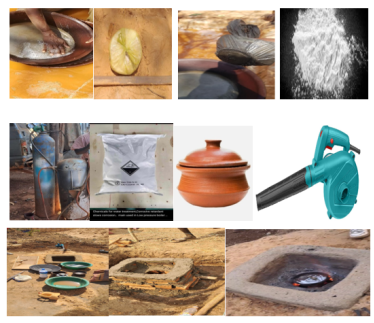
Resources utilized and equipment used for this fieldwork assessment was borax chemicals, detergent, magnet, sodium chloride (NaCl), oxy-acetylene torch, clay pots, charcoal, water (diverted from a river 1 km away by Fetih gold mining group), generator, fuel, hammers, shovels, iron bars, handheld jackhammers, ropes, torches, sacks, buckets, traditional ventilation, hammermill, batea and furnace. Additionally, the materials enumerated and described below were used as inputs to simplify the washing process (
Figure 2). The detailed purpose of adding these materials during the washing of milled ground ore through panning is described as follows.
Detergents help reduce surface tension, and gold particles sink to the bottom instead of floating away with tailings. The detergent primarily acts as a surfactant to enhance the efficiency of the separation process, contributing to more effective and environmentally friendly gold production when using the borax method.
Sodium chloride (NaCl) was used as a collector and remover of heavy metals and elements through ionization. Sodium chloride (NaCl) is primarily used to enhance fluxing properties, remove impurities, and improve the efficiency of the smelting process, contributing to cleaner and more efficient gold extraction in the borax method.
Magnets were used to remove ferromagnetic metals. The magnet is primarily used to remove magnetic impurities from the gold concentrate, thereby improving the overall quality and efficiency of the borax method in gold production. It is a preparatory or auxiliary tool, rather than a direct part of the borax smelting process.
Borax is a naturally occurring mineral and a compound of boron with the chemical formula Na
2B
4O
7·10H
2O (sodium tetraborate decahydrate). It is a white powdery substance that is soluble in water and has been used for centuries in various applications. Borax acts as a flux to improve the smelting efficiency, promote the separation of gold from impurities, and protect gold during the melting process, making it an effective and eco-friendly tool in gold production.
| [25] | Veiga, M. M., Angeloci, G., Hitch, M. and Velasquez-López, P. C. 2014, Processing centres in artisanal gold mining. Journal of Cleaner Production, 64, 535–544. |
| [27] | Sewagegn Yenesew, 2020, Determination of genesis of orogenic gold and sulfide prospects at Ashashire Western Ethiopia. |
| [28] | Birhanu Bekele. 2022, Assessing the effects of gold mining on environment: A case study of Shekiso district, Guji zone, Ethiopia. Heliyon, 8, e11882. |
| [37] | Tadesse, S., Milese, J-P. & Deschamps, Y. 2003, Geology and mineral potential of Ethiopia: a note on geology and mineral map of Ethiopia. |
[25, 27, 28, 37]
.
Heaters are essential for achieving the high temperatures required to melt the ore, activate the flux, remove impurities, and concentrate gold, making it a vital component of the borax method. For this purpose, an oxy-acetylene torch (gas welder) was used in the smelting process. The oxy-acetylene torch, commonly referred to as a gas welder, is a versatile tool that is widely used in metalworking applications, including the smelting of concentrated materials. This torch utilizes a mixture of oxygen and acetylene gases to produce a high-temperature flame, capable of reaching temperatures of up to 3,480°C (6,296 °F). The oxy-acetylene torch remains a crucial tool in metallurgy and small-scale smelting operations, owing to its efficiency and adaptability. When combined with borax as a flux, this offers a reliable method for recovering metals from concentrates.
Clay pots are traditional and eco-friendly earthenware and handmade containers crafted from natural clay that are fired at high temperatures to harden. They have been used for centuries for cooking, storage, and decoration Owing to their porous nature, clay pots allow air and moisture to pass through, which makes them excellent for cooking and storing food.
An electric blower is a device that uses an electric motor to generate airflow for various applications. It works by drawing in the air through an intake and expelling it at a high speed through an outlet. Electric blowers are of different types and sizes depending on their intended use.
Charcoal is a lightweight black carbon residue produced by heating wood or other organic materials in the absence of oxygen. Charcoal is widely used for cooking, heating, and industrial applications. Here, coal helps generate heat energy in the furnace at the production site.
Figure 2. All necessary inputs equipment for experiment.
2.2. Methodology
The experimental assessment involves various activities, such as mini-discussion oral interviews with gold mining site owners and stakeholders from Asosa University (AsU), Regional Mineral Resource Development Office, and Woreda managers and experts, and conducting experimental trials at the mine operation sites. The focus of the assessment was to evaluate the efficiency of the borax method for gold extraction in Artisanal and Small-Scale Gold Mining (ASGM) operations. The trials were conducted at the Agusha site (Fethih Mining Group site).
Additionally, the experimental study approach for this trial included several key stages, such as site selection, mining, sample collection; ore sample preparation, crushing, grinding, panning, concentration, and borax trials. The ore was mined by manual digging and collected in a sack. The collected sample in the sack was subjected to crushing and grinding for size reduction. Then, the crushed quartz vein ore was collected from the hammer mill using sacks and was ready for panning.
Fieldwork Experimental Procedure
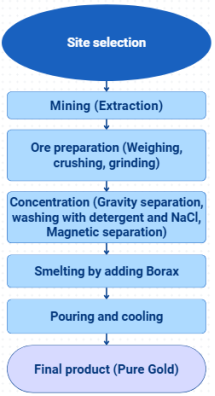
The borax method requires the involvement of a multi-step process, such as crushing and grinding of ore rock into fine particles to unlock, liberate, or release valuable gold mineral particles from the gangue (waste minerals) (
Figure 3). In the first step, after crushing and milling the quartz vein ore, the ground ore was poured into a gold pan batea (
Figure 3). Then, the concentration of the ground material is achieved using traditional methods such as sluicing or panning to isolate gold-bearing particles. Washing was performed thoroughly to produce a sufficiently high percentage of gold concentrate. Additionally, during panning, sodium chloride (NaCl) and detergent were added to the gold concentrate on the batea to simplify the process of washing and concentration through panning by batea. In addition a magnet was used to remove ferromagnetic metals during ground ore washing (
Figure 3),
| [25] | Veiga, M. M., Angeloci, G., Hitch, M. and Velasquez-López, P. C. 2014, Processing centres in artisanal gold mining. Journal of Cleaner Production, 64, 535–544. |
| [26] | Netsanet Zeleke, Admassu Tesso and Amsalu Bedemo. 2024, Impacts of mining projects on food security of households in Ethiopia: Empirical evidence from Benishangul-Gumuz Region. Frontiers in Sustainable Food Systems, Food Sys.,. 8: 1481827. |
[25, 26]
.
Figure 3. Borax method gold production process Experimental Procedure flowsheet.
Furthermore, the concentrated gold-bearing material was mixed with borax powder and added to a clay pot for smelting and refining the gold concentrate by heating to high temperatures using a blowtorch or furnace. Borax lowers the melting point of impurities, allowing gold to separate more efficiently during smelting
| [25] | Veiga, M. M., Angeloci, G., Hitch, M. and Velasquez-López, P. C. 2014, Processing centres in artisanal gold mining. Journal of Cleaner Production, 64, 535–544. |
| [26] | Netsanet Zeleke, Admassu Tesso and Amsalu Bedemo. 2024, Impacts of mining projects on food security of households in Ethiopia: Empirical evidence from Benishangul-Gumuz Region. Frontiers in Sustainable Food Systems, Food Sys.,. 8: 1481827. |
[25, 26]
. Finally, gold capture evaluation and analysis of gold recovery using the borax method were conducted during the field study. The results demonstrate the technical feasibility of gold recovery, efficiency, and environmental impact scale. The following flow sheet provides a detailed breakdown of the main activities conducted during the experimental steps, which were aimed at assessing the viability of borax technology.
3. Result and Discussion
3.1. Result
This section provides detailed experimental fieldwork findings and conclusions drawn from the experimental trial assessment study (
Table 1). The experimental results demonstrate that the borax method efficiently yields higher gold production.
Table 1. Gold produced by using borax conducted during the field study.
Trial | Sample Size | Gold Concentrate (g) | Recovered (g) – Borax | Key Observations |
First Trial -1 | 2 sacks (30kg) | 54.48g | 0.1g | The borax trial had a slightly higher recovery, but thermal heat problems and incomplete gold recovery affected the result. |
Second Trial-2 | 4 sacks (60kg) | 29g | 0.3g | Borax methods showed outperforming results in gold recovery. |
Third Trial-3 (6 sacks) | 6 sacks (90kg) | 75 g | 0.75g | Field test results showed that the borax method yielded slightly better recovery |
General Observation | - | - | - | The borax method effectively reduced the melting point of gold, making it accessible for ASGM with limited technology. |
3.2. Discussion
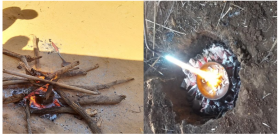
An experimental fieldwork assessment trial was conducted using different modalities. The first experiment was started by frying gold concentrate on the fire using a clay pot prepared for this purpose. However, the trial was unsuccessful. Therefore, another attempt was made by digging a hole and place a clay pot in it, using oxy-acetylene as a heater. This is better than previous attempts and is successful; however, there is still heat loss and little heat control (
Figures 4, 5). Therefore, on another day, another attempt was made by constructing a furnace that was able to extract gold successfully without using oxy-acetylene as a heater.
The borax method is safe for both the environment and human health. However, its adoption can be hindered by the dependency on oxy-acetylene torches, which are expensive and inaccessible in remote areas. Therefore, this assessment should bring ideas as new innovative ways in fieldwork experimental trials by optimizing the smelting process to refine the gold concentrate by mixing it with borax powder. Thus we replaced oxy-acetylene with charcoal-fueled furnaces to enhance accessibility and sustainability. As improvement to our work, this improvement is attributed to
1) Increased Combustion Efficiency: The electric blower enhances airflow, intensifies charcoal combustion, and generates higher temperatures more quickly.
2) Heat Retention and Concentration: ensuring that the furnace maintains optimal temperatures throughout the process and the underground brick structure minimizes heat loss.
3) Optimized Fuel Usage: The Controlled air supply ensures efficient burning of charcoal, reducing fuel waste, and maximizing heat output.
The furnace is built using heat-resistant bricks and is strategically positioned 0.5 meters underground to maximize heat retention and ensure structural stability. This underground design minimizes heat loss, enhances energy efficiency, and allows furnaces to maintain the high temperatures required for efficient gold smelting. The charcoal-fueled furnace is a crucial innovation in the modified borax gold recovery process designed to address the challenges associated with oxyacetylene dependence. This furnace provides a cost-effective, locally accessible, and sustainable alternative for smelting gold in artisanal and small-scale mining (ASGM) operations, particularly in rural areas where industrial fuel sources are scarce.
Inside the furnace, charcoal serves as the primary fuel source owing to its widespread availability and affordability. To enhance the combustion efficiency, the system is equipped with an electric blower, which supplies a controlled stream of air to the burning charcoal. When powered by a generator/electric power, the blower significantly increases the intensity of combustion, resulting in higher and more sustained temperatures that facilitate gold smelting. The concentrated heat generated by charcoal and enhanced by the blower ensures that gold particles are efficiently separated from impurities, making the smelting process highly effective without the need for oxyacetylene. The charcoal-fueled furnace significantly improved the gold smelting process by reducing the melting time by 50% compared with the initial trial. Initially, the process takes a long time to reach the necessary temperature for melting concentrated gold. However, with the optimized furnace design and the introduction of an electric blower, the production time was reduced to just less time.
An electric blower is a device that uses an electric motor to generate airflow for various applications. It works by drawing in the air through an intake and expelling it at a high speed through an outlet. Electric blowers are of different types and sizes depending on their intended use.
Charcoal is a lightweight black carbon residue produced by heating wood or other organic materials in the absence of oxygen. Charcoal is widely used for cooking, heating, and industrial applications.
Figure 4. The first gold concentrate smelting process.
Figure 5. Gold concentrate produced by borax method.
By reducing the smelting time by half, this technology not only boosts productivity but also makes gold extraction more energy-efficient and cost-effective for artisanal and small-scale miners. This advancement plays a vital role in promoting sustainable gold production, particularly in rural areas, where alternative fuel sources are limited.
The generator, charcoal, and electric blowers are additional inputs and equipment necessary to produce gold without oxy-acetylene using the borax method. By integrating charcoal-fueled furnace technology into borax-based gold extraction, artisanal miners can achieve higher efficiency, lower costs, and reduced environmental impacts, making sustainable gold production more practical and widespread.
This charcoal-fueled furnace-based processing method has several advantages, including a simple access to charcoal in rural areas, unlike oxyacetylene. It is also cost-effective, significantly reducing smelting costs compared with the use of gas-based fuels. Additionally, an electric blower increases efficiency ensuring consistent airflow and maintaining the high temperatures necessary for effective smelting.
3.3. Analysis of Fieldwork Trial Procedure per Each Experiment
3.3.1. Operational Cost Analysis
This analysis is based on the economic implications of the borax method in gold processing based on the fieldwork assessment experimental trials in terms of material and operational costs (
Tables 2-5).
Table 2. Trial 1 Cost Analysis.
Cost Item | Borax Trial 1,040 (ETB)/kg |
Material Cost | 15.08 |
Operational Cost | 15 |
Total Cost | 30.08 |
Table 3. Trial 2 Cost Analysis.
Cost Item | Borax Trial (ETB) |
Material Cost | 28.08 |
Operational Cost | 20 |
Total Cost | 48.08 |
Table 4. Trial 3 Cost Analysis.
Cost Item | Borax Trial (ETB) |
Material Cost | 39 |
Operational Cost | 15 |
Total Cost | 54 |
3.3.2. Environmental Impact Analysis
Table 5. Environmental Impact analysis.
Parameter | Borax Trial (Impact level) |
Water Contamination | Low |
Soil Contamination | Low |
Air Emissions | Low |
3.3.3. Health and Safety Impact Analysis
Table 6. Health and Safety Impact analysis.
Parameter | Observation |
Borax Exposure Levels | Very High |
Miners’ Physical Strain | --- |
Across all trials, the borax method consistently proved cost-efficient, with minimal waste management expenses despite occasional material cost increases. These lower costs make the borax method more economical and environmentally friendly. The borax method is safer, cleaner, and better with minimal environmental impact. The borax method has no impact on the environment and reduces waste management levels from high to low, aligning with sustainable and eco-friendly practices
| [38] | Abiye, T. A. 2011, "The Geothermal and Mineral Resources of Ethiopia." Journal of African Earth Sciences. |
[38]
. The borax method proved to be significantly more environmentally friendly as it eliminated the hazardous effects associated with the use of toxic hazardous chemicals. Sustainable practices and advanced processing are critical for optimizing gold recovery while mitigating the health and environmental impacts. While operational costs for the borax method require additional material expenses, the overall cost savings and environmental benefits make it a viable alternative method that can be scalable. This analysis underscores the potential of the borax method for gold production in artisanal and small-scale mining, by promoting cost-effective and sustainable practices.
4. Challenges and Limitations of Borax Method Adoption and Modification
While the Borax method offers a safer environment and human health, its adoption can be hindered by different barriers and faces dual challenges. This challenge can be social and institutional barriers, such as lack of awareness, technical knowledge, and policy enforcement hindering borax adoption and technical limitations in which current borax smelting requires oxy-acetylene torches, which are inaccessible in rural areas, making the process impractical for small-scale miners
| [25] | Veiga, M. M., Angeloci, G., Hitch, M. and Velasquez-López, P. C. 2014, Processing centres in artisanal gold mining. Journal of Cleaner Production, 64, 535–544. |
| [26] | Netsanet Zeleke, Admassu Tesso and Amsalu Bedemo. 2024, Impacts of mining projects on food security of households in Ethiopia: Empirical evidence from Benishangul-Gumuz Region. Frontiers in Sustainable Food Systems, Food Sys.,. 8: 1481827. |
[25, 26]
. Another challenge might be high heat demands in which smelting requires optimum refining heat, awareness gap of limited knowledge among miners to hinder the adoption, time consumption in which complex ores with more impurities require more time to purify before smelting. Generally, Borax offers a safer and more efficient method but requires technical upgrades, education, and investment
| [26] | Netsanet Zeleke, Admassu Tesso and Amsalu Bedemo. 2024, Impacts of mining projects on food security of households in Ethiopia: Empirical evidence from Benishangul-Gumuz Region. Frontiers in Sustainable Food Systems, Food Sys.,. 8: 1481827. |
| [27] | Sewagegn Yenesew, 2020, Determination of genesis of orogenic gold and sulfide prospects at Ashashire Western Ethiopia. |
[26, 27]
. Transitioning to borax aligns with global sustainability goals; however, success depends on addressing awareness, training, and resource access.
Many miners remain reliant on the usual method because of a lack of awareness and unfamiliarity with the borax method as a viable alternative. To fill the technical gap, exist among miners it entails training and educating miners on the borax method, smelting techniques, temperature control, and equipment handling. Miners’ cultural resistance to long-standing reliance on the usual method creates reluctance to adopt new methods, despite known risks. Weak enforcement of policy and regulatory frameworks on the borax method and limited institutional support for promoting borax can be another barrier.
In other ways, technical challenges such as clay pot durability, furnace design limitations, and dependence on oxy-acetylene torches to save smelting time can consume the time required for borax method adaptation.
5. Conclusion
The overall analysis of the borax method in Ethiopian ASGM demonstrates the efficiency of borax in gold recovery, with higher yields, environmental safety, and operational cost-effectiveness with waste management expenses. The borax method is effective even with limited technology, although improvements to the furnace and crucible are required. Addressing both technical challenges (equipment durability and heat management) and social barriers (awareness, training, and policy gaps) is critical for widespread adoption of the borax method in the ASGM sector. By integrating technical innovation, community engagement, and policy reform, Ethiopia can transition into sustainable ASGM practices. Prioritizing pilot projects and partnerships will ensure that the borax method aligns with global environmental goals, while improving the livelihoods of mining communities.
6. Recommendations
Addressing social and institutional challenges through awareness campaigns, capacity building, and policy interventions could improve the adoption of new methods. Demonstrating workshops for the community on borax’s economic and health benefits and training programs on borax smelting, furnace operation, and safety protocols. Strengthening enforcement of policy interventions to subsidize borax adoption instead of the usual method provides incentives for ASGM to start the borax method and integrate the borax method as a new technology into national ASGM strategies. By using critical modifications and scaling up of the method, such as improving furnace design with better insulation and airflow regulation to maintain consistent temperatures, finding alternative heat-resistant crucibles to replace clay pots, partnering with local artisans to develop low-cost, durable crucibles, eliminating oxy-acetylene dependency by optimizing furnace efficiency to remove the need for torches, reducing operational costs, and implementing strategies with engagement of stakeholders (collaborate with NGOs, universities, and regional offices) to implement pilot projects to test with modified facilities. Geological exploration surveys can be applied to identify domestic borax reserves to reduce import dependency and begin feasibility studies to evaluate the adaptation of the new method.
Abbreviations
ASGM | Artisanal and Small-Scale Gold Mining |
NaCl | Sodium Chloride |
NANS | Neoproterozoic Arabian-Nubian Shield |
Ma | Million Years Ago |
Na2B3O3·10H2O | Sodium Tetraborate Decahydrate |
UN | United Nations |
UNIDO | United Nations Industrial Development Organization |
UNEP | United Nations Environment Program |
AsU | Asosa University |
GEUS | Geological Survey of Denmark and Greenland |
BGNRS | Benishangul-Gumuz National Regional State |
PPE | Personnel Protective Equipment |
ETB | Ethiopian Birr |
kg | Kilogram |
NGOs | Non-Governmental Organizations |
Author Contributions
Misganu Kabeta: Conceptualization, Writing – original draft, Writing – review & editing, Data curation, Investigation, Methodology, Validation, Visualization
Gera Techane: Conceptualization, Writing – original draft, Writing – review & editing, Data curation, Formal Analysis, Supervision, Project administration
Meaza Girmay: Conceptualization, Writing – original draft, Writing review – & editing, Data Curation, Investigation, Supervision, Visualization, Software, Methodology, Validation
Seyidu Wohabrebie: Conceptualization, Writing – original draft, Writing – original draft, Formal, Analysis, Resources, Validation, Visualization, Methodology, Supervision, Project Administration,
Tatek Tadesse: Investigation, Conceptualization, Writing – original draft, Writing – review & editing, Validation, Visualization, Supervision, Resources, Project Administration
Enatfenta Melaku: Conceptualization, Writing – original draft, Writing – review & editing, Methodology, Visualization, Validation, Investigation, Project administration, Resources, Supervision
Bisrat Kebede: Conceptualization, Project administration, Supervision, Visualization, Resources, Funding acquisition, Investigation, Methodology, Validation
Conflicts of Interest
The authors declare that they have no known competing financial interests or personal relationships that could have influenced the work reported in this study.
References
| [1] |
Bullock, L. and Morgan, O., 2018, Map of General Geology of the region of known gold occurrence south of Asosa in the Benishangul-Gumuz state of Ethiopia.
|
| [2] |
Bullock, L. and Morgan, O. (2018). The Asosa region of western Ethiopia: A golden exploration opportunity. Geology Today, 34(1), 31–36.
|
| [3] |
T. M. & Stern, R. J. 2011, Late Cryogenian–Ediacaran history of the Arabian–Nubian Shield: a review of depositional, plutonic, structural, and tectonic events in the closing stages of the northern East African Orogen.
|
| [4] |
Asrat, A., Barbey, P., and Gleizes, G., 2001, The Precambrian Geology of Ethiopia: a review. Africa Geoscience Review, 8, 271-288.
|
| [5] |
Geological Map of Ethiopia, Edited in 1972,
https://www.exploratorium.edu/evidence/images/geomap-large.jpg
|
| [6] |
Temesgen Oljira, Olugbenga Akindeji Okunlola, Akinade Shadrach Olatunji, Dereje Ayalew, Bekele Ayele Bedada, 2022, Petrogenesis of the Neoproterozoic rocks of Megele area, Asosa, Western Ethiopia, Earth Sciences Research Journal, 26(2): 157–172.
|
| [7] |
Natnael Wondera. 2017, Petrogenesis of Granitoid Rocks of Assosa Area, Western Ethiopia. Unpublished MSc Thesis, Addis Ababa University, Addis Ababa, Ethiopia, 65 pp.
|
| [8] |
Bullock, L. A. and Morgan, O. J., 2015, A New Occurrence of Gold-Bearing Graphite in the Assosa Region, Benishangul-Gumuz State, western Ethiopia. Journal of Earth Science and Engineering, 5: 417–435.
|
| [9] |
Alam, T. A., Monsef, M. A. E. and Grosch, E. 2021, Shear-zone hosted gold mineralization of the Arabian–Nubian Shield: devolatilization processes across the greenschist–amphibolite-facies transition. Geological Society, London, Special Publications, 478(1), 241–262.
|
| [10] |
Zhao, K., Yao, H., Wang, J., Ghebretnsae, G. F., Xiang, W. and Xiong, Y. Q. 2019, Genesis of the Koka Gold Deposit in Northwest Eritrea, NE Africa: Constraints from Fluid Inclusions andC–H–O–S Isotopes. Minerals, 9(4), 201.
|
| [11] |
Wahed, M. A. E., Zoheir, B., Pour, A. B. and Kamh, S. 2021, Shear-Related Gold Ores in the Wadi Hodein Shear Belt, South Eastern Desert of Egypt: Analysis of Remote Sensing, Field and Structural Data. Minerals, 11(5), 474.
|
| [12] |
Allen, A. & Tadesse, G. 2003, Geological setting and tectonic subdivision of the Neoproterozoic orogenic belt of Tuludimtu, western Ethiopia.
|
| [13] |
Solomon Tadesse, 1999, Geology and Gold Mineralization in the Pan-African Rocks of the Adola Area, Southern Ethiopia.
|
| [14] |
Abebe Bedassa. 2014, Geology, Geochemistry & Genesis of Gold Mineralization in Ashashire Prospect, Benishangul-Gumuz Region, Western Ethiopia. Unpublished MSc Thesis, Addis Ababa University, Addis Ababa, Ethiopia, 70 pp.
|
| [15] |
Benzu Gold mining Plc. 2013, Independent technical report of Dul-Menghe and Agusha Liecense, Benshangul Gumuz region, Ethiopia. Unpublished technical report.
|
| [16] |
Alim Gül, Olgaç Kangal, Ayhan A. Sirkeci, and Güven Önal, 2010, Beneficiation of the gold bearing ore by gravity and flotation.
|
| [17] |
Gerardo Martinez, Oscar Jaime Restrepo-Baena, Marcello M. Veiga 2021, The myth of gravity concentration to eliminate mercury use in artisanal gold mining.
|
| [18] |
Hinton, J. J., Veiga, M. M. and Veiga, A. T. C. 2003, Clean artisanal gold mining: A utopian approach? Journal of Cleaner Production, 11(2), 99-115.
|
| [19] |
Peter Wiltje Uitterdijk Appel, Leoncio Degay Na-Oy, 2014, Mercury-Free Gold Extraction Using Borax for Small-Scale Gold Miners.
http://dx.doi.org/10.4236/jep.2014.5605
|
| [20] |
Hilson, G. and Pardie, S. 2006, Mercury: An agent of poverty in Ghana’s small-scale goldmining sector? Resources Policy, 31(2), 106–116.
|
| [21] |
Hindersah, R., Risamasu, R., Kalay, A. M., Dewi, T. and Makatita, I. 2018, Mercury contamination in soil, tailing and plants on agricultural fields near closed gold mine in Buru Island, Maluku. Journal of Degraded and Mining Lands Management, 5(2), 1027–1034.
|
| [22] |
World Health Organization (WHO). 2024, Mercury and health: Key facts. Retrieved from
https://www.who.int/news-room/fact-sheets/detail/mercury-and-health
|
| [23] |
United Nations Environment Programme (UNEP). 2013, Minamata Convention on Mercury: Text and annexes. Geneva: UNEP.
|
| [24] |
United States Environmental Protection Agency (US EPA), 2022, Health effects of exposures to mercury. Retrieved from
https://www.epa.gov/mercury/health-effects-exposures-mercury
|
| [25] |
Veiga, M. M., Angeloci, G., Hitch, M. and Velasquez-López, P. C. 2014, Processing centres in artisanal gold mining. Journal of Cleaner Production, 64, 535–544.
|
| [26] |
Netsanet Zeleke, Admassu Tesso and Amsalu Bedemo. 2024, Impacts of mining projects on food security of households in Ethiopia: Empirical evidence from Benishangul-Gumuz Region. Frontiers in Sustainable Food Systems, Food Sys.,. 8: 1481827.
|
| [27] |
Sewagegn Yenesew, 2020, Determination of genesis of orogenic gold and sulfide prospects at Ashashire Western Ethiopia.
|
| [28] |
Birhanu Bekele. 2022, Assessing the effects of gold mining on environment: A case study of Shekiso district, Guji zone, Ethiopia. Heliyon, 8, e11882.
|
| [29] |
Appel, P. W. U. and Na-Oy, L. D. 2014, Mercury-free gold extraction using borax for small-scale gold miners. Journal of Environmental Protection, 5(5), 493–499.
|
| [30] |
Appel, P. W. U., & Na-Oy, L. D. 2012, The borax method of gold extraction for small-scale miners. Journal of Health and Pollution, 2(3), 5–10.
|
| [31] |
Appel, P. W. U., & Na-Oy, L. D. 2014, Mercury-free gold mining technologies: Possibilities for adoption in the Guianas. Journal of Cleaner Production, 41, 1–9.
|
| [32] |
Appel, P. W. U. and Jønsson, J. B. 2010, Borax – an alternative to mercury for gold extraction by small-scale miners: introducing the method in Tanzania. Geological Survey of Denmark and Greenland Bulletin, 20, 87–90.
|
| [33] |
Peter W. U. Appel and Jesper Bosse Jønsson, Borax, 2010 – an alternative to mercury for gold extraction by small-scale miners: introducing the method in Tanzania, Open Access:
www.geus.dk/publications/bull
|
| [34] |
Peter W. U. Appel, Leoncio Na-Oy, 2013, How to Mitigate Mercury Pollution in Tanzania.
|
| [35] |
Veiga, M. M., Maxson, P. A. and Hylander, L. D. 2006, Origin and consumption of mercury in small-scale gold mining. Journal of Cleaner Production, 14(3–4), 436–447.
|
| [36] |
Ethiopia Ministry of Mines and Petroleum 2020, "National Report on Mineral Resources."
|
| [37] |
Tadesse, S., Milese, J-P. & Deschamps, Y. 2003, Geology and mineral potential of Ethiopia: a note on geology and mineral map of Ethiopia.
|
| [38] |
Abiye, T. A. 2011, "The Geothermal and Mineral Resources of Ethiopia." Journal of African Earth Sciences.
|
| [39] |
Assefa, G. 2008, "Potential of Soda Lakes in the Ethiopian Rift Valley for Industrial Use." Addis Ababa University Repository.
|
| [40] |
Solomon Tadesse, 1999, Geology and Gold Mineralization in the Pan-African Rocks of the Adola Area, Southern Ethiopia.
|
Cite This Article
-
APA Style
Kabeta, M., Techane, G., Girmay, M., Wohabrebie, S., Tadesse, T., et al. (2026). Promoting Sustainable Gold Processing Practices: Utilizing Borax in Artisanal and Small-scale Gold Mining (ASGM) Operations in Benishangul Gumuz, Western Ethiopia. International Journal of Mineral Processing and Extractive Metallurgy, 11(1), 1-11. https://doi.org/10.11648/j.ijmpem.20261101.11
 Copy
|
Copy
|
 Download
ACS Style
Kabeta, M.; Techane, G.; Girmay, M.; Wohabrebie, S.; Tadesse, T., et al. Promoting Sustainable Gold Processing Practices: Utilizing Borax in Artisanal and Small-scale Gold Mining (ASGM) Operations in Benishangul Gumuz, Western Ethiopia. Int. J. Miner. Process. Extr. Metall. 2026, 11(1), 1-11. doi: 10.11648/j.ijmpem.20261101.11
Copy
|
Download
AMA Style
Kabeta M, Techane G, Girmay M, Wohabrebie S, Tadesse T, et al. Promoting Sustainable Gold Processing Practices: Utilizing Borax in Artisanal and Small-scale Gold Mining (ASGM) Operations in Benishangul Gumuz, Western Ethiopia. Int J Miner Process Extr Metall. 2026;11(1):1-11. doi: 10.11648/j.ijmpem.20261101.11
Copy
|
Download
-
@article{10.11648/j.ijmpem.20261101.11,
  author = {Misganu Kabeta and Gera Techane and Meaza Girmay and Seyidu Wohabrebie and Tatek Tadesse and Enatfenta Melaku and Bisrat Kebede},
  title = {Promoting Sustainable Gold Processing Practices: Utilizing Borax in Artisanal and Small-scale Gold Mining (ASGM) Operations in Benishangul Gumuz, Western Ethiopia},
  journal = {International Journal of Mineral Processing and Extractive Metallurgy},
  volume = {11},
  number = {1},
  pages = {1-11},
  doi = {10.11648/j.ijmpem.20261101.11},
  url = {https://doi.org/10.11648/j.ijmpem.20261101.11},
  eprint = {https://article.sciencepublishinggroup.com/pdf/10.11648.j.ijmpem.20261101.11},
  abstract = {The Asosa Zone in Ethiopia, which is part of the Neoproterozoic Arabian-Nubian Shield, is rich in metallogenic minerals, particularly gold. The Asosa Zone is the cornerstone of Ethiopia's rural economy, which employs thousands of households. Gold recovery methods have evolved over the centuries, with ancient methods being mechanical and based on density differences. The borax method is a safer and more environmentally friendly alternative technique for artisanal and small scale gold mining (ASGM) in gold recovery. The borax method is cost-effective and energy-efficient for artisanal and small-scale gold extraction. The implementation of the Borax method faces challenges such as lack of awareness, technical knowledge, policy enforcement, and limitations, and requires technical upgrades, education, investment, and cultural resistance. Sustainable practices can be achieved through technical innovation, community engagement, policy reform, and stakeholder engagement in the implementation of the borax method of gold extraction. The assessment study was conducted in Ura Woreda, Asosa Zone, western Ethiopia, with a focus on artisanal gold production. The Agusha Kebele site is known for its significant Au deposits. Gold mining and processing are widely practiced by local small-scale miners, with women and youth actively participating in the Ura Woreda, Asosa Zone, making mining a significant source of income. This fieldwork assessment utilized various resources and equipment for gold mining, including borax chemicals, detergents, magnets, sodium chloride (NaCl), oxy-acetylene torch, clay pots, charcoal, water, generators, fuel, hammers, shovels, iron bars, and traditional ventilation. These tools enhance the separation efficiency, remove impurities and ferromagnetic metals, and protect gold during melting. The borax method is a multistep process that involves crushing and grinding ore rock into fine particles to release valuable gold minerals, sluicing or panning, washing, and adding sodium chloride, detergent, and magnets. The concentrated gold-bearing material was mixed with borax powder and heated to high temperature for smelting and refining. A charcoal-fueled furnace, built with heat-resistant bricks, uses charcoal as the primary fuel and is a cost-effective, sustainable, and locally accessible gold smelting solution in small-scale mining operations in rural areas. Ethiopia has diverse mineral resources that support the production of borax and related compounds. A field study evaluated the technical feasibility, efficiency, and environmental suitability of the borax method.},
 year = {2026}
}
Copy
|
Download
-
TY  - JOUR
T1  - Promoting Sustainable Gold Processing Practices: Utilizing Borax in Artisanal and Small-scale Gold Mining (ASGM) Operations in Benishangul Gumuz, Western Ethiopia
AU  - Misganu Kabeta
AU  - Gera Techane
AU  - Meaza Girmay
AU  - Seyidu Wohabrebie
AU  - Tatek Tadesse
AU  - Enatfenta Melaku
AU  - Bisrat Kebede
Y1  - 2026/03/05
PY  - 2026
N1  - https://doi.org/10.11648/j.ijmpem.20261101.11
DO  - 10.11648/j.ijmpem.20261101.11
T2  - International Journal of Mineral Processing and Extractive Metallurgy
JF  - International Journal of Mineral Processing and Extractive Metallurgy
JO  - International Journal of Mineral Processing and Extractive Metallurgy
SP  - 1
EP  - 11
PB  - Science Publishing Group
SN  - 2575-1859
UR  - https://doi.org/10.11648/j.ijmpem.20261101.11
AB  - The Asosa Zone in Ethiopia, which is part of the Neoproterozoic Arabian-Nubian Shield, is rich in metallogenic minerals, particularly gold. The Asosa Zone is the cornerstone of Ethiopia's rural economy, which employs thousands of households. Gold recovery methods have evolved over the centuries, with ancient methods being mechanical and based on density differences. The borax method is a safer and more environmentally friendly alternative technique for artisanal and small scale gold mining (ASGM) in gold recovery. The borax method is cost-effective and energy-efficient for artisanal and small-scale gold extraction. The implementation of the Borax method faces challenges such as lack of awareness, technical knowledge, policy enforcement, and limitations, and requires technical upgrades, education, investment, and cultural resistance. Sustainable practices can be achieved through technical innovation, community engagement, policy reform, and stakeholder engagement in the implementation of the borax method of gold extraction. The assessment study was conducted in Ura Woreda, Asosa Zone, western Ethiopia, with a focus on artisanal gold production. The Agusha Kebele site is known for its significant Au deposits. Gold mining and processing are widely practiced by local small-scale miners, with women and youth actively participating in the Ura Woreda, Asosa Zone, making mining a significant source of income. This fieldwork assessment utilized various resources and equipment for gold mining, including borax chemicals, detergents, magnets, sodium chloride (NaCl), oxy-acetylene torch, clay pots, charcoal, water, generators, fuel, hammers, shovels, iron bars, and traditional ventilation. These tools enhance the separation efficiency, remove impurities and ferromagnetic metals, and protect gold during melting. The borax method is a multistep process that involves crushing and grinding ore rock into fine particles to release valuable gold minerals, sluicing or panning, washing, and adding sodium chloride, detergent, and magnets. The concentrated gold-bearing material was mixed with borax powder and heated to high temperature for smelting and refining. A charcoal-fueled furnace, built with heat-resistant bricks, uses charcoal as the primary fuel and is a cost-effective, sustainable, and locally accessible gold smelting solution in small-scale mining operations in rural areas. Ethiopia has diverse mineral resources that support the production of borax and related compounds. A field study evaluated the technical feasibility, efficiency, and environmental suitability of the borax method.
VL  - 11
IS  - 1
ER  -
Copy
|
Download

 ,
Gera Techane
,
Gera Techane


 Share This Article
 Twitter
 Linked In
 Facebook