Abstract
This study examines the role of game-based learning (GBL) in supporting vocabulary retention among Vietnamese Grade 8 EFL students. The study was conducted within authentic lower secondary classroom settings where games were regularly integrated into vocabulary instruction. A mixed-methods design was employed to investigate both students’ vocabulary performance and teachers’ perceptions of game-based instruction. Quantitative data were collected through a vocabulary retention test administered to 100 Grade 8 students, assessing recognition, recall, and productive vocabulary use. In addition, semi-structured interviews with three English teachers explored perceptions of the effectiveness and challenges of implementing GBL in vocabulary teaching. The findings indicated relatively positive performance across all three dimensions of vocabulary retention, with recognition showing the strongest results and productive vocabulary use demonstrating substantial learner achievement. The results suggest that retrieval-oriented and communicative game activities may contribute to vocabulary retention through repeated exposure, active retrieval, and contextualized language use. The qualitative findings further indicated that teachers viewed GBL as an engaging and pedagogically valuable approach that increased student participation, interaction, and classroom engagement. Nevertheless, several implementation challenges were identified, including classroom management difficulties, time constraints, and technological limitations. Overall, the study highlights the pedagogical potential of game-based learning in promoting deeper vocabulary retention in Vietnamese lower secondary EFL classrooms. The findings also suggest that different game formats may support different dimensions of vocabulary learning unevenly, particularly receptive and productive vocabulary development.
Keywords
Game-Based Learning, Vocabulary Retention, Productive Vocabulary Use, EFL Classrooms, Lower Secondary Students
1. Introduction
Vocabulary knowledge is widely recognized as one of the most essential components of second language acquisition because it directly influences learners’ ability to comprehend and produce language effectively
| [1] | Ahmed, A. A. A., Sayed, B. T., Wekke, I. S., Widodo, M., Rostikawati, D., Ali, M. H.,. Azizian, M. (2022). An empirical study on the effects of using Kahoot as a game-based learning tool on EFL learners’ vocabulary recall and retention. Education Research International, 2022(1), 9739147.
https://doi.org/10.1155/2022/9739147 |
| [2] | Chen, C. M., Liu, H., & Huang, H. B. (2019). Effects of a mobile game-based English vocabulary learning app on learners’ perceptions and learning performance: A case study of Taiwanese EFL learners. ReCALL, 31(2), 170–188.
https://doi.org/10.1017/S0958344018000228 |
| [3] | Chowdhury, M., Dixon, L. Q., Kuo, L. J., Donaldson, J. P., Eslami, Z., Viruru, R., & Luo, W. (2024). Digital game-based language learning for vocabulary development. Computers and Education Open, 6, 100160.
https://doi.org/10.1016/j.caeo.2024.100160 |
[1-3]
. In English as a Foreign Language (EFL) contexts, vocabulary plays a particularly important role since learners often have limited opportunities to encounter and use English outside the classroom. Without sufficient vocabulary knowledge, students may experience difficulties in reading comprehension, listening comprehension, spoken interaction, and written communication
| [4] | Krashen, S. D. (1982). Principles and practice in second language acquisition. Pergamon Press. |
| [5] | Long, M. H. (1996). The role of the linguistic environment in second language acquisition. In W. C. Ritchie & T. K. Bhatia (Eds.), Handbook of second language acquisition (pp. 413-468). Academic Press. |
| [6] | Nation, I. S. P. (2001). Learning Vocabulary in Another Language (2nd ed.). Cambridge University Press. |
| [7] | Poole, F. J., & Clarke-Midura, J. (2020). A systematic review of digital games in second language learning studies. International Journal of Game-Based Learning, 10(3), 1–15.
https://doi.org/10.4018/IJGBL.2020070101 |
[4-7]
. Consequently, vocabulary instruction has become a major focus in English language teaching, especially at the lower secondary level, where learners are expected to develop foundational communicative competence.
Despite the importance of vocabulary learning, vocabulary retention remains a persistent challenge for many EFL learners. Students frequently memorize new lexical items for short-term classroom tasks or examinations but fail to retain and use them meaningfully over time. Traditional vocabulary instruction in many classrooms still relies heavily on memorization, repetition, and teacher-centered explanation, which may not sufficiently support long-term retention or meaningful vocabulary use. As a result, language educators and researchers have increasingly sought instructional approaches that promote active engagement, repeated retrieval, and contextualized language learning.
In recent years, game-based learning (GBL) has attracted considerable attention as an innovative and engaging pedagogical approach in language education. GBL refers to the integration of game elements and game-oriented activities into instructional processes to enhance learning experiences and learner participation. In EFL classrooms, game-based activities are believed to increase students’ motivation, reduce anxiety, encourage interaction, and create enjoyable learning environments. Previous studies have suggested that games can facilitate vocabulary acquisition by promoting repeated exposure to target lexical items, encouraging retrieval practice, and providing immediate feedback during learning activities.
From a cognitive perspective, vocabulary retention requires more than simple exposure to new words. Effective retention involves repeated retrieval, meaningful processing, and opportunities to use vocabulary in authentic contexts. Cognitive theories of learning emphasize that active retrieval strengthens memory consolidation more effectively than passive review alone. Similarly, communicative approaches to language teaching suggest that vocabulary knowledge develops more deeply when learners use lexical items interactively and meaningfully. In this regard, game-based learning may provide valuable opportunities for both receptive and productive vocabulary development because many games require learners to recognize, retrieve, and apply vocabulary during communicative interaction.
Nevertheless, despite the growing body of research supporting the pedagogical value of GBL, several important gaps remain in the existing literature. First, many previous studies have primarily focused on learners’ motivation, engagement, or general vocabulary improvement rather than examining vocabulary retention in depth. Although increased engagement is often associated with game-based activities, engagement alone does not necessarily guarantee durable vocabulary learning. More research is therefore needed to investigate how game-based learning supports different dimensions of vocabulary retention over time.
Second, a large number of existing studies measure vocabulary learning mainly at the recognition level through multiple-choice tests or matching activities. Recognition-level knowledge, however, represents only one dimension of vocabulary mastery. Learners may recognize the meaning of a word when provided with contextual or visual support, but still struggle to retrieve or use the word independently in communication. Comparatively fewer studies have examined deeper levels of vocabulary retention, such as recall and productive vocabulary use. As a result, important distinctions between receptive and productive vocabulary knowledge remain insufficiently explored within GBL research.
Third, previous studies often treat game-based learning as a single instructional approach without considering how different types of games may support different dimensions of vocabulary knowledge. Recognition-based games, such as quizzes, matching games, or visual identification activities, may primarily strengthen receptive vocabulary knowledge through repeated exposure and rapid lexical recognition. In contrast, communicative and collaborative games may contribute more effectively to productive vocabulary development by requiring learners to retrieve and apply vocabulary actively during interaction. However, this distinction has received relatively limited attention in previous research.
Another limitation in the existing literature concerns research context. Many studies investigating GBL have been conducted in universities, private language centers, or highly controlled experimental settings. Comparatively fewer studies have examined game-based learning in authentic lower secondary school classrooms where games are integrated naturally into regular teaching practices rather than implemented as isolated interventions. Consequently, further research is needed to understand how GBL functions within real-world classroom environments, particularly in underrepresented EFL contexts such as Vietnam.
In the Vietnamese lower secondary context, vocabulary instruction continues to face several practical challenges. Students often depend heavily on rote memorization and may quickly forget newly learned vocabulary after classroom instruction. In addition, teacher-centered teaching practices may limit opportunities for meaningful vocabulary retrieval and communicative language use. Although many English teachers have increasingly incorporated games into vocabulary lessons, relatively little empirical research has examined how game-based activities influence different levels of vocabulary retention among Vietnamese lower secondary learners.
To address these gaps, the present study investigates the role of game-based learning in supporting vocabulary retention among Grade 8 students in a Vietnamese lower secondary school. Specifically, the study examines vocabulary retention across three cognitive levels: recognition, recall, and productive vocabulary use. In addition, the study explores teachers’ perceptions regarding the effectiveness and challenges of implementing game-based learning in vocabulary instruction within authentic classroom settings.
The study is significant for several reasons. Theoretically, it contributes to the growing body of literature on game-based learning by providing a more nuanced understanding of vocabulary retention beyond recognition alone. By examining recognition, recall, and productive vocabulary use separately, the study highlights the multidimensional nature of lexical knowledge and retention. Furthermore, the study contributes to existing GBL research by suggesting that different game formats may support different dimensions of vocabulary learning unevenly. Pedagogically, the findings may help teachers design more effective game-based vocabulary activities that align with specific instructional objectives. Rather than assuming that all games contribute equally to vocabulary development, teachers may need to select game formats strategically depending on whether the instructional focus involves vocabulary recognition, retrieval, or communicative application. Finally, by focusing on an authentic Vietnamese lower secondary classroom context, the study offers practical insights into the implementation of game-based learning in real-world EFL instruction.
The study is guided by the following research questions:
1) What levels of vocabulary retention do Grade 8 students demonstrate in game-based vocabulary learning contexts?
2) What are teachers’ perceptions of the effectiveness of using games in teaching English vocabulary?
2. Literature Review
2.1. Vocabulary Retention in EFL Learning
Vocabulary knowledge is widely recognized as a fundamental component of second language proficiency because it enables learners to comprehend and produce meaning effectively. In EFL contexts, vocabulary retention is particularly important since learners often have limited exposure to English outside the classroom. However, vocabulary learning does not necessarily guarantee long-term retention. Learners may recognize lexical items temporarily but struggle to retrieve or apply them meaningfully over time.
Contemporary vocabulary research views vocabulary knowledge as a multidimensional construct involving receptive and productive dimensions
| [7] | Poole, F. J., & Clarke-Midura, J. (2020). A systematic review of digital games in second language learning studies. International Journal of Game-Based Learning, 10(3), 1–15.
https://doi.org/10.4018/IJGBL.2020070101 |
| [8] | Rojabi, A. R., Setiawan, S., Munir, A., Purwati, O., Safriyani, R., Hayuningtyas, N.,. Amumpuni, R. S. (2022). Kahoot, is it fun or unfun? Gamifying vocabulary learning to boost exam scores, engagement, and motivation. Frontiers in Education, 7, Article 939884. https://doi.org/10.3389/feduc.2022.939884 |
| [9] | Sadeghi, K., Sağlık, E., Mede, E., Samur, Y., & Comert, Z. (2022). The effects of implementing gamified instruction on vocabulary gain and motivation among language learners. Heliyon, 8(11), e11700.
https://doi.org/10.1016/j.heliyon.2022.e11700 |
| [10] | Schmitt, N. (2010). Researching Vocabulary: A Vocabulary Research Manual. Palgrave Macmillan. |
| [11] | Vygotsky, L. S. (1978). Mind in society: The development of higher psychological processes. Harvard University Press. |
[7-11]
. Receptive vocabulary refers to learners’ ability to recognize and understand lexical items, whereas productive vocabulary involves retrieving and using vocabulary appropriately in communication. Productive vocabulary knowledge is generally considered more cognitively demanding because learners must actively recall lexical forms and apply them accurately in context.
Building upon this distinction, the present study conceptualizes vocabulary retention across three dimensions: recognition, recall, and productive use. Recognition refers to learners’ ability to identify lexical meanings with contextual support, recall involves retrieving vocabulary independently from memory, and productive use refers to the ability to apply vocabulary meaningfully in communication. These dimensions reflect increasing levels of cognitive processing and lexical mastery.
From a cognitive perspective, vocabulary retention is strongly associated with meaningful processing and retrieval practice. Research on memory suggests that repeated retrieval strengthens memory consolidation more effectively than passive review. Similarly, contextualized language use may facilitate stronger lexical associations and deeper semantic understanding. Consequently, vocabulary instruction should provide learners with opportunities not only to encounter vocabulary repeatedly but also to retrieve and apply lexical items actively.
Despite the importance of vocabulary retention, vocabulary instruction in many EFL classrooms continues to rely heavily on rote memorization and teacher-centered explanation. Although such approaches may support short-term recognition, they often fail to promote durable retention or productive vocabulary use. This limitation has encouraged researchers to explore more interactive instructional approaches capable of supporting meaningful vocabulary engagement and retrieval practice.
2.2. Game-Based Learning in Vocabulary Instruction
Game-based learning (GBL) has received increasing attention in language education because of its potential to enhance learner engagement, motivation, and participation
. Broadly defined, GBL refers to the integration of games or game-like activities into instructional processes to facilitate learning outcomes. Unlike traditional teacher-centered instruction, GBL encourages learners to participate actively through interaction, collaboration, competition, and problem-solving.
In vocabulary instruction, games may provide repeated exposure to lexical items within meaningful and enjoyable contexts
| [9] | Sadeghi, K., Sağlık, E., Mede, E., Samur, Y., & Comert, Z. (2022). The effects of implementing gamified instruction on vocabulary gain and motivation among language learners. Heliyon, 8(11), e11700.
https://doi.org/10.1016/j.heliyon.2022.e11700 |
[9]
. Such activities may reduce learner anxiety, increase classroom participation, and encourage learners to interact with vocabulary more actively. These features are particularly important in EFL settings where opportunities for authentic language exposure are often limited.
Several theoretical perspectives support the pedagogical value of GBL. From a cognitive perspective, many games require learners to recognize, retrieve, and apply vocabulary repeatedly during classroom interaction. Repeated retrieval practice may strengthen memory consolidation and facilitate long-term retention. From a communicative perspective, games create opportunities for meaningful interaction and contextualized language use rather than isolated memorization.
The affective dimension of learning also contributes to the effectiveness of GBL. According to
| [5] | Long, M. H. (1996). The role of the linguistic environment in second language acquisition. In W. C. Ritchie & T. K. Bhatia (Eds.), Handbook of second language acquisition (pp. 413-468). Academic Press. |
[5]
’s Affective Filter Hypothesis, learners acquire language more effectively in low-anxiety environments. Because games often create supportive and enjoyable classroom atmospheres, learners may feel more willing to participate and experiment with language use.
However, the effectiveness of GBL may depend on the design and implementation of activities. Recognition-based games such as quizzes and matching tasks may primarily strengthen receptive vocabulary knowledge through repeated exposure and visual reinforcement, whereas communicative games involving collaboration and discussion may contribute more effectively to productive vocabulary use. Excessive competition or fast-paced gameplay may also encourage superficial processing rather than deeper vocabulary learning.
Therefore, although GBL appears to provide promising opportunities for vocabulary learning, its effectiveness depends largely on how game activities are integrated into instructional practice.
2.3. Previous Studies on Game-Based Learning and Vocabulary Retention
A growing body of research has investigated the relationship between game-based learning and vocabulary development in EFL contexts. Many studies report that game-based activities positively influence learner motivation, classroom participation, and vocabulary learning outcomes.
Previous research has shown that quiz-based games, matching activities, and digital vocabulary platforms may improve vocabulary recognition through repeated exposure and visual reinforcement. Other studies emphasize the importance of retrieval practice, suggesting that activities requiring learners to retrieve vocabulary actively from memory contribute more effectively to long-term retention than passive memorization.
Some researchers also highlight the role of communicative games in supporting productive vocabulary development. Collaborative tasks, role-play activities, and information-gap games may encourage learners to use vocabulary meaningfully in interaction, thereby facilitating deeper lexical processing and contextualized language use.
Despite these positive findings, several important limitations remain in the literature. First, many previous studies focus primarily on learner motivation or general vocabulary improvement rather than examining vocabulary retention across different cognitive dimensions. Comparatively fewer studies investigate recognition, recall, and productive vocabulary use separately.
Second, much existing research relies heavily on recognition-based assessment tasks such as multiple-choice or matching exercises. Consequently, receptive vocabulary knowledge is often emphasized more strongly than productive vocabulary ability. However, learners who can recognize vocabulary successfully may still experience difficulty retrieving or applying lexical items independently in communication.
Third, previous research frequently treats GBL as a single instructional approach without considering how different game formats may support different dimensions of vocabulary retention unevenly. Recognition-oriented games may strengthen receptive vocabulary familiarity, whereas communicative games may contribute more substantially to productive vocabulary use.
Finally, many previous studies have been conducted in universities, language centers, or controlled experimental settings. Comparatively limited research has explored game-based vocabulary instruction in authentic Vietnamese lower secondary EFL classrooms, where contextual factors such as large class sizes, exam-oriented curricula, and technological limitations may influence classroom implementation.
These limitations reveal several important research gaps. First, there remains limited evidence regarding how GBL supports different dimensions of vocabulary retention, particularly productive vocabulary use. Second, relatively few studies integrate quantitative evidence of vocabulary retention with qualitative insights from teachers’ classroom experiences. Third, research examining GBL in authentic Vietnamese lower secondary classrooms remains limited.
Therefore, further research is needed to investigate how game-based learning supports recognition, recall, and productive vocabulary use in authentic Vietnamese EFL contexts. The present study addresses these gaps by examining multiple dimensions of vocabulary retention while also exploring teachers’ perceptions regarding the implementation of game-based vocabulary instruction.
2.4. Conceptual Framework
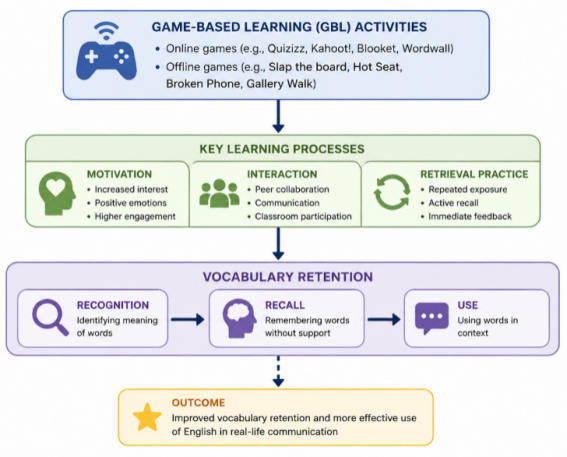
The present study is grounded in the assumption that vocabulary retention depends not only on repeated exposure to lexical items but also on meaningful processing, retrieval practice, learner engagement, and communicative use. Within this framework, game-based learning is viewed as an instructional approach capable of supporting vocabulary retention through cognitive, social, and affective mechanisms.
Specifically, GBL may enhance vocabulary retention by increasing learner engagement, encouraging repeated retrieval practice, and promoting interaction during classroom activities. Through repeated exposure and meaningful language use, learners may gradually develop stronger vocabulary retention at the levels of recognition, recall, and productive use.
Figure 1. Conceptual Framework of the Study.
The framework suggests that game-based learning activities may enhance learner motivation, interaction, and retrieval practice, which in turn contribute to vocabulary retention at the levels of recognition, recall, and productive use.
Overall, the conceptual framework provides the theoretical foundation for the study and informs the development of research instruments as well as the analysis of findings presented in subsequent chapters.
3. Methodology
3.1. Research Design
This study employed a mixed-methods descriptive design to investigate the role of game-based learning (GBL) in supporting vocabulary retention among Grade 8 students in a Vietnamese lower secondary EFL context. A mixed-methods approach was considered appropriate because vocabulary retention involves both measurable learning outcomes and instructional experiences that cannot be fully captured through a single method.
The quantitative component examined students’ vocabulary retention through a vocabulary test measuring recognition, recall, and productive use. The qualitative component explored teachers’ perceptions of game-based vocabulary instruction through semi-structured interviews. The integration of quantitative and qualitative findings enabled methodological triangulation and provided a more comprehensive understanding of vocabulary retention within authentic classroom settings.
The study adopted a descriptive rather than experimental design because game-based activities had already been integrated into regular classroom instruction prior to the research. Consequently, the study focused on examining naturally occurring instructional practices rather than implementing a controlled intervention.
3.2. Participants
The participants consisted of 100 Grade 8 students and three English teachers from a lower secondary school in Vietnam. The student participants had experienced regular exposure to game-based vocabulary activities during English lessons, including quiz-based games, matching activities, guessing games, collaborative competitions, and communicative tasks. Game-based vocabulary activities had been regularly integrated into English lessons for approximately one academic year prior to the study. According to school assessment standards, their English proficiency levels ranged from lower-intermediate to intermediate.
The teacher participants had practical experience implementing game-based learning in vocabulary instruction. Their participation provided additional insights into the pedagogical effectiveness and classroom implementation of game-based activities.
Participation in the study was voluntary. All participants were informed of the purpose of the research, and confidentiality and anonymity were maintained throughout the study.
3.3. Research Instruments
Two primary research instruments were employed in the study: (1) a vocabulary retention test and (2) semi-structured teacher interviews.
The vocabulary retention test was designed to assess students’ vocabulary knowledge across three cognitive dimensions: recognition, recall, and productive use. The instrument consisted of 20 items with a total score of 32 points.
Table 1. Structure of Vocabulary Retention Test.
Dimension | Description | Number of Items | Score per Item | Total Score |
Recognition | Identifying meanings of vocabulary items | 8 | 1 | 8 |
Recall | Retrieving vocabulary based on cues or definitions | 6 | 2 | 12 |
Use | Applying vocabulary appropriately in context | 6 | 2 | 12 |
Total | | 20 | | 32 |
The test structure reflected the multidimensional nature of vocabulary retention by assessing vocabulary knowledge progressively from receptive recognition to productive application.
The first section measured recognition-level retention through multiple-choice items requiring students to identify target vocabulary meanings with contextual or visual support. This section primarily assessed receptive vocabulary knowledge.
The second section examined recall-level retention by requiring students to retrieve vocabulary independently from memory based on definitions or contextual clues. This section assessed learners’ ability to reconstruct lexical knowledge without direct prompts.
The third section evaluated productive vocabulary use through contextualized sentence completion and short written responses. Students were required to apply target vocabulary appropriately within meaningful contexts. This section measured learners’ productive vocabulary knowledge, including lexical accuracy and contextual appropriateness.
The vocabulary items were selected from the Grade 8 English curriculum and reflected lexical items encountered during regular classroom instruction. By separating recognition, recall, and productive use, the instrument aimed to provide a more comprehensive assessment of vocabulary retention than recognition-based testing alone.
To facilitate interpretation of students’ overall performance, total scores were categorized into three achievement levels:
+ High achievement: 26–32 points
+Moderate achievement: 13-25 points
+Low achievement: 0-12 points
The scoring criteria were designed to reflect varying degrees of vocabulary retention across receptive and productive dimensions of vocabulary knowledge.
Semi-structured interviews were conducted with the participating English teachers to explore their perceptions of game-based vocabulary instruction. The interviews focused on several themes, including learner engagement, classroom participation, vocabulary retention, retrieval practice, productive vocabulary use, and challenges associated with implementing game-based activities.
The semi-structured format enabled consistency across interviews while allowing participants to elaborate on their instructional experiences and classroom observations.
3.4. Data Collection Procedures
Data collection was conducted in two stages.
First, the vocabulary retention test was administered to the participating students under regular classroom conditions. Students completed the test individually within the allocated time to ensure consistency across participants while maintaining the authenticity of the classroom context.
Following the quantitative phase, semi-structured interviews were conducted with the participating teachers. The interviews took place in a quiet setting to facilitate open discussion and reflective responses regarding classroom practices and vocabulary instruction. With participants’ consent, the interviews were audio-recorded and subsequently transcribed for analysis.
The sequential collection of quantitative and qualitative data allowed the interview findings to complement and contextualize the vocabulary retention results obtained from the student test.
3.5. Data Analysis
Both quantitative and qualitative analytical procedures were employed in the study.
The quantitative data obtained from the vocabulary retention test were analyzed using descriptive statistics, including frequencies, percentages, and mean scores. The analysis focused on students’ performance across the three dimensions of vocabulary retention: recognition, recall, and productive use. Students’ overall scores were additionally categorized into high, moderate, and low achievement levels to provide a broader overview of vocabulary retention performance.
The qualitative interview data were analyzed using thematic analysis. The interview transcripts were reviewed repeatedly to identify recurring themes and patterns related to learner engagement, retrieval practice, classroom interaction, vocabulary retention, and instructional challenges associated with game-based learning.
The integration of quantitative and qualitative findings strengthened the interpretive validity of the study through methodological triangulation and enabled a more comprehensive understanding of the role of game-based learning in vocabulary instruction.
3.6. Validity and Reliability
Several measures were employed to enhance the validity and reliability of the study.
First, the vocabulary retention test was developed based on the theoretical framework of recognition, recall, and productive vocabulary use, thereby supporting content validity. The test items were aligned with the Grade 8 English curriculum and reflected vocabulary encountered during classroom instruction, and were also reviewed by experienced English teachers to ensure clarity, appropriateness, and alignment with the research objectives.
Second, the use of multiple data sources contributed to methodological triangulation. While the vocabulary test provided measurable evidence of students’ vocabulary retention, the teacher interviews offered additional insights into classroom implementation and instructional experiences.
Third, the study was conducted within an authentic classroom environment where game-based learning had already been integrated into regular instructional practice. This naturalistic context enhanced the ecological validity of the findings and increased their relevance to real-world EFL teaching practices in Vietnamese lower secondary classrooms.
Finally, clear scoring criteria were established for each section of the vocabulary test to improve scoring consistency and reduce subjectivity in evaluating productive vocabulary responses.
4. Findings and Discussion
This section presents and discusses the findings regarding the role of game-based learning (GBL) in supporting vocabulary retention among Grade 8 students at Phong Phu Secondary School. Quantitative findings from the vocabulary retention test are presented first, followed by qualitative findings from teacher interviews. The findings are interpreted in relation to previous research and theoretical perspectives on vocabulary learning and game-based instruction.
4.1. Quantitative Findings: Vocabulary Retention
The vocabulary retention test assessed three dimensions of vocabulary knowledge: recognition, recall, and productive use. Overall, the findings indicate relatively positive levels of vocabulary retention among the participants.
4.1.1. Overall Vocabulary Retention Performance
Table 2. Students’ Overall Vocabulary Retention Performance.
Achievement Level | Score Range | Number of Students | Percentage |
High | 26-32 | 55 | 55% |
Moderate | 13-25 | 28 | 28% |
Low | 0-12 | 17 | 17% |
As shown in
Table 2, more than half of the students (55%) achieved scores within the high-achievement range, while 28% performed at the moderate level. Only 17% of students were categorized within the low-achievement group. The mean score of 23.51 out of 32 further suggests relatively positive vocabulary retention among the participants.
These findings suggest that game-based vocabulary instruction may have created supportive learning conditions for vocabulary retention. During classroom activities such as matching games, team competitions, guessing games, and communicative tasks, students repeatedly encountered and used vocabulary in meaningful contexts. Such repeated exposure may have strengthened lexical familiarity and supported memory retention over time.
The findings are generally consistent with previous studies reporting that game-based learning increases learner motivation, classroom participation, and vocabulary development in EFL settings. Increased engagement during vocabulary activities may have encouraged students to pay greater attention to lexical items and interact more actively during classroom tasks.
However, the presence of lower-performing students indicates that GBL may not support all learners equally. Individual differences such as language proficiency, motivation, learning strategies, and opportunities for vocabulary review may continue to influence retention outcomes. Therefore, the findings should be interpreted within the broader classroom context rather than viewed as evidence of direct causal effectiveness.
4.1.2. Vocabulary Recognition
Table 3. Students’ Performance in Vocabulary Recognition.
Performance Level | Score Range | Number of Students | Percentage |
High | 7–8 | 63 | 63% |
Moderate | 4–6 | 25 | 25% |
Low | 0–3 | 12 | 12% |
Among the three dimensions of vocabulary retention, students demonstrated the strongest performance in vocabulary recognition. As shown in
Table 3, 63% of students achieved high scores, while only 12% performed at the low level.
The relatively strong recognition performance may be explained by repeated vocabulary exposure during game-based activities. Games such as Quizizz, Kahoot!, picture association tasks, and Slap the Board repeatedly exposed students to sounds, images, and contextual clues associated with target vocabulary. Such activities may have strengthened receptive vocabulary knowledge and facilitated faster recognition during testing situations.
The findings also reflect the lower cognitive demands of recognition tasks. Unlike recall or productive-use activities, recognition primarily requires learners to identify familiar vocabulary rather than retrieve or produce lexical items independently. Consequently, recognition represents the most accessible dimension of vocabulary retention for many EFL learners.
The findings support theories emphasizing repeated exposure and meaningful interaction in vocabulary learning. They are also consistent with previous research indicating that repeated lexical encounters within engaging learning environments contribute positively to receptive vocabulary development.
Nevertheless, recognition alone should not be interpreted as complete vocabulary mastery. Learners who recognize vocabulary successfully may still experience difficulty retrieving or using lexical items appropriately in communication.
4.1.3. Vocabulary Recall
Table 4. Students’ Performance in Vocabulary Recall.
Performance Level | Score Range | Number of Students | Percentage |
High | 10–12 | 46 | 46% |
Moderate | 5–9 | 37 | 37% |
Low | 0–4 | 17 | 17% |
Students’ performance in the recall section was slightly lower than in the recognition section, indicating that retrieving vocabulary independently required greater cognitive effort. As shown in
Table 4, 46% of students achieved high scores, while 37% performed at the moderate level.
The findings suggest that game-based activities may have supported vocabulary recall through repeated retrieval practice. During classroom games, students frequently participated in guessing games, memory challenges, word races, and team competitions that required them to retrieve vocabulary quickly while interacting with classmates. Such repeated retrieval may have strengthened memory consolidation and long-term retention.
From a cognitive perspective, retrieval practice plays an important role in vocabulary learning because actively reconstructing lexical information strengthens memory more effectively than passive review. This may explain why many students demonstrated relatively positive recall performance.
Another possible explanation is that games increased students’ motivation and concentration during vocabulary activities. Competitive and collaborative tasks may have encouraged learners to pay closer attention to vocabulary items and participate more actively during classroom interaction.
Despite these positive findings, recall remained difficult for some students. Unlike recognition tasks, recall activities require learners to retrieve vocabulary without direct prompts or answer choices. Students with weaker vocabulary knowledge or limited review habits may therefore experience greater difficulty in recall-based tasks.
Overall, the findings suggest that game-based learning may support vocabulary recall by encouraging repeated lexical retrieval and active learner participation.
4.1.4. Vocabulary Use
Table 5. Students’ Performance in Vocabulary Use.
Performance Level | Score Range | Number of Students | Percentage |
High | 10–12 | 41 | 41% |
Moderate | 5–9 | 39 | 39% |
Low | 0–4 | 20 | 20% |
The Use section represented the highest level of cognitive demand because students were required not only to remember vocabulary but also to apply it appropriately in context. Although productive vocabulary use remained more challenging than recognition or recall, the findings still indicate relatively positive performance.
Some game-based activities appeared to encourage students to construct sentences, respond to contextualized prompts, describe objects, or participate in communicative interaction. Such activities may have encouraged learners to move beyond passive recognition toward more meaningful vocabulary use.
One notable finding is that a relatively large proportion of students demonstrated productive vocabulary knowledge. This is important because productive vocabulary is generally considered more difficult to develop than receptive vocabulary knowledge. Students were not only able to recognize or recall vocabulary but also apply lexical items appropriately within communicative contexts.
Several theoretical perspectives may explain this outcome. First, Swain’s Output Hypothesis suggests that language production promotes deeper cognitive processing because learners become aware of gaps in their knowledge while attempting to produce language. Many game-based activities required students to produce vocabulary under communicative or time-pressured conditions, thereby encouraging deeper lexical processing.
Second,
| [6] | Nation, I. S. P. (2001). Learning Vocabulary in Another Language (2nd ed.). Cambridge University Press. |
[6]
’s Interaction Hypothesis may also help explain the findings. During collaborative games, students negotiated meaning, exchanged feedback, and refined language use through peer interaction. Such interactional processes may have contributed positively to vocabulary development.
Third, repeated retrieval practice likely played a central role. Rather than memorizing vocabulary passively, students repeatedly retrieved and applied vocabulary during games, which may have strengthened long-term retention.
The affective dimension of learning may also be important. Games often reduce anxiety and create a more relaxed classroom atmosphere. According to
| [5] | Long, M. H. (1996). The role of the linguistic environment in second language acquisition. In W. C. Ritchie & T. K. Bhatia (Eds.), Handbook of second language acquisition (pp. 413-468). Academic Press. |
[5]
’s Affective Filter Hypothesis, lower anxiety levels facilitate language acquisition because learners become more willing to participate and take communicative risks.
Despite these positive findings, productive vocabulary use remained challenging for some students because learners needed to apply vocabulary both grammatically and contextually. Some students may therefore recognize vocabulary successfully while still struggling to use it accurately in communication.
4.1.5. Interpretation of Quantitative Findings
Overall, the quantitative findings suggest that game-based learning may support multiple dimensions of vocabulary retention. Students demonstrated the strongest performance in recognition tasks, while recall and productive use required higher levels of cognitive processing and therefore showed slightly lower performance.
A particularly important finding is that many students achieved moderate to high scores not only in recognition but also in productive vocabulary use. This suggests that vocabulary learning extended beyond surface-level memorization and involved deeper lexical processing.
The findings support previous research emphasizing the importance of repeated exposure, retrieval practice, learner engagement, and meaningful interaction in vocabulary learning. At the same time, variation in student performance indicates that not all learners benefited equally from game-based instruction, highlighting the importance of differentiated classroom support.
4.2. Qualitative Findings: Teachers’ Perceptions of Game-Based Learning
4.2.1. Student Engagement and Classroom Participation
All interviewed teachers reported that students responded more positively to vocabulary lessons when games were integrated into classroom activities. According to the teachers, games created a more interactive and supportive learning environment in which students became more active and willing to participate.
Teachers consistently emphasized that games encouraged participation from students who were normally less confident in English lessons. As Teacher A noted, games helped “quiet students … become more confident” by creating “a more comfortable learning atmosphere.” Similarly, Teacher B observed that students became “more active and more involved in the learning process” during game-based activities.
Another recurring theme concerned peer collaboration. Teachers explained that group-based games encouraged stronger students to support weaker classmates because students wanted “the whole team to succeed” (Teacher C). This finding suggests that game-based activities may promote both individual participation and collaborative learning.
These perceptions correspond closely with the quantitative findings. The relatively positive performance across the Recognition, Recall, and Use sections may partly reflect the increased participation and interaction observed during classroom games.
From a theoretical perspective, the findings support communicative and sociocultural approaches to language learning. Games created opportunities for interaction, negotiation of meaning, and peer support, all of which may facilitate vocabulary learning through social participation.
4.2.2. Teachers’ Perceptions of Vocabulary Retention
The interviewed teachers generally believed that game-based learning supported vocabulary retention more effectively than traditional memorization-based instruction. According to the participants, games encouraged students to interact with vocabulary repeatedly through retrieval, communication, and contextualized practice.
A major theme emerging from the interviews involved retrieval practice. Teachers observed that many classroom games required students to recall vocabulary continuously during activities. Teacher C explained that games required students to “retrieve information continuously,” which may help strengthen long-term memory retention.
The teachers also emphasized the importance of contextualized language use. Rather than memorizing isolated words, students used vocabulary meaningfully during communication. Teacher B commented that games “not only help students know words but also help them use words.” This finding is particularly important because it suggests that games may support productive vocabulary development in addition to receptive recognition.
Interestingly, teachers perceived different game formats as contributing to different aspects of vocabulary learning. Quiz-based games such as Kahoot! and Quizizz were viewed as especially effective for vocabulary recognition, whereas communicative games appeared more beneficial for productive vocabulary use.
These qualitative findings align closely with the quantitative results showing relatively positive performance across recognition, recall, and use. The findings also support theoretical perspectives emphasizing retrieval practice, interaction, and meaningful output in vocabulary learning.
However, teachers also acknowledged that vocabulary retention depended on factors beyond classroom games alone. Limited opportunities for English exposure outside the classroom may continue to affect long-term vocabulary development.
4.2.3. Challenges in Implementing Game-Based Learning
Although teachers expressed generally positive attitudes toward game-based learning, they also identified several implementation challenges.
One commonly reported issue involved classroom management during competitive activities. Teachers explained that students sometimes became excessively excited during games, making classroom control more difficult. As Teacher A noted, students could become “too excited” during competitive activities, particularly in crowded classrooms.
Another challenge involved technological limitations during online games. Unstable internet connections occasionally interrupt activities using platforms such as Kahoot! and Quizizz, negatively affecting classroom continuity and student motivation.
Importantly, teachers emphasized that games should not be treated merely as entertainment. According to Teacher B, games should remain connected to “the vocabulary or structures being taught,” while Teacher C highlighted the importance of post-game review activities to reinforce learning.
These findings suggest that the effectiveness of game-based learning depends not only on learner motivation but also on instructional design, classroom management, and pedagogical integration.
4.3. Overall Discussion
Overall, the findings of the present study suggest that game-based learning may support vocabulary retention among Grade 8 students in Vietnamese lower secondary EFL classrooms. Students demonstrated relatively positive performance across recognition, recall, and productive vocabulary use, while teachers perceived games as beneficial for learner engagement, repeated retrieval, and communicative language use.
One important contribution of the study is the finding that game-based learning appeared to support not only receptive vocabulary knowledge but also productive vocabulary use. While many previous studies focus primarily on recognition-based outcomes, the present findings suggest that communicative and retrieval-oriented games may also facilitate deeper levels of lexical processing and productive vocabulary development.
The findings further highlight the multidimensional nature of vocabulary retention. Recognition emerged as the strongest area of performance because receptive tasks generally require lower levels of cognitive processing, whereas recall and productive use required learners to retrieve and apply vocabulary independently.
At the same time, the findings indicate that GBL should not be viewed as a universal solution benefiting all learners equally. Some students continued to experience difficulty, particularly in recall and productive tasks. This suggests that vocabulary retention remains influenced by multiple learner-related and contextual factors, including language proficiency, learning habits, confidence, and opportunities for continued English exposure.
Several pedagogical implications may therefore be drawn from the findings. First, game-based learning should be integrated strategically rather than used purely for entertainment. Games should remain closely connected to vocabulary objectives and include opportunities for review and reflection.
Second, teachers should balance different types of game formats according to instructional goals. Recognition-oriented games may strengthen receptive vocabulary familiarity, whereas communicative and collaborative games may contribute more substantially to productive vocabulary use.
Finally, the presence of lower-performing students highlights the importance of differentiated instruction within game-based learning environments. Teachers may need to combine competitive activities with collaborative and supportive tasks to ensure that weaker students also receive sufficient opportunities for meaningful vocabulary practice.
In summary, the integration of quantitative and qualitative findings suggests that well-designed game-based instruction may contribute positively to both receptive and productive vocabulary development by increasing learner engagement, repeated exposure, retrieval practice, and meaningful language use.
5. Conclusion
The present study investigated the role of game-based learning (GBL) in supporting vocabulary retention among Grade 8 students at Phong Phu Secondary School. The findings indicate that students demonstrated relatively positive performance across the three dimensions of vocabulary retention, namely recognition, recall, and productive use. Among these dimensions, recognition showed the strongest performance, while recall and productive use required greater cognitive effort and therefore produced slightly lower results. Nevertheless, many students were still able to achieve moderate to high scores in productive vocabulary use, suggesting that vocabulary learning extended beyond surface-level memorization.
The qualitative findings further supported the quantitative results. Teachers generally perceived game-based learning as an effective approach for increasing student engagement, classroom interaction, and vocabulary practice. According to the participants, games created opportunities for repeated vocabulary exposure, retrieval practice, and contextualized language use, all of which may contribute positively to vocabulary retention. At the same time, the teachers emphasized that the effectiveness of games depended largely on instructional design, classroom management, and alignment with lesson objectives.
Taken together, the findings suggest that game-based learning may provide supportive conditions for vocabulary learning in lower secondary EFL classrooms. The results are also consistent with theoretical perspectives emphasizing the importance of repeated retrieval, meaningful interaction, and learner engagement in vocabulary acquisition. In particular, the findings support the view that communicative and retrieval-oriented games may facilitate not only receptive vocabulary knowledge but also productive vocabulary development.
Several pedagogical implications can be drawn from the study. First, vocabulary instruction should incorporate more interactive and meaningful learning activities rather than relying primarily on rote memorization. Carefully designed games may encourage students to engage with vocabulary more actively and confidently during classroom interaction. Second, teachers should select and adapt game formats according to instructional objectives. Recognition-based games may strengthen receptive vocabulary familiarity, whereas communicative and collaborative games may better support productive vocabulary use. Third, post-game review activities should be included to reinforce vocabulary learning and consolidate students’ understanding after gameplay.
Despite these contributions, several limitations should be acknowledged. The study was conducted in a single lower secondary school with a relatively limited number of participants, which may restrict the generalizability of the findings. In addition, because the study did not employ an experimental design with control groups or pre-test/post-test procedures, the findings should not be interpreted as evidence of direct causal relationships. Future studies are therefore encouraged to involve larger participant groups, adopt experimental research designs, and examine the long-term effects of game-based learning on vocabulary retention across different educational contexts.
Abbreviations
EFL | English as a Foreign Language |
GBL | Game-Based Learning |
Author Contributions
Nguyen Thi Thuy Duong: Conceptualization, Data curation, Investigation, Writing – original draft
Ho Van Han: Formal Analysis, Methodology, Resources, Writing – review & editing
Conflicts of Interest
The authors have no known competing financial interests or personal relationships that could have appeared to influence the work reported in this paper.
References
| [1] |
Ahmed, A. A. A., Sayed, B. T., Wekke, I. S., Widodo, M., Rostikawati, D., Ali, M. H.,. Azizian, M. (2022). An empirical study on the effects of using Kahoot as a game-based learning tool on EFL learners’ vocabulary recall and retention. Education Research International, 2022(1), 9739147.
https://doi.org/10.1155/2022/9739147
|
| [2] |
Chen, C. M., Liu, H., & Huang, H. B. (2019). Effects of a mobile game-based English vocabulary learning app on learners’ perceptions and learning performance: A case study of Taiwanese EFL learners. ReCALL, 31(2), 170–188.
https://doi.org/10.1017/S0958344018000228
|
| [3] |
Chowdhury, M., Dixon, L. Q., Kuo, L. J., Donaldson, J. P., Eslami, Z., Viruru, R., & Luo, W. (2024). Digital game-based language learning for vocabulary development. Computers and Education Open, 6, 100160.
https://doi.org/10.1016/j.caeo.2024.100160
|
| [4] |
Krashen, S. D. (1982). Principles and practice in second language acquisition. Pergamon Press.
|
| [5] |
Long, M. H. (1996). The role of the linguistic environment in second language acquisition. In W. C. Ritchie & T. K. Bhatia (Eds.), Handbook of second language acquisition (pp. 413-468). Academic Press.
|
| [6] |
Nation, I. S. P. (2001). Learning Vocabulary in Another Language (2nd ed.). Cambridge University Press.
|
| [7] |
Poole, F. J., & Clarke-Midura, J. (2020). A systematic review of digital games in second language learning studies. International Journal of Game-Based Learning, 10(3), 1–15.
https://doi.org/10.4018/IJGBL.2020070101
|
| [8] |
Rojabi, A. R., Setiawan, S., Munir, A., Purwati, O., Safriyani, R., Hayuningtyas, N.,. Amumpuni, R. S. (2022). Kahoot, is it fun or unfun? Gamifying vocabulary learning to boost exam scores, engagement, and motivation. Frontiers in Education, 7, Article 939884.
https://doi.org/10.3389/feduc.2022.939884
|
| [9] |
Sadeghi, K., Sağlık, E., Mede, E., Samur, Y., & Comert, Z. (2022). The effects of implementing gamified instruction on vocabulary gain and motivation among language learners. Heliyon, 8(11), e11700.
https://doi.org/10.1016/j.heliyon.2022.e11700
|
| [10] |
Schmitt, N. (2010). Researching Vocabulary: A Vocabulary Research Manual. Palgrave Macmillan.
|
| [11] |
Vygotsky, L. S. (1978). Mind in society: The development of higher psychological processes. Harvard University Press.
|
| [12] |
Yu, Z. (2023). Learning outcomes, motivation, and satisfaction in gamified English vocabulary learning. Sage Open, 13(2),
https://doi.org/10.1177/21582440231158332
|
Cite This Article
-
APA Style
Duong, N. T. T., Han, H. V. (2026). From Recognition to Productive Use: Examining Vocabulary Retention Through Game-Based Learning in Vietnamese Lower Secondary Classrooms. International Journal of Language and Linguistics, 14(3), 127-138. https://doi.org/10.11648/j.ijll.20261403.15
 Copy
|
Copy
|
 Download
ACS Style
Duong, N. T. T.; Han, H. V. From Recognition to Productive Use: Examining Vocabulary Retention Through Game-Based Learning in Vietnamese Lower Secondary Classrooms. Int. J. Lang. Linguist. 2026, 14(3), 127-138. doi: 10.11648/j.ijll.20261403.15
Copy
|
Download
AMA Style
Duong NTT, Han HV. From Recognition to Productive Use: Examining Vocabulary Retention Through Game-Based Learning in Vietnamese Lower Secondary Classrooms. Int J Lang Linguist. 2026;14(3):127-138. doi: 10.11648/j.ijll.20261403.15
Copy
|
Download
-
@article{10.11648/j.ijll.20261403.15,
  author = {Nguyen Thi Thuy Duong and Ho Van Han},
  title = {From Recognition to Productive Use: Examining Vocabulary Retention Through Game-Based Learning in Vietnamese Lower Secondary Classrooms},
  journal = {International Journal of Language and Linguistics},
  volume = {14},
  number = {3},
  pages = {127-138},
  doi = {10.11648/j.ijll.20261403.15},
  url = {https://doi.org/10.11648/j.ijll.20261403.15},
  eprint = {https://article.sciencepublishinggroup.com/pdf/10.11648.j.ijll.20261403.15},
  abstract = {This study examines the role of game-based learning (GBL) in supporting vocabulary retention among Vietnamese Grade 8 EFL students. The study was conducted within authentic lower secondary classroom settings where games were regularly integrated into vocabulary instruction. A mixed-methods design was employed to investigate both students’ vocabulary performance and teachers’ perceptions of game-based instruction. Quantitative data were collected through a vocabulary retention test administered to 100 Grade 8 students, assessing recognition, recall, and productive vocabulary use. In addition, semi-structured interviews with three English teachers explored perceptions of the effectiveness and challenges of implementing GBL in vocabulary teaching. The findings indicated relatively positive performance across all three dimensions of vocabulary retention, with recognition showing the strongest results and productive vocabulary use demonstrating substantial learner achievement. The results suggest that retrieval-oriented and communicative game activities may contribute to vocabulary retention through repeated exposure, active retrieval, and contextualized language use. The qualitative findings further indicated that teachers viewed GBL as an engaging and pedagogically valuable approach that increased student participation, interaction, and classroom engagement. Nevertheless, several implementation challenges were identified, including classroom management difficulties, time constraints, and technological limitations. Overall, the study highlights the pedagogical potential of game-based learning in promoting deeper vocabulary retention in Vietnamese lower secondary EFL classrooms. The findings also suggest that different game formats may support different dimensions of vocabulary learning unevenly, particularly receptive and productive vocabulary development.},
 year = {2026}
}
Copy
|
Download
-
TY  - JOUR
T1  - From Recognition to Productive Use: Examining Vocabulary Retention Through Game-Based Learning in Vietnamese Lower Secondary Classrooms
AU  - Nguyen Thi Thuy Duong
AU  - Ho Van Han
Y1  - 2026/06/25
PY  - 2026
N1  - https://doi.org/10.11648/j.ijll.20261403.15
DO  - 10.11648/j.ijll.20261403.15
T2  - International Journal of Language and Linguistics
JF  - International Journal of Language and Linguistics
JO  - International Journal of Language and Linguistics
SP  - 127
EP  - 138
PB  - Science Publishing Group
SN  - 2330-0221
UR  - https://doi.org/10.11648/j.ijll.20261403.15
AB  - This study examines the role of game-based learning (GBL) in supporting vocabulary retention among Vietnamese Grade 8 EFL students. The study was conducted within authentic lower secondary classroom settings where games were regularly integrated into vocabulary instruction. A mixed-methods design was employed to investigate both students’ vocabulary performance and teachers’ perceptions of game-based instruction. Quantitative data were collected through a vocabulary retention test administered to 100 Grade 8 students, assessing recognition, recall, and productive vocabulary use. In addition, semi-structured interviews with three English teachers explored perceptions of the effectiveness and challenges of implementing GBL in vocabulary teaching. The findings indicated relatively positive performance across all three dimensions of vocabulary retention, with recognition showing the strongest results and productive vocabulary use demonstrating substantial learner achievement. The results suggest that retrieval-oriented and communicative game activities may contribute to vocabulary retention through repeated exposure, active retrieval, and contextualized language use. The qualitative findings further indicated that teachers viewed GBL as an engaging and pedagogically valuable approach that increased student participation, interaction, and classroom engagement. Nevertheless, several implementation challenges were identified, including classroom management difficulties, time constraints, and technological limitations. Overall, the study highlights the pedagogical potential of game-based learning in promoting deeper vocabulary retention in Vietnamese lower secondary EFL classrooms. The findings also suggest that different game formats may support different dimensions of vocabulary learning unevenly, particularly receptive and productive vocabulary development.
VL  - 14
IS  - 3
ER  -
Copy
|
Download





 Share This Article
 Twitter
 Linked In
 Facebook