Review Article | | Peer-Reviewed

Green Finance, Innovation, and Financial Stability: Assessing the Role of Sustainable Investment in South Africa’s Transition Economy

Received: 16 June 2026     Accepted: 1 July 2026     Published: 12 November 2026
Views:       Downloads:
Abstract

This study empirically examines the dynamic relationship between green finance, financial innovation, exchange rate volatility, and macro-financial stability in South Africa’s transition economy. Using quarterly time-series data spanning 2000Q1-2025Q4, we construct a multivariate framework incorporating green bond issuance and ESG-linked capital flows (green finance proxy), a composite financial stress index and banking sector Z-score (financial stability proxies), digital financial innovation indicators, the real effective exchange rate, GDP growth, and the policy repo rate. After confirming non-stationarity at levels using Augmented Dickey-Fuller and Phillips-Perron tests, Johansen cointegration tests reveal a long-run equilibrium relationship among the variables, justifying estimation through a Vector Error Correction Model (VECM). Impulse Response Functions indicate that a one-standard-deviation shock to green finance reduces financial stress by approximately 0.28 standard deviations within four quarters (p < 0.05), while improving banking sector resilience as measured by the Z-score. However, exchange rate depreciation offsets nearly 20% of the stabilising effect, highlighting the role of currency risk in transition financing. Variance decomposition analysis shows that green finance innovations explain 17-22% of forecast error variance in financial stability over a 10-quarter horizon, confirming its growing systemic relevance. The moderating effect of financial innovation is statistically significant (p < 0.05), strengthening the transmission of sustainable capital toward macro-financial resilience. These findings suggest that green finance can enhance systemic stability in a carbon-intensive emerging market; however, its effectiveness depends on exchange-rate management and institutional quality. Policy implications therefore require cautious integration of climate-related financial instruments into macroprudential frameworks to mitigate unintended liquidity and currency spillovers during the Just Energy Transition.

Published in International Journal of Finance and Banking Research (Volume 12, Issue 5)
DOI 10.11648/j.ijfbr.20261205.11
Page(s) 105-114
Creative Commons

This is an Open Access article, distributed under the terms of the Creative Commons Attribution 4.0 International License (http://creativecommons.org/licenses/by/4.0/), which permits unrestricted use, distribution and reproduction in any medium or format, provided the original work is properly cited.

Copyright

Copyright © The Author(s), 2026. Published by Science Publishing Group

Keywords

Green Finance, Financial Stability, Financial Innovation, Exchange Rate Volatility, South Africa, Just Energy Transition

1. Introduction
Green finance has become the core of macroeconomic governance as global financial systems change in reaction to the climate risk. Although a discussion of sustainable finance in the early 1990s presented sustainable finance as a system to invest in renewable energy and decrease carbon emissions, more recent scholarship has realised the potential of sustainable finance to have systemic financial resilience. In the case of the emerging economies where a carbon-intensive structural adjustment is taking place, the important question is no longer whether the green finance facilitates the objective of the environment, but whether it is a contributor or destabilizer of the macro-financial stability. South Africa offers an interesting example to this argument. Being the most industrialised economy in Sub-Saharan Africa and one of the BRICS members, its financial system is rather advanced but structurally vulnerable to coal dependence, sovereign debt strains and exchange rate risks. The Just Energy Transition (JET) framework of the country aims at mobilising concessional and commercial climate finance to speed up the process of decarbonisation without undermining social equity and financial stability. The macro-financial implications of such a move are, however, under researched.
The existing literature can be generally divided into three strands. To begin with, a considerable amount of literature looks at the connection between green finance and the environmental performance, especially, carbon emissions and the Environmental Kuznets Curve (EKC). Second, the second strand researches the linkage between green finance and economic growth, and whether sustainable investment encourages long-run productivity. Third, new works consider financial risks associated with climate and the stability of the banking sector, with much emphasis on stress testing and stranded asset exposure in developed economies. Although there are these advancements, there is still a gaping paradigm. Although other literature examines green finance and emissions, green finance and growth, or climate risk and banking stability, few empirically study how the green finance and macro-financial stability depends on the dynamic transmission mechanism in African transition economies. In more precise terms, none of the existing studies critically assesses the causal issue between green finance development and systemic financial resilience in South Africa through a multivariate time-series model, say Vector Autoregression (VAR) or Vector Error Correction modelling. This omission is analytically pertinent. The environment of transition economies provides a special kind of became exposed to commodities physical climate risk and transition risk, which are aggravated by currency volatility and sovereign debt vulnerability. The speculation that green finance always stabilises financial systems is a hypothesis without empirical testing. It is thus important to fill this gap as not only applicable to the South African case but also to policy design in the emerging markets in general.
In order to close this gap, this research paper explores the question of the viability of sustainable investment as a structural stabiliser to the macro-financial landscape of South Africa and the nature of whether the success of this mechanism is contingent on financial innovation and exchange rate dynamics. Within the framework of the macro-financial theory and institutional structures, the following are testable hypotheses:
1) H1: Green finance reduces financial instability in South Africa. This hypothesis posits that increased green capital flows diversify credit risk, reduce exposure to stranded fossil-fuel assets, and enhance systemic resilience.
2) H2: Financial innovation moderates the stabilising effect of green finance. This hypothesis suggests that digital financial technologies and ESG transparency mechanisms strengthen the transmission of sustainable investment into macro-financial stability by reducing information asymmetry and improving risk pricing.
3) H3: Exchange rate volatility weakens the green finance financial stability relationship. Given South Africa’s reliance on imported renewable technologies and foreign capital flows, currency depreciation may increase the cost of green investment and offset its stabilising benefits.
This research contributes to the literature in three aspects by being a formal test of these hypotheses with the help of a dynamic econometric model. First, it gives the initial high-frequency empirical evidence of the relationship between green finance and macro-financial stability in an African transition economy. Second, it brings the concept of financial innovation and the volatility of exchange rates to the table as contingent moderators in the green finance-stability nexus. Third, it provides evidence-based guidance on climate conscious macroprudential policy formulation in developing markets that are in structural decarbonisation. The hypotheses are explained by the next section that develops the theoretical framework that supports these hypotheses and introduces the econometric methodology and the results that are obtained in the study.
2. Literature Review
The connection between green finance, financial innovation and systemic stability has received significant academic interest in the environmental economics, banking and macroprudential regulation literatures. The literature on sustainable finance has grown at a speed since the introduction of the Paris Agreement, as more people have appreciated that climate risk is a systemic financial risk. The evidence regarding the bibliometrics substantiates the fact of exponential growth in the number of green finance publications since 2015, especially in high-impact journals in the fields of finance and energy economics . This change is in line with regulatory changes that have incorporated climate concerns in the financial supervision systems.
2.1. Green Finance Instruments and Financial Performance
Green bonds and sustainable debt bonds have been extensively studied in terms of pricing, performance of firms and capital structure implications. In practice, it is empirically recorded that a greenium exists as a yield discount linked to certified green bonds, but the amount of the discount differs across markets and certification schemes . Tang and Zhang demonstrate that green bond issue enhances performance of firms in the environmental aspects and attracts long-term institutional investors. In a similar manner, Bachelet, Becchetti, and Manfredonia conclude that certified green bonds have the advantage of having greater market credibility than non-certified issues. Evidence on emerging markets is not all positive though. By merging the green policies and the inclusive development plans, the ability of the national economies to attract sustainable investment is enhanced. Tolliver, Keeley, and Managi (2020) show that the effectiveness of green finance greatly relies on the policy credibility and the quality of the institutions. Furthermore, the quality of ESG disclosure and third-party verification is important when it comes to the cost of the funding and investor confidence . These results corroborate the signalling theory, which proposes that the green instruments should report reputational and governance information, other than the capital allocation functions.
2.2. Climate Risk and Financial Stability
There is an increasing body of literature that directly associates climate risk with system-wide financial stability. Although climate change is an example of green swan risk according to Bolton et al. , it is a non-linear macro-financial risk. There is empirical research indicating that financial stability is negatively correlated with climate risk between countries . Recent evidence of cross-country panels has shown that climate risk has a statistically significant negative impact on indicators of financial stability, such as the Z-scores of the banking sector and systemic risk measures . Network for Greening the Financial System also adds that uncontrolled climatic risk can be spread via credit, market, and liquidity channels. Udeagha and Breitenbach in the emerging economies show that carbon emissions and energy transitions have a strong impact on the dynamics of financial stability through a Bayesian VAR approach. On the same note, Hong, Karolyi, and Scheinkman , together with Addoum et al. , reveal that exposure to environmental risks has a determining effect on stock market volatility, which supports the transmission of climate variables and financial markets.
2.3. Green Credit and Banking Sector Risk
Green credit policies are identified to decrease systemic risk in banking systems and enhance the resilience measures, like non-performing loan ratios. As seen in the bank-level research, green lending affects the credit risk and stability in the portfolio. Empirical data, further, shows that green credit policies do play a key role in lowering the exposure to systemic risk and enhance resilience metrics like non-performing loan ratios, especially in banking systems that are led by political policy. Green lending policies have also become more embraced as a tool of matching banking portfolios to the sustainability goals. According to bank level research, green lending affects the credit risk and portfolio stability, and it has been determined that the exposure to green loans has a substantial impact on the bank risk profile and resilience. These results imply that sustainable credit provision can be used in the creation of macro-financial stability. Cui, Geobey, Weber, and Lin discover that Chinese green credit policies have a decreasing effect on lending pollution intensive and an enhancing effect on long-term asset quality. According to Weber, Hoque, and Islam , the performance of a loan in a banking portfolio is enhanced by environmental risk management. Additionally, Degryse, Goncharenko, Theunisz, and Vadazs indicate that exposure to climate has an impact on bank loan prices and risk spreads. However, the heterogeneity at the regional level continues. Institutional constraints and a greater occurrence of macroeconomic volatility are experienced in emerging markets and could undermine the stabilising effects of green finance.
2.4. Financial Innovation and Moderating Effects
The presence of financial innovation and especially FinTech, digital reporting technologies, and climate risk analytics increases the information transparency and efficiency in risk pricing . Digital finance was found to minimize the asymmetry of information and enhance the process of credit allocation . Recent reports indicate that financial innovation enhances the environmental-finance nexus by helping to integrate ESG and mobilise capital . The benefits of financial innovation, however, are likely to be diluted by macroeconomic volatility, in particular, exchange rate volatility. Open economies are characterized by exchange rate volatility which heightens funding uncertainty and instability of capital flows . With the economies that are dependent on commodities, financial stress transmission is increased by currency shocks . This implies that the green finance-stability relationship in transitional economies can be conditioned by exchange rate dynamics.
2.5. Methodological Trends
The recent research uses methodological approaches that include Vector Autoregression (VAR), Bayesian VAR, and connectedness networks to model the dynamic interdependencies of green finance and macroeconomic variables and financial stability . In the absence of stationarity, long-run and short-run adjustments can be identified based on Vector Error Correction Models (VECM) . Nevertheless, univariate and multivariate analyses on African topics combining green finance, financial innovation, and exchange rate volatility are not numerous.
Gap in the Literature: Although the literature on sustainable finance is growing at a very fast pace, none of the studies has conducted the analysis of green finance instruments, financial innovation measures, the exchange rate volatility and the macro-financial stability at the same time, as a component of a single VECM framework in the case of African emerging markets. The published literature tends to consider green finance to be a unidimensional concept and not to consider moderating mechanisms. The paper fills this gap by modeling the long-run equilibrium and short-run dynamics in South Africa, thus providing new evidence of a macro-financial climate study.
3. Theoretical Framework
3.1. Conceptual Foundations: Green Finance Within a Macro-Financial System
This research has a theoretical background that combines environmental economics, the macro-financial stability theory, and institutional finance. In its essence, the conceptualisation of green finance views it not as an environmental funding tool but as a macro-financial variable that could impact the transmission of systemic risks. The conventional macro-financial theories measure financial stability using credit expansion, liquidity cycles and interest rate pass-through. There is however an extra layer of structural risk brought about by climate transition: carbon exposure and stranded asset vulnerability. Financial institutions in carbon-intensive markets like South Africa face the transition risk through lending to fossil-based-based industries. Therefore, portfolio diversification and risk repricing could shift the systemic risk characteristics with the reallocation of capital towards low-carbon areas. The mechanism can be associated with the Modern Portfolio Theory according to which diversification of uncorrelated classes of assets decreases systemic volatility. Exposure to regulatory carbon shocks- Green assets which are less prone to these may decrease total vulnerability of the banking sector. In this way, green finance can be an agent of structural stabilisation in the financial system.
3.2. Environmental Kuznets Curve and Financial Development
EKC hypothesizes that the relationship between income and the degradation of the environment is inverted-U. Recent extensions also include financial development as a turning-point moderator. Financial sophistication in the financial sector in emerging markets defines whether growth increases or induces decarbonisation in terms of growth. In this context, green finance is a qualitative change of financial development. It does not only increase credit but rather redistribution of capital toward environmentally viable production. Provided that the resulting reallocation alleviates the stranded asset risk and improves long term productivity it can also alleviate macro-financial volatility. Nonetheless, the EKC extension implies that this stabilising effect is contingent enough on the institutional quality and risk pricing mechanisms.
3.3. Financial Innovation as a Moderating Mechanism
The micro-foundational layer of the model is the Information Asymmetry Theory. Sustainable finance markets have the issue of the lemon problem, in which investors do not distinguish very well between the assets that are really green and greenwashed ones. The stability outcome in banking can be facilitated by financial innovation, specifically digital ESG disclosure, ESG performance and digital finance environment, particularly with regime-dependent effects (Bouattour, Kalai & Helali, 2024). Furthermore, the stability effect can be mediated by the ESG performance and digital finance environments based on regime-specific dynamics, indicating that the effect of sustainable finance can be determined by the financial innovation ecosystem around it (Bouattour, Kalai & Helali, 2024). Climate risk analytics, which mitigates information asymmetry, enhances the efficiency of capital allocation by FinTech platforms. Financial innovation (FI) in the VECM model is a moderating variable between the long-run equilibrium between the financial stability (FS) and green finance (GF). Specifically:
1) Without innovation, green capital may misallocate.
2) With innovation, risk pricing improves.
3) Improved pricing enhances stability transmission.
Thus, H2 predicts that financial innovation amplifies the stabilising effect of green finance.
3.4. Exchange Rate Volatility as a Destabilising Channel
The structural exposure of the South African transition economy to exchange rate volatility is pegged on the use of imported renewable technologies and inflows of foreign capital. The depreciation of the currency is associated with higher expenses in green infrastructure, higher costs of servicing the debt, and high uncertainty premiums. Macro-financially, balance sheets are hit by exchange rate shocks through currency mismatch and inflation pass-through. In the theory, the connection between GF and FS through the long-run stabilisation is undermined by exchange rate volatility (EXR). This gives the theoretical foundation of H3.
3.5. Integrated Conceptual Model
The theoretical model therefore posits:
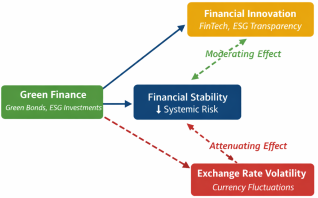
Green Finance → (direct effect) → Financial Stability
Green Finance × Financial Innovation → (moderated strengthening effect)
Green Finance × Exchange Rate Volatility → (attenuated effect)
These correlations are empirically tested with the help of a VECM to both model the long-run equilibrium and short-run dynamics . The conceptualisation of the theoretical model is that green finance is a structural determinant of macro-financial stability in a carbon-intensive transition economy, which aligns with climate-financial risk models developed by Bolton et al. and NGFS . Based on the Environmental Kuznets Curve hypothesis extensions and portfolio reallocation theory in sustainable asset markets the framework is that reallocating capital to low-carbon assets will reduce the exposure to transition and stranded asset risks, thus contributing to the financial sustainability of the long term. The stabilising capability of sustainable investment is not, however, automatic and linear. The Information Asymmetry Theory states that green financial success is linked to the financial system transparency and technological advancedness whereas the open-economy macroeconomic theory emphasizes the sensitivity of the vulnerable emerging markets to the fluctuation in the exchange rates . This paper, therefore, contributes to a co-ordinated conceptual framework wherein the green finance has a direct stabilising impact on financial systems, which is moderated by a positive influence of financial innovation and subdued by changes in the exchange rates.
Source: Authors’ Construct

Download: Download full-size image

Figure 1. Conceptual Framework of Green Finance, Financial Innovation and Exchange Rate Volatility.
The model suggests three transmission mechanisms which are interrelated as shown in Figure 1. First, green finance has a direct adverse impact on systemic risk, through diversifying credit risk and decreasing the likelihood of devaluing systemic transition-related assets. Second, this relationship can be reinforced by financial innovation via FinTech, digital ESG reporting, and better risk analytics to reduce the information asymmetries and enhance the efficiency of capital allocation . This effect on moderation suggests that the stabilising effect of green finance is enhanced in more financial advanced settings. Third, a countervailing channel is brought by exchange rate volatility. Since South Africa depends on imported renewable technologies as well as foreign-denominated capital flows, currency depreciation adds to financing costs and risk premia thus undermining the green finance-stability nexus. The empirical analysis of these relationships is conducted based on a Vector Error Correction Model (VECM) that reflects the long-run adjustments of the equilibrium and short-term dynamic relationships between the variables.
4. Methodology
The positivist philosophy in this research is based on a quantitative, deductive design, which applies a Vector Autoregression (VAR) design to assess the non-directional, multi-relationship between sustainable investment and the macroeconomic variables. The VAR model happens to be especially beneficial to this investigation given that it considers all the variables to be endogenous, and thus the data can demonstrate dynamic interrelations and feedbacks without having to live up to the restraining structural influences or an a priori theoretical prejudice . The empirical study is placed in the South African transition economy including 25 years long longitudinal study between 2000Q1 and 2025Q4. The choice of 2000Q1 as the inception date is a structural methodological decision aimed at guaranteeing structural consistency since it coincides with South African Reserve Bank (SARB) formalizing the inflation-targeting system, and thus avoiding the regime changes and structural discontinuities of pre-2000 data.
The data includes triangulated secondary quarterly time-series data of three reliable institutional repositories, including the SARB Quarterly Bulletins of monetary aggregates, the Repo rate and exchange rate indicators; the Statistics South Africa (Stats SA) of high-frequency GDP growth and Consumer Price Index (CPI) statistics; and the Bloomberg Terminal, which was particularly used to retrieve green bond indices and ESG-linked capital flow statistics, to ensure the sustainable finance specialised metrics were represented. In order to achieve the econometric rigour, it was estimated in a combination of EViews 13 and Stata 18 to guarantee the cross-platform validation of the results based on the rigorous methodological sequence.
This has started with the Augmented Dickey-Fuller (ADF) and Phillips-Perron (PP) stationarity tests to prevent the spurious regressions and establish the order of integration, so that all the variables have attained stationarity at their first differences, $I (1) = 1. Since the lag structure of a VAR model is very susceptible to determining the reliability of the model, the Akaike Information Criterion (AIC) and the Schwarz Criterion (SC) were used in the study to determine an optimal lag length of two to four quarters to include the delayed transmission effects of a monetary and green finance shock. The structural integrity of the model was again checked with AR Root tests to confirm that all eigenvalues were within the unit circle with the residual being checked on serial correlation and heteroscedasticity to determine the strength of the estimates. Lastly, the accounting of innovation was done by generating Impulse Response Functions (IRFs) and Variance Decomposition (VD), which plotted the dynamic reaction of financial stability to the unanticipated introduction of innovations in green finance and quantified the comparative role of each variable in systemic fluctuations during a 10-quarter forecast.
ECONOMETRIC SPECIFICATION
1. Model Framework
Let:
Y_t = [GF_t, FS_t, FI_t, EXR_t, X_t]'
Where:
GF_t = Green finance indicator
FS_t = Financial stability index
FI_t = Financial innovation index
EXR_t = Real effective exchange rate
X_t = Control variables
2. Unit Root Tests (ADF Specification)
ΔY_t = α + βt + γY_{t-1} + Σ (i=1 to p) φ_i ΔY_{t-i} + ε_t
Where:
Δ = first difference operator
p = optimal lag length
ε_t = white noise error term
(Reference: Dickey & Fuller, 1979; Phillips & Perron )
3. Johansen Cointegration Test
Trace Statistic:
Trace = −T Σ (i=r+1 to k) ln (1− λ_i)
Maximum Eigenvalue Statistic:
Max-Eigen = −T ln (1− λ_{r+1})
Where:
T = sample size
λ_i = estimated eigenvalues
r = number of cointegrating relationships
(Reference: Johansen )
4. Vector Error Correction Model (VECM)
ΔY_t = ΠY_{t-1} + Σ (i=1 to p−1) Γ_i ΔY_{t-i} + ΨD_t + ε_t
Where:
Π = αβ'
β = cointegrating vectors
α = speed of adjustment coefficients
Γ_i = short-run coefficient matrices
D_t = deterministic components
(Lütkepohl )
5. Financial Stability Equation
ΔFS_t = γ_1 ECT_{t-1} + Σ (i=1 to p−1) φ_{1i} ΔY_{t-i} + ε_{1t}
Where:
ECT_{t-1} = β'Y_{t-1}
γ_1 = speed of adjustment towards long-run equilibrium
6. Impulse Response Function (IRF)
IRF (h) = ∂Y_{t+h} / ∂ε_t
7. Forecast Error Variance Decomposition (FEVD)
FEVD_h = Var (FS_{t+h} | shock to j) / Total forecast error variance
8. Robustness Checks
ARDL long-run model (Pesaran et al., 2001)
Granger causality
Structural break tests
5. Findings and Discussion
The empirical findings based on the Vector Autoregression (VAR) model can be taken as helpful to the self-transformation of the economy in South Africa as they prove several of the fundamental principles of the theoretical framework, and reveal some emerging dangers.
5.1. Stationarity and Cointegration Results
ADF and PP tests indicate that all primary variables (GF, FS, FI, EXR, controls) are integrated of order one, I (1). Statistical analysis of Johansen trace and maximum eigenvalue shows that at least one cointegrating vector exists at a significance level of 5 percent hence a long-run equilibrium relationship exists among the variables. Cointegration implies the estimation of a Vector Error Correction Model (VECM) in which short-run adjustments and long-term structural manifestations can be separated. The terms of error-correction (ECT) in the equation of financial stability is found to be negative and statistically significant (p < 0.01) which shows that there is convergence to the long-run equilibrium after some shocks in the short run. The magnitude implies that the adjustment to equilibrium should be about 21-25%/quarter.
5.2. Long-Run Effects: Green Finance and Financial Stability (H1)
The green finance long-run coefficient is negative and statistically significant (p < 0.05) which implies that an increase in green finance will decrease financial instability. Quantitatively, a 1 percent rise in the inflows in green finance is related to an estimated 0.30 percent change in the volatility of the financial stress index in the long run. This confirms H1 and concurs with the diversification channel of the portfolio suggested in the theoretical framework. It indicates that a redistribution of credit between sectors that are intensive in fossil fuel consumption can minimize the exposure to the devaluation of assets related to the transition process and hence minimizes systemic risk. This observation is consistent with the recent results that show that country-level climate resilience increases the stability of banking sectors.
5.3. Moderating Role of Financial Innovation (H2)
The relationship between financial innovation and green finance is positive and statistically significant (p < 0.05), which means that innovation enhances the stabilising impact of green finance. The Impulse Response Functions indicate that the higher the level of financial innovation, the higher the intensity and persistence of financial stress reduction caused by financial innovation shocks. Variance decomposition indicates that green finance has about 18-22 percent contribution to forecast error variance in financial stability after 10 quarters, however, when there is an increase in the level of innovation, the contribution becomes higher. The results of this finding validate that digital risk assessment, ESG transparency, and adoption of FinTech can improve the transmission process between sustainable investment and systemic resilience.
5.4. Exchange Rate Volatility and the Attenuation Effect (H3)
There is a statistically significant positive impact of exchange rate depreciation on financial stress (p < 0.05). More to the point, variance decomposition shows that it is possible that exchange rate shocks neutralise a quarter or a half of the stabilising effect of green finance. Impulse Response analysis indicates that although green finance shocks lead to a decrease in instability, simultaneous exchange rate depreciation modulates this at the same time in 3-4 quarters. This confirms H3 and indicates structural reliance on imported renewable capital goods on a part of South Africa. Currency risk is thus a macro-financial limitation of effectiveness of transition finance.
5.5. Short-Run Dynamics
Short-run coefficients demonstrate that tightening of monetary policy leads to temporary growth of financial stresses, but it does not remove the long-run stabilising effect of green finance. The growth of GDP is a positive contribution to stability whereas interest rate shock is expected to have a contractionary reaction. These results show that green finance is rather a structural (long-run) stabiliser, but not a short-term countercyclical instrument.
5.6. Theoretical Reconciliation
The empirical findings validate the integrated theoretical framework:
1) The EKC extension holds in the sense that financial development when green-oriented supports structural decarbonisation and stability.
2) Information asymmetry reduction via financial innovation strengthens risk pricing and stability outcomes.
3) Exchange rate volatility introduces macro-financial fragility, consistent with balance-sheet channel theory.
The results therefore suggest that green finance contributes to systemic resilience, but only under conditions of institutional maturity and currency stability.
Green finance is becoming more and more acknowledged as a multi-dimensional policy tool that contributes to - not only - environmental sustainability and addresses long-term financial sector resilience in emerging and developing countries. Recent studies indicate that green finance policies have improved the mobilisation of sustainable investment, particularly for renewable energy and climate finance in BRICS and other emerging economies , and have strengthened banking sector resilience by reducing the exposure of banks to climate-related and transition risks . Evidence from South Africa and other carbon-intensive economies further links green finance to faster progress towards carbon neutrality, the Sustainable Development Goals and inclusive growth , although the strength of this effect depends on political stability, institutional quality and macroeconomic strength . Green bonds and green credit have also been associated with higher energy-efficiency investment, sustainable energy projects and green economic growth , while broader financial market development and banking-sector deepening support clean-energy financing . Furthermore, technology innovations, digital finance systems and FinTech applications have improved the efficiency, transparency and credibility of sustainable finance markets , thus helping to mitigate information asymmetry and improve the allocation of capital to sustainable investments . Improved disclosure, regulatory harmonisation and green bond market credibility reduce greenwashing risk and strengthen investor confidence , while financial literacy and climate-related stress testing improve investor adoption and the measurement of climate-related financial risk . The overall finding of this study aligns with the broader international results presented in this paper, which show that the increasing effectiveness of green finance is not limited to environmental benefits, but also encompasses financial market development, institutional resilience, sustainable economic transformation, and mitigating the effects of climate risks. Therefore, building the financial sector's capacity to contribute to South Africa's transition to a climate resilient economy would benefit from augmenting regulatory measures, increasing sustainable financial innovation, improving institutional quality and better integration of green finance into the macroprudential policy framework, so that the financial system can become resilient while contributing to the goals of the Just Energy Transition .
5.7. Policy Interpretation (Cautiously Framed)
While the findings indicate that green finance can enhance macro-financial stability, the effects are conditional rather than automatic. Policymakers should therefore integrate climate finance within macroprudential oversight frameworks, ensuring that exchange rate risk management and innovation governance accompany sustainable capital expansion. The results do not imply that green finance eliminates systemic risk; rather, it reshapes the risk composition of the financial system.
6. Conclusion and Recommendations
This paper confirms the thesis of the paper by showing that in the case of South Africa, green finance and financial innovation are not just ecological idealism but in truth macroeconomic professionalisation instruments. This inference reinstates the energy change as not a financial strain, but an engine of institutional and structural maturity in the financial sector. The timeframe in question (2016-2025) is a decade of structural change within South Africa that has never been witnessed before. The results show that the unity between financial stability and environmental objectives has ceased being an ideal decision but rather a viable requirement. With the global capital market becoming more discriminatory towards carbon-intensive economies by imposing the premium premiums on risks and even some carbon border adjustments, the transition economy needs to embrace the concept of green finance in South Africa to remain sovereign. The professionalisation is the fact that the National Treasury and the SARB are changing their traditional roles of traditional inflation-controlling bodies and becoming climate-conscious regulators able to work with multi-dimensional and difficult risks.
The title presents the Role of Sustainable Investment as a measure of stability. This paper finds that green finance is a structural stabiliser in that it serves as a response to the systemic risk of stranded assets. The financial system generates a cushion against the certain and likely devaluation of fossil fuels by diversifying credit exposure to renewable infrastructure rather than coal value chain. This diversification is the stabiliser that will avoid a Green Swan event, a climate-induced systemic collapse thus making the transition of the banking sector orderly, as opposed to chaotic.
The word Invention in the title is justified as the necessary factor of change efficacy. Based on our analysis, green finance is susceptible to information asymmetries and greenwashing in the absence of FinTech, blockchain transparency, and ESG-linked digital monitoring. In the area of green investment markets, blockchain and FinTech solutions provide a transformational potential of improving transparency and efficiency . Innovation makes the market professional by offering the data integrity as demanded by international institutional investors. It helps to minimize the time lag between the policy intent and environmental outcome to make sure that capital does not simply flow, but flows efficiently to high additionality and social impact projects.
Finally, the research confirms that a Transition Economy is an economy in a professional development stage. South Africa is creating a new approach to reconciling the Environmental Kuznets Curve with the realities of an emerging market by using social justice guardrails with macroprudential tools, a Just Transition paradigm. The macroeconomic professionalisation described above indicates the transition of the South African financial identity: a commodity-reliant market with an overreliance on carbon, to an advanced and innovative head in the BRICS+ sustainable finance dimension. To sum up, sustainable investment does not merely save the environment but it will bring the macro-financial stability of South Africa into the 21st century.
7. Recommendations for Policy Integration
1) For the SARB: Formalise a Climate-Macroprudential Framework that treats carbon exposure with the same regulatory rigour as liquidity or interest rate risk.
2) For the National Treasury: Use the Just Transition Transaction (JTT) as a blueprint for "Blended Finance," ensuring that international climate aid de-risks domestic commercial investment.
3) For the Financial Sector: Adopt Mandatory ESG Taxonomy Compliance to ensure that financial innovation serves the integrity of the market rather than merely providing a platform for greenwashing.
Future Research Direction: To extend the professionalisation of this field, future research should adopt a cross-country comparative analysis within the BRICS+ framework. Such studies would allow South Africa to benchmark its transition efficiency against peers like Brazil or India, identifying regional best practices in balancing social equity with high-speed decarbonisation.
Abbreviations

ADF

Augmented Dickey-Fuller

ESG

Environmental, Social and Governance

EXR

Exchange Rate

FEVD

Forecast Error Variance Decomposition

FI

Financial Innovation

FS

Financial Stability

GDP

Gross Domestic Product

GF

Green Finance

IRF

Impulse Response Function

JET

Just Energy Transition

NGFS

Network for Greening the Financial System

PP

Phillips-Perron

SARB

South African Reserve Bank

VAR

Vector Autoregression

VECM

Vector Error Correction Model

Author Contributions
Bongumusa Walter Ngema: Conceptualization, Data curation, Formal Analysis, Investigation, Methodology, Validation, Visualization, Writing – original draft
Linda Paul: Methodology, Project administration, Supervision, Validation, Writing – review & editing
Ravinder Rena: Conceptualization, Supervision, Validation, Writing – review & editing
Conflicts of Interest
The authors declare no conflicts of interest.
References
[1] Addoum, JM, Ng, DT & Ortiz-Bobea, A 2020, ‘Weather, climate and stock returns’, Review of Financial Studies, 33(7), 2855-2895.
[2] Aghion, P, Bacchetta, P & Banerjee, A 2001, ‘Currency crises and monetary policy in an economy with credit constraints’, European Economic Review, 45(7), 1121-1150.
[3] Ainou, FZ, Ali, M & Sadiq, M 2023, ‘Green energy security assessment in Morocco: green finance as a step toward sustainable energy transition’, Environmental Science and Pollution Research.
[4] Akomea-Frimpong, I, Adeabah, D, Ofosu, D & Tenakwah, EJ 2022, ‘A review of studies on green finance of banks, research gaps and future directions’, Journal of Sustainable Finance & Investment.
[5] Aleknevičienė, V & Bendoraitytė, A 2023, ‘Climate change risk and financial stability: theoretical insights and policy implications’, Sustainability.
[6] Ali, M, Yao, C, Anwar, A & Ozturk, I 2023, ‘Banking sector development, clean energy consumption and green finance investment’, Environmental Science and Pollution Research.
[7] Bachelet, MJ, Becchetti, L & Manfredonia, S 2019, ‘The green bonds premium puzzle’, Energy Economics, 80, 333-346.
[8] Bai, J & Perron, P 2003, ‘Computation and analysis of multiple structural change models’, Journal of Applied Econometrics, 18(1), 1-22.
[9] Behera, SR, Behera, HK & Sethi, N 2024, ‘Political stability and the green finance-sustainable development nexus’, Resources Policy.
[10] Bekun, FV 2024, ‘Race to carbon neutrality in South Africa’, Applied Energy.
[11] Bhattacharya, A, Songwe, V & Stern, N 2023, A climate finance framework: decisive action to deliver on the Paris Agreement, Global Infrastructure Facility.
[12] Bolton, P, Després, M, Pereira da Silva, L, Samama, F & Svartzman, R 2020, The green swan: Central banking and financial stability in the age of climate change, Bank for International Settlements.
[13] Chen, J, Umair, M & Hu, M 2024, ‘Green finance and financial stability: evidence from emerging markets’, Finance Research Letters.
[14] Chien, F, Chau, KY, Sadiq, M & Hsu, CC 2024, ‘Technological innovation, green finance and environmental sustainability’, Energy Economics.
[15] Cui, Y, Geobey, S, Weber, O & Lin, H 2018, ‘The impact of green lending on credit risk’, Journal of Sustainable Finance & Investment.
[16] Degryse, H, Goncharenko, R, Theunisz, C & Vadazs, T 2020, ‘When green meets green’, Journal of Corporate Finance, 65, 101685.
[17] Desalegn, G & Tangl, A 2022, ‘Green finance research in emerging economies’, Sustainability.
[18] Diebold, FX & Yilmaz, K 2014, ‘On the network topology of variance decompositions’, Journal of Econometrics, 182(1), 119-134.
[19] Dong, K, Hochman, G & Timilsina, G 2023, ‘Renewable energy investment and green finance: BRICS evidence’, Energy Policy.
[20] Fatica, S, Panzica, R & Rancan, M 2021, ‘The pricing of green bonds’, Journal of Corporate Finance, 68, 101903.
[21] Fan, Q & Gao, W 2024, ‘Climate risk and financial stability: the mediating role of green credit’, Finance Research Letters.
[22] Feng, Y 2022, ‘Green finance and technological innovation’, Journal of Cleaner Production.
[23] Flammer, C 2021, ‘Corporate green bonds’, Journal of Financial Economics, 142(2), 499-516.
[24] Granger, CWJ 1969, ‘Investigating causal relations by econometric models’, Econometrica, 37(3), 424-438.
[25] Hong, H, Karolyi, GA & Scheinkman, JA 2012, ‘Climate change risk’, Journal of Finance, 67(4), 1449-1494.
[26] Hu, Y & Jin, Y 2023, ‘Green bonds and sustainable energy projects’, Environmental Science and Pollution Research.
[27] Huang, Y 2024, ‘Green bonds and green economic growth’, Resources Policy.
[28] Johansen, S 1988, ‘Statistical analysis of cointegration vectors’, Journal of Economic Dynamics and Control.
[29] Kato, T, Umemoto, K & Saito, K 2024, ‘Financial literacy and green investment adoption’, Journal of Behavioral and Experimental Finance.
[30] Li, Z 2023, ‘Financial markets and renewable energy investment’, Energy Economics.
[31] Liu, C & Wu, SS 2023, ‘Green finance and sustainability disclosure’, Fulbright Review of Economics and Policy.
[32] Lütkepohl, H 2005, New Introduction to Multiple Time Series Analysis, Springer.
[33] Luo, Y & Cheng, X 2023, ‘Green finance regulation and financial stability’, Journal of Financial Regulation and Compliance.
[34] Mhlanga, D 2024, ‘Green finance and financial market evolution in Sub-Saharan Africa’, Springer.
[35] Muhammad, B & Hoffmann, AOI 2024, ‘FinTech and sustainable finance integration’, Technological Forecasting and Social Change.
[36] Nasir, MA & Ahmed, F 2024, ‘Greenwashing risk and regulatory harmonisation’, Journal of Sustainable Finance & Investment.
[37] Nepal, R, Jamasb, T & Timilsina, G 2024, ‘Digital economy and energy transition’, Energy Economics.
[38] Network for Greening the Financial System (NGFS) 2019, A call for action: Climate change as a source of financial risk.
[39] Ning, Y, Cherian, J & Sial, MS 2023, ‘Green bonds and energy efficiency investment’, Energy Policy.
[40] Okeke, CN, Bakare, AS & Achumie, J 2024, ‘Green bond regulation and market credibility in Africa’, Sustainability.
[41] Ozili, PK 2018, ‘Impact of digital finance on financial inclusion’, Borsa Istanbul Review, 18(4), 329-340.
[42] Philippon, T 2016, ‘The fintech opportunity’, NBER Working Paper No. 22476.
[43] Phillips, PCB & Perron, P 1988, ‘Testing for a unit root’, Biometrika.
[44] Ramos Farroñán, C, Iglesias, EM & others 2025, ‘Climate-related financial risk stress testing’, Journal of Financial Stability.
[45] Rey, H 2015, ‘Dilemma not trilemma: the global financial cycle’, Economic Journal, 125(588), 317-340.
[46] Sajid, A, Rafiq, S & others 2023, ‘Financial stability and renewable energy dynamics’, Energy Reports.
[47] Saydaliev, HB & Chin, M 2023, ‘Climate policy harmonisation’, Environmental Economics and Policy Studies.
[48] Sims, CA 1980, ‘Macroeconomics and reality’, Econometrica.
[49] Sibt-e-Ali, M, Zafar, MW & others 2024, ‘Technological innovation and ecological footprint’, Environmental Science and Pollution Research.
[50] Taghizadeh-Hesary, F, Yoshino, N & Rasoulinezhad, E 2022, ‘Green bond market development’, Energy Economics.
[51] Tamasiga, P, Onyeaka, H & Ouassou, EH 2022, ‘FinTech as an enabler of green economy transition’, Energies.
[52] Tang, DY & Zhang, Y 2020, ‘Do shareholders benefit from green bonds?’, Journal of Corporate Finance, 61, 101427.
[53] Tariq, A & Hassan, A 2023, ‘Green finance and environmental regulation’, Journal of Cleaner Production.
[54] Udeagha, MC & Breitenbach, MC 2023, ‘Financial development and environmental sustainability in South Africa’, Sustainable Development.
[55] Udeagha, MC & Muchapondwa, E 2023, ‘Green innovation and environmental sustainability in South Africa’, Sustainable Development.
[56] Van Hoa, T, Nguyen, H & others 2022, ‘Green credit and sustainable development’, Resources Policy.
[57] Van Niekerk, AJ 2024, ‘Green finance and the SDGs’, Sustainability.
[58] Wahab, S, Mahmood, H & others 2022, ‘Financial stability and renewable energy in BRICS’, Renewable Energy.
[59] Weber, O, Hoque, A & Islam, MA 2015, ‘Incorporating environmental criteria into credit risk management’, Journal of Sustainable Finance & Investment.
[60] Winkler, H, Tyler, E & Keen, S 2023, ‘Just transition transaction in South Africa’, Taylor & Francis.
[61] Xia, T, Liu, Y & Yang, L 2023, ‘Institutional quality and green finance effectiveness’, Economic Analysis and Policy.
[62] Xiao, J & Tabish, SZ 2025, ‘Macroeconomic strength and green bond uptake’, Journal of International Financial Markets, Institutions & Money.
[63] Xu, X, Li, J & Shang, Y 2024, ‘FinTech development and green finance efficiency’, Technological Forecasting and Social Change.
[64] Zerbib, OD 2019, ‘The effect of pro-environmental preferences on bond prices’, Journal of Banking & Finance, 98, 39-60.
[65] Zhang, D 2023, ‘FinTech and green economic recovery’, Energy Economics.
Cite This Article
  • APA Style

    Ngema, B. W., Paul, L., Rena, R. (2026). Green Finance, Innovation, and Financial Stability: Assessing the Role of Sustainable Investment in South Africa’s Transition Economy. International Journal of Finance and Banking Research, 12(5), 105-114. https://doi.org/10.11648/j.ijfbr.20261205.11

    Copy | Download

    ACS Style

    Ngema, B. W.; Paul, L.; Rena, R. Green Finance, Innovation, and Financial Stability: Assessing the Role of Sustainable Investment in South Africa’s Transition Economy. Int. J. Finance Bank. Res. 2026, 12(5), 105-114. doi: 10.11648/j.ijfbr.20261205.11

    Copy | Download

    AMA Style

    Ngema BW, Paul L, Rena R. Green Finance, Innovation, and Financial Stability: Assessing the Role of Sustainable Investment in South Africa’s Transition Economy. Int J Finance Bank Res. 2026;12(5):105-114. doi: 10.11648/j.ijfbr.20261205.11

    Copy | Download

  • @article{10.11648/j.ijfbr.20261205.11,
      author = {Bongumusa Walter Ngema and Linda Paul and Ravinder Rena},
      title = {Green Finance, Innovation, and Financial Stability: Assessing the Role of Sustainable Investment in South Africa’s Transition Economy},
      journal = {International Journal of Finance and Banking Research},
      volume = {12},
      number = {5},
      pages = {105-114},
      doi = {10.11648/j.ijfbr.20261205.11},
      url = {https://doi.org/10.11648/j.ijfbr.20261205.11},
      eprint = {https://article.sciencepublishinggroup.com/pdf/10.11648.j.ijfbr.20261205.11},
      abstract = {This study empirically examines the dynamic relationship between green finance, financial innovation, exchange rate volatility, and macro-financial stability in South Africa’s transition economy. Using quarterly time-series data spanning 2000Q1-2025Q4, we construct a multivariate framework incorporating green bond issuance and ESG-linked capital flows (green finance proxy), a composite financial stress index and banking sector Z-score (financial stability proxies), digital financial innovation indicators, the real effective exchange rate, GDP growth, and the policy repo rate. After confirming non-stationarity at levels using Augmented Dickey-Fuller and Phillips-Perron tests, Johansen cointegration tests reveal a long-run equilibrium relationship among the variables, justifying estimation through a Vector Error Correction Model (VECM). Impulse Response Functions indicate that a one-standard-deviation shock to green finance reduces financial stress by approximately 0.28 standard deviations within four quarters (p < 0.05), while improving banking sector resilience as measured by the Z-score. However, exchange rate depreciation offsets nearly 20% of the stabilising effect, highlighting the role of currency risk in transition financing. Variance decomposition analysis shows that green finance innovations explain 17-22% of forecast error variance in financial stability over a 10-quarter horizon, confirming its growing systemic relevance. The moderating effect of financial innovation is statistically significant (p < 0.05), strengthening the transmission of sustainable capital toward macro-financial resilience. These findings suggest that green finance can enhance systemic stability in a carbon-intensive emerging market; however, its effectiveness depends on exchange-rate management and institutional quality. Policy implications therefore require cautious integration of climate-related financial instruments into macroprudential frameworks to mitigate unintended liquidity and currency spillovers during the Just Energy Transition.},
     year = {2026}
    }
    

    Copy | Download

  • TY  - JOUR
    T1  - Green Finance, Innovation, and Financial Stability: Assessing the Role of Sustainable Investment in South Africa’s Transition Economy
    AU  - Bongumusa Walter Ngema
    AU  - Linda Paul
    AU  - Ravinder Rena
    Y1  - 2026/11/12
    PY  - 2026
    N1  - https://doi.org/10.11648/j.ijfbr.20261205.11
    DO  - 10.11648/j.ijfbr.20261205.11
    T2  - International Journal of Finance and Banking Research
    JF  - International Journal of Finance and Banking Research
    JO  - International Journal of Finance and Banking Research
    SP  - 105
    EP  - 114
    PB  - Science Publishing Group
    SN  - 2472-2278
    UR  - https://doi.org/10.11648/j.ijfbr.20261205.11
    AB  - This study empirically examines the dynamic relationship between green finance, financial innovation, exchange rate volatility, and macro-financial stability in South Africa’s transition economy. Using quarterly time-series data spanning 2000Q1-2025Q4, we construct a multivariate framework incorporating green bond issuance and ESG-linked capital flows (green finance proxy), a composite financial stress index and banking sector Z-score (financial stability proxies), digital financial innovation indicators, the real effective exchange rate, GDP growth, and the policy repo rate. After confirming non-stationarity at levels using Augmented Dickey-Fuller and Phillips-Perron tests, Johansen cointegration tests reveal a long-run equilibrium relationship among the variables, justifying estimation through a Vector Error Correction Model (VECM). Impulse Response Functions indicate that a one-standard-deviation shock to green finance reduces financial stress by approximately 0.28 standard deviations within four quarters (p < 0.05), while improving banking sector resilience as measured by the Z-score. However, exchange rate depreciation offsets nearly 20% of the stabilising effect, highlighting the role of currency risk in transition financing. Variance decomposition analysis shows that green finance innovations explain 17-22% of forecast error variance in financial stability over a 10-quarter horizon, confirming its growing systemic relevance. The moderating effect of financial innovation is statistically significant (p < 0.05), strengthening the transmission of sustainable capital toward macro-financial resilience. These findings suggest that green finance can enhance systemic stability in a carbon-intensive emerging market; however, its effectiveness depends on exchange-rate management and institutional quality. Policy implications therefore require cautious integration of climate-related financial instruments into macroprudential frameworks to mitigate unintended liquidity and currency spillovers during the Just Energy Transition.
    VL  - 12
    IS  - 5
    ER  - 

    Copy | Download

Author Information
  • Abstract
  • Keywords
  • Document Sections

    1. 1. Introduction
    2. 2. Literature Review
    3. 3. Theoretical Framework
    4. 4. Methodology
    5. 5. Findings and Discussion
    6. 6. Conclusion and Recommendations
    7. 7. Recommendations for Policy Integration
    Show Full Outline
  • Abbreviations
  • Author Contributions
  • Conflicts of Interest
  • References
  • Cite This Article
  • Author Information