Abstract
In Nigerian universities, undergraduates are expected to write essays, term papers and research projects using scholarly sources, but many have difficulty locating suitable sources, reading and evaluating them, incorporating them into their own writing and citing them correctly. These problems are typically treated as English language difficulties, to be dealt with in courses on the use of English, or as problems of library use, to be dealt with in library orientation. This paper proposes that they are better seen as problems at the intersection of information literacy and academic writing, and that information literacy is not a standalone skill but a foundation of source-based English academic writing. The argument is about writing from sources, not all aspects of academic writing, such as grammar, vocabulary or general English proficiency. Using a conceptual design based on a purposive integrative review, the paper brings together the Association of College and Research Libraries Framework for Information Literacy for Higher Education, the cognitive process and discourse synthesis models of writing, research on patchwriting and textual borrowing in second-language writing, and the academic literacies perspective, and links these to the position of English and of information literacy instruction in Nigerian universities. From this synthesis it develops the Information Literacy for Academic Writing Framework. The framework maps the six frames of information literacy, in a many-to-many relationship, onto six recursive stages of source-based writing: framing a question, searching, reading and evaluating, synthesising and integrating, attributing, and positioning one’s own argument. It suggests that four instructional mechanisms (joint teaching by librarians and English lecturers, scaffolded source-based assignments, explicit instruction in paraphrase and citation with formative feedback, and library-based writing consultations) develop information literacy dispositions, treated as both an intermediate outcome and a proposed mediator, and writing-from-sources practices that are expected to improve the quality of sources used, the integration of sources, the accuracy of attribution and the strength of argument. English reading proficiency, access to information resources, assessment practices and the availability of generative artificial intelligence tools are conditions that may strengthen or weaken these effects. The relationships are theoretical expectations, not demonstrated findings. Nine propositions in six groups, with operational definitions, and practical suggestions for English departments, university libraries and university management are presented to guide empirical research and practice.
1. Introduction
In higher education, academic writing seldom consists of writing from personal knowledge alone. Undergraduates are expected to find scholarly sources, read and evaluate them, combine ideas from several of them, credit them properly and use them to develop an argument of their own. In Nigerian universities this work is done almost entirely in English, the medium of instruction and the language of most of the textbooks, journals and databases available to students
| [1] | Bamgbose, A. Language and Exclusion: The Consequences of Language Policies in Africa. Münster: LIT Verlag; 2000. |
| [2] | Federal Republic of Nigeria. National Policy on Education. 6th ed. Lagos: Nigerian Educational Research and Development Council; 2013. |
[1, 2]
. For most students English is a second language, and the formal register of academic writing is quite different from the English they use in everyday life
| [3] | Jowitt, D. Nigerian English Usage: An Introduction. Ikeja: Longman Nigeria; 1991. |
[3]
.
Lecturers often report that students’ written work relies on a narrow range of readily available sources, reproduces the wording of sources too closely and credits them inaccurately. The available Nigerian evidence is consistent with these reports, although it is limited. In their survey of final-year library and information science undergraduates in Nigerian universities, Okeji, Ilika and Baro
| [4] | Okeji, C. C., Ilika, O. M., Baro, E. E. Assessment of information literacy skills: A survey of final year undergraduates of library and information science in Nigerian universities. Global Knowledge, Memory and Communication. 2020, 69(6/7), 521–535. https://doi.org/10.1108/GKMC-10-2019-0130 |
[4]
found that students rated their ability to find and organise information highly but were weak in paraphrasing to avoid plagiarism and in applying citation and referencing styles. Orim et al.
| [5] | Orim, S.-M., Davies, J. W., Borg, E., Glendinning, I. Exploring Nigerian postgraduate students’ experience of plagiarism: A phenomenographic case study. International Journal for Educational Integrity. 2013, 9(1).
https://doi.org/10.21913/ijei.v9i1.845 |
[5]
found that Nigerian postgraduate students in the United Kingdom often had only a partial understanding of plagiarism, which was related in part to their earlier education in Nigeria. These findings concern particular groups, and the extent of such difficulties among undergraduates in general is treated here as a contextual assumption that requires empirical confirmation.
Such problems are usually given one of two separate remedies. They are treated as problems of English proficiency, to be addressed in general studies courses in the use of English, or as problems of library use, to be addressed in library orientation and in courses on the use of the library. A survey of 36 Nigerian university libraries found that information literacy instruction was delivered mainly through orientation and use of library courses, rather than being integrated into teaching in the disciplines
. Research in writing studies, however, suggests that the most persistent problems of source-based writing, such as patchwriting, weak synthesis and inaccurate attribution, arise where reading, information evaluation and writing meet
| [7] | Howard, R. M. Plagiarisms, authorships, and the academic death penalty. College English. 1995, 57(7), 788–806.
https://doi.org/10.2307/378403 |
| [8] | Howard, R. M., Serviss, T., Rodrigue, T. K. Writing from sources, writing from sentences. Writing and Pedagogy. 2010, 2(2), 177–192. https://doi.org/10.1558/wap.v2i2.177 |
| [9] | Pecorari, D. Good and original: Plagiarism and patchwriting in academic second-language writing. Journal of Second Language Writing. 2003, 12(4), 317–345.
https://doi.org/10.1016/j.jslw.2003.08.004 |
[7-9]
. Students who can locate sources are not always able to read them well enough to paraphrase them, and students who write fluent English may still not understand why and how scholarly sources are acknowledged. Neither remedy, delivered on its own, reaches this meeting point.
Library and information science has a well-developed account of information literacy, most recently in the Framework for Information Literacy for Higher Education of the Association of College and Research Libraries (ACRL), which describes information literacy through six interconnected frames
. Writing studies has well-developed accounts of the processes of writing and of writing from sources
| [11] | Flower, L., Hayes, J. R. A cognitive process theory of writing. College Composition and Communication. 1981, 32(4), 365–387. https://doi.org/10.2307/356600 |
| [12] | Spivey, N. N. Transforming texts: Constructive processes in reading and writing. Written Communication. 1990, 7(2), 256–287. https://doi.org/10.1177/0741088390007002004 |
| [13] | Bereiter, C., Scardamalia, M. The Psychology of Written Composition. Hillsdale, NJ: Lawrence Erlbaum; 1987. |
[11-13]
. Writers in both fields have called for the two to be brought together
| [14] | Norgaard, R. Writing information literacy: Contributions to a concept. Reference & User Services Quarterly. 2003, 43(2), 124–130. |
| [15] | Elmborg, J. Critical information literacy: Implications for instructional practice. The Journal of Academic Librarianship. 2006, 32(2), 192–199. https://doi.org/10.1016/j.acalib.2005.12.004 |
[14, 15]
, and recent conceptual work has proposed collaboration between Nigerian university libraries and English departments in teaching specific features of academic writing
| [16] | Igbokwe, B., Nwanekezie, N. P. Hedging, signposting and stance: A conceptual model of library–English department collaboration for developing metadiscourse competence in Nigerian undergraduate research proposals. Research Journal of English Language and Literature. 2026, 14(3), 508–522. http://rjelal.com |
[16]
, and the combination of information literacy with task-based language teaching in secondary schools
| [17] | Igbokwe, B., Nwanekezie, N. P. A conceptual model for integrating information literacy and task-based language teaching: Rethinking English language instruction in Nigerian secondary schools. International Journal of English Language, Literature and Translation Studies. 2026, 13(3), 121–134. http://ijelr.in |
[17]
. To the authors’ knowledge, however, no framework has yet mapped the information literacy frames systematically onto the stages of source-based academic writing for undergraduates in Nigerian universities, specified the instructional mechanisms through which the two can be taught together, or identified the conditions under which such teaching is likely to succeed.
This paper addresses that gap. Its central argument is that information literacy is a foundation for source-based English academic writing, because each stage of writing from sources depends on a corresponding information literacy disposition or practice. The contribution is integrative, contextual and pedagogical rather than an entirely new theory. Conceptually, it proposes relationships that earlier work linking information literacy and writing
| [14] | Norgaard, R. Writing information literacy: Contributions to a concept. Reference & User Services Quarterly. 2003, 43(2), 124–130. |
| [15] | Elmborg, J. Critical information literacy: Implications for instructional practice. The Journal of Academic Librarianship. 2006, 32(2), 192–199. https://doi.org/10.1016/j.acalib.2005.12.004 |
[14, 15]
did not specify: a many-to-many mapping between the six ACRL frames and six stages of source-based writing, a link from reading and evaluating sources to patchwriting, and conditions, including generative artificial intelligence, that act at particular points. Contextually, it applies these ideas to second-language writers in Nigerian universities, where information literacy and English are taught in separate courses by separate staff. Pedagogically, it specifies which instructional mechanisms are expected to act on which stages and outcomes, so that integrated instruction can be designed and evaluated rather than simply recommended. The paper has three aims: first, to synthesise research on information literacy, the writing process, writing from sources and academic literacies; second, to present the Information Literacy for Academic Writing Framework, setting out its stages, mechanisms, outcomes and conditions; and third, to derive testable propositions and practical recommendations. The paper is conceptual. It presents no new data; it builds an argument from existing theory and evidence and offers a framework that future empirical research can test, refine or reject.
2. Literature Review
2.1. Key Concepts
Information literacy is understood here, following the ACRL
, as the set of integrated abilities that include the reflective discovery of information, an understanding of how information is produced and valued, and the use of information in creating new knowledge and participating ethically in communities of learning. The ACRL Framework describes it in six frames: Authority Is Constructed and Contextual; Information Creation as a Process; Information Has Value; Research as Inquiry; Scholarship as Conversation; and Searching as Strategic Exploration. Each frame integrates knowledge practices, which are what learners do, with dispositions, which are attitudes and habits of mind.
English academic writing is the production of extended written texts in English that meet the conventions of a discipline, such as using evidence, building an argument and acknowledging sources
| [18] | Hyland, K. Disciplinary Discourses: Social Interactions in Academic Writing. Ann Arbor, MI: University of Michigan Press; 2004. |
| [19] | Swales, J. M. Genre Analysis: English in Academic and Research Settings. Cambridge: Cambridge University Press; 1990. |
[18, 19]
.
Writing from sources, also called source-based writing, is the part of academic writing in which the writer selects, reads, combines and acknowledges the work of others in order to build an argument
| [8] | Howard, R. M., Serviss, T., Rodrigue, T. K. Writing from sources, writing from sentences. Writing and Pedagogy. 2010, 2(2), 177–192. https://doi.org/10.1558/wap.v2i2.177 |
| [12] | Spivey, N. N. Transforming texts: Constructive processes in reading and writing. Written Communication. 1990, 7(2), 256–287. https://doi.org/10.1177/0741088390007002004 |
[8, 12]
.
Patchwriting is a term introduced by Howard
for copying from a source text and then deleting some words, altering grammatical structures or substituting synonyms. Howard and Pecorari
do not regard it as deliberate cheating but as a developmental stage in learning to write from sources, often linked to an incomplete understanding of the source text. This distinction matters for the present argument, because it locates part of the problem of plagiarism in reading and source use rather than in intention alone.
Four further constructs are distinguished, because the framework does not claim to give a complete account of academic writing.
Source-based writing competence is the ability to select, represent, combine and acknowledge sources in the service of an argument.
General English proficiency refers to grammar, vocabulary and fluency in English.
Disciplinary writing competence is command of the genres, rhetorical organisation and conventions of a particular discipline
| [18] | Hyland, K. Disciplinary Discourses: Social Interactions in Academic Writing. Ann Arbor, MI: University of Michigan Press; 2004. |
| [19] | Swales, J. M. Genre Analysis: English in Academic and Research Settings. Cambridge: Cambridge University Press; 1990. |
[18, 19]
.
Information literacy, as defined above, overlaps with source-based writing competence but not with general English proficiency. The framework’s explanatory claim is restricted to source-based writing competence; it does not claim that information literacy explains grammar, vocabulary, coherence or disciplinary conventions, although these also affect the quality of a written assignment.
Information literacy as a foundation for writing is the central claim of the paper. It does not mean that information literacy must be mastered before writing can begin. It means that each stage of writing from sources relies on particular information literacy dispositions and practices, and that weaknesses in these will show up as weaknesses in the writing.
2.2. Theoretical Foundations
2.2.1. The ACRL Framework for Information Literacy
The ACRL Framework
replaced an earlier set of standards that defined information literacy as a list of skills. It offers instead a set of threshold concepts, ideas that change the way learners think once they grasp them. Several frames relate directly to writing. Scholarship as Conversation presents scholarly work as an ongoing conversation in which new contributions respond to earlier ones, which is also how academic writing frames its argument. Information Has Value includes an understanding of why sources are attributed, which underlies citation. Authority Is Constructed and Contextual concerns how writers judge the credibility of sources. The Framework is written for librarians and does not specify how its frames relate to the stages of writing, which is the task of this paper.
2.2.2. The Writing Process and Knowledge Transformation
Flower and Hayes
| [11] | Flower, L., Hayes, J. R. A cognitive process theory of writing. College Composition and Communication. 1981, 32(4), 365–387. https://doi.org/10.2307/356600 |
[11]
described writing as a set of recursive cognitive processes, planning, translating and reviewing, guided by the writer’s goals and constrained by the task environment and the writer’s long-term memory. Writing is therefore not linear but a cycle in which writers revisit earlier stages as their understanding develops. Bereiter and Scardamalia
| [13] | Bereiter, C., Scardamalia, M. The Psychology of Written Composition. Hillsdale, NJ: Lawrence Erlbaum; 1987. |
[13]
distinguished knowledge telling, in which writers set down what they know in the order in which it comes to mind, from knowledge transforming, in which writing changes the writer’s understanding because ideas are reorganised to serve rhetorical goals. Source-based writing that merely strings together information from sources resembles knowledge telling; writing that uses sources to build an argument requires knowledge transforming.
2.2.3. Discourse Synthesis
Spivey
called writing from several sources discourse synthesis, a constructive process in which writers select content from sources, organise it according to a structure of their own and relate it to their own knowledge and purposes. Writers who select and organise in this way produce texts that are more than the sum of their sources. Discourse synthesis therefore links reading and writing directly: what writers take from sources depends on how well they understand them and on the purpose for which they read them.
2.2.4. Patchwriting and Textual Borrowing in Second-Language Writing
Howard
argued that patchwriting is a normal stage in learning to write from unfamiliar sources and should be addressed through teaching rather than punishment. Pecorari
found that second-language postgraduate writers often produced patchwriting while believing that they were acknowledging their sources appropriately, and argued that this reflected developmental difficulty rather than intent to deceive. Shi
found that second-language writers borrowed more words from source texts than first-language writers, particularly when summarising. Howard, Serviss and Rodrigue
found that student writers in the United States worked mainly from isolated sentences in sources rather than summarising whole texts, which suggests that weak engagement with the source as a whole contributes to patchwriting. Together, these studies indicate that patchwriting has several possible causes. Weak comprehension of the source is one; others include limited instruction in paraphrase, limited knowledge of attribution conventions, time pressure and disciplinary conventions about how closely sources may be followed
| [7] | Howard, R. M. Plagiarisms, authorships, and the academic death penalty. College English. 1995, 57(7), 788–806.
https://doi.org/10.2307/378403 |
| [9] | Pecorari, D. Good and original: Plagiarism and patchwriting in academic second-language writing. Journal of Second Language Writing. 2003, 12(4), 317–345.
https://doi.org/10.1016/j.jslw.2003.08.004 |
| [20] | Shi, L. Textual borrowing in second-language writing. Written Communication. 2004, 21(2), 171–200.
https://doi.org/10.1177/0741088303262846 |
[7, 9, 20]
. The framework treats reading comprehension as one hypothesised pathway among these, not as a complete explanation.
2.2.5. The Academic Literacies Perspective
Lea and Street
identified three approaches to student writing: a study skills approach, which sees writing as a set of transferable technical skills; an academic socialisation approach, which focuses on inducting students into the culture of a discipline; and an academic literacies approach, which treats writing as a social practice in which identity, power and the negotiation of meaning are central. Wingate
| [22] | Wingate, U. Using Academic Literacies and genre-based models for academic writing instruction: A “literacy” journey. Journal of English for Academic Purposes. 2012, 11(1), 26–37. https://doi.org/10.1016/j.jeap.2011.11.006 |
[22]
argued for combining the academic literacies perspective with genre-based teaching, so that students are taught explicitly how texts in their discipline are constructed. From this perspective, information literacy and writing are both social practices embedded in disciplines, and separating them into a library skill and a language skill reflects the study skills approach that Lea and Street criticised.
2.3. Review of Related Literature
2.3.1. Writing Information Literacy
Norgaard
| [14] | Norgaard, R. Writing information literacy: Contributions to a concept. Reference & User Services Quarterly. 2003, 43(2), 124–130. |
[14]
argued that rhetoric and composition could contribute to information literacy by treating research as a situated, rhetorical activity rather than a set of retrieval skills, and coined the term “writing information literacy” to describe the combination. Elmborg
argued for a critical information literacy in which librarians help students understand how knowledge is produced and contested, not only how to locate it, and drew parallels with the teaching of writing. These arguments establish the case for integration, but they were developed in the context of first-year composition in the United States and do not consider second-language writers in multilingual settings.
2.3.2. Students’ Use of Sources
Head and Eisenberg
| [23] | Head, A. J., Eisenberg, M. B. Truth Be Told: How College Students Evaluate and Use Information in the Digital Age. Project Information Literacy Progress Report. Seattle, WA: University of Washington Information School; 2010. |
[23]
found that many students relied on a small set of familiar sources, such as course readings and general web searches, and seldom consulted librarians, even when they found research difficult. Students also reported difficulty in selecting and evaluating sources for assignments. Larger studies support the link between information literacy and learning. In a multi-institutional survey, Fosnacht
| [24] | Fosnacht, K. Information literacy’s influence on undergraduates’ learning and development: Results from a large multi-institutional study. College & Research Libraries. 2020, 81(2), 272. https://doi.org/10.5860/crl.81.2.272 |
[24]
found that students’ experiences of information use and evaluation, and instructors’ emphasis on them, were positively associated with higher-order and integrative learning. Barratt et al.
| [25] | Barratt, C. C., Nielsen, K., Desmet, C., Balthazor, R. Collaboration is key: Librarians and composition instructors analyze student research and writing. portal: Libraries and the Academy. 2009, 9(1), 37–56.
https://doi.org/10.1353/pla.0.0038 |
[25]
analysed the citations in first-year composition students’ papers and concluded that teaching by librarians or writing instructors alone did not produce the best results, and that joint planning of assignments and instruction was essential. Pickard and Sterling
| [26] | Pickard, E., Sterling, S. What we talk about when we talk about quality: A librarian and instructor compare how they assess students’ sources. Collaborative Librarianship. 2020, 12(1), 8. |
[26]
found that a librarian and a writing instructor used similar indicators of source quality but weighted them differently, which suggests that integrated teaching requires shared criteria. These patterns suggest that problems of source selection begin before writing does, at the stages of framing a question and searching, which information literacy addresses directly.
2.3.3. Information Literacy Instruction and Source Use in Nigeria
Baro and Zuokemefa
surveyed 36 Nigerian university libraries and found that information literacy was taught mainly through library orientation and use of library courses, with limited collaboration with teaching staff. Okeji, Ilika and Baro
| [4] | Okeji, C. C., Ilika, O. M., Baro, E. E. Assessment of information literacy skills: A survey of final year undergraduates of library and information science in Nigerian universities. Global Knowledge, Memory and Communication. 2020, 69(6/7), 521–535. https://doi.org/10.1108/GKMC-10-2019-0130 |
[4]
found that the information literacy of final-year library and information science students was moderate overall, and that they were weakest in paraphrasing and in applying citation styles, even though they rated their ability to organise and combine information highly. Orim et al.
| [5] | Orim, S.-M., Davies, J. W., Borg, E., Glendinning, I. Exploring Nigerian postgraduate students’ experience of plagiarism: A phenomenographic case study. International Journal for Educational Integrity. 2013, 9(1).
https://doi.org/10.21913/ijei.v9i1.845 |
[5]
found that Nigerian postgraduate students in the United Kingdom often had only a partial understanding of plagiarism, which was related in part to their earlier education. Buraimo et al.
| [27] | Buraimo, O., Oyedokun, O. S., Olusanya, O. F., Adekunmisi, R. S. Plagiarism perceptions among undergraduates at Olabisi Onabanjo University, Nigeria. Mousaion: South African Journal of Information Studies. 2019, 37(4).
https://doi.org/10.25159/2663-659X/6409 |
[27]
found that undergraduates at a Nigerian university knew what plagiarism was and considered it serious, but cited the desire for high marks, fear of failure and poor planning as reasons for it, which suggests that knowledge of the rules alone does not prevent plagiarism. Taken together, these studies point to a gap between knowing where information is and knowing how to use it in writing. Comparable studies of undergraduates across disciplines are scarce, and the evidence is treated here as indicative rather than conclusive.
2.3.4. Reading, Language and Source-Based Writing in Nigeria
Students in Nigerian universities read and write academic texts in a second language, and the formal academic register is unfamiliar to many first-year students
| [3] | Jowitt, D. Nigerian English Usage: An Introduction. Ikeja: Longman Nigeria; 1991. |
[3]
. Igbokwe and Nwanekezie
| [28] | Igbokwe, B., Nwanekezie, N. P. Metacognitive reading strategies and English academic comprehension: A conceptual framework for Nigerian LIS education. Research Journal of English Language and Literature. 2025, 13(4), 515–526. http://rjelal.com |
[28]
argued that explicit instruction in metacognitive reading strategies gives students greater control over difficult academic texts. Because patchwriting is associated with incomplete understanding of sources
| [8] | Howard, R. M., Serviss, T., Rodrigue, T. K. Writing from sources, writing from sentences. Writing and Pedagogy. 2010, 2(2), 177–192. https://doi.org/10.1558/wap.v2i2.177 |
| [9] | Pecorari, D. Good and original: Plagiarism and patchwriting in academic second-language writing. Journal of Second Language Writing. 2003, 12(4), 317–345.
https://doi.org/10.1016/j.jslw.2003.08.004 |
[8, 9]
, weaknesses in reading academic English are likely to contribute to weaknesses in source integration. Recent conceptual work has also proposed collaboration between libraries and English departments in teaching the metadiscourse of research proposals
| [16] | Igbokwe, B., Nwanekezie, N. P. Hedging, signposting and stance: A conceptual model of library–English department collaboration for developing metadiscourse competence in Nigerian undergraduate research proposals. Research Journal of English Language and Literature. 2026, 14(3), 508–522. http://rjelal.com |
[16]
, and the integration of information literacy with task-based language teaching in secondary schools
| [17] | Igbokwe, B., Nwanekezie, N. P. A conceptual model for integrating information literacy and task-based language teaching: Rethinking English language instruction in Nigerian secondary schools. International Journal of English Language, Literature and Translation Studies. 2026, 13(3), 121–134. http://ijelr.in |
[17]
. The present paper extends this work beyond particular features of writing, and beyond secondary schooling, to the whole process of source-based academic writing at undergraduate level.
2.3.5. Generative Artificial Intelligence and Source-Based Writing
The spread of generative artificial intelligence tools has added a new dimension to source-based writing. Kasneci et al.
| [29] | Kasneci, E., Seßler, K., Küchemann, S., Bannert, M., Dementieva, D., Fischer, F., et al. ChatGPT for good? On opportunities and challenges of large language models for education. Learning and Individual Differences. 2023, 103, 102274.
https://doi.org/10.1016/j.lindif.2023.102274 |
[29]
identified opportunities for such tools to support writing and learning, together with risks that include overreliance and the generation of plausible but incorrect content. Walters and Wilder
found that a large proportion of the bibliographic citations generated by ChatGPT in literature reviews were fabricated or contained substantive errors, although the proportion was lower for a later model, and Spennemann
found that fabricated citations are often plausible recombinations of real authors, journals and titles, which makes them hard to detect. Four kinds of use can usefully be distinguished.
AI-assisted discovery, such as generating search terms or identifying topics, may support the searching stage if students then verify what they find.
Reading support, such as asking a tool to explain a difficult passage, may aid comprehension if students check the explanation against the source.
Drafting and revision support, such as feedback on clarity, may support writing if it is used within institutional rules and acknowledged where required.
Unverified or undisclosed AI-generated submission, in which a tool produces text and references that the student does not check or acknowledge, bypasses searching, reading and synthesis altogether and may introduce fabricated sources. Information literacy is relevant to each kind of use: the dispositions of verifying sources and judging authority are what distinguish supported use from unverified substitution.
2.4. Gap in the Literature
Three gaps emerge from this review. First, the ACRL Framework describes information literacy in terms of frames, but does not specify how those frames relate to the stages of academic writing. Second, research on writing from sources and patchwriting gives a good account of the difficulties of second-language writers but rarely relates them to library instruction. Third, in Nigeria, information literacy and English academic writing are taught largely in separate courses by separate staff, and existing proposals for integration address particular features of writing or particular levels of education. To the authors’ knowledge, no framework has yet brought these strands together to explain how information literacy can serve as a foundation for English academic writing among undergraduates in Nigerian universities.
3. Materials and Methods
The paper used a conceptual research design based on an integrative review of literature. Integrative reviews seek to generate new frameworks and perspectives by critically combining existing literature rather than summarising it
, and the approach corresponds to what Jaakkola
calls a theory synthesis design, in which a conceptual article integrates theories from different fields to explain a phenomenon that no single theory fully captures. A systematic review was not undertaken, because the purpose was to build a framework rather than to estimate the size of effects.
Scope and sources. The review was purposive and nonsystematic. It covered literature from the early 1980s, when cognitive process models of writing were developed, to 2025. Searches were conducted in Google Scholar and on publisher and journal websites using combinations of the following terms: “information literacy” with “academic writing”, “writing”, “composition” or “citation”; “ACRL Framework”; “writing from sources” or “source-based writing”; “discourse synthesis”; “patchwriting” or “textual borrowing”; “academic literacies”; and “Nigeria” combined with “information literacy”, “plagiarism”, “referencing” and “use of English”. The ACRL Framework was obtained from the ACRL website, and further sources were identified from the reference lists of key works. The number of records screened was not recorded, and no retrospective count is reported. Before submission, the bibliographic details of journal articles were checked against publisher, journal, Crossref or OpenAlex records, including whether each DOI resolves to the stated work, and the details of books and reports were checked against publisher or library catalogue records.
Choice of theoretical traditions. Five traditions were chosen because each explains one aspect of the phenomenon: the ACRL Framework describes the information literacy dispositions and practices involved; the cognitive process model of writing explains the recursive stages of writing; discourse synthesis explains how writers combine sources; research on patchwriting and textual borrowing explains the difficulties of second-language writers; and the academic literacies perspective explains why information literacy and writing should be taught together as social practices. Literature on students’ use of sources, information literacy instruction in Nigeria and generative artificial intelligence was then added to relate these theories to the setting of the paper.
Selection and evaluation. Sources were included if they offered a foundational theoretical statement, a widely cited model, a review of evidence or an empirical study of source use, information literacy or academic writing in higher education, or if they provided direct evidence on information literacy or source use in Nigeria. Opinion pieces lacking an evidential or theoretical basis were excluded. Each source was assessed for its central claim, its evidence base and its fit with the other strands. Empirical studies were given more weight than descriptive accounts of practice. Because much of the evidence on writing from sources comes from settings outside Nigeria, claims about Nigerian students are presented as theoretical expectations rather than established facts.
Conceptual adequacy. The review was not intended to be comprehensive. Traditions and studies were added until each component of the framework, namely the frames, the writing stages, the instructional mechanisms, the outcomes and the conditions, had at least one theoretical basis and, where available, empirical support, and until the main competing explanation for each relationship had been identified. Further sources were then checked to see whether they would change the framework; when they did not, the search was not extended. This is a judgement of conceptual sufficiency for theory synthesis, not a claim of systematic coverage.
Treatment of contradictory perspectives. Where the literature offered competing views, these were retained and incorporated. The most important example concerns plagiarism. One view treats it mainly as misconduct to be detected and punished; another, represented by Howard and Pecorari, treats much apparent plagiarism as patchwriting, a developmental stage to be addressed through teaching. The framework adopts the developmental view for instructional purposes, while acknowledging that deliberate misconduct does occur and that institutional integrity policies remain necessary.
From synthesis to framework. The framework was developed in four steps. First, the central claims of each tradition about information, reading and writing were summarised. Second, the six ACRL frames were mapped onto the stages of source-based writing, using the cognitive process and discourse synthesis models to define the stages. Third, instructional mechanisms and conditions were identified from the literature on information literacy instruction, writing pedagogy and the Nigerian context. Fourth, the expected relationships were stated as propositions. Because the paper is conceptual, its findings are arguments and hypothesised relationships rather than measured effects, and they should be judged by their clarity, coherence and usefulness for empirical research.
4. The Information Literacy for Academic Writing Framework
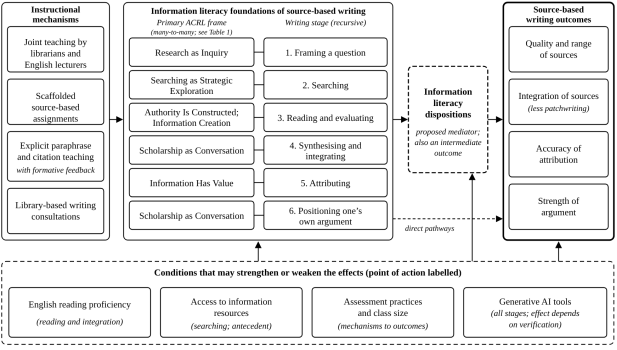
Figure 1. The Information Literacy for Academic Writing Framework.
The framework proposes that source-based academic writing proceeds through six recursive stages; that each stage draws mainly on one or two information literacy frames, in a many-to-many relationship; that four instructional mechanisms, each operating mainly at particular stages, develop the dispositions and practices required; and that these improve four aspects of students’ source-based writing. Information literacy dispositions are treated both as an intermediate outcome of instruction and as a proposed mediator between instruction and writing outcomes. Conditions such as English reading proficiency, access to information resources, assessment practices and generative artificial intelligence may strengthen or weaken these effects.
Figure 1 presents the framework,
Table 1 sets out the mapping between frames and writing stages,
Table 2 maps the mechanisms to stages and outcomes, and
Table 3 sets out the propositions. All of these relationships are theoretical expectations derived from the reviewed literature, not demonstrated findings: the framework has not been tested empirically, and each relationship is stated as a proposition for testing.
Four instructional mechanisms develop the information literacy foundations of six recursive stages of source-based writing; the central panel shows the primary ACRL frame for each stage, and the full many-to-many mapping is given in
Table 1, with the mechanisms mapped to stages and outcomes in
Table 2. Information literacy dispositions are shown as a proposed mediator, and also an intermediate outcome, between the writing stages and the four source-based writing outcomes; the dashed arrow indicates that some effects are expected to be direct. The lower panel shows conditions that may strengthen or weaken these effects, with the point at which each is expected to act. Source: the authors.
4.1. Stages of Source-based Writing and Their Information Literacy Foundations
The six stages are derived from the cognitive process model
| [11] | Flower, L., Hayes, J. R. A cognitive process theory of writing. College Composition and Communication. 1981, 32(4), 365–387. https://doi.org/10.2307/356600 |
[11]
and from discourse synthesis
. They are recursive: writers move back and forth between them as their understanding develops. The relationship between frames and stages is many-to-many rather than one-to-one. Each stage draws mainly on a primary frame, but other frames are also relevant, and some frames, such as Scholarship as Conversation, bear on several stages. Information Has Value also extends beyond citation to questions of access, ownership and the economics of information, which are not the focus of this paper.
Table 1 therefore distinguishes primary and secondary connections.
Framing a question. The writer turns an assignment topic into a focused question that sources can help to answer. This stage draws on the frame Research as Inquiry, which views research as a process of asking increasingly sophisticated questions
. Students who skip this step tend to gather information about a topic rather than evidence for an argument.
Searching. The writer locates sources, modifying search terms and strategies as results come in. This stage draws on Searching as Strategic Exploration. Reliance on a single general web search, which Head and Eisenberg
| [23] | Head, A. J., Eisenberg, M. B. Truth Be Told: How College Students Evaluate and Use Information in the Digital Age. Project Information Literacy Progress Report. Seattle, WA: University of Washington Information School; 2010. |
[23]
found to be common, restricts the range and quality of sources from the outset.
Reading and evaluating. The writer reads sources closely enough to understand their arguments and judges their credibility and relevance. This stage depends on Authority Is Constructed and Contextual and on Information Creation as a Process, which help students recognise what kind of source they are reading and why it should or should not be trusted. Weak comprehension at this stage is one likely precursor of patchwriting
| [8] | Howard, R. M., Serviss, T., Rodrigue, T. K. Writing from sources, writing from sentences. Writing and Pedagogy. 2010, 2(2), 177–192. https://doi.org/10.1558/wap.v2i2.177 |
| [9] | Pecorari, D. Good and original: Plagiarism and patchwriting in academic second-language writing. Journal of Second Language Writing. 2003, 12(4), 317–345.
https://doi.org/10.1016/j.jslw.2003.08.004 |
[8, 9]
, alongside limited paraphrase instruction, limited knowledge of attribution and time pressure.
Synthesising and integrating. The writer combines ideas from several sources, organises them around the question and expresses them in his or her own words through summary, paraphrase and quotation. This stage draws on Scholarship as Conversation, which presents sources as voices in a discussion that the writer can relate to one another
.
Attributing. The writer cites sources accurately and consistently. This stage depends on Information Has Value, which explains why intellectual work is attributed, and on knowledge of citation conventions. Okeji, Ilika and Baro
| [4] | Okeji, C. C., Ilika, O. M., Baro, E. E. Assessment of information literacy skills: A survey of final year undergraduates of library and information science in Nigerian universities. Global Knowledge, Memory and Communication. 2020, 69(6/7), 521–535. https://doi.org/10.1108/GKMC-10-2019-0130 |
[4]
found this to be among the weakest areas for Nigerian students.
Positioning one’s own argument. The writer takes a stance in relation to the sources, agreeing with, disagreeing with or extending them, and makes his or her own contribution clear. This stage again draws on Scholarship as Conversation, and corresponds to the move from knowledge telling to knowledge transforming
| [13] | Bereiter, C., Scardamalia, M. The Psychology of Written Composition. Hillsdale, NJ: Lawrence Erlbaum; 1987. |
[13]
and to the rhetorical moves through which writers establish a place for their own work
| [18] | Hyland, K. Disciplinary Discourses: Social Interactions in Academic Writing. Ann Arbor, MI: University of Michigan Press; 2004. |
| [19] | Swales, J. M. Genre Analysis: English in Academic and Research Settings. Cambridge: Cambridge University Press; 1990. |
[18, 19]
.
Table 1. Mapping of ACRL information literacy frames onto the stages of source-based academic writing.
Writing stage | Primary frame(s) | Secondary frame(s) | Typical difficulty | Instructional response |
Framing a question | Research as Inquiry | Scholarship as Conversation | Collecting information on a topic rather than evidence for a question | Require a research question before searching |
Searching | Searching as Strategic Exploration | Research as Inquiry | Reliance on a single general web search | Jointly taught database searching linked to the assignment |
Reading and evaluating | Authority Is Constructed and Contextual; Information Creation as a Process | Scholarship as Conversation | Weak comprehension of sources; uncritical acceptance of web content | Guided reading of sources; credibility checklists |
Synthesising and integrating | Scholarship as Conversation | Information Has Value | Patchwriting; listing sources one by one | Synthesis paragraphs with feedback on paraphrase |
Attributing | Information Has Value | Scholarship as Conversation | Inaccurate or inconsistent citation | Explicit citation instruction; draft checking |
Positioning one’s own argument | Scholarship as Conversation | Authority Is Constructed and Contextual | Reporting sources without a stance | Teaching moves for agreeing, disagreeing and extending |
Note: The stages are recursive and the relationship between frames and stages is many-to-many; the table shows primary and secondary correspondences, not exclusive ones.
4.2. Instructional Mechanisms
The framework identifies four mechanisms through which information literacy and academic writing can be taught together.
Joint teaching by librarians and English lecturers. Selected sessions of the use of English course are planned and taught jointly by librarians and English lecturers, so that searching, evaluating and citing sources are taught in the context of a writing task rather than in a separate orientation. This builds on existing proposals for collaboration between libraries and English departments
| [16] | Igbokwe, B., Nwanekezie, N. P. Hedging, signposting and stance: A conceptual model of library–English department collaboration for developing metadiscourse competence in Nigerian undergraduate research proposals. Research Journal of English Language and Literature. 2026, 14(3), 508–522. http://rjelal.com |
| [17] | Igbokwe, B., Nwanekezie, N. P. A conceptual model for integrating information literacy and task-based language teaching: Rethinking English language instruction in Nigerian secondary schools. International Journal of English Language, Literature and Translation Studies. 2026, 13(3), 121–134. http://ijelr.in |
[16, 17]
and reflects the academic literacies view that information use and writing are linked practices
.
Scaffolded source-based assignments. Writing assignments are broken into stages that mirror the framework, for example a research question, a short list of sources with reasons for choosing them, an annotated bibliography, a synthesis paragraph and a full draft. Each stage receives feedback before the next begins, so that problems are detected early.
Explicit instruction in paraphrase and citation with formative feedback. Students learn to read a source for its meaning before paraphrasing it, to compare their paraphrases with the original and to cite consistently. Feedback on early drafts treats patchwriting as a learning issue rather than as misconduct
, while making clear the boundaries set by institutional integrity policies.
Library-based writing consultations. Students can book short consultations in which a librarian, an English lecturer or a trained senior student helps them with a particular stage, such as narrowing a search or integrating a source. Such consultations offer one-to-one support at the moment of need.
Table 2 summarises the stages and outcomes on which each mechanism is expected to act most directly. The mechanisms are complementary rather than interchangeable: joint teaching acts mainly on the early stages of searching and evaluating, and on attribution where citation is taught within the jointly planned assignment, as Barratt et al.
| [25] | Barratt, C. C., Nielsen, K., Desmet, C., Balthazor, R. Collaboration is key: Librarians and composition instructors analyze student research and writing. portal: Libraries and the Academy. 2009, 9(1), 37–56.
https://doi.org/10.1353/pla.0.0038 |
[25]
found when librarians and writing instructors planned assignments together; explicit instruction acts on integration and attribution; scaffolded assignments act on the whole sequence and on argument; and consultations act on whichever stage an individual student finds difficult.
Table 2. Instructional mechanisms, the writing stages on which they mainly act, and their expected outcomes.
Mechanism | Main writing stages | Main expected outcomes |
Joint teaching by librarians and English lecturers | Framing a question; searching; reading and evaluating; attributing, where citation is taught within the jointly planned assignment | Information literacy dispositions; quality and range of sources; accuracy of attribution, indirectly, through jointly planned assignments |
Scaffolded source-based assignments | All six stages, in sequence | Strength of argument; integration of sources |
Explicit instruction in paraphrase and citation with formative feedback | Synthesising and integrating; attributing | Integration of sources (less patchwriting); accuracy of attribution |
Library-based writing consultations | Any stage, as needed by the individual student | Depends on the stage addressed; mainly quality of sources and accuracy of attribution |
Note: The table indicates main expected effects, not exclusive ones; it is a hypothesis for empirical testing.
4.3. Outcomes
The framework expects four outcomes in students’ writing.
Quality and range of sources refers to the use of credible, relevant and appropriately varied sources.
Integration of sources refers to the accurate representation of sources through summary and paraphrase, with less patchwriting, and to the combination of several sources around a single question.
Accuracy of attribution refers to correct and consistent citation and referencing.
Strength of argument refers to how far the writer uses sources to support a position of his or her own rather than simply reporting them. The framework also expects a change in students’ dispositions, such as greater willingness to treat research as inquiry and to verify sources, which is treated both as an intermediate outcome of instruction and as a proposed mediator through which instruction is expected to affect the four writing outcomes. This mediating role is proposed as a general hypothesis; the pathway shown in
Figure 1 is conceptual and has not been demonstrated. The framework does not assume that dispositions mediate the effect of every mechanism on every outcome; for example, explicit citation instruction may improve attribution directly, without changing dispositions. Which pathways are mediated, and whether mediation is full or partial, are questions for empirical research. These outcomes concern source-based writing only. Grammar, vocabulary, coherence and disciplinary conventions also affect the quality of written work, but they lie outside the framework’s explanatory claim. Improvement in general English proficiency is not a direct aim of the framework, although regular practice in reading and writing from sources may contribute to it over time.
4.4. Conditions
The conditions below are expected to act at different points in the framework, and not all of them are moderators in the statistical sense.
English reading proficiency. Students with weaker reading proficiency in academic English are expected to find the reading and synthesis stages harder and to be more likely to patchwrite
. Reading proficiency is therefore expected to moderate the effect of instruction on integration of sources, although it is only one of several influences on patchwriting, alongside paraphrase instruction, knowledge of attribution, time pressure and disciplinary conventions. Instruction in reading strategies
| [28] | Igbokwe, B., Nwanekezie, N. P. Metacognitive reading strategies and English academic comprehension: A conceptual framework for Nigerian LIS education. Research Journal of English Language and Literature. 2025, 13(4), 515–526. http://rjelal.com |
[28]
may reduce this effect.
Access to information resources. Unreliable internet access, limited subscriptions to electronic databases and outdated print collections may restrict the searching stage regardless of instruction. Access is better thought of as an antecedent condition that determines what students can find.
Assessment practices. Where assignments reward the reproduction of information, or where large classes prevent feedback on drafts, students have little incentive to engage in synthesis and argument. Assessment practices are expected to moderate whether the mechanisms translate into changes in writing. Feedback on drafts, by contrast, is part of two of the mechanisms themselves; where it is omitted, the mechanism has not been implemented as intended, which is a question of implementation fidelity rather than of moderation (P5b).
Generative artificial intelligence. Generative artificial intelligence tools can act at every stage, and the direction of their effect is expected to depend on the kind of use (Section 2.3.5). Supported uses for discovery, reading support and revision may assist the searching, reading and integrating stages when students verify what the tools produce. Unverified or undisclosed generation of text and references bypasses searching, reading and synthesis and may introduce fabricated sources
. Information literacy instruction that addresses the verification of sources and institutional rules on acknowledgement is expected to shift use towards the supported kinds.
The framework yields nine propositions in six groups for empirical testing, presented in
Table 3 together with the operational definitions and controls each requires. They are selected, testable priorities rather than an exhaustive account of every relationship in the framework, and associations observed in non-randomised comparisons should not be interpreted as causal effects without a suitable design.
Table 3. Propositions derived from the Information Literacy for Academic Writing Framework.
No. | Proposition | Operational definitions and controls | Main theoretical basis |
P1 | Students’ information literacy dispositions and practices are positively associated with the quality and range of sources in their writing. | Source quality rated for credibility, relevance and type; control for English reading proficiency, prior academic achievement and access to resources | | [10] | Association of College and Research Libraries. Framework for Information Literacy for Higher Education. Chicago, IL: American Library Association; 2016. Available from:
https://www.ala.org/acrl/standards/ilframework | | [23] | Head, A. J., Eisenberg, M. B. Truth Be Told: How College Students Evaluate and Use Information in the Digital Age. Project Information Literacy Progress Report. Seattle, WA: University of Washington Information School; 2010. | | [24] | Fosnacht, K. Information literacy’s influence on undergraduates’ learning and development: Results from a large multi-institutional study. College & Research Libraries. 2020, 81(2), 272. https://doi.org/10.5860/crl.81.2.272 |
[10, 23, 24] |
P2a | English reading proficiency is negatively associated with the proportion of patchwriting in students’ source-based writing, as one influence among several. | Patchwriting coded as source wording retained with minor substitutions or deletions, distinguished from paraphrase, which restates the idea in new wording and structure, and from marked quotation; control for paraphrase instruction received and time allowed | | [8] | Howard, R. M., Serviss, T., Rodrigue, T. K. Writing from sources, writing from sentences. Writing and Pedagogy. 2010, 2(2), 177–192. https://doi.org/10.1558/wap.v2i2.177 | | [9] | Pecorari, D. Good and original: Plagiarism and patchwriting in academic second-language writing. Journal of Second Language Writing. 2003, 12(4), 317–345.
https://doi.org/10.1016/j.jslw.2003.08.004 | | [20] | Shi, L. Textual borrowing in second-language writing. Written Communication. 2004, 21(2), 171–200.
https://doi.org/10.1177/0741088303262846 |
[8, 9, 20] |
P2b | Instruction that combines guided reading of sources with paraphrase practice is associated with a lower proportion of patchwriting than paraphrase instruction alone. | Comparison groups receive equal instructional time and complete comparable assignments | | [8] | Howard, R. M., Serviss, T., Rodrigue, T. K. Writing from sources, writing from sentences. Writing and Pedagogy. 2010, 2(2), 177–192. https://doi.org/10.1558/wap.v2i2.177 | | [28] | Igbokwe, B., Nwanekezie, N. P. Metacognitive reading strategies and English academic comprehension: A conceptual framework for Nigerian LIS education. Research Journal of English Language and Literature. 2025, 13(4), 515–526. http://rjelal.com |
[8, 28] |
P3 | Course sections that receive joint instruction by librarians and English lecturers, including citation teaching within a jointly planned assignment, show greater gains in accuracy of attribution than sections that receive separate library orientation and writing instruction. | Attribution accuracy coded per citation and reference; control for class size, assessment requirements and teaching experience | | [4] | Okeji, C. C., Ilika, O. M., Baro, E. E. Assessment of information literacy skills: A survey of final year undergraduates of library and information science in Nigerian universities. Global Knowledge, Memory and Communication. 2020, 69(6/7), 521–535. https://doi.org/10.1108/GKMC-10-2019-0130 | | [6] | Baro, E. E., Zuokemefa, T. Information literacy programmes in Nigeria: A survey of 36 university libraries. New Library World. 2011, 112(11/12), 549–565.
https://doi.org/10.1108/03074801111190428 | | [25] | Barratt, C. C., Nielsen, K., Desmet, C., Balthazor, R. Collaboration is key: Librarians and composition instructors analyze student research and writing. portal: Libraries and the Academy. 2009, 9(1), 37–56.
https://doi.org/10.1353/pla.0.0038 |
[4, 6, 25] |
P4 | Scaffolded source-based assignments with feedback at each stage are associated with stronger argument than single-submission assignments. | Argument rated on four dimensions: clarity of claim, use of evidence from sources, engagement with alternative views and the writer’s own stance | | [12] | Spivey, N. N. Transforming texts: Constructive processes in reading and writing. Written Communication. 1990, 7(2), 256–287. https://doi.org/10.1177/0741088390007002004 | | [13] | Bereiter, C., Scardamalia, M. The Psychology of Written Composition. Hillsdale, NJ: Lawrence Erlbaum; 1987. |
[12, 13] |
P5a | The association between integrated instruction and writing outcomes is weaker where assessment rewards the reproduction of information. | Assessment incentives coded from assignment briefs and marking schemes | |
P5b | Among sections that use scaffolded assignments, writing outcomes are stronger where feedback is given at each stage as planned than where it is omitted or delayed. | Feedback is treated as an implementation component of the mechanisms, so the contrast is implementation fidelity; the timing and amount of feedback are recorded for each section | | [22] | Wingate, U. Using Academic Literacies and genre-based models for academic writing instruction: A “literacy” journey. Journal of English for Academic Purposes. 2012, 11(1), 26–37. https://doi.org/10.1016/j.jeap.2011.11.006 | | [25] | Barratt, C. C., Nielsen, K., Desmet, C., Balthazor, R. Collaboration is key: Librarians and composition instructors analyze student research and writing. portal: Libraries and the Academy. 2009, 9(1), 37–56.
https://doi.org/10.1353/pla.0.0038 |
[22, 25] |
P6a | Instruction that explicitly addresses the verification of sources and the acknowledged use of generative artificial intelligence is associated with fewer unverifiable or fabricated references in students’ writing. | Exposure to such instruction recorded at section level; references checked against databases | | [29] | Kasneci, E., Seßler, K., Küchemann, S., Bannert, M., Dementieva, D., Fischer, F., et al. ChatGPT for good? On opportunities and challenges of large language models for education. Learning and Individual Differences. 2023, 103, 102274.
https://doi.org/10.1016/j.lindif.2023.102274 | | [30] | Walters, W. H., Wilder, E. I. Fabrication and errors in the bibliographic citations generated by ChatGPT. Scientific Reports. 2023, 13, 14045. https://doi.org/10.1038/s41598-023-41032-5 |
[29, 30] |
P6b | Among students who use generative artificial intelligence tools to suggest sources or references, those who do not verify the suggested sources include more fabricated references than those who check them against databases or the original sources. | Primary contrast is verification status, holding task type constant. Each reference is checked independently against bibliographic databases and publisher records: a fabricated reference has no matching publication, whereas an erroneous reference is a genuine work cited with incorrect details; the two are coded separately. Students’ reported verification is validated against this independent check | |
Note: The propositions are hypotheses to be tested empirically; arrows indicate expected directions of influence, not demonstrated causal effects.
Plausible indicators exist for each construct. Information literacy dispositions and practices can be measured with self-report instruments based on the ACRL frames, combined with performance tasks such as evaluating a set of sources. Writing outcomes can be assessed by analysing students’ assignments for the number, type and credibility of sources cited; the proportion of source-based sentences that are summary, paraphrase, quotation or patchwriting, following the coding approaches of Howard, Serviss and Rodrigue
and Shi
; the accuracy of citations and references; and the strength of argument, rated with a rubric. Such rubrics should be applied by at least two trained raters working independently, with inter-rater agreement reported. P6a concerns instruction about generative artificial intelligence and P6b concerns students’ actual use of such tools, and the two should be measured separately. Propositions about instruction should be tested by comparing course sections or cohorts that receive integrated instruction with those that do not, measuring outcomes on comparable assignments before and after the instruction and controlling for initial English reading proficiency. Because students are not randomly assigned to course sections in most Nigerian universities, observed differences should be interpreted cautiously.
4.5. Feasibility and Academic Integrity
The four mechanisms differ in the resources they require. Explicit instruction in paraphrase and citation and scaffolded assignments can be introduced within existing courses at little cost. Joint teaching requires the library and the English department to agree on timetables and workload. Writing consultations require trained staff or senior students and a suitable space. Large classes in general studies courses are a particular constraint, and may require the use of tutorials or online platforms for feedback.
Treating patchwriting as a developmental issue does not mean neglecting academic integrity. The framework assumes that institutions maintain clear integrity policies, that students are told what counts as plagiarism, and that text-matching software, where used, serves mainly to support learning, for example by allowing students to check drafts, rather than only to detect and punish.
5. Discussion
5.1. Contribution of the Framework to Existing Theory
The framework’s contribution lies in integrating existing theories and applying them to a new setting, and in relationships that the source theories do not state individually, although elements of them may appear in other literatures: that the information literacy frames relate to identifiable stages of source-based writing in a many-to-many pattern (
Table 1); that particular instructional mechanisms act mainly on particular stages and outcomes (
Table 2); that weaknesses in reading and evaluating sources are one pathway linking information literacy to patchwriting; and that the effect of integrated instruction depends on conditions acting at different points, including generative artificial intelligence.
Information literacy theory. The ACRL Framework
describes information literacy in terms of frames but leaves their application to particular tasks to practitioners. The framework specifies how the frames apply to the most common academic task, writing from sources, and so makes them easier to teach and to assess in writing.
Writing studies. Cognitive process and discourse synthesis models
describe how writers work with sources but have little to say about how writers find and judge those sources. Research on patchwriting
explains a key difficulty but seldom links it to library instruction. The framework connects these stages and links patchwriting to reading and evaluating sources as well as to writing.
Academic literacies. The academic literacies perspective
argues that writing should be taught as a social practice embedded in disciplines. The framework extends this argument to information use and proposes a concrete form of integration in which librarians and English lecturers teach together.
Nigerian scholarship. Nigerian research has documented the limited integration of information literacy instruction
and students’ difficulties with paraphrase and citation
| [4] | Okeji, C. C., Ilika, O. M., Baro, E. E. Assessment of information literacy skills: A survey of final year undergraduates of library and information science in Nigerian universities. Global Knowledge, Memory and Communication. 2020, 69(6/7), 521–535. https://doi.org/10.1108/GKMC-10-2019-0130 |
| [5] | Orim, S.-M., Davies, J. W., Borg, E., Glendinning, I. Exploring Nigerian postgraduate students’ experience of plagiarism: A phenomenographic case study. International Journal for Educational Integrity. 2013, 9(1).
https://doi.org/10.21913/ijei.v9i1.845 |
[4, 5]
. The framework offers an explanation that links these findings and a set of mechanisms that address them together.
5.2. Illustrative Application
The following hypothetical example shows how the framework might be applied. It is a constructed example, not a report of data. In a first-year use of English course, a librarian and an English lecturer jointly teach a four-week unit built around a short source-based essay. In the first week, students turn a topic into a question and the librarian shows them how to search a database for relevant articles. In the second week, students read two articles, discuss with the lecturer how to identify each author’s main claim, and judge the credibility of each source. In the third week, students write a synthesis paragraph comparing the two articles, receive feedback that distinguishes paraphrase from patchwriting, and revise. In the fourth week, students write the essay, cite their sources in a consistent style and state their own position. In the framework’s terms, the unit uses joint teaching, a scaffolded assignment and explicit instruction with feedback; it addresses all six stages; and it is expected to improve the quality of sources, integration, attribution and argument. If some students read the articles with great difficulty, or use a generative artificial intelligence tool to produce the essay, the conditions in Section 4.4 predict that the effect will be weaker unless reading support and explicit guidance on such tools are provided.
5.3. Implications for Practice
For English departments. English lecturers can redesign writing assignments in the use of English course as scaffolded source-based tasks, invite librarians to teach selected sessions, and give formative feedback on paraphrase and citation before final assessment.
For university libraries. Libraries can shift part of their instruction from general orientation to course-integrated sessions linked to writing assignments, offer writing consultations, and teach the verification of sources, including sources produced or suggested by generative artificial intelligence tools.
For university management. Management can recognise joint teaching in staff workload, support the training of librarians and English lecturers in each other’s fields, adopt integrity policies that combine education with sanctions, and provide access to electronic resources. The National Universities Commission could encourage the inclusion of information literacy in general studies courses through its curriculum guidance.
5.4. Limitations and Suggestions for Further Research
The framework is developed from theory and a purposive, nonsystematic review of literature rather than from new data. The integrative review has its own limitations. Sources were selected by the authors’ judgement rather than by predefined criteria applied to a systematic search; the searches were confined to Google Scholar and publisher and journal websites, so relevant work in other databases, in grey literature or in languages other than English may have been missed; the number of records screened was not recorded; and the selection and weighting of sources may reflect the authors’ own theoretical starting points. The relationships in the framework are therefore theoretical expectations, not demonstrated findings, and their support depends on the strength of the studies on which they draw. Much of the evidence on writing from sources comes from settings outside Nigeria, and the Nigerian evidence concerns particular groups of students, such as library and information science undergraduates and postgraduates studying abroad. The framework focuses on undergraduate writing in English and does not address postgraduate research writing, writing in Nigerian languages or differences between disciplines in their use of sources. Nigerian universities also differ in class size, library resources and staffing, and the framework may need to be adapted to each. Future research should pilot integrated instruction in use of English courses and evaluate it with comparison groups and analysis of students’ writing; develop and validate instruments for assessing information literacy and source use in Nigerian contexts; and examine how students actually use generative artificial intelligence tools in source-based writing.





 Share This Article
 Twitter
 Linked In
 Facebook

 Copy
 Download