Abstract
Environmental degradation remains one of the greatest challenges confronting humanity despite advances in science, technology, and environmental policy. In many African societies, indigenous religious beliefs and cultural practices have historically played a significant role in regulating human interaction with nature. However, modernization, Christianity, formal education, globalization, and socio-economic transformations have altered traditional environmental management systems. This study examined the persistence of indigenous religious beliefs and cultural practices that promote environmental preservation among the Luo community of Lower Nyakach in Kisumu County, Kenya. Specifically, it investigated the extent to which traditional ecological knowledge continues to influence environmental stewardship despite increasing exposure to foreign religions and modern lifestyles. The study employed a mixed-methods research design, integrating quantitative and qualitative approaches. Data were collected through questionnaires, key informant interviews, focus group discussions, and observation. Quantitative data were analyzed using descriptive statistics and Bayesian correlation analysis, while qualitative data were analyzed thematically. Findings revealed that although indigenous environmental beliefs have declined due to modernization and religious transformation, many traditional conservation practices continue to shape community attitudes toward biodiversity conservation, sacred sites, vegetation protection, and sustainable farming. Sacred forests, protection of particular plant and animal species, respect for ancestral sites, and the continued use of indigenous agricultural practices remain important mechanisms of environmental stewardship. Nevertheless, harmful beliefs, declining traditional authority and reduced intergenerational transmission of indigenous knowledge threaten the sustainability of these practices. The study concludes that indigenous religious beliefs remain an essential component of community-based environmental conservation and recommends integrating indigenous ecological knowledge into national environmental policies, educational curricula, and community conservation programmes to strengthen sustainable environmental management.
Keywords
Indigenous Religion, Environmental Preservation, Traditional Ecological Knowledge, Luo Culture,
Environmental Stewardship, Lower Nyakach, Biodiversity Conservation, Kenya
1. Introduction
Environmental conservation has become a major global concern due to challenges such as climate change, biodiversity loss, deforestation, pollution, and unsustainable use of natural resources. While scientific and technological approaches have contributed to environmental management, indigenous knowledge systems have also played an important role in promoting sustainable conservation practices. Among the Luo community of Lower Nyakach; traditional beliefs, cultural values, sacred sites, and customary practices have historically guided the protection of forests, water resources, biodiversity, and agricultural land. However, modernization, urbanization, formal education, and religious transformations have affected the continuity of these indigenous practices. This study examines the persistence of indigenous religious beliefs and cultural practices that support environmental preservation among the Luo community of Lower Nyakach and explores their contribution to sustainable environmental management.
1.1. Background of the Study
Environmental degradation has become one of the most pressing challenges facing humanity due to increasing climate change, biodiversity loss, deforestation, land degradation, pollution, and unsustainable exploitation of natural resources. Although governments, international organizations, and environmental agencies have invested in scientific and policy-based conservation approaches, environmental challenges continue to persist, particularly in developing regions where communities depend heavily on natural resources for their livelihoods.
In recent years, researchers have increasingly acknowledged that effective environmental conservation cannot depend exclusively on modern scientific approaches and government policy
| [17] | Öhlmann, P., & Swart, I. (2022). Religion and Environment: Exploring the Ecological Turn in Religious Traditions, the Religion and Development Debate and Beyond. Religion and Theology, 29(3-4), 292-321. |
[17]
. Indigenous knowledge systems, developed through centuries of interaction between communities and their environments, provide valuable approaches to sustainable resource management. Indigenous societies have traditionally regulated the use of forests, rivers, wetlands, wildlife, medicinal plants, and agricultural resources through religious beliefs, cultural values, customary laws, taboos, rituals, and traditional governance systems,
| [4] | Goldman, M. (2003). Partitioned Nature, Privileged Knowledge: Community-based Conservation in Tanzania. Development & Change, 34 (5). |
| [14] | Morompi, J., Mary, W., Godrick, O. A. B., & Chaka, B. (2020). Impacts of neglecting African Traditional Environmental Conservation Practices and education on the environment: A Case of the Maasai People of Narok County, Kenya. International Journal of Cultural Inheritance & Social Sciences ISSN: 2632-7597, 2(3), 1-14. |
| [21] | Woodburn, J. (1997). Indigenous discrimination: The ideological basis for local discrimination against hunter‐gatherer minorities in sub-Saharan Africa. Ethnic and Racial Studies, 20(2), 345–361. |
[4, 14, 21]
.
Across many African societies, indigenous religions have historically promoted a close relationship between humans and nature. Natural features such as forests, rivers, mountains, specific trees, and animal species were considered sacred and associated with spiritual beings, ancestors, or divine powers,
| [16] | Nkama, C. L., Okoro, K. N., & Egbule, E. (2022). Eco-Preservation through the Lens of Igbo. Beliefs and Practices: A Re-Imagination. Religions, 13(11), 1066. |
[16]
. Consequently, cultural restrictions and spiritual beliefs discouraged destructive environmental practices and encouraged responsible utilization of natural resources. For example, due to their theological belief that wild animals are “Enkai” creatures, the Maasai culture has historically been stigmatized for not eating wild animals
| [4] | Goldman, M. (2003). Partitioned Nature, Privileged Knowledge: Community-based Conservation in Tanzania. Development & Change, 34 (5). |
[4]
.
However, the continuity of these indigenous environmental practices has been affected by modernization, globalization, and formal education, urbanization, changing economic systems, and the spread of Christianity and other world religions. These transformations have weakened traditional institutions and reduced the transmission of indigenous ecological knowledge, especially among younger generations.
Among the Luo community of Lower Nyakach in Kisumu County, indigenous environmental conservation has historically been promoted through sacred sites, protection of specific tree and animal species, preservation of indigenous crops, ancestral respect, and cultural restrictions on resource exploitation. These practices contributed to biodiversity conservation, soil fertility maintenance, water protection, and sustainable agricultural production. Despite modernization and religious transformation, some indigenous beliefs and cultural practices continue to influence environmental behaviour within the Luo community. Lower Nyakach therefore provides an important context for examining whether traditional ecological knowledge remains relevant in contemporary environmental conservation. This study examined the persistence of indigenous religious beliefs and cultural practices that support environmental preservation among the Luo community of Lower Nyakach, with the aim of understanding how indigenous knowledge can complement modern approaches to sustainable environmental management.
1.2. Statement of the Problem
Environmental degradation remains a major global challenge, particularly in developing communities that rely heavily on natural resources for survival. Despite scientific and policy-based conservation efforts, environmental challenges persist partly because these approaches often overlook indigenous knowledge systems, cultural values, and traditional environmental practices. African communities have historically used religious beliefs, cultural norms, taboos, and customary laws to regulate human interaction with nature, promoting biodiversity conservation and ecological balance. However, modernization, globalization, Christianity, formal education, urbanization, and changing economic systems have weakened these traditional conservation practices and reduced the transmission of indigenous ecological knowledge to younger generations. Among the Luo community of Lower Nyakach, indigenous beliefs and practices such as protection of sacred sites, conservation of specific tree and animal species, preservation of indigenous crops, and environmental taboos have traditionally supported environmental stewardship. Nevertheless, limited research has examined the extent to which these practices continue to influence contemporary environmental preservation. This study therefore sought to investigate the persistence of Luo indigenous religious beliefs and cultural practices in promoting environmental conservation in Lower Nyakach, addressing the knowledge gap on how traditional ecological knowledge can contribute to modern sustainable environmental management.
1.3. Significance of the Study
This study is significant because it highlights the role of indigenous religious beliefs and cultural practices in promoting environmental conservation. It demonstrates how indigenous knowledge systems can complement modern environmental management approaches by encouraging sustainable resource use and community participation. The findings may assist policymakers, conservation agencies, and environmental organizations in integrating indigenous ecological knowledge into conservation strategies. The study also preserves the environmental heritage of the Luo community of Lower Nyakach and contributes to academic fields such as environmental studies, anthropology, religious studies, and cultural ecology. Furthermore, it supports global sustainability efforts by emphasizing the contribution of indigenous knowledge to achieving environmental conservation goals.
1.4. Limitations of the Study
This study was limited to the Luo community of Lower Nyakach, Kisumu County; therefore, its findings may not be generalized to other communities or indigenous societies. Some information relied on respondents’ memories and personal interpretations, which may have resulted in variations due to the oral transmission of indigenous knowledge and the influence of modernization, Christianity, formal education, and globalization. Additionally, some spiritual and cultural aspects of environmental practices were difficult to capture fully despite the use of multiple research methods. The study focused mainly on environmental beliefs and conservation practices and did not examine other cultural dimensions such as gender roles, youth participation, and indigenous governance systems, which may require further investigation.
2. Literature Review
2.1. Theoretical Framework--Cultural Ecology Theory
This study was guided by cultural Ecology theory. Cultural Ecology Theory, developed by Steward, explains how human societies adapt to their physical environments through cultural practices, belief systems, technologies, and social institutions
| [19] | Steward, J. H. (1955). Theory of culture change: The methodology of multilinear evolution. University of Illinois press. |
[19]
. The theory argues that culture evolves partly as a response to environmental conditions, enabling communities to survive while maintaining ecological balance.
Within indigenous African societies, cultural values, myths, taboos, rituals, customary laws, and religious beliefs developed as adaptive mechanisms that regulated the use of natural resources. These practices discouraged overexploitation of forests, rivers, wildlife, and agricultural land by attaching spiritual significance to elements of nature.
Among the Luo community of Lower Nyakach, sacred trees, ancestral shrines, wetlands, and particular animal species have traditionally been protected because they were associated with spiritual powers or ancestral presence. Such beliefs indirectly promoted biodiversity conservation long before formal environmental legislation existed.
The theory is particularly appropriate for this study because it explains why environmental conservation practices remain embedded within indigenous culture even after the introduction of Christianity, formal education, and modernization. It further demonstrates that environmental sustainability is not solely dependent on scientific knowledge but is also shaped by cultural values transmitted across generations.
2.2. Conceptual Framework
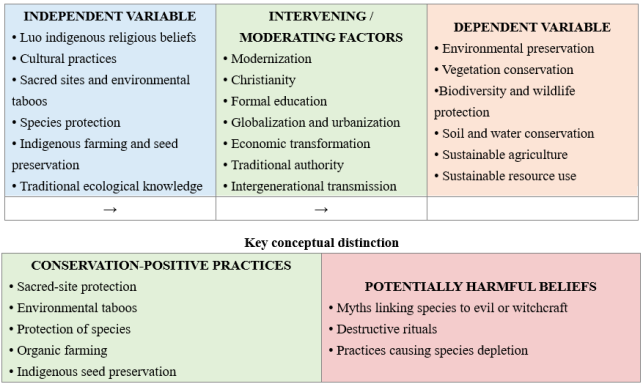
The framework proposes that Luo indigenous religious beliefs and cultural practices influence environmental preservation in Lower Nyakach. The strength of this relationship is shaped by modernization, Christianity, education, globalization, economic change, traditional authority, and intergenerational transmission. It also recognizes that indigenous practices may have both positive and negative environmental effects.
Figure 1. Overall relationship: Indigenous knowledge can strengthen environmental preservation when beneficial practices are sustained, critically evaluated, and complemented by modern conservation approaches.
2.3. Indigenous Religion and Environmental Stewardship
The relationship between indigenous religion and environmental conservation has increasingly attracted scholarly attention because of its potential contribution to sustainable development. Unlike modern environmental management approaches that often emphasize scientific and legal mechanisms, indigenous religions approach environmental conservation from a spiritual, moral, and communal perspective. In many indigenous societies, the environment is perceived as a sacred entity inhabited by divine beings, ancestors, and spiritual forces. Consequently, forests, rivers, mountains, wetlands, wildlife, and particular plant species are protected not merely because of their economic value but because they possess religious significance.
African Indigenous Religion (AIR) regards humanity as inseparable from nature. Human beings are viewed as custodians rather than owners of the environment. According to Mbiti, African cosmology recognizes an interconnected relationship among God, ancestors, human beings, animals, plants, and the physical environment
| [12] | Mbiti J. S. (1969). African Religions and Philosophy. Nairobi: Heinemann. |
[12]
. This interconnectedness establishes moral obligations that regulate human interaction with natural resources. Environmental exploitation that violates these obligations is traditionally considered both a social and spiritual offence.
Magesa argues that African ethics are fundamentally ecological because they emphasize harmony between humanity and creation
| [13] | Magesa, L. (2014). African Religion: The moral traditions of abundant life. Orbis Books. |
[13]
. Traditional beliefs surrounding sacred forests, ritual sites, rivers, and animal species function as informal conservation laws that restrict environmental destruction. Unlike statutory environmental regulations, these indigenous systems are enforced through communal norms, religious obligations, and fear of supernatural sanctions, making compliance largely voluntary yet highly effective
| [10] | Kothari, A., Pathak, N., Anuradha, R. V. S., & Taneja, Bansuri (1998). Communities in South & Central Asia. New Delhi, India: Sage Publications Ltd. |
[10]
.
Globally, indigenous communities occupy approximately one-quarter of the Earth's land surface while safeguarding nearly 80 percent of the world's remaining biodiversity. This remarkable contribution demonstrates that indigenous knowledge systems have significant practical value for biodiversity conservation and sustainable resource management. Increasingly, international conservation organizations recognize indigenous ecological knowledge as an important complement to scientific environmental management.
2.4. Persistence of Indigenous Religious Beliefs in Contemporary African Society
One of the most debated issues within African religious scholarship concerns whether indigenous religions have disappeared following the spread of Christianity and Islam. Early missionary literature predicted that African Traditional Religion would gradually become extinct as conversion increased. However, subsequent scholarship has demonstrated that conversion rarely resulted in the complete abandonment of indigenous beliefs.
Magesa argues that Africans generally "come out of" rather than "leave behind" African religion when embracing Christianity or Islam. Indigenous beliefs continue to shape perceptions of illness, death, fertility, environmental ethics, and relationships with ancestors
| [13] | Magesa, L. (2014). African Religion: The moral traditions of abundant life. Orbis Books. |
[13]
. Christianity often becomes incorporated into an already existing indigenous worldview rather than replacing it entirely.
Similarly, Jacobs & Kaslow explains that when two religious traditions interact, the newer system frequently broadens rather than replaces the older one. This process creates religious continuity in which indigenous beliefs coexist with Christian doctrines. Rather than being mutually exclusive, the two systems become intertwined through a process commonly referred to as religious syncretism
| [5] | Jacobs, C. F., & Kaslow, A. J. (2001). The Spiritual Churches of New Orleans: Origins, Beliefs, and Rituals of an African-American Religion. Univ. of Tennessee Press. |
[5]
.
Magesa observes that many African Christians continue to consult traditional healers, observe indigenous rituals, respect sacred sites, and follow traditional taboos during periods of crisis
| [13] | Magesa, L. (2014). African Religion: The moral traditions of abundant life. Orbis Books. |
[13]
. Such practices illustrate that indigenous religion remains embedded within African social life despite widespread religious conversion. Similarly demonstrates that traditional religious practices remain evident even within established mission churches
| [14] | Morompi, J., Mary, W., Godrick, O. A. B., & Chaka, B. (2020). Impacts of neglecting African Traditional Environmental Conservation Practices and education on the environment: A Case of the Maasai People of Narok County, Kenya. International Journal of Cultural Inheritance & Social Sciences ISSN: 2632-7597, 2(3), 1-14. |
[14]
. His analysis of Buganda Christianity revealed that indigenous political, religious, and cultural identities continued influencing believers despite formal Christian affiliation. These findings suggest that African indigenous religion possesses remarkable resilience because it is deeply embedded within cultural identity rather than functioning merely as a formal religious institution.
2.5. Indigenous Knowledge and Environmental Conservation
Indigenous knowledge refers to cumulative knowledge, practices, innovations, and beliefs developed by local communities through prolonged interaction with their environment. Unlike scientific knowledge, indigenous ecological knowledge evolves through observation, experience, oral transmission, and practical application across generations.
The United Nations and UNESCO increasingly recognize indigenous knowledge as an essential resource for achieving sustainable development. Indigenous environmental knowledge contributes significantly to biodiversity conservation, climate change adaptation, sustainable agriculture, water resource management, disaster risk reduction, and ecosystem restoration.
Beyene & Bellis found that indigenous knowledge among the Oromo community in Ethiopia continues to support environmental conservation despite modernization
| [3] | Beyene, E., & Bellis, D. (2019). Roles of Indigenous Knowledge (IK) in Promoting Sustainable Development: The Case of Environmental Protection among the Hararghe Oromo. East African Journal of Social Sciences and Humanities, 4(2), 13–28. |
[3]
. Through customary laws, religious teachings, and traditional governance institutions, communities regulate tree harvesting, grazing, and wildlife protection. Religious ethics embedded within the
Gadaa system encourage collective responsibility for environmental stewardship.
Similarly, Wicaksono
et. al reported that traditional ecological knowledge in Desa Wates, Indonesia remains highly relevant in environmental management
| [20] | Wicaksono, B. S., Rismana, D., Dewi, L., Indriyanti, S., Fanesa, F. P., Ramadhani, S. E....& Badriah, T. L. (2024, June). Spirituality and Sustainability: How Local Wisdom in Desa Wates is Paving the Way for Cultural and Environmental Preservation. In Prosiding Seminar Nasional Ilmu Pendidikan Agama dan Filsafat (Vol. 1, No. 1, pp. 137-145). |
[20]
. Rituals such as Earth Alms-Giving reinforce community responsibility toward conservation by promoting reforestation, sustainable agriculture, and responsible utilization of natural resources. Their findings demonstrate that indigenous knowledge systems continue evolving rather than remaining static relics of the past.
These studies indicate that indigenous knowledge should not be viewed as opposing scientific conservation. Instead, both systems can complement one another by combining scientific innovation with locally accepted cultural practices.
2.6. Indigenous Environmental Conservation Practices in Africa
Across Africa, numerous indigenous communities have developed sophisticated environmental management systems based upon religious beliefs and customary law.
Among the Shona of Zimbabwe, sacred forests, rivers, mountains, and wildlife are protected through indigenous religious beliefs
| [2] | Chidarikire, M., Muza, C., & Beans, H. (2021). Integration of gender equality and language diversity in Zimbabwe teacher education curriculum. East African Journal of Education and Social Sciences, 2(2), 231-238. |
[2]
. Community members regard natural resources as gifts from
Mwari (God), making irresponsible exploitation morally unacceptable. Sacred forests prohibit unauthorized tree felling, hunting, and cultivation
| [11] | Ladle, R. J. & Whittaker, R. J. (Eds) (2011). ‘Conservation biogeography’ Blackwell Publishing Ltd., Oxford, UK. |
[11]
, thereby preserving biodiversity over generations.
Among the Mijikenda of coastal Kenya, Kaya forests remain protected primarily because of their religious significance
| [22] | Kibet, S., & Nyamweru, C. (2008). Cultural and biological heritage at risk: the case of the Rabai Kaya forests in Coastal Kenya. In Journal of Human Ecology, 24(4), 287-295. |
[22]
. Despite increasing urbanization and changing economic conditions, many Kaya forests continue functioning as sacred cultural landscapes that support biodiversity conservation.
Knighton similarly found that the Karamojong community maintains strong indigenous religious traditions that regulate land use, livestock management, and environmental stewardship
| [7] | Knighton, B. (2017). The Vitality of Karamojong Religion: dying tradition or living faith? Routledge. |
[7]
. Their traditional institutions continue influencing environmental governance despite political and social transformation.
Among the Oromo of Ethiopia, customary institutions combine indigenous spirituality with community governance to regulate natural resource use
| [3] | Beyene, E., & Bellis, D. (2019). Roles of Indigenous Knowledge (IK) in Promoting Sustainable Development: The Case of Environmental Protection among the Hararghe Oromo. East African Journal of Social Sciences and Humanities, 4(2), 13–28. |
[3]
. Sacred groves, traditional laws, communal sanctions, and religious ceremonies reinforce ecological responsibility.
Collectively, these studies illustrate that indigenous environmental conservation remains an active component of community life across Africa rather than merely representing historical traditions.
2.7. Indigenous Religious Beliefs among the Luo Community
The Luo community has historically maintained a rich indigenous religious tradition that closely connects human wellbeing with environmental sustainability. Sacred trees, rivers, hills, ancestral shrines, and particular animal species occupy important positions within Luo cosmology. Traditionally, environmental resources were governed through customary laws enforced by elders, clan leaders, and ritual specialists.
Certain tree species were preserved because they served ritual purposes or were believed to host ancestral spirits. Likewise, some animal species were protected through taboos prohibiting their killing or consumption. Indigenous farming systems emphasized organic manure, indigenous seed varieties, seasonal knowledge, crop diversity, and respect for ecological cycles.
Although Christianity has become the dominant religion among the Luo, many traditional beliefs continue influencing environmental behaviour. The continued protection of sacred sites, indigenous seed preservation, organic farming practices, and respect for culturally protected species demonstrates that indigenous environmental ethics remain relevant within Lower Nyakach. However, modernization has weakened traditional authority structures responsible for transmitting ecological knowledge. Younger generations increasingly depend upon formal education and modern agricultural technologies, reducing opportunities for learning indigenous environmental practices.
2.8. Modernization and the Decline of Indigenous Ecological Knowledge
Despite the resilience of indigenous knowledge systems, globalization, urbanization, technological advancement, commercialization, formal education, and religious transformation have significantly altered traditional environmental management.
Modern economic pressures encourage overexploitation of forests, wetlands, fisheries, and wildlife. Population growth has increased demand for agricultural land, often resulting in the destruction of sacred forests and traditional conservation areas.
Formal education has also contributed to changing attitudes among younger generations. Indigenous knowledge is frequently excluded from school curricula, creating a perception that traditional beliefs lack scientific credibility. Consequently, intergenerational transmission of ecological knowledge has weakened.
Christian missionary activities further discouraged numerous indigenous religious practices by portraying them as incompatible with Christian doctrine. While this strengthened Christian identity, it also unintentionally contributed to the erosion of environmental practices previously sustained through indigenous spirituality.
Nevertheless, recent scholarship increasingly advocates for integrating indigenous knowledge with scientific conservation rather than treating the two systems as competing approaches. Such integration can enhance community participation, strengthen conservation outcomes, and preserve valuable cultural heritage.
2.9. Research Gap
Existing studies have extensively documented indigenous environmental conservation among communities such as the Oromo, Mijikenda, Shona, Amazonians, Karamojong, and Igbo. However, relatively few empirical studies have specifically examined how indigenous religious beliefs continue to influence environmental preservation among the Luo community of Lower Nyakach despite modernization, Christianity, and globalization.
Moreover, many previous studies focused primarily on cultural preservation or religious continuity without quantitatively examining the relationship between indigenous beliefs and specific environmental outcomes such as vegetation conservation, wildlife protection, and soil conservation. The present study addresses these gaps by combining quantitative and qualitative evidence to evaluate the persistence of Luo indigenous beliefs and their contribution to environmental stewardship in Lower Nyakach, Kisumu County.
3. Methodology
3.1. Research Design
This study adopted a mixed-methods research design, integrating both quantitative and qualitative approaches. The mixed-methods approach was appropriate because it enabled the researcher to obtain both numerical evidence regarding the persistence of indigenous beliefs and detailed explanations of how these beliefs influence environmental conservation
| [10] | Kothari, A., Pathak, N., Anuradha, R. V. S., & Taneja, Bansuri (1998). Communities in South & Central Asia. New Delhi, India: Sage Publications Ltd. |
[10]
.
The quantitative component provided measurable evidence concerning respondents' perceptions of indigenous environmental practices, while the qualitative component generated deeper insights into cultural meanings, lived experiences, and traditional ecological knowledge that could not be adequately captured through questionnaires alone. Using both approaches enhanced the validity of the findings through methodological triangulation.
3.2. Study Area
The study was conducted in Lower Nyakach Sub-County, Kisumu County, Kenya. Lower Nyakach lies within the Lake Victoria Basin and experiences a tropical climate characterized by bimodal rainfall patterns. The area supports mixed farming, livestock keeping, fishing, and small-scale business activities. The region possesses significant cultural heritage associated with the Luo community. Indigenous beliefs regarding sacred trees, ancestral sites, traditional farming systems, wetlands, medicinal plants, and culturally protected wildlife continue to exist despite increasing modernization and religious transformation.
3.3. Target Population
The target population comprised community members possessing knowledge of indigenous religious beliefs and environmental management practices within Lower Nyakach. Participants included: Household heads, community elders, Religious leaders, Traditional custodians, farmers chiefs and assistant chiefs, and Youth representatives. These categories were selected because they represent different perspectives regarding indigenous environmental knowledge and cultural continuity.
3.4. Sampling Procedures
Both probability and non-probability sampling techniques were employed
| [6] | Kasomo, D. (2006). Research methods in the humanities and education. Egerton: Egerton University. |
| [9] | Kothari, C. R. (2004). Research Methodology: Methods and Techniques. (2nded.). New Delhi: New Age International. |
[6, 9]
. Simple random sampling was used to select household respondents who participated in the questionnaire survey. This technique minimized sampling bias by giving every eligible household an equal chance of participation
| [6] | Kasomo, D. (2006). Research methods in the humanities and education. Egerton: Egerton University. |
| [8] | Kombo, D. K., & Tromp, D. L. A. (2006). Proposal and Thesis Writing: An Introduction. Nairobi: Pauline’s. |
[6, 8]
. Purposive sampling was employed to identify key informants possessing specialized knowledge concerning indigenous religious beliefs and environmental conservation. These included respected elders, traditional custodians, chiefs, religious leaders, agricultural officers, and community opinion leaders. The combination of these sampling techniques ensured both statistical representation and rich qualitative information.
3.5. Sample Size
The study involved 208 respondents, comprising questionnaire respondents and key informants. The sample size was considered sufficient to provide statistically meaningful quantitative findings while allowing detailed qualitative exploration of indigenous environmental knowledge
| [7] | Knighton, B. (2017). The Vitality of Karamojong Religion: dying tradition or living faith? Routledge. |
[7]
. The demographic diversity of participants enhanced the credibility and representativeness of the study findings.
3.6. Data Collection Instruments
Multiple instruments were used to improve the reliability and comprehensiveness of the data
| [7] | Knighton, B. (2017). The Vitality of Karamojong Religion: dying tradition or living faith? Routledge. |
[7]
. This included questionnaire, interviews, focus group discussion, and observation.
4. Findings and Discussion
Persistence of Luo Indigenous Religious Beliefs and Cultural Practices in Lower Nyakach
The study examined how, and to what extent, indigenous religious beliefs and cultural practices that ensured environmental preservation in Lower Nyakach persist. Indigenous religious beliefs and cultural practices have sustained environmental conservation efforts in most African communities.
In Lower Nyakach, this research focused in what ways do the indigenous religious cultural practices and beliefs that endorse environmental preservation continue to persist among the Luo of Lower Nyakach, and help in shaping the concept of environmental stewardship in the modern world, amid the rising influence of modernization, formal education, and Christianity.
The research used both questionnaires and detailed interviews to investigate whether these indigenous systems are becoming popular, becoming less popular, or remaining relevant. The results indicated that cultural practices such as sacred taboos, organic agriculture, and biodiversity conservation still play an important role in shaping local environmental ethics. By situating these practices within a broader ecological and spiritual framework, the study demonstrates that indigenous knowledge systems are not only resilient but also complementary to modern conservation approaches. This provides an important lens for understanding how cultural continuity can contribute to sustainable resource management while reinforcing the community's cultural identity.
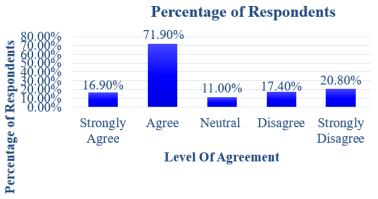
This figure presents respondents' agreement or disagreement with the statement that indigenous norms and management practices are increasingly popular, indicating perceptions of continuity in cultural practices.
Figure 2. Respondent’s Level of Agreement on Indigenous Norms and Management system.
Distribution of respondents’ agreement levels regarding the increasing popularity of indigenous norms and management systems (N = 207). Percentages are based on the total sample size.
The research illustrated in
Figure 2, to evaluate the persistence and continuity of indigenous norms and management practices in Lower Nyakach. The bar graph indicates a strong positive correlation of the role of indigenous norms and management systems in environmental preservation. A majority of respondents either strongly agree (16.9%) or agree (31.9%) that these indigenous norms and management systems are becoming increasingly popular in environmental preservation. This suggests a continuity and relevance of indigenous norms in a modern environmental context.
Notably, the relatively low level of disagreement and uncertainty (as shown by the bars "Disagree (17.4%), "Strongly disagree" (20.8%), and "Neutral level of agreement"(13.0%) highlights the persistence of these beliefs across generations, reflecting their deep-rooted presence in the Lower Nyakach community's worldview and practices. Generally, the data support the idea that the indigenous cultural framework continues to shape attitudes and behaviors towards environmental stewardship in Lower Nyakach. The findings confirm that indigenous norms remain valued and continue to guide environmental preservation practices.
The results are consistent with those reported by Opas among Amazonian Christians, in which the majority were depicted more often as animists
| [18] | Opas, M. (2017). Not Real Christians? On the Relation between Christianity and Indigenous Religions in Amazonia and Beyond. In Handbook of Indigenous Religion (s) (pp. 120–137). Brill. |
[18]
. These people are tied to their ancestral land, territories, and natural environment. They are depicted as more mystical than religious, even though the majority of the respondents were Catholic Christians.
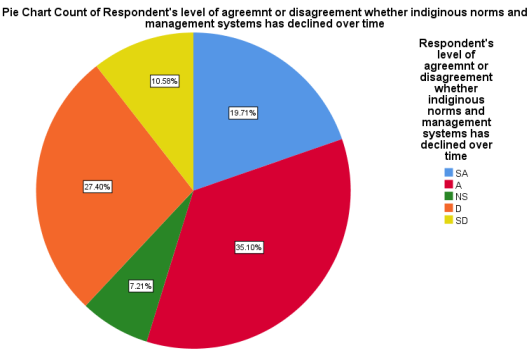
The figure illustrates the distribution of responses on whether indigenous norms and management systems for environmental conservation have declined over time.
Figure 3. Analysis of Respondents' Level of Agreement whether Indigenous Norms and Management had declined.
Figure 3 A pie chart titled "Pie chart count of respondents' level of agreement or disagreement whether indigenous norms and management systems have declined over time," shows how respondents felt about the perceived decline in indigenous norms and management systems in environmental preservation in Lower Nyakach. Each pie chart segment is labeled with the percentage it represents and color-coded to reflect a distinct response category.
The red section of the chart (the most significant) shows that 35.10% of respondents agree (A) with the statement that indigenous systems have declined significantly, indicating that over one-third believe this. The disagree (D) category, shown in orange, comes in second, with 27.40% of respondents indicating that sizable portions do not believe there has been a drop. Nineteen point seven one percent (19.71%) of responses fall into the strongly agree (SA) group, which is indicated in blue and supports the declining opinion with greater vigor. Strongly disagree (SD), indicated in yellow and accounting for 10.58% of the replies, represents a minority that is adamantly opposed to any decline. Lastly, 7.21% of respondents fall into the not sure (NS) group, which is represented by the green symbol. This suggests that a tiny percentage of respondents are ambivalent or uncertain. In conclusion, the pie chart indicates that more than half (54.81%) of respondents agree (A) or strongly agree (SA) that indigenous norms and management systems have deteriorated over time.
Although a smaller percentage remains unsure, a sizable portion also disagrees or strongly disagrees, indicating a variety of viewpoints on the matter. This data implies that indigenous practices are not only still valued and practiced but also play a crucial role in promoting sustainable environmental practices. These traditions likely include rituals and customary laws that regulate the use of natural resources, and their continued relevance is essential for reinforcing conservation efforts rooted in cultural identity. The results suggest that most respondents perceive indigenous practices as having declined, though a significant portion disagrees, reflecting mixed but critical views about cultural continuity in environmental management.
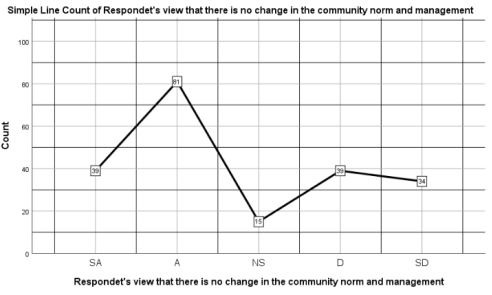
This figure depicts the respondents’ level of agreement on whether community norms and management systems have remained unchanged in environmental preservation.
Figure 4. Analysis of Respondents' views that there is no Change in the Community Norm and Management.
Figure 4 the line graph illustrates varying levels of agreement among respondents regarding whether there is no change in the community norm and in the management of environmental preservation. Significant proportions of respondents strongly agree (SA) or agree (A), indicating a high level of persistence and continuity in these norms and management practices that influence environmental stewardship. This trend suggests that indigenous cultural values remain and are actively upheld in efforts to protect and manage the environment in Lower Nyakach. The relatively low number of "disagree" and "strongly disagree" responses further emphasizes that modern environmental practices may still be rooted in or complemented by traditional beliefs. The small proportion of "not sure" respondents may reflect a lack of awareness or a generational disconnects, but it significantly undermines the overall pattern of cultural continuity. A majority indicated agreement, showing that despite a perceived decline, many community members still see continuity in indigenous environmental norms, reinforcing their persistence alongside modern practices.
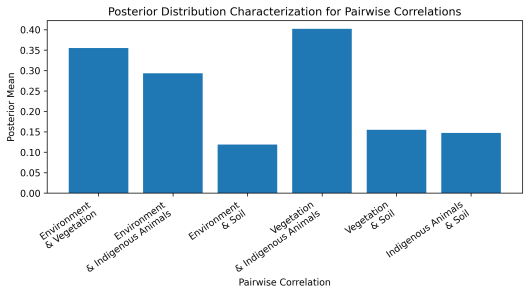
The table examines correlations between Luo norms and their influence on environmental outcomes, including vegetation cover, conservation of indigenous animals, and soil protection.
The graph below presents the posterior mean values for the pairwise correlations reported in the study. The values are derived from the posterior distribution table in the uploaded document.
Figure 5. Bayesian Posterior Estimates of Pairwise Correlations Between Luo Norms and Influence on Environment, Improved Vegetation Cover, and Conservation of Indigenous Animals, And Conservation of Soil.
The graph presents the posterior mean values of pairwise correlations among different aspects of Luo indigenous environmental norms. The results show that the strongest relationship was between Luo norms and improved vegetation cover, with a posterior mean correlation of 0.402, suggesting a relatively strong positive association between indigenous practices and vegetation conservation. This indicates that traditional norms may have played an important role in promoting the protection and regeneration of plant resources.
The relationship between Luo norms and environmental influence also showed a positive association, with a posterior mean of 0.355, implying that respondents generally perceived indigenous norms as contributing positively to environmental conservation. Similarly, the association between Luo norms and conservation of indigenous animals recorded a moderate positive correlation of 0.147, indicating some contribution of cultural practices toward wildlife protection, although the relationship was weaker compared with vegetation conservation.
The weakest association was observed between Luo norms and soil conservation, with a posterior mean correlation of 0.119. This suggests that while indigenous beliefs may support environmental protection generally, their influence on soil conservation practices may be less pronounced or affected by other factors such as modern farming methods and land-use changes.
Overall, the graph demonstrates that indigenous Luo environmental norms are positively associated with conservation outcomes, particularly vegetation protection. The findings suggest that cultural beliefs and traditional practices can serve as valuable tools for environmental sustainability. However, the variation in correlation strengths indicates the need to strengthen the integration of indigenous knowledge with modern conservation strategies, especially in areas such as soil management and biodiversity protection.
During interviews with one of the elders, it was also noted that some Luo norms related to environmental conservation continue to persist despite modern technology, education, and conversion to Christianity in the study area. For instance, one of the elders had to say that;
“Some of the farmers in this area do not use inorganic fertilizers, nor do they use chemicals during crop production. Some have been using the “kienyeji” seeds. They say that mbloea mar duka ketho puotho (inorganic fertilizer destroys the soil). They have been using organic manure. Their farms seem to be doing better". (Elder J, 2 May 2025).
The Chief of Agoro West also offered;
"I have welcomed most of the NGOs that promote organic farming in my location. This is because this system has improved the soil fertility and conserved the environment. This is seen in the way their crops have been performing well. We have even developed an indigenous seed bank for this location" (Chief B, 2 May 2025)
In another interview, one of the residents of Asao said,
"Around this area, we still have some indigenous birds like hamerkop (onjinjo), owl (tula), eagle (ongo wang), ground hornbill(arum didi), and Hadada ibis (n’gan’ga). This is because such birds are not eaten according to the Luo norms. No one bothers to kill them, and when killed, something bad may happen to that individual". (Elder K, 2 May 2025)
The sentiments show that Luo norms persist despite conversion to Christianity, Islam, and modernization and continue to contribute to soil conservation and the conservation of indigenous birds in Lower Nyakach. Magesa also indicated that despite Christianity's success in converting Africans, the suppression of the African intellectual, ethical values, and worldview has been slight, more superficial than tangible
| [13] | Magesa, L. (2014). African Religion: The moral traditions of abundant life. Orbis Books. |
[13]
. Similarly, Beyene & Bellis found that, despite contemporary society's influence of modernity and technological innovations, indigenous knowledge remains relevant in people's lives and enhances environmental conservation
| [3] | Beyene, E., & Bellis, D. (2019). Roles of Indigenous Knowledge (IK) in Promoting Sustainable Development: The Case of Environmental Protection among the Hararghe Oromo. East African Journal of Social Sciences and Humanities, 4(2), 13–28. |
[3]
.
The study sought to evaluate the persistence and continuity of indigenous beliefs and cultural practices related to environmental preservation in Lower Nyakach. The study found that the persistence of harmful myths negatively affects environmental conservation efforts in Lower Nyakach. During an interview session, one of the respondents explained that:
“Certain animals, such as arum ground hornbill (tidi), owls (tula), thuonde (snakes), and kwach (leopard), are associated with witchcraft or evil spirits and are routinely killed on sight. These acts diminish biodiversity and disrupt the ecological balance by removing essential species from the food chain”. (Respondent 058, 20 April 2025)
The findings align with
| [1] | Adebayo, T., & Musa, H. (2022). Indigenous rituals and biodiversity: Implications of ritual Slaughter of Conservation in Northern Nigeria: African Journal of Indigenous Knowledge System, 10(1), 21-35. |
[1]
in Nigeria, who documented that myths linking certain animals to witchcraft, such as owls and snakes, have led to the routine killing of key species, which mirrors the Luo belief systems and their adverse ecological outcomes.
Another respondent also explained that:
“With the erosion of traditional authority and the increasing influence of Christianity, education, and globalization, traditional beliefs that once protected the environment are losing relevance. Younger generations in Lower Nyakach are less likely to observe taboos, leading to the degradation of previously conserved sacred sites like forests and sacred plant and animal species” (Respondent 029, 20th April 2025)
The results align with
| [15] | Mutua, L., Kipkoech, S., & Otieno, M. (2023). Sacred groves and their conservation role in Western Kenya: A socio-ecological analysis. African Journal of Ecology and Culture, 15(4), 99–113. |
[15]
, who argue that while traditional ecological knowledge remains vital in guiding sustainable resource use in Kenya, the erosion of such systems, especially among youth, has led to the degradation of sacred sites and the overexploitation of natural resources.
Taken together, these findings indicate that Luo indigenous religious beliefs and cultural practices remain an integral part of environmental preservation in Lower Nyakach, despite facing significant decline due to modernization, Christianity, and generational shifts. Sacred tree protection; protection of endangered animals; taboos against the harmful use; and respect for the ancestral sites remain practices that protect biodiversity and maintain ecological equilibrium. The very high correlations among the rituals, sacred sites, and the preservation of medicinal plants indicate that spirituality and culture provide effective environmental stewardship.
However, other types of obstacles, such as ritual decline, animal sacrifices, harmful myths, and gender exclusion, were also identified in the study as some of practices that have persisted but continue to damage environmental preservation measures. Therefore, there is need to reconcile these conventional models with present-day science. The results point to the need to incorporate indigenous knowledge into current environmental policies and to address adverse environmental impacts. By integrating conventional knowledge and modern methods, Lower Nyakach can achieve sustainable environmental management that values both cultural identity and ecological integrity.
5. Conclusion and Recommendation
This study examined the persistence of indigenous religious beliefs and cultural practices that endorse environmental preservation among the Luo community of Lower Nyakach, Kisumu County. The findings demonstrate that indigenous ecological knowledge remains an important component of community environmental stewardship despite increasing influences of modernization, Christianity, formal education, globalization, and socio-economic transformation.
The study established that indigenous beliefs continue to promote conservation through the protection of sacred sites, preservation of culturally significant tree species, conservation of indigenous birds and wildlife, organic farming practices, indigenous seed preservation, and communal environmental responsibility. These practices continue to influence environmental behaviour because they are embedded within the cultural identity and moral values of the community.
At the same time, the research found evidence of gradual erosion of indigenous environmental knowledge. Younger generations are increasingly detached from traditional ecological practices, while some indigenous conservation institutions have weakened following religious transformation and modernization. The decline of traditional authority structures threatens the long-term transmission of valuable ecological knowledge.
Importantly, the study also identified that not all indigenous beliefs contribute positively to environmental conservation. Certain myths associating specific wildlife species with witchcraft or evil spirits continue to encourage the destruction of ecologically important animals. Consequently, indigenous knowledge should not be adopted uncritically but should instead be carefully evaluated to distinguish environmentally beneficial practices from those that undermine biodiversity conservation.
Overall, the findings demonstrate that indigenous religion and modern environmental science are not mutually exclusive. Rather, they offer complementary approaches to sustainable environmental governance. Integrating indigenous ecological knowledge into contemporary conservation policies would strengthen community participation while preserving valuable cultural heritage.
6. Areas for Further Research
1) The Role of Youth in the Transmission of Indigenous Environmental Knowledge: Further research should investigate how younger generations acquire, preserve, or abandon Luo indigenous ecological knowledge. This is important because the study found that modernization, formal education, and globalization have weakened intergenerational transmission of indigenous conservation practices.
2) Gender Roles in Indigenous Environmental Conservation Practices: A study should examine the contribution of men and women in preserving indigenous environmental practices. Gender-based roles in farming, seed preservation, medicinal plant conservation, and community decision-making remain underexplored.
3) Integration of Indigenous Knowledge into Formal Environmental Policies: Research is needed on practical ways of incorporating Luo indigenous ecological knowledge into government conservation programmes, environmental policies, and climate change adaptation strategies. The study recommends integrating indigenous ecological knowledge into national environmental policies and conservation programmes.
Abbreviations
AIR | African Indigenous Religion |
UN | United Nations |
UNESCO | United Nations Education, Scientific and Cultural Organizations |
Author Contributions
Alwala Bernard Odhiambo: Conceptualization, Methodology, Writing – original draft
Mary Getui: Formal Analysis, Supervision, Writing – review & editing
Chrispin Ouma Nyandiwa: Methodology, Supervision, Writing – review & editing
Conflicts of Interest
The authors declare no conflict of interest.
References
| [1] |
Adebayo, T., & Musa, H. (2022). Indigenous rituals and biodiversity: Implications of ritual Slaughter of Conservation in Northern Nigeria: African Journal of Indigenous Knowledge System, 10(1), 21-35.
|
| [2] |
Chidarikire, M., Muza, C., & Beans, H. (2021). Integration of gender equality and language diversity in Zimbabwe teacher education curriculum. East African Journal of Education and Social Sciences, 2(2), 231-238.
|
| [3] |
Beyene, E., & Bellis, D. (2019). Roles of Indigenous Knowledge (IK) in Promoting Sustainable Development: The Case of Environmental Protection among the Hararghe Oromo. East African Journal of Social Sciences and Humanities, 4(2), 13–28.
|
| [4] |
Goldman, M. (2003). Partitioned Nature, Privileged Knowledge: Community-based Conservation in Tanzania. Development & Change, 34 (5).
|
| [5] |
Jacobs, C. F., & Kaslow, A. J. (2001). The Spiritual Churches of New Orleans: Origins, Beliefs, and Rituals of an African-American Religion. Univ. of Tennessee Press.
|
| [6] |
Kasomo, D. (2006). Research methods in the humanities and education. Egerton: Egerton University.
|
| [7] |
Knighton, B. (2017). The Vitality of Karamojong Religion: dying tradition or living faith? Routledge.
|
| [8] |
Kombo, D. K., & Tromp, D. L. A. (2006). Proposal and Thesis Writing: An Introduction. Nairobi: Pauline’s.
|
| [9] |
Kothari, C. R. (2004). Research Methodology: Methods and Techniques. (2nded.). New Delhi: New Age International.
|
| [10] |
Kothari, A., Pathak, N., Anuradha, R. V. S., & Taneja, Bansuri (1998). Communities in South & Central Asia. New Delhi, India: Sage Publications Ltd.
|
| [11] |
Ladle, R. J. & Whittaker, R. J. (Eds) (2011). ‘Conservation biogeography’ Blackwell Publishing Ltd., Oxford, UK.
|
| [12] |
Mbiti J. S. (1969). African Religions and Philosophy. Nairobi: Heinemann.
|
| [13] |
Magesa, L. (2014). African Religion: The moral traditions of abundant life. Orbis Books.
|
| [14] |
Morompi, J., Mary, W., Godrick, O. A. B., & Chaka, B. (2020). Impacts of neglecting African Traditional Environmental Conservation Practices and education on the environment: A Case of the Maasai People of Narok County, Kenya. International Journal of Cultural Inheritance & Social Sciences ISSN: 2632-7597, 2(3), 1-14.
|
| [15] |
Mutua, L., Kipkoech, S., & Otieno, M. (2023). Sacred groves and their conservation role in Western Kenya: A socio-ecological analysis. African Journal of Ecology and Culture, 15(4), 99–113.
|
| [16] |
Nkama, C. L., Okoro, K. N., & Egbule, E. (2022). Eco-Preservation through the Lens of Igbo. Beliefs and Practices: A Re-Imagination. Religions, 13(11), 1066.
|
| [17] |
Öhlmann, P., & Swart, I. (2022). Religion and Environment: Exploring the Ecological Turn in Religious Traditions, the Religion and Development Debate and Beyond. Religion and Theology, 29(3-4), 292-321.
|
| [18] |
Opas, M. (2017). Not Real Christians? On the Relation between Christianity and Indigenous Religions in Amazonia and Beyond. In Handbook of Indigenous Religion (s) (pp. 120–137). Brill.
|
| [19] |
Steward, J. H. (1955). Theory of culture change: The methodology of multilinear evolution. University of Illinois press.
|
| [20] |
Wicaksono, B. S., Rismana, D., Dewi, L., Indriyanti, S., Fanesa, F. P., Ramadhani, S. E....& Badriah, T. L. (2024, June). Spirituality and Sustainability: How Local Wisdom in Desa Wates is Paving the Way for Cultural and Environmental Preservation. In Prosiding Seminar Nasional Ilmu Pendidikan Agama dan Filsafat (Vol. 1, No. 1, pp. 137-145).
|
| [21] |
Woodburn, J. (1997). Indigenous discrimination: The ideological basis for local discrimination against hunter‐gatherer minorities in sub-Saharan Africa. Ethnic and Racial Studies, 20(2), 345–361.
|
| [22] |
Kibet, S., & Nyamweru, C. (2008). Cultural and biological heritage at risk: the case of the Rabai Kaya forests in Coastal Kenya. In Journal of Human Ecology, 24(4), 287-295.
|
Cite This Article
-
APA Style
Odhiambo, A. B., Getui, M., Nyandiwa, C. O. (2026). The Luo Indigenous Religious Beliefs and Cultural Practices of Environmental Preservation: A Case of Lower Nyakach: Kisumu County, Kenya. International Journal of Environmental Protection and Policy, 14(4), 93-104. https://doi.org/10.11648/j.ijepp.20261404.12
 Copy
|
Copy
|
 Download
ACS Style
Odhiambo, A. B.; Getui, M.; Nyandiwa, C. O. The Luo Indigenous Religious Beliefs and Cultural Practices of Environmental Preservation: A Case of Lower Nyakach: Kisumu County, Kenya. Int. J. Environ. Prot. Policy 2026, 14(4), 93-104. doi: 10.11648/j.ijepp.20261404.12
Copy
|
Download
AMA Style
Odhiambo AB, Getui M, Nyandiwa CO. The Luo Indigenous Religious Beliefs and Cultural Practices of Environmental Preservation: A Case of Lower Nyakach: Kisumu County, Kenya. Int J Environ Prot Policy. 2026;14(4):93-104. doi: 10.11648/j.ijepp.20261404.12
Copy
|
Download
-
@article{10.11648/j.ijepp.20261404.12,
  author = {Alwala Bernard Odhiambo and Mary Getui and Chrispin Ouma Nyandiwa},
  title = {The Luo Indigenous Religious Beliefs and Cultural Practices of Environmental Preservation: A Case of Lower Nyakach: Kisumu County, Kenya},
  journal = {International Journal of Environmental Protection and Policy},
  volume = {14},
  number = {4},
  pages = {93-104},
  doi = {10.11648/j.ijepp.20261404.12},
  url = {https://doi.org/10.11648/j.ijepp.20261404.12},
  eprint = {https://article.sciencepublishinggroup.com/pdf/10.11648.j.ijepp.20261404.12},
  abstract = {Environmental degradation remains one of the greatest challenges confronting humanity despite advances in science, technology, and environmental policy. In many African societies, indigenous religious beliefs and cultural practices have historically played a significant role in regulating human interaction with nature. However, modernization, Christianity, formal education, globalization, and socio-economic transformations have altered traditional environmental management systems. This study examined the persistence of indigenous religious beliefs and cultural practices that promote environmental preservation among the Luo community of Lower Nyakach in Kisumu County, Kenya. Specifically, it investigated the extent to which traditional ecological knowledge continues to influence environmental stewardship despite increasing exposure to foreign religions and modern lifestyles. The study employed a mixed-methods research design, integrating quantitative and qualitative approaches. Data were collected through questionnaires, key informant interviews, focus group discussions, and observation. Quantitative data were analyzed using descriptive statistics and Bayesian correlation analysis, while qualitative data were analyzed thematically. Findings revealed that although indigenous environmental beliefs have declined due to modernization and religious transformation, many traditional conservation practices continue to shape community attitudes toward biodiversity conservation, sacred sites, vegetation protection, and sustainable farming. Sacred forests, protection of particular plant and animal species, respect for ancestral sites, and the continued use of indigenous agricultural practices remain important mechanisms of environmental stewardship. Nevertheless, harmful beliefs, declining traditional authority and reduced intergenerational transmission of indigenous knowledge threaten the sustainability of these practices. The study concludes that indigenous religious beliefs remain an essential component of community-based environmental conservation and recommends integrating indigenous ecological knowledge into national environmental policies, educational curricula, and community conservation programmes to strengthen sustainable environmental management.},
 year = {2026}
}
Copy
|
Download
-
TY  - JOUR
T1  - The Luo Indigenous Religious Beliefs and Cultural Practices of Environmental Preservation: A Case of Lower Nyakach: Kisumu County, Kenya
AU  - Alwala Bernard Odhiambo
AU  - Mary Getui
AU  - Chrispin Ouma Nyandiwa
Y1  - 2026/08/27
PY  - 2026
N1  - https://doi.org/10.11648/j.ijepp.20261404.12
DO  - 10.11648/j.ijepp.20261404.12
T2  - International Journal of Environmental Protection and Policy
JF  - International Journal of Environmental Protection and Policy
JO  - International Journal of Environmental Protection and Policy
SP  - 93
EP  - 104
PB  - Science Publishing Group
SN  - 2330-7536
UR  - https://doi.org/10.11648/j.ijepp.20261404.12
AB  - Environmental degradation remains one of the greatest challenges confronting humanity despite advances in science, technology, and environmental policy. In many African societies, indigenous religious beliefs and cultural practices have historically played a significant role in regulating human interaction with nature. However, modernization, Christianity, formal education, globalization, and socio-economic transformations have altered traditional environmental management systems. This study examined the persistence of indigenous religious beliefs and cultural practices that promote environmental preservation among the Luo community of Lower Nyakach in Kisumu County, Kenya. Specifically, it investigated the extent to which traditional ecological knowledge continues to influence environmental stewardship despite increasing exposure to foreign religions and modern lifestyles. The study employed a mixed-methods research design, integrating quantitative and qualitative approaches. Data were collected through questionnaires, key informant interviews, focus group discussions, and observation. Quantitative data were analyzed using descriptive statistics and Bayesian correlation analysis, while qualitative data were analyzed thematically. Findings revealed that although indigenous environmental beliefs have declined due to modernization and religious transformation, many traditional conservation practices continue to shape community attitudes toward biodiversity conservation, sacred sites, vegetation protection, and sustainable farming. Sacred forests, protection of particular plant and animal species, respect for ancestral sites, and the continued use of indigenous agricultural practices remain important mechanisms of environmental stewardship. Nevertheless, harmful beliefs, declining traditional authority and reduced intergenerational transmission of indigenous knowledge threaten the sustainability of these practices. The study concludes that indigenous religious beliefs remain an essential component of community-based environmental conservation and recommends integrating indigenous ecological knowledge into national environmental policies, educational curricula, and community conservation programmes to strengthen sustainable environmental management.
VL  - 14
IS  - 4
ER  -
Copy
|
Download





 Share This Article
 Twitter
 Linked In
 Facebook