Abstract
In the context of global climate change and environmental regulations, it is worth exploring in theory and practice how coal enterprises can achieve green and low-carbon transformation and maintain sustainable development. This article takes Shandong Energy in China as an example, analyzes the obstacles faced by Shandong Energy's green and low-carbon transformation, such as resource distribution, talent structure, industrial structure, and supporting policies. From the perspectives of mergers and acquisitions, industrial structure, resource reserves, intelligent mines, technological innovation, integration of industry and finance, and resource integration, it deeply analyzes and summarizes Shandong Energy's practical paths and beneficial experiences in green and low-carbon transformation and achieving sustainable development. The research results have been found that mergers and acquisitions, as well as resource integration, have broadened the temporal and spatial boundaries and opportunity set for the green and low-carbon transformation of coal enterprises; Technological innovation is the intrinsic driving force for the green and low-carbon transformation of coal enterprises, providing technical support for their sustainable development; Financial innovation provides fund support for the green and low-carbon transformation and sustainable development of coal enterprises. The research conclusions have important practical significance and theoretical marginal contributions, provides experience reference and theoretical guidance for the green and low-carbon transformation of the other coal industry enterprises.
Keywords
Coal Industry, Green and Low-Carbon, Transformation Barriers, Implementation Path, Shandong Energy
1. Introduction
Against the backdrop of global climate change and green and low-carbon development, Shandong, as a province with a large economy and population, faces the dilemma of imbalanced coal supply and demand, as well as significant pressure on carbon reduction. Coal not only needs to play a fundamental role in energy security, but also faces the challenges of green and low-carbon transformation and development
| [1] | Kechang X. Develop new energy system and promote clean and efficient conversion of coal. Journal of China Coal Society, 2024, 49(01): 47-56. https://doi.org/10.13225/j.cnki.jccs.ZZ23.1712 |
| [2] | Shuchang W., Qunsheng Y. Discussion on green and low-carbon transformation of coal enterprises under the "Double Carbon" goal. China Collective Economy, 2023, (04): 42-45. |
[1, 2]
. As a fossil energy source, the green and low-carbon transformation of the coal industry is a strategic choice to adapt to environmental changes and achieve sustainable development
| [3] | Ping L., Liyang D. Study on of Influencing Factors of Target Location Selecting of Inter-regional Transfer of the coal industry in Shandong Province. Science Technology and Industry, 2016(2): 31. |
[3]
. It is necessary to clarify the transformation goals, improve institutional mechanisms, optimize industrial structure, and develop green technologies
. Through optimizing spatial layout, transforming production methods, coordinating the advantages of coal and non coal industries, and building a multi-level innovation system, it is necessary to achieve the transformation of new and old kinetic energy
| [5] | Lingyu S. Research on the construction of a theoretical framework for the green transformation and growth of resource-based enterprises. Qinghai Social Science, 2013(5): 45-50. https://doi.org/10.14154/j.cnki.qss.2013.05.029 |
| [6] | Fawen Y., Shan L. Promotion strategies of green transformation and development of enterprises under the "Double Carbon" Goal. Reform, 2022(2): 144 - 155. |
[5, 6]
. Coal is the fundamental energy source in Shandong, with a large demand and industrial scale. The green and low-carbon transformation requires balancing the conflict between coal demand and carbon reduction, ensuring the mutual promotion and orderly transformation of new and old driving forces
, and expanding the coal industry chain according to the principles of "research and development design equipment development graded transformation and efficient, multi-level utilization clean consumption"
. However, the coal industry has characteristics such as capital intensity, irreversible investment, and high social responsibility
| [9] | Gan Z., Bingnan H., Xing B. Research and practice on development path of new and old energy conversion in Jining coal industry. Coal Economic Research, 2018, 38(08): 24 - 29. https://doi.org/10.13202/j.cnki.cer.2018.08.004 |
| [10] | Jia Z., Shiqiang Z., Jinquan Z. Review on strategic cost management of coal enterprises and groups. Coal Engineering, 2017, 4 9(06): 146 - 148. |
[9, 10]
. It is necessary to examine and solve the obstacles faced by coal enterprises in green and low-carbon transformation from a strategic perspective, and consider how to achieve green and low-carbon transformation from two strategic dimensions: cross time and cross space. Shandong Energy is a state-owned asset platform for the operation of Shandong's coal industry. Through a case study of Shandong's green and low-carbon transformation of energy, this study summarizes and extracts effective paths to overcome the obstacles to green and low-carbon transformation of coal enterprises, taking it as a reference to promote the transformation and development of the coal industry.
2. Introduction to Shandong Energy Green and Low Carbon Transformation Case
2.1. Merger and Integration to form Shandong Energy
Under the dual carbon strategy, facing significant opportunities for energy structure transformation and industrial structure optimization, The original Shandong Energy Group Co., Ltd. (referred to as "Energy Group") and Yankuan Group Co., Ltd. (referred to as "Yankuan Group"), as large coal holding groups in Shandong Province, implemented a strategic merger and reorganization in July 2020 to improve the scale economy and overcome obstacles to green and low-carbon transformation in the coal industry. Yankuan Group was renamed Shandong Energy Group Co., Ltd. (referred to as "Shandong Energy") as the surviving company. After the cancellation of the Energy Group, it was merged into Shandong Energy. With the merger of two major energy groups in Shandong province, the integration and restructuring of Shandong's coal industry has accelerated, breaking the temporal and spatial boundaries of green and low-carbon transformation among enterprises, and providing opportunities for improving the quality, efficiency, and transformation development of Shandong's coal industry.
2.2. Strategic Positioning of Shandong's Energy Transformation and Development
The strategic goal of Shandong Energy's green and low-carbon transformation is to become a global clean energy supplier and a world-class energy enterprise group. Focusing on clean and low-carbon development, implementing full industry chain innovation
| [11] | Ximin S. Research and practice on high quality development strategy of coal industry. Coal Engineering, 2019, 51(01): 152-156. |
| [12] | Delin X., Xinying F., Yiyang Z. Master plan of Xinjie Taigemiao mining area based on the Five Development Principles. Coal Engineering, 2020, 52(12): 1-6. |
[11, 12]
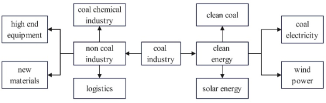
, leveraging the advantages of diversified industry collaboration and strategic leadership, establishing cross regional energy bases in Shaanxi Gansu Mongolia, Australia, Xinjiang, and other regions, leveraging the advantages of coal power and coal chemical linkage, and coordinated development of resources within and outside the province, establishing six main businesses: mining, electricity, high-end chemical industry, new energy and new materials, high-end equipment manufacturing, and modern logistics trade. The integrated Shandong energy strategy has a clear positioning, establishing strategic goals and directions for green and low-carbon transformation and development. It`s Strategic positioning is shown in
Figure 1.
Figure 1. Strategic positioning of Shandong Energy transformation.
3. Analysis of Obstacles to Shandong's Green and Low-Carbon Energy Transformation
3.1. Uneven Distribution of Coal Resources And Vastly Different Conditions for Green and Low-Carbon Transformation
The distribution of coal resources in China is extremely uneven, with more in the northwest and less in the southeast. In areas with abundant coal resources, coal seam occurrence conditions are often better, mining costs are lower, coal enterprises have strong profitability, and the foundation and conditions for transformation are better
. Shandong, as a coastal province in eastern China, has abundant coal resources. However, compared with the northwest region, after years of mining, coal resources have been frequently depleted, and mining costs have gradually increased. The coal industry is facing dual pressures of cross spatial transfer of remaining production capacity and green and low-carbon transformation.
3.2. Unreasonable Talent Structure Constrains the Green and Low-Carbon Transformation of the Coal Industry
Reducing carbon emissions and reducing production capacity means that there will be an excess of coal production capacity and operating personnel, and the cost of coal mining will also increase. Coal enterprises are facing dual pressures of reducing personnel and increasing costs and efficiency. Coal enterprises are mostly state-owned holding enterprises, responsible for employment and maintaining social stability, and cannot easily lay off employees. The expansion of the coal industry into non coal industries such as electricity, chemicals, building materials, logistics, machinery, and new energy requires a large number of professional and technical talents
, which requires a long period of introduction and cultivation.
3.3. Coal Industry Capacity Cut Hard, Non-Coal Chain Expansion Harder
With the gradual adjustment of energy consumption structure, the proportion of fossil energy consumption will gradually decrease, and there will be excess coal production capacity. Coal enterprises need to mitigate the operational risks caused by overcapacity, as well as the financial risks that may lead to cost increases and poor profitability due to capacity reduction. Expanding the non coal industry chain can not only offset the operational risks brought by reducing production capacity, but also leverage the existing advantages of coal enterprises to achieve low-carbon development in industries such as coal-fired power, heating, coal chemical, and building materials. However, the technology content of the non coal industry is relatively high, and the initial investment is large, so there is uncertainty about whether the advantages of the non coal industry can be constructed.
3.4. The Exit Mechanism Is Not Sound, and There Are Obstacles to the Merger and Restructuring of Coal Enterprises
The particularity of the coal industry determines the asset specificity of coal enterprises and the irreversibility of coal mining investment. Exiting from the coal industry will expose coal enterprises to the risk of asset depreciation, difficulty in recovering investments, and high exit costs. At the same time, exiting the coal industry means that many people will become unemployed, pushing a large number of employees into society, which is difficult for state-owned enterprises to achieve and also something the government does not want to see. For coal enterprises that have exhausted their resources, mining costs are high, their financial situation is poor, and they lack funds for transformation; The implementation of mergers and acquisitions is too costly. Therefore, simply exiting the coal industry is not enough, and implementing mergers and acquisitions also faces obstacles. The transformation of coal enterprises at a disadvantage will be even more difficult
.
4. Implementation Path of Shandong Energy Green and Low Carbon Transformation Strategy
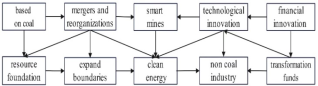
Faced with obstacles to transformation, Shandong Energy has expanded its business boundaries through mergers and acquisitions, and its resource base in coal, human resources, technology, and other areas has become more competitive, creating conditions for transformation and development. By shutting down small coal mines and building smart mines, clean coal production and economies of scale can be achieved. Through technological innovation, provide technical solutions for coal mining, expanding the coal industry chain, and developing non coal industries. Provide financial support for transformation and development through financial innovation and green finance. The implementation path of its transformation strategy is shown in
Figure 2.
Figure 2. Shandong Energy transformation paths.
4.1. Industrial Merger and Integration, Expanding the Boundaries of Enterprise Transformation
The merger and integration of Energy Group and Yankuan Group has opened up space for the transformation of Shandong's coal industry and the optimization of resource allocation, providing multiple transformation path choices. This not only benefits the competitive advantage of Shandong's coal industry, but also lays a solid foundation for the green and low-carbon transformation of coal enterprises. In order to achieve the transformation from factor driven to innovation driven and from external development to internal improvement, Shandong Energy has cleared and disposed of a batch of non main and non advantageous businesses, and revitalized inefficient and ineffective assets through transfer, liquidation, bankruptcy, and other means; By integrating the advantageous resources of the two major groups, it is more conducive to expanding and strengthening the coal industry in Shandong.
4.2. Increase Coal Resource Reserves and Solidify the Foundation of Green and Low-Carbon Transformation
Although China's proven coal resource reserves are about 1.5 trillion tons, the exploitable coal resources are less than 500 billion tons. In order to ensure the sustainability of coal mining, Shandong Energy has chosen to strategically increase coal reserves, continuously optimize the occurrence conditions, regions, coal types, and coal quality of coal reserves. By leveraging our advantages in technology, funding, and management, we will continuously increase investment in coal rich regions such as Inner Mongolia and Xinjiang, as well as foreign coal resource development investments such as Australia and Canada, by increasing capital and expanding shares. This will increase coal reserves and solidify the foundation for the green and low-carbon transformation of the coal industry.
4.3. Building Smart Mines to Ensure Clean and Efficient Coal Mining
To achieve clean and efficient coal mining, modern information technologies such as digitization and artificial intelligence are needed. Shandong Energy has established a joint innovation center through cooperation with Huawei to build a closely collaborative digital innovation model. The application of new generation information technologies such as the Internet of Things, big data, artificial intelligence, 5G, and F5G in coal mines has been achieved, and a real-time interconnected, multi-dimensional perception, self-learning, analysis and prediction, and accurate decision-making intelligent management system for mining areas has been constructed
| [14] | Shuchang W., Jing Y. Performance evaluation for new and old kinetic energy conversion of coal enterprises based on DEA-Malmquist index. Coal Engineering, 2020, 52(09): 183-187. |
| [15] | Shuchang W., Fangfei P., Yun G. Environmental performance evaluation of green and low-carbon transformation in coal enterprises based on DPSIR: A case study of Yankuan Energy. Financial Management Research, 2023, 45(06): 24 - 29. |
[14, 15]
. This plays a key role in monitoring and controlling clean and efficient coal production.
4.4. Intensify Technological Innovation Efforts to Achieve Low-Carbon Development of High Carbon Industries
The focus of Shandong's energy transformation and development is technological upgrading and low-carbon development
| [15] | Shuchang W., Fangfei P., Yun G. Environmental performance evaluation of green and low-carbon transformation in coal enterprises based on DPSIR: A case study of Yankuan Energy. Financial Management Research, 2023, 45(06): 24 - 29. |
| [16] | Lu X., Cong W. Research on dynamic relationship among environmental regulation, w-carbon technological innovation and coal consumption carbon emission reduction. Coal Engineering, 2018, 50(07): 177-180. |
| [17] | Shuchang W., Di Q., Yun G., et al. Ownership concentration, management shareholding and corporate green technology innovation. Financial Research, 2023(6): 80 - 89. https://doi.org/10.14115/j.cnki.10-1242/f.2023.06.009 |
[15-17]
. The company focuses on core technologies in the fields of coal, coal-fired power, chemical industry, equipment manufacturing, new energy, new materials, etc., accelerates new technology innovation and product development, and promotes low-carbon development of high carbon industries.
(1) Develop high-end precision industries. High end fine chemical industry is a key development direction of coal chemical industry, with the characteristics of high technological content and high added value. Shandong Energy has achieved results in this industry through technological research and product innovation. The organic chemical raw material caprolactam products have been put into the market and can be made into textiles, industrial silk, carpet silk, and food packaging, etc., with broad market promotion prospects.
(2) Develop the power industry. Electricity is an important link in the non coal industry chain, and using coal to generate electricity is beneficial for centralized control of carbon emissions, which is one of the important directions for low-carbon development. Shandong Energy has developed large capacity and high parameter power generation units, shut down small-scale coal-fired power companies, continuously optimized power supply structure, centralized control of pollutant emissions, and improved the efficiency of green power generation.
(3) Develop the high-end equipment industry. The high-end equipment industry is conducive to leveraging the existing advantages of mining equipment in coal enterprises, and has a more solid foundation for transformation and development. By increasing research and development investment, Shandong Energy has successfully developed a 10 meter ultra high mining hydraulic support, which has reached European standards and has mass production capacity.
(4) Develop the new materials industry. New materials are one of the development directions of coal chemical industry. Shandong Energy has the production capacity of more than 10 new material products in four categories: long carbon chain nylon, high-temperature nylon, transparent nylon, and long carbon chain nylon elastomers. It has now developed into a "chain leader" enterprise in the special nylon industry chain of Shandong Province.
(5) Develop the new energy industry. New energy is the preferred direction for achieving the development goals of clean energy suppliers. Shandong Energy has established a new energy company and used it as the main investment and operation entity in the new energy industry. It has developed and constructed new energy projects such as wind power and photovoltaic energy storage in Shandong, Inner Mongolia, Gansu, and other places. The new energy company will also introduce strategic investors, implement mixed ownership, innovate institutional mechanisms, integrate the coal industry with new energy development
| [18] | Shaofeng Z., Jiarui L., Yuhan C., et al. Implementation path of integrated development of coal mines and new energy in northwest china. Coal Engineering, 2023, 55(12): 178 - 183. |
[18]
, and create new energy industry clusters such as sea and land wind power, photovoltaic, hydrogen energy, geothermal, etc.
4.5. Utilizing Financial Innovation Tools to Meet the Funding Needs for Green and Low-Carbon Transformation
The demand for funds for green and low-carbon transformation projects is high, and the degree of financing constraints is high
| [19] | Shuchang W., Xinkai W., Di Q. Internal Control Quality, nancing constraints and green investment: evidence from heavily polluted industries. Journal of Nanjing Audit University, 2022, 19(06): 21-30. |
| [20] | Shuchang W., Shuli T., Yun G. Analysis of relevant issues and countermeasures for green bond issuance - Taking BYD as an Example. Finance & Accounting, 2023, (16): 19-22. |
| [21] | Xinying F., Rusheng J., Zhongwen Z. Green low-carbon circular economy model of China Pingmei Shenma Group. Coal Engineering, 2017, 49(08): 158 - 161. |
[19-21]
. It is necessary to use green financial innovation tools to solve the funding gap problem of technological innovation and new project investment during the transformation period.
(1) Low carbon financing promotes the development of the new energy industry. New energy companies solve the funding needs for project development by applying for carbon neutrality policy loans. The loan funds are mainly invested in the county wide distributed photovoltaic development project of Shanneng New Energy (Yishui) Co., Ltd., a subsidiary of new energy, effectively alleviating the financing constraints of new energy projects.
(2) Supply chain financing promotes the development of modern logistics industry. Yankuan Smart Logistics is a global industrial supply chain platform built by Shandong Energy in Hainan Free Trade Port. Based on the main credit of Yankuan Smart Logistics platform between upstream and downstream enterprises and banks, it leverages platform transactions, taxation, and other major factors
5. Evaluation of the Effect of Shandong Energy Integration and Transformation
After the merger, Shandong Energy has gradually leveraged its collaborative advantages in management, market, regional personnel, industry, and resources through integration, and the transformation effect has gradually become apparent. According to the "Shandong Energy 2022 Financial and Other Major Information Announcement", it was found that the operating revenue in 2022 was 834.715 billion yuan, a year-on-year increase of 10.72%; Net profit was 24.041 billion yuan, a year-on-year increase of 71.72%, of which collaborative efficiency was 10 billion yuan; The return on equity was 9.45%, an increase of 3.25% year-on-year. The proportion of R&D investment exceeds 20%, and high-level talents such as academicians and young Changjiang scholars are introduced to enrich the R&D team. Five national level innovation platforms and 92 provincial and ministerial level innovation platforms have been established. After the merger, Shandong Energy is still in the process of integration and efficiency creation. From the perspective of financial and innovation performance in 2022 alone, the transformation effect is initially evident, and the energy and industrial structures have been preliminarily optimized and adjusted.
6. Conclusion and Inspiration
By integrating two major state-owned energy groups, Shandong Energy has broadened the boundaries and opportunities of green and low-carbon transformation for coal enterprises, solved the obstacles to green and low-carbon transformation for coal enterprises, and achieved the transformation and development of the coal industry towards clean energy and non coal industries through means such as mergers and acquisitions, industrial restructuring, increasing coal reserves, smart mine construction, technological innovation, and financial innovation, effectively resolving the conflict between coal consumption demand and low-carbon transformation and development. Based on the above case analysis and conclusions, the following suggestions are proposed for the green and low-carbon transformation of the coal industry:
(1) Choose a green and low-carbon transformation path based on coal resource reserve conditions
For regions facing resource depletion, if non coal industries have advantages, they can exit the coal industry through bankruptcy or liquidation, and allocate resources to non coal industries; If coal mining technology and personnel have advantages, surplus coal production capacity can be transferred to coal rich areas through external investment, mergers and acquisitions, internal integration, and other means. For regions with abundant coal resources and advantages in the coal industry, the focus can be on developing clean coal, cultivating non coal industries, or transferring some remaining coal production capacity across regions.
(2) Based on coal, transforming and developing towards clean energy and non coal industries
Coal is the energy foundation of our country, and we need to focus on coal, provide clean energy, and expand the coal industry chain. On the one hand, by cleaning the raw coal to remove impurities and harmful substances, clean energy is provided to the outside world; On the other hand, expanding the coal industry chain to include industries such as coal-fired power generation, coal chemical industry, coal to oil (steam) conversion, coal machinery, and building materials. To achieve the improvement of coal quality, the transformation from high carbon to low-carbon, coal to non coal, and pollution to environmental protection, in order to meet the requirements of green, low-carbon, and environmental regulations.
(3) Leveraging the advantages of regional coal industry and collaborating to achieve green and low-carbon transformation
Due to limitations in resources, technology, personnel, and other factors, there are many constraints on the green and low-carbon transformation of a single enterprise. However, if coal enterprises in the collaborative region complement each other's advantages in resources, technology, and personnel, not only can they develop and strengthen the coal industry, but they can also cultivate and strengthen non coal industries through resource integration, collaborative innovation, and achieve green and low-carbon transformation and development of the coal industry in their jurisdiction.
Abbreviations
Energy Group | The original Shandong Energy Group Co., Ltd. |
Yankuan Group | Yankuan Group Co., Ltd. |
Shandong Energy | Shandong Energy Group Co., Ltd. |
Conflicts of Interest
The authors declare no conflicts of interest.
References
| [1] |
Kechang X. Develop new energy system and promote clean and efficient conversion of coal. Journal of China Coal Society, 2024, 49(01): 47-56.
https://doi.org/10.13225/j.cnki.jccs.ZZ23.1712
|
| [2] |
Shuchang W., Qunsheng Y. Discussion on green and low-carbon transformation of coal enterprises under the "Double Carbon" goal. China Collective Economy, 2023, (04): 42-45.
|
| [3] |
Ping L., Liyang D. Study on of Influencing Factors of Target Location Selecting of Inter-regional Transfer of the coal industry in Shandong Province. Science Technology and Industry, 2016(2): 31.
|
| [4] |
Peng L. Research on green development strategy of coal enterprises from the perspective of social responsibility. Coal Economic Research, 2018, 38(10): 65-68.
https://doi.org/10.13202/j.cnki.cer.2018.10.012
|
| [5] |
Lingyu S. Research on the construction of a theoretical framework for the green transformation and growth of resource-based enterprises. Qinghai Social Science, 2013(5): 45-50.
https://doi.org/10.14154/j.cnki.qss.2013.05.029
|
| [6] |
Fawen Y., Shan L. Promotion strategies of green transformation and development of enterprises under the "Double Carbon" Goal. Reform, 2022(2): 144 - 155.
|
| [7] |
Yuyong D., Hui L. Research on new and old kinetic energy conversion of coal industry in Shandong Province. Coal Economic Research, 2018(08): 18-23.
https://doi.org/10.13202/j.cnki.cer.2018.08.003
|
| [8] |
Lina Z. Research on industrial transformation and upgrading and orderly conversion of new and old kinetic energy: Taking Shandong Province as an example. Theory Journal, 2017, (02): 68 - 74.
https://doi.org/10.14110/j.cnki.cn-37-1059/d.2017.02.012
|
| [9] |
Gan Z., Bingnan H., Xing B. Research and practice on development path of new and old energy conversion in Jining coal industry. Coal Economic Research, 2018, 38(08): 24 - 29.
https://doi.org/10.13202/j.cnki.cer.2018.08.004
|
| [10] |
Jia Z., Shiqiang Z., Jinquan Z. Review on strategic cost management of coal enterprises and groups. Coal Engineering, 2017, 4 9(06): 146 - 148.
|
| [11] |
Ximin S. Research and practice on high quality development strategy of coal industry. Coal Engineering, 2019, 51(01): 152-156.
|
| [12] |
Delin X., Xinying F., Yiyang Z. Master plan of Xinjie Taigemiao mining area based on the Five Development Principles. Coal Engineering, 2020, 52(12): 1-6.
|
| [13] |
Yixin Z., Shuchang W. The implementation path, obstacles, and countermeasures for the transformation of new and old kinetic energy in coal enterprises. Business Economy, 2020, (12): 126 - 129.
https://doi.org/10.19905/j.cnki.syjj1982.2020.12.048
|
| [14] |
Shuchang W., Jing Y. Performance evaluation for new and old kinetic energy conversion of coal enterprises based on DEA-Malmquist index. Coal Engineering, 2020, 52(09): 183-187.
|
| [15] |
Shuchang W., Fangfei P., Yun G. Environmental performance evaluation of green and low-carbon transformation in coal enterprises based on DPSIR: A case study of Yankuan Energy. Financial Management Research, 2023, 45(06): 24 - 29.
|
| [16] |
Lu X., Cong W. Research on dynamic relationship among environmental regulation, w-carbon technological innovation and coal consumption carbon emission reduction. Coal Engineering, 2018, 50(07): 177-180.
|
| [17] |
Shuchang W., Di Q., Yun G., et al. Ownership concentration, management shareholding and corporate green technology innovation. Financial Research, 2023(6): 80 - 89.
https://doi.org/10.14115/j.cnki.10-1242/f.2023.06.009
|
| [18] |
Shaofeng Z., Jiarui L., Yuhan C., et al. Implementation path of integrated development of coal mines and new energy in northwest china. Coal Engineering, 2023, 55(12): 178 - 183.
|
| [19] |
Shuchang W., Xinkai W., Di Q. Internal Control Quality, nancing constraints and green investment: evidence from heavily polluted industries. Journal of Nanjing Audit University, 2022, 19(06): 21-30.
|
| [20] |
Shuchang W., Shuli T., Yun G. Analysis of relevant issues and countermeasures for green bond issuance - Taking BYD as an Example. Finance & Accounting, 2023, (16): 19-22.
|
| [21] |
Xinying F., Rusheng J., Zhongwen Z. Green low-carbon circular economy model of China Pingmei Shenma Group. Coal Engineering, 2017, 49(08): 158 - 161.
|
Cite This Article
-
APA Style
Yun, G., Shuchang, W. (2024). Case Study on Obstacles and Implementation Paths of Shandong Energy's Green and Low-carbon Transformation. International Journal of Economics, Finance and Management Sciences, 12(4), 211-216. https://doi.org/10.11648/j.ijefm.20241204.11
 Copy
|
Copy
|
 Download
ACS Style
Yun, G.; Shuchang, W. Case Study on Obstacles and Implementation Paths of Shandong Energy's Green and Low-carbon Transformation. Int. J. Econ. Finance Manag. Sci. 2024, 12(4), 211-216. doi: 10.11648/j.ijefm.20241204.11
Copy
|
Download
AMA Style
Yun G, Shuchang W. Case Study on Obstacles and Implementation Paths of Shandong Energy's Green and Low-carbon Transformation. Int J Econ Finance Manag Sci. 2024;12(4):211-216. doi: 10.11648/j.ijefm.20241204.11
Copy
|
Download
-
@article{10.11648/j.ijefm.20241204.11,
  author = {Guo Yun and Wu Shuchang},
  title = {Case Study on Obstacles and Implementation Paths of Shandong Energy's Green and Low-carbon Transformation
},
  journal = {International Journal of Economics, Finance and Management Sciences},
  volume = {12},
  number = {4},
  pages = {211-216},
  doi = {10.11648/j.ijefm.20241204.11},
  url = {https://doi.org/10.11648/j.ijefm.20241204.11},
  eprint = {https://article.sciencepublishinggroup.com/pdf/10.11648.j.ijefm.20241204.11},
  abstract = {In the context of global climate change and environmental regulations, it is worth exploring in theory and practice how coal enterprises can achieve green and low-carbon transformation and maintain sustainable development. This article takes Shandong Energy in China as an example, analyzes the obstacles faced by Shandong Energy's green and low-carbon transformation, such as resource distribution, talent structure, industrial structure, and supporting policies. From the perspectives of mergers and acquisitions, industrial structure, resource reserves, intelligent mines, technological innovation, integration of industry and finance, and resource integration, it deeply analyzes and summarizes Shandong Energy's practical paths and beneficial experiences in green and low-carbon transformation and achieving sustainable development. The research results have been found that mergers and acquisitions, as well as resource integration, have broadened the temporal and spatial boundaries and opportunity set for the green and low-carbon transformation of coal enterprises; Technological innovation is the intrinsic driving force for the green and low-carbon transformation of coal enterprises, providing technical support for their sustainable development; Financial innovation provides fund support for the green and low-carbon transformation and sustainable development of coal enterprises. The research conclusions have important practical significance and theoretical marginal contributions, provides experience reference and theoretical guidance for the green and low-carbon transformation of the other coal industry enterprises.
},
 year = {2024}
}
Copy
|
Download
-
TY  - JOUR
T1  - Case Study on Obstacles and Implementation Paths of Shandong Energy's Green and Low-carbon Transformation

AU  - Guo Yun
AU  - Wu Shuchang
Y1  - 2024/08/06
PY  - 2024
N1  - https://doi.org/10.11648/j.ijefm.20241204.11
DO  - 10.11648/j.ijefm.20241204.11
T2  - International Journal of Economics, Finance and Management Sciences
JF  - International Journal of Economics, Finance and Management Sciences
JO  - International Journal of Economics, Finance and Management Sciences
SP  - 211
EP  - 216
PB  - Science Publishing Group
SN  - 2326-9561
UR  - https://doi.org/10.11648/j.ijefm.20241204.11
AB  - In the context of global climate change and environmental regulations, it is worth exploring in theory and practice how coal enterprises can achieve green and low-carbon transformation and maintain sustainable development. This article takes Shandong Energy in China as an example, analyzes the obstacles faced by Shandong Energy's green and low-carbon transformation, such as resource distribution, talent structure, industrial structure, and supporting policies. From the perspectives of mergers and acquisitions, industrial structure, resource reserves, intelligent mines, technological innovation, integration of industry and finance, and resource integration, it deeply analyzes and summarizes Shandong Energy's practical paths and beneficial experiences in green and low-carbon transformation and achieving sustainable development. The research results have been found that mergers and acquisitions, as well as resource integration, have broadened the temporal and spatial boundaries and opportunity set for the green and low-carbon transformation of coal enterprises; Technological innovation is the intrinsic driving force for the green and low-carbon transformation of coal enterprises, providing technical support for their sustainable development; Financial innovation provides fund support for the green and low-carbon transformation and sustainable development of coal enterprises. The research conclusions have important practical significance and theoretical marginal contributions, provides experience reference and theoretical guidance for the green and low-carbon transformation of the other coal industry enterprises.

VL  - 12
IS  - 4
ER  -
Copy
|
Download





 Share This Article
 Twitter
 Linked In
 Facebook