Abstract
Chinese the WRITE Way (CtWW) is a pedagogical approach proposed by the authors to address the limitations of traditional Chinese character instruction, which primarily emphasizes repetitive stroke-order practice and rote memorization. Although such methods are effective for native Chinese-speaking children who are simultaneously developing language proficiency and literacy skills, they are often less engaging for non-heritage learners at the high school and college levels, who seek a more meaningful understanding of the writing system. As the only surviving independently invented writing system, Chinese preserves pictorial and conceptual features that reveal the original design logic of many characters, providing valuable learning cues for students accustomed to alphabetic languages. Building upon our previous work on knowledge annotation, this study investigates how structured character knowledge can be integrated with generative artificial intelligence to create personalized instructional materials. The proposed methodology represents stroke-level, radical-level, and etymological knowledge using JSON-based annotations within an expert-system architecture named CharActER. These structured knowledge representations are infused into prompts for large language models to generate contextualized, story-driven explanations that follow the Chinese the WRITE Way methodology. Two proof-of-concept case studies demonstrate the feasibility of the proposed framework, including explanations for the character 不 and a lesson involving the related characters 人、大、天. The results indicate that combining structured knowledge with generative AI produces coherent, personalized teaching materials that move beyond rote memorization, providing a scalable foundation for adaptive Chinese language instruction and demonstrating the value of integrating expert-system knowledge representation with large language models in language education.
Keywords
Chinese the WRITE Way, Meaning Annotation for Chinese Characters, Knowledge Infusion, Prompt Engineering,
AI in Education
1. Introduction
The Chinese writing system, or
Hanzi (汉字), is one of the oldest and most complex writing systems still in use today. Unlike alphabetic systems that rely on a small set of letters, Chinese characters are logograms, with each symbol representing a whole word or a meaningful part of a word. According to the Unicode Consortium, the Chinese character set for mainland China includes a total of 65,941 unique characters
. Each character has a unique two-dimensional structure, often with no clear phonetic or syntactic cues to its pronunciation
| [2] | Kuo L-J, Ku Y-M, Chen Z, Shih C-Y. Acquisition of Chinese characters: the impact of character properties and the contribution of individual differences. Applied Psycholinguistics. 2024; 45(6): 1114-1146.
https://doi.org/10.1017/S0142716424000420 |
[2]
. This complexity makes learning Chinese particularly challenging, especially for speakers of alphabetic languages
| [3] | Chua, N. A., Tajudddin, A., Yingsoon, G., Zaid, C. Perceived Difficulties in Learning of Mandarin Among Foreign-Language Learners and Strategies to Mitigate Them. Journal of Business and Social Development 8(2): 43-52.
https://doi.org/10.46754/jbsd.2020.09.005 |
[3]
. The visual nature of the characters, as well as their semantic depth, demands an entirely different approach to learning compared to alphabetic systems.
Traditional Chinese language instruction, particularly the "speak way" approach, has long relied on the assumption that students will first acquire spoken language skills before moving on to writing. In this approach, teachers focus primarily on teaching students how to write characters by rote, emphasizing stroke order and memorization
| [4] | Hsiang-Yu Hsiung, Yu-Lin Chang, Hsueh-Chih Chen, Yao-Ting Sung, Effect of stroke-order learning and handwriting exercises on recognizing and writing Chinese characters by Chinese as a foreign language learners, Computers in Human Behavior, 2017; 74: 303-310, ISSN 0747-5632,
https://doi.org/10.1016/j.chb.2017.04.022 |
[4]
. This method, while effective for native children who are already fluent in Chinese speech, presents significant challenges for non-heritage learners, who struggle to connect spoken language with its written representation. Studies have shown that for these learners, the "speak way" approach is not as effective, as it often fails to explain the underlying reasons for the shapes and structures of Chinese characters
| [5] | Li, X., Cutting, J. (2011). Rote Learning in Chinese Culture: Reflecting Active Confucian-Based Memory Strategies. In: Jin, L., Cortazzi, M. (eds) Researching Chinese Learners. Palgrave Macmillan, London.
https://doi.org/10.1057/9780230299481_2 |
[5]
.
1.1. Chinese the WRITE Way
To address these shortcomings, the "WRITE Way" approach was proposed by the authors
| [6] | Zhao, M. Q., Digh, A. Chinese the WRITE Way: An Innovative Approach to Teaching Chinese Characters Through Stories Behind the Scripts. In: INTED2025 Proceedings, Proceedings of the 19th Annual International Technology, Education and Development Conference, Valencia, Spain (2025).
https://doi.org/10.21125/inted.2025 |
[6]
, which focuses on understanding the "why" behind each character. This method emphasizes the pictorial, etymological, and cultural aspects of characters, helping learners recognize and internalize their meanings. As described in
| [6] | Zhao, M. Q., Digh, A. Chinese the WRITE Way: An Innovative Approach to Teaching Chinese Characters Through Stories Behind the Scripts. In: INTED2025 Proceedings, Proceedings of the 19th Annual International Technology, Education and Development Conference, Valencia, Spain (2025).
https://doi.org/10.21125/inted.2025 |
[6]
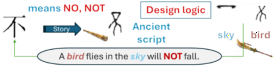
, when teaching the character 不, a teacher adopting the “speak way” approach typically will typically emphasize on the order in which the four strokes should be written. The WRITE Way approach (Figure. 1) will point out its pictorial components: the top stroke symbolizes the sky, while the three strokes below represent a bird. This visual story aligns with the meaning of negation—just as a bird cannot fall from the sky, the character represents "no" or "not”
| [7] | Xu, S.: Shuowen Jiezi, Yunnan People's Publishing House (2019). |
[7]
. By learning the visual and historical significance of characters, students can better grasp their meanings and recall them more effectively.
The WRITE Way approach draws heavily on the scholarly traditions of ancient Chinese linguistics, particularly the work of Xu Shen in his
Shuowen Jiezi (说文解字), an early dictionary that categorizes over 9,000 characters and explains their meanings based on ancient forms and pictorial elements (Xu, 2019). Xu Shen’s work laid the foundation for understanding characters through two key tools: the "knife," which divides characters into meaningful components; and the "lens," which looks back at the ancient forms of characters to reveal their original meanings
| [8] | Tse, S. K., Marton, F., Ki, W. W., Loh, E, An integrative perceptual approach for teaching Chinese characters. Instructional Science 2007; 35(5): 375-406. |
[8]
.
Figure 1. Modeling Design Logic in the WRITE Way Approach.
1.2. The Proposed CharActER System
The effectiveness of using ancient scripts to demonstrate the “design logic” of why a character is formed in a certain way can be seen in the 不 episode (
Figure 1). It is not uncommon for a textbook to list such images without
telling the story behind the scenes. In addition, overusing ancient scripts will overload the student with extra information rarely used in modern contexts.
Our approach is to start with the simplified character set and annotate related knowledge at the stroke-level
| [9] | Zhao, M.Q., Chen, J. L., Digh, A.D. (2026). Codification, Annotation and Rule-Based Inferencing for CharActER: A Proposed Application for Teaching Chinese the WRITE Way. In: Arabnia, H.R., Deligiannidis, L., Amirian, S., Ghareh Mohammadi, F., Shenavarmasouleh, F. (eds) AI Revolution: Research, Ethics and Society. AIR-RES 2025. Communications in Computer and Information Science, vol 2723. Springer, Cham.
https://doi.org/10.1007/978-3-032-13056-3_42 |
[9]
when available. Indeed, in Xu’s tradition, the knife tool is reserved for
analyzing (解 or dividing) the composite characters (such as 字, which can be divided to 宀 and 子). Single-unit characters and especially radicals (such as文 and 不) are explained (说) by telling a story embedded in the Qin
seal script (as unified by the First Emperor of Qin) or the
bronze inscription style. (For more details about evolution of representative script styles, interested readers can check the chart in Appendix 1.).
With the CharActER was proposed by the authors [6, 9-10] to embed such knowledge that is limited usually to experts about ancient scripts and use GPT-like functions to teach Chinese characters by personalize and contextual storytelling. On the one hand, ER coincides with entity and relationship as used in ER modeling. Meaning as encoded in a certain character can only be understood by seeing both the strokes and radicals (i.e., entities) and the relationships among them, such as relative positions and ways they are combined. On the other hand, ER intends to be an extended-reality system, which aims to provide a personalized and immersive learning experience.
CHN123 is developed based on the CtWW methodology, which introduces the “first” 100-or-so Chinese characters based on their meaning-formation relationships in a logic order and pursues to generate simple reading and speaking contexts along the way. Each lesson has a topic (such as numbers, time units, body parts, family members) and drilling practices can be built naturally. As shown in Appendix 2, the first two lessons cover characters for numbers 1 through 10. They can be used with characters for day, month, and week to form weekly schedule forms and monthly calendars.
As described in
| [6] | Zhao, M. Q., Digh, A. Chinese the WRITE Way: An Innovative Approach to Teaching Chinese Characters Through Stories Behind the Scripts. In: INTED2025 Proceedings, Proceedings of the 19th Annual International Technology, Education and Development Conference, Valencia, Spain (2025).
https://doi.org/10.21125/inted.2025 |
[6]
, the explanation of the number words in CHN123 differs from the sequential order as used in the speak way approach: After covering 一二三, 十 (for ten) is explained with a story revealing its meaning of completeness (the number of all 10 fingers) as indicated with the horizontal and vertical strokes (encompassing east-to-west and south-to-north). Then it goes on to 五, which reuses the cross-like form to show a partial whole. Similarly, even numbers like 八, 六, and 四 use balanced, divisible stroke designs, whereas odd numbers like 七 and 九 use more asymmetric patterns.
Furthermore, this approach allows learners to develop a deeper connection with Chinese culture, as the characters themselves carry centuries of history and philosophy. The 人大天episode as to be discussed later in this paper demonstrates how these characters are used in DaoDe Jing (道德经)
.
We have introduced ways to use JSON to annotate related knowledge in
| [9] | Zhao, M.Q., Chen, J. L., Digh, A.D. (2026). Codification, Annotation and Rule-Based Inferencing for CharActER: A Proposed Application for Teaching Chinese the WRITE Way. In: Arabnia, H.R., Deligiannidis, L., Amirian, S., Ghareh Mohammadi, F., Shenavarmasouleh, F. (eds) AI Revolution: Research, Ethics and Society. AIR-RES 2025. Communications in Computer and Information Science, vol 2723. Springer, Cham.
https://doi.org/10.1007/978-3-032-13056-3_42 |
[9]
, to extend commonly used JSON databases decoding meaning and stroke information of Chinese characters. In the next section, we will briefly summarize such knowledge modeling practices and then discuss how to apply them in a prototype of the CharActER system.
2. Materials and Methods
This section will lay out the framework for a prototype of the CharActER application. We will first summarize data and knowledge models as introduced in early works. The focus will then be shifted to a proof-of-concept implementation using an expert system approach. This system will access databases of essential meaning and stroke information as well as knowledge about meaning carrying components.
In this phase, we will infuse stroke-meaning knowledge into prompts sent to an existing generative AI to generate contextual teaching materials. Later effort will be placed in including teaching strategies and psychologies to improve user experience.
2.1 Knowledge Modeling and Annotations
An open-source project
as used in our previous work
| [9] | Zhao, M.Q., Chen, J. L., Digh, A.D. (2026). Codification, Annotation and Rule-Based Inferencing for CharActER: A Proposed Application for Teaching Chinese the WRITE Way. In: Arabnia, H.R., Deligiannidis, L., Amirian, S., Ghareh Mohammadi, F., Shenavarmasouleh, F. (eds) AI Revolution: Research, Ethics and Society. AIR-RES 2025. Communications in Computer and Information Science, vol 2723. Springer, Cham.
https://doi.org/10.1007/978-3-032-13056-3_42 |
[9]
provides two datasets in JSON format. The dictionary.txt file includes facts about 9575 commonly used Chinese characters and components; and the graphics.txt file includes data that defines a specific Kai-style font for each character in the same set.
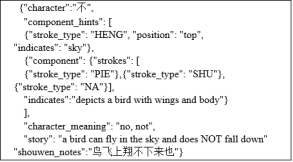
Figure 2. JSON Syntax for Stroke-Level Story Annotation.
JSON syntax for annotating graphical hints regarding an individual stroke or stroke combination can have been discussed in
| [9] | Zhao, M.Q., Chen, J. L., Digh, A.D. (2026). Codification, Annotation and Rule-Based Inferencing for CharActER: A Proposed Application for Teaching Chinese the WRITE Way. In: Arabnia, H.R., Deligiannidis, L., Amirian, S., Ghareh Mohammadi, F., Shenavarmasouleh, F. (eds) AI Revolution: Research, Ethics and Society. AIR-RES 2025. Communications in Computer and Information Science, vol 2723. Springer, Cham.
https://doi.org/10.1007/978-3-032-13056-3_42 |
[9]
. As an example, stroke-level knowledge as depicted in Figure. 1 can be embedded in JSON as shown below.
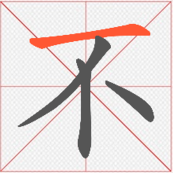
The stroke outline data can be used to visualize the form of a character. With the stroke-level annotation, corresponding strokes may be highlighted when hints are told with text-to-speech features.
2.2 An Expert System Approach
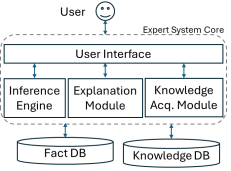
In this phase, an expert system approach is adopted in the prototype of the proposed CharActER system. It includes elements typically included in a rule-based expert system, as illustrated in
Figure 4.
Figure 3. Displaying and Highlighting Components Based on the JSON Notations.
2.2.1. Fact Database
The dictionary.txt file provided on
includes facts about 9575 commonly used Chinese characters and components, which can provide essential information like a character, its meaning in English and
pinyin. Another important attribute is decomposition style, which indicates whether the character is of single unit or composite. When applicable, it also denotes etymology information, regarding the composite type, such as picto-phonetic or associative. The etymology attribute may also include a hint value, though which is usually inaccurate or hard to be used.
The graphics.txt file includes data that defines outlines and medians (or central lines) of a specific Kai-style font with a size of 1000 by 1000 pixels. This JSON model is useful for visualizing the strokes in a character and determining stroke types. When explaining meaning indication regarding a specific component in a character, these specifics can be used to highlight the corresponding strokes in the user interface (UI) element to be described later.
Figure 4. Expert System Architecture.
2.2.2. Knowledge Database
Three types of knowledge about meaning indications can be denoted in JSON format. The first two types are related to the “knife” tool, to encode radical (more accurately, PianPang- or 偏旁) and sub-radical level “stories”. The other type is for the “lens” tool, which denotes the evolution of Chinese scripts for a specific character. Certain meaning carrying features may be more apparent in an earlier version of the writing system.
JSON models used in two test cases will be discussed in the Results section. More syntax details will be listed as appendixes.
2.2.3. Inference Engine
The rule-based inference engine will carry out tests in the order of has-entry (in the knowledge base), composite type, single-unit has sub-radical stories, need-use-lens, as well as with-modern-stories. The evolution and alternative cases may be used in addition to the decomposition rules to generate prompts to GPT used by the explanation module.
Use a relational database to manage the knowledge entries due to dynamics during the initial knowledge acquisition process.
2.2.4. Explanation Module
When interacting with a student to explain the meaning of one or a series of Chinese characters, the explanation module is responsible for infusing the annotated knowledge into a student-specific context to generate prompts to an LLM and seek for personalized “stories” as necessary
. Stories received from GPT may be stored in the knowledge database to be reused for other transactions. Even in a standard teaching scenario like explaining characters in the CHN123 lessons, it may need new prompt to ChatGPT 5 when stories need to be retold in a different language.
2.2.5. Knowledge Acquisition Module
Initially, stroke-level and radical-level knowledge entries are loaded manually. Simple forms corresponding to target JSON formats are used to fill up the knowledge points. While this process will continue in the initial trial, new mechanisms are also needed to bulk load prepared knowledge bundles or save successful explanation generated by the explanation module.
2.2.6. User Interface Layer
Will include lesson selection, displaying characters in the lessons with stroke/component highlighting and animation features.
Also included will be interfaces for loading knowledge about the characters. These could include bulk loading and individual input and editing specific characters. For proof-of-concept purposes as discussed in this paper, an editor for inputting stroke and component level annotations in JSON templates.
Examples will be given in the next section, with a focus on generating contextual prompts by infusing hints denoted in the knowledge database as well as how to use responses generated by ChatGPT to interact with students.
3. Results
In this section, we will present two test cases as proof-of-concept. Both are from preparing knowledge infused prompts to ChatGPT 5 to generate explanations of Chinese characters based on the knowledge annotations. The 不 episode as described is used as the first test case, to check feasibility of the proposed methodology. The second test case explores the ways to develop teaching materials for a lesson in the CHN123 text, which includes characters related to one another.
In these tests, we interacted with GPT 5 on openai.com. Prompts sent to and responses from GPT are discussed here, with sample JSON and response details provided in Appendixes.
3.1. The 不 Episode
As described earlier, the character 不 is generally regarded as a single-unit character and thus needs a sub-radical level JSON model to annotate stroke-level hints. JSON notation for such cases has been introduced in
| [10] | Zhao, M. Q.: “Using a Chinese Learning Application for Case Studies in OO Programming, Database Systems, and Software Engineering Courses”. In: Daimi, K., Al Sadoon, A. (eds) Proceedings of the Third International Conference on Innovations in Computing Research (ICR’24). ICR 2024. Lecture Notes in Networks and Systems, vol 1058. Springer, Cham.
https://doi.org/10.1007/978-3-031-65522-7_67 (2024). |
[10]
. It has a character attribute with the value 不, which is a unique identifier. Stroke or component-level hints are denoted with a component_hints array. Each sub-radical component may be a single stroke or includes several strokes listed in an order as denoted in graphics.txt. A JSON array will be used to organize strokes in a component, with stroke_type and optionally a location indicator tagged.
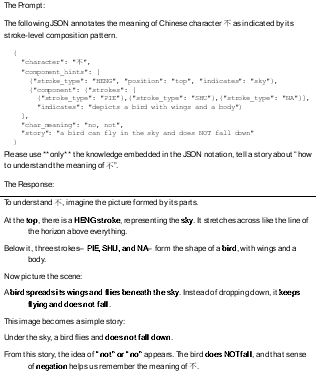
A prompt can then be prepared with the JSON model, together with instructions to GPT to use **only** the knowledge as annotated in the model to generate a story.
A sample prompt embedding the JSON knowledge notation to ChatGPT 5 is shown in Appendix 3. In the response, knowledge point as denoted are highlighted in boldface, such as “At the top, there is a HENG stroke, representing the sky”.
The response is structured in paragraphs along the line with stroke or component level hint element defined in JSON, which can be used by the Explanation Module to generate animated visuals to the student through the User Interface layer. These animation features can include with stroke(s) in the story context with colors, and text-to-speech when selected by the student.
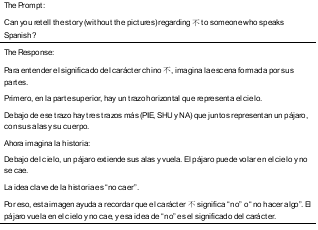
Telling the story in another language, such as Spanish, is an easy task for GPT, as shown in Appendix 4.
3.2. The 人大天 Episode
This test case focuses on generating teaching materials for related characters in a lesson from the CHN123 text. These three characters are from a lesson that teaches 人大天地, namely human or person, big or great, sky or heaven, and earth or land. Human, heaven, and earth are regarded as the three (great) assets or talents (三才 sān-cái) in Chinese cosmology. Another notion, 天人合一, or harmony of humanity and the universe is reflected in the form of the character 天 is related to 人.
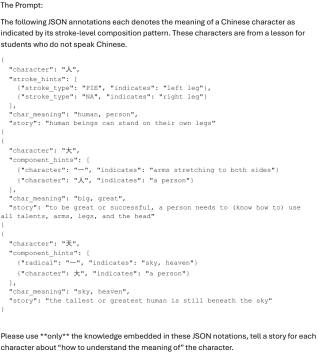
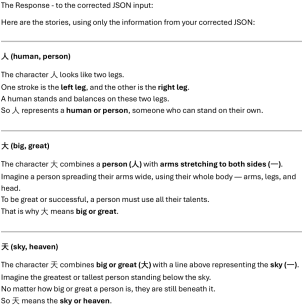
JSON notations for the three characters are listed in Appendix 5, which is infused in the prompt that requires GPT to use **only** the embedded knowledge as before. The results from GPT are to the point but seem like isolated explanations, as shown in Appendix 6.
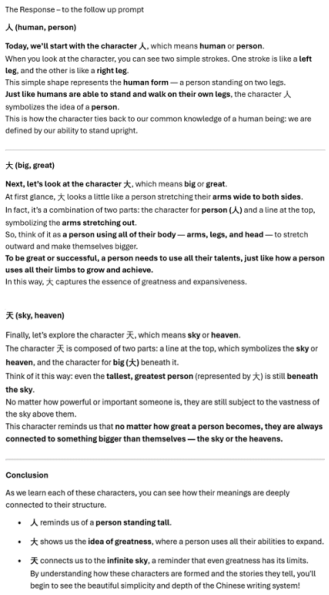
A follow-up prompt was designed to encourage the LLM to reference previously mastered characters and incorporate common sense reasoning. As illustrated in Appendix 7, this strategy resulted in significantly more cohesive pedagogical materials. By prioritizing the reuse of radicals and components in a logical sequence, the system generated a narrative that reinforces prior knowledge while introducing new concepts.
4. Discussion
A proof-of-concept for the proposed CharActER system is presented in this paper. The focus is to show the effectiveness of infusing stroke-level knowledge into an existing LLM like ChatGPT to teach Chinese the WRITE Way. Teaching episodes used so far showcase a direct mapping between strokes in the characters and the “graphical design logic” as inspired from Shuowen Jiezi. Although ancient scripts exist for all the four characters involved, and meaningful stories may be told to provide deeper insight, it is beneficial to just apply the “knife” tool to avoid overloading students with information not usually seen in modern contexts. In the UI layer, accesses to the “lens” tool stories can be provided (through a button) when applicable.
Since the current stroke structure often diverts from the ancient scripts, it is beneficial to develop stories that are in the same light as the original design logic and fit more naturally in the modern settings. Take the 不 character as an example, students may feel it is hard to see a bird figure in it but instead think it resembles an airplane. Such modern explanations may be annotated in the JSON as an “alternative_hints” attribute and labelled in the UI for interested users to select.
While results presented here are based on “manual” interactions with GPT-5 on openai.com, we have also experimented with automation using API calls. Integrating responses from GPT into user interfaces reported in
| [10] | Zhao, M. Q.: “Using a Chinese Learning Application for Case Studies in OO Programming, Database Systems, and Software Engineering Courses”. In: Daimi, K., Al Sadoon, A. (eds) Proceedings of the Third International Conference on Innovations in Computing Research (ICR’24). ICR 2024. Lecture Notes in Networks and Systems, vol 1058. Springer, Cham.
https://doi.org/10.1007/978-3-031-65522-7_67 (2024). |
[10]
are used as workshops in MQZ’s software engineering class to get students involved in this R&D endeavor. Initial comparisons reveal that responses from API calls are more concise and only include basic points as denoted in the JSON data. More prompt engineering efforts are needed to make responses more like storytelling.
To generate effective teaching materials, the system needs to be aware of the student’s background of Chinese characters. When teaching with the CHN123 text, the system can be aware of coverages of this and previous lessons. Additional modules are needed to trace student’s learning history for registered users. The CharActER system also needs to include modules for teaching strategies and psychologies to improve user experience.
5. Conclusions
In conclusion, this paper has presented a proof-of-concept implementation of the CharActER system, demonstrating how stroke-level knowledge and etymological insights can be systematically modeled and integrated with large language models to support the WRITE Way approach to Chinese character instruction. By embedding structured annotations in JSON and leveraging an expert system architecture, the proposed framework enables the generation of contextualized, story-driven explanations that align with the graphical “design logic” of characters. The test cases, including the 不 and 人大天 episodes, illustrate that combining structured knowledge with generative AI can produce coherent, engaging, and pedagogically meaningful learning materials.
The results further suggest that the WRITE Way approach completements the traditional rote-based methods by making character formation more interpretable and culturally grounded, while also allowing for personalization and multilingual delivery. At the same time, challenges remain in scaling knowledge acquisition, refining prompt engineering for richer storytelling, and incorporating learner modeling to adapt instruction dynamically. Future work will focus on expanding the knowledge base, enhancing automation through API integration, and developing user-centered modules that incorporate teaching strategies and learning psychology to improve overall effectiveness and user experience.
Abbreviations
API | Application Programming Interface |
CtWW | Chinese the WRITE Way |
ER | Entity and Relationship (as in data modeling); also, Extended Reality |
GPT | Generative Pre-trained Transformer |
JSON | JavaScript Object Notation |
LLM | Large Language Model |
UI | User Interface |
Acknowledgments
Our sincere gratitude goes to the students from MQZ’s classes, especially, Davis Guest, Maryam Koya, and Jennifer Chen—for their valuable work on related projects. An extra thank-you goes to Beth Stewart, who suggested the WRITE Way (in place of the Right Way); to Maria Cristina Petruso, who suggested ER in CharActER is also related with ER as in
ER modeling. We also appreciate Ding Gang and Pardeep Singh for their insights and discussions.
Author Contributions
Martin Qiang Zhao: Conceptualization, Formal Analysis, Project administration, Methodology, Software, Visualization, Writing – original draft, Writing – review & editing
Rajwol Chapagain: Methodology, Software, Writing – review & editing
Andy Digh: Conceptualization, Writing – original draft, Writing – review & editing
Funding
This work is not supported by any external funding.
Data Availability Statement
Data will be made available upon request to the authors.
Conflicts of Interest
The authors declare no conflicts of interest.
Appendix
1) The Evolution of the Chinese Writing System
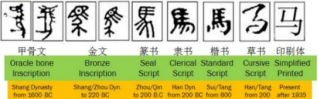
It is appropriate to use the character 马 (for horse) in the Year of Horse to demonstrate the evolution of major script styles of the Chinese writing system.
Figure 5. Evolution of the Chinese Character for "Horse" (马).
2) Characters Covered in First Six Lessons of CHN123
The introductory course includes two dozen short lessons with about 5 characters each. Components used in main characters will be explained, like 生 used in 星.
Lesson 1. 一二三
Lesson 2. 四五六七八九十
Lesson 3. 日月星期(生其)
Lesson 4. 金木水火土
Lesson 5. 东西南北中
Lesson 6. 人大天地(也)
Exercises will also be provided: such as monthly calendar and weekly schedule for the first 3 lessons. Quotes from DaoDe Jing: 25
“道大,天大,地大,人亦大” can be used to lead to deeper cultural insights with simple characters.
3) The 不 Episode – Initial Prompt and Response
Figure 6. Prompt and Response for the 不 Episode.
4) The 不 Episode – Follow-up Prompt and Response
Figure 7. Follow-up with the 不 Episode: Story in Spanish.
5) The 人大天 Episode – Initial Prompt and Response
Figure 8. Initial Prompt and Response for the 人大天 Episode.
6) The 人大天 Episode – Initial Response from GPT 5.3
Figure 9. Stories for Individual Characters Phrased in Isolation.
7) The 人大天 Episode – Follow-up Prompt and Response
Figure 10. Contextualized Stories for the Three Characters.
References
| [1] |
Wikipedia, CJK Unified Ideographs. Retrieved from
https://en.wikipedia.org/wiki/CJK_Unified_Ideographs
[Accessed May 2023]
|
| [2] |
Kuo L-J, Ku Y-M, Chen Z, Shih C-Y. Acquisition of Chinese characters: the impact of character properties and the contribution of individual differences. Applied Psycholinguistics. 2024; 45(6): 1114-1146.
https://doi.org/10.1017/S0142716424000420
|
| [3] |
Chua, N. A., Tajudddin, A., Yingsoon, G., Zaid, C. Perceived Difficulties in Learning of Mandarin Among Foreign-Language Learners and Strategies to Mitigate Them. Journal of Business and Social Development 8(2): 43-52.
https://doi.org/10.46754/jbsd.2020.09.005
|
| [4] |
Hsiang-Yu Hsiung, Yu-Lin Chang, Hsueh-Chih Chen, Yao-Ting Sung, Effect of stroke-order learning and handwriting exercises on recognizing and writing Chinese characters by Chinese as a foreign language learners, Computers in Human Behavior, 2017; 74: 303-310, ISSN 0747-5632,
https://doi.org/10.1016/j.chb.2017.04.022
|
| [5] |
Li, X., Cutting, J. (2011). Rote Learning in Chinese Culture: Reflecting Active Confucian-Based Memory Strategies. In: Jin, L., Cortazzi, M. (eds) Researching Chinese Learners. Palgrave Macmillan, London.
https://doi.org/10.1057/9780230299481_2
|
| [6] |
Zhao, M. Q., Digh, A. Chinese the WRITE Way: An Innovative Approach to Teaching Chinese Characters Through Stories Behind the Scripts. In: INTED2025 Proceedings, Proceedings of the 19th Annual International Technology, Education and Development Conference, Valencia, Spain (2025).
https://doi.org/10.21125/inted.2025
|
| [7] |
Xu, S.: Shuowen Jiezi, Yunnan People's Publishing House (2019).
|
| [8] |
Tse, S. K., Marton, F., Ki, W. W., Loh, E, An integrative perceptual approach for teaching Chinese characters. Instructional Science 2007; 35(5): 375-406.
|
| [9] |
Zhao, M.Q., Chen, J. L., Digh, A.D. (2026). Codification, Annotation and Rule-Based Inferencing for CharActER: A Proposed Application for Teaching Chinese the WRITE Way. In: Arabnia, H.R., Deligiannidis, L., Amirian, S., Ghareh Mohammadi, F., Shenavarmasouleh, F. (eds) AI Revolution: Research, Ethics and Society. AIR-RES 2025. Communications in Computer and Information Science, vol 2723. Springer, Cham.
https://doi.org/10.1007/978-3-032-13056-3_42
|
| [10] |
Zhao, M. Q.: “Using a Chinese Learning Application for Case Studies in OO Programming, Database Systems, and Software Engineering Courses”. In: Daimi, K., Al Sadoon, A. (eds) Proceedings of the Third International Conference on Innovations in Computing Research (ICR’24). ICR 2024. Lecture Notes in Networks and Systems, vol 1058. Springer, Cham.
https://doi.org/10.1007/978-3-031-65522-7_67
(2024).
|
| [11] |
DaoDe Jing (道德经, also known as Tao Teh Ching or the Book of Tao). Available from
https://ctext.org/dao-de-jing
[Accessed 26 March 2026]
|
| [12] |
Make Me a Hanzi – Free, open-source Chinese character data:
https://www.skishore.me/makemeahanzi/
[Accessed May 2, 2025].
|
| [13] |
Vasisht, K., Ganesan B., Kumar, V., Bhatnagar, V. (2024). Infusing Knowledge into Large Language Models with Contextual Prompts.
https://arxiv.org/html/2403.01481v1
|
Cite This Article
-
APA Style
Zhao, M. Q., Chapagain, R., Digh, A. (2026). Knowledge Annotation and Infusion for a Chinese Teaching AI: An Expert System Approach. International Journal of Education, Culture and Society, 11(4), 164-171. https://doi.org/10.11648/j.ijecs.20261104.16
 Copy
|
Copy
|
 Download
ACS Style
Zhao, M. Q.; Chapagain, R.; Digh, A. Knowledge Annotation and Infusion for a Chinese Teaching AI: An Expert System Approach. Int. J. Educ. Cult. Soc. 2026, 11(4), 164-171. doi: 10.11648/j.ijecs.20261104.16
Copy
|
Download
AMA Style
Zhao MQ, Chapagain R, Digh A. Knowledge Annotation and Infusion for a Chinese Teaching AI: An Expert System Approach. Int J Educ Cult Soc. 2026;11(4):164-171. doi: 10.11648/j.ijecs.20261104.16
Copy
|
Download
-
@article{10.11648/j.ijecs.20261104.16,
  author = {Martin Qiang Zhao and Rajwol Chapagain and Andy Digh},
  title = {Knowledge Annotation and Infusion for a Chinese Teaching AI: An Expert System Approach},
  journal = {International Journal of Education, Culture and Society},
  volume = {11},
  number = {4},
  pages = {164-171},
  doi = {10.11648/j.ijecs.20261104.16},
  url = {https://doi.org/10.11648/j.ijecs.20261104.16},
  eprint = {https://article.sciencepublishinggroup.com/pdf/10.11648.j.ijecs.20261104.16},
  abstract = {Chinese the WRITE Way (CtWW) is a pedagogical approach proposed by the authors to address the limitations of traditional Chinese character instruction, which primarily emphasizes repetitive stroke-order practice and rote memorization. Although such methods are effective for native Chinese-speaking children who are simultaneously developing language proficiency and literacy skills, they are often less engaging for non-heritage learners at the high school and college levels, who seek a more meaningful understanding of the writing system. As the only surviving independently invented writing system, Chinese preserves pictorial and conceptual features that reveal the original design logic of many characters, providing valuable learning cues for students accustomed to alphabetic languages. Building upon our previous work on knowledge annotation, this study investigates how structured character knowledge can be integrated with generative artificial intelligence to create personalized instructional materials. The proposed methodology represents stroke-level, radical-level, and etymological knowledge using JSON-based annotations within an expert-system architecture named CharActER. These structured knowledge representations are infused into prompts for large language models to generate contextualized, story-driven explanations that follow the Chinese the WRITE Way methodology. Two proof-of-concept case studies demonstrate the feasibility of the proposed framework, including explanations for the character 不 and a lesson involving the related characters 人、大、天. The results indicate that combining structured knowledge with generative AI produces coherent, personalized teaching materials that move beyond rote memorization, providing a scalable foundation for adaptive Chinese language instruction and demonstrating the value of integrating expert-system knowledge representation with large language models in language education.},
 year = {2026}
}
Copy
|
Download
-
TY  - JOUR
T1  - Knowledge Annotation and Infusion for a Chinese Teaching AI: An Expert System Approach
AU  - Martin Qiang Zhao
AU  - Rajwol Chapagain
AU  - Andy Digh
Y1  - 2026/08/26
PY  - 2026
N1  - https://doi.org/10.11648/j.ijecs.20261104.16
DO  - 10.11648/j.ijecs.20261104.16
T2  - International Journal of Education, Culture and Society
JF  - International Journal of Education, Culture and Society
JO  - International Journal of Education, Culture and Society
SP  - 164
EP  - 171
PB  - Science Publishing Group
SN  - 2575-3363
UR  - https://doi.org/10.11648/j.ijecs.20261104.16
AB  - Chinese the WRITE Way (CtWW) is a pedagogical approach proposed by the authors to address the limitations of traditional Chinese character instruction, which primarily emphasizes repetitive stroke-order practice and rote memorization. Although such methods are effective for native Chinese-speaking children who are simultaneously developing language proficiency and literacy skills, they are often less engaging for non-heritage learners at the high school and college levels, who seek a more meaningful understanding of the writing system. As the only surviving independently invented writing system, Chinese preserves pictorial and conceptual features that reveal the original design logic of many characters, providing valuable learning cues for students accustomed to alphabetic languages. Building upon our previous work on knowledge annotation, this study investigates how structured character knowledge can be integrated with generative artificial intelligence to create personalized instructional materials. The proposed methodology represents stroke-level, radical-level, and etymological knowledge using JSON-based annotations within an expert-system architecture named CharActER. These structured knowledge representations are infused into prompts for large language models to generate contextualized, story-driven explanations that follow the Chinese the WRITE Way methodology. Two proof-of-concept case studies demonstrate the feasibility of the proposed framework, including explanations for the character 不 and a lesson involving the related characters 人、大、天. The results indicate that combining structured knowledge with generative AI produces coherent, personalized teaching materials that move beyond rote memorization, providing a scalable foundation for adaptive Chinese language instruction and demonstrating the value of integrating expert-system knowledge representation with large language models in language education.
VL  - 11
IS  - 4
ER  -
Copy
|
Download




 Share This Article
 Twitter
 Linked In
 Facebook