Abstract
The Lake Victoria Basin is increasingly exposed to climate variability, environmental damage, and persistent food insecurity, all of which undermine families' and communities' resilience. Despite these interconnected challenges, most adaptation efforts remain fragmented, addressing food, water, and energy systems. This study assesses the efficacy of integrated Food–Water–Energy (FWE) adaptation bundles in enhancing resilience relative to single-sector interventions. The study uses a two-stage sampling framework to conduct cross-sectional research. Primary data were collected from 423 households across the basin, while secondary data were obtained from regional and international sources. Descriptive statistics, correlation analysis, and binary logistic regression are some of the analytical methods used to examine the link between adopting the FWE bundle and household resilience. A composite resilience index was constructed to measure food security, water reliability, energy access, and adaptive capacity. The results show that households adopting integrated FWE bundles are much more resilient, with an average score of 0.68 compared to 0.44 for non-adopters. Correlation analysis indicates that resilience is strongly linked to having access to irrigation (r = 0.61), using renewable energy (r = 0.58), and livelihood diversification (r = 0.64). Logistic regression results further demonstrate that using integrated bundles increases the likelihood of resilience by approximately 2.7 times (p < 0.01), even when socioeconomic and institutional factors are taken into account. The study concludes that nexus-based adaptation strategies are more effective than fragmented approaches at making climate-sensitive basin systems more resilient. It highlights the significance of integrated, household-focused interventions that simultaneously address food, water, and energy limitations as a vital strategy for sustainable adaptation in vulnerable areas.
Keywords
Climate Variability, Food–Water–Energy (FWE) Adaptation, Household Resilience, Livelihood Diversification,
Nexus-based Adaptation
1. Background
One of the most socially and ecologically important areas of Africa, the Lake Victoria Basin supports millions of people who rely on fisheries, rain-fed agriculture, livestock rearing, trade, and domestic water consumption
| [7] | Kertolli, E., Prosperi, P., Harbouze, R., Moussadek, R., Echchgadda, G., & Belhouchette, H. (2024). The water–energy–food–ecosystem nexus in North Africa dryland farming: a multi-criteria analysis of climate-resilient innovations in Morocco. Agricultural and Food Economics, 12(1), 34.
https://doi.org/10.1186/s40100-024-00327-5 |
[7]
. Nevertheless, climate variability, environmental degradation, high population growth, and poor infrastructure are pressing the basin, and these factors combine to increase household vulnerability and reduce adaptive capacity
| [9] | Nyamweya, C., Lawrence, T. J., Ajode, M. Z., Smith, S., Achieng, A. O., Barasa, J. E.,... & Nkalubo, W. (2023). Lake Victoria: Overview of research needs and the way forward. Journal of Great Lakes Research, 49(6), 102211.
https://doi.org/10.1016/j.jglr.2023.06.009 |
[9]
. The literature available in the basin demonstrates how livelihoods are conditioned by compounded exposures to drought, flooding, deteriorating ecosystem quality, and economic stress, as well as the problematic implementation of partial, short-term, and poorly coordinated cross-sectoral responses
| [14] | United Nations Environment Programme. (2024). Ecosystem-based adaptation in Lake Victoria. UNEP. |
[14]
.
A central gap in the literature is that, although the Food-Water-Energy nexus has been conceptually discussed in Africa, very few studies have experimented with the efficacy of integrated adaptation bundles at the household level in tangible terms of resilience, specifically in the LVB context
| [1] | Botai, J. O., Botai, C. M., Ncongwane, K. P., Mpandeli, S., Nhamo, L., Masinde, M.,... & Mabhaudhi, T. (2021). A review of the water–energy–food nexus research in Africa. Sustainability, 13(4), 1762. https://doi.org/10.3390/su13041762 |
[1]
. The article fills that gap by exploring whether integrated interventions across food production, water access, and energy use are more effective than individual interventions in enhancing household and community resilience. The primary goal is then to evaluate the efficiency of integrated FWE adaptation packages as a viable resilience-establishing measure in the Lake Victoria Basin.
2. Theoretical Framework
2.1. Social-ecological Resilience Theory
The first theory underpinning the article is social-ecological resilience theory, which views resilience as the ability of a system to absorb disequilibrium, restructure, and maintain its core functions, structure, and identity under stress. This viewpoint has particular value in the context of livelihood studies, since climate-related shocks rarely affect households through a single channel
| [8] | Mutanga, S. S., Mantlana, B. K., Mudavanhu, S., Muthige, M. S., Skhosana, F. V., Lumsden, T.,... & John, J. (2024). Implementation of water energy food-health nexus in a climate constrained world: a review for South Africa. Frontiers in Environmental Science, 12, 1307972.
https://doi.org/10.3389/fenvs.2024.1307972 |
[8]
. Rather, droughts, floods, declining fish stocks, crop losses, erratic input prices, and poor water quality interact as interrelated disturbances within a more inclusive social-ecological context. According to Speranza, livelihood resilience should be understood not only as material resources but also as three interconnected aspects: buffer capacity, self-organization, and learning capacity
| [13] | Speranza, C. I., Wiesmann, U., & Rist, S. (2014). An indicator framework for assessing livelihood resilience in the context of social–ecological dynamics. Global environmental change, 28, 109–119. https://doi.org/10.1016/j.gloenvcha.2014.06.005 |
[13]
. The formulation is particularly pertinent in the Lake Victoria Basin, where households must continuously adapt to both ecological and socio-economic pressures, rather than incidents. Similarly, local empirical evidence has demonstrated that the basin has experienced vulnerability due to exposure, sensitivity, and adaptive capacity, underscoring the need for a clearly systemic resilience lens
| [3] | Gabrielsson, S., Brogaard, S., & Jerneck, A. (2012). Living Without Buffers—illustrating Climate Vulnerability in the Lake Victoria Basin. Sustainability Science, 8(2), 143–157.
https://doi.org/10.1007/s11625-012-0191-3 |
[3]
.
2.2. Sustainable Livelihoods Thinking
The second foundation of the framework is the sustainable livelihoods approach, which puts households, assets, and agency at the center of the model of adaptation analysis. Instead of viewing resilience as an ecological characteristic or a result of the intervention, the livelihoods perspective describes resilience in terms of access to human, natural, physical, financial, and social capital
| [11] | Simpson, G. B., Jewitt, G. P., Mabhaudhi, T., Taguta, C., & Badenhorst, J. (2023). An African perspective on the water-energy-food nexus. Scientific Reports, 13(1), 16842.
https://doi.org/10.1038/s41598-023-43606-9 |
[11]
. This is significant because, even in situations where similar climatic shocks occur, households may differ significantly in terms of land access, education, infrastructure, credit, extension support, and social networks. One continuation of this tradition is the Household Livelihood Resilience Approach (HLRA) by Quandt, who argues that resilience should be measured at the household level and assessed using both objective and subjective measures, while accounting for power, agency, and disparities in access to assets
. Another key point made by the HLRA is that resilience measurement should not focus solely on output measures to determine whether households have viable ways to mitigate shocks, restructure, and cope over time. This view is useful for understanding why the concept of resilience is not uniform even within the same community and why institutional access is as significant as biophysical exposure
.
2.3. Food-Water-Energy Nexus and Adaptation Bundles
Food-Water-Energy (FWE) nexus analysis is the third pillar of the framework, explaining livelihoods as dependent on interdependent resource systems. Crop production and some energy production require water; energy sustains irrigation, pumping, processing, and storage; and food systems affect both water and energy demand
. Due to the close relationship between these sectors, unilateral actions can lead to trade-offs or the transfer of susceptibility rather than mitigating it. According to Ioannou and Laspidou, resilience in water-energy-food systems is associated with the ability to identify feedback loops and interactions between sectors, as well as the system-wide capacity to absorb shocks
| [6] | Ioannou, A. E., & Laspidou, C. S. (2022). Resilience Analysis Framework for a Water–Energy–Food Nexus System under Climate Change. Frontiers in Environmental Science, 10.
https://doi.org/10.3389/fenvs.2022.820125 |
[6]
. This article relies on the nexus perspective to define an adaptation bundle as a combination of irrigation, improved access to water, clean energy, water and soil conservation, climate information, and livelihood diversification at the household level. The actions are likely to create complementarities that enhance production stability, minimise constraints and risk spreading, and improve adaptive decision-making, thereby boosting household resilience
| [10] | Petty, C., Ngoleka, S., Cornforth, R., Achiro, E., Acidri, J., Ainslie, A.,... & Walker, G. (2022). Adaptation planning: an integrated approach to understanding vulnerability in the Lake Victoria Basin. Frontiers in Climate, 3, 782534.
https://doi.org/10.3389/fclim.2021.782534 |
[10]
.
3. Methodology
3.1. Design and Sampling
The article utilised the empirical cross-sectional design that relied on primary and secondary data. Primary data were obtained from a household survey in the Lake Victoria Basin. In contrast, secondary data were obtained from regional and international sources, such as the IPCC and the World Bank, to provide background and supplementary information. The analytical household-level dataset included 423 observations and showed differences across rural communities in Kenya, Uganda, and Tanzania in climate exposure, education, landholding, access to extension services, climate information, savings participation, and Food-Water-Energy (FWE) adaptation behaviour
| [4] | Hofmann, V. S., Egieya, J. M., Parker, Y., Gorgens, J., & Goosen, N. J. (2024). Impact of resilience policies on cape town's water-food nexus: A system dynamics approach. Bulletin of the National Research Centre, 48(1), 102.
https://doi.org/10.1186/s42269-024-01255-6 |
[4]
. The two-stage sampling procedure was used. First, 18 community clusters were selected from nine districts, and second, households were assigned to clusters to facilitate multivariate and comparative analysis across basins. Such a method aligns with traditional practice in geographically dispersed household research.
3.2. Data Integrity and Reproducibility
To enhance methodological integrity, variable construction, index development, and model specification were predefined. A composite index of food security, water reliability, energy security, and indicators of adaptive capacity was used to measure household resilience, which was then dichotomized to allow regression analysis. The composite resilience index (RI) formula is as follows:
Where:
1) Food security score
2) Water reliability score
3) Energy security score
4) Adaptive capacity score
5) Weights assigned to each indicator based on their relative importance (normalised to sum to 1)
This composite resilience index was then transformed into a binary variable for the regression model, with houses having index values exceeding a predetermined threshold considered resilient (1) and those with index values below it considered non-resilient (0). Previous standards in the resilience literature and context-driven data guided the predetermined thresholds.
3.3. Data Analysis
The analysis was done in four phases. First, descriptive statistics summarised the patterns of adapting to household characteristics. Second, a bivariate correlation analysis was conducted to examine the relationship between resilience and the explanatory variables. Third, the means of the resilience scores were compared across FWE bundle-intensity categories. Lastly, binary logistic regression was used to estimate the likelihood of household resilience, with household size, landholding, shock exposure, extension access, climate information, social capital, savings membership, market distance, and country fixed effects as key controls, along with bundle intensity.
4. Results
4.1. Descriptive Profile of the Sample
The descriptive statistics of the household data collected are shown in
Table 1. The average household resilience index was 49.1, and 47.3% of households were found to be resilient according to the article's threshold.
Table 1. Descriptive statistics (n = 423).
Variable | Mean/Prop. | Std. Dev. | Min | Max | N |
Resilience index | 49.14 | 17.10 | 0.0 | 100.0 | 423 |
Bundle score | 2.69 | 1.08 | 0.0 | 5.0 | 423 |
Education (years) | 8.37 | 3.60 | 0.0 | 17.0 | 423 |
Household size | 6.20 | 2.33 | 2.0 | 12.0 | 423 |
Land owned (ha) | 1.85 | 1.16 | 0.3 | 8.5 | 423 |
Shock count | 1.98 | 1.41 | 0.0 | 5.0 | 423 |
Distance to market (km) | 6.92 | 3.79 | 0.5 | 18.9 | 423 |
Resilient households (%) | 47.28 | NaN | NaN | NaN | 423 |
The mean household had 2.69 FWE adaptation practices, indicating moderate adoption of the integrated strategies within the sample. The socioeconomic portrait also indicates the situation characteristic of rural regions in Lake Victoria Basin: the mean education level was 8.4 years, the household size was 6.2 persons, and the landholding was 1.85 hectares. The number of recent climate-related shocks reported by households was 1.98, indicating that exposure to frequent environmental stress was a significant component of the article's setting.
Table 1 also indicates that livelihood diversification (68.3%), adoption of clean energy (57.7%), and soil and water conservation (54.4%) were the most prevalent practices of individuals.
4.2. Bundle Intensity and Resilience Outcomes
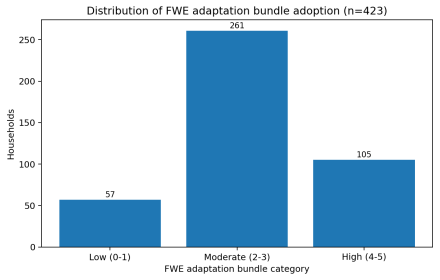
Figure 1 shows the distribution of households across the adaptation bundle categories. A majority of households were found in the moderate bundle category (n = 261), followed by the high bundle category (n = 105), and lastly the low bundle category (n = 57). This tendency indicates that the relative frequency of partial integration of adaptation practices was higher than in cases of minimal and highly comprehensive adoption.
Figure 1. Distribution of FWE adaptation bundle adoption.
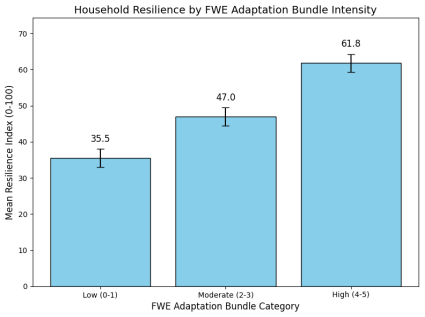
Significant variability in resilience results occurred within these groups regarding bundle intensity. Low-bundle households had a mean resilience of only 35.5, compared with 47.0 among moderate adopters and 61.8 among high adopters. The same gradient is observed in the percentage of households labelled resilient, with 14.0% in the low-bundle category, a sharp jump to 41.4% in the moderate adopters, and 80.0% in the high adopters group. Combined, these findings suggest that the improvements in resilience were not due to incremental gains, but to larger improvements in households with a more integrated adaptation bundle.
Figure 2. Mean resilience index by bundle category with 95% confidence intervals.
Results show a strong positive association between the intensity of the integrated FWE bundle and household resilience. As shown in
Figure 2, mean resilience steadily increased from 35.5 in low-bundle households to 47.0 and 61.8 in moderate and high adopters, respectively. This strong gradient indicates that resilience benefits increase significantly as a household shifts isolated practices toward more holistic, integrated adaptation packages.
4.3. Correlation Structure
Table 2. Correlation matrix.
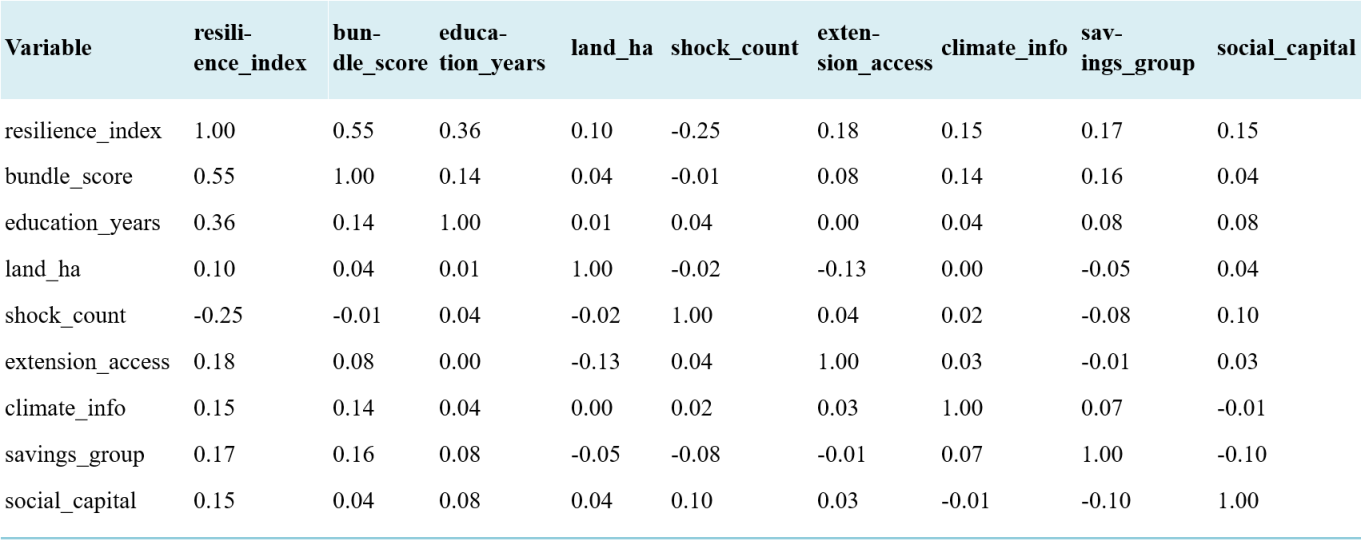
Table 2 presents the correlation table and provides further evidence of these connections. There was a positive relationship between bundle score and household resilience (r = 0.55), education (r = 0.36), access to extension (r = 0.18), climate information (r = 0.15), savings participation (r = 0.17), and social capital (r = 0.15). Shock exposure, on the other hand, was negatively correlated to resilience (r = -0.25). The moderate size of these coefficients indicates that resilience is determined by multiple positive factors rather than a single strong predictor, and that multicollinearity among the predictors is not very strong.
4.4. Multivariate Effects of FWE Bundles
Table 3 below shows that integrated adaptation occupies center stage in the logistic regression.
Table 3. Logistic regression output (dependent variable: resilient household).
Variable | Coef. | Std. Err. | z | P>|z| | [95% Conf. Interval] | Odds Ratio |
Tanzania (vs Kenya) | -0.146 | 0.300 | -0.49 | 0.627 | -0.734 to 0.442 | 0.864 |
Uganda (vs Kenya) | 0.006 | 0.301 | 0.02 | 0.984 | -0.584 to 0.597 | 1.006 |
Bundle score | 1.170 | 0.142 | 8.22 | 0.000 | 0.891 to 1.449 | 3.221 |
Education years | 0.208 | 0.038 | 5.46 | 0.000 | 0.133 to 0.282 | 1.231 |
Household size | -0.023 | 0.052 | -0.44 | 0.659 | -0.126 to 0.080 | 0.977 |
Land (ha) | 0.186 | 0.107 | 1.74 | 0.083 | -0.024 to 0.396 | 1.205 |
Shock count | -0.364 | 0.092 | -3.94 | 0.000 | -0.545 to -0.183 | 0.695 |
Extension access | 0.827 | 0.253 | 3.27 | 0.001 | 0.331 to 1.322 | 2.286 |
Climate information | 0.311 | 0.252 | 1.24 | 0.216 | -0.182 to 0.805 | 1.365 |
Savings group | 0.448 | 0.252 | 1.78 | 0.076 | -0.047 to 0.942 | 1.565 |
Social capital | 0.475 | 0.165 | 2.88 | 0.004 | 0.152 to 0.798 | 1.608 |
Distance to market (km) | -0.065 | 0.032 | -2.03 | 0.043 | -0.129 to -0.002 | 0.937 |
After adjusting for household and locational factors, any additional FWE practice increased the risk of household resilience by a factor of 3.22 (p <.001). There was also a positive relationship between resilience and education (OR = 1.23, p <.001), and access to extensions (OR = 2.29, p <.01) and social capital (OR = 1.61, p <.01). In comparison, the effect of each new climate shock was to lower the probability of resilience (OR = 0.69, p <.001). In contrast, higher market distance had a small negative effect (OR = 0.94, p <.05). The country effects were minor and statistically significant. They indicated that household capabilities and institutional access showed greater variation in resilience than national location. On the whole, the findings support the thesis that FWE adaptation bundles with integrated interventions are closely linked to increased household resilience in the Lake Victoria Basin.
5. Discussion
The findings show that integrated Food–Water-Energy (FWE) bundles offer a better solution to resilience deficits in the Lake Victoria Basin compared to other interventions, which are only single sectors. The central issue this article touches on is that the risks households in the basin face intersect: climate shocks, unreliable water access, energy availability, and livelihood security, and that adaptation is most often implemented separately. This mismatch is evident not only in the findings but also aligns with broader evidence of collective shortages in water, sanitation, and adaptive services, rather than isolated limitations on vulnerable rural households
| [15] | World Health Organisation. (2025). Progress on household drinking water, sanitation, and hygiene 2000-2024: special focus on inequalities. World Health Organisation. |
[15]
.
Table 1 shows that the mean resilience index was 49.1 and that resilience was only 47.3% of households, indicating that resilience remains low despite the average household adopting 2.69 adaptation practices.
The clearest indication is the distinct gradient in bundle-intensity categories.
Figure 2 indicates that mean resilience increased with the level of bundle adoption, from 35.5 to 47.0 among low-adopting households to 61.8 among moderate and high adopters. Similarly, the percentage of resilient households increased dramatically from 14.0% with the low bundle to 41.4% and 80.0% with the high bundle, respectively. These findings indicate that the benefits of resilience are non-marginal; that is, households gain the most when adaptation measures are integrated in ways that reduce food production, improve water security, and increase energy availability. This definition aligns with IPCC findings, supporting the idea that disparities in access to home water and the conditions of climate-sensitive services only aggravate vulnerability and are not addressed by coordinated system approaches
| [5] | Intergovernmental Panel on Climate Change. (2022). Climate change 2022: Impacts, adaptation and vulnerability. Working Group II contribution to the Sixth Assessment Report of the Intergovernmental Panel on Climate Change. Cambridge University Press. |
[5]
.
The correlation and regression results support this.
Table 2 indicates that resilience was positively correlated with bundle score (r = 0.55), education (r = 0.36), extension access (r = 0.18), and social capital (r = 0.15), whereas shock exposure was negatively correlated with resilience (r = -0.25).
Table 3 further establishes that each additional practice of FWE was associated with a resiliency odds ratio of 3.22, whereas education, access to extensions, and social capital had a significant positive impact. In general, the discussion implies that resilience issues in the basin cannot be solved without technologies, but with more powerful institutions, information systems, and coordinated cross-sector adaptation policies.
6. Conclusion
As this article shows, integrated Food-Water-Energy (FWE) adaptation bundles are closely associated with enhanced household resilience in the Lake Victoria Basin. Households with more integrated bundles always fared better than those with individual measures, and the average resilience increased to 61.8 in the high-bundle group compared to 35.5 in the low-bundle group. The logistic regression also revealed that each successive practice of adaptation significantly increased resilience, even after adjusting for education, shocks, market distance, and institutional factors. The results indicate that resilience cannot be enhanced by individual interventions, but rather by the interrelation of measures addressing food production, water security, energy availability, and adaptive capacity. In sum, the article contributes by providing evidence to the claim that nexus-based, household-centered adaptation is a better mechanism of enhancing resilience in climate-prone and vulnerable basin systems.
7. Policy and Practical Implications
1) Promote integrated adaptation packages: The policy should emphasize integrated interventions that incorporate irrigation, clean energy, water access, soil conservation, and livelihood diversification. Interlocked vulnerabilities must be addressed through bundled services to households, not sectoral interventions.
2) Pro-poor target mechanisms: Due to the huge contribution of education, extension access, and social capital to resilience, the policy must have the targeted provision of subsidized clean energy technologies, microcredit, and pay-as-you-go models to marginalized households, which lowers the financial threshold to adaptation.
3) Enhance institutional support for cross-sector coordination: Decentralise local advisory services, climate information systems, and community organisations in order to enable the uptake of integrated bundles. This demands enhanced integration across the sector at the basin level, including local governments and development partners.
4) Monitor resilience using nexus-aware metrics: Design and establish new monitoring systems that simultaneously measure food, water, and energy access to determine how the monitoring systems respond to climate shocks in order to guarantee sustainable resilience.
Abbreviations
FWE | Food–Water–Energy |
LVB | Lake Victoria Basin |
HLRA | Household Livelihood Resilience Approach |
RI | Resilience Index |
FS | Food Security |
WR | Water Reliability |
ES | Energy Security |
AC | Adaptive Capacity |
IPCC | Intergovernmental Panel on Climate Change |
UNEP | United Nations Environment Programme |
Author Contributions
Ibrahim Suleiman Roba: Conceptualization, Methodology, Supervision, Validation, Resources
Maxwell Muthini Kyalo: Data curation, Formal Analysis, Investigation, Writing – original draft, Visualization
Conflicts of Interest
The authors declare no conflicts of interest.
References
| [1] |
Botai, J. O., Botai, C. M., Ncongwane, K. P., Mpandeli, S., Nhamo, L., Masinde, M.,... & Mabhaudhi, T. (2021). A review of the water–energy–food nexus research in Africa. Sustainability, 13(4), 1762.
https://doi.org/10.3390/su13041762
|
| [2] |
Dhar, A. R. (2025). Building climate-resilient food systems through the water–energy–food–environment nexus. Environments, 12(5), 167.
https://doi.org/10.3390/environments12050167
|
| [3] |
Gabrielsson, S., Brogaard, S., & Jerneck, A. (2012). Living Without Buffers—illustrating Climate Vulnerability in the Lake Victoria Basin. Sustainability Science, 8(2), 143–157.
https://doi.org/10.1007/s11625-012-0191-3
|
| [4] |
Hofmann, V. S., Egieya, J. M., Parker, Y., Gorgens, J., & Goosen, N. J. (2024). Impact of resilience policies on cape town's water-food nexus: A system dynamics approach. Bulletin of the National Research Centre, 48(1), 102.
https://doi.org/10.1186/s42269-024-01255-6
|
| [5] |
Intergovernmental Panel on Climate Change. (2022). Climate change 2022: Impacts, adaptation and vulnerability. Working Group II contribution to the Sixth Assessment Report of the Intergovernmental Panel on Climate Change. Cambridge University Press.
|
| [6] |
Ioannou, A. E., & Laspidou, C. S. (2022). Resilience Analysis Framework for a Water–Energy–Food Nexus System under Climate Change. Frontiers in Environmental Science, 10.
https://doi.org/10.3389/fenvs.2022.820125
|
| [7] |
Kertolli, E., Prosperi, P., Harbouze, R., Moussadek, R., Echchgadda, G., & Belhouchette, H. (2024). The water–energy–food–ecosystem nexus in North Africa dryland farming: a multi-criteria analysis of climate-resilient innovations in Morocco. Agricultural and Food Economics, 12(1), 34.
https://doi.org/10.1186/s40100-024-00327-5
|
| [8] |
Mutanga, S. S., Mantlana, B. K., Mudavanhu, S., Muthige, M. S., Skhosana, F. V., Lumsden, T.,... & John, J. (2024). Implementation of water energy food-health nexus in a climate constrained world: a review for South Africa. Frontiers in Environmental Science, 12, 1307972.
https://doi.org/10.3389/fenvs.2024.1307972
|
| [9] |
Nyamweya, C., Lawrence, T. J., Ajode, M. Z., Smith, S., Achieng, A. O., Barasa, J. E.,... & Nkalubo, W. (2023). Lake Victoria: Overview of research needs and the way forward. Journal of Great Lakes Research, 49(6), 102211.
https://doi.org/10.1016/j.jglr.2023.06.009
|
| [10] |
Petty, C., Ngoleka, S., Cornforth, R., Achiro, E., Acidri, J., Ainslie, A.,... & Walker, G. (2022). Adaptation planning: an integrated approach to understanding vulnerability in the Lake Victoria Basin. Frontiers in Climate, 3, 782534.
https://doi.org/10.3389/fclim.2021.782534
|
| [11] |
Simpson, G. B., Jewitt, G. P., Mabhaudhi, T., Taguta, C., & Badenhorst, J. (2023). An African perspective on the water-energy-food nexus. Scientific Reports, 13(1), 16842.
https://doi.org/10.1038/s41598-023-43606-9
|
| [12] |
Quandt, A. (2018). Measuring livelihood resilience: The household livelihood resilience approach (HLRA). World Development, 107, 253–263.
https://doi.org/10.1016/j.worlddev.2018.02.024
|
| [13] |
Speranza, C. I., Wiesmann, U., & Rist, S. (2014). An indicator framework for assessing livelihood resilience in the context of social–ecological dynamics. Global environmental change, 28, 109–119.
https://doi.org/10.1016/j.gloenvcha.2014.06.005
|
| [14] |
United Nations Environment Programme. (2024). Ecosystem-based adaptation in Lake Victoria. UNEP.
|
| [15] |
World Health Organisation. (2025). Progress on household drinking water, sanitation, and hygiene 2000-2024: special focus on inequalities. World Health Organisation.
|
Cite This Article
-
APA Style
Roba, I. S., Kyalo, M. M. (2026). Effectiveness of Integrated Food–Water–Energy (FWE) Adaptation Bunles on Household and Community Resilience in the Lake Victoria Basin. International Journal of Education, Culture and Society, 11(2), 79-86. https://doi.org/10.11648/j.ijecs.20261102.17
 Copy
|
Copy
|
 Download
ACS Style
Roba, I. S.; Kyalo, M. M. Effectiveness of Integrated Food–Water–Energy (FWE) Adaptation Bunles on Household and Community Resilience in the Lake Victoria Basin. Int. J. Educ. Cult. Soc. 2026, 11(2), 79-86. doi: 10.11648/j.ijecs.20261102.17
Copy
|
Download
AMA Style
Roba IS, Kyalo MM. Effectiveness of Integrated Food–Water–Energy (FWE) Adaptation Bunles on Household and Community Resilience in the Lake Victoria Basin. Int J Educ Cult Soc. 2026;11(2):79-86. doi: 10.11648/j.ijecs.20261102.17
Copy
|
Download
-
@article{10.11648/j.ijecs.20261102.17,
  author = {Ibrahim Suleiman Roba and Maxwell Muthini Kyalo},
  title = {Effectiveness of Integrated Food–Water–Energy (FWE) Adaptation Bunles on Household and Community Resilience in the Lake Victoria Basin},
  journal = {International Journal of Education, Culture and Society},
  volume = {11},
  number = {2},
  pages = {79-86},
  doi = {10.11648/j.ijecs.20261102.17},
  url = {https://doi.org/10.11648/j.ijecs.20261102.17},
  eprint = {https://article.sciencepublishinggroup.com/pdf/10.11648.j.ijecs.20261102.17},
  abstract = {The Lake Victoria Basin is increasingly exposed to climate variability, environmental damage, and persistent food insecurity, all of which undermine families' and communities' resilience. Despite these interconnected challenges, most adaptation efforts remain fragmented, addressing food, water, and energy systems. This study assesses the efficacy of integrated Food–Water–Energy (FWE) adaptation bundles in enhancing resilience relative to single-sector interventions. The study uses a two-stage sampling framework to conduct cross-sectional research. Primary data were collected from 423 households across the basin, while secondary data were obtained from regional and international sources. Descriptive statistics, correlation analysis, and binary logistic regression are some of the analytical methods used to examine the link between adopting the FWE bundle and household resilience. A composite resilience index was constructed to measure food security, water reliability, energy access, and adaptive capacity. The results show that households adopting integrated FWE bundles are much more resilient, with an average score of 0.68 compared to 0.44 for non-adopters. Correlation analysis indicates that resilience is strongly linked to having access to irrigation (r = 0.61), using renewable energy (r = 0.58), and livelihood diversification (r = 0.64). Logistic regression results further demonstrate that using integrated bundles increases the likelihood of resilience by approximately 2.7 times (p < 0.01), even when socioeconomic and institutional factors are taken into account. The study concludes that nexus-based adaptation strategies are more effective than fragmented approaches at making climate-sensitive basin systems more resilient. It highlights the significance of integrated, household-focused interventions that simultaneously address food, water, and energy limitations as a vital strategy for sustainable adaptation in vulnerable areas.},
 year = {2026}
}
Copy
|
Download
-
TY  - JOUR
T1  - Effectiveness of Integrated Food–Water–Energy (FWE) Adaptation Bunles on Household and Community Resilience in the Lake Victoria Basin
AU  - Ibrahim Suleiman Roba
AU  - Maxwell Muthini Kyalo
Y1  - 2026/04/23
PY  - 2026
N1  - https://doi.org/10.11648/j.ijecs.20261102.17
DO  - 10.11648/j.ijecs.20261102.17
T2  - International Journal of Education, Culture and Society
JF  - International Journal of Education, Culture and Society
JO  - International Journal of Education, Culture and Society
SP  - 79
EP  - 86
PB  - Science Publishing Group
SN  - 2575-3363
UR  - https://doi.org/10.11648/j.ijecs.20261102.17
AB  - The Lake Victoria Basin is increasingly exposed to climate variability, environmental damage, and persistent food insecurity, all of which undermine families' and communities' resilience. Despite these interconnected challenges, most adaptation efforts remain fragmented, addressing food, water, and energy systems. This study assesses the efficacy of integrated Food–Water–Energy (FWE) adaptation bundles in enhancing resilience relative to single-sector interventions. The study uses a two-stage sampling framework to conduct cross-sectional research. Primary data were collected from 423 households across the basin, while secondary data were obtained from regional and international sources. Descriptive statistics, correlation analysis, and binary logistic regression are some of the analytical methods used to examine the link between adopting the FWE bundle and household resilience. A composite resilience index was constructed to measure food security, water reliability, energy access, and adaptive capacity. The results show that households adopting integrated FWE bundles are much more resilient, with an average score of 0.68 compared to 0.44 for non-adopters. Correlation analysis indicates that resilience is strongly linked to having access to irrigation (r = 0.61), using renewable energy (r = 0.58), and livelihood diversification (r = 0.64). Logistic regression results further demonstrate that using integrated bundles increases the likelihood of resilience by approximately 2.7 times (p < 0.01), even when socioeconomic and institutional factors are taken into account. The study concludes that nexus-based adaptation strategies are more effective than fragmented approaches at making climate-sensitive basin systems more resilient. It highlights the significance of integrated, household-focused interventions that simultaneously address food, water, and energy limitations as a vital strategy for sustainable adaptation in vulnerable areas.
VL  - 11
IS  - 2
ER  -
Copy
|
Download





 Share This Article
 Twitter
 Linked In
 Facebook