Research Article | | Peer-Reviewed

A Cross-sectional Survey of Urological Emergency Management by General Practitioners, with a Focus on Acute Scrotal Pain and Testicular Torsion in Chad

Received: 11 December 2025     Accepted: 13 January 2026     Published: 12 May 2026
Views:       Downloads:
Abstract

Urological emergencies account for a significant proportion of medical consultations, with acute scrotal pain and testicular torsion being common and high-risk causes. Rapid treatment is essential to preserve testicular function. In Chad, general practitioners are the first point of contact, but their practices had never been studied. Methods: A descriptive, cross-sectional study was conducted in July 2025 among 136 general practitioners in Chad working in public and mixed, urban and rural settings. Participants completed an online questionnaire on urological emergencies, their management, and complications. The analysis was performed using Excel and presented in proportions and absolute values. A total of 136 general practitioners participated in the survey, the majority of whom were men (87.5%) aged 28 to 44. More than half had been practicing for less than five years, and the majority worked in public facilities (65.4%) or in urban areas (53.7%). The most frequently reported urological emergencies were acute urinary retention (79.4%), acute scrotal pain (55.9%), and renal colic (47.1%). Almost all respondents (94.1%) reported seeing young patients with sudden unilateral scrotal pain; 20.6% encountered this at least once a month. The consultation time varied, with 8.8% of patients consulting within an hour and 20.6% after 24 hours. When faced with a painful scrotum without fever, 26.5% of doctors suspected testicular torsion, while 20.6% suggested epididymitis. The majority (97.1%) had already suspected or diagnosed testicular torsion. Management was mainly based on immediate referral to a specialized center (50%), sometimes combined with the prescription of analgesics (50%) or a scrotal ultrasound (14.7%). Testicular necrosis was the most feared complication (94.1%). No physician performed exploratory scrototomy. Chadian general practitioners recognize testicular torsion but have limited surgical skills and face prolonged delays in consultation, increasing the risk of testicular loss. Enhanced training, the development of standardized protocols, clinical simulation, and improved access to specialized centers are essential to optimize care and reduce morbidity.

Published in International Journal of Clinical Urology (Volume 10, Issue 1)
DOI 10.11648/j.ijcu.20261001.25
Page(s) 85-91
Creative Commons

This is an Open Access article, distributed under the terms of the Creative Commons Attribution 4.0 International License (http://creativecommons.org/licenses/by/4.0/), which permits unrestricted use, distribution and reproduction in any medium or format, provided the original work is properly cited.

Copyright

Copyright © The Author(s), 2026. Published by Science Publishing Group

Keywords

Urological Emergencies, Acute Scrotal Pain, Testicular Torsion, General Practitioners, Emergency Management, Chad

1. Introduction
Urological emergencies remain an important aspect of daily clinical practice and account for up to 27% of all urological admissions in tertiary care facilities . They encompass a wide spectrum of conditions that can lead to significant morbidity and mortality . They are highly variable in nature (traumatic, infectious, obstructive, ischemic, and hemorrhagic) . The epidemiological profile differs depending on the region of the world or country ). Regardless of the region of the world, acute scrotal pain is a common reason for visiting the urological emergency department . It poses a diagnostic challenge that must be carefully evaluated using a complete medical history and physical examination . This is because it represents a wide range of diagnoses . In cases of acute scrotal pain suggestive of testicular torsion, rapid surgical intervention is required to prevent loss of testicular function . The onset of acute scrotal pain poses several problems when it occurs in a young man in certain contexts in Africa . A review of 23 articles on testicular torsion reports that the average time to consultation in sub-Saharan Africa is more than 52 hours, with an orchidectomy rate of around 46.4%. The conclusion of this review recommends raising awareness and training healthcare providers . To date, no specific study has been conducted on this subject in Chad. In an article on the epidemiology of urological emergencies conducted in a pediatric referral hospital and including 193 patients, 12 exploratory scrototomies were performed (6.2%), with one case of orchidectomy and one orchidopexy in another .
In Chad, the healthcare pyramid places general practitioners at the forefront of emergency management. In this context, where acute scrotal pain, and in particular testicular torsion, represents a major diagnostic and therapeutic challenge, it is essential to evaluate front-line practices. That is why we analyzed the management of urological emergencies by general practitioners in Chad, with a particular focus on acute scrotal pain and testicular torsion.
2. Methodology
This is a descriptive, cross-sectional survey conducted among general practitioners practicing in Chad in July 2025. It involved practitioners from different healthcare facilities at different levels, exclusively public centers, located in both urban and rural areas. General practitioners who were working at the time of the survey and who agreed to participate voluntarily by completing a pre-established questionnaire were included, while interns and specialists were excluded. The sampling was non-probabilistic convenience sampling, and a total of 136 general practitioners responded to the questionnaire. The questionnaire was developed on Google Forms and included data on various aspects. Statistical analysis was performed using Excel software, and the results were presented as absolute values, averages, and proportions, illustrated by tables and figures. The consent of each participant was obtained prior to participation, and anonymity was respected.
3. Results
3.1. Sociodemographic Characteristics and Professional Practice Setting of Respondents
Table 1. Sociodemographic and professional characteristics of the general practitioners surveyed.

Characteristic

Category

Number (n)

Percentage (%)

Sex

Male

120

88

Female

16

12

Age (years)

Age moyen: 31 (extremes: 28 et 44)

Work Experience (years)

2

24

18

5

16

12

Structure type

Public

60

44

Public-private

64

47

Private

12

9

Exercise area

Urban

106

78

Rurale

30

22

A total of 136 general practitioners participated in the survey. Respondents ranged in age from 28 to 44 years, with a mean age of 31 years. The majority were male (n = 119, or 87.5%) compared to 12.5% female. In terms of professional experience, 17.6% had been practicing for less than two years and 54.8% for five years, with an overall range of 1 to 10 years. Initial training had primarily taken place in Chad (82.4%), followed by Cuba and Niger. The majority of respondents worked in public facilities (n = 89, or 65.44%) or mixed public-private settings (n = 27, or 19.8%), while 14.7% (n = 20) practiced exclusively in the private sector. The practice area was predominantly urban (n = 73, or 53.7%). Table 1 summarizes the sociodemographic and professional characteristics of the general practitioners interviewed.
3.2. Urological Emergencies Encountered: Consultation Delay and Associated Signs
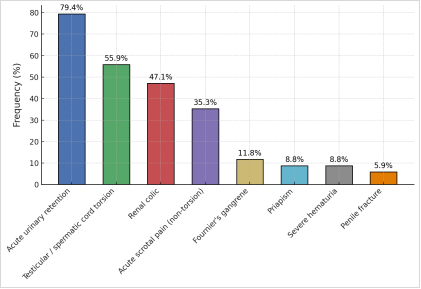
The three main urological emergencies reported were acute urinary retention (79.4%), acute scrotal pain (55.9%), including testicular torsion and renal colic (47.1%). The distribution of urological emergencies reported by general practitioners is shown in Figure 1. Almost all respondents (94.1%, n = 32) reported seeing young patients with sudden-onset unilateral scrotal pain.
Figure 1. Distribution of the most frequently reported urological emergencies by general practitioners.
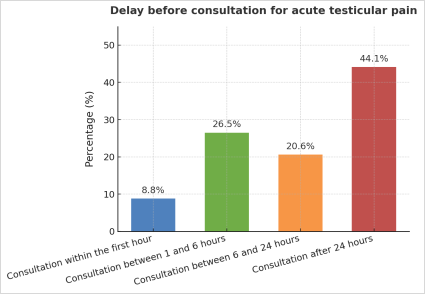
Figure 2. Distribution of patients according to the time elapsed between the onset of scrotal pain and the first medical consultation.
Regarding scrotal pain, the frequency of this reason for consultation varied considerably among practitioners. Among the general practitioners surveyed, 20.6% reported encountering at least one case per month, while 23.5% reported two to three cases per month, and 8.8% reported more than three cases. The time between the onset of symptoms and the first medical consultation also appeared highly variable. Thus, 8.8% of patients consulted within the first hour following the onset of pain, while 20.6% consulted more than 24 hours later. Figure 2 shows the distribution of patients according to the time elapsed between the onset of scrotal pain and the first medical consultation.
3.3. Diagnostic and Therapeutic Practices and Complications
Table 2. Distribution of knowledge, practices, and perceptions of complications of testicular torsion among 136 physicians facing acute, non-febrile scrotal pain.

Variable

Category

Number (n)

Percentage (%)

Diagnostic suspicion

Spermatic cord torsion

72

52,9

Epididymitis / Orchiepididymitis

28

20,6

Others

36

26,5

Previous experience of testicular torsion

Yes

132

97,1

No

4

2,9

Initial conduct

Prescription for painkillers

48

35,3

Request for scrotal ultrasound

20

14,7

Immediate referral to a specialist center

68

50

Feared complications

Testicular necrosis

128

94,1

Others

8

5,9

None of the participants reported being able to perform an exploratory scrototomy.
When faced with acute, non-febrile scrotal pain in a young patient, the majority of physicians (n=72; 52.9%) suspected testicular torsion, while others suggested epididymitis or epididymo-orchidism (n=28; 20.6%). Nearly all participants (n=132; 97.1%) had previously suspected or diagnosed testicular torsion in their practice. Regarding management, 50% of physicians (n=68) referred patients to a specialized center. The most feared complication of testicular torsion was testicular necrosis, reported by 94.1% of physicians (n=128). Table 2 summarizes knowledge, diagnostic and therapeutic practices, and perceptions of complications.
4. Discussion
This study sheds light on how general practitioners in Chad manage urological emergencies, particularly acute scrotal pain and testicular torsion. These results provide a basis for reflection and evaluation of current practices. Analysis of the collected responses, which will be discussed in conjunction with other data from the literature, highlights several key findings, notably regarding the clinical recognition of testicular torsion, the time frame for treatment, and the therapeutic approaches adopted in these emergencies.
4.1. Main Urological Emergencies in General and the Role of Acute Scrotal Pain/Testicular Torsion
The results of our survey show that, according to the general practitioners interviewed, the main urological emergencies encountered were acute urinary retention (108 mentions, 79.4%), followed by testicular or spermatic cord torsion (76 mentions, 55.9%) and renal colic (64 mentions, 47.1%). These observations are generally consistent with data from African literature. Diallo et al. , Owon’Abessolo et al. in Cameroon, and Vadandi et al. in Chad reported that acute urinary retention was the main urological emergency encountered. In France, Boissier et al. reported a slightly different profile, with renal colic being the most common, followed by acute urinary retention and hematuria. In this survey, considering the clinical presentation of testicular torsion, acute scrotal pain was the most frequently encountered emergency. This may support the answer to the question: "Do you see young patients presenting with sudden onset of unilateral scrotal pain?" 94.1% of respondents indicated that the answer was yes.
4.2. Time Between the Onset of Symptoms and Consultation
According to the results of our survey of general practitioners, the time between the onset of symptoms and consultation was highly variable among patients with acute scrotal pain. Only 8.8% of patients consulted within one hour of the onset of symptoms, and nearly half (44.1%) did not seek care until 24 hours later. In our Chadian context, the delay in seeking medical attention for acute testicular pain can be explained by several interdependent factors. On an individual level, a lack of awareness of the urgent nature of the pain often leads patients to minimize it or mistake it for a benign condition. Self-medication, the use of traditional remedies, and discomfort associated with genital examinations are also frequent obstacles to prompt consultation. Socioeconomic constraints, such as the cost of care and the distance to specialized facilities, also influence the time it takes to receive treatment. Cultural factors, including certain beliefs about the origin of pain or fear of surgery, further contribute to delaying consultation. This combination of individual, socioeconomic, and cultural factors largely explains the observed delays and underscores the importance of community outreach and health education to improve the speed of care. The healthcare system itself may also play a role.
Indeed, experiences reported in remote areas, such as Nepal, show that a trained general practitioner can quickly diagnose testicular torsion, perform emergency surgical exploration, and limit testicular loss. These data illustrate that strengthening the skills of primary care physicians is a crucial lever for improving testicular prognosis in resource-limited settings.
Regarding the time to consultation, a study in Burkina Faso reported that the average consultation time was 24.6 hours, and 84.3% of patients consulted after the sixth hour . In a Nigerian study including 31 patients, the majority (77.4%) presented within 6 hours of the onset of pain . According to Rampaul et al. in England, the median duration of symptoms was 5.5 hours in patients with a viable testis, compared to 42 hours in those requiring orchiectomy. In the case-control study conducted by Kabore et al. in Burkina Faso on predictive factors for orchiectomy in adults with spermatic cord torsion, three factors were identified: prior medical management, duration of symptoms, and the performance of a scrotal ultrasound. It is clear that the time to consultation and treatment has an impact on testicular preservation.
4.3. Diagnostic Approach to Acute Nonfebrile Scrotal Pain in Young Adults
When faced with acute nonfebrile scrotal pain in a young adult, testicular torsion was the first hypothesis reported by the majority of physicians surveyed, followed by epididymo-orchitis. These conditions can be clinically indistinguishable, as characteristic symptoms and signs overlap, while pathognomonic features are rare. Accurate and rapid diagnosis is necessary to avoid loss of testicular function in cases of testicular torsion and unnecessary surgery in other cases. A thorough understanding of the key clinical features of each condition, combined with proficiency in the appropriate use of perfusion imaging, will provide the emergency physician with the necessary tools to accomplish this task . Diabaté et al. reported that in Africa, more than 50% of clinical presentations of scrotal pain are of infectious origin. Overall, the differential diagnosis of acute scrotal pain is broad, and the proportion of patients presenting with each of these conditions varies . A thorough knowledge of andrological emergencies, particularly testicular torsion, is essential for any general practitioner. A precise medical history and a well-targeted physical examination allow for suspicion or guidance of the diagnosis, which will then necessitate surgical intervention. This not only confirms the diagnosis but also, when the testicle is still viable, ensures scrotal salvage.
4.4. Management of Acute Scrotal Pain in Young Men
Regarding management, 50% prescribed analgesics and 14.7% requested a scrotal ultrasound. However, the main therapeutic response was immediate referral to a specialized center (50%, n = 17). While analgesics can relieve pain, they do not replace prompt management of testicular torsion, the diagnosis of which remains primarily clinical. The limited use of imaging reflects a diagnostic deficit, but international guidelines emphasize the urgency of surgical exploration in cases of suspected testicular torsion. Immediate referral is beneficial, but transfer delays can limit the effectiveness of this strategy. These results confirm observations made in other sub-Saharan African countries, where diagnostic delays contribute to high rates of orchiectomy .
None of the respondents reported having the ability to perform an exploratory scrototomy. It is important that general practitioners be able to manage surgical emergencies such as testicular torsion and others, especially those practicing in rural areas. In Australia, an analysis by Tree et al. on the impact of rural geography and socioeconomic status on the management of testicular torsion showed that, despite significant differences in terms of geographical distance, socioeconomic level, age, and access to care, patients living in rural and isolated areas had outcomes equivalent to those in urban areas. This study highlights that the management of testicular torsion remained effective thanks to the organization around a central referral center, supported by a peripheral hospital, which made it possible to overcome delays related to geographical remoteness or lower socioeconomic status. Initiatives like that of the Canadian Association of General Surgeons allow general practitioners to participate in a program training them to assess and manage acute urological emergencies such as testicular torsion and others (paraphimosis, acute urinary retention, and Fournier's gangrene) . In Chad, the government, in partnership with its development partners, organizes capacity-building training in surgery for general practitioners. This training would allow them to manage the main surgical emergencies and also provide routine care in response to their caseload. This training is not regular, as it depends on funding. Furthermore, since the creation of surgical specialty diplomas, investments have been somewhat modified.
4.5. Feared Complications of Spermatic Cord Torsion Reported by Surveys
In this survey, the majority of general practitioners (94.1%, n = 128) reported testicular necrosis as the most feared complication of spermatic cord torsion, highlighting their awareness of the critical urgency. Indeed, the functional and vital prognosis of the testicle is correlated with the promptness of intervention. The overall testicular preservation rate after torsion is 40% to 70%, but preservation is 100% before 3 hours, 90% before 6 hours, and less than 50% after 10 hours . Neglected cases lead to aseptic necrosis with progressive testicular atrophy or sometimes purulent effusion with a risk of cutaneous fistulization . This is why emergency surgical exploration is necessary in the presence of any suggestive picture . Delayed treatment can have an impact on subsequent fertility .
4.6. Perspectives and Recommendations for Improving Patient Care
The results of this study highlight the need to strengthen general practitioners' training in the recognition and management of urological emergencies, particularly testicular torsion, in order to reduce diagnostic delays and preserve testicular function. The development of standardized protocols, improved referral pathways, and rapid access to specialized centers are essential to limit the risk of testicular loss. Simultaneously, raising public awareness of the urgent nature of scrotal pain and promoting early consultation could reduce delays in care related to cultural, socioeconomic, and individual factors. Finally, context-appropriate strategies, such as practical training via clinical simulation, access to imaging in frontline facilities or the use of teleconsultations, could improve the management of urological emergencies in resource-limited regions, while paving the way for prospective studies to evaluate the effectiveness of these interventions.
5. Limitations
This study has several limitations, including the small sample size and potential bias related to participant self-selection. The data are based on self-reporting rather than direct observation, and lack objective assessment of practical skills. Furthermore, the predominance of respondents working in urban areas and the absence of clinical follow-up (diagnostic delays, testicular salvage rates) limit the generalizability and interpretation of the results.
6. Conclusion
General practitioners in Chad frequently encounter urological emergencies, including acute scrotal pain and testicular torsion. The majority clinically suspect torsion, but interventions are often limited to prescribing analgesics or referring patients to specialized centers. This approach reveals gaps in primary surgical skills and rapid access to care. Prolonged consultation delays, with nearly half of patients presenting after 24 hours, increase the risk of testicular loss. These delays are linked to individual, socioeconomic, cultural, and systemic factors. Community awareness and enhanced training for primary care physicians are essential to improve the speed of care. Developing standardized protocols and facilitating access to specialized centers and diagnostic tools are crucial. Hands-on training through clinical simulation and the use of telemedicine represent promising avenues. These combined measures could reduce morbidity and improve testicular prognosis in Chad.
Conflicts of Interest
The authors declare no conflicts of interest.
References
[1] Kinnear N, Herath M, Barnett D, Hennessey D, Dobbins C, Sammour T, Moore J. A systematic review of dedicated models of care for emergency urological patients. Asian J Urol. 2021 Jul; 8(3): 315-323.
[2] Talreja S, Banerjee I, Teli R, Agarwal N, Vyas N, Priyadarshi S, Yadav S, Tomar V. A Spectrum of Urological Emergency Reported at a Tertiary Care Teaching Hospital: An Experience. J Clin Diagn Res. 2015 Nov; 9(11): PC12-5.
[3] Osmancevic A, Petersson A, Duverin A, Merzaai B, Hedlund E, Porras GM, Albinsson I, Al-Hadad J, Olsson S, Vestberg D, Sagen E, Abuhasanein S. Epidemiology and management of urological emergencies in a tertiary care setting in Scandinavia. Int J Emerg Med. 2025 Apr 15; 18(1): 79.
[4] Diabaté I, Ondo CZ, Sow I, et al. Urgences urologiques au Centre Hospitalier de Louga, Sénégal: aspects épidémiologiques et évaluation de la prise en charge. African J Urol 21 (2015): 181-186.
[5] Girgin R, Erdem K. Epidemiologic Analysis of Urological Cases Admitted to an Emergency Department of a Tertiary Care Center. J Urol Surg. 2020 Aug 20; 7(3): 227-231.
[6] Boissier R, Savoie PH, Long JA. Épidémiologie des urgences urologiques en France [Epidemiology of urological emergencies in France]. Prog Urol. 2021 Nov; 31(15): 945-955. French.
[7] Okpani C. P., and Kufre U. 2024. “Urological Emergencies; Spectrum of Cases Seen Over a Three Year Period in a Tertiary Care Teaching Hospital in West Africa”. Asian Journal of Research and Reports in Urology 7(1): 20-27.
[8] Davis JE, Silverman M. Scrotal emergencies. Emerg Med Clin North Am. 2011 Aug; 29(3): 469-84.
[9] Gordhan CG, Sadeghi-Nejad H. Scrotal pain: evaluation and management. Korean J Urol. 2015 Jan; 56(1): 3-11.
[10] Burgher SW. Acute scrotal pain. Emerg Med Clin North Am. 1998 Nov; 16(4): 781-809, vi.
[11] Long-Depaquit T, Chiron P, Bourgouin S, Hardy J, Deledalle FX, Laroche J, Molimard B, Savoie PH. Prise en charge de la torsion du testicule par un chirurgien généraliste isolé en Afrique [Management of testicular torsion by a general surgeon isolated in Africa]. Med Trop Sante Int. 2022 Apr 4; 2(2): mtsi.v2i2.2022.230. French.
[12] Ngueringem, O., Mahamat, M. A., Abakar, M. N., & Gondjé, A. (2014). Épidémiologie des urgences urologiques en chirurgie pédiatrique à l’Hôpital de la Mère et de l’Enfant de N’Djamena. Revue scientifique du Tchad.
[13] Diallo TO, Diabaté I, Barry M, Bah OR. Le profil des urgences urologiques dans un hôpital régional au Sénégal: étude rétrospective de 20 mois [Urological emergencies in a regional hospital in Senegal: a 20-month retrospective study]. Pan Afr Med J. 2022 Aug 22; 42: 302. French.
[14] Owon’Abessolo, P. F., Mayopa, C. F., Mekeme, J., Fouda, J. C., Biyouma, M. D. C., Dongmo, G. Sosso, M. A. (2020). Urgences Urologiques: Aspects Épidémiologiques, Cliniques et Thérapeutiques à l’Hôpital Central de Yaoundé. HEALTH SCIENCES AND DISEASE, 21(8).
[15] Vadandi V, Mahamat A, Temga O, Minguemadji A, Vounouzia B, Abdelmamoud C, et al. Urological Emergencies at the Abeche University Teaching Hospital: Epidemioclinicial Pattern and Management: Les Urgences Urologiques au Centre Hospitalier Universitaire d’Abeche: Profil Épidémiologique, Clinique et Thérapeutique. Health Sci. Dis. 2024 Apr. 28 [cited 2025 Jul. 29]; 25(5). Available from:
[16] Kaboré, F. A., Zango, B., Yaméogo, C., Sanou, A., Kirakoya, B., & Traoré, S. S. (2011). Les torsions du cordon spermatique chez l’adulte au CHU Yalgado Ouédraogo de Ouagadougou. Basic and Clinical Andrology, 21(4), 254-259.
[17] Obi AO, Okeke CJ, Ugwuidu EI. Acute testicular torsion: A critical analysis of presentation, management and outcome in southeast Nigeria. Niger J Clin Pract. 2020 Nov; 23(11): 1536-1541.
[18] Rampaul MS, Hosking SW. Testicular torsion: most delay occurs outside hospital. Ann R Coll Surg Engl. 1998 May; 80(3): 169-72.
[19] Kabore FA, Kabore KK, Kabore M, Kirakoya B, Yameogo C, Ky BD, Zango B. Predictive factors for orchiectomy in adult's spermatic cord torsion: a case-control study. Basic Clin Androl. 2021 Jan 21; 31(1): 2.
[20] Diabaté I, Ouédraogo B, Thiam M. Les grosses bourses aiguës au centre hospitalier de Louga, Sénégal: aspects épidémiologiques, étiologiques et thérapeutiques [Acute scrotal swellings at Louga Regional Hospital, Senegal: epidemiologic, etiologic and therapeutic aspects]. Pan Afr Med J. 2016 Jul 12; 24: 214. French.
[21] Gatti JM, Patrick Murphy J. Current management of the acute scrotum. Semin Pediatr Surg. 2007; 16(1): 58-63.
[22] Nedjim, S. A., Biyouma, M. D. C., Mahamat, M. A. et al. Testicular torsion in Sub-Saharan Africa: a scoping review. Afr J Urol 29, 50 (2023).
[23] Tree K, Buckland BC, Huynh R, Baskaranathan S, Fisher D, Indrajit B. Testicular Torsion: An Analysis of Rural Geography and Socioeconomic Status. Société Internationale d’Urologie Journal. 2023; 4(4): 257-264.
[24] Practical Urology for the Rural General Surgeon – CAGS. Available from:
[25] Cummings JM, Boullier JA, Sekhon D, Bose K. Adult testicular tor- sion. J Urol 2002; 167: 2109–10.
[26] Audenet F. Torsion du cordon spermatique et des annexes testiculaires: physiopathologie, diagnostic et principes du traitement. EMC Urologie 2012; 5(2): 1-7 [Article 18-622-A-10].
[27] Anderson MJ, Dunn JK, Lipshultz LI, Coburn M. Semen quality and endocrine parameters after acute testicular torsion. J Urol. 1992; 147: 1545–50.
Cite This Article
  • APA Style

    Nedjim, S. A., Mahamat, M. A., Kouldjim, A., Allah-Syengar, N., Younous, S., et al. (2026). A Cross-sectional Survey of Urological Emergency Management by General Practitioners, with a Focus on Acute Scrotal Pain and Testicular Torsion in Chad. International Journal of Clinical Urology, 10(1), 85-91. https://doi.org/10.11648/j.ijcu.20261001.25

    Copy | Download

    ACS Style

    Nedjim, S. A.; Mahamat, M. A.; Kouldjim, A.; Allah-Syengar, N.; Younous, S., et al. A Cross-sectional Survey of Urological Emergency Management by General Practitioners, with a Focus on Acute Scrotal Pain and Testicular Torsion in Chad. Int. J. Clin. Urol. 2026, 10(1), 85-91. doi: 10.11648/j.ijcu.20261001.25

    Copy | Download

    AMA Style

    Nedjim SA, Mahamat MA, Kouldjim A, Allah-Syengar N, Younous S, et al. A Cross-sectional Survey of Urological Emergency Management by General Practitioners, with a Focus on Acute Scrotal Pain and Testicular Torsion in Chad. Int J Clin Urol. 2026;10(1):85-91. doi: 10.11648/j.ijcu.20261001.25

    Copy | Download

  • @article{10.11648/j.ijcu.20261001.25,
      author = {Saleh Abdelkerim Nedjim and Mahamat Ali Mahamat and Adoumadji Kouldjim and Ndormadjita Allah-Syengar and Seid Younous and Sadié Ismael and Moussa Kalli and Choua Ouchemi},
      title = {A Cross-sectional Survey of Urological Emergency Management by General Practitioners, with a Focus on Acute Scrotal Pain and Testicular Torsion in Chad},
      journal = {International Journal of Clinical Urology},
      volume = {10},
      number = {1},
      pages = {85-91},
      doi = {10.11648/j.ijcu.20261001.25},
      url = {https://doi.org/10.11648/j.ijcu.20261001.25},
      eprint = {https://article.sciencepublishinggroup.com/pdf/10.11648.j.ijcu.20261001.25},
      abstract = {Urological emergencies account for a significant proportion of medical consultations, with acute scrotal pain and testicular torsion being common and high-risk causes. Rapid treatment is essential to preserve testicular function. In Chad, general practitioners are the first point of contact, but their practices had never been studied. Methods: A descriptive, cross-sectional study was conducted in July 2025 among 136 general practitioners in Chad working in public and mixed, urban and rural settings. Participants completed an online questionnaire on urological emergencies, their management, and complications. The analysis was performed using Excel and presented in proportions and absolute values. A total of 136 general practitioners participated in the survey, the majority of whom were men (87.5%) aged 28 to 44. More than half had been practicing for less than five years, and the majority worked in public facilities (65.4%) or in urban areas (53.7%). The most frequently reported urological emergencies were acute urinary retention (79.4%), acute scrotal pain (55.9%), and renal colic (47.1%). Almost all respondents (94.1%) reported seeing young patients with sudden unilateral scrotal pain; 20.6% encountered this at least once a month. The consultation time varied, with 8.8% of patients consulting within an hour and 20.6% after 24 hours. When faced with a painful scrotum without fever, 26.5% of doctors suspected testicular torsion, while 20.6% suggested epididymitis. The majority (97.1%) had already suspected or diagnosed testicular torsion. Management was mainly based on immediate referral to a specialized center (50%), sometimes combined with the prescription of analgesics (50%) or a scrotal ultrasound (14.7%). Testicular necrosis was the most feared complication (94.1%). No physician performed exploratory scrototomy. Chadian general practitioners recognize testicular torsion but have limited surgical skills and face prolonged delays in consultation, increasing the risk of testicular loss. Enhanced training, the development of standardized protocols, clinical simulation, and improved access to specialized centers are essential to optimize care and reduce morbidity.},
     year = {2026}
    }
    

    Copy | Download

  • TY  - JOUR
    T1  - A Cross-sectional Survey of Urological Emergency Management by General Practitioners, with a Focus on Acute Scrotal Pain and Testicular Torsion in Chad
    AU  - Saleh Abdelkerim Nedjim
    AU  - Mahamat Ali Mahamat
    AU  - Adoumadji Kouldjim
    AU  - Ndormadjita Allah-Syengar
    AU  - Seid Younous
    AU  - Sadié Ismael
    AU  - Moussa Kalli
    AU  - Choua Ouchemi
    Y1  - 2026/05/12
    PY  - 2026
    N1  - https://doi.org/10.11648/j.ijcu.20261001.25
    DO  - 10.11648/j.ijcu.20261001.25
    T2  - International Journal of Clinical Urology
    JF  - International Journal of Clinical Urology
    JO  - International Journal of Clinical Urology
    SP  - 85
    EP  - 91
    PB  - Science Publishing Group
    SN  - 2640-1355
    UR  - https://doi.org/10.11648/j.ijcu.20261001.25
    AB  - Urological emergencies account for a significant proportion of medical consultations, with acute scrotal pain and testicular torsion being common and high-risk causes. Rapid treatment is essential to preserve testicular function. In Chad, general practitioners are the first point of contact, but their practices had never been studied. Methods: A descriptive, cross-sectional study was conducted in July 2025 among 136 general practitioners in Chad working in public and mixed, urban and rural settings. Participants completed an online questionnaire on urological emergencies, their management, and complications. The analysis was performed using Excel and presented in proportions and absolute values. A total of 136 general practitioners participated in the survey, the majority of whom were men (87.5%) aged 28 to 44. More than half had been practicing for less than five years, and the majority worked in public facilities (65.4%) or in urban areas (53.7%). The most frequently reported urological emergencies were acute urinary retention (79.4%), acute scrotal pain (55.9%), and renal colic (47.1%). Almost all respondents (94.1%) reported seeing young patients with sudden unilateral scrotal pain; 20.6% encountered this at least once a month. The consultation time varied, with 8.8% of patients consulting within an hour and 20.6% after 24 hours. When faced with a painful scrotum without fever, 26.5% of doctors suspected testicular torsion, while 20.6% suggested epididymitis. The majority (97.1%) had already suspected or diagnosed testicular torsion. Management was mainly based on immediate referral to a specialized center (50%), sometimes combined with the prescription of analgesics (50%) or a scrotal ultrasound (14.7%). Testicular necrosis was the most feared complication (94.1%). No physician performed exploratory scrototomy. Chadian general practitioners recognize testicular torsion but have limited surgical skills and face prolonged delays in consultation, increasing the risk of testicular loss. Enhanced training, the development of standardized protocols, clinical simulation, and improved access to specialized centers are essential to optimize care and reduce morbidity.
    VL  - 10
    IS  - 1
    ER  - 

    Copy | Download

Author Information
  • Faculty of Medicine, Adam Barka University of Abeche, Abeche, Chad

  • Faculty of Medicine, University of N'djamena, N'djamena, Chad

  • Faculty of Medicine, Adam Barka University of Abeche, Abeche, Chad

  • Faculty of Medicine, Adam Barka University of Abeche, Abeche, Chad

  • Faculty of Medicine, Adam Barka University of Abeche, Abeche, Chad

  • Faculty of Medicine, University of N'djamena, N'djamena, Chad

  • Faculty of Medicine, University of N'djamena, N'djamena, Chad

  • Faculty of Medicine, University of N'djamena, N'djamena, Chad

  • Abstract
  • Keywords
  • Document Sections

    1. 1. Introduction
    2. 2. Methodology
    3. 3. Results
    4. 4. Discussion
    5. 5. Limitations
    6. 6. Conclusion
    Show Full Outline
  • Conflicts of Interest
  • References
  • Cite This Article
  • Author Information