Research Article | | Peer-Reviewed

Structural, Electronic, and Spectroscopic Effects of Ligand Modification in RuCl2L2 Complexes: A Comparative DFT and TD-DFT Study

Received: 17 September 2026     Accepted: 27 September 2026     Published: 5 November 2026
Views:       Downloads:
Abstract

The nature of the heterocyclic rings in azo ligands plays a crucial role in modulating the physicochemical properties of ruthenium complexes. However, the effects of replacing an azopyridine ligand with an azopyrrole analogue on the structural, thermodynamic, electronic, and photophysical properties of ruthenium complexes remain insufficiently understood. This study investigates the influence of ligand ring modification on the properties of RuCl2L2 complexes, where L denotes either 2-phenylazopyridine (azpy) or 2-cyclopentadienylazopyrrole (azopyrrole). Ground-state geometries were optimized at the B3LYP/LANL2DZ level and characterized by vibrational frequency calculations. Thermodynamic and electronic properties were examined using Density Functional Theory (DFT), Natural Bond Orbital (NBO) analysis, and Time-Dependent DFT (TD-DFT) calculations. The results indicate that ligand substitution has a limited effect on the coordination geometry around the ruthenium center but significantly modifies the electronic distribution within the complexes. Among the three investigated isomers, the α-Cl isomer is predicted to be the most stable in both series. The formation of RuCl2(azpy)2 is thermodynamically favorable, whereas the formation of RuCl2(azopyrrole)2 is unfavorable at 298 K under the computational conditions considered. Frontier molecular orbital analysis reveals predominantly Metal-to-Ligand Charge-Transfer (MLCT) character for the azpy complexes, while the azopyrrole complexes exhibit a stronger Ligand-to-Metal Charge-Transfer (LMCT) contribution. The latter also display lower HOMO–LUMO gaps and chemical hardness values, together with higher electrophilicity indices. TD-DFT calculations predict absorption bands in the visible and near-infrared regions, highlighting ligand modification as a promising strategy for tuning the electronic and photophysical properties of ruthenium complexes.

Published in International Journal of Computational and Theoretical Chemistry (Volume 14, Issue 2)
DOI 10.11648/j.ijctc.20261402.14
Page(s) 84-98
Creative Commons

This is an Open Access article, distributed under the terms of the Creative Commons Attribution 4.0 International License (http://creativecommons.org/licenses/by/4.0/), which permits unrestricted use, distribution and reproduction in any medium or format, provided the original work is properly cited.

Copyright

Copyright © The Author(s), 2026. Published by Science Publishing Group

Keywords

Ruthenium Complexes, Azo Ligands, DFT, TD-DFT, Photophysical Properties

1. Introduction
Ruthenium is an attractive metal center for the design of coordination complexes because of its versatile electronic properties and ability to access multiple oxidation states. In particular, its coordination with nitrogen-containing ligands such as 2-phenylazopyridine (azpy) can give rise to stable ruthenium(II) complexes with properties of interest in several fields, including catalysis, electrochemistry , and anticancer drug development . Complexation of RuCl₃·3H2O with azpy gives rise to five geometric isomers of RuCl2(azpy)2 .
These isomers can be broadly classified into two families according to the relative arrangement of the ligands around the ruthenium center. The α-Cl, β-Cl, and ε-Cl isomers adopt a cis configuration, whereas γ-Cl and δ-Cl exhibit a trans configuration. Such structural differences can substantially influence the electronic and biological properties of these complexes .
The biological relevance of these systems is illustrated by their cytotoxic activity against several cancer cell lines, including A498, EVSA-T, IGROV, H226, MCF-7, and WIDR . Previous studies have shown that the biological activity of these complexes is strongly influenced by their geometry and by the orientation of the ligands around the metal center. The introduction of substituents, such as a methyl group, can also significantly modify their cytotoxic properties . To rationalize these structure–activity relationships, several structure–activity relationship (SAR) and quantitative structure–activity relationship (QSAR) studies have been reported.
These studies have highlighted the role of several molecular descriptors in the anticancer activity of ruthenium azopyridine complexes. In particular, the trans geometry of the γ-Cl and δ-Cl isomers may favor specific interactions with DNA. In addition, the dipole moment, ligand charge, LUMO energy, and HOMO–LUMO energy gap have been identified as important descriptors of biological activity . QSAR models have further indicated that the reaction free energy change (ΔrG∘), dipole moment (μ), and ligand charge within the complex can contribute to explaining and predicting variations in anticancer activity .
Beyond their biological properties, ruthenium azopyridine complexes also exhibit interesting photophysical properties, including absorption in the visible region and metal–ligand charge-transfer transitions that may be exploited in photoinduced applications. These characteristics have attracted interest in their potential use as photosensitizers in dye-sensitized solar cells, particularly for the sensitization of titanium dioxide , as well as in photodynamic therapy .
Despite the considerable attention devoted to RuCl2(azpy)2 complexes, the influence of the nature and size of the rings located on either side of the azo group (–N=N–) on their structural, electronic, and spectroscopic properties remains insufficiently explored. Previous studies have mainly focused on the effects of complex geometry, ligand substitution, and substituent effects on biological activity and electronic properties . In contrast, the effect of simultaneously replacing the pyridine ring with a pyrrole ring and the phenyl ring with a cyclopentadienyl ring has received comparatively little attention. Such structural modifications may significantly affect electronic conjugation, steric interactions, bond polarization, and electron-density distribution around the ruthenium center. It is therefore important to determine how these structural changes influence the intrinsic properties of ruthenium complexes.
In this context, comparing ligands that differ in both ring size and electronic character provides a useful strategy for gaining deeper insight into structure–property relationships in ruthenium complexes containing azo ligands. Such a comparison can help distinguish the effects associated with ring-size reduction from those arising from changes in the electronic nature of the rings.
Computational modeling provides an effective means of investigating these effects at the molecular level. In particular, density functional theory (DFT) provides access to optimized geometries, electronic properties, frontier molecular orbitals, and other molecular descriptors, while time-dependent DFT (TD-DFT) enables the investigation of the electronic excitation and absorption properties of the complexes. These approaches allow structurally related systems bearing ligands with different sizes and electronic characteristics to be compared under consistent theoretical conditions.
Accordingly, the main objective of this study is to theoretically investigate the influence of ring size and ring nature in azo ligands on the properties of ruthenium complexes of the type RuCl2L2. More specifically, the study aims to:
1) determine and compare the equilibrium geometries of the selected complexes;
2) assess the effect of replacing the pyridine ring with a pyrrole ring;
3) evaluate the effect of replacing the phenyl ring with a cyclopentadienyl ring;
4) compare the resulting electronic properties and reactivity descriptors; and
5) examine the impact of these structural modifications on their spectroscopic properties.
To achieve these objectives, 2-phenylazopyridine (azpy) and cyclopentadienylazopyrrole (azopyrrole) were considered as representative azo ligands for the construction of RuCl2L2 complexes. Their structural, thermodynamic, electronic, and spectroscopic properties were investigated using DFT and TD-DFT calculations.
The originality of this work lies in providing a systematic theoretical comparison of ruthenium complexes bearing azo ligands that differ in both the size and electronic nature of the rings flanking the azo group. Unlike previous studies that have focused mainly on biological activity, conventional ligand substitution, or the geometry of RuCl2(azpy)2 complexes, the present work specifically examines the effects of the pyridine→pyrrole and phenyl→cyclopentadienyl substitutions on the structural, electronic, reactivity, and spectroscopic properties of RuCl2L2 complexes. This approach is expected to contribute to a better understanding of the structure–property relationships governing ruthenium azo complexes and to provide theoretical guidelines for the design of new complexes with tunable electronic and spectroscopic characteristics.
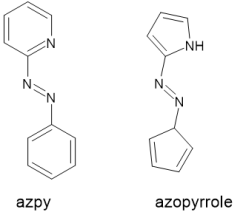
Figure 1 shows the two-dimensional molecular structures of 2-phenylazopyridine (azpy) and cyclopentadienylazopyrrole (azopyrrole) investigated in this study.
Figure 1. 2D structures of the 2-phenylazopyridine (azpy) and cyclopentadienylazopyrrole (azopyrrole) ligands.
2. Computational Details
2.1. Molecular Systems and Structural Design
The reaction of hydrated ruthenium chloride (RuCl₃·3H2O) with 2-phenylazopyridine (azpy) gives rise to several isomers of the RuCl2(azpy)2 complex. Owing to the different ways in which the ligands can be arranged around the ruthenium centre, five distinct geometric isomers can be formed.
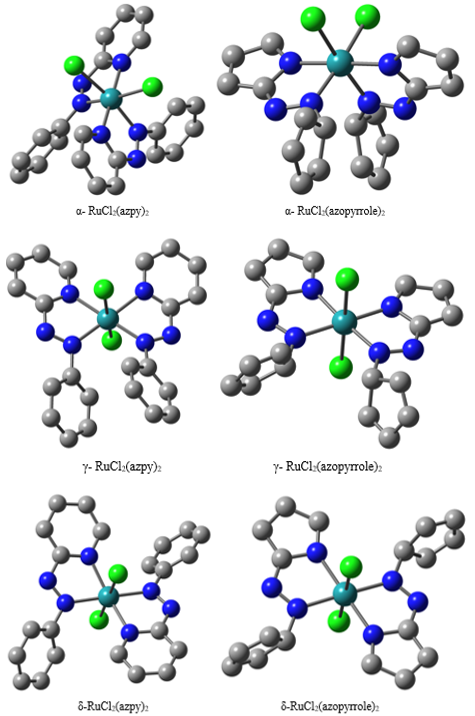
These isomers can be classified into two main families, cis and trans, according to the relative positions of the chloride and azopyridine ligands. The α-Cl, β-Cl and ε-Cl isomers belong to the cis family, in which the two chloride ligands adopt a cis arrangement with respect to the plane defined by the azopyridine ligands. In contrast, the γ-Cl and δ-Cl isomers display a trans configuration. The different geometries considered in this study are presented in Figure 2.
Figure 2. Optimised geometries of the α-Cl, γ-Cl and δ-Cl isomers of RuCl2(azpy)2 and RuCl2(azopyrrole)2.
The molecular structures were optimised using density functional theory (DFT), followed by vibrational frequency calculations. The B3LYP hybrid functional was employed in combination with the LANL2DZ pseudopotential and associated effective basis set. This approach makes it possible to confirm that the optimised structures correspond to stationary points on the potential energy surface. The absence of imaginary frequencies confirms that the optimized structures correspond to local minima on the potential energy surface. However, this criterion does not establish that they are global minima.
Under the computational conditions used, the α-Cl, γ-Cl and δ-Cl isomers were found to exhibit C2 symmetry, irrespective of the nature of the azo ligand. These structural findings provide a foundation for comparing the electronic and spectroscopic properties of the different complexes.
Among the five geometrical isomers reported for RuCl2(azpy)2, the α-Cl, γ-Cl, and δ-Cl configurations were selected for the present comparative study. This selection was made to represent both cis and trans coordination arrangements while maintaining a consistent structural framework for comparison with the azopyrrole analogues. The β-Cl and ε-Cl isomers were not considered in the present work and are therefore outside the scope of the comparison.
2.2. Computational Methodology and Level of Theory
The quantum chemistry calculations were carried out within the framework of Density Functional Theory (DFT), using the B3LYP (Becke–Lee–Yang–Parr) hybrid functional . This theoretical level was chosen for the balance it strikes between the accuracy of the description of molecular properties and computational cost, and for its previous use in the study of organometallic systems and transition metal complexes.
Geometric optimisations were carried out at the B3LYP/LANL2DZ level. The choice of the LANL2DZ basis set is due to the presence of ruthenium and the use of an Effective Core Potential (ECP), which allows the inner electrons to be represented whilst reducing the computational cost.
All calculations were carried out using the Gaussian 09 software . For each optimised structure, a vibrational frequency calculation was performed to verify the nature of the stationary point obtained. The absence of imaginary frequencies indicates that the structure corresponds to a local minimum of the potential energy surface.
The electronic properties of the complexes were then determined from the optimised geometries, in particular the energies of the HOMO (Highest Occupied Molecular Orbital) and LUMO (Lowest Unoccupied Molecular Orbital) molecular orbitals.
2.3. Thermodynamic Quantities of Reactions
The thermodynamic quantities associated with complex formation reactions were evaluated on the basis of the thermodynamic parameters calculated for the reactants and products. The quantities considered include, in particular, the change in reaction enthalpy (ΔrH∘), the change in Gibbs free energy (ΔrG∘) and the change in entropy (ΔrS∘).
For a general formation reaction:
Reactants → Products(2)
The thermodynamic changes are obtained from the differences between the corresponding quantities for the products and the reactants:
∆rX298K=∑Products∆fX0298K-∑Reactants∆fX0298K(3)
The values of (ΔrH∘), (ΔrG∘) and (ΔrS∘) used for these calculations were obtained from the output files of calculations carried out at the same theoretical level. The change in Gibbs free energy allows, in particular, the thermodynamic feasibility of the formation reaction to be assessed, whilst the changes in enthalpy and entropy provide information on its energetic and entropic nature, respectively.
2.4. Global Reactivity Descriptors
The HOMO and LUMO molecular orbitals are important parameters for analysing the reactivity of the complexes under study. The energy of the HOMO is generally associated with the system’s ability to donate electron density, whilst the energy of the LUMO provides information on its ability to accept electron density.
The energy difference between these two orbitals is defined by:
∆E=ELUMO-EHOMO(4)
Within the framework of conceptual DFT, several global reactivity descriptors have been calculated, notably the electronic chemical potential μ, the chemical hardness η and the electrophilicity index ω. These parameters enable the analysis of relative trends in the donation, acceptance and redistribution of electron density within the complexes .
In the boundary orbital approximation, the ionisation potential I and the electron affinity A are approximated by:
I≈-EHOMO and A≈-ELUMO(5)
The electronic chemical potential is then defined by:
μ=- I+A2=12ELUMO+EHOMO= -χ(6)
and electronegativity by:
μ=- I+A2=12ELUMO+EHOMO= -χ(7)
The chemical hardness is calculated as:
η=I-A2(8)
or, in this approximation:
η=12ELUMO-EHOMO(9)
The overall softness S is given by:
S=12η(10)
Finally, the global electrophilicity index is defined as:
ω= μ22η = χ22η(11)
These descriptors enable a comparison of the overall electronic behaviour of the various complexes and an examination of the influence of the nature and size of the azo ligand rings on their reactivity. The concepts of hardness and softness form part of the HSAB (Hard and Soft Acids and Bases) theory developed by Pearson .
2.5. Natural Bond Orbital Analysis
Natural Bond Orbital (NBO) analysis was used to provide a more detailed description of the electronic structure of the complexes under investigation . This method enables the electronic structure to be described in terms of localised orbitals and allows the donor–acceptor interactions between occupied and vacant orbitals to be analysed.
In particular, NBO analysis enables the identification of the electronic interactions responsible for delocalisation, hyperconjugation and charge transfer. It also provides information on natural populations, atomic charges and the stabilisation energies associated with donor–acceptor interactions.
In the present study, NBO analysis is used to characterise the electronic interactions within ruthenium complexes and to examine the influence of structural modifications to azo ligands on the electronic distribution and metal–ligand interactions. Particular attention is paid to interactions involving the metal centre and the donor atoms of the ligands.
2.6. Calculation of UV-Visible Absorption Spectra
The spectroscopic properties of the complexes were investigated using Time-Dependent Density Functional Theory (TD-DFT) . Calculations of excited states were carried out using geometries optimised in the ground state in order to simulate the electronic absorption spectra in the UV-visible region. TD-DFT enables the determination of vertical excitation energies, absorption wavelengths and oscillator forces associated with electronic transitions. These parameters are used to characterise the main absorption bands and identify the nature of the electronic transitions.
Where relevant, the most intense transitions are analysed on the basis of the molecular orbitals involved in order to distinguish between ligand-centred, metal-centred and metal-ligand charge transfer (MLCT) contributions. The theoretical UV-visible spectra are then used to compare the optical properties of the different complexes and assess their potential in photo-induced applications.
3. Results and Discussion
3.1. Geometry of the Ground State of the Compounds
Table 1 presents the calculated and experimental geometric parameters of RuCl2(azpy)2-type ruthenium complexes, where L = azpy or azopyrrole, including the bond lengths involving the metal centre and the main coordination angles.
Table 1. Geometric parameters (bond lengths in Å and angles in °) of the RuCl2L2 isomers (L = azpy or azopyrrole) in a vacuum at the B3LYP/Lanl2DZ energy level .

N1=N2

Ru-N2

Ru-Npy

Ru-Cl1

Ru-Cl2

Cl1-Ru-Cl2

Npy-Ru-Npy

N2-Ru-N2

RuCl2(azpy)2

α-Cl

theo

1.317

2.034

2.066

2.477

2.477

92.202

178.709

90.493

exp

1.28

1.98

2.05

2.400

2.40

89.50

174.50

93.50

γ-Cl

theo

1.320

2.030

2.104

2.479

2.479

170.599

102.968

104.949

exp

1.31

1.99

2.110

2.38

2.38

170.50

103.80

104.10

δ-Cl

theo

1.308

2.062

2.102

2.488

2.511

180.000

167.431

177.671

exp

1.28

2.020

2.060

2.38

2.38

180.00

180.00

180.00

RuCl2(azopyrrole)2

α-Cl

theo

1.334

2.015

2.054

2.429

2.429

96.509

178.563

89.100

γ-Cl

theo

1.324

2.073

2.036

2.430

2.429

176.692

99.593

105.113

δ-Cl

theo

1.340

2.023

2.091

2.427

2.447

180.000

178.90

176.033

For the RuCl2(azpy)2 complexes, the geometrical parameters calculated at the B3LYP/LANL2DZ level are generally in good agreement with the available experimental data. The differences observed are relatively small, particularly for the Ru–N and Ru–Cl bond lengths and the coordination angles. This level of agreement suggests that the selected computational approach provides a reliable description of the geometries of ruthenium complexes containing azopyridine ligands, supporting its application to related systems.
A comparison of the RuCl2(azpy)2 and RuCl2(azopyrrole)2 complexes further reveals that replacing azopyridine with azopyrrole produces only minor changes in the geometric parameters around the ruthenium centre. In particular, the Ru–N bond lengths remain within a similar range. In the azopyrrole-containing complexes, the Ru–N2 bond lengths range from 2.015 to 2.073 Å, while the Ru–Nₚ bond lengths vary between 2.036 and 2.091 Å. These findings indicate that variations in the nature and size of the rings within the azo ligands have only a limited influence on the coordination geometry around the metal centre.
3.2. Standard Enthalpies and Gibbs Free Energies of Formation and Formation Reactions
Thermodynamic quantities provide valuable information for evaluating the energetics and thermodynamic feasibility of complex formation reactions. Table 2 presents the standard enthalpies of formation (ΔfH∘), the standard Gibbs free energies of formation (ΔfG∘), and the enthalpy and Gibbs free energy changes associated with the formation reactions.
Table 2. Standard thermodynamic formation and reaction enthalpies.

Isomers

ΔfH° (ua)

ΔfG°(ua)

ΔrH (kcal/mol)

ΔrG (kcal/mol)

RuCl2(azpy)2

α-Cl

-1300.986

-1301.071

-22.662

-26.186

γ-Cl

-1300.975

-1301.059

-15.934

-18.881

δ-Cl

-1300.975

-1301.061

-15.643

-19.797

RuCl2(azpyrrole)2

α-Cl

-1147.243

-1147.321

56.398

43.534

γ-Cl

-1147.234

-1147.316

61.970

46.800

δ-Cl

-1147.238

-1147.317

59.611

46.098

For all the isomers considered, the calculated values of ΔfH∘ and ΔfG∘ are negative, indicating that the complex species are thermodynamically stabilised relative to the reference compounds used in the calculations. Within each ligand family, comparison of the ΔfG∘ values gives the following order:
ΔfG°(α-Cl)˂ΔfG°(δ-Cl)˂ΔfG°(γ-Cl)
The α-Cl isomer therefore appears to be the most thermodynamically stable of the three geometries considered.
However, a comparison of the two families of complexes reveals a significant difference. For the RuCl2(azpy)2 complexes, the values of ΔrH° and ΔrG° are both negative, indicating exothermic formation reactions that are thermodynamically favourable at 298 K. Conversely, for RuCl2(azopyrrole)2, the positive values of ΔrH° and ΔrG° show that the formation reactions under consideration are thermodynamically unfavourable at 298 K under the calculation conditions used.
Thus, the replacement of six-membered rings with five-membered rings not only alters the electronic properties of the complexes; it is also accompanied by a decrease in the calculated thermodynamic favourability of their formation. This difference highlights the importance of the nature of the ligand in the thermodynamic stabilisation of the ruthenium complexes studied.
Under the computational model and reference reaction considered, the formation reactions of the azopyrrole complexes exhibit positive ΔrG° values at 298 K, indicating that these reactions are thermodynamically less favourable than the corresponding azopyridine reactions.
3.3. NBO Analysis of the Geometric Structures of the Ground State
Natural bond orbital (NBO) analysis enables the examination of the electronic distribution within complexes and the characterisation of electron density transfers between the metal centre and the ligands. The NBO charges of the main constituent entities of the complexes, together with their dipole moments, are summarised in Table 3.
Table 3. NBO charges of the various constituents and dipole moment (in Debye).

isomers

Ru

Ligand

Cl

µD

RuCl2(azpy)2

α-Cl

0.007

0.751

-0.758

7.814

γ-Cl

-0.018

0.748

-0.730

1.674

δ-Cl

-0.008

0.786

-0.778

1.335

RuCl2(azopyrrole)2

α-Cl

0.108

0.370

-0.478

5.779

γ-Cl

0.104

0.344

-0.448

0.144

δ-Cl

0.097

0.390

-0.487

0.208

For the RuCl2(azpy)2 complexes, the charges carried by the ligands are relatively high and positive, with values ranging from 0.748 to 0.786, whilst the charges calculated for the ruthenium remain close to neutral. Upon replacement of azopyridine with azopyrrole, the ligand charge decreases significantly to 0.344–0.390, whilst the charge carried by ruthenium becomes positive and ranges from 0.097 to 0.108.
This change reflects a significant alteration in the electronic distribution within the complexes. The decrease in the positive charge carried by the azopyrrole ligand is accompanied by an increase in the charge at the metal centre, indicating a redistribution of electron density between ruthenium and the ligand. This redistribution may be linked to the electronic differences between the pyridine and pyrrole rings, as well as to the nature of their orbitals involved in coordination.
The NBO data thus show that the substitution of azopyridine with azopyrrole significantly alters the electronic character of the metal–ligand bond, even though the coordination geometry remains broadly comparable.
Dipole moment
The dipole moment is a complementary indicator of the overall polarity of the complexes. For RuCl2(azpy)2, the calculated values range from 1.335 to 7.814 D, whilst those for RuCl2(azopyrrole)2 vary between 0.144 and 5.779 D.
Generally speaking, complexes with azopyrrole ligands exhibit lower dipole moments than their azopyridine analogues. In particular, the γ-Cl and δ-Cl isomers exhibit the lowest values in both families. This decrease in dipole moment reflects a change in the overall polarisation of the complexes resulting from the ligand change.
However, caution is advised when directly interpreting the dipole moment in terms of lipophilicity or solubility. A high dipole moment is generally associated with greater polarity, but it is not, on its own, a sufficient descriptor of solubility or lipophilicity. These properties also depend on numerous other parameters, notably molecular size, polarizability and solute-solvent interactions.
3.4. Investigation of the Effect of Size on the Reactivity of Ruthenium Complexes
Composition of Boundary Orbitals
Molecular boundary orbitals play a major role in interpreting the reactivity and electronic properties of complexes. In particular, their composition enables the identification of the molecular regions involved in electronic transitions and charge transfers.
Table 4. Composition of the molecular frontier orbitals of RuCl2L2 isomers.

Isomers

Molecular orbitals

Energy (eV)

MO composition (in %)

Index

Orbital

Ru

Cl

Ligand

RuCl2(azpy)2

α-Cl

112

L

-3.337

8

2

90

111

H

-5.432

48

31

21

γ-Cl

112

L

-3.365

8

4

88

111

H

-5.387

54

26

20

δ-Cl

112

L

-3.440

2

3

95

111

H

-5.224

62

26

12

RuCl2(azopyrrole)2

α-Cl

99

L

-4.799

46

13

41

98

H

-6.249

3

3

94

γ-Cl

95

L

-4.927

50

11

39

94

H

-6.134

17

5

78

δ-Cl

93

L

-4.780

45

9

46

92

H

-6.232

43

24

33

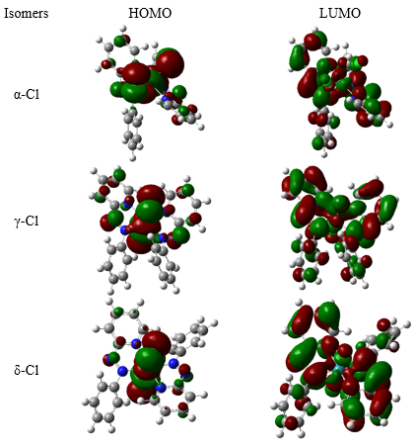
The results in Table 4 show that, for the isomers of RuCl2(azpy)2, the HOMO exhibits a significant contribution from the ruthenium orbitals, ranging from 48 to 62 per cent, with a complementary contribution from the chlorine atoms and the ligand. Conversely, the LUMO is predominantly localised on the azopyridine ligand, with a ligand contribution ranging from 88 to 95 per cent.
This electronic organisation indicates that, for RuCl2(azpy)2, the electronic promotion from the HOMO to the LUMO essentially corresponds to a metal–ligand charge transfer (MLCT). This result is consistent with the isodensity surfaces shown in Figure 3, which reveal an electron density strongly, localised on the metal centre in the HOMO and mainly on the ligand in the LUMO.
Figure 3. Isodensity surfaces of the boundary molecular orbitals of the RuCl2(azpy)2 isomers.
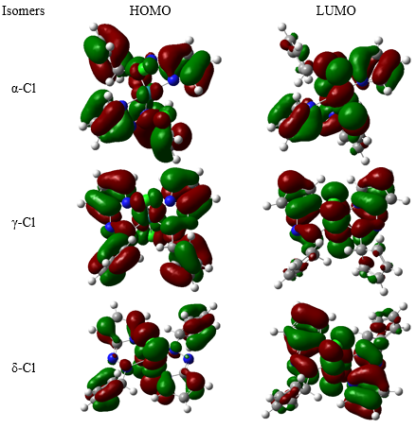
Replacing azopyridine with azopyrrole profoundly alters this distribution. For RuCl2(azopyrrole)2, the HOMO is dominated by the ligand, whilst the LUMO shows a significant contribution from ruthenium, ranging from 45 to 50 per cent for the α-Cl, γ-Cl and δ-Cl isomers. The HOMO → LUMO electron promotion can therefore be associated with a Ligand–Metal Charge Transfer (LMCT).
Figure 4. The frontier molecular orbitals of the RuCl2(azopyrrole)2 isomers.
The substitution of pyridine with pyrrole therefore induces not only a change in the electronic distribution but also a relative inversion in the localisation of the frontier molecular orbitals. This observation is relevant to understanding the differences in photophysical behaviour between the two families of complexes.
In addition, the frontier orbital energies generally become more negative when moving from RuCl2(azpy)2 to RuCl2(azopyrrole)2. This shift reflects a significant modification of the electronic structure resulting from the replacement of the pyridine rings by pyrrole rings.
Regarding potential interactions with DNA, the energetic compatibility between the orbitals of the nucleobases and those of the complexes may be an important consideration. The calculated LUMO energies of the azopyrrole complexes appear to be closer to certain reported HOMO energies of DNA bases than those of the corresponding azopyridine complexes. This observation suggests that some azopyrrole complexes may be more favourably suited to electronic interactions with DNA bases. However, this interpretation remains theoretical and, by itself, does not establish DNA affinity or actual intercalation.
3.5. Overall Reactivity Descriptors
The overall reactivity of the complexes was evaluated using several global reactivity descriptors, namely the HOMO–LUMO energy gap, the chemical potential (μ), the electrophilicity index (ω), and the chemical hardness (η). The corresponding calculated values are summarised in Table 5.
Table 5. Calculated values of the global reactivity descriptors (in eV) for the RuCl2L2 isomers, where L = azpy or azopyrrole.

Ehomo

Elumo

ΔE

µ (-χ)

ω

η

RuCl2(azpy)2

α-Cl

-5.432

-3.337

2.095

-4.385

4.588

1.048

γ-Cl

-5.387

-3.365

2.022

-4.376

4.735

1.011

δ-Cl

-5.224

-3.440

1.784

-4.332

5.260

0.892

RuCl2(azopyrrole)2

α-Cl

-6.249

-4.799

1.450

-5.524

10.522

0.725

γ-Cl

-6.134

-4.927

1.207

-5.531

12.670

0.604

δ-Cl

-6.232

-4.780

1.452

-5.506

10.439

0.726

3.5.1. Energy Gap
The HOMO–LUMO energy gap is widely used as an indicator of the relative electronic stability and reactivity of molecular systems. In the present study, the calculated energy gap values range from 1.784 to 2.095 eV for RuCl2(azpy)2, compared with 1.207–1.452 eV for RuCl2(azopyrrole)2.
A comparison of these values suggests that the calculated electronic reactivity increases in the following order:
α-RuCl2(azpy)2˂γ-RuCl2(azpy)2˂δ-RuCl2(azpy)2˂δ-RuCl2(azopyrrole)2˂α-RuCl2(azopyrrole)2˂γ-RuCl2(azopyrrole)2
Among the complexes investigated, the γ-RuCl2(azopyrrole)2 isomer exhibits the smallest energy gap, 1.207 eV, suggesting a greater ease of electronic redistribution within the framework of the calculated descriptors.
The reduction in the energy gap following the replacement of azopyridine with azopyrrole indicates an increase in the electronic flexibility of the complexes. This behaviour may be associated with changes in the conjugation pathway and electronic distribution induced by the ligand substitution.
The smaller HOMO–LUMO gaps and lower chemical hardness values suggest an increased electronic softness within the conceptual DFT framework. These descriptors should nevertheless be regarded as qualitative indicators rather than direct quantitative measures of experimental reactivity.
3.5.2. Chemical Potential and Electrophilicity
The calculated chemical potential values, μ, range from −4.332 to −5.531 eV. The RuCl2(azopyrrole)2 complexes exhibit the most negative values, indicating a difference in their predicted tendency to exchange electron density compared with the corresponding azopyridine complexes.
The electrophilicity index, ω, provides further insight into this trend. For the azopyridine complexes, the calculated values range from 4.588 to 5.260 eV, whereas the azopyrrole complexes exhibit higher values, ranging from 10.439 to 12.670 eV. The highest value is obtained for γ-RuCl2(azopyrrole)2 (ω = 12.670 eV), suggesting a greater capacity for electron-density acceptance within the framework of the theoretical model employed.
3.5.3. Chemical Hardness
The calculated chemical hardness values range from 0.892 to 1.048 eV for RuCl2(azpy)2, compared with 0.604–0.726 eV for RuCl2(azopyrrole)2.
The azopyrrole-based complexes therefore exhibit lower chemical hardness and, consequently, greater electronic softness. This observation is consistent with the previously discussed reduction in the HOMO–LUMO gap, suggesting that these complexes can more readily redistribute their electronic density.
Overall, the different global reactivity descriptors reveal a consistent trend: replacing azopyridine with azopyrrole enhances the electronic flexibility and the calculated reactivity of the ruthenium complexes. Among the studied systems, the γ-isomer appears particularly favourable for electronic redistribution.
3.6. Effect of Ligand Ring Size on Complex–light Interactions
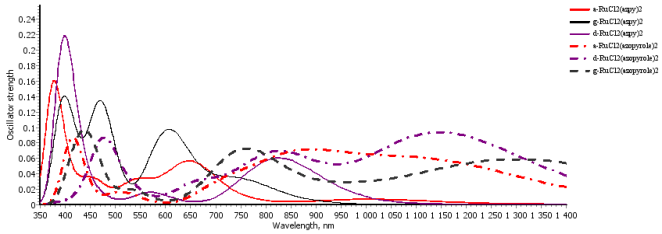
The influence of ligand ring size on the electronic absorption properties of the complexes was investigated using time-dependent density functional theory (TD-DFT). The calculated absorption spectra are presented in Figure 5, while the main electronic transitions, along with their excitation energies, oscillator strengths, and corresponding wavelengths, are summarised in Table 6.
Figure 5. UV-Vis absorption spectra of the RuCl2(azpy)2 and RuCl2(azopyrrole)2 isomers.
Table 6. Excitation energy, oscillator strength, wavelength and transition type characteristic of the absorption spectra calculated in a vacuum at the TD-B3LYP/Lanl2DZ level.

Isomers

Eexc

f

λ (nm)

Transition type

RuCl2(azpy)2

α-Cl

2.693

0.028

460.328

MLCT

3.333

0.063

371.936

LLCT

γ-Cl

2.045

0.096

606.402

MLCT

2.640

0.124

469.622

LLCT

δ-Cl

1.501

0.060

825.905

MLCT

3.143

0.165

394.417

LLCT

RuCl2(azpyrole)2

α-Cl

1.436

0.052

863.645

LMCT

3.048

0.038

406.828

MLCT

γ-Cl

1.618

0.058

766.332

LMCT

2.722

0.051

455.475

MLCT

δ-Cl

1.066

0.08

1163.522

LMCT

2.618

0.039

473.568

MLCT

3.6.1. RuCl2(azpy)2 Complexes
The calculated absorption spectra of the α-Cl, γ-Cl, and δ-Cl isomers of RuCl2(azpy)2 display two main absorption regions. The first, located in the ultraviolet or near the UV–visible boundary, is primarily associated with ligand-centered electronic transitions. The second appears at longer wavelengths and is mainly attributed to Metal-to-Ligand Charge-Transfer (MLCT) transitions.
The calculated MLCT absorption maxima are 460.328 nm for the α-Cl isomer, 606.402 nm for the γ-Cl isomer, and 825.905 nm for the δ-Cl isomer.
A progressive shift toward longer wavelengths is observed from α-Cl to δ-Cl, indicating that less energy is required for electronic excitation. Notably, the δ-Cl isomer absorbs in the near-infrared region, highlighting its potential interest from a photophysical perspective.
3.6.2. RuCl2(azopyrrole)2 Complexes
Replacing azopyridine with azopyrrole leads to a more pronounced change in the absorption profile. The three isomers considered still show two main absorption bands, but these bands are generally shifted toward longer wavelengths.
The main MLCT transitions are observed at approximately 406.828 nm for α-Cl, 455.475 nm for γ-Cl, and 473.568 nm for δ-Cl. A second set of absorption bands, assigned to LMCT transitions, appears at 863.645, 766.332, and 1163.522 nm for the α-Cl, γ-Cl, and δ-Cl isomers, respectively. These transitions therefore extend from the visible region into the near-infrared.
The spectra of RuCl2(azopyrrole)2 clearly differ from those of RuCl2(azpy)2, indicating that the nature of the azo ligand has a strong influence on the electronic transitions. This observation is consistent with the frontier molecular orbital analysis. In the azopyridine complexes, the HOMO is mainly associated with the ruthenium center, whereas the LUMO is largely localized on the ligand, giving the main excitation a predominantly metal-to-ligand charge-transfer (MLCT) character. By contrast, replacing azopyridine with azopyrrole changes the distribution of the frontier orbitals and increases the contribution of ligand-to-metal charge-transfer (LMCT) transitions.
These findings highlight the role of ligand design in tuning the optical properties of ruthenium complexes. In particular, the shift of some absorption bands toward longer wavelengths extends their response into the near-infrared region, which may be relevant to applications involving visible and near-infrared light, such as photosensitization and other photoinduced processes.
Overall, replacing azopyridine with azopyrrole has only a limited effect on the coordination geometry around the ruthenium center but produces much more significant changes in the thermodynamic, electronic, reactivity, and spectroscopic properties of the complexes. The smaller HOMO–LUMO gaps and lower chemical hardness, together with the higher electrophilicity observed for the azopyrrole derivatives, indicate a greater ability to redistribute electron density. At the same time, the change in frontier-orbital localization is accompanied by a shift in the dominant charge-transfer character, from predominantly MLCT in the azopyridine complexes toward a stronger LMCT contribution in the azopyrrole complexes.
4. Conclusion
This theoretical study investigated how the nature and size of the rings in azo ligands affect the properties of ruthenium complexes of the RuCl2(azpy)2 type by comparing systems containing 2-phenylazopyridine (azpy) and azopyrrole ligands. The calculations performed at the B3LYP/LANL2DZ level show that replacing azopyridine with azopyrrole has only a limited effect on the coordination geometry around the ruthenium center, while producing more pronounced changes in the electronic structure and spectroscopic properties.
The thermodynamic analysis indicates that the α-Cl isomer is the most stable of the three geometries considered in both families. However, the formation reactions of the RuCl2(azpy)2 complexes are thermodynamically favorable at 298 K, whereas those of the RuCl2(azopyrrole)2 complexes are unfavorable under the computational conditions considered, as reflected by their positive enthalpy and Gibbs free energy changes.
NBO analysis further shows that replacing azopyridine with azopyrrole leads to a significant redistribution of electron density within the complexes. This change is accompanied by variations in the charges of both the ruthenium center and the ligands, together with an overall decrease in the dipole moments. Frontier molecular orbital analysis also reveals a clear change in orbital localization. The RuCl2(azpy)2 complexes show predominantly metal-to-ligand charge-transfer (MLCT) character, whereas the azopyrrole complexes display a stronger ligand-to-metal charge-transfer (LMCT) contribution.
The global reactivity descriptors support these findings. Compared with the azopyridine complexes, the azopyrrole derivatives have smaller HOMO–LUMO gaps, lower chemical hardness, and higher electrophilicity, indicating a greater ability to redistribute electron density. TD-DFT calculations further show that replacing azopyridine with azopyrrole significantly modifies the absorption profiles and shifts some electronic transitions toward the near-infrared region.
Overall, the results demonstrate that modifying the ring structure of azo ligands provides an effective strategy for tuning the electronic, reactivity, and spectroscopic properties of ruthenium complexes. This work therefore provides useful molecular-level insights for the rational design of new ruthenium complexes with adjustable electronic and photophysical properties.
Future work will focus on experimentally validating these theoretical predictions through the synthesis and structural, spectroscopic, and photophysical characterization of the selected complexes. The computational study could also be extended to include solvent effects and more advanced theoretical methods, providing a more realistic description of their electronic and spectroscopic properties. In addition, investigating their interactions with DNA and other biomolecules, together with their photoactivity, would help assess their potential for applications in phototherapy and photosensitization.
Abbreviations

AZPY

2-phenylazopyridine

AZOPYRROLE

2-cyclopentadienylazopyrrole

DFT

Density Functional Theory

NBO

Natural Bond Orbital

TD-DFT

Time-Dependent DFT

MLCT

Metal-to-Ligand Charge-Transfer

LMCT

Ligand-to-Metal Charge-Transfer

SAR

Structure–Activity Relationship

QSAR

Quantitative Structure–Activity Relationship

B3LYP

Becke–Lee–Yang–Parr

ECP

Effective Core Potential

HOMO

Highest Occupied Molecular Orbital

LUMO

Lowest Unoccupied Molecular Orbital

HSAB

Hard and Soft Acids and Bases

Author Contributions
N’guessan Kouakou Nobel: Conceptualization, Resources
Ouattara Wawohinlin Patrice: Conceptualization, Resources
Bléhoué Clémence Ingrid: Conceptualization, Resources
Koné Mamadou Guy-Richard: Writing – review & editing
Koudjina Simplice: Writing – original draft
Ouattara Lamoussa: Writing – original draft
Dembélé Georges Stéphane: Data curation, Software
Bamba Kafoumba: Writing – original draft
Ziao Nahossé: Writing – original draft
Conflicts of Interest
The authors declare no conflicts of interest.
References
[1] Affi, S. T.; Bamba, K.; Ziao, N. Computational Characterization of Organometallic Ligands Coordinating Metal: Case of Azopyridine Ligands. J. Theor. Comput. Chem. 2015, 14 (1), 1550006.
[2] Bamba, K.; Leger, J. M.; Garnier, E.; Bachmann, C.; Servat, K.; Kokoh, K. B. Selective Electro-Oxidation of D-Glucose by RuCl2(azpy)2 Complexes as Electrochemical Mediators. Electrochim. Acta 2005, 50 (16–17), 3341–3346.
[3] Velders, A. H.; van der Schilden, K.; Hotze, A. C. G.; Reedijk, J.; Kooijman, H.; Spek, A. L. Dichlorobis (2-phenylazopyridine) ruthenium(II) Complexes: Characterisation, Spectroscopic and Structural Properties of Four Isomers. Dalton Trans. 2004, (3), 448–455.
[4] Krause, R. A.; Krause, K. Chemistry of Bipyridyl-like Ligands. Isomeric Complexes of Ruthenium(II) with 2 - (Phenylazo) pyridine. Inorg. Chem. 1980, 19 (9), 2600–2603.
[5] Goswami, S.; Chakravarty, A. R.; Chakravorty, A. Chemistry of Ruthenium. 2. Synthesis, Structure, and Redox Properties of 2 - (Arylazo) pyridine Complexes. Inorg. Chem. 1981, 20 (7), 2246–2250.
[6] Velders, A. H.; Kooijman, H.; Spek, A. L.; Haasnoot, J. G.; De Vos, D.; Reedijk, J. Strong Differences in the in Vitro Cytotoxicity of Three Isomeric Dichlorobis (2-phenylazopyridine) ruthenium(II) Complexes. Inorg. Chem. 2000, 39 (14), 2966–2967.
[7] Bamba, K.; Ouattara, W. P.; N’Guessan, K. N.; Ziao, N. SARs Investigation of α-, β-, γ-, δ-, ε-RuCl2(Azpy)2 Complexes as Antitumor Drugs. Comput. Chem. 2016, 4 (1), 1–10.
[8] Torrens, F.; de Julián-Ortiz, J. V. Editorial Board Members’ Collection Series: QSAR and Computational Approaches to Drug Discovery. Int. J. Mol. Sci. 2026, 27, 7247.
[9] Casida, M. E.; Jamorski, C.; Casida, K. C.; Salahub, D. R. Molecular Excitation Energies to High-Lying Bound States from Time-Dependent Density-Functional Response Theory: Characterization and Correction of the Time-Dependent Local Density Approximation Ionization Threshold. J. Chem. Phys. 1998, 108 (11), 4439–4449.
[10] N’guessan, K. N.; Koné, M. G.-R.; Bamba, K.; Ouattara, W. P.; Ziao, N. Quantitative Structure Anti-Cancer Activity Relationship (QSAR) of a Series of Ruthenium Complex Azopyridine by the Density Functional Theory (DFT) Method. Comput. Mol. Biosci. 2017, 7 (2), 19–31.
[11] N’guessan, N. K.; Bamba, K.; Ouattara, W. P.; Ziao, N. Theoretical Investigation of Structural and Electronic Properties of Ruthenium Azopyridine Complexes Dyes for Photovoltaic Applications by Using DFT and TD-DFT Methods. Eur. Sci. J. 2018, 14 (21), 424.
[12] Ouattara, W. P.; Bamba, K.; N’guessan, K. N.; Tuo, N. T.; Konate, B.; Ouattara, L.; Affi, S. T.; Charles, G. K.; Ziao, N. Theranostic Agent Study for Cancer Treatment by the TDDFT Method: Case of Some Ruthenium Azopyridine Complexes. Mod. Chem. 2022, 10 (3), 74–85.
[13] Adeloye, A. O.; Koudjina, S.; Kumar, V.; Tapala, K. C.; Gbenou, J. D.; Chetti, P. One-Pot Synthesis, Photophysical, Electrochemical and Molecular Property of Mixed-Ligands Ruthenium Complex Functionalities: Potential Materials for Dye-Sensitized Solar Cells (DSSCs). Dyes Pigments 2025, 235, 112626.
[14] Kohn, W.; Sham, L. J. Self-Consistent Equations Including Exchange and Correlation Effects. Phys. Rev. 1965, 140 (4A), A1133–A1138.
[15] M. J. Frisch, G. W. Trucks, H. B. Schlegel, G. E. Scuseria, M. A. Robb, J. R. Cheeseman, G. Scalmani, V. Barone, B. Mennuci, G. A. Petersson, H. Nakatsuji, M. Caricato, X. Li, H. P. Hratchian, A. F. Izmaylov, J. Bloino, G. Zheng, J. L. Sonnerberg, M. Hada, Ehara, K. Toyota, R. Fukuda, J. Hasegawa, M. Ishida, T. Nakajima, Y. Honda, O. Kitao, H. Nakai, T. Vreven, A. Montgomery, J. E. Peralta, F. Ogliaro, M. Bearpark, J. J. Heyd, E. Brothers, K. N. Kudin, V. N. Staroverov, R. Kobayashi, J. Normand, K. Raghavachari, A. Rendell, J. C. Burant, S. S. Iyengar, J. Tomasi, M. Cossi, N. Rega, J. M. Milliam, M. Klene, J. E. Knox, J. B. Cross, V. Bakken, C. Adamo, J. Jaramillo, R. Gomperts, R. E. stratmann, O. Yazyev, A. J. Austin, R. Cammi, C. Pomeli, J. W. Ochterski, R. L. Martin, K. Morokuma, V. G. Zakrzewski, G. A. Voth, P. Salvador, J. J. Dannenberg, S. Dapprich, S. Daniels, O. Farkas, J. B. Foresman, J. V. Ortiz, J. Cioslowski et D. J. Fox, Gaussian 09, Revison A.02, WAllingford C T: inc, 2009.
[16] Bauernschmitt, R.; Ahlrichs, R. Treatment of Electronic Excitations within the Adiabatic Approximation of Time-Dependent Density Functional Theory. Chem. Phys. Lett. 1996, 256 (4–5), 454–464.
[17] Melnikov, F.; Geohagen, B. C.; Gavin, T.; LoPachin, R. M.; Anastas, P. T.; Coish, P.; Herr, D. W. Application of the Hard and Soft Acids and Bases (HSAB) Theory as a Method to Predict Cumulative Neurotoxicity. Neurotoxicology 2020, 79, 95–103.
[18] Ulaş, Y. Natural Bond Orbital (NBO) Population Analysis and Non-Linear Optical (NLO) Properties of 2-(Azepan-1-yl (naphthalen-1-yl) methyl) phenol. Int. J. Chem. Technol. 2020, 4 (2), 138–145.
Cite This Article
  • APA Style

    Nobel, N. K., Patrice, O. W., Ingrid, B. C., Guy-Richard, K. M., Simplice, K., et al. (2026). Structural, Electronic, and Spectroscopic Effects of Ligand Modification in RuCl2L2 Complexes: A Comparative DFT and TD-DFT Study. International Journal of Computational and Theoretical Chemistry, 14(2), 84-98. https://doi.org/10.11648/j.ijctc.20261402.14

    Copy | Download

    ACS Style

    Nobel, N. K.; Patrice, O. W.; Ingrid, B. C.; Guy-Richard, K. M.; Simplice, K., et al. Structural, Electronic, and Spectroscopic Effects of Ligand Modification in RuCl2L2 Complexes: A Comparative DFT and TD-DFT Study. Int. J. Comput. Theor. Chem. 2026, 14(2), 84-98. doi: 10.11648/j.ijctc.20261402.14

    Copy | Download

    AMA Style

    Nobel NK, Patrice OW, Ingrid BC, Guy-Richard KM, Simplice K, et al. Structural, Electronic, and Spectroscopic Effects of Ligand Modification in RuCl2L2 Complexes: A Comparative DFT and TD-DFT Study. Int J Comput Theor Chem. 2026;14(2):84-98. doi: 10.11648/j.ijctc.20261402.14

    Copy | Download

  • @article{10.11648/j.ijctc.20261402.14,
      author = {N’guessan Kouakou Nobel and Ouattara Wawohinlin Patrice and Bléhoué Clémence Ingrid and Koné Mamadou Guy-Richard and Koudjina Simplice and Ouattara Lamoussa and Dembélé Georges Stéphane and Bamba Kafoumba and Ziao Nahossé},
      title = {Structural, Electronic, and Spectroscopic Effects of Ligand Modification in RuCl2L2 Complexes: A Comparative DFT and TD-DFT Study},
      journal = {International Journal of Computational and Theoretical Chemistry},
      volume = {14},
      number = {2},
      pages = {84-98},
      doi = {10.11648/j.ijctc.20261402.14},
      url = {https://doi.org/10.11648/j.ijctc.20261402.14},
      eprint = {https://article.sciencepublishinggroup.com/pdf/10.11648.j.ijctc.20261402.14},
      abstract = {The nature of the heterocyclic rings in azo ligands plays a crucial role in modulating the physicochemical properties of ruthenium complexes. However, the effects of replacing an azopyridine ligand with an azopyrrole analogue on the structural, thermodynamic, electronic, and photophysical properties of ruthenium complexes remain insufficiently understood. This study investigates the influence of ligand ring modification on the properties of RuCl2L2 complexes, where L denotes either 2-phenylazopyridine (azpy) or 2-cyclopentadienylazopyrrole (azopyrrole). Ground-state geometries were optimized at the B3LYP/LANL2DZ level and characterized by vibrational frequency calculations. Thermodynamic and electronic properties were examined using Density Functional Theory (DFT), Natural Bond Orbital (NBO) analysis, and Time-Dependent DFT (TD-DFT) calculations. The results indicate that ligand substitution has a limited effect on the coordination geometry around the ruthenium center but significantly modifies the electronic distribution within the complexes. Among the three investigated isomers, the α-Cl isomer is predicted to be the most stable in both series. The formation of RuCl2(azpy)2 is thermodynamically favorable, whereas the formation of RuCl2(azopyrrole)2 is unfavorable at 298 K under the computational conditions considered. Frontier molecular orbital analysis reveals predominantly Metal-to-Ligand Charge-Transfer (MLCT) character for the azpy complexes, while the azopyrrole complexes exhibit a stronger Ligand-to-Metal Charge-Transfer (LMCT) contribution. The latter also display lower HOMO–LUMO gaps and chemical hardness values, together with higher electrophilicity indices. TD-DFT calculations predict absorption bands in the visible and near-infrared regions, highlighting ligand modification as a promising strategy for tuning the electronic and photophysical properties of ruthenium complexes.},
     year = {2026}
    }
    

    Copy | Download

  • TY  - JOUR
    T1  - Structural, Electronic, and Spectroscopic Effects of Ligand Modification in RuCl2L2 Complexes: A Comparative DFT and TD-DFT Study
    AU  - N’guessan Kouakou Nobel
    AU  - Ouattara Wawohinlin Patrice
    AU  - Bléhoué Clémence Ingrid
    AU  - Koné Mamadou Guy-Richard
    AU  - Koudjina Simplice
    AU  - Ouattara Lamoussa
    AU  - Dembélé Georges Stéphane
    AU  - Bamba Kafoumba
    AU  - Ziao Nahossé
    Y1  - 2026/11/05
    PY  - 2026
    N1  - https://doi.org/10.11648/j.ijctc.20261402.14
    DO  - 10.11648/j.ijctc.20261402.14
    T2  - International Journal of Computational and Theoretical Chemistry
    JF  - International Journal of Computational and Theoretical Chemistry
    JO  - International Journal of Computational and Theoretical Chemistry
    SP  - 84
    EP  - 98
    PB  - Science Publishing Group
    SN  - 2376-7308
    UR  - https://doi.org/10.11648/j.ijctc.20261402.14
    AB  - The nature of the heterocyclic rings in azo ligands plays a crucial role in modulating the physicochemical properties of ruthenium complexes. However, the effects of replacing an azopyridine ligand with an azopyrrole analogue on the structural, thermodynamic, electronic, and photophysical properties of ruthenium complexes remain insufficiently understood. This study investigates the influence of ligand ring modification on the properties of RuCl2L2 complexes, where L denotes either 2-phenylazopyridine (azpy) or 2-cyclopentadienylazopyrrole (azopyrrole). Ground-state geometries were optimized at the B3LYP/LANL2DZ level and characterized by vibrational frequency calculations. Thermodynamic and electronic properties were examined using Density Functional Theory (DFT), Natural Bond Orbital (NBO) analysis, and Time-Dependent DFT (TD-DFT) calculations. The results indicate that ligand substitution has a limited effect on the coordination geometry around the ruthenium center but significantly modifies the electronic distribution within the complexes. Among the three investigated isomers, the α-Cl isomer is predicted to be the most stable in both series. The formation of RuCl2(azpy)2 is thermodynamically favorable, whereas the formation of RuCl2(azopyrrole)2 is unfavorable at 298 K under the computational conditions considered. Frontier molecular orbital analysis reveals predominantly Metal-to-Ligand Charge-Transfer (MLCT) character for the azpy complexes, while the azopyrrole complexes exhibit a stronger Ligand-to-Metal Charge-Transfer (LMCT) contribution. The latter also display lower HOMO–LUMO gaps and chemical hardness values, together with higher electrophilicity indices. TD-DFT calculations predict absorption bands in the visible and near-infrared regions, highlighting ligand modification as a promising strategy for tuning the electronic and photophysical properties of ruthenium complexes.
    VL  - 14
    IS  - 2
    ER  - 

    Copy | Download

Author Information
  • Laboratory of Thermodynamics and Environmental Physical Chemistry, Nangui Abrogoua University, Abidjan, Ivory Coast
  • Laboratory of Thermodynamics and Environmental Physical Chemistry, Nangui Abrogoua University, Abidjan, Ivory Coast

  • Department of Physics and Chemistry, Alassane Ouattara University of Bouaké, Bouaké, Ivory Coast

  • Laboratory of Thermodynamics and Environmental Physical Chemistry, Nangui Abrogoua University, Abidjan, Ivory Coast

  • National Graduate School of Biosciences and Applied Biotechnologies (ENSBBA), National University of Sciences, Technologies, Engineering and Mathematics, Dassa-Zoumé, Benin

  • Faculty of Marine Sciences, SAN PEDRO Polytechnic University, San Pedro, Ivory Coast

  • Laboratory of Thermodynamics and Environmental Physical Chemistry, Nangui Abrogoua University, Abidjan, Ivory Coast

  • Laboratory of Thermodynamics and Environmental Physical Chemistry, Nangui Abrogoua University, Abidjan, Ivory Coast

  • Laboratory of Thermodynamics and Environmental Physical Chemistry, Nangui Abrogoua University, Abidjan, Ivory Coast

  • Abstract
  • Keywords
  • Document Sections

    1. 1. Introduction
    2. 2. Computational Details
    3. 3. Results and Discussion
    4. 4. Conclusion
    Show Full Outline
  • Abbreviations
  • Author Contributions
  • Conflicts of Interest
  • References
  • Cite This Article
  • Author Information