
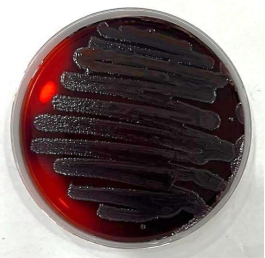
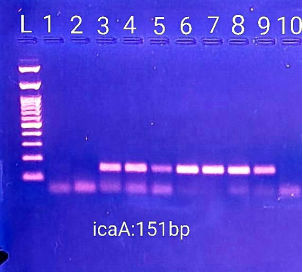
Background: Staphylococcus aureus is a major opportunistic pathogen implicated in various infections, including ocular infections. One of its key virulence factors is the ability to form biofilms, which are structured bacterial communities embedded in a self-produced extracellular matrix. Biofilm formation enhances bacterial survival under adverse conditions, including antibiotic exposure and host immune defenses, thereby contributing to chronic and recurrent infections. Aim: This study aimed to evaluate the biofilm-forming ability of S. aureus isolates obtained from ocular infections using the Congo Red Agar (CRA) method and to detect the presence of the biofilm-associated icaA gene using polymerase chain reaction (PCR). Methods: A total of 35 clinical isolates of S. aureus were included in this study. Biofilm formation was assessed phenotypically using the Congo Red Agar (CRA) method. Based on the results, isolates were categorized into strong, moderate, weak, and non-biofilm producers. Additionally, PCR was performed on 10 selected isolates to detect the presence of the icaA gene, a key determinant involved in biofilm formation. Results: Out of the 35 isolates, 10 (28.6%) exhibited strong biofilm formation, 15 (42.8%) showed moderate formation, 5 (14.3%) demonstrated weak formation, and 5 (14.3%) were non-biofilm producers. Overall, 71.4% of the isolates displayed varying degrees of biofilm production, indicating a high prevalence of this virulence trait. PCR analysis revealed that 7 out of 10 tested isolates (70%) were positive for the icaA gene. A correlation was observed between phenotypic biofilm formation and the presence of the icaA gene. Conclusion: The findings demonstrate a high prevalence of biofilm-forming S. aureus isolates in ocular infections and highlight the role of the icaA gene in biofilm production. The observed correlation between phenotypic and genotypic methods suggests that molecular detection can serve as a reliable complementary tool. Identification of biofilm-producing strains is essential for improving treatment strategies and reducing the risk of persistent and recurrent infections associated with biofilm-mediated antibiotic resistance.
| Published in | International Journal of Clinical and Experimental Medical Sciences (Volume 12, Issue 4) |
| DOI | 10.11648/j.ijcems.20261204.11 |
| Page(s) | 64-68 |
| Creative Commons |
This is an Open Access article, distributed under the terms of the Creative Commons Attribution 4.0 International License (http://creativecommons.org/licenses/by/4.0/), which permits unrestricted use, distribution and reproduction in any medium or format, provided the original work is properly cited. |
| Copyright |
Copyright © The Author(s), 2026. Published by Science Publishing Group |
Biofilms, Staphylococcus Aureus, icaA, PCR, Ocular Infection
Biofilm Category | Number of Isolates | Percentage (%) |
|---|---|---|
Strong | 10 | 28.6 |
Moderate | 15 | 42.8 |
Weak | 5 | 14.3 |
None | 5 | 14.3 |
Total | 35 | 100 |
icaA | F | GAGGTAAAGCCAACGCACTC | 151 | (Nourbakhsh and Namvar, 2016) |
|---|---|---|---|---|
R | CCTGTAACCGCACCAAGTTT |
CRA | Congo Red Agar |
PCR | Polymerase Chain Reaction |
EPS | Extracellular Polymeric Substance |
PIA | Polysaccharide Intercellular Adhesin |
| [1] | Abdel-Shafi, S., Al-Mohammadi, A. R., Alharbi, O., & Al-Masaudi, S. (2022). Molecular detection of biofilm-associated genes in Staphylococcus aureus from clinical isolates. Pathogens, 11(3), 338. |
| [2] | Arciola, C. R., Campoccia, D., Ravaioli, S., & Montanaro, L. (2015). Polysaccharide intercellular adhesin in biofilm: structural and regulatory aspects. Frontiers in Cellular and Infection Microbiology, 5, 7. |
| [3] | Arciola, C. R., Campoccia, D., Speziale, P., Montanaro, L., & Costerton, J. W. (2015). Biofilm formation in Staphylococcus implant infections. A review of molecular mechanisms and implications for biofilm-resistant materials. Biomaterials, 33(26), 5967-5982. |
| [4] | Benoit, M. R., Shiels, I. A., Donlan, R. M., & Jett, B. D. (2021). Biofilms and ocular infections. Antibiotics, 10(3), 254. |
| [5] | Boles, B. R., & Horswill, A. R. (2008). Staphylococcus aureus biofilm formation and toxin production: a role for quorum sensing? Current Opinion in Microbiology, 11(6), 638-643. |
| [6] | Costerton, J. W., Stewart, P. S., & Greenberg, E. P. (1999). Bacterial biofilms: A common cause of persistent infections. Science, 284(5418), 1318-1322. |
| [7] | Cramton, S. E., Gerke, C., Schnell, N. F., Nichols, W. W., & Götz, F. (1999). The intercellular adhesion (ica) locus is present in Staphylococcus aureus and is required for biofilm formation. Infection and Immunity, 67(10), 5427-5433. |
| [8] | Cucarella, C., Solano, C., Valle, J., Amorena, B., Lasa, I., & Penadés, J. R. (2001). Bap, a Staphylococcus aureus surface protein involved in biofilm formation. Journal of Bacteriology, 183(9), 2888-2896. |
| [9] | Flemming, H. C., & Wuertz, S. (2019). Bacteria and archaea on Earth and their abundance in biofilms. Nature Reviews Microbiology, 17(4), 247-260. |
| [10] | Freeman, D. J., Falkiner, F. R., & Keane, C. T. (1989). New method for detecting slime production by coagulase negative staphylococci. Journal of Clinical Pathology, 42(8), 872-874. |
| [11] | Gabriel, M. M., & Baqai, R. (2008). Evaluation of biofilm production in clinical isolates of Staphylococcus aureus. Pakistan Journal of Medical Sciences, 24(2), 261-265. |
| [12] | Hamad, S. K. (2023). Molecular detection of icaA gene in Staphylococcus aureus isolates from ocular infections. Iraqi Journal of Veterinary Sciences, 37(2), 210-217. |
| [13] | Knobloch, J. K. M., Horstkotte, M. A., Rohde, H., & Mack, D. (2002). Evaluation of different detection methods of biofilm formation in Staphylococcus aureus. Medical Microbiology and Immunology, 191(2), 101-106. |
| [14] | Lauderdale, K. J., Malone, C. L., Boles, B. R., Morcuende, J., & Horswill, A. R. (2009). Biofilm dispersal of Staphylococcus aureus by the serum protease staphopain. Journal of Bacteriology, 191(6), 2109-2117. |
| [15] | Nourbakhsh, F. and Namvar, A. E. (2016) ‘Detection of Genes Involved in Biofilm Formation in Staphylococcus Aureus Isolates’. GMS Hygiene and Infection Control, 11, p. Doc07. |
| [16] | Omidi, M., Firoozeh, F., Zibaei, M., & Azizi, O. (2020). The role of ica operon in biofilm formation in Staphylococcus spp.: a review. Iranian Journal of Microbiology, 12(5), 383-391. |
| [17] | Otto, M. (2008). Staphylococcus aureus biofilms. Current Topics in Microbiology and Immunology, 322, 207-228. |
| [18] | Taha, R., Abdulrahman, R. J., & Ali, M. A. (2019). Biofilm formation and detection of ica genes among Staphylococcus aureus isolates from ocular infections. Iraqi Journal of Science, 60(8), 1700-1709. |
APA Style
Abdulkhuder, K. A., Awad, M. N. (2026). Biofilm Formation and Detection of the icaA Gene in Staphylococcus Aureus Isolates from Ocular Infections. International Journal of Clinical and Experimental Medical Sciences, 12(4), 64-68. https://doi.org/10.11648/j.ijcems.20261204.11
ACS Style
Abdulkhuder, K. A.; Awad, M. N. Biofilm Formation and Detection of the icaA Gene in Staphylococcus Aureus Isolates from Ocular Infections. Int. J. Clin. Exp. Med. Sci. 2026, 12(4), 64-68. doi: 10.11648/j.ijcems.20261204.11
@article{10.11648/j.ijcems.20261204.11,
  author = {Karar Ali Abdulkhuder and Mahmood Nabeel Awad},
  title = {Biofilm Formation and Detection of the icaA Gene in Staphylococcus Aureus Isolates from Ocular Infections},
  journal = {International Journal of Clinical and Experimental Medical Sciences},
  volume = {12},
  number = {4},
  pages = {64-68},
  doi = {10.11648/j.ijcems.20261204.11},
  url = {https://doi.org/10.11648/j.ijcems.20261204.11},
  eprint = {https://article.sciencepublishinggroup.com/pdf/10.11648.j.ijcems.20261204.11},
  abstract = {Background: Staphylococcus aureus is a major opportunistic pathogen implicated in various infections, including ocular infections. One of its key virulence factors is the ability to form biofilms, which are structured bacterial communities embedded in a self-produced extracellular matrix. Biofilm formation enhances bacterial survival under adverse conditions, including antibiotic exposure and host immune defenses, thereby contributing to chronic and recurrent infections. Aim: This study aimed to evaluate the biofilm-forming ability of S. aureus isolates obtained from ocular infections using the Congo Red Agar (CRA) method and to detect the presence of the biofilm-associated icaA gene using polymerase chain reaction (PCR). Methods: A total of 35 clinical isolates of S. aureus were included in this study. Biofilm formation was assessed phenotypically using the Congo Red Agar (CRA) method. Based on the results, isolates were categorized into strong, moderate, weak, and non-biofilm producers. Additionally, PCR was performed on 10 selected isolates to detect the presence of the icaA gene, a key determinant involved in biofilm formation. Results: Out of the 35 isolates, 10 (28.6%) exhibited strong biofilm formation, 15 (42.8%) showed moderate formation, 5 (14.3%) demonstrated weak formation, and 5 (14.3%) were non-biofilm producers. Overall, 71.4% of the isolates displayed varying degrees of biofilm production, indicating a high prevalence of this virulence trait. PCR analysis revealed that 7 out of 10 tested isolates (70%) were positive for the icaA gene. A correlation was observed between phenotypic biofilm formation and the presence of the icaA gene. Conclusion: The findings demonstrate a high prevalence of biofilm-forming S. aureus isolates in ocular infections and highlight the role of the icaA gene in biofilm production. The observed correlation between phenotypic and genotypic methods suggests that molecular detection can serve as a reliable complementary tool. Identification of biofilm-producing strains is essential for improving treatment strategies and reducing the risk of persistent and recurrent infections associated with biofilm-mediated antibiotic resistance.},
 year = {2026}
}
TY  - JOUR
T1  - Biofilm Formation and Detection of the icaA Gene in Staphylococcus Aureus Isolates from Ocular Infections
AU  - Karar Ali Abdulkhuder
AU  - Mahmood Nabeel Awad
Y1  - 2026/08/27
PY  - 2026
N1  - https://doi.org/10.11648/j.ijcems.20261204.11
DO  - 10.11648/j.ijcems.20261204.11
T2  - International Journal of Clinical and Experimental Medical Sciences
JF  - International Journal of Clinical and Experimental Medical Sciences
JO  - International Journal of Clinical and Experimental Medical Sciences
SP  - 64
EP  - 68
PB  - Science Publishing Group
SN  - 2469-8032
UR  - https://doi.org/10.11648/j.ijcems.20261204.11
AB  - Background: Staphylococcus aureus is a major opportunistic pathogen implicated in various infections, including ocular infections. One of its key virulence factors is the ability to form biofilms, which are structured bacterial communities embedded in a self-produced extracellular matrix. Biofilm formation enhances bacterial survival under adverse conditions, including antibiotic exposure and host immune defenses, thereby contributing to chronic and recurrent infections. Aim: This study aimed to evaluate the biofilm-forming ability of S. aureus isolates obtained from ocular infections using the Congo Red Agar (CRA) method and to detect the presence of the biofilm-associated icaA gene using polymerase chain reaction (PCR). Methods: A total of 35 clinical isolates of S. aureus were included in this study. Biofilm formation was assessed phenotypically using the Congo Red Agar (CRA) method. Based on the results, isolates were categorized into strong, moderate, weak, and non-biofilm producers. Additionally, PCR was performed on 10 selected isolates to detect the presence of the icaA gene, a key determinant involved in biofilm formation. Results: Out of the 35 isolates, 10 (28.6%) exhibited strong biofilm formation, 15 (42.8%) showed moderate formation, 5 (14.3%) demonstrated weak formation, and 5 (14.3%) were non-biofilm producers. Overall, 71.4% of the isolates displayed varying degrees of biofilm production, indicating a high prevalence of this virulence trait. PCR analysis revealed that 7 out of 10 tested isolates (70%) were positive for the icaA gene. A correlation was observed between phenotypic biofilm formation and the presence of the icaA gene. Conclusion: The findings demonstrate a high prevalence of biofilm-forming S. aureus isolates in ocular infections and highlight the role of the icaA gene in biofilm production. The observed correlation between phenotypic and genotypic methods suggests that molecular detection can serve as a reliable complementary tool. Identification of biofilm-producing strains is essential for improving treatment strategies and reducing the risk of persistent and recurrent infections associated with biofilm-mediated antibiotic resistance.
VL  - 12
IS  - 4
ER  -
College of Pharmacy, The Islamic University, Al-Diwaniyah, Iraq
College of Pharmacy, The Islamic University, Al-Diwaniyah, Iraq

Information



 Share This Article
 Twitter
 Linked In
 Facebook
 Copy
Copy Download