Abstract
This study investigates the factors influencing online education outcomes, focusing on learner engagement, self-directed learning, active learning methods, the flipped classroom approach, flexibility, and accessibility. Using a quantitative research design, the study examined the extent to which these factors contribute to successful online learning outcomes. Data were collected through an online survey administered to students enrolled in online universities. SPSS version 23 was used to run data analysis. Of the 900 questionnaires distributed, 849 valid responses were received, resulting in a response rate of 94.3%. Multiple regression analysis was employed to test the proposed hypotheses and assess the relationships between the independent variables and online education outcomes. The findings indicate that all five factors exert a positive and statistically significant influence on online education outcomes, supporting the proposed hypotheses. The regression model explained 59.2% of the variance in online education outcomes (R2 = 0.592), demonstrating strong explanatory power. Learner engagement (β = 0.301) and self-directed learning (β = 0.297) emerged as the most influential predictors, highlighting the importance of active participation and autonomous learning behaviors. Active learning methods (β = 0.279) also significantly enhanced learning effectiveness, while the flipped classroom approach, flexibility, and accessibility showed positive and significant contributions. The results emphasize the need for learner-centered, interactive, flexible, and accessible online learning environments. These findings provide valuable implications for educators, institutions, and policymakers seeking to improve the quality and effectiveness of online education.
Keywords
Online Education, Learner Engagement, Self-directed Learning, Instructional Approach, Flexibility and Accessibility
1. Introduction
Online education has become an essential mode of learning in modern educational systems, particularly with the rapid advancement of digital technologies and global connectivity. It provides learners with opportunities to access education regardless of geographical and time constraints, offering flexibility and diverse learning experiences. As a result, institutions increasingly adopt online learning platforms to enhance educational accessibility and effectiveness. However, despite its growth, concerns remain regarding the quality of learning outcomes delivered through online education compared to traditional face-to-face learning
| [12] | Moore, J. L., Dickson-Deane, C., Galyen, K. e-Learning, Online Learning, and Distance Learning Environments: Are They the Same? The Internet and Higher Education. 2011, 14(2), 129-135. https://doi.org/10.1016/j.iheduc.2010.10.001 |
| [13] | Ulfa, S., Fatawi, I. Predicting Factors That Influence Students' Learning Outcomes Using Learning Analytics in an Online Learning Environment. International Journal of Emerging Technologies in Learning (iJET). 2021, 16(1), 4-17. |
| [14] | McLeod, S. Vygotsky's Theory of Cognitive Development. Simply Psychology. 2025.
https://doi.org/10.5281/zenodo.15680745 |
| [15] | Allen, I. E., Seaman, J. Learning on Demand: Online Education in the United States, 2009. Sloan Consortium. 2010. |
[12-15]
.
Learning outcomes in online education are influenced by multiple factors that shape students’ engagement, understanding, and academic performance. Among these, learner engagement plays a critical role in determining how actively students participate in course activities and interact with instructional materials. Engaged learners are more likely to achieve improved cognitive and academic outcomes, as engagement fosters deeper learning and knowledge retention
. Therefore, identifying the level and impact of learner engagement is essential in understanding the success of online learning environments.
Another important factor influencing online learning outcomes is the flexibility and accessibility of the learning platform. Online education systems are designed to provide learners with convenient access to educational resources anytime and anywhere. This flexibility allows learners to manage their own learning pace, which may enhance motivation and performance. However, challenges such as poor usability, limited access to devices, or unstable internet connectivity can negatively affect learning experiences and outcomes, especially in developing regions
.
Instructional approaches and the integration of collaborative and active learning methods also play a significant role in shaping learning outcomes. Effective online teaching strategies, such as flipped classroom models and scaffolding techniques, support learners in understanding complex concepts. Similarly, collaborative learning activities encourage interaction and knowledge sharing among learners, which enhances critical thinking and problem-solving skills. These approaches contribute to more meaningful and engaging learning experiences when well implemented
.
Lastly, learner autonomy, or the ability to learn independently, is a key determinant of success in online educational environments. Since online learning requires a higher degree of independence, learners must take responsibility for managing their learning activities, setting goals, and monitoring progress. Students with strong self-directed learning skills are more likely to succeed in online education compared to those who rely heavily on instructor guidance. Despite the significance of these variables, there is still limited empirical research examining how these factors collectively influence learning outcomes, particularly in developing countries, which indicates a need for further investigation.
Despite the growing body of literature on online education, several important research gaps remain. There are limited integrated studies that examine all five key variables: learner engagement, platform flexibility and accessibility, instructional approaches, collaborative learning methods, and learner autonomy simultaneously in influencing learning outcomes. Additionally, much of the existing research has been conducted in developed countries, with insufficient focus on developing country contexts where access to technology and infrastructure varies significantly. There is also a lack of empirical evidence exploring the combined effect of instructional approaches and learner autonomy on student performance. Furthermore, existing measurement frameworks are often fragmented and do not comprehensively assess the effectiveness of online learning environments. Lastly, only a few studies have directly linked critical factors such as engagement, collaboration, and flexibility to measurable academic outcomes, indicating a need for more holistic and context-specific research.
Research Hypotheses
H1: Active Learning (AL) positively affects Online Education Outcome (OEO).
H2: Flexibility and Accessibility (FA) positively affect Online Education Outcome (OEO).
H3: Flipped Classroom (FC) positively affects Online Education Outcome (OEO).
H4: Learner Engagement (LE) positively affects Online Education Outcome (OEO).
H5: Self-Directed Learning (SDL) positively affects Online Education Outcome (OEO).
2. Literature Review
The concept of learning outcomes in online education can be explained through Constructivist Learning Theory, which posits that learners actively construct knowledge through experiences and interactions. In online environments, learners engage with digital content, discussions, and tasks that help them build understanding and meaning. Constructivism emphasizes that effective learning outcomes occur when learners are actively involved in knowledge construction rather than passively receiving information
| [13] | Ulfa, S., Fatawi, I. Predicting Factors That Influence Students' Learning Outcomes Using Learning Analytics in an Online Learning Environment. International Journal of Emerging Technologies in Learning (iJET). 2021, 16(1), 4-17. |
[13]
.
The variable learner engagement is grounded in Student Engagement Theory, which highlights the importance of students’ active participation in learning activities. This theory suggests that cognitive, emotional, and behavioral involvement in learning processes leads to improved academic achievement. In online education, engagement through discussions, assignments, and interaction with content significantly enhances learning outcomes
| [11] | Ren, W., Wang, R., Azlan, S. N., Mao, C. Factors Influencing Students' Learning Satisfaction and Students' Learning Outcomes in Blended Learning. International Journal of Education and Practice. 2024, 12(1), 95-108.
https://doi.org/10.18488/61.v12i1.3624 |
[11]
.
The flexibility and accessibility of the learning platform can be explained by the Technology Acceptance Model (TAM), which states that perceived ease of use and usefulness determine how learners accept and use technology. When online platforms are accessible and user-friendly, learners are more likely to engage effectively, which positively influences their overall learning outcomes
| [4] | Dong, X., Yuan, H., Xue, H., Li, Y., Jia, L., Chen, J., Zhang, X. Factors Influencing College Students' Self-Regulated Learning in an Online Learning Environment: A Systematic Review. Nurse Education Today. 2024, 133.
https://doi.org/10.1016/j.nedt.2023.106071 |
[4]
.
The type of instructional approach is supported by Instructional Design Theory, which emphasizes structured and well-organized teaching methods to facilitate learning. Effective instructional strategies such as scaffolding and flipped classroom approaches improve comprehension and retention by guiding learners through a systematic learning process
.
The use of collaborative and active learning methods is based on Social Learning Theory, which emphasizes learning through interaction, observation, and collaboration with others. In online environments, group discussions, teamwork, and interactive activities foster deeper understanding and critical thinking skills, thereby enhancing learning outcomes
| [2] | Eom, S. B., Ashill, N. The Determinants of Students' Perceived Learning Outcomes and Satisfaction in University Online Education: An Update. Decision Sciences Journal of Innovative Education. 2016, 14, 185-215.
https://doi.org/10.1111/dsji.12097 |
[2]
.
Finally, learner autonomy or self-directed learning ability is explained by Self-Directed Learning Theory, which highlights the learner’s ability to take responsibility for planning, implementing, and evaluating their learning process. Autonomous learners are more motivated and capable of managing their learning effectively in online settings, leading to improved academic performance
| [9] | Kahu, E. R. Framing Student Engagement in Higher Education. Studies in Higher Education. 2013, 38(5), 758-773.
https://doi.org/10.1080/03075079.2011.598505 |
| [16] | Hashmi, Z. F., Iqbal, J., Asghar, M. Z., Siming, L. The Influence of Online Learning Interactions on Self-Regulated Learning: Mediating Role of Technology Proficiencies Among Higher Education Students. Open Learning: The Journal of Open, Distance and e-Learning. 2026, 41(1), 41-66.
https://doi.org/10.1080/02680513.2025.2492657 |
[9, 16]
.
Conceptual Framework of the Study
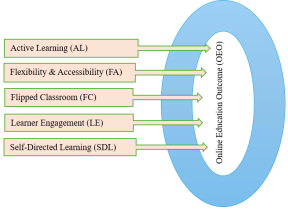
The conceptual framework of this study illustrates the relationship between the independent variables learner engagement, flexibility and accessibility of the learning platform, type of instructional approach, use of collaborative and active learning methods, and learner autonomy and the dependent variable, learning outcomes in online education. The framework proposes that these five factors positively influence students’ knowledge acquisition, skill development, and academic performance in an online learning environment. Each independent variable represents a critical dimension of the online learning experience, contributing individually and collectively to improving educational effectiveness. The model further assumes that when learners are actively engaged, supported by accessible platforms, exposed to effective teaching strategies, involved in collaborative activities, and capable of self-directed learning, they are more likely to achieve better learning outcomes. This framework, therefore, provides a structured basis for testing the hypothesized relationships through empirical analysis.
Figure 1. Conceptual Framework.
3. Materials and Methods
This study adopts a quantitative research approach to examine the factors influencing learning outcomes in online education. The quantitative method is appropriate because it allows for the systematic collection and statistical analysis of data to test the hypothesized relationships between variables. A cross-sectional survey design is used, where data are collected from respondents at a single point in time to assess their perceptions of online learning experiences.
The target population of the study consists of 900 students participating in online education programs. A sample of respondents is selected using a simple random sampling technique to ensure that each individual has an equal chance of being included in the study. Data are collected using a structured questionnaire based on a 5-point Likert scale (1 = Strongly Disagree to 5 = Strongly Agree). The questionnaire includes items measuring one dependent variable (learning outcomes) and five independent variables (learner engagement, flexibility and accessibility of the platform, instructional approach, collaborative learning methods, and learner autonomy). The instrument is designed based on established literature to ensure content validity.
Table 1. Reliability Statistics.
Cronbach's Alpha | N of Items |
.766 | 6 |
Source: Survey results, 2026
To ensure the quality of data, validity and reliability tests are conducted. Content validity is assured through expert review, while Cronbach’s alpha is used to test the reliability of the measurement scales, with a threshold value of 0.70 considered acceptable (see
Table 1). In this study, factor analysis is used mainly to test construct validity, which includes convergent validity and discriminant validity. A sampling adequacy test was conducted using Kaiser-Meyer-Olkin (KMO). See
Table 2 below.
Table 2. KMO and Bartlett's Test.
KMO and Bartlett's Test |
Kaiser-Meyer-Olkin Measure of Sampling Adequacy. | .783 |
Bartlett's Test of Sphericity | Approx. Chi-Square | 1590.208 |
Df | 15 |
Sig. | .000 |
Source: Survey results, 2026
Construct validity was assessed using Exploratory Factor Analysis (EFA). The KMO value of 0.783 and the significant Bartlett's Test of Sphericity (p < 0.001) confirmed that the data were suitable for factor analysis, thereby supporting the construct validity of the measurement model. In addition to the KMO, the Total Variance Explained and Rotated Component Matrix tables are below:
Table 3. Total Variance Explained.
Component | Initial Eigenvalues | Extraction Sums of Squared Loadings | Rotation Sums of Squared Loadings |
Total | % of Variance | Cumulative% | Total | % of Variance | Cumulative% | Total | % of Variance | Cumulative% |
1 | 2.898 | 48.293 | 48.293 | 2.898 | 48.293 | 48.293 | 2.882 | 48.038 | 48.038 |
2 | 1.177 | 19.618 | 67.911 | 1.177 | 19.618 | 67.911 | 1.192 | 19.874 | 67.911 |
3 | .698 | 11.634 | 79.545 | | | | | | |
4 | .503 | 8.387 | 87.932 | | | | | | |
5 | .424 | 7.075 | 95.007 | | | | | | |
6 | .300 | 4.993 | 100.000 | | | | | | |
Extraction Method: Principal Component Analysis. |
Source: Survey results, 2026
The Total Variance Explained results in
Table 3 revealed that two components had eigenvalues greater than 1 and were retained for further analysis. These components jointly explained 67.911% of the total variance, exceeding the recommended minimum threshold of 60%. This indicates that the extracted factors adequately capture the variance among the study variables and provide evidence of satisfactory construct validity. Therefore, the factor structure was considered appropriate for investigating the factors influencing learning outcomes in online education.
Table 4. Rotated Component Matrix.
Rotated Component Matrixa | Component |
1 | 2 |
Outcomes in online education | .844 | .260 |
Flipped Classroom | .765 | |
Learner engagement | .824 | |
Flexibility and accessibility | .761 | -.261 |
Active learning | | .894 |
self-directed learning | .565 | .460 |
Extraction Method: Principal Component Analysis. Rotation Method: Varimax with Kaiser Normalization. |
a. Rotation converged in 3 iterations. |
Source: Survey results, 2026
The rotated component matrix showed that all study variables loaded significantly on their respective factors with factor loadings above 0.50. This provides evidence of construct validity, particularly convergent validity, as variables designed to measure related concepts clustered together on common factors. The two-factor solution explains 67.911% of the total variance, confirming that the measurement model is valid and suitable for further analysis.
The collected data are analysed using statistical software such as SPSS. Descriptive statistics (mean, frequency, standard deviation) are used to summarize respondent characteristics, while inferential analysis, including correlation and multiple regression analysis, is applied to test the hypotheses. Regression analysis helps determine the strength and significance of the relationship between independent variables and learning outcomes. The findings are presented in tables and interpreted to draw conclusions and recommendations.
4. Results
Out of the 900 online learning students targeted for this study, 849 students successfully participated, yielding a response rate of 94.3%. This exceptionally high response rate indicates strong participant engagement and provides a robust dataset for analysis. According to survey research standards, response rates above 70% are generally considered adequate for minimizing non-response bias and enhancing the representativeness of the findings. Therefore, the 94.3% response rate achieved in this study suggests that the results are highly reliable and can be considered reflective of the perceptions and experiences of the online learning student population under investigation. The remaining 51 students (5.7%) did not participate or provided incomplete responses and were excluded from the final analysis.
Table 5. Descriptive Statistics.
Variables | N | MinV | MaxV | Mean | Std. Dev |
OEO | 849 | 1 | 5 | 2.8257 | 1.18371 |
FC | 849 | 1 | 5 | 2.9743 | 1.11125 |
LE | 849 | 1 | 5 | 2.7621 | 1.16247 |
FA | 849 | 1 | 5 | 2.9788 | 1.29295 |
AL | 849 | 1 | 5 | 4.706 | .6030 |
SDL | 849 | 1 | 5 | 2.7691 | 1.20276 |
Survey results, 2026
Based on the descriptive statistics in
Table 5, of 849 respondents, Outcomes in Online Education (OEO) recorded a mean score of 2.83 (SD = 1.18), indicating a moderate level of learning outcomes among participants. Among the independent variables, Active Learning (AL) demonstrated the highest mean score (M = 4.71, SD = 0.60), suggesting that respondents strongly perceived active learning practices in their online education experience and that responses were relatively consistent. Flexibility and Accessibility (FA) (M = 2.98, SD = 1.29) and Flipped Classroom (FC) (M = 2.97, SD = 1.11) showed moderate average ratings, indicating a reasonable presence of these factors in the learning environment. Meanwhile, Learner Engagement (LE) (M = 2.76, SD = 1.16) and Self-Directed Learning (SDL) (M = 2.77, SD = 1.20) received comparatively lower mean scores, reflecting moderate to below-average perceptions among respondents. Overall, the findings suggest that while active learning is strongly practiced in online education settings, other factors such as learner engagement, self-directed learning, flexibility and accessibility, and flipped classroom approaches exhibit moderate levels and may influence the overall learning outcomes experienced by students.
Table 6. Correlation Analysis.
Variables | OEO | FC | LE | FA | AL | SDL |
OEO | 1 | | | | | |
FC | .602** | 1 | | | | |
LE | .604** | .517** | 1 | | | |
FA | .498** | .457** | .565** | 1 | | |
AL | .110** | .055 | -.134** | -.149** | 1 | |
SDL | .534** | .324** | .316** | .251** | .134** | 1 |
**. Correlation is significant at the 0.01 level (2-tailed). |
Source: Survey result, 2026
The correlation analysis in
Table 6 indicates that Outcomes in Online Education (OEO) have significant positive relationships with all the main independent variables at the 0.01 level. The strongest correlations with OEO were found for Learner Engagement (LE) (r =.604) and Flipped Classroom (FC) (r =.602), suggesting that higher levels of engagement and effective flipped classroom practices are associated with better online learning outcomes. Self-Directed Learning (SDL) (r =.534) and Flexibility and Accessibility (FA) (r =.498) also showed moderate positive correlations with OEO, indicating that students who can learn independently and access learning resources flexibly tend to achieve better outcomes. In contrast, Active Learning (AL) (r =.110) exhibited a weak but statistically significant positive relationship with OEO. Among the independent variables, significant positive associations were observed between FC, LE, FA, and SDL. At the same time, AL showed weak negative correlations with LE (r = -.134) and FA (r = -.149), and a weak positive correlation with SDL (r =.134). Overall, the findings suggest that learner engagement, flipped classroom strategies, self-directed learning, and flexibility and accessibility are important factors associated with improved online education outcomes, with learner engagement and flipped classroom practices showing the strongest relationships.
Table 7. Model Summary Interpretation.
Model | R | R Square | Adjusted R-Square | Std. Error of the Estimate |
1 | .770a | .592 | .590 | .75811 |
Source: Survey results, 2026
The model summary results in
Table 7 indicate a strong and reliable regression model. Specifically, the correlation coefficient (R = 0.770) shows a strong positive relationship between the independent variables—self-directed learning, instructional approach, flexibility and accessibility, and learner engagement and online education outcomes. The coefficient of determination (R Square = 0.592) reveals that approximately 59.2% of the variation in online education outcomes is explained by these predictors, demonstrating moderate to high explanatory power. Additionally, the Adjusted R Square (0.590) remains very close to R Square, indicating that the model is stable and not overfitted despite multiple predictors. The standard error of the estimate (0.758) is relatively low, suggesting that the model’s predictions are reasonably accurate. Overall, these results confirm that the regression model is strong and reliable in explaining the determinants of online education outcomes.
Table 8. ANOVA Table Interpretation.
Model | Sum of Squares | Df | Mean Square | F | Sig. |
1 | Regression | 703.699 | 5 | 140.740 | 244.878 | .000b |
Residual | 484.501 | 843 | .575 | | |
Total | 1188.200 | 848 | | | |
Source: Survey results, 2026
The ANOVA
Table 8 results indicate that the overall regression model is statistically significant, with F (5, 843) = 244.878 and p =.000, which is well below the 0.05 threshold. This demonstrates that the independent variables self-directed learning, instructional approach, flexibility and accessibility, and learner engagement—collectively have a significant effect on online education outcomes. The high F-value further suggests that the model has strong explanatory power, meaning the predictors reliably account for variation in the dependent variable. Overall, these findings confirm that the regression model provides a good fit to the data and significantly explains changes in online education outcomes.
Table 9. Regression Coefficients Table Interpretation.
Model | Unstandardized Coefficients | Standardized Coefficients | t | Sig. |
B | Std. Error | Beta |
1 | Constant | -1.176 | .229 | | -5.134 | .000 |
FC | .228 | .045 | .116 | 5.057 | .000 |
LE | .307 | .030 | .301 | 10.354 | .000 |
FA | .131 | .025 | .143 | 5.155 | .000 |
AL | .297 | .029 | .279 | 10.260 | .000 |
SDL | .293 | .024 | .297 | 12.375 | .000 |
a. Dependent Variable: outcomes in online education |
Source: Survey results, 2026
Table 9 shows that all independent variables have a positive and statistically significant influence on online education outcomes (p =.000 for all variables). The constant value (-1.176) indicates the baseline level of the outcome when all predictors are zero, though it has limited practical interpretation. Among the predictors, self-directed learning (β = 0.297) and learner engagement (β = 0.301) are the strongest contributors, indicating that students who actively manage their learning and engage more deeply tend to achieve better outcomes. The use of collaborative and active learning methods (β = 0.279) also plays a substantial role, suggesting that interactive teaching strategies significantly enhance learning results. Additionally, flexibility and accessibility (β = 0.143) and type of instructional approach (β = 0.116) have moderate yet significant positive effects. Overall, the regression results demonstrate that all included variables meaningfully contribute to improving online education outcomes, with learner engagement and self-directed learning being the most influential factors.
5. Discussion
Empirical studies consistently demonstrate that self-directed learning has a significant positive impact on online learning outcomes, including academic performance, learner satisfaction, and course completion. For instance, studies
| [1] | Baliram, N., Henrikson, R. Student Perceptions of the Vital Role of Engagement in Online Learning. Journal of Open, Flexible and Distance Learning. 2025, 29(1), 109-131.
https://doi.org/10.61468/jofdl.v29i1.709 |
| [2] | Eom, S. B., Ashill, N. The Determinants of Students' Perceived Learning Outcomes and Satisfaction in University Online Education: An Update. Decision Sciences Journal of Innovative Education. 2016, 14, 185-215.
https://doi.org/10.1111/dsji.12097 |
| [3] | Pérez-Pérez, M., Serrano-Bedia, A. M., García-Piqueres, G. An Analysis of Factors Affecting Students' Perceptions of Learning Outcomes with Moodle. Journal of Further and Higher Education. 2020, 44(8), 1114-1129.
https://doi.org/10.1080/0309877X.2019.1664730 |
| [4] | Dong, X., Yuan, H., Xue, H., Li, Y., Jia, L., Chen, J., Zhang, X. Factors Influencing College Students' Self-Regulated Learning in an Online Learning Environment: A Systematic Review. Nurse Education Today. 2024, 133.
https://doi.org/10.1016/j.nedt.2023.106071 |
| [5] | Maheshwari, G. Factors Affecting Students' Intentions to Undertake Online Learning: An Empirical Study in Vietnam. Education and Information Technologies. 2021, 26, 6629-6649. https://doi.org/10.1007/s10639-021-10465-8 |
[1-5]
found that online self-directed learning readiness is positively associated with students’ grades and overall satisfaction, suggesting that learners who take responsibility for planning, monitoring, and regulating their learning achieve better educational outcomes.
Similarly, learner engagement has been identified as one of the strongest predictors of success in online education. Research indicates that engaged learners are more likely to achieve higher academic performance, persist in their studies, and report greater satisfaction with the learning experience. A systematic review by
| [4] | Dong, X., Yuan, H., Xue, H., Li, Y., Jia, L., Chen, J., Zhang, X. Factors Influencing College Students' Self-Regulated Learning in an Online Learning Environment: A Systematic Review. Nurse Education Today. 2024, 133.
https://doi.org/10.1016/j.nedt.2023.106071 |
[4]
highlighted learner engagement as a critical indicator of learning quality and a key determinant of student achievement and retention in online learning environments.
Evidence also suggests that flexibility and accessibility play an important role in enhancing online learning outcomes by increasing participation and satisfaction. Studies
reported that students prefer online learning because it accommodates their personal schedules, work commitments, and geographical constraints, thereby facilitating continuous engagement and learning.
Furthermore, active learning methods have been shown to significantly improve student engagement and academic achievement. Research
| [4] | Dong, X., Yuan, H., Xue, H., Li, Y., Jia, L., Chen, J., Zhang, X. Factors Influencing College Students' Self-Regulated Learning in an Online Learning Environment: A Systematic Review. Nurse Education Today. 2024, 133.
https://doi.org/10.1016/j.nedt.2023.106071 |
| [5] | Maheshwari, G. Factors Affecting Students' Intentions to Undertake Online Learning: An Empirical Study in Vietnam. Education and Information Technologies. 2021, 26, 6629-6649. https://doi.org/10.1007/s10639-021-10465-8 |
| [6] | Gagné, R. M. The Conditions of Learning and Theory of Instruction. 4th ed. Holt, Rinehart & Winston. 1985.
https://doi.org/10.1007/978-1-4613-3618-5 |
| [7] | Hrastinski, S. A Theory of Online Learning as Online Participation. Computers & Education. 2009, 52(1), 78-82.
https://doi.org/10.1016/j.compedu.2008.06.009 |
| [8] | Hu, J., Xiao, W. What Are the Influencing Factors of Online Learning Engagement? A Systematic Literature Review. Frontiers in Psychology. 2025, 16, 1542652.
https://doi.org/10.3389/fpsyg.2025.1542652 |
[4-8]
indicates that active and collaborative learning approaches promote interaction, critical thinking, and knowledge construction. In particular, active learning strategies were found to increase student engagement substantially and improve knowledge retention by up to 54%, demonstrating their effectiveness in supporting student success.
Finally, empirical evidence highlights the importance of instructional approaches, particularly the flipped classroom model, in enhancing online education outcomes. Studies show that well-designed instructional strategies encourage active participation, collaboration, and deeper understanding of course content. The flipped classroom approach allows students to engage with learning materials before class and participate in interactive activities during instructional sessions, leading to improved learning performance and satisfaction. Collectively, these findings support the significance of learner engagement, self-directed learning, active learning methods, flipped classroom approaches, flexibility, and accessibility as key determinants of successful online education outcomes.
6. Conclusions
This study concludes that online education outcomes are significantly influenced by learner engagement, self-directed learning, Active Learning Methods, flipped classroom, flexibility, and accessibility. The findings indicate that all these factors positively contribute to learning success, with learner engagement and self-directed learning emerging as the strongest predictors of positive outcomes. Students who actively participate in learning activities and effectively manage their own learning processes are more likely to achieve better academic performance in online environments. The results also demonstrate that collaborative and active learning approaches enhance the effectiveness of online education by promoting interaction, participation, and deeper understanding of course content. Furthermore, flexible and accessible learning environments support student achievement by accommodating diverse learning needs and circumstances. Overall, the study highlights the importance of fostering active engagement, encouraging learner autonomy, implementing effective instructional strategies, and maintaining accessible online learning systems to improve educational outcomes. These findings provide valuable guidance for educators, institutions, and policymakers seeking to enhance the quality, effectiveness, and sustainability of online education.
Abbreviations
AL | Active Learning |
FA | Flexibility and Accessibility |
FC | Flipped Classroom |
LE | Learner Engagement |
OEO | Online Education Outcome |
SDL | Self-Directed Learning |
Author Contributions
Kanbiro Orkaido Deyganto: Data curation, Formal Analysis, Methodology, Validation, Writing – review & editing
Edward Lambert: Conceptualization, Investigation, Resources, Writing – original draft
Data Availability Statement
The data are available from the corresponding author upon reasonable request.
Conflicts of Interest
The authors declare no conflicts of interest.
References
| [1] |
Baliram, N., Henrikson, R. Student Perceptions of the Vital Role of Engagement in Online Learning. Journal of Open, Flexible and Distance Learning. 2025, 29(1), 109-131.
https://doi.org/10.61468/jofdl.v29i1.709
|
| [2] |
Eom, S. B., Ashill, N. The Determinants of Students' Perceived Learning Outcomes and Satisfaction in University Online Education: An Update. Decision Sciences Journal of Innovative Education. 2016, 14, 185-215.
https://doi.org/10.1111/dsji.12097
|
| [3] |
Pérez-Pérez, M., Serrano-Bedia, A. M., García-Piqueres, G. An Analysis of Factors Affecting Students' Perceptions of Learning Outcomes with Moodle. Journal of Further and Higher Education. 2020, 44(8), 1114-1129.
https://doi.org/10.1080/0309877X.2019.1664730
|
| [4] |
Dong, X., Yuan, H., Xue, H., Li, Y., Jia, L., Chen, J., Zhang, X. Factors Influencing College Students' Self-Regulated Learning in an Online Learning Environment: A Systematic Review. Nurse Education Today. 2024, 133.
https://doi.org/10.1016/j.nedt.2023.106071
|
| [5] |
Maheshwari, G. Factors Affecting Students' Intentions to Undertake Online Learning: An Empirical Study in Vietnam. Education and Information Technologies. 2021, 26, 6629-6649.
https://doi.org/10.1007/s10639-021-10465-8
|
| [6] |
Gagné, R. M. The Conditions of Learning and Theory of Instruction. 4th ed. Holt, Rinehart & Winston. 1985.
https://doi.org/10.1007/978-1-4613-3618-5
|
| [7] |
Hrastinski, S. A Theory of Online Learning as Online Participation. Computers & Education. 2009, 52(1), 78-82.
https://doi.org/10.1016/j.compedu.2008.06.009
|
| [8] |
Hu, J., Xiao, W. What Are the Influencing Factors of Online Learning Engagement? A Systematic Literature Review. Frontiers in Psychology. 2025, 16, 1542652.
https://doi.org/10.3389/fpsyg.2025.1542652
|
| [9] |
Kahu, E. R. Framing Student Engagement in Higher Education. Studies in Higher Education. 2013, 38(5), 758-773.
https://doi.org/10.1080/03075079.2011.598505
|
| [10] |
Knowles, M. S. Self-Directed Learning: A Guide for Learners and Teachers. Association Press. 1975.
https://doi.org/10.4324/9781315044303
|
| [11] |
Ren, W., Wang, R., Azlan, S. N., Mao, C. Factors Influencing Students' Learning Satisfaction and Students' Learning Outcomes in Blended Learning. International Journal of Education and Practice. 2024, 12(1), 95-108.
https://doi.org/10.18488/61.v12i1.3624
|
| [12] |
Moore, J. L., Dickson-Deane, C., Galyen, K. e-Learning, Online Learning, and Distance Learning Environments: Are They the Same? The Internet and Higher Education. 2011, 14(2), 129-135.
https://doi.org/10.1016/j.iheduc.2010.10.001
|
| [13] |
Ulfa, S., Fatawi, I. Predicting Factors That Influence Students' Learning Outcomes Using Learning Analytics in an Online Learning Environment. International Journal of Emerging Technologies in Learning (iJET). 2021, 16(1), 4-17.
|
| [14] |
McLeod, S. Vygotsky's Theory of Cognitive Development. Simply Psychology. 2025.
https://doi.org/10.5281/zenodo.15680745
|
| [15] |
Allen, I. E., Seaman, J. Learning on Demand: Online Education in the United States, 2009. Sloan Consortium. 2010.
|
| [16] |
Hashmi, Z. F., Iqbal, J., Asghar, M. Z., Siming, L. The Influence of Online Learning Interactions on Self-Regulated Learning: Mediating Role of Technology Proficiencies Among Higher Education Students. Open Learning: The Journal of Open, Distance and e-Learning. 2026, 41(1), 41-66.
https://doi.org/10.1080/02680513.2025.2492657
|
Cite This Article
-
-
@article{10.11648/j.iedu.20260104.11,
  author = {Kanbiro Orkaido Deyganto and Edward Lambert},
  title = {Factors Influencing Learning Outcomes in Online Education Environments},
  journal = {Innovation Education},
  volume = {1},
  number = {4},
  pages = {197-205},
  doi = {10.11648/j.iedu.20260104.11},
  url = {https://doi.org/10.11648/j.iedu.20260104.11},
  eprint = {https://article.sciencepublishinggroup.com/pdf/10.11648.j.iedu.20260104.11},
  abstract = {This study investigates the factors influencing online education outcomes, focusing on learner engagement, self-directed learning, active learning methods, the flipped classroom approach, flexibility, and accessibility. Using a quantitative research design, the study examined the extent to which these factors contribute to successful online learning outcomes. Data were collected through an online survey administered to students enrolled in online universities. SPSS version 23 was used to run data analysis. Of the 900 questionnaires distributed, 849 valid responses were received, resulting in a response rate of 94.3%. Multiple regression analysis was employed to test the proposed hypotheses and assess the relationships between the independent variables and online education outcomes. The findings indicate that all five factors exert a positive and statistically significant influence on online education outcomes, supporting the proposed hypotheses. The regression model explained 59.2% of the variance in online education outcomes (R2 = 0.592), demonstrating strong explanatory power. Learner engagement (β = 0.301) and self-directed learning (β = 0.297) emerged as the most influential predictors, highlighting the importance of active participation and autonomous learning behaviors. Active learning methods (β = 0.279) also significantly enhanced learning effectiveness, while the flipped classroom approach, flexibility, and accessibility showed positive and significant contributions. The results emphasize the need for learner-centered, interactive, flexible, and accessible online learning environments. These findings provide valuable implications for educators, institutions, and policymakers seeking to improve the quality and effectiveness of online education.},
 year = {2026}
}
 Copy
|
 Download
-
TY  - JOUR
T1  - Factors Influencing Learning Outcomes in Online Education Environments
AU  - Kanbiro Orkaido Deyganto
AU  - Edward Lambert
Y1  - 2026/11/19
PY  - 2026
N1  - https://doi.org/10.11648/j.iedu.20260104.11
DO  - 10.11648/j.iedu.20260104.11
T2  - Innovation Education
JF  - Innovation Education
JO  - Innovation Education
SP  - 197
EP  - 205
PB  - Science Publishing Group
SN  - 3071-494X
UR  - https://doi.org/10.11648/j.iedu.20260104.11
AB  - This study investigates the factors influencing online education outcomes, focusing on learner engagement, self-directed learning, active learning methods, the flipped classroom approach, flexibility, and accessibility. Using a quantitative research design, the study examined the extent to which these factors contribute to successful online learning outcomes. Data were collected through an online survey administered to students enrolled in online universities. SPSS version 23 was used to run data analysis. Of the 900 questionnaires distributed, 849 valid responses were received, resulting in a response rate of 94.3%. Multiple regression analysis was employed to test the proposed hypotheses and assess the relationships between the independent variables and online education outcomes. The findings indicate that all five factors exert a positive and statistically significant influence on online education outcomes, supporting the proposed hypotheses. The regression model explained 59.2% of the variance in online education outcomes (R2 = 0.592), demonstrating strong explanatory power. Learner engagement (β = 0.301) and self-directed learning (β = 0.297) emerged as the most influential predictors, highlighting the importance of active participation and autonomous learning behaviors. Active learning methods (β = 0.279) also significantly enhanced learning effectiveness, while the flipped classroom approach, flexibility, and accessibility showed positive and significant contributions. The results emphasize the need for learner-centered, interactive, flexible, and accessible online learning environments. These findings provide valuable implications for educators, institutions, and policymakers seeking to improve the quality and effectiveness of online education.
VL  - 1
IS  - 4
ER  -
Copy
|
Download







 Share This Article
 Twitter
 Linked In
 Facebook