
In response to the dilemmas in traditional rural landscape design education, this study takes Henggang Village, a typical Jiangnan watertown in Jiaxing, as a practical carrier to explore a data-driven teaching reform model integrating landscape narration, sensory experience and aesthetic perception. Based on field surveys and questionnaire data from 330 visitors, this research constructs an integrated evaluation system by combining the Activity-setting-Experience-Benefit (AESB) and Plot-Experience-Assessment-Reflection (PEAR) models, and systematically analyzes tourists’ demographic features, behavioral preferences, spatial perceptions and experiential feedback. The findings indicate that visitors highly appreciate the natural scenery, artistic spaces and humanistic environment of Henggang Village, while the perception of folk customs and historical context remains weak, and the interactivity of cultural activities and some functional landscapes needs improvement. Accordingly, this study proposes a closed-loop teaching framework of “narrative theory–case analysis–investigation–design optimization”, which effectively addresses the deficiencies of conventional courses such as overemphasis on form rather than connotation and insufficient practical training. This teaching mode enhances students’ abilities in cultural translation, spatial narration and evidence-based design innovation, provides a replicable paradigm for rural landscape curriculum reform, and offers empirical support for the sustainable development of rural cultural tourism.
| Published in | Humanities and Social Sciences (Volume 14, Issue 3) |
| DOI | 10.11648/j.hss.20261403.20 |
| Page(s) | 288-296 |
| Creative Commons |
This is an Open Access article, distributed under the terms of the Creative Commons Attribution 4.0 International License (http://creativecommons.org/licenses/by/4.0/), which permits unrestricted use, distribution and reproduction in any medium or format, provided the original work is properly cited. |
| Copyright |
Copyright © The Author(s), 2026. Published by Science Publishing Group |
Poetic Countryside, Landscape Narrative, Experience Research, Rural Landscape Design
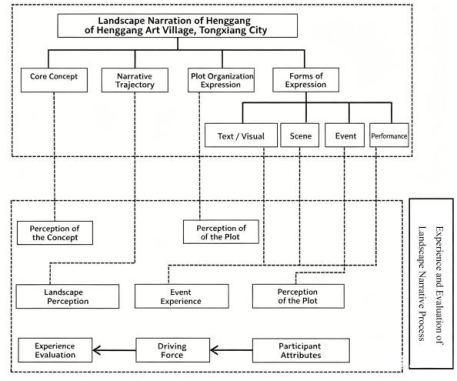
Number | Category | Subcategory | Expression way | Text/Pattern Options |
|---|---|---|---|---|
1 | Theme Connotation | Core Theme | Literal Description | Historical Culture and Rural Characteristics & Style |
Auxiliary Theme | Picture Display | Ancient Architecture, Traditional Cultural Activities | ||
2 | Narrative clue | Time Clue | Timeline Display | Timeline from tradition to modernity |
Spatial Clue | Map Annotation | Geographical Location and Scenic Spot Distribution | ||
3 | Plot Arrangement | Setup, Development, Turn, Resolution | Plot Description | Preliminary Impression, Experience Change, Feelings and Memories |
Climax Node | Highlight Display | Scenic Spots or Activities, Emotional Resonance | ||
4 | Viewer Experience Based on Landscape Narrative | Viewer Perception | Theme and Plot Perception | Satisfaction with plot arrangement |
Viewer Experience | Scenic Spot, Environment, Activity Narrative | Scenic Spot Evaluation, Environmental Perception, Participation and Preference | ||
5 | Basic Characteristics of Viewers | Viewer Feedback | Satisfaction and Suggestions | Visitor satisfaction, improvement suggestions and expectations. |
Basic Information Collection | Age, gender, occupation, travel purposes and expectations. | |||
6 | Viewer Motivation | Motivation Survey | Analyze visitors' motives and interests in Henggang Village. |
Category | Theme Description Vocabulary | Frequency(N=330) | Frequency |
|---|---|---|---|
Narrative Theme | Pastoral Culture: Duck Farm / Sericulture / Rice Farming Culture Folk Story Themes: Folk Customs / Folk Dwellings / Dyeing Workshop / Craft Workshop / Performances (Cross-talk / Acrobatics) / Bamboo Weaving | 125 | 37.9% |
30 | 9.0% | ||
Environmental Elements | Nature Category: Water source / Trees and shrubs / Farmland / Plants Culture Category: Jiangnan folk dwellings / Chinese style / Retro / Simple and quaint / Ancient / Alley / Courtyard / Ancient charm | 197 | 59.7% |
72 | 21.0% | ||
Overall Atmosphere | Modern Fashion: Diversified / Ambiance / Slow Life / Nostalgia Beautiful Environment: Elegant / Distant / Secluded / Clean / Fresh / Serene omfortable Sensation: Quiet / Tranquil / Easy / Leisurely / Comfortable / Relaxed | 123 | 37.3% |
197 | 59.7% | ||
185 | 56.1% | ||
72 | 21.8% | ||
121 | 36.7% |
Option | Project Description | 1 | 2 | 3 | 4 | 5 | Mean |
|---|---|---|---|---|---|---|---|
Little Duck Station | Duck Station: Henggang Village's visitor center rebuilt from an old shed. | 4.1 | 3.0 | 19.9 | 25.8 | 39.5 | 3.70 |
Shadow Puppetry Museum | Rural old houses regain new vitality via traditional elements. | 3.3 | 4.1 | 19.9 | 27.3 | 34.7 | 3.54 |
Henggang Academy | Once a Qing private school, now a venue for culture and education. | 2.6 | 5.9 | 17.0 | 26.6 | 38.4 | 3.63 |
Artist Studio | Scattered in the village, each studio boasts unique design and vibe. | 1.8 | 10.3 | 20.7 | 10.3 | 34.3 | 2.97 |
Henggang Restaurant | Rural and modern styles merge in the restaurant’s dining space. | 3.0 | 5.9 | 26.9 | 20.3 | 32.5 | 3.39 |
Option | Descriptive item | 1 | 2 | 3 | 4 | 5 | Mean |
|---|---|---|---|---|---|---|---|
Dream-seeking in Water Town | The design combines steel and stone to create layered mountain-like forms and undulating steps. | 2.3 | 4.7 | 20.7 | 21.5 | 27.7 | 2.98 |
Henggang Grid | Extract Mondrian’s line-plane composition and blend it with Henggang Village’s story to forge a new artistic structure. | 4.5 | 5.8 | 17.8 | 29.2 | 32.0 | 3.46 |
Corridor of Time | Combine roadside blue bricks with glass blocks for layered light and shadow space. | 0.7 | 6.8 | 23.1 | 21.2 | 33.5 | 3.36 |
Cultural and Creative Bridge, Zhoumu Bridge | Windmills and acrylic refraction endow the bridge with vivid light, shadow and sound. | 0.9 | 5.2 | 24.3 | 20.9 | 35.5 | 3.45 |
Environmental Experience and Benefit Items | Mean |
|---|---|
01-Exquisitely laid-out buildings and courtyards are ideal for photography. | 4.32 |
02-Superior farmland and water landscapes with diverse plants bring aesthetic enjoyment. | 4.52 |
03-Distinct spatial decoration creates a strong cultural atmosphere. | 3.53 |
04-Rustic countryside lacks cultural depth and historical vibe. | 4.01 |
Activity Experience Items | Mean |
|---|---|
01-Visiting Xiaoyang Station and Henggang Bookstore arouses nostalgia for the past. | 4.01 |
02-Rich interactive DIY activities are fun and enrich folk experience. | 3.01 |
03-Excellent shows delight people and enrich cultural cognition. | 3.11 |
04-Leisure relaxation via reading, tea break and foot bath. | 3.87 |
Item | Educational background | Monthly income |
|---|---|---|
01-Evaluation of Commercial Space and Workshop Cultural Activities | -.280 | -.197 |
03-Performance & DIY Cultural Activity Evaluation | -.210 | -.170 |
Item | Educational Background | Monthly income |
|---|---|---|
01-Architectural Style Environment Evaluation | -.280 | -.197 |
02-# Pastoral Natural Environment Evaluation | -.301 | -.120 |
AESB | The Activity-setting-Experience-Benefit |
PEAR | The Plot-Experience-Assessment-Reflection |
| [1] | Qin, K., Meng, X. B., Liu, L. M., et al. Research on the Creation of Rural Landscape Imagery from the Aesthetic Perspective of Traditional Chinese Culture. Chinese Landscape Architecture, 2022, 38(6), 18–22. |
| [2] | Xue, L. A Review and Enlightenment of Foreign Research on Rural Amenity. Progress in Geography, 2020, 39(12), 2129–2138. |
| [3] | Wu, X. Y., Liang, X. C., Song, H. Users' Sensory Experience: Research Review and Prospect. Tourism Tribune, 2023, 7(5), 94–119. |
| [4] | Long, Y. L., Wu, J. A Review of Domestic and Foreign Research on the Application of Aesthetic Experience in Tour-ism. Tourism Perspectives, 2020, 4(3), 87–104. |
| [5] | Li, X. M., Li, X. L., Shi, P. F., et al. Research on the Integration Path of Rural Culture and Tourism Based on the Decoding of Nostalgia Cultural Genes. Journal of Southwest University (Social Science Edition), 2024, 50(1), 156–164. |
| [6] | Ding, K., Zhao, S. S. Exploration on Integrating Spiritual Ecological Aesthetic Education into the Teaching of Landscape Design Series Courses. Chinese Forestry Education, 1–5. |
| [7] | Yang, X. J., Song, Z. T., Liu, Y. C. Strategies for RuralLandscape Space Construction Based on the Smart Village Concept—A Case Study of Henggang Village in Wuzhen. Decoration, 2017, (10), 136–137. |
| [8] | Lu, S. M. Architectural Narratology: From Space to Place. Beijing: China Architecture & Building Press, 2019. |
| [9] | Duan, J. Spatial Narratology: From Architecture to the City. Nanjing: Southeast University Press, 2014. |
| [10] | L&A Design. Henggang International Art Village: Village Revitalization through Art and the Construction of Land-scape Narrative System. Beijing: China Architecture & Building Press, 2020. |
| [11] | Lin, J. Y., Li, X., Wu, X. G. Application of Landscape Narratives in the Construction of Beautiful Countryside. Journal of Chinese Urban Forestry, 2020, 18(2), 25–29. |
| [12] | Zhu Shengxuan Studio. Dream-seeking in Water Towns: The Whole-process Design of High-quality Beautiful Rural Routes in Henggang Village and Beizhuang Village, Wuzhen. Tongxiang: Tongxiang Bureau of Agriculture and Rural Af-fairs, 2020. |
| [13] | Li, F. Y., Yan, J., Zheng, Z. Analysis on the Development Model of Rural Community—Taking the Local Practice of Henggang Village as an Example. Chinese Landscape Architecture, 2018, 34(5), 5–10. |
| [14] | Zhang, L. Y., Li, N., Liu, M. Basic Concepts and Theoretical System of Smart Tourism. Tourism Tribune, 2012, 27(5), 66–73. |
| [15] | Wei, S. N., Fu, Y. H. Research on Vitality Improvement Strategies of Rural Public Space—Taking Xiushui Village, Chashan Village and Fuxi Village of Fuchuan Yao Autonomous County in Hezhou City as Examples. Guangxi Urban Con-struction, 2025, (9), 60–68. |
| [16] | Mao, H. S., Wu, M. X., Hu, B. Research on Cultural Information Interpretation and Narrative Landscape Recon-struction of Traditional Ancient Towns—Taking Mudong Town of Banan District as an Example. Landscape Architecture, 2020, (11), 50–55. |
APA Style
Yancheng, Q., Mengyun, M. (2026). Narrative Experience Integration in Landscape Design Curriculum: A Case Study of Jiaxing Henggang Art Village. Humanities and Social Sciences, 14(3), 288-296. https://doi.org/10.11648/j.hss.20261403.20
ACS Style
Yancheng, Q.; Mengyun, M. Narrative Experience Integration in Landscape Design Curriculum: A Case Study of Jiaxing Henggang Art Village. Humanit. Soc. Sci. 2026, 14(3), 288-296. doi: 10.11648/j.hss.20261403.20
@article{10.11648/j.hss.20261403.20,
  author = {Qi Yancheng and Ma Mengyun},
  title = {Narrative Experience Integration in Landscape Design Curriculum: A Case Study of Jiaxing Henggang Art Village},
  journal = {Humanities and Social Sciences},
  volume = {14},
  number = {3},
  pages = {288-296},
  doi = {10.11648/j.hss.20261403.20},
  url = {https://doi.org/10.11648/j.hss.20261403.20},
  eprint = {https://article.sciencepublishinggroup.com/pdf/10.11648.j.hss.20261403.20},
  abstract = {In response to the dilemmas in traditional rural landscape design education, this study takes Henggang Village, a typical Jiangnan watertown in Jiaxing, as a practical carrier to explore a data-driven teaching reform model integrating landscape narration, sensory experience and aesthetic perception. Based on field surveys and questionnaire data from 330 visitors, this research constructs an integrated evaluation system by combining the Activity-setting-Experience-Benefit (AESB) and Plot-Experience-Assessment-Reflection (PEAR) models, and systematically analyzes tourists’ demographic features, behavioral preferences, spatial perceptions and experiential feedback. The findings indicate that visitors highly appreciate the natural scenery, artistic spaces and humanistic environment of Henggang Village, while the perception of folk customs and historical context remains weak, and the interactivity of cultural activities and some functional landscapes needs improvement. Accordingly, this study proposes a closed-loop teaching framework of “narrative theory–case analysis–investigation–design optimization”, which effectively addresses the deficiencies of conventional courses such as overemphasis on form rather than connotation and insufficient practical training. This teaching mode enhances students’ abilities in cultural translation, spatial narration and evidence-based design innovation, provides a replicable paradigm for rural landscape curriculum reform, and offers empirical support for the sustainable development of rural cultural tourism.},
 year = {2026}
}
TY  - JOUR
T1  - Narrative Experience Integration in Landscape Design Curriculum: A Case Study of Jiaxing Henggang Art Village
AU  - Qi Yancheng
AU  - Ma Mengyun
Y1  - 2026/06/09
PY  - 2026
N1  - https://doi.org/10.11648/j.hss.20261403.20
DO  - 10.11648/j.hss.20261403.20
T2  - Humanities and Social Sciences
JF  - Humanities and Social Sciences
JO  - Humanities and Social Sciences
SP  - 288
EP  - 296
PB  - Science Publishing Group
SN  - 2330-8184
UR  - https://doi.org/10.11648/j.hss.20261403.20
AB  - In response to the dilemmas in traditional rural landscape design education, this study takes Henggang Village, a typical Jiangnan watertown in Jiaxing, as a practical carrier to explore a data-driven teaching reform model integrating landscape narration, sensory experience and aesthetic perception. Based on field surveys and questionnaire data from 330 visitors, this research constructs an integrated evaluation system by combining the Activity-setting-Experience-Benefit (AESB) and Plot-Experience-Assessment-Reflection (PEAR) models, and systematically analyzes tourists’ demographic features, behavioral preferences, spatial perceptions and experiential feedback. The findings indicate that visitors highly appreciate the natural scenery, artistic spaces and humanistic environment of Henggang Village, while the perception of folk customs and historical context remains weak, and the interactivity of cultural activities and some functional landscapes needs improvement. Accordingly, this study proposes a closed-loop teaching framework of “narrative theory–case analysis–investigation–design optimization”, which effectively addresses the deficiencies of conventional courses such as overemphasis on form rather than connotation and insufficient practical training. This teaching mode enhances students’ abilities in cultural translation, spatial narration and evidence-based design innovation, provides a replicable paradigm for rural landscape curriculum reform, and offers empirical support for the sustainable development of rural cultural tourism.
VL  - 14
IS  - 3
ER  -
School of Design, Jiaxing University, Jiaxing, China
School of Fashion Design, Jiaxing Nanhu University, Jiaxing, China

Information



 Share This Article
 Twitter
 Linked In
 Facebook
 Copy
Copy Download