
Max Reger’s Three Suites for Solo Cello, Op. 131c, occupy a significant place in the cello repertoire as among the earliest major unaccompanied cello works composed after Johann Sebastian Bach’s Six Cello Suites. Reger’s deep admiration for Bach and his extensive study of Bach’s music profoundly influenced his compositional style. This study aims to examine the extent to which Bach’s compositional characteristics are reflected in Reger’s cello suites and to identify the musical elements that demonstrate this influence. This research employs comparative musical analysis of Reger’s Three Suites for Solo Cello, Op. 131c, alongside Bach’s Six Cello Suites and Sonatas and Partitas for Solo Violin. The analysis focuses on formal structure, melodic design, rhythmic patterns, harmonic organization, and contrapuntal techniques. The findings reveal that Reger incorporated numerous features associated with Bach’s compositional style. These include the use of preludes, fugue writing, Baroque dance movements, melodic sequences, scalar passages, arpeggiated textures, and polyphonic writing. Reger’s suites also demonstrate similarities to Bach’s works in movement organization, thematic materials, and contrapuntal treatment. At the same time, Reger reinterpreted these Baroque elements through a late-Romantic musical language characterized by richer harmony and denser textures. The study concludes that Reger’s cello suites represent both a continuation and a transformation of Bach’s compositional traditions. By combining Baroque structural principles with nineteenth-century musical aesthetics, Reger created works that honor Bach’s legacy while contributing to the development of the modern solo cello repertoire.
| Published in | Humanities and Social Sciences (Volume 14, Issue 3) |
| DOI | 10.11648/j.hss.20261403.15 |
| Page(s) | 232-239 |
| Creative Commons |
This is an Open Access article, distributed under the terms of the Creative Commons Attribution 4.0 International License (http://creativecommons.org/licenses/by/4.0/), which permits unrestricted use, distribution and reproduction in any medium or format, provided the original work is properly cited. |
| Copyright |
Copyright © The Author(s), 2026. Published by Science Publishing Group |
Max Reger, J. S. Bach, Cello Suites
J.S. Bach | Johann Sebastian Bach |
| [1] | Sadie, Stanley. The New Grove Dictionary of Music and Musician. 2nd. Macmillan Publisher Limited; 2001, pp 93. |
| [2] | Frisch, Walter. Reger’s Bach and Historicist Modernism. 19th –Century Music. 2001-02, 25(2-3) |
| [3] | Blom, Eric. Grove’s Dictionary of Music and Musicians. 5th. Martin Press INC; 1954, pp 92. |
| [4] | Anderson, Christopher. Reger in Bach's Notes: On Self-Image and Authority in Max Reger's Bach Playing. The Musical Quarterly. 2004, 87(4), 708-731. |
| [5] |
Oxford Music Online, “Suites in Grove music online”. Available from:
http://www.oxfordmusiconline.com [Accessed 3 February 2023] |
| [6] | Braun, W. The Evolution of the Cello Endpin and Its Effect on Technique and Repertoire. D. M. A. Dissertation, University of Nebraska – Lincoln, 2015. |
| [7] | Leonard, B. H. An Analysis of Max Reger's Suites for Unaccompanied Cello. M. M. Thesis, University of South Carolina, 2012. |
| [8] | Adams, J. W. The Viola Stands Alone: The Rise in Sonatas and Suites for Unaccompanied Viola, 1915–1923. D. M. A. Dissertation, University of California, Santa Barbara, 2014. |
| [9] | Grim, W. E. Max Reger: A Bio-Bibliography. New York: Greenwood Press; 1988, pp 23-25. |
| [10] |
The Cello Museum, “The Intersection of Homage and Originality: Max Reger’s Suites for Unaccompanied Cello”. Available from:
https://cellomuseum.org/ [Accessed 1 April 2026] |
APA Style
Chen, Y. (2026). Finding Bach's Compositional Characteristics in Max Reger’s Cello Suites. Humanities and Social Sciences, 14(3), 232-239. https://doi.org/10.11648/j.hss.20261403.15
ACS Style
Chen, Y. Finding Bach's Compositional Characteristics in Max Reger’s Cello Suites. Humanit. Soc. Sci. 2026, 14(3), 232-239. doi: 10.11648/j.hss.20261403.15
@article{10.11648/j.hss.20261403.15,
  author = {Yichun Chen},
  title = {Finding Bach's Compositional Characteristics in Max Reger’s Cello Suites},
  journal = {Humanities and Social Sciences},
  volume = {14},
  number = {3},
  pages = {232-239},
  doi = {10.11648/j.hss.20261403.15},
  url = {https://doi.org/10.11648/j.hss.20261403.15},
  eprint = {https://article.sciencepublishinggroup.com/pdf/10.11648.j.hss.20261403.15},
  abstract = {Max Reger’s Three Suites for Solo Cello, Op. 131c, occupy a significant place in the cello repertoire as among the earliest major unaccompanied cello works composed after Johann Sebastian Bach’s Six Cello Suites. Reger’s deep admiration for Bach and his extensive study of Bach’s music profoundly influenced his compositional style. This study aims to examine the extent to which Bach’s compositional characteristics are reflected in Reger’s cello suites and to identify the musical elements that demonstrate this influence. This research employs comparative musical analysis of Reger’s Three Suites for Solo Cello, Op. 131c, alongside Bach’s Six Cello Suites and Sonatas and Partitas for Solo Violin. The analysis focuses on formal structure, melodic design, rhythmic patterns, harmonic organization, and contrapuntal techniques. The findings reveal that Reger incorporated numerous features associated with Bach’s compositional style. These include the use of preludes, fugue writing, Baroque dance movements, melodic sequences, scalar passages, arpeggiated textures, and polyphonic writing. Reger’s suites also demonstrate similarities to Bach’s works in movement organization, thematic materials, and contrapuntal treatment. At the same time, Reger reinterpreted these Baroque elements through a late-Romantic musical language characterized by richer harmony and denser textures. The study concludes that Reger’s cello suites represent both a continuation and a transformation of Bach’s compositional traditions. By combining Baroque structural principles with nineteenth-century musical aesthetics, Reger created works that honor Bach’s legacy while contributing to the development of the modern solo cello repertoire.},
 year = {2026}
}
TY  - JOUR
T1  - Finding Bach's Compositional Characteristics in Max Reger’s Cello Suites
AU  - Yichun Chen
Y1  - 2026/06/09
PY  - 2026
N1  - https://doi.org/10.11648/j.hss.20261403.15
DO  - 10.11648/j.hss.20261403.15
T2  - Humanities and Social Sciences
JF  - Humanities and Social Sciences
JO  - Humanities and Social Sciences
SP  - 232
EP  - 239
PB  - Science Publishing Group
SN  - 2330-8184
UR  - https://doi.org/10.11648/j.hss.20261403.15
AB  - Max Reger’s Three Suites for Solo Cello, Op. 131c, occupy a significant place in the cello repertoire as among the earliest major unaccompanied cello works composed after Johann Sebastian Bach’s Six Cello Suites. Reger’s deep admiration for Bach and his extensive study of Bach’s music profoundly influenced his compositional style. This study aims to examine the extent to which Bach’s compositional characteristics are reflected in Reger’s cello suites and to identify the musical elements that demonstrate this influence. This research employs comparative musical analysis of Reger’s Three Suites for Solo Cello, Op. 131c, alongside Bach’s Six Cello Suites and Sonatas and Partitas for Solo Violin. The analysis focuses on formal structure, melodic design, rhythmic patterns, harmonic organization, and contrapuntal techniques. The findings reveal that Reger incorporated numerous features associated with Bach’s compositional style. These include the use of preludes, fugue writing, Baroque dance movements, melodic sequences, scalar passages, arpeggiated textures, and polyphonic writing. Reger’s suites also demonstrate similarities to Bach’s works in movement organization, thematic materials, and contrapuntal treatment. At the same time, Reger reinterpreted these Baroque elements through a late-Romantic musical language characterized by richer harmony and denser textures. The study concludes that Reger’s cello suites represent both a continuation and a transformation of Bach’s compositional traditions. By combining Baroque structural principles with nineteenth-century musical aesthetics, Reger created works that honor Bach’s legacy while contributing to the development of the modern solo cello repertoire.
VL  - 14
IS  - 3
ER  -
School of Music, Zhaoqing University, Zhaoqing, China
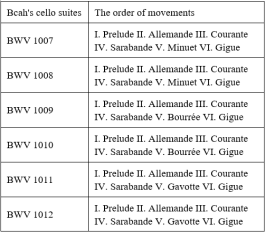
Figure 1. The movements of Bach’s cello suites.
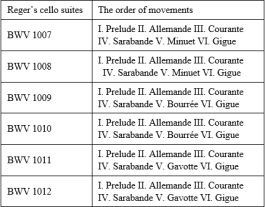
Figure 2. The movements of Bach’s violin sonatas and partitas.
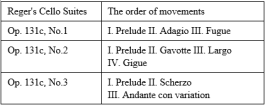
Figure 3. The movements of Reger’s cello suites.
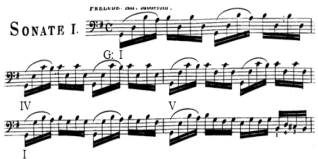
Figure 4. J. S. Bach, Cello Suite, No1, BWV1007, Prelude, mm. 1-5.
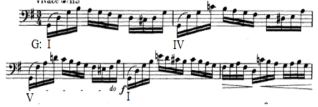
Figure 5. Max Reger, Cello Suite Op. 131c, No. 1, Prelude, mm. 1-4.

Figure 6. Max Reger, Cello Suite Op. 131c, No. 1, Prelude, mm. 3-5.
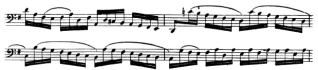
Figure 7. J. S. Bach, Cello Suite, No. 1, BWV1007, Prelude, mm. 28-31.
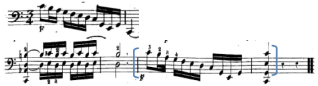
Figure 8. J. S. Bach, Cello Suite, No.3, BWV1009, Prelude, mm.1-2, mm85-88.
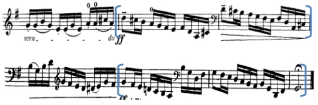
Figure 9. Max Reger, Cello Suite Op. 131c, No. 1, Prelude, mm.9-11, mm.80-83.
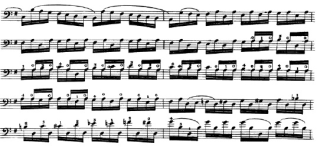
Figure 10. J. S. Bach, Cello Suite, No.1, BWV1007, Prelude, mm. 30-39.
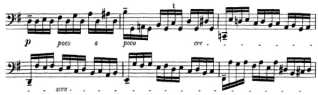
Figure 11. Max Reger, Cello Suite Op. 131c, No. 1, Prelude, mm. 10-15.
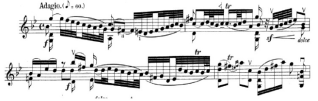
Figure 12. J. S. Bach, Violin Sonata No.1 BWV 1001, Adagio, mm. 1-4.

Figure 13. Max Reger, Cello Suite Op. 131c, No. 1, Adagio, mm. 1-4.
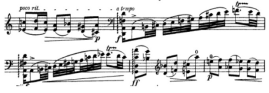
Figure 14. Max Reger, Cello Suite Op. 131c, No. 1, Adagio, mm. 13-16.
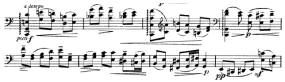
Figure 15. Max Reger, Cello Suite Op. 131c, No. 1, Adagio, mm. 41-48.
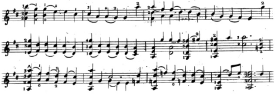
Figure 16. J. S. Bach, Cello Suite, No. 6, BWV1012, Sarabande, mm. 17-28.

Figure 17. Max Reger, Cello Suite Op. 131c, No. 1, Adagio, mm. 58-60.
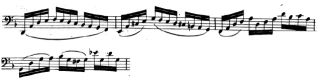
Figure 18. J. S. Bach, Cello Suite, No.2, BWV1008, Prelude, mm. 55-58.
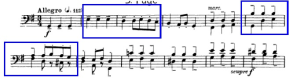
Figure 19. Max Reger, Cello Suite Op. 131c, No. 1, Fugue, mm. 1-12.

Figure 20. J. S. Bach, Cello Suite, No. 5, BWV 1011, Prelude, mm. 27-31.
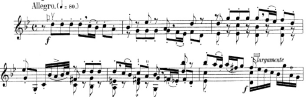
Figure 21. J. S. Bach, Violin Sonata No.1 BWV 1001, Fugue, mm. 1-6.
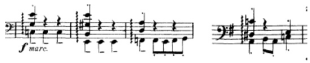
Figure 22. Max Reger, Cello Suite Op. 131c, No. 1, Fugue, mm. 38-41.

Figure 23. Max Reger, Cello Suite Op. 131c, No. 1, Prelude, mm. 34-37.
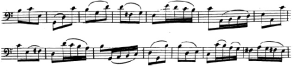
Figure 24. J. S. Bach, Cello Suite, No.3, BWV 1009, Gigue, mm. 6-19.
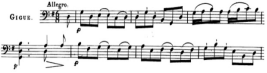
Figure 25. J. S. Bach, Cello Suite, No.1, BWV 1007, Gigue, mm. 1-7.

Figure 26. Max Reger, Cello Suite Op. 131c, No. 2, Gigue, mm. 1-5.
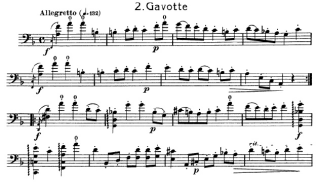
Figure 27. Max Reger, Cello Suite Op. 131c, No. 2, Gavotte, mm. 1-16.
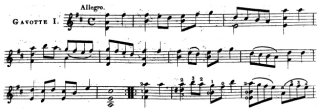
Figure 28. J.S. Bach, Cello Suite, No.6, BWV 1012, Gavotte, mm. 1-12.
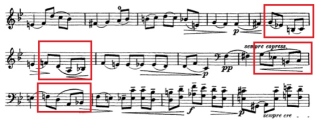
Figure 29. Max Reger, Cello Suite Op. 131c, No. 2, Largo, mm. 5-17.
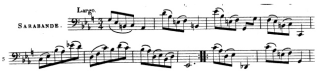
Figure 30. J.S. Bach, Cello Suite, No.5, BWV 1011, Sarabande, mm. 1-10.

Figure 31. Max Reger, Cello Suite Op. 131c, No. 3, Andante con variazioni, mm. 133-134.
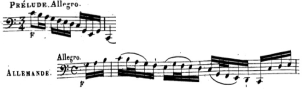
Figure 32. J.S. Bach, Cello Suite BWV 1009, Prelude, mm. 1 and Allemande, mm. 1.

Information



 Share This Article
 Twitter
 Linked In
 Facebook
 Copy
Copy Download