Abstract
The article analyzes main directions of development of soft magnetic powder materials. It includes research on certain materials developed using soft magnetic materials in production of electric motors. The elimination of known shortcomings in production of electric motors, acceleration of its assembly process is studied. The production of magnetic materials with low energy loss during magnetization reversal is one of the urgent problems of industry today. Despite the fact that research and development of such materials has been carried out since the beginning of the last century, studying the mechanism of magnetization reversal and improving the quality of these materials is still relevant today. This is due to the fact that soft magnetic materials are widely used in various technical devices (electric generators, electric motors, measuring instruments, inductors, etc.), the quality level of which is determined by the properties of modern varieties of such materials. The purpose of the study. Acceleration of electric motor development processes, increase in economic efficiency and study of the performance of electric motors. Results of the study. During the period of use of the materials, small dimensions of the product are obtained, in which, when the directional effect of the magnetic fluxes is changed, a reverse change in magnetization is achieved throughout the thickness of the part.
|
Published in
|
Engineering and Applied Sciences (Volume 11, Issue 1)
|
|
DOI
|
10.11648/j.eas.20261101.12
|
|
Page(s)
|
6-11 |
|
Creative Commons
|

This is an Open Access article, distributed under the terms of the Creative Commons Attribution 4.0 International License (http://creativecommons.org/licenses/by/4.0/), which permits unrestricted use, distribution and reproduction in any medium or format, provided the original work is properly cited.
|
|
Copyright
|
Copyright © The Author(s), 2026. Published by Science Publishing Group
|
Keywords
Electric Motor, Electric Car, Transport, Magnet, Soft Material, Motor-Wheel
1. Introduction
The automotive sector plays a significant role in the development of transport systems, energy consumption, and urban infrastructure, making it an important subject of engineering and applied sciences research. In recent years, Uzbekistan’s automobile market has experienced notable structural and quantitative changes influenced by economic conditions, regulatory measures, and shifts in consumer demand. Short-term fluctuations in vehicle sales provide valuable insights into market stability and the dynamics of transport system development.
According to an analytical assessment conducted by the Center for Economic Research and Reforms, the automobile market in Uzbekistan showed a marked decline in activity in February. Sales of all categories of vehicles decreased by 20.4% compared to the previous month and by 6.3% on a year-on-year basis. Passenger car sales, which constitute the dominant share of the market, declined by 14% compared to January, indicating a contraction in consumer demand within a relatively short period.
Official registration data from the State Traffic Safety Inspectorate indicate that approximately 115,000 vehicles of all types were sold in February, representing a substantial reduction relative to both the previous month and the corresponding period of the previous year. Passenger car sales amounted to about 109,700 units, reflecting a 14% month-on-month decrease and a 5.6% decline compared to February of the previous year. These trends were particularly evident in the primary market, where sales of new passenger cars fell by 16.8% compared to January, despite demonstrating moderate growth on an annual basis.
Further differentiation of the market reveals contrasting dynamics between domestic, foreign, and secondary segments. While sales of newly produced domestic vehicles and imported foreign cars increased on a year-on-year basis, both categories experienced significant monthly declines. The secondary market also showed a reduction in activity, with used passenger car sales decreasing by more than 13% compared to the previous month. At the same time, the electric vehicle segment demonstrated divergent behavior: although monthly demand declined, annual sales volumes increased substantially, indicating a growing long-term interest in alternative vehicle technologies.
These observed fluctuations highlight the complexity of the automotive market in Uzbekistan and underscore the importance of systematic analysis of vehicle sales dynamics. Understanding such trends is essential for engineering-oriented studies focused on transport planning, infrastructure development, and the assessment of technological transitions within the automotive sector
.
As the vehicle fleet grows, so do traffic jams in major cities. The depletion of oil resources, much of which is used to produce motor fuel, is forcing the government to fund programs to explore new deposits and alternative fuels.
Enormous fuel consumption inevitably impacts the country's air quality. Near highways, air pollution levels are 1.3–1.5 times higher than in residential areas protected from traffic by buildings. The frequency of exceeding the average daily limit for nitrogen dioxide near highways reaches 306 days, or 84% of the year, while in residential areas far from pollution sources, it occurs no more than 180 days, or 49% of the year
| [2] | Frey, H. C., Grieshop, A. P., Khlystov, A., Bang, J. J., Rouphail, N., Guinness, J., & Singh, S. (2022). Characterizing determinants of near-road ambient air quality for an urban intersection and a freeway site. Research Reports: Health Effects Institute, 207. |
| [3] | Tortbayeva, D., Pernebekov, S., Mutalov, A., & Makhanbetzhanov, M. (2020). Substantiation of the environmental safety method (on the example of the city of shimkent of the republic of Kazakhstan, pp. 87-91. |
[2, 3]
.
Suspended particulate matter, its toxic components, and ozone pose a serious health hazard. According to various estimates, polluted air threatens the health and development of children and reduces life expectancy by approximately one year.
In order to reduce vehicle emissions in the European Union, Regulation No. 443/2009 concerning the limitation of CO
2 emissions from new passenger cars of category M1 was adopted in April 2009. This Regulation sets a target of achieving average CO
2 emissions from new passenger cars across the European Union of 120 g/km by 2012 and 95 g/km after 2020
| [4] | Das J. et al. (2008) Novel powder metallurgy technique for development of Fe–P-based soft magnetic materials. J. of Mag. and Mag. Mat. – Vol. 320, № 6. – pp. 906–915. |
[4]
.
In 2011, the decline in CO
2 emissions was 4.1%, after which it slowed down somewhat. In 2012, the decrease was 2.1% compared to 2011
| [5] | Olivier, J., Janssens-Maenhout, G., & Peters, J. (2012). Trends in global CO2 emissions: 2012 report. |
| [6] | Fontaras, G., & Dilara, P. (2012). The evolution of European passenger car characteristics 2000–2010 and its effects on real-world CO2 emissions and CO2 reduction policy. Energy Policy, 49, 719-730. |
[5, 6]
. Car manufacturers are set carbon dioxide emission limits depending on the vehicle's kerb weight. If the average CO
2 emission exceeds the calculated limit, the manufacturer is charged a fine depending on the amount of the excess. From 2012 to 2018, the fine for exceeding the CO
2 limit by up to 1 g/km was €5 per vehicle. For exceeding the limit by up to 2 g/km, 3 g/km, and more than 3 g/km, the fine is €15, €25, and €90 per gram per 1 km driven, respectively. From 2022, the fine will be set at €95 for each gram of CO
2 emissions (g/km) exceeding the manufacturer's calculated standard. This policy encourages automakers to develop innovative projects in the field of alternative energy sources.
The use of combined heat and power plants (CHPs) and electric vehicles has significant potential for reducing carbon dioxide emissions.
2. Materials and Methods
The problem of environmental pollution from motor vehicles can be addressed in the following ways.
1) Energy conservation:
a) improving vehicle design;
b) reducing vehicle weight;
c) reducing the number of vehicles;
d) managing traffic and constructing roads to reduce the likelihood of traffic jams.
e) improving fuel emissions;
f) through engine design;
g) using hybrid powertrains.
2) Transition to electric vehicles.
In 2010, the electric vehicle fleet was split 60% to 40% between battery electric vehicles (BEVs) and plug-in hybrids (PHEVs). However, between 2011 and 2022, the share of battery electric vehicles increased by 13 percentage points and now exceeds 73%. This indicates a gradual shift toward BEV dominance.
Statistical data on the dynamics of motorization were obtained from official national and international sources. In particular, information on changes in the number of registered vehicles in Uzbekistan for the period 2021–2024 was collected from analytical materials and visual statistics presented by the State Traffic Inspectorate of the Republic of Uzbekistan in February 2023
. These data were used to assess trends in the growth of the vehicle fleet and to characterize the level of motorization in the country.
In addition, comparative indicators of vehicle ownership were analyzed using internationally published statistics. According to global datasets, the total number of vehicles has increased by 44.2% over the past eight years, reaching approximately 50 million units, while the number of passenger cars worldwide amounted to about 86 million units in 2023. To evaluate Uzbekistan’s position in the global context, data on the number of private passenger cars per 1,000 inhabitants were examined. In 2023, Uzbekistan ranked 121st globally, with approximately 104 cars per 1,000 population, indicating a relatively low level of private car ownership compared to many other countries
| [8] | Sazonov, S. L. (2022). PRC: Transport Infrastructure, Innovation, Belt and Road Project (pp. 408-408). Federal State Budgetary Institution of Science Institute of the Far East of the Russian Academy of Sciences. |
[8]
.
The collected statistical indicators were subsequently used as input data for analytical comparisons and for identifying general trends relevant to transport engineering and applied infrastructure studies.
Currently, the global automobile market is at its peak in terms of the number of vehicles available to consumers by engine type, but starting in 2025, this choice will become increasingly narrow, as happened once before at the turn of the 19th and 20th centuries, when steam, electric, and gasoline-powered vehicles competed for market share
| [9] | Irle R. Global EV Sales for 2022. EV-volumes.com. 2023. |
[9]
. Electric vehicles lost the competition back then, but now they have a much better chance of becoming the dominant mode of transport globally. Therefore, it is important to study the impact of this process on both the automobile and related markets.
Government policies supporting markets and production are crucial for the successful development of the electric vehicle industry. Well-designed financial incentives for consumers at the national and local levels, reduced initial costs of electric vehicle production, and an increased number of charging stations not only contribute to the current industry's development but also provide automakers and consumers with confidence in future market modernization. Support for battery and fuel cell production is also having a positive impact on the market. Battery development costs have fallen significantly in recent years, thereby lowering the cost barrier to mass production of electric vehicles.
In Uzbekistan, the development of the electric vehicle industry remains an open question. Some institutes and factories are developing prototypes of electric vehicles, but they have never been mass-produced.
Initially, electric vehicles used conventional DC or AC motors–those used for general industrial applications. Recently, electric motors specifically designed for electric vehicles have increasingly been used. These include requirements for high fuel efficiency while maintaining traction characteristics over a wide speed range, pollution resistance, and simplified maintenance.
3. Results and Discussion
Due to intense competition, manufacturers are constantly improving electric cars for children. A wide variety of models are available.
There are two alternative approaches to optimizing the design parameters of an electric vehicle. The first involves solving a direct problem, i.e., using the electric vehicle's design parameters as the objective or objective functions, which are then optimized using one of the numerical methods. The second involves solving an inverse problem, using the vehicle's output parameters, specifically traction, speed, energy, and fuel economy, as the objective functions. Regression equations are constructed to relate these objective functions to the electric vehicle's design parameters.
During the optimization of objective functions, the optimal values of the output parameters and the corresponding design parameters are determined. In this paper, the design parameters of the electric vehicle traction drive will be determined based on the solution of an inverse problem. During optimization, the assumption is made that all functions of the complex indicators depend only on the same internal control parameters: the specific energy of the battery, the mass of the battery pack, and the transmission gear ratio, while other vehicle parameters-electric motor characteristics, transmission efficiency, drag coefficient, etc. – remain constant.
Electric transport is demonstrating significant scientific and technological progress in the field of highly efficient electromagnetic motors and batteries. Consequently, we can clearly see how electric vehicles are conquering the global market and becoming a symbol of innovative development.
One method for producing highly efficient materials for electrical devices is coating metal powder particles with oxide shells
| [10] | Bespalov V.Ya., Kovarsky M. E., Sidorov A. O. Study of Pulsations of the Electromagnetic Moment of Synchronous Machines with Permanent Magnets with Integer and Fractional Values of q. - 2018. - №5. - pp. 45-51. |
| [11] | Bespalov V. Y., Sidorov A. O. Electromagnetic Forces of Synchronous Machines with Permanent Magnets / M. E. Kovarsky, A. O. Sidorov // Proceedings of the XVII International Conference "Electromechanics, Electrical Technologies, Electrotechnical Materials and Components". 2018. P. 99-100. |
| [12] | Vavilov V. E., Ematin E. A. Restrictions in the design of non-contact electric machines with permanent magnets / V. E. Vavilov, E. A. Ematin // Molodezhnyy vestnik Ufimskogo gosudarstvennogo aviatsionnogo tekhnicheskogo universiteta. 2019. № 1. Pp. 29-34. |
[10-12]
.
When applying a thin oxide layer to iron powder particles, methods such as mechanical deposition of the oxide layer, decomposition of metal sulfates and nitrides, and formation of an oxide layer from gaseous oxides result in the formation of a poor-quality coating
| [13] | Vavilov V. E., Ismagilov F. R., Sayakhov I. F., Ematin E. A. Analysis of the productivity of disk high-speed generators. 2019. № 8. Pp. 3-12. |
| [14] | Switched Reluctance Dvigatels / Generators / Kaskod-Electro: an innovative and technical company.
https://kaskod.ru/srm_article01/ (accessed 04.12.2025). |
[13, 14]
.
Our proposed method for applying an oxide layer to iron powder is cost-effective and can be widely used to produce composites with specified magnetic parameters and electrical resistance. It can also be used in practice for the production of MDM (metal-dielectric-metal) alloys with unique magnetic and electrical properties.
Development of a method for producing a composite soft magnetic material taking into account the required parameters. Current methods of encapsulating iron powder with a thin oxide layer, namely mechanical oxide layer deposition, oxide layer formation by decomposition of metal sulfates and nitrides, and oxide layer formation from a gaseous oxide layer, produce poor-quality coatings and are ineffective.
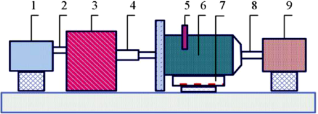
The essence of the method we developed is illustrated in
Figure 1, which shows a schematic of a soft magnetic material preparation system, including a vacuum pump electric drive 1, a coupling sleeve 2, a vacuum pump 3, a movable vacuum connector 4, a drum containing a soft magnetic composite material 5, a temperature sensor 6, a heater 7, a movable shaft 8, and a reactor electric drive 9
| [15] | Minchukova, O. F., Normirzaev, A. R., & Tukhtabaev, M. A. (2025). Study of the physical properties of new composite low-frequency soft magnetic materials. Ilm, tadqiqot va taraqqiyot/Science, Research and Development, 5(13), 152-156. |
| [16] | Demidenko, O. (2023). Production of hub motors for prototypes of mini-electric vehicles. Innovative techniques and technologies in agriculture and transport: problems, solutions and prospects"/Collection of scientific articles of the Republican scientific and practical conference. Karshi, 61-65. |
[15, 16]
.
The advantage of this method compared to known ones is the reduction of the lubricant content to 0.01–0.1%, which allows for the subsequent production of a high-quality pressed product made of a soft magnetic composite material with a density of 7.5–7.65 g/cm
3 and, as a consequence, possessing high magnetic characteristics
| [17] | Govor, G., Demidenko, O., Zhaludkevich, A., Normirzaev, A., Tukhtabayev, M., & Valiev, B. (2023). Production of motor-wheels for prototypes of mini-electric vehicles based on new soft magnetic materials. In E3S Web of Conferences, Vol. 452, p. 04012. |
| [18] | Govor, G. A., Demidenko, O. F., Normirzaev, A. R., & Tukhtabayev, M. A. (2023). Properties of a composite magnetically soft material based on coated iron powders. In E3S Web of Conferences, Vol. 365, p. 05001. |
[17, 18]
.
To apply phosphorus oxide coatings to the surface of ABC100.30 particles, the proposed method was modified. The application method included a pre-mixing step of the original metal powders with a specified amount of a reagent, which consisted of an alcohol solution of orthophosphoric acid in a ratio of 40% H3PO4 + 60% ethyl alcohol.
In the next step, the prepared powder was placed in a reactor for applying insulating coatings (
Figure 2). The powders with the reactive additive were processed in a reaction drum at a pressure of 105 to 106 Pa, heated to a temperature of 150–200°C for 15–30 minutes. As a result, a complex coating of ferrite compounds and phosphates formed on the surface of the iron particles. The elemental composition was analyzed using an Oxford Instruments (England) X-ray spectral analyzer with a minimum detection limit of 0.5% and a method error of 3–5 relative percent. The chemical composition of the oxide coatings is a complex system of iron oxides FeO, Fe
2O
3, and phosphorus oxide P
2O
5. Small amounts of carbon and silicon are also present. The thickness of the insulating layer on the iron particle depends on the powder processing time and the concentration of the alcoholic phosphoric acid solution
| [17] | Govor, G., Demidenko, O., Zhaludkevich, A., Normirzaev, A., Tukhtabayev, M., & Valiev, B. (2023). Production of motor-wheels for prototypes of mini-electric vehicles based on new soft magnetic materials. In E3S Web of Conferences, Vol. 452, p. 04012. |
| [18] | Govor, G. A., Demidenko, O. F., Normirzaev, A. R., & Tukhtabayev, M. A. (2023). Properties of a composite magnetically soft material based on coated iron powders. In E3S Web of Conferences, Vol. 365, p. 05001. |
[17, 18]
.
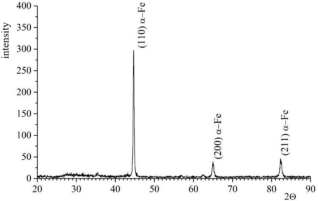
According to the results of researchers Govor, Zheludkevich, and Demidenko,
Figure 2 shows an X-ray diffraction pattern of a composite based on ABC100.30 iron powder encapsulated in P2O5. The analysis of the data obtained by X-ray diffraction showed that the sample contains only one α-Fe phase of pure iron. The composite has a cubic unit cell of the
Im3̅
m space group. The parameter is a ≈ 0.2867±0.0003 nm. In the region of small angles of 25 – 35°, insignificant diffuse scattering inherent in the amorphous phase of P
2O
5 is observed. Based on the results of X-ray diffraction determination of the unit cell volume V = a
3, the theoretical density of the composite materials was calculated. The calculated value of the theoretical density is approximately 3% higher than the density value obtained by direct measurement by hydrostatic weighing (7.7 g/cm
3). Thus, the porosity of the composites is less than 5%.
A study of the properties of sheet molding compound (SMC) materials based on ultra-pure iron powders revealed that materials with the lowest carbon content, such as ABC100.30 iron powder, exhibit higher magnetic properties and minimal losses. A study examining the influence of various types of insulating coatings on the properties of SMC materials demonstrated that SMC materials with a titanium oxide coating exhibit superior performance. The effect of oxide coating thickness on the reduction of magnetic permeability of SMC materials was also assessed.
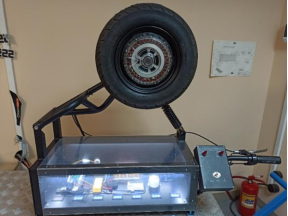
The results of theoretical research and experimental testing on the development of a children’s mini-electric car have been analyzed (
Figure 3). A pilot model of a motor-wheel based on composite magnetic materials was developed in collaboration with a researcher from the State Scientific and Production Center of the National Academy of Sciences of Belarus for Materials Science and a researcher from the Namangan State Technical University.
Experimental studies of a sample of a motor-wheel made of a soft magnetic composite material were carried out on September 23, 2022, by employees of the Laboratory of Physics of Magnetic Materials of the Scientific and Practical Center of Materials Science of the National Academy of Sciences of Belarus (Minsk, Belarus) and the Namangan Civil Engineering Institute (Namangan, Uzbekistan).
Experimental hub motor prototypes were manufactured using the resulting magnetic cores. Design documentation for all components of the prototype was developed.
4. Conclusions
A comparative analysis of modern soft magnetic powder materials demonstrates significant improvements in their properties, making them promising for future use in electric vehicles.
Thus, the development of in-wheel motors is closely linked to the improvement of magnetic materials and power sources, which together determine the efficiency and performance of mini-electric vehicles. The developed composite magnetic material outperforms electrical steel due to its lower losses, high rotation speed, increased power density, and potential for widespread use in the production of electrical products.
Abbreviations
CHPs | Combined Heat and Power Plants |
BEVs | Battery Electric Vehicles |
PHEVs | Plug-in Hybrids |
AC | Alternating Current |
DC | Direct Current |
SMC | Sheet Molding Compound |
Conflicts of Interest
The authors declare no conflicts of interest.
References
| [1] |
Gazeta News LLC. Car sales in Uzbekistan fell by 20.4% in February. Available from:
https://www.gazeta.uz/ru/2024/03/14/auto-market/
(accessed 06 January 2026).
|
| [2] |
Frey, H. C., Grieshop, A. P., Khlystov, A., Bang, J. J., Rouphail, N., Guinness, J., & Singh, S. (2022). Characterizing determinants of near-road ambient air quality for an urban intersection and a freeway site. Research Reports: Health Effects Institute, 207.
|
| [3] |
Tortbayeva, D., Pernebekov, S., Mutalov, A., & Makhanbetzhanov, M. (2020). Substantiation of the environmental safety method (on the example of the city of shimkent of the republic of Kazakhstan, pp. 87-91.
|
| [4] |
Das J. et al. (2008) Novel powder metallurgy technique for development of Fe–P-based soft magnetic materials. J. of Mag. and Mag. Mat. – Vol. 320, № 6. – pp. 906–915.
|
| [5] |
Olivier, J., Janssens-Maenhout, G., & Peters, J. (2012). Trends in global CO2 emissions: 2012 report.
|
| [6] |
Fontaras, G., & Dilara, P. (2012). The evolution of European passenger car characteristics 2000–2010 and its effects on real-world CO2 emissions and CO2 reduction policy. Energy Policy, 49, 719-730.
|
| [7] |
“WEB EXPERT” LLC. Cars owned by individuals increased by 415 thousand in one year. Available from:
https://kun.uz/news/2025/12/09/jismoniy-shaxslarga-tegishli-avtomobillar-bir-yilda-415-mingtaga-kopaydi
(accessed 06 January 2026).
|
| [8] |
Sazonov, S. L. (2022). PRC: Transport Infrastructure, Innovation, Belt and Road Project (pp. 408-408). Federal State Budgetary Institution of Science Institute of the Far East of the Russian Academy of Sciences.
|
| [9] |
Irle R. Global EV Sales for 2022. EV-volumes.com. 2023.
|
| [10] |
Bespalov V.Ya., Kovarsky M. E., Sidorov A. O. Study of Pulsations of the Electromagnetic Moment of Synchronous Machines with Permanent Magnets with Integer and Fractional Values of q. - 2018. - №5. - pp. 45-51.
|
| [11] |
Bespalov V. Y., Sidorov A. O. Electromagnetic Forces of Synchronous Machines with Permanent Magnets / M. E. Kovarsky, A. O. Sidorov // Proceedings of the XVII International Conference "Electromechanics, Electrical Technologies, Electrotechnical Materials and Components". 2018. P. 99-100.
|
| [12] |
Vavilov V. E., Ematin E. A. Restrictions in the design of non-contact electric machines with permanent magnets / V. E. Vavilov, E. A. Ematin // Molodezhnyy vestnik Ufimskogo gosudarstvennogo aviatsionnogo tekhnicheskogo universiteta. 2019. № 1. Pp. 29-34.
|
| [13] |
Vavilov V. E., Ismagilov F. R., Sayakhov I. F., Ematin E. A. Analysis of the productivity of disk high-speed generators. 2019. № 8. Pp. 3-12.
|
| [14] |
Switched Reluctance Dvigatels / Generators / Kaskod-Electro: an innovative and technical company.
https://kaskod.ru/srm_article01/
(accessed 04.12.2025).
|
| [15] |
Minchukova, O. F., Normirzaev, A. R., & Tukhtabaev, M. A. (2025). Study of the physical properties of new composite low-frequency soft magnetic materials. Ilm, tadqiqot va taraqqiyot/Science, Research and Development, 5(13), 152-156.
|
| [16] |
Demidenko, O. (2023). Production of hub motors for prototypes of mini-electric vehicles. Innovative techniques and technologies in agriculture and transport: problems, solutions and prospects"/Collection of scientific articles of the Republican scientific and practical conference. Karshi, 61-65.
|
| [17] |
Govor, G., Demidenko, O., Zhaludkevich, A., Normirzaev, A., Tukhtabayev, M., & Valiev, B. (2023). Production of motor-wheels for prototypes of mini-electric vehicles based on new soft magnetic materials. In E3S Web of Conferences, Vol. 452, p. 04012.
|
| [18] |
Govor, G. A., Demidenko, O. F., Normirzaev, A. R., & Tukhtabayev, M. A. (2023). Properties of a composite magnetically soft material based on coated iron powders. In E3S Web of Conferences, Vol. 365, p. 05001.
|
Cite This Article
-
APA Style
Mirzokhid, T., Bobur, V. (2026). Development of Rational Design Parameters for the Traction Drive and Motor-Wheel of an Electric Vehicle. Engineering and Applied Sciences, 11(1), 6-11. https://doi.org/10.11648/j.eas.20261101.12
 Copy
|
Copy
|
 Download
ACS Style
Mirzokhid, T.; Bobur, V. Development of Rational Design Parameters for the Traction Drive and Motor-Wheel of an Electric Vehicle. Eng. Appl. Sci. 2026, 11(1), 6-11. doi: 10.11648/j.eas.20261101.12
Copy
|
Download
AMA Style
Mirzokhid T, Bobur V. Development of Rational Design Parameters for the Traction Drive and Motor-Wheel of an Electric Vehicle. Eng Appl Sci. 2026;11(1):6-11. doi: 10.11648/j.eas.20261101.12
Copy
|
Download
-
@article{10.11648/j.eas.20261101.12,
  author = {Tukhtabayev Mirzokhid and Valiev Bobur},
  title = {Development of Rational Design Parameters for the Traction Drive and Motor-Wheel of an Electric Vehicle},
  journal = {Engineering and Applied Sciences},
  volume = {11},
  number = {1},
  pages = {6-11},
  doi = {10.11648/j.eas.20261101.12},
  url = {https://doi.org/10.11648/j.eas.20261101.12},
  eprint = {https://article.sciencepublishinggroup.com/pdf/10.11648.j.eas.20261101.12},
  abstract = {The article analyzes main directions of development of soft magnetic powder materials. It includes research on certain materials developed using soft magnetic materials in production of electric motors. The elimination of known shortcomings in production of electric motors, acceleration of its assembly process is studied. The production of magnetic materials with low energy loss during magnetization reversal is one of the urgent problems of industry today. Despite the fact that research and development of such materials has been carried out since the beginning of the last century, studying the mechanism of magnetization reversal and improving the quality of these materials is still relevant today. This is due to the fact that soft magnetic materials are widely used in various technical devices (electric generators, electric motors, measuring instruments, inductors, etc.), the quality level of which is determined by the properties of modern varieties of such materials. The purpose of the study. Acceleration of electric motor development processes, increase in economic efficiency and study of the performance of electric motors. Results of the study. During the period of use of the materials, small dimensions of the product are obtained, in which, when the directional effect of the magnetic fluxes is changed, a reverse change in magnetization is achieved throughout the thickness of the part.},
 year = {2026}
}
Copy
|
Download
-
TY  - JOUR
T1  - Development of Rational Design Parameters for the Traction Drive and Motor-Wheel of an Electric Vehicle
AU  - Tukhtabayev Mirzokhid
AU  - Valiev Bobur
Y1  - 2026/01/20
PY  - 2026
N1  - https://doi.org/10.11648/j.eas.20261101.12
DO  - 10.11648/j.eas.20261101.12
T2  - Engineering and Applied Sciences
JF  - Engineering and Applied Sciences
JO  - Engineering and Applied Sciences
SP  - 6
EP  - 11
PB  - Science Publishing Group
SN  - 2575-1468
UR  - https://doi.org/10.11648/j.eas.20261101.12
AB  - The article analyzes main directions of development of soft magnetic powder materials. It includes research on certain materials developed using soft magnetic materials in production of electric motors. The elimination of known shortcomings in production of electric motors, acceleration of its assembly process is studied. The production of magnetic materials with low energy loss during magnetization reversal is one of the urgent problems of industry today. Despite the fact that research and development of such materials has been carried out since the beginning of the last century, studying the mechanism of magnetization reversal and improving the quality of these materials is still relevant today. This is due to the fact that soft magnetic materials are widely used in various technical devices (electric generators, electric motors, measuring instruments, inductors, etc.), the quality level of which is determined by the properties of modern varieties of such materials. The purpose of the study. Acceleration of electric motor development processes, increase in economic efficiency and study of the performance of electric motors. Results of the study. During the period of use of the materials, small dimensions of the product are obtained, in which, when the directional effect of the magnetic fluxes is changed, a reverse change in magnetization is achieved throughout the thickness of the part.
VL  - 11
IS  - 1
ER  -
Copy
|
Download







 Share This Article
 Twitter
 Linked In
 Facebook