Abstract
Background. The performance of the vaccination supply chain management system directly determines the vaccination programmes effectiveness. This study evaluates this performance in the Littoral Department of Benin in 2023. Methods. A cross-sectional, descriptive and evaluative study was conducted from March to June 2023 in 19 public vaccination facilities in the Littoral Department. The Donabedian model was operationalised using composite indicators, scored in a binary manner and benchmarked against national standards and World Health Organization (WHO) guidelines. Results. The ‘Structure’ component achieved 82.0% (satisfactory), despite deficiencies in dry storage facilities (8/19), vaccinator guides (6/19), computer equipment (5/19), and dedicated transport (5/19). The ‘Process’ component achieved 75% (insufficient), primarily due to poor completion of logistics management tools in 9 of 19 facilities. The ‘Outcomes’ component achieved 48% (insufficient): wastage rates ranged from 0% to 80% (mean: 63%), and only 2 of 19 facilities met the national target of 5%. The overall performance score was 73% (insufficient). Conclusion. Despite satisfactory basic infrastructure, the supply chain management system demonstrated insufficient performance owing to operational shortcomings and inadequate outcomes, highlighting the need for targeted action on the Logistics Management Information System, strengthened implementation of standardised operating procedures, and enhanced staff motivation.
|
Published in
|
Central African Journal of Public Health (Volume 12, Issue 3)
|
|
DOI
|
10.11648/j.cajph.20261203.15
|
|
Page(s)
|
166-172 |
|
Creative Commons
|

This is an Open Access article, distributed under the terms of the Creative Commons Attribution 4.0 International License (http://creativecommons.org/licenses/by/4.0/), which permits unrestricted use, distribution and reproduction in any medium or format, provided the original work is properly cited.
|
|
Copyright
|
Copyright © The Author(s), 2026. Published by Science Publishing Group
|
Keywords
Performance, Supply Chain Management, COVID-19, Vaccine Inputs, Vaccine Cold Chain, Benin
1. Introduction
The year 2020 was marked by the emergence of a global public health emergency caused by coronavirus disease 2019 (COVID-19), responsible for substantial morbidity and mortality worldwide
| [1] | Ramakanth D, Singh S, Maji PK et al. Advanced packaging for distribution and storage of COVID-19 vaccines: a review. Environmental Chemistry Letters. 2021, 19, 3597–3608.
https://doi.org/10.1007/s10311-021-01256-1 |
[1]
. Approximately 20% of cases progressed to severe forms, compelling health systems to implement exceptional prevention and response measures
. The rapid development and authorisation of efficacious vaccines enabled the launch of mass vaccination campaigns aimed at reducing pandemic-related mortality and restoring the resilience of health systems
.
The effectiveness of vaccination campaigns, however, is not solely dependent on vaccine quality: it relies equally on the performance of logistical systems responsible for their procurement, storage, and distribution. Vaccines are highly sensitive immunobiological products whose integrity requires an uninterrupted cold chain, appropriate management procedures, and trained personnel at all levels
| [4] | Wisner JD. Principles of Supply Chain Management: A Balanced Approach. 3rd ed. Mason (OH): South-Western; 2012. |
| [5] | Ayenigbara IO, Adegboro JS, Ayenigbara GO et al. Challenges to a successful COVID-19 vaccination programme in Africa. Germs. 2021, 11, 427–440.
https://doi.org/10.18683/germs.2021.1280 |
[4, 5]
. In low-resource settings in West Africa, structural constraints such as insufficient storage capacity, inadequate transport for thermosensitive products, and critical equipment shortages directly limit effective access to vaccination
| [5] | Ayenigbara IO, Adegboro JS, Ayenigbara GO et al. Challenges to a successful COVID-19 vaccination programme in Africa. Germs. 2021, 11, 427–440.
https://doi.org/10.18683/germs.2021.1280 |
| [6] | Oyadiran OT, Usman SA, Osoba ME et al. Towards effective and efficient COVID-19 vaccination in Nigeria. Journal of Global Health Reports. 2021, 5, e202102.
https://doi.org/10.29392/001c.21404 |
[5, 6]
.
In Benin, recent national assessments and strategic documents have identified persistent weaknesses in the vaccine supply chain management system: limited warehousing capacity, transport shortfalls, deficient computer equipment, difficulties in managing donated supplies, and gaps in logistics information systems
| [7] | Ministry of Health (Benin). Intra-action review of the COVID-19 pandemic response in Benin. Cotonou: Ministry of Health; 2021. |
| [8] | Ministry of Health (Benin), National Agency for Primary Health Care. National COVID-19 deployment and vaccination plan. Cotonou: Ministry of Health; 2022. |
[7, 8]
. These dysfunctions result in substantial dose wastage, avoidable financial costs, and reduced impact of interventions
. Recurring operational factors—including long distances between depots and vaccination sites, failures in thermal monitoring, and weak coordination—further impede logistical performance
| [10] | Alam ST, Ahmed S, Ali SM, Sarker S, Kabir G, ul-Islam A. Challenges to COVID-19 vaccine supply chain: implications for sustainable development goals. International Journal of Production Economics. 2021, 239, 108193.
https://doi.org/10.1016/j.ijpe.2021.108193 |
[10]
.
In response, the Government of Benin has implemented corrective measures: strengthening storage capacity and personnel training, and deploying the Logistics Data Visualisation System and the Electronic Logistics Management Information System
| [7] | Ministry of Health (Benin). Intra-action review of the COVID-19 pandemic response in Benin. Cotonou: Ministry of Health; 2021. |
| [8] | Ministry of Health (Benin), National Agency for Primary Health Care. National COVID-19 deployment and vaccination plan. Cotonou: Ministry of Health; 2022. |
[7, 8]
. Despite these efforts, national vaccination coverage remains below targets and the logistical chain has yet to achieve full effectiveness. The Littoral Department, with its 852,361 inhabitants, high population density, and strategic health importance, is no exception and presents a particularly demanding operational context.
A rigorous evaluation of the COVID-19 vaccination inputs supply chain management system in the Littoral Department was therefore necessary to document structural capacity levels, the quality of operational processes, and their actual effectiveness. Accordingly, the present study aims to evaluate the performance of the COVID-19 vaccination inputs supply chain management system in the Littoral Department in 2023, to identify its strengths and weaknesses, and to guide evidence-based system-strengthening decisions.
2. Materials and Methods
2.1. Study Setting
The study was conducted in the Littoral Department, in the commune of Cotonou, the economic capital of Benin. This department is the most densely populated in the country, with 852,361 inhabitants across 72 km2 as of 2021. The tertiary sector is predominant, and the department concentrates industrial activity, national and international transport infrastructure, and a large population flow. In terms of health services, it comprises public, private, and faith-based facilities, the latter providing more than two-thirds of curative care to the population.
2.2. Study Population and Eligibility Criteria
The study population comprised the management units of COVID-19 vaccination inputs in the department: the Vaccination and Logistics Division of the Departmental Directorate of Health, the vaccination services of 18 public health centres, the Head of the Vaccination and Logistics Division, and the Expanded Programme on Immunisation (EPI) coordinators of each health centre. Cold chain equipment, programmatic documents, and individuals vaccinated against COVID-19 in the department were also included. Individuals who did not provide consent to participate were excluded.
2.3. Study Design and Sampling
This was a cross-sectional, descriptive and evaluative study conducted from March to June 2023. The COVID-19 vaccination inputs supply chain management system was conceptualised through the Donabedian model, structuring the analysis into three components: ‘Structure’ (availability and organisation of resources), ‘Process’ (implementation of procedures), and ‘Outcomes’ (products and changes generated by the system).
Selection was exhaustive for the Vaccination and Logistics Division, the 18 public health centres, and their cold chain equipment. The Head of the Vaccination and Logistics Division and the 18 EPI coordinators were enrolled as participants, given their direct responsibility for COVID-19 vaccination input logistics. Service users were selected by convenience sampling. The total sample comprised 19 facilities and 19 internal clients.
2.4. Variables and Data Collection Instruments
The primary variable was the performance of the COVID-19 vaccination inputs supply chain management system. Explanatory variables corresponded to the three Donabedian components: ‘Structure’ (with sub-components of human resources, infrastructure, management tools, normative documents, and financial resources); ‘Process’ (with sub-components of quantification, procurement, stock management, distribution, maintenance, waste management, and the Logistics Management Information System); and ‘Outcomes’ (vaccination coverage, wastage rates, input availability, and client satisfaction). Operational criteria for each sub-component were defined in relation to the standards of the National Deployment and Vaccination Plan (PNDV 2022), the COVID-19 logistics plan, standard operating procedures, and WHO standards for vaccine and cold chain management
| [11] | World Health Organization. Vaccine management: training course for managers of the Expanded Programme on Immunisation. Module 8. Revised edition. Geneva: WHO; 2014. |
[11]
. Each criterion was scored in a binary manner (1 = criterion met; 0 = criterion not met).
Four data collection methods were employed: (i) direct observation of cold chain equipment using a standardised observation grid; (ii) documentary review using a data extraction form; (iii) administration of structured questionnaires to EPI coordinators and service users; and (iv) semi-structured interviews with the Head of the Vaccination and Logistics Division using an interview guide.
2.5. Data Processing and Analysis
Systematic quality control of data collection instruments was carried out, followed by manual processing of interview guides (transcription and thematic coding). Quantitative data were entered into Microsoft Excel 2016 and analysed using Stata 11. Sub-component scores were aggregated to obtain component scores (Structure, Process, Outcomes), expressed as a percentage of the expected score. The adapted Varkevisser scale was used, distinguishing two levels of appraisal: Grade A (≥80%) = ‘good’ performance; Grade B (<80%) = ‘insufficient’ performance. The overall performance score of the supply chain management system was obtained by aggregating results across all components using the same scale.
2.6. Ethical Considerations
The study received approval from the Scientific Expert Panel of the Regional Institute of Public Health (IRSP-CAQ), which validated the research protocol in accordance with Beninese regulations on health research ethics. Administrative authorisation was obtained from the Departmental Directorate of Health of the Littoral, which informed the heads of the concerned health facilities. Participation was voluntary. Free and informed consent was formally obtained from each participant prior to enrolment. Data confidentiality and participant anonymity were strictly guaranteed. Collected data were used exclusively for scientific purposes and published solely in aggregated form.
3. Results
3.1. Sample Description
Data collection covered the 18 health centres offering vaccination services, as well as the Vaccination and Logistics Division of the Departmental Directorate of Health of the Littoral. A total of 19 internal clients were surveyed, comprising 18 EPI coordinators and one Head of the Vaccination and Logistics Division, with a mean professional experience of 37 ± 20 months (range: 6–72 months). The majority of staff were nursing auxiliaries (11/19) or registered nurses (7/19).
3.2. Structure Component
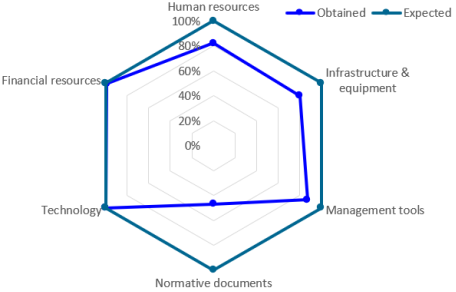
The ‘Structure’ component achieved 82% (735 of 896 criteria met), rated ‘good’. The majority of staff had received training on COVID-19 vaccination inputs (15/19) and management tools (16/19); all (19/19) had benefited from supervision during the preceding six months. Job descriptions (6/19) and organisational charts (5/19) were frequently absent. Cold chain infrastructure was generally satisfactory: functional refrigerators and freezers (18/19), backup generators (17/19), and insulated carriers in good condition (18/19). However, fewer than half of the facilities had a dedicated dry storage room (8/19; 42%), and only 5 of 19 (26%) had appropriate transport.
Management tools (stock cards, order forms, vaccination registers, and maintenance registers) were available in 17 to 19 of 19 facilities. Nevertheless, only 5 of 19 facilities (26%) had functional computer equipment for digital data entry. The availability of normative documents remained insufficient: standard operating procedures were present in 12 of 19 facilities, and vaccinator guides in only 6 of 19 (32%). In financial terms, all facilities benefited from dedicated vaccination budget lines and active technical and financial partnerships.
Figure 1 presents the achievement rates for expected scores for each sub-component of the ‘Structure’ component (range: 47%–100%; overall score: 82%).
Figure 1. Sub-components of the Structure component of the COVID-19 vaccination inputs supply chain management system, Littoral Department, Benin, 2023.
3.3. Process Component
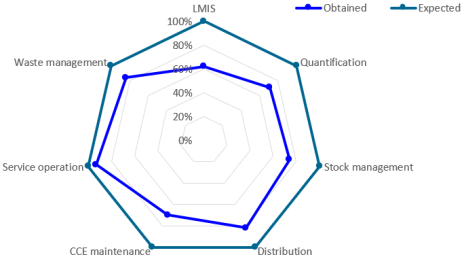
The ‘Process’ component achieved 75% (879 of 1,175 criteria met), rated ‘insufficient’. The primary deficiency concerned the Logistics Management Information System: completion of management tools, reports, and data entry was incomplete in 9 of 19 facilities, and only 14 of 19 facilities submitted their reports on a regular basis. Formal needs quantification was performed in only 11 of 19 facilities, whereas 16 of 19 adhered to procurement timelines. All facilities conducted twice-daily temperature monitoring. The majority had adequate storage capacity (12/19) and appropriate storage rooms (14/19).
The open multi-dose vial policy was implemented in 15 of 19 facilities (79%), and waste segregation was correctly ensured in 17 of 19. Vaccines were stored at the recommended temperature (+2°C to +8°C) in 18 of 19 facilities, with all cold chain equipment functional on the day of the survey. Distribution of inputs was conducted under thermal monitoring. Preventive maintenance was regular in 12 of 19 facilities, with easy access to a maintenance technician reported by 14 of 19. Frost accumulation exceeding 10 cm was absent in 14 of 19 facilities. Periodic meetings and debriefing sessions facilitated coordination and information sharing in 18 of 19 facilities. Systematic or occasional task delegation ensured service continuity in 17 of 19 facilities.
Figure 2 presents the achievement rates for expected scores for each sub-component of the ‘Process’ component (range: 62%–93.0%; overall score: 75%).
Figure 2. Sub-components of the Process component of the COVID-19 vaccination inputs supply chain management system, Littoral Department, Benin, 2023.
3.4. Outcomes Component
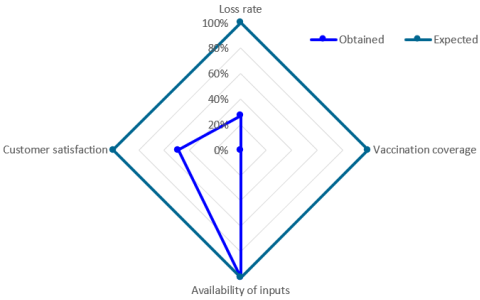
The ‘Outcomes’ component achieved 48% (207 of 433 criteria met), rated ‘insufficient’; this represents the most critical performance deficit identified in this evaluation. Wastage rates ranged from 0% to 80%, with a mean of 63%; only 2 of 19 facilities (11%) met the national target of 5%. Regarding vaccination coverage, 8 of 18 facilities (44%) achieved the national objective of 60% set for 2023. Vaccination inputs were continuously available in all facilities throughout the preceding six months.
With respect to internal client satisfaction, 14 of 19 staff members (74%) reported satisfaction with the training and supervision received. In contrast, only 4 of 19 (21%) considered themselves motivated in their role, a low proportion with direct implications for protocol adherence and overall system performance.
Figure 3 presents the achievement rates for expected scores for each sub-component of the ‘Outcomes’ component (range: 27%–100%; overall score: 48%).
Figure 3. Sub-components of the Outcomes component of the COVID-19 vaccination inputs supply chain management system, Littoral Department, Benin, 2023.
3.5. Overall Performance of the COVID-19 Vaccination Inputs Supply Chain Management System
Table 1 presents aggregated scores by component. Only the ‘Structure’ component achieved the satisfactory threshold (82.0%); the ‘Process’ (74.8%) and ‘Outcomes’ (47.8%) components were rated ‘insufficient’. The ‘Outcomes’ component constitutes the most critical area of underperformance. The overall performance score of the supply chain management system was 72.7% (1,821/2,504), classified as ‘insufficient’.
Table 1. Overall performance of the COVID-19 vaccination inputs supply chain management system by Donabedian component, Littoral Department, Benin, 2023.
Component | Score obtained | Expected score | % | Rating |
Structure | 735 | 896 | 82 | Good |
Process | 879 | 1,175 | 75 | Insufficient |
Outcomes | 207 | 433 | 48 | Insufficient |
Overall SCM system performance | 1,821 | 2,504 | 73 | Insufficient |
4. Discussion
4.1. Assessment of the Structure Component
The satisfactory score of the ‘Structure’ component (82%) is largely attributable to the integration of the COVID-19 vaccination inputs supply chain management system into the Expanded Programme on Immunisation (EPI) infrastructure, which is already at an advanced stage of maturity. Agueh et al. reported a score of 90% for this component in their evaluation of the EPI in the Comè health zone in 2015
| [12] | Agueh V, Sossa Jerome C, Nyametso D, Paraiso MN, Azandjemè CS, Metonou C et al. Evaluation of the performance of expanded immunization programme supply chain and logistics management in southern Benin rural health district. Universal Journal of Public Health. 2016, 4(4), 162–170.
https://doi.org/10.13189/ujph.2016.040402 |
[12]
; the observed difference is consistent with the more recent establishment of the COVID-19 system.
The availability of trained and supervised personnel constitutes a major asset: 15 of 19 staff had received specific training on COVID-19 vaccination inputs, 16 of 19 on management tools, and all 19 had benefited from supervision within the preceding six months. These findings exceed those reported by Feyisa et al. in Ethiopia in 2022, where 51% of respondents had received no training and none had benefited from supervision
| [13] | Feyisa D, Ejeta F, Aferu T, Kebede O. Adherence to WHO vaccine storage codes and vaccine cold chain management practices at primary healthcare facilities in Dalocha District, Ethiopia. Tropical Diseases, Travel Medicine and Vaccines. 2022, 8, 10. https://doi.org/10.1186/s40794-022-00167-5 |
[13]
. The pandemic context and the high political priority accorded to COVID-19 may explain this exceptional mobilisation in Benin.
Cold chain infrastructure was generally adequate: 18 of 19 facilities had functional refrigerators and freezers, and 17 of 19 had backup generators. These results are comparable to those of Feyisa et al.
| [13] | Feyisa D, Ejeta F, Aferu T, Kebede O. Adherence to WHO vaccine storage codes and vaccine cold chain management practices at primary healthcare facilities in Dalocha District, Ethiopia. Tropical Diseases, Travel Medicine and Vaccines. 2022, 8, 10. https://doi.org/10.1186/s40794-022-00167-5 |
[13]
and exceed proportions reported in Kenya by Sinnei et al.
| [14] | Sinnei DK, Karimi PN, Maru SM et al. Evaluation of vaccine storage and distribution practices in rural healthcare facilities in Kenya. Journal of Pharmaceutical Policy and Practice. 2023, 16, 25. https://doi.org/10.1186/s40545-023-00535-2 |
[14]
and in Ethiopia by Bogale et al.
| [15] | Bogale HA, Amhare AF, Bogale AA. Assessment of factors affecting vaccine cold chain management practice in public health institutions in East Gojam Zone, Ethiopia. BMC Public Health. 2019, 19, 1433.
https://doi.org/10.1186/s12889-019-7786-x |
[15]
and Erassa et al.
| [16] | Erassa TE, Bachore BB, Faltamo WF et al. Vaccine cold chain management and associated factors in public health facilities and district health offices of Wolaita Zone, Ethiopia. Journal of Multidisciplinary Healthcare. 2023, 16, 75–84.
https://doi.org/10.2147/JMDH.S385466 |
[16]
. Insulated carriers in good condition were available in 18 of 19 facilities, a proportion higher than the 73% reported by Sinnei et al.
| [14] | Sinnei DK, Karimi PN, Maru SM et al. Evaluation of vaccine storage and distribution practices in rural healthcare facilities in Kenya. Journal of Pharmaceutical Policy and Practice. 2023, 16, 25. https://doi.org/10.1186/s40545-023-00535-2 |
[14]
and the 79% reported by Erassa et al.
| [16] | Erassa TE, Bachore BB, Faltamo WF et al. Vaccine cold chain management and associated factors in public health facilities and district health offices of Wolaita Zone, Ethiopia. Journal of Multidisciplinary Healthcare. 2023, 16, 75–84.
https://doi.org/10.2147/JMDH.S385466 |
[16]
. The high frequency of supervision visits and the recent reinforcement of cold chain equipment reported by managers contributed to this satisfactory performance.
Two critical structural deficiencies nonetheless warrant attention. Dry storage rooms were present in only 8 of 19 facilities (42%), limiting the management of non-thermosensitive inputs. Computer equipment was functional in only 5 of 19 facilities (26%), compromising the systematic deployment of the Electronic Logistics Management Information System and the transition to digitalised logistics management—a key determinant of system modernisation.
4.2. Assessment of the Process Component
The insufficient score of the ‘Process’ component (75%) is close to the 79% reported by Agueh et al. for the EPI in Comè in 2015
| [12] | Agueh V, Sossa Jerome C, Nyametso D, Paraiso MN, Azandjemè CS, Metonou C et al. Evaluation of the performance of expanded immunization programme supply chain and logistics management in southern Benin rural health district. Universal Journal of Public Health. 2016, 4(4), 162–170.
https://doi.org/10.13189/ujph.2016.040402 |
[12]
, suggesting that the quality of operational processes represents a recurrent structural challenge in Benin’s vaccination programme.
Poor completion of management tools (9/19; 47%) represents the primary deficiency of the Logistics Management Information System. This finding echoes that of Ouro-Koura et al., who reported 68% completion in the same department for logistics management of malaria control inputs in 2017
| [17] | Ouro-Koura A, Sopoh EG, Sossa JC et al. Évaluation de la performance du système de gestion logistique des intrants de lutte contre le paludisme dans le département du Littoral au Bénin, 2017. Pan African Medical Journal. 2018, 29(1), 1–14.
https://doi.org/10.11604/pamj.2018.29.61.14024 |
[17]
. The recurrence of this weakness across two distinct programmes and over a five-year interval points to a structural problem linked to the multiplicity of tools and the workload of front-line staff.
On a positive note, all facilities conducted twice-daily temperature monitoring, a proportion significantly higher than the 67% reported by Sinnei et al. in Kenya
| [14] | Sinnei DK, Karimi PN, Maru SM et al. Evaluation of vaccine storage and distribution practices in rural healthcare facilities in Kenya. Journal of Pharmaceutical Policy and Practice. 2023, 16, 25. https://doi.org/10.1186/s40545-023-00535-2 |
[14]
. Vaccines were stored between +2°C and +8°C in 18 of 19 facilities, a result comparable to the 94% reported by Nestory et al. in Tanzania
| [18] | Nestory B, Anasel M, Nyandwi JB, Asingizwe D. Vaccine management practices among healthcare workers in Morogoro, Tanzania: a cross-sectional study. Journal of Pharmaceutical Policy and Practice. 2022, 15, 95.
https://doi.org/10.1186/s40545-022-00496-y |
[18]
. The open multi-dose vial policy was applied in 15 of 19 facilities (79%), close to the 81% reported by Sinnei et al.
| [14] | Sinnei DK, Karimi PN, Maru SM et al. Evaluation of vaccine storage and distribution practices in rural healthcare facilities in Kenya. Journal of Pharmaceutical Policy and Practice. 2023, 16, 25. https://doi.org/10.1186/s40545-023-00535-2 |
[14]
. All facilities stored only vaccines and diluents in cold chain equipment, compared with 39% in the Feyisa et al. study
| [13] | Feyisa D, Ejeta F, Aferu T, Kebede O. Adherence to WHO vaccine storage codes and vaccine cold chain management practices at primary healthcare facilities in Dalocha District, Ethiopia. Tropical Diseases, Travel Medicine and Vaccines. 2022, 8, 10. https://doi.org/10.1186/s40794-022-00167-5 |
[13]
, a result attributable to the intensity of close supervisory visits.
Storage rooms complied with standards in 14 of 19 facilities (74%), consistent with the 73% reported by Feyisa et al.
| [19] | Feyisa D. Cold chain maintenance and vaccine stock management practices at public health centres providing child immunisation services in Jimma Zone, Oromia Regional State, Ethiopia: a multi-centred, mixed-methods study. Pediatric Health, Medicine and Therapeutics. 2021, 12, 359–372.
https://doi.org/10.2147/PHMT.S312039 |
[19]
. A displayed and monitored cold chain equipment maintenance plan was observed in 17 of 19 facilities (90%), markedly higher than the 48% reported by Sinnei et al.
| [14] | Sinnei DK, Karimi PN, Maru SM et al. Evaluation of vaccine storage and distribution practices in rural healthcare facilities in Kenya. Journal of Pharmaceutical Policy and Practice. 2023, 16, 25. https://doi.org/10.1186/s40545-023-00535-2 |
[14]
, a finding linked to the homogeneity of the Littoral sample and the presence of departmental EPI support consultants. Absence of frost exceeding 10 cm was noted in 14 of 19 facilities (74%), broadly consistent with the 84% reported by Agueh et al. in Comè
| [12] | Agueh V, Sossa Jerome C, Nyametso D, Paraiso MN, Azandjemè CS, Metonou C et al. Evaluation of the performance of expanded immunization programme supply chain and logistics management in southern Benin rural health district. Universal Journal of Public Health. 2016, 4(4), 162–170.
https://doi.org/10.13189/ujph.2016.040402 |
[12]
. These recurrent process shortcomings call for systematic strengthening of the Logistics Management Information System: training on tool completion, establishment of accountability mechanisms, and accelerated digital transition via the eLMIS. Formalisation and dissemination of standard operating procedures and vaccinator guides across all facilities represent high-impact, low-cost corrective measures that should be prioritised.
4.3. Assessment of the Outcomes Component
The ‘Outcomes’ component (48%) represents the most critical performance deficit, consistent with the 59% reported by Agueh et al. in Comè
| [12] | Agueh V, Sossa Jerome C, Nyametso D, Paraiso MN, Azandjemè CS, Metonou C et al. Evaluation of the performance of expanded immunization programme supply chain and logistics management in southern Benin rural health district. Universal Journal of Public Health. 2016, 4(4), 162–170.
https://doi.org/10.13189/ujph.2016.040402 |
[12]
, suggesting that outcomes constitute the most challenging domain to achieve in vaccination programmes. The mean wastage rate of 63%, with only 2 of 19 facilities meeting the national target of 5%, represents a major efficiency loss with direct financial and public health consequences. This result is partly attributable to low community uptake of COVID-19 vaccination, which reduces utilisation of opened vials. Only 8 of 18 facilities (44%) achieved the 60% coverage objective, confirming that supply chain optimisation is insufficient without additional demand-side interventions. Continuous input availability in all facilities, exceeding the at-least-partial stock-out rate of 16% reported in Tanzania
| [18] | Nestory B, Anasel M, Nyandwi JB, Asingizwe D. Vaccine management practices among healthcare workers in Morogoro, Tanzania: a cross-sectional study. Journal of Pharmaceutical Policy and Practice. 2022, 15, 95.
https://doi.org/10.1186/s40545-022-00496-y |
[18]
, represents a genuine strength of the centralised supply system. In view of a mean wastage rate of 63%, targeted motivation and incentive strategies for front-line staff are warranted, combined with communication and social mobilisation interventions to strengthen community uptake of COVID-19 vaccination—an indispensable condition for reducing vaccine wastage.
4.4. Limitations
Three principal limitations should be acknowledged. First, district hospitals and national teaching hospitals located in the Littoral Department were not included. Although they are not routine vaccination sites, their exclusion may limit the holistic assessment of the system. Second, restricting the study to the Littoral Department, which has atypical demographic and economic characteristics, limits the generalisability of findings to other departments and their applicability at national level. Third, the binary scoring system does not capture nuances in implementation quality. Despite these limitations, the methodological rigour and the precise results obtained provide a solid evidence base for strategic reflection on vaccination logistics management, particularly in crisis settings.
5. Conclusions
This evaluation demonstrates that the COVID-19 vaccination inputs supply chain management system had a satisfactory structural foundation that was insufficiently translated into operational performance and outcomes. The deficiencies identified in logistics information management, low staff motivation, and high vaccine wastage rates call for targeted and coordinated responses across all levels of the health system. Sustained improvement in supply chain management system performance requires convergence of efforts from institutional actors, technical partners, and front-line staff. This study provides a quantitative baseline to guide investment decisions and evaluate the impact of corrective interventions. A national-level evaluative study of the determinants of supply chain management performance would yield the insights necessary for systemic and equitable strengthening of the vaccine logistics chain in Benin.
Abbreviations
COVID-19 | Coronavirus Disease 2019 |
EPI | Expanded Programme on Immunisation |
eLMIS | Electronic Logistics Management Information System |
LMIS | Logistics Management Information System |
PNDV | National COVID-19 Deployment and Vaccination Plan |
SCM | Supply Chain Management |
WHO | World Health Organization |
Acknowledgments
The authors thank the team at the Regional Institute of Public Health (IRSP) and the staff of the Departmental Directorate of Health of the Littoral for their support and for the assistance provided in the conduct of this study. They also express their gratitude to the EPI coordinators for their availability and collaboration throughout the study.
Author Contributions
Lamidhi Salami: Conceptualization, Data curation, Formal Analysis, Investigation, Methodology, Project administration, Resources, Software, Supervision, Validation, Visualization, Writing – original draft, Writing – review & editing
Aminatou Fassassi: Data curation, Formal Analysis, Investigation, Methodology, Project administration, Resources, Software, Visualization, Writing – original draft, Writing – review & editing
Cyriaque Comlan Degbey: Conceptualization, Methodology, Validation, Visualization, Writing – original draft, Writing – review & editing
Charles Sossa Jerome: Conceptualization, Formal Analysis, Methodology, Software, Supervision, Validation, Visualization, Writing – review & editing
Luc Djogbenou: Conceptualization, Formal Analysis, Methodology, Project administration, Software, Visualization, Writing – original draft
Data Availability Statement
The data supporting the outcome of this research work has been reported in this manuscript.
Conflicts of Interest
The authors declare no conflicts of interest.
References
| [1] |
Ramakanth D, Singh S, Maji PK et al. Advanced packaging for distribution and storage of COVID-19 vaccines: a review. Environmental Chemistry Letters. 2021, 19, 3597–3608.
https://doi.org/10.1007/s10311-021-01256-1
|
| [2] |
Eroglu B, Nuwarda RF, Ramzan I, Kayser V. A narrative review of COVID-19 vaccines. Vaccines (Basel). 2021, 10, 62.
https://doi.org/10.3390/vaccines10010062
|
| [3] |
Li Y, Tenchov R, Smoot J et al. A comprehensive review of the global efforts on COVID-19 vaccine development. ACS Central Science. 2021, 7, 512–533.
https://doi.org/10.1021/acscentsci.1c00120
|
| [4] |
Wisner JD. Principles of Supply Chain Management: A Balanced Approach. 3rd ed. Mason (OH): South-Western; 2012.
|
| [5] |
Ayenigbara IO, Adegboro JS, Ayenigbara GO et al. Challenges to a successful COVID-19 vaccination programme in Africa. Germs. 2021, 11, 427–440.
https://doi.org/10.18683/germs.2021.1280
|
| [6] |
Oyadiran OT, Usman SA, Osoba ME et al. Towards effective and efficient COVID-19 vaccination in Nigeria. Journal of Global Health Reports. 2021, 5, e202102.
https://doi.org/10.29392/001c.21404
|
| [7] |
Ministry of Health (Benin). Intra-action review of the COVID-19 pandemic response in Benin. Cotonou: Ministry of Health; 2021.
|
| [8] |
Ministry of Health (Benin), National Agency for Primary Health Care. National COVID-19 deployment and vaccination plan. Cotonou: Ministry of Health; 2022.
|
| [9] |
Wang J, Peng Y, Xu H et al. The COVID-19 vaccine race: challenges and opportunities in vaccine formulation. AAPS PharmSciTech. 2020, 21, 225.
https://doi.org/10.1208/s12249-020-01744-7
|
| [10] |
Alam ST, Ahmed S, Ali SM, Sarker S, Kabir G, ul-Islam A. Challenges to COVID-19 vaccine supply chain: implications for sustainable development goals. International Journal of Production Economics. 2021, 239, 108193.
https://doi.org/10.1016/j.ijpe.2021.108193
|
| [11] |
World Health Organization. Vaccine management: training course for managers of the Expanded Programme on Immunisation. Module 8. Revised edition. Geneva: WHO; 2014.
|
| [12] |
Agueh V, Sossa Jerome C, Nyametso D, Paraiso MN, Azandjemè CS, Metonou C et al. Evaluation of the performance of expanded immunization programme supply chain and logistics management in southern Benin rural health district. Universal Journal of Public Health. 2016, 4(4), 162–170.
https://doi.org/10.13189/ujph.2016.040402
|
| [13] |
Feyisa D, Ejeta F, Aferu T, Kebede O. Adherence to WHO vaccine storage codes and vaccine cold chain management practices at primary healthcare facilities in Dalocha District, Ethiopia. Tropical Diseases, Travel Medicine and Vaccines. 2022, 8, 10.
https://doi.org/10.1186/s40794-022-00167-5
|
| [14] |
Sinnei DK, Karimi PN, Maru SM et al. Evaluation of vaccine storage and distribution practices in rural healthcare facilities in Kenya. Journal of Pharmaceutical Policy and Practice. 2023, 16, 25.
https://doi.org/10.1186/s40545-023-00535-2
|
| [15] |
Bogale HA, Amhare AF, Bogale AA. Assessment of factors affecting vaccine cold chain management practice in public health institutions in East Gojam Zone, Ethiopia. BMC Public Health. 2019, 19, 1433.
https://doi.org/10.1186/s12889-019-7786-x
|
| [16] |
Erassa TE, Bachore BB, Faltamo WF et al. Vaccine cold chain management and associated factors in public health facilities and district health offices of Wolaita Zone, Ethiopia. Journal of Multidisciplinary Healthcare. 2023, 16, 75–84.
https://doi.org/10.2147/JMDH.S385466
|
| [17] |
Ouro-Koura A, Sopoh EG, Sossa JC et al. Évaluation de la performance du système de gestion logistique des intrants de lutte contre le paludisme dans le département du Littoral au Bénin, 2017. Pan African Medical Journal. 2018, 29(1), 1–14.
https://doi.org/10.11604/pamj.2018.29.61.14024
|
| [18] |
Nestory B, Anasel M, Nyandwi JB, Asingizwe D. Vaccine management practices among healthcare workers in Morogoro, Tanzania: a cross-sectional study. Journal of Pharmaceutical Policy and Practice. 2022, 15, 95.
https://doi.org/10.1186/s40545-022-00496-y
|
| [19] |
Feyisa D. Cold chain maintenance and vaccine stock management practices at public health centres providing child immunisation services in Jimma Zone, Oromia Regional State, Ethiopia: a multi-centred, mixed-methods study. Pediatric Health, Medicine and Therapeutics. 2021, 12, 359–372.
https://doi.org/10.2147/PHMT.S312039
|
Cite This Article
-
APA Style
Salami, L., Fassassi, A., Degbey, C. C., Jerome, C. S., Djogbenou, L. (2026). Performance of the COVID-19 Vaccination Inputs Supply Chain Management System in the Littoral Department, Benin. Central African Journal of Public Health, 12(3), 166-172. https://doi.org/10.11648/j.cajph.20261203.15
 Copy
|
Copy
|
 Download
ACS Style
Salami, L.; Fassassi, A.; Degbey, C. C.; Jerome, C. S.; Djogbenou, L. Performance of the COVID-19 Vaccination Inputs Supply Chain Management System in the Littoral Department, Benin. Cent. Afr. J. Public Health 2026, 12(3), 166-172. doi: 10.11648/j.cajph.20261203.15
Copy
|
Download
AMA Style
Salami L, Fassassi A, Degbey CC, Jerome CS, Djogbenou L. Performance of the COVID-19 Vaccination Inputs Supply Chain Management System in the Littoral Department, Benin. Cent Afr J Public Health. 2026;12(3):166-172. doi: 10.11648/j.cajph.20261203.15
Copy
|
Download
-
@article{10.11648/j.cajph.20261203.15,
  author = {Lamidhi Salami and Aminatou Fassassi and Cyriaque Comlan Degbey and Charles Sossa Jerome and Luc Djogbenou},
  title = {Performance of the COVID-19 Vaccination Inputs Supply Chain Management System in the Littoral Department, Benin},
  journal = {Central African Journal of Public Health},
  volume = {12},
  number = {3},
  pages = {166-172},
  doi = {10.11648/j.cajph.20261203.15},
  url = {https://doi.org/10.11648/j.cajph.20261203.15},
  eprint = {https://article.sciencepublishinggroup.com/pdf/10.11648.j.cajph.20261203.15},
  abstract = {Background. The performance of the vaccination supply chain management system directly determines the vaccination programmes effectiveness. This study evaluates this performance in the Littoral Department of Benin in 2023. Methods. A cross-sectional, descriptive and evaluative study was conducted from March to June 2023 in 19 public vaccination facilities in the Littoral Department. The Donabedian model was operationalised using composite indicators, scored in a binary manner and benchmarked against national standards and World Health Organization (WHO) guidelines. Results. The ‘Structure’ component achieved 82.0% (satisfactory), despite deficiencies in dry storage facilities (8/19), vaccinator guides (6/19), computer equipment (5/19), and dedicated transport (5/19). The ‘Process’ component achieved 75% (insufficient), primarily due to poor completion of logistics management tools in 9 of 19 facilities. The ‘Outcomes’ component achieved 48% (insufficient): wastage rates ranged from 0% to 80% (mean: 63%), and only 2 of 19 facilities met the national target of 5%. The overall performance score was 73% (insufficient). Conclusion. Despite satisfactory basic infrastructure, the supply chain management system demonstrated insufficient performance owing to operational shortcomings and inadequate outcomes, highlighting the need for targeted action on the Logistics Management Information System, strengthened implementation of standardised operating procedures, and enhanced staff motivation.},
 year = {2026}
}
Copy
|
Download
-
TY  - JOUR
T1  - Performance of the COVID-19 Vaccination Inputs Supply Chain Management System in the Littoral Department, Benin
AU  - Lamidhi Salami
AU  - Aminatou Fassassi
AU  - Cyriaque Comlan Degbey
AU  - Charles Sossa Jerome
AU  - Luc Djogbenou
Y1  - 2026/05/21
PY  - 2026
N1  - https://doi.org/10.11648/j.cajph.20261203.15
DO  - 10.11648/j.cajph.20261203.15
T2  - Central African Journal of Public Health
JF  - Central African Journal of Public Health
JO  - Central African Journal of Public Health
SP  - 166
EP  - 172
PB  - Science Publishing Group
SN  - 2575-5781
UR  - https://doi.org/10.11648/j.cajph.20261203.15
AB  - Background. The performance of the vaccination supply chain management system directly determines the vaccination programmes effectiveness. This study evaluates this performance in the Littoral Department of Benin in 2023. Methods. A cross-sectional, descriptive and evaluative study was conducted from March to June 2023 in 19 public vaccination facilities in the Littoral Department. The Donabedian model was operationalised using composite indicators, scored in a binary manner and benchmarked against national standards and World Health Organization (WHO) guidelines. Results. The ‘Structure’ component achieved 82.0% (satisfactory), despite deficiencies in dry storage facilities (8/19), vaccinator guides (6/19), computer equipment (5/19), and dedicated transport (5/19). The ‘Process’ component achieved 75% (insufficient), primarily due to poor completion of logistics management tools in 9 of 19 facilities. The ‘Outcomes’ component achieved 48% (insufficient): wastage rates ranged from 0% to 80% (mean: 63%), and only 2 of 19 facilities met the national target of 5%. The overall performance score was 73% (insufficient). Conclusion. Despite satisfactory basic infrastructure, the supply chain management system demonstrated insufficient performance owing to operational shortcomings and inadequate outcomes, highlighting the need for targeted action on the Logistics Management Information System, strengthened implementation of standardised operating procedures, and enhanced staff motivation.
VL  - 12
IS  - 3
ER  -
Copy
|
Download





 Share This Article
 Twitter
 Linked In
 Facebook