Research Article | | Peer-Reviewed

Prevalence and Determinants of Malaria at the Regional Hospital of Garoua in the North Region of Cameroon: A Retrospective Study

Received: 8 April 2026     Accepted: 20 April 2026     Published: 12 May 2026
Views:       Downloads:
Abstract

Background: Malaria remains a leading public health problem in Cameroon, with the northern Sahelian region experiencing intense seasonal transmission. This study aimed to determine the prevalence and identify the determinants of malaria infection and its severity at Regional Hospital of Garoua (RHG). Methods: A hospital-based retrospective analysis was conducted between January 1, 2021, and December 31, 2023. Records of 3,506 patients with suspected malaria were reviewed. Data from 663 patients with confirmed malaria and complete files were collected and analyzed to determine malaria severity. Results: The prevalence of confirmed malaria was 30.6%. Among the analytical sample of confirmed cases, the population was predominantly male (77.4%) and young children (55.4%). Relevant determinants for malaria infection among suspected cases included age 0-6 years (aOR=3.42), rural residence (aOR=2.25), marshy area residence (aOR=2.18), and non-use of Insecticide Treated Nets (aOR=1.92). Among confirmed cases, 24.8% were severe. Determinants of severe malaria included convulsions (aOR=28.45), delayed presentation (>48h) (aOR=3.76), absence of prior consultation at another health facility (aOR=3.25), and lower paternal education level (aOR=2.85 for no formal education). Conclusion: This study confirms the high malaria burden in northern Cameroon, driven by pediatric age, environmental and seasonal exposure, and healthcare access barriers. Progression to severe disease is strongly associated with specific clinical signs, paternal education level, and care-seeking behavior.

Published in Central African Journal of Public Health (Volume 12, Issue 3)
DOI 10.11648/j.cajph.20261203.11
Page(s) 130-140
Creative Commons

This is an Open Access article, distributed under the terms of the Creative Commons Attribution 4.0 International License (http://creativecommons.org/licenses/by/4.0/), which permits unrestricted use, distribution and reproduction in any medium or format, provided the original work is properly cited.

Copyright

Copyright © The Author(s), 2026. Published by Science Publishing Group

Keywords

Malaria, Determinants, Garoua, Retrospective Study, Prevalence

1. Introduction
Malaria is a major public health problem caused by parasitic protozoa of the genus Plasmodium. It is endemic in several countries on at least three continents and particularly targets children aged 0-5 years and pregnant women, and to a lesser extent, the rest of the population in endemic areas . In 2024, approximately 282 million people worldwide were infected, with an incidence of 64 cases per 1,000 individuals in endemic areas. Africa is the most affected continent, with sub-Saharan countries accounting for approximately 94% of diagnosed cases. In the last two decades, the African region alone has accounted for 1.7 million cases and more than 12 million deaths .
Cameroon is highly endemic, with an overall incidence of 100.5 cases per 1,000 inhabitants, which is markedly higher than the global incidence . In 2024, approximately 3 million cases were registered in Cameroon, of which more than one-third involved children aged 0-5 years . The main species threatening the health of Cameroonians is P. falciparum, which is present throughout the country in most cities and villages. Several approaches to control are currently implemented by Cameroonian health authorities, such as the distribution of mosquito insecticide-treated nets (ITNs) and intermittent administration of preventive drug therapies with relative success. A recent study showed insufficient coverage of the targeted population regarding the assigned objective of 80%, with approximately 59% of households having enough ITNs, of which approximately 72% of people used them either occasionally or regularly . Elsewhere, the income and education of the household head influence the access and use of ITNs and, therefore, may influence the occurrence of malaria , particularly in such a region .
The North Region of Cameroon, where Garoua is located, is a Sahelian zone characterized by a short rainy season (3–4 months) and intense seasonal transmission. This region is among the poorest in the country and therefore lacks access to health facilities and education . The Regional Hospital of Garoua (RHG) serves as a critical referral center for malaria cases in this region. Although national control strategies are in place, localized epidemiological data from hospital settings in this region remain limited.
Therefore, this study aimed to determine the prevalence of malaria and identify the key determinants associated with both infection and disease severity among patients attending the RHG, Cameroon.
2. Methods
2.1. Study Design
This study was a retrospective review of hospital records conducted at the RHG (9°18'19"N, 13°23'17"E) in the northern region of Cameroon. It is a health structure of the 2nd category according to the Cameroonian sanitary map.
Study Period and Population
The study population was represented by the records of all patients suspected of having malaria from January 1, 2021, to December 31, 2023, at the Regional Hospital of Garoua.
2.2. Data Collection
For all patients, data on malaria test results (positive/negative), age, sex, residence, and season were extracted. Patients with confirmed malaria, data on environmental exposure (marshy areas), symptoms, prior healthcare-seeking, parental education, and disease severity were further extracted.
2.3. Statistical Analysis
Data were analyzed using SPSS v26.0. The prevalence was calculated from the total suspected cohort (N=3,506), considering confirmed positive cases. Two separate multivariable logistic regression analyses were performed.
1) Determinants of Infection: Using the full cohort, with the outcome being a positive malaria test.
2) Determinants of Severity: Using only confirmed cases with complete files (n=663), with the outcome being severe (vs. uncomplicated) malaria.
Results are expressed as adjusted Odds Ratios (aOR) with 95% Confidence Intervals (CI).
2.4. Ethical Considerations
This research was conducted in accordance with the Declaration of Helsinki (1964). Ethical approval was granted by the Garoua Regional Ethics Committee under reference N° 0020/CERSH/NO/2024 on the 22nd of January 2024, and administrative authorization N°144/24/L/HRG/CM on the 25th of January 2024 was obtained from the Director of the Regional Hospital of Garoua. Patient data were anonymized prior to analysis.
3. Results
3.1. Study Population and Prevalence
From January 1, 2021, to December 31, 2023, records of 3,506 patients with suspected malaria were reviewed. Among them, 1,074 patients (30.6%) had a confirmed malaria diagnosis after biological assays. Of the confirmed cases, 663 (61.7%) had complete files and constituted the analytical sample for the severity determinant analysis. The analysis of infection determinants used the full cohort of 3,506 suspected cases.
3.2. Sociodemographic Characteristics
Sex distribution and environmental characteristics
Table 1 presents the socio-demographic characteristics of the study population. The studied population was essentially young, with approximately 55% aged 0–5 years. Male patients were the most represented (17 of 5), and most of the patients came from rural and marshy areas.
Table 1. Sociodemographic Characteristics of the Analytical Sample (N=663).

Characteristic

Category

Frequency (n)

Percentage (%)

Sex,

Male

513

77.4

Female

150

22.6

Sex Ratio (M: F)

3.4: 1

Age Group

0-5 years

367

55.4

6-20 years

232

35.0

21-35 years

52

7.8

36-65 years

12

1.8

Residence Type

Rural

447

67.4

Residence Type,

Urban

216

32.6

Environmental Exposure

Marshy Area

384

57.9

Non-Marshy Area

279

42.1

Neighborhood Distribution
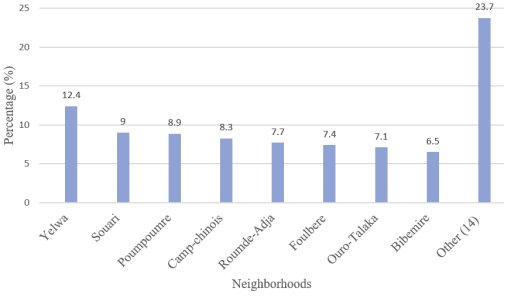
The patients originated from 22 distinct neighborhoods, regardless of their comfort. Figure 1 presents the distribution of patients according to their neighborhood. The top eight neighborhoods have similar frequencies and represent the popular neighborhoods of the city. The less represented are either far from the regional hospital, or have a health structure of 3rd or 1st category near their home, or live in a residential neighborhood where the inhabitants have a higher income.
Figure 1. Distribution of attendance frequencies of patients according to the neighborhood (N= 663).
Other neighborhoods (with <40 patients each): Lainde (35), Plateau (23), Djamboutou (18), Soweto (18), Lagdo (17), Kanadi (16), Marouare (14), Ouro-labo (13), Nigeriare (13), Guider (12), Pitoa (10), Ngalbidje (10), Ngong (8), Quartier Bamileke (5), Djaouro-Baba (5).
This figure depicts the frequencies of malaria-positive cases of patients according to the neighborhoods where they live in a population of 663 positive cases. The proportions in percentage of patients from 22 neighborhoods of the studied city (Garoua) are represented with an emphasis on the first 8 with the highest proportions.
3.3. Clinical Presentation
Clinical Symptoms
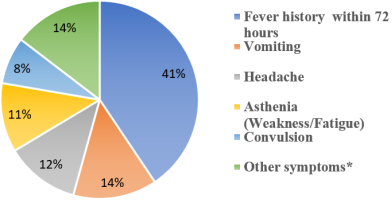
Several symptoms were registered, including classic symptoms such as fever, vomiting, headache, asthenia, and convulsions, which were the most frequent, with approximately 75% of the observed clinical signs. Less frequent symptoms included diarrhea, abdominal pain, myalgia, and arthralgia. The figure below presents the details of the symptoms.
*Includes diarrhea, abdominal pain, myalgia, and arthralgia.

Download: Download full-size image

Figure 2. Frequencies of clinical symptoms of patients.
This figure presents the relative frequencies of each clinical symptom over all the observed symptoms reccurent of not.
Seasonal Distribution
The Garoua region experiences a distinct unimodal rainy season lasting approximately four months (typically May to August), followed by a prolonged 8-month dry season. Hospital attendance among patients with complete files was 329 (40.62%) for the rainy season and 334 (50.38) for the dry season.
Healthcare Access, Clinical Management, and Outcomes
Healthcare-Seeking Behavior Before Admission
Table 2 presents the patients’ behavior when seeking care. The primary choice of the GHR in almost ¾ of cases (71.5%) demonstrates a good reputation for the RHG and weak fulfillment of its function as a referring hospital.
Table 2. Patients’ choice when seeking care.

Parameter

Category

Number of Patients

Percentage (%)

Therapeutic pathway before RHG admission

Yes

474

71.5

No

189

28.5

Consultation in another Health Facility

Yes

189

28.5

No

474

71.5

Compliance with Clinical Guidelines
An assessment of the clinical management quality of 663 patients revealed high adherence to national treatment and diagnostic protocols. As presented in the table below, more than 98% of the prescribed treatments were performed in compliance with the recommendations.
Table 3. Observance of recommendations on diagnostic and clinical management.

Clinical Management Parameter

Category

Number of Patients

Percentage (%)

Treatment Compliance

Yes

656

98.9

No

7

1.1

Diagnostic Pathway Compliance

Yes

653

98.5

No

10

1.5

Final Health Status
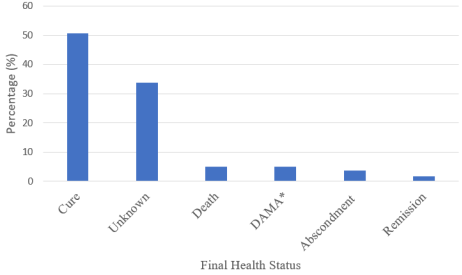
The final health outcomes of the 663 patients in the analytical cohort are presented below. Approximately 85% of patients were normally taken care of and followed up. The remaining patients were either discharged against medical advice or escaped from the hospital. More than 60% of patients were known to be free of malaria after their treatment, and 5% unfortunately died. A significant proportion of patients (33.79) had unknown follow-up status, which may be attributed to a lack of registration by the hospital staff.
*Discharged Against Medical Advice

Download: Download full-size image

Figure 3. Distribution of patients according to the final health status (N=663).
This figure represents the relative frequencies of each kind of outcome as final status of the followed-up patients.
Socioeconomic Factors
3.4. Father's Education Level
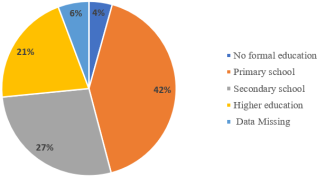
Data on the fathers’ education level were available for 628 patients (94.7% of the sample). These data show that approximately 85% of the patients attending RHG were educated at least to the level of primary school, and very few (5%) did not receive a formal education and were not even able to read.
Figure 4. Distribution of patients according to the education level of the fathers (N=583).
This figure presents a circle diagram of proportion in percentage of parents according to their education (formal or not).
3.5. Monthly Household Income and Malaria Severity
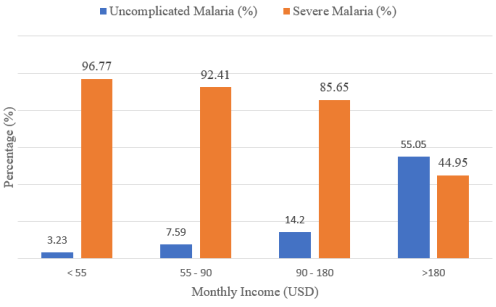
Data on monthly household income (USD) and its association with disease severity among confirmed cases are presented below. The data show a clear inverse relationship between income levels and the proportion of severe malaria cases. The more a patient or the head of the family earns, the less likely they are to develop severe malaria.
This figure depicts the frequencies of uncomplicated and severe malaria as a function of the monthly income of the parent in charge of the household.
The proportion of patients with severe malaria decreased sharply as household income increased. More than 95% of severe malaria was observed when the head of household earned less than 30,000 CFA monthly, whereas in the highest income category (>100,000 CFA), severe cases constituted less than half (44.95%) of patients in this category.
Figure 5. Comparison of severe and uncomplicated malaria with respect to the monthly income of the head of household.

3.6. Disease Severity Among Confirmed Cases
Within the analytical sample of 663 confirmed cases, 459 cases were classified for severity analysis after excluding cases with insufficient clinical details for severity grading. Among these patients, 345 (75.2%) had uncomplicated malaria, and 24.8% (114) had severe malaria.
3.7. Determinants of Malaria Infection
Table 4. Determinants of Malaria Infection (Full Suspected Cohort, N=3,506).

Factor

Category

aOR

95% CI

p-value

Age Group

0-6 years

3.42

2.91 – 4.01

<0.001

6-20 years

1.28

1.09 – 1.51

0.003

>20 years

Ref.

Residence Type

Rural

2.25

1.98 – 2.56

<0.001

Urban

Ref.

Environmental Exposure

Marshy Area

2.18

1.89 – 2.52

<0.001

Non-Marshy Area

Ref.

Season

Rainy Season

1.88

1.62 – 2.18

<0.001

Dry Season

Ref.

ITNs Use

No

1.92

1.61 – 2.29

<0.001

Yes

Ref.

Prior Consultation

Yes

0.62

0.51 – 0.75

<0.001

No

Ref.

Father's Education

Higher

0.58

0.45 – 0.75

<0.001

Secondary

0.72

0.57 – 0.91

0.006

Primary

0.85

0.68 – 1.06

0.148

Ref.

Multivariable logistic regression identified the following independent determinants of a positive malaria test result among all suspected cases. Table 4 shows a highly significant positive association between younger age, residing in rural and marshy areas, the rainy season, non-use of ITNs, and malaria infection. Elsewhere, a moderate negative association was observed between those aged 6–20 years old, being educated (higher or secondary school), and malaria infection.
3.8. Determinants of Severe Malaria
Among confirmed cases, several factors, including clinical symptoms, clinical course, healthcare access, age, father’s education, use of ITNs, type of environment (marshy or not), season, and sex of the patient, affected the progression to severe disease. Table 5 details each factor in the occurrence of severe malaria. Convulsions, delayed presentation in the sanitary structure, younger age, and absence of prior consultation were strongly associated with severe malaria (P<0.001). Father’s education, non-use of ITNs, dwelling in marshy areas, and the rainy season were moderately associated with the occurrence of severe malaria (P>0.001), but the gender of the patient was not (P>0.05).
Table 5. Determinants of Severe Malaria (Among Confirmed Cases, n=459).

Factor

Category

aOR

95% CI

p-value

Clinical Symptoms

Convulsions (Present)

28.45

15.80 – 51.20

<0.001

Absent

Ref.

Clinical Course

Delayed Presentation (>48h)

3.76

2.31 – 6.11

<0.001

Presentation ≤48h

Ref.

Healthcare Access

No Prior FOSA Consultation

3.25

1.98 – 5.33

<0.001

Prior Consultation

Ref.

Age Group

0-6 years

3.85

2.31 – 6.42

<0.001

>20 years

Ref.

Father's Education

No Formal Education

2.85

1.42 – 5.72

0.003

Higher Education

Ref.

ITNs Use

Non-use of ITNs

2.18

1.31 – 3.61

0.003

ITNs Use

Ref.

Environmental Exposure

Marshy Area

2.05

1.29 – 3.26

0.002

Non-Marshy Area

Ref.

Season

Rainy Season

2.08

1.12 – 3.85

0.020

Dry Season

Ref.

Sex

Male

1.12

0.71 – 1.77

0.624

Female

Ref.

4. Discussion
The studied population of confirmed malaria patients exhibited notable heterogeneity in gender distribution, with a marked predominance of males. This imbalance mirrors the general population demographics in Cameroon, where boys outnumber girls in the 0–5-year age group . The lack of a significant association between sex and severe malaria in the multivariable analysis (Table 5: aOR 1.12, 95% CI 0.71–1.77, p=0.624) further supports that this reflects demographic patterns rather than any substantial sex-based susceptibility to malaria progression in young children. Conversely, the robust association between younger age (0–6 years) and both malaria infection and severe disease aligns with established epidemiological trends, where young children are disproportionately affected by the most severe forms of malaria due to developing immunity . Moreover, socioeconomic factors, such as low household income and limited paternal education, significantly heighten the risk of malaria infection and its progression to severe forms, underscoring the critical influence of broader societal determinants on disease outcomes .
The observed distribution of patients appears to be proportional to their proximity to the RHG, the nearest of which is the neighborhood “Yelwa” known for various activities during the day and night. This pattern aligns with our findings on residence type, where urban areas served as the reference category for malaria infection risk compared to rural areas (aOR 2.25, 95% CI 1.98–2.56, p<0.001; Table 4), indicating easier access for nearby urban dwellers. A similar observation was made by other authors, indicating an influence of distance and consequently the means of transport on attendance to health facilities and sometimes leading to a worsening of patients' status . This highlights the critical role of geographical accessibility and infrastructure in mediating health-seeking behaviors and disease prognosis.
This study presented fever as the main symptom in positive patients, as observed in non-severe or severe malaria cases . These few occurrences of convulsions suggest a reduced frequency of severe malaria in the studied population. Severe malaria is characterized by convulsive seizures, fever, and other clinical signs .
The observed attendance frequency in the rainy and dry seasons was similar, although the rainy season was shorter (4 months), indicating that transmission was approximately twice as active in this season. The rainy season is favorable for mosquito breeding, with numerous breeding sites that facilitate malaria transmission compared to the dry season . Thus, the incidence rate was higher during the rainy season.
Patients do not choose to go directly to the RHG without consultation in lower-category health facilities or with their traditional healers. This observation may indicate patients’ dissatisfaction when visiting these lower-category health facilities because of their quality or limited financial means to sustain their health charges. Similar observations have been made by other authors , confirming the influence of quality on the choice of health facility.
The recommendation for the management of malaria relies on the WHO guidelines ruling the categorization of clinical features and the suitable approach to management . These recommendations particularly the “test and treat” approach, were broadly applied by practitioners of RHG, as reported for most low- and middle-income countries .
The observed deaths may be attributed to the severity of the disease and inadequate follow-up upon patients' arrival at the RHG, despite this health facility's strict adherence to WHO recommendations . This underscores the need for continuous evaluation of clinical practice, especially concerning the timely and appropriate administration of parenteral antimalarial treatments and referrals for severe cases, to mitigate avoidable mortality .
The lack of formal education influenced the ability of the household head to obtain useful information on the origin of malaria and the way of healing or preventing infection. Since the head of household (generally men) ensures the entire family’s health through his financial resources, his understanding of the disease greatly influences malaria incidence in his family. A similar observation was made by Nyasa et al. (2023) in the neighboring region of Maroua (Cameroon) and by other authors who observed the influence of household head education and knowledge of the community on the incidence of malaria in children .
The observed increase in prevalence inversely with income could be explained by the direct relationship between financial means and quality treatment of malaria and prevention against mosquito bites. Household heads and the number of family members, particularly children, are additional factors that may be considered in malaria control at the family level. It has been established that family incomes influence the incidence of malaria in families in sub-Saharan countries, including the Democratic Republic of Congo, Nigeria, and Tanzania .
Approximately 25% of patients were infected with the severe form, which may include an important proportion of children, considering that they are more susceptible to severe malaria. The observed frequency in this study was similar to that of Chiabi et al. (2020) in Yaoundé and suggests a national proportion of severe malaria approximately 25% among malaria patients.
Malaria infection is influenced by multiple factors, which result in a high probability of infection. The influence of age is related to the fragility of the immune response of young children (less than 6 years old), their inability to apply control measures conveniently to avoid mosquito bites, and the education or awareness of their parents .
Severe malaria occurred more frequently in younger patients in this study, those aged 0-6 years, than in young adults >20 years. Convulsions are the most frequently reported clinical feature among several features in young children, such as respiratory distress or clinical jaundice (Olupot‐Olupot et al., 2020). As recommended by the WHO guidelines, the observation of one of these severe clinical features is sufficient, in addition to parasitological evidence, to conclude a case of severe malaria . Elsewhere, neurological disorders authors present neurological disorders as the main sign of severity, including convulsions in the same sub-region . These factors are interdependent due to their cause-effect relationship. As an illustration, the misuse or non-use of ITNs exposes young children to frequent bites from mosquito vectors that may transmit a large number of parasites, which may lead to severe malaria , knowing that hyperparasitemia is one of the signs of severe malaria. The evolution from uncomplicated malaria to severe malaria seems to be driven by the host’s intrinsic factors, such as age, with the consequence of low circulation of antibodies and low premunition . In addition, the father’s education level may impact his reactivity in the event of an infection of a household member, resulting in a treatment delay of 24 h to 7 days, which significantly increases the risk of evolution to severe malaria . The rainy season was found, similar to numerous studies , to be conducive to malaria episodes and contribute to a lesser extent to the severity of malaria via the possible transmission of resistant strains of Plasmodium .
5. Conclusion
In conclusion, this study confirms that malaria in northern Cameroon is driven by a convergence of demographic (young age), environmental (marshy residence), and behavioral (healthcare access, prevention) factors. The prevalence of malaria among the suspected population was 30.6%, a close value to the national prevalence. Severity is powerfully signaled by specific symptoms like convulsions and exacerbated by delays in appropriate care. Elsewhere, this study supports the use of ITNs, seasonal and environmental control measures as first approaches for malaria prevention. In addition, sensitization and community-directed education are needed to strengthen prevention and evolution to severe malaria. Prevention approaches directed to young children are required to reduce severe malaria prevalence efficiently and ensure a safer childhood in Garoua. A further investigation into the reason of gender disparity in hospital attendance and the role of maternal education may give better insight to stakeholders for malaria control and eradication.
Abbreviations

DAMA

Discharged Against Medical Advice

ITNs

Insecticide Treated Nets

RHG

Regional Hospital of Garoua

USD

United States’ Dollar

Acknowledgments
We thank the staff of the Regional Hospital of Garoua. We also acknowledge Mr. YOUSSOUFA, Mr. NETTAOULASSA Calvin, and Mr. ABOUBAKAR for their assistance in the hospital. The authors would like to acknowledge the use of Jenni.ai and Grammarly ai for writing assistance and grammatical editing to improve readability and reduce spelling mistakes in this manuscript.
Author Contributions
Djafsia Boursou: Conceptualization, Data curation, Resources, Writing – original draft
Adamou Moise: Conceptualization, Supervision, Validation
Daiferle Godwe Viviane: Investigation, Methodology, Software
Gake Bouba: Conceptualization, Writing – review & editing
Abessolo Abessolo Hermine: Project administration, Supervision, Validation
Okomo Marie Claire: Project administration, Supervision, Validation
Funding
The author's personal funds funded the research activities and author processing charges (APC).
Conflicts of Interest
The authors declare no conflicts of interest.
References
[1] Obasohan PE, Walters SJ, Jacques R, Khatab K. A Scoping Review of the Risk Factors Associated with Anaemia among Children Under Five Years in Sub-Saharan African Countries. International Journal of Environmental Research and Public Health. 2020; 17: 8829.
[2] World malaria report 2025: addressing the threat of antimalarial drug resistance. Geneva: World Health Organization; 2025. Licence: CC BY-NC-SA 3.0 IGO.
[3] Programme National de Lutte contre le Paludisme (PNLP). Synthèse des données de surveillance en 2024. 2025.
[4] Kuetche MTC, Tabue RN, Fokoua-Maxime CD, Evouna AM, Billong S, Kakesa O. Prevalence and risk factors determinants of the non-use of insecticide-treated nets in an endemic area for malaria: analysis of data from Cameroon. Malar J. Springer Science and Business Media LLC; 2023; 22.
[5] Nyasa RB, Ngwa SF, Esemu SN, Titanji VPK. A Comparative Study of the Risk Factors of Malaria within Urban and Rural Settings in the Sahelian Region of Cameroon and the Role of Insecticide Resistance in Mosquitoes. Int J Trop Dis Health. 2023; 44: 43–59.
[6] National Institute of Statistics. Fifth Cameroon Household Survey: Situation of household living conditions in 2021-2022. 2024.
[7] Nembot Ndeffo L, Tene MM, Kuelah JRT, Ningaye P. Analysis of monetary and non-monetary determinants of access to education in Cameroon. Rev of economy Dev. 2013; Vol. 21: 91–125.
[8] Saïdou S. Urgences Educatives à l’Extrême-Nord du Cameroun : Réponses aux Crises et Enjeux de la Scolarisation. J Educ Pract. 2025; 9: 36–50.
[9] Achidi EA, Apinjoh TO, Anchang-Kimbi JK, Mugri RN, Ngwai AN, Yafi CN. Severe and uncomplicated falciparum malaria in children from three regions and three ethnic groups in Cameroon: prospective study. Malar J. 2012; 11: 215.
[10] Imboumy-Limoukou RK, Lendongo-Wombo JB, Nguimbyangue-Apangome AF, Biteghe Bi Essone J-C, Mounioko F, Oyegue-Libagui LS, et al. Severe malaria in Gabon: epidemiological, clinical and laboratory features in Amissa Bongo Hospital of Franceville. Malar J. 2023; 22: 88.
[11] Kwenti TE, Kwenti TDB, Njunda LA, Latz A, Tufon KA, Nkuo-Akenji T. Identification of the Plasmodium species in clinical samples from children residing in five epidemiological strata of malaria in Cameroon. Trop Med Health. 2017; 45: 14.
[12] Ashaolu JO, Akanji TS, Ayansola VI, Olawale-Succes OO, Sunday AJ, Some SYM. From risk factors to predictive modelling: applying machine learning to childhood malaria surveillance in resource-limited settings. BMC Infect Dis. 2025; 25: 1693.
[13] Nounouce NPJ, Zakariaou N, Marie-José E, Yollande T, Carele D, Christelle B. Prevalence and socio-economic determinants of malaria among children under five in Cameroon. Int J Community Med Public Health. 2022; 9: 603–11.
[14] Kenny A, Basu G, Ballard M, Griffiths T, Kentoffio K, Niyonzima JB, et al. Remoteness and maternal and child health service utilization in rural Liberia: A population–based survey. J Glob Health. 2015; 5: 020401.
[15] Nishan MDNH, Akter K. Coverage and determinants of Intermittent Preventive Treatment in pregnancy (IPTp) in Cameroon, Guinea, Mali, and Nigeria. PLOS ONE. 2024; 19: e0313087.
[16] McLaren ZM, Ardington C, Leibbrandt M. Distance decay and persistent health care disparities in South Africa. BMC Health Serv Res. 2014; 14: 541.
[17] Chiabi A, Djimafo ANM, Nguefack S, Mah E, Nguefack Dongmo F, Angwafo F. Severe malaria in Cameroon: Pattern of disease in children at the Yaounde Gynaeco-Obstetric and Pediatric hospital. J Infect Public Health. 2020; 13: 1469–72.
[18] Mala W, Wilairatana P, Samerjai C, Masangkay FR, Kotepui KU, Kotepui M. Prevalence of Signs of Severity Identified in the Thai Population with Malaria: A Systematic Review and Meta-Analysis. Int J Environ Res Public Health. 2022; 19: 1196.
[19] Zhou G, Minakawa N, Githeko A, Yan G. Spatial Distribution Patterns of Malaria Vectors and Sample Size Determination in Spatially Heterogeneous Environments: A Case Study in the West Kenyan Highland. J Med Entomol. 2004; 41: 1001–9.
[20] James M, Edward M. Analysis of the Factors Influencing Healthcare Provider Choice in Rural Uganda, a Case of 2009/10 Uganda National Household Survey. Rochester, NY: Social Science Research Network; 2015.
[21] Konde-Lule J, Gitta SN, Lindfors A, Okuonzi S, Onama VO, Forsberg BC. Private and public health care in rural areas of Uganda. BMC Int Health Hum Rights. 2010; 10: 29.
[22] Weltgesundheitsorganisation, editor. Management of severe and complicated malaria: a practical handbook. 3. ed. Geneva: World Health Organization; 2012.
[23] Macarayan E, Papanicolas I, Jha A. The quality of malaria care in 25 low-income and middle-income countries. BMJ Glob Health. 2020; 5: e002023.
[24] Mousa A, Al-Taiar A, Anstey NM, Badaut C, Barber BE, Bassat Q, et al. The impact of delayed treatment of uncomplicated P. falciparum malaria on progression to severe malaria: A systematic review and a pooled multicentre individual-patient meta-analysis. PLOS Med. Public Library of Science; 2020; 17: e1003359.
[25] Anjorin S, Okolie E, Yaya S. Malaria profile and socioeconomic predictors among under-five children: an analysis of 11 sub-Saharan African countries. Malar J. 2023; 22: 55.
[26] Diiro GM, Affognon HD, Muriithi BW, Wanja SK, Mbogo C, Mutero C. The role of gender on malaria preventive behaviour among rural households in Kenya. Malar J. 2016; 15: 14.
[27] Tesfahunegn A, Zenebe D, Addisu A. Determinants of malaria treatment delay in northwestern zone of Tigray region, Northern Ethiopia, 2018. Malar J. 2019; 18: 358.
[28] Argy N, Kendjo E, Augé-Courtoi C, Cojean S, Clain J, Houzé P, et al. Influence of host factors and parasite biomass on the severity of imported Plasmodium falciparum malaria. Plos One. 2017; 12: e0175328.
[29] Atieli HE, Zhou G, Afrane Y, Lee M-C, Mwanzo I, Githeko AK, et al. Insecticide-treated net (ITN) ownership, usage, and malaria transmission in the highlands of western Kenya. Parasit Vectors. 2011; 4: 113.
[30] Koenker H, Taylor C, Burgert-Brucker CR, Thwing J, Fish T, Kilian A. Quantifying Seasonal Variation in Insecticide-Treated Net Use among Those with Access. Am J Trop Med Hyg. 2019; 101: 371–82.
[31] Wehner S, Stieglbauer G, Traoré C, Sie A, Becher H, Müller O. Malaria incidence during early childhood in rural Burkina Faso: Analysis of a birth cohort protected with insecticide-treated mosquito nets. Acta Trop. 2017; 175: 78–83.
Cite This Article
  • APA Style

    Boursou, D., Moise, A., Viviane, D. G., Bouba, G., Hermine, A. A., et al. (2026). Prevalence and Determinants of Malaria at the Regional Hospital of Garoua in the North Region of Cameroon: A Retrospective Study. Central African Journal of Public Health, 12(3), 130-140. https://doi.org/10.11648/j.cajph.20261203.11

    Copy | Download

    ACS Style

    Boursou, D.; Moise, A.; Viviane, D. G.; Bouba, G.; Hermine, A. A., et al. Prevalence and Determinants of Malaria at the Regional Hospital of Garoua in the North Region of Cameroon: A Retrospective Study. Cent. Afr. J. Public Health 2026, 12(3), 130-140. doi: 10.11648/j.cajph.20261203.11

    Copy | Download

    AMA Style

    Boursou D, Moise A, Viviane DG, Bouba G, Hermine AA, et al. Prevalence and Determinants of Malaria at the Regional Hospital of Garoua in the North Region of Cameroon: A Retrospective Study. Cent Afr J Public Health. 2026;12(3):130-140. doi: 10.11648/j.cajph.20261203.11

    Copy | Download

  • @article{10.11648/j.cajph.20261203.11,
      author = {Djafsia Boursou and Adamou Moise and Daiferle Godwe Viviane and Gake Bouba and Abessolo Abessolo Hermine and Okomo Marie Claire},
      title = {Prevalence and Determinants of Malaria at the Regional Hospital of Garoua in the North Region of Cameroon: 
    A Retrospective Study},
      journal = {Central African Journal of Public Health},
      volume = {12},
      number = {3},
      pages = {130-140},
      doi = {10.11648/j.cajph.20261203.11},
      url = {https://doi.org/10.11648/j.cajph.20261203.11},
      eprint = {https://article.sciencepublishinggroup.com/pdf/10.11648.j.cajph.20261203.11},
      abstract = {Background: Malaria remains a leading public health problem in Cameroon, with the northern Sahelian region experiencing intense seasonal transmission. This study aimed to determine the prevalence and identify the determinants of malaria infection and its severity at Regional Hospital of Garoua (RHG). Methods: A hospital-based retrospective analysis was conducted between January 1, 2021, and December 31, 2023. Records of 3,506 patients with suspected malaria were reviewed. Data from 663 patients with confirmed malaria and complete files were collected and analyzed to determine malaria severity. Results: The prevalence of confirmed malaria was 30.6%. Among the analytical sample of confirmed cases, the population was predominantly male (77.4%) and young children (55.4%). Relevant determinants for malaria infection among suspected cases included age 0-6 years (aOR=3.42), rural residence (aOR=2.25), marshy area residence (aOR=2.18), and non-use of Insecticide Treated Nets (aOR=1.92). Among confirmed cases, 24.8% were severe. Determinants of severe malaria included convulsions (aOR=28.45), delayed presentation (>48h) (aOR=3.76), absence of prior consultation at another health facility (aOR=3.25), and lower paternal education level (aOR=2.85 for no formal education). Conclusion: This study confirms the high malaria burden in northern Cameroon, driven by pediatric age, environmental and seasonal exposure, and healthcare access barriers. Progression to severe disease is strongly associated with specific clinical signs, paternal education level, and care-seeking behavior.},
     year = {2026}
    }
    

    Copy | Download

  • TY  - JOUR
    T1  - Prevalence and Determinants of Malaria at the Regional Hospital of Garoua in the North Region of Cameroon: 
    A Retrospective Study
    AU  - Djafsia Boursou
    AU  - Adamou Moise
    AU  - Daiferle Godwe Viviane
    AU  - Gake Bouba
    AU  - Abessolo Abessolo Hermine
    AU  - Okomo Marie Claire
    Y1  - 2026/05/12
    PY  - 2026
    N1  - https://doi.org/10.11648/j.cajph.20261203.11
    DO  - 10.11648/j.cajph.20261203.11
    T2  - Central African Journal of Public Health
    JF  - Central African Journal of Public Health
    JO  - Central African Journal of Public Health
    SP  - 130
    EP  - 140
    PB  - Science Publishing Group
    SN  - 2575-5781
    UR  - https://doi.org/10.11648/j.cajph.20261203.11
    AB  - Background: Malaria remains a leading public health problem in Cameroon, with the northern Sahelian region experiencing intense seasonal transmission. This study aimed to determine the prevalence and identify the determinants of malaria infection and its severity at Regional Hospital of Garoua (RHG). Methods: A hospital-based retrospective analysis was conducted between January 1, 2021, and December 31, 2023. Records of 3,506 patients with suspected malaria were reviewed. Data from 663 patients with confirmed malaria and complete files were collected and analyzed to determine malaria severity. Results: The prevalence of confirmed malaria was 30.6%. Among the analytical sample of confirmed cases, the population was predominantly male (77.4%) and young children (55.4%). Relevant determinants for malaria infection among suspected cases included age 0-6 years (aOR=3.42), rural residence (aOR=2.25), marshy area residence (aOR=2.18), and non-use of Insecticide Treated Nets (aOR=1.92). Among confirmed cases, 24.8% were severe. Determinants of severe malaria included convulsions (aOR=28.45), delayed presentation (>48h) (aOR=3.76), absence of prior consultation at another health facility (aOR=3.25), and lower paternal education level (aOR=2.85 for no formal education). Conclusion: This study confirms the high malaria burden in northern Cameroon, driven by pediatric age, environmental and seasonal exposure, and healthcare access barriers. Progression to severe disease is strongly associated with specific clinical signs, paternal education level, and care-seeking behavior.
    VL  - 12
    IS  - 3
    ER  - 

    Copy | Download

Author Information
  • Abstract
  • Keywords
  • Document Sections

    1. 1. Introduction
    2. 2. Methods
    3. 3. Results
    4. 4. Discussion
    5. 5. Conclusion
    Show Full Outline
  • Abbreviations
  • Acknowledgments
  • Author Contributions
  • Funding
  • Conflicts of Interest
  • References
  • Cite This Article
  • Author Information