
Levodopa is a core therapeutic agent for Parkinson's disease (PD), while its long-term administration often leads to levodopa-induced dyskinesia (LID), which significantly compromises patients’ quality of life. This study utilizes bibliometric analysis to examine research trends in LID over the past decade, with the aim of identifying key research hotspots and prospective directions in the field. Relevant publications published between 2015 and 2024 were retrieved from the Web of Science and PubMed databases. A total of 691 articles were ultimately included for systematic analysis. Visual analytic techniques were applied using VOSviewer and CiteSpace to examine publication trends, contributions by countries and institutions, author collaboration networks, and keyword clustering. The annual number of publications in LID research exhibited a declining trend over the study period, with a peak in 2015. The United States and institution CNRS (Centre National de la Recherche Scientifique) contributed most significantly. Movement Disorders was the leading journal in both publication volume (54 articles) and citations (2,369). Author Huot P. was the most prolific (25 articles). Keyword analysis identified core themes encompassing "disease-drug-complication-intervention-model." The knowledge structure developed around key clusters: disease models and Parkinson Disease/Drug Therapy. Trend analysis revealed a move from retrospective etiology to refined safety assessments and mechanism-driven interventions. This study outlines the global research landscape and developmental trends in LID, thereby providing a theoretical foundation for future investigations into non-invasive brain stimulation, precision medicine, and novel drug therapies. Further research should emphasize early LID prediction, targeted treatments, and multidisciplinary management.
| Published in | Biomedical Statistics and Informatics (Volume 11, Issue 1) |
| DOI | 10.11648/j.bsi.20261101.11 |
| Page(s) | 1-13 |
| Creative Commons |
This is an Open Access article, distributed under the terms of the Creative Commons Attribution 4.0 International License (http://creativecommons.org/licenses/by/4.0/), which permits unrestricted use, distribution and reproduction in any medium or format, provided the original work is properly cited. |
| Copyright |
Copyright © The Author(s), 2026. Published by Science Publishing Group |
Parkinson’s Disease, Levodopa-induced Dyskinesia, Bibliometric Analysis, Hotspots, VOSviewer, CiteSpace
Rank | Country | Number of articles | Betweenness Centrality |
|---|---|---|---|
1 | USA | 218 | 0.50 |
2 | CHINA | 99 | 0.21 |
3 | ITALY | 92 | 0.29 |
4 | CANADA | 64 | 0.30 |
5 | FRANCE | 64 | 0.22 |
6 | SPAIN | 50 | 0.13 |
7 | SWEDEN | 45 | 0.11 |
8 | BRAZIL | 33 | 0.05 |
9 | SOUTH KOREA | 32 | 0.05 |
10 | GERMANY | 31 | 0.07 |
Rank | Organizations | Country | Number of articles |
|---|---|---|---|
1 | CNRS (Centre National de la Recherche Scientifique) | France | 49 |
2 | Lund University | Sweden | 33 |
3 | University of Bordeaux | France | 29 |
4 | McGill University | Canada | 26 |
5 | University of Cagliari | Italy | 26 |
Rank | Journals | H-index | Impact Factor | Number of articles |
|---|---|---|---|---|
1 | Movement Disorders | 174 | 7.6 | 54 |
2 | Neurobiology Disease | 151 | 5.6 | 34 |
3 | Neuropharmacology | 150 | 4.6 | 32 |
4 | Journal of Neural Transmission | 100 | 4.0 | 29 |
5 | Experimental Neurology | 168 | 4.2 | 21 |
6 | Parkinsonism & Related Disorders | 84 | 3.4 | 17 |
7 | Journal of Parkinson’s Disease | 32 | 5.0 | 16 |
8 | Neuroscience | 204 | 2.8 | 15 |
9 | Scientific Reports | 149 | 3.9 | 13 |
10 | Frontiers In Aging Neuroscience | 55 | 4.5 | 12 |
Rank | Journals | H-index | CiteScore | Citations |
|---|---|---|---|---|
1 | Movement Disorders | 174 | 13.20 | 2369 |
2 | Journal of Neuroscience | 422 | 8.00 | 1062 |
3 | Neurobiology of Disease | 151 | 8.90 | 876 |
4 | Neurology | 331 | 10.20 | 780 |
5 | Brain | 308 | 20.4 | 632 |
6 | Neuropharmacology | 150 | 9.40 | 577 |
7 | Experimental Neurology | 168 | 8.70 | 534 |
8 | Parkinsonism & Related Disorders | 84 | 6.00 | 520 |
9 | Annals of Neurology | 273 | 15.90 | 516 |
10 | Neuroscience | 204 | 5.60 | 514 |
Rank | Author | Number of articles | Total link strength |
|---|---|---|---|
1 | Huot P. | 25 | 97 |
2 | Bishop C. | 25 | 28 |
3 | Bezard E. | 21 | 34 |
4 | Hamadjida A. | 17 | 81 |
5 | Fox S. H. | 17 | 26 |
6 | Frouni I. | 16 | 74 |
7 | Chung S. J. | 16 | 51 |
7 | Li Q. | 16 | 29 |
9 | Calabresi P. | 15 | 29 |
10 | Cenci M. A. | 15 | 6 |
Rank | Keywords | Counts |
|---|---|---|
1 | Levodopa induced dyskinesia | 676 |
2 | Parkinson’s disease | 621 |
3 | Levodopa | 590 |
4 | Drug therapy | 417 |
5 | Disease models | 392 |
Rank | Title | Year | Journal | IF | CiteScore | Citation times |
|---|---|---|---|---|---|---|
1 | Pathophysiology of L-dopa-induced motor and non-motor complications in Parkinson's disease | 2015 | Progress in Neurobiology | 6.1 | 13.90 | 74 |
2 | Levodopa-induced dyskinesia in Parkinson disease: Current and evolving concepts | 2018 | Annals of Neurology | 7.7 | 15.90 | 44 |
3 | Eltoprazine counteracts l-DOPA-induced dyskinesias in Parkinson's disease: a dose-finding study | 2015 | Brain | 11.7 | 20.40 | 30 |
4 | Dopamine D3 Receptor Modulates L-DOPA-Induced Dyskinesia by Targeting D1 Receptor-Mediated Striatal Signaling | 2017 | Cerebral Cortex | 2.9 | 5.80 | 27 |
5 | Amantadine extended release for levodopa-induced dyskinesia in Parkinson's disease | 2015 | Movement Disorders | 7.6 | 13.20 | 25 |
LID | Levodopa-Induced Dyskinesia |
CNRS | Centre National de la Recherche Scientifique |
PD | Parkinson’s Disease |
WoSCC | Web of Science Core Collection |
DBS | Deep Brain Stimulation |
Levodopa | L-3, 4-dihydroxyphenylalanine |
USA | The United States |
DOIs | Digital Object Identifiers |
| [1] | Zhu J, C. Y. et al. Temporal trends in the prevalence of Parkinson’s disease from 1980 to 2023: a systematic review and meta-analysis. The Lancet Healthy Longevity. 2024, 5, e464-e479. |
| [2] | Sharma, S. et al. Neurobiology of L-DOPA induced dyskinesia and the novel therapeutic strategies. Biomedicine & Pharmacotherapy. 2015, 70, 283-293. |
| [3] | Van Eck, N. J., Waltman, L. Software survey: VOSviewer, a computer program for bibliometric mapping. Scientometrics. 2010, 84(2), 523-538. |
| [4] | Chen, C. CiteSpace II: Detecting and Visualizing Emerging Trends and Transient Patterns in Scientific Literature. Journal of the American Society for Information Science and Technology. 2006, 57(3), 359-377. |
| [5] | Chen, Y.-J., et al. Microglia-associated research in Parkinson’s disease: a bibliometric analysis. Frontiers in Aging Neuroscience. 2025, 17, 1657349. |
| [6] | Phillips, J. R. et al. Neural substrates and potential treatments for levodopa-induced dyskinesias in Parkinson’s disease. Reviews in the Neurosciences. 2016, 27(7), 729-738. |
| [7] | Ryu, H.-S., et al. Genomic Analysis Identifies New Loci Associated With Motor Complications in Parkinson’s Disease. Frontiers in Neurology. 2020, 11, 570. |
| [8] | Jung, J. H. et al. White matter connectivity networks predict levodopa-induced dyskinesia in Parkinson’s disease. Journal of Neurology. 2022, 269(6), 2948-2960. |
| [9] | Wang, P.-F., et al. Fenobam modulates distinct electrophysiological mechanisms for regulating excessive gamma oscillations in the striatum of dyskinetic rats. Experimental Neurology. 2024, 378, 114833. |
| [10] | Johnston, T. M. and S. H. Fox, Symptomatic Models of Parkinson's Disease and L-DOPA-Induced Dyskinesia in Non-human Primates. Curr Top Behav Neurosci. 2015, 22, 221-35. |
| [11] | Ba, M. M. Kong, and G. Ma, Postsynaptic density protein 95-regulated NR2B tyrosine phosphorylation and interactions of Fyn with NR2B in levodopa-induced dyskinesia rat models. Drug Des Devel Ther. 2015, 9, 199-206. |
| [12] | Bortolanza, M. et al. Glial activation is associated with l-DOPA induced dyskinesia and blocked by a nitric oxide synthase inhibitor in a rat model of Parkinson's disease. Neurobiol Dis. 2015, 73, 377-87. |
| [13] | Dekundy, A. et al. Effects of dopamine uptake inhibitor MRZ-9547 in animal models of Parkinson's disease. J Neural Transm (Vienna). 2015, 122(6), 809-18. |
| [14] | Divito, C. B. et al. Loss of VGLUT3 Produces Circadian-Dependent Hyperdopaminergia and Ameliorates Motor Dysfunction and l-Dopa-Mediated Dyskinesias in a Model of Parkinson's Disease. J Neurosci. 2015, 35(45), 14983-99. |
| [15] | Fidalgo, C. et al. Effect of serotonin transporter blockade on L-DOPA-induced dyskinesia in animal models of Parkinson's disease. Neuroscience. 2015, 298, 389-96. |
| [16] | Iderberg, H. et al. Activity of serotonin 5-HT (1A) receptor 'biased agonists' in rat models of Parkinson's disease and L-DOPA-induced dyskinesia. Neuropharmacology. 2015, 93, 52-67. |
| [17] | Mellone, M. et al. NMDA receptor GluN2A/GluN2B subunit ratio as synaptic trait of levodopa-induced dyskinesias: from experimental models to patients. Frontiers In Cellular Neuroscience. 2015, 9. |
| [18] | Potts, L. F. et al. Dual κ-agonist/μ-antagonist opioid receptor modulation reduces levodopa-induced dyskinesia and corrects dysregulated striatal changes in the nonhuman primate model of Parkinson disease. Ann Neurol. 2015, 77(6), 930-41. |
| [19] | Shen, W. et al. M4 Muscarinic Receptor Signaling Ameliorates Striatal Plasticity Deficits in Models of L-DOPA-Induced Dyskinesia. Neuron. 2015, 88(4), 762-73. |
| [20] | Urs, N. M. et al. Targeting β-arrestin2 in the treatment of L-DOPA-induced dyskinesia in Parkinson's disease. Proc Natl Acad Sci U S A. 2015, 112(19), E2517-26. |
| [21] | Haaxma, C. A. et al. Risk of Disabling Response Fluctuations and Dyskinesias for Dopamine Agonists Versus Levodopa in Parkinson's Disease. Journal Of Parkinsons Disease. 2015, 5(4), 847-853. |
| [22] | Lenderking, W. R. et al. Assessment of Parkinson's disease levodopa-induced dyskinesia: a qualitative research study. Qual Life Res. 2015, 24(8), 1899-910. |
| [23] | Alam, M. R. and S. Singh, Neuromodulation in Parkinson's disease targeting opioid and cannabinoid receptors, understanding the role of NLRP3 pathway: a novel therapeutic approach. Inflammopharmacology. 2023, 31(4), 1605-1627. |
| [24] | Oertel, W. et al. Randomized, placebo-controlled trial of ADS-5102 (amantadine) extended-release capsules for levodopa-induced dyskinesia in Parkinson's disease (EASE LID 3). Mov Disord. 2017, 32(12), 1701-1709. |
| [25] | Pahwa, R. et al. ADS-5102 (Amantadine) Extended-Release Capsules for Levodopa-Induced Dyskinesia in Parkinson Disease (EASE LID Study): A Randomized Clinical Trial. Jama Neurol. 2017, 74(8), 941-949. |
| [26] | Choi, H. and S. H. Koh, Understanding the role of glycogen synthase kinase-3 in L-DOPA-induced dyskinesia in Parkinson's disease. Expert Opin Drug Metab Toxicol. 2018, 14(1), 83-90. |
| [27] | Lopez-Lopez, A. et al. Rho kinase inhibitor fasudil reduces l-DOPA-induced dyskinesia in a rat model of Parkinson's disease. Br J Pharmacol. 2020, 177(24), 5622-5641. |
| [28] | Bariotto-Dos-Santos, K., et al. Rating L-DOPA-Induced Dyskinesias in the Unilaterally 6-OHDA-Lesioned Rat Model of Parkinson's Disease. Journal of Visualized Experiments. 2021, (176), 62924. |
| [29] | Negida, A. et al. Mavoglurant (AFQ056) for the treatment of levodopa-induced dyskinesia in patients with Parkinson's disease: a meta-analysis. Neurol Sci. 2021, 42(8), 3135-3143. |
| [30] | Hansen, C. A. et al. Levodopa-induced dyskinesia: a historical review of Parkinson's disease, dopamine, and modern advancements in research and treatment. J Neurol. 2022, 269(6), 2892-2909. |
| [31] | Kwon, D. K., et al. Levodopa-Induced Dyskinesia in Parkinson's Disease: Pathogenesis and Emerging Treatment Strategies. Cells. 2022, 11(23), 3736. |
| [32] | Wang, Q. and W. Zhang, Maladaptive Synaptic Plasticity in L-DOPA-Induced Dyskinesia. Front Neural Circuits. 2016, 10, 105. |
| [33] | Cerovic, M. et al. Derangement of Ras-guanine nucleotide-releasing factor 1 (Ras-GRF1) and extracellular signal-regulated kinase (ERK) dependent striatal plasticity in L-DOPA-induced dyskinesia. Biol Psychiatry. 2015, 77(2), 106-15. |
| [34] | Dyavar, S. R. et al. Transcriptomic approach predicts a major role for transforming growth factor beta type 1 pathway in L-Dopa-induced dyskinesia in parkinsonian rats. Genes Brain Behav. 2020, 19(8), e12690. |
| [35] | Brugnoli, A. et al. Genetic deletion of Rhes or pharmacological blockade of mTORC1 prevent striato-nigral neurons activation in levodopa-induced dyskinesia. Neurobiol Dis. 2016, 85, 155-163. |
| [36] | Caulfield, M. E. et al. Downregulation of striatal Ca (V)1. 3 inhibits the escalation of levodopa-induced dyskinesia in male and female parkinsonian rats of advanced age. Neurobiol Dis. 2023, 181, 106111. |
| [37] | Wang, Q. et al. Eltoprazine prevents levodopa-induced dyskinesias by reducing causal interactions for theta oscillations in the dorsolateral striatum and substantia nigra pars reticulate. Neuropharmacology. 2019, 148, 1-10. |
| [38] | Brugnoli, A. C. A. Pisanò, and M. Morari, Striatal and nigral muscarinic type 1 and type 4 receptors modulate levodopa-induced dyskinesia and striato-nigral pathway activation in 6-hydroxydopamine hemilesioned rats. Neurobiol Dis. 2020, 144, 105044. |
| [39] | Wei, Y., Tu, L., et al. Research hotspots and trends of transcranial magnetic stimulation in Parkinson’s disease: a bibliometric analysis. Frontiers in Neuroscience. 2023, 17, 1280180. |
| [40] | Peng, J., Hao, C., Wan, H. Bibliometric analysis of rehabilitation in Alzheimer’s disease (2000–2023): trends, hotspots and prospects. Frontiers in Aging Neuroscience. 2024, 16, 1457982. |
APA Style
Shi, H., Chen, J., Fan, X., Xu, X., Xu, X. (2026). Research Trends and Hotspots in Levodopa-induced Dyskinesia: A Bibliometric Analysis (2015-2024). Biomedical Statistics and Informatics, 11(1), 1-13. https://doi.org/10.11648/j.bsi.20261101.11
ACS Style
Shi, H.; Chen, J.; Fan, X.; Xu, X.; Xu, X. Research Trends and Hotspots in Levodopa-induced Dyskinesia: A Bibliometric Analysis (2015-2024). Biomed. Stat. Inform. 2026, 11(1), 1-13. doi: 10.11648/j.bsi.20261101.11
AMA Style
Shi H, Chen J, Fan X, Xu X, Xu X. Research Trends and Hotspots in Levodopa-induced Dyskinesia: A Bibliometric Analysis (2015-2024). Biomed Stat Inform. 2026;11(1):1-13. doi: 10.11648/j.bsi.20261101.11
@article{10.11648/j.bsi.20261101.11,
  author = {Haixin Shi and Jiaxuan Chen and Xinman Fan and Xiaoxin Xu and Xiaohong Xu},
  title = {Research Trends and Hotspots in Levodopa-induced Dyskinesia: A Bibliometric Analysis (2015-2024)},
  journal = {Biomedical Statistics and Informatics},
  volume = {11},
  number = {1},
  pages = {1-13},
  doi = {10.11648/j.bsi.20261101.11},
  url = {https://doi.org/10.11648/j.bsi.20261101.11},
  eprint = {https://article.sciencepublishinggroup.com/pdf/10.11648.j.bsi.20261101.11},
  abstract = {Levodopa is a core therapeutic agent for Parkinson's disease (PD), while its long-term administration often leads to levodopa-induced dyskinesia (LID), which significantly compromises patients’ quality of life. This study utilizes bibliometric analysis to examine research trends in LID over the past decade, with the aim of identifying key research hotspots and prospective directions in the field. Relevant publications published between 2015 and 2024 were retrieved from the Web of Science and PubMed databases. A total of 691 articles were ultimately included for systematic analysis. Visual analytic techniques were applied using VOSviewer and CiteSpace to examine publication trends, contributions by countries and institutions, author collaboration networks, and keyword clustering. The annual number of publications in LID research exhibited a declining trend over the study period, with a peak in 2015. The United States and institution CNRS (Centre National de la Recherche Scientifique) contributed most significantly. Movement Disorders was the leading journal in both publication volume (54 articles) and citations (2,369). Author Huot P. was the most prolific (25 articles). Keyword analysis identified core themes encompassing "disease-drug-complication-intervention-model." The knowledge structure developed around key clusters: disease models and Parkinson Disease/Drug Therapy. Trend analysis revealed a move from retrospective etiology to refined safety assessments and mechanism-driven interventions. This study outlines the global research landscape and developmental trends in LID, thereby providing a theoretical foundation for future investigations into non-invasive brain stimulation, precision medicine, and novel drug therapies. Further research should emphasize early LID prediction, targeted treatments, and multidisciplinary management.},
 year = {2026}
}
TY  - JOUR
T1  - Research Trends and Hotspots in Levodopa-induced Dyskinesia: A Bibliometric Analysis (2015-2024)
AU  - Haixin Shi
AU  - Jiaxuan Chen
AU  - Xinman Fan
AU  - Xiaoxin Xu
AU  - Xiaohong Xu
Y1  - 2026/02/27
PY  - 2026
N1  - https://doi.org/10.11648/j.bsi.20261101.11
DO  - 10.11648/j.bsi.20261101.11
T2  - Biomedical Statistics and Informatics
JF  - Biomedical Statistics and Informatics
JO  - Biomedical Statistics and Informatics
SP  - 1
EP  - 13
PB  - Science Publishing Group
SN  - 2578-8728
UR  - https://doi.org/10.11648/j.bsi.20261101.11
AB  - Levodopa is a core therapeutic agent for Parkinson's disease (PD), while its long-term administration often leads to levodopa-induced dyskinesia (LID), which significantly compromises patients’ quality of life. This study utilizes bibliometric analysis to examine research trends in LID over the past decade, with the aim of identifying key research hotspots and prospective directions in the field. Relevant publications published between 2015 and 2024 were retrieved from the Web of Science and PubMed databases. A total of 691 articles were ultimately included for systematic analysis. Visual analytic techniques were applied using VOSviewer and CiteSpace to examine publication trends, contributions by countries and institutions, author collaboration networks, and keyword clustering. The annual number of publications in LID research exhibited a declining trend over the study period, with a peak in 2015. The United States and institution CNRS (Centre National de la Recherche Scientifique) contributed most significantly. Movement Disorders was the leading journal in both publication volume (54 articles) and citations (2,369). Author Huot P. was the most prolific (25 articles). Keyword analysis identified core themes encompassing "disease-drug-complication-intervention-model." The knowledge structure developed around key clusters: disease models and Parkinson Disease/Drug Therapy. Trend analysis revealed a move from retrospective etiology to refined safety assessments and mechanism-driven interventions. This study outlines the global research landscape and developmental trends in LID, thereby providing a theoretical foundation for future investigations into non-invasive brain stimulation, precision medicine, and novel drug therapies. Further research should emphasize early LID prediction, targeted treatments, and multidisciplinary management.
VL  - 11
IS  - 1
ER  -
Department of Neurology and Stroke Center, The First Affiliated Hospital of Jinan University, Guangzhou, China;Clinical Neuroscience Institute, Jinan University, Guangzhou, China
Department of Neurology and Stroke Center, The First Affiliated Hospital of Jinan University, Guangzhou, China;Clinical Neuroscience Institute, Jinan University, Guangzhou, China
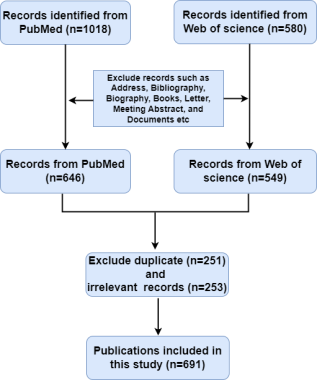
Figure 1. PRISMA flowchart of study selection for research on levodopa-induced dyskinesia. A total of 1,018 records were retrieved from PubMed and 580 from Web of Science. After deduplication by EndNote and exclusion of irrelevant studies, 691 publications were included for final analysis.
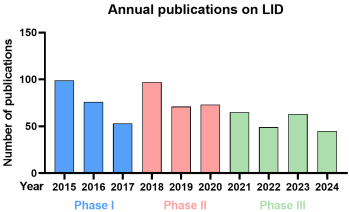
Figure 2. Annual publication volume on Levodopa-Induced Dyskinesia research. The chart shows publication trends across three-time phases: 2015–2017 (Phase I), 2018–2020 (Phase II), and 2021–2024 (Phase III).
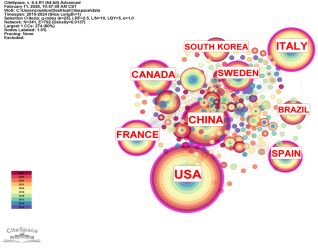
Figure 3. Global research network for Levodopa-Induced Dyskinesia. CiteSpace was used to map country-level collaborations based on co-authored publications from 2015 to 2024. The size of each node reflects the national publication output, and connections represent collaboration strength.
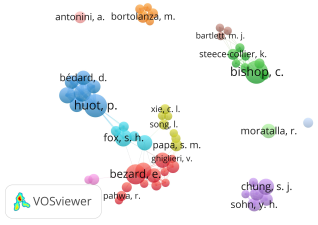
Figure 4. Co-author network in the field of Levodopa-Induced Dyskinesia. Analyzing publication data from 2015–2024 with VOSviewer yields a co-occurrence network where node size indicates an author’s publication volume, and link strength reflects the intensity of collaboration.
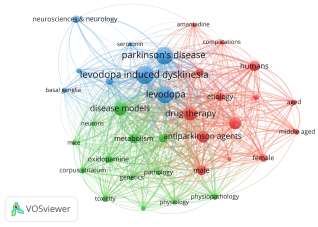
Figure 5. Keyword co-occurrence network in Levodopa-Induced Dyskinesia research. Generated with VOSviewer (2015–2024), the map visualizes thematic linkages based on keyword co-occurrence. Larger nodes indicate higher frequency keywords, highlighting central research themes.
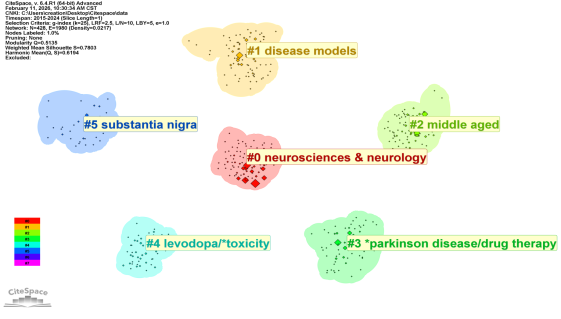
Figure 6. Keyword cluster analysis map of Levodopa-Induced Dyskinesia research. The cluster structure is validated as highly efficient and significant, with a silhouette coefficient (S) of 0.7803 and a modularity (Q) of 0.5135. Using the LLR algorithm on the keyword co-occurrence matrix, six distinct research subdomains were identified: disease models, middle-aged populations, neuroscience fundamentals, levodopa toxicity, Parkinson's disease pharmacotherapy, and substantia nigra lesions.
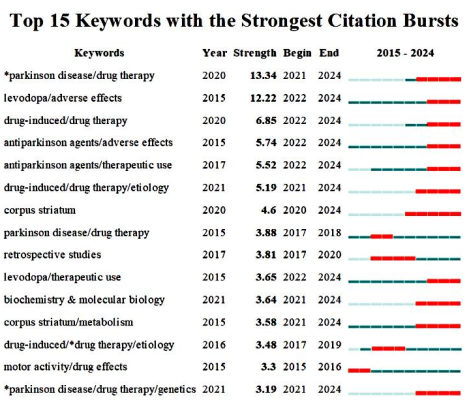
Figure 7. Temporal hotspots in LID research based on citation bursts. The 15 keywords with the highest burst strength between 2015 and 2024 were identified. For each keyword, the corresponding red bar represents the active period of its citation surge, mapping the dynamic landscape of research interest.
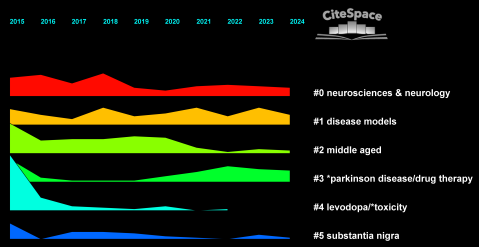
Figure 8. Landscape of keyword clusters over time. The CiteSpace timeline plot maps the dynamic evolution of six research clusters from 2015 to 2024. Larger nodes indicate higher annual publication output within a cluster, and the spanning color bands signify the period during which each thematic cluster was most active.

Information



 Share This Article
 Twitter
 Linked In
 Facebook
 Copy
Copy Download