Research Article | | Peer-Reviewed

Evaluation of Vermicompost Integrated with Chemical Fertilizer on Yield and Yield Components of Tef in Dugda District of East Shoa Zone, Oromia

Received: 12 March 2026     Accepted: 31 March 2026     Published: 27 June 2026
Views:       Downloads:
Abstract

The Integrated Soil Fertility Management (ISFM) is to maintain soil health and crop production. A study was carried out in East Shewa Zone, Dugda District, on farmers’ fields to evaluate the combined effects of vermicompost (organic fertilizer) and NPS (inorganic fertilizer) on soil chemical properties and Tef production. Integrated soil fertility management, involving the use of both organic and inorganic fertilizers, aims to sustain soil fertility and enhance crop yields. Although analysis of variance revealed no significant differences (p≥ 0.05) in Tef grain yield, panicle length, plant height, and harvest index among treatments, the highest grain yield of Tef (1750.33 kg ha-1) was recorded in the treatment where 50% of the Nitrogen requirement was supplied through vermicompost. Composite soil samples collected before fertilizer application and after harvest were analyzed to assess the residual effects of vermicompost on soil physicochemical properties. Results showed that soil pH was not significantly influenced (p≥ 0.05) by vermicompost application. However, soil organic carbon (SOC), cation exchange capacity (CEC), available phosphorus (P), and total nitrogen (TN) significantly improved (P≤0.05) with vermicompost use. Initial soil tests indicated low levels of SOC, CEC, available P, and TN, highlighting the positive residual impact of vermicompost on soil fertility. A partial budget analysis identified the economically optimal treatment as the one combining 50% vermicompost with NPS fertilizer, yielding the highest net benefit of 202,540 Birr per hectare. Therefore, the study concludes that integrating 50% vermicompost (1.725 t/ha) with 46 kg ha-1 P2O5 (100kgDAP) fertilizer enhances Tef productivity and soil fertility in the study area and similar agro-ecological zones.

Published in American Journal of Bioscience and Bioengineering (Volume 14, Issue 2)
DOI 10.11648/j.bio.20261402.11
Page(s) 14-21
Creative Commons

This is an Open Access article, distributed under the terms of the Creative Commons Attribution 4.0 International License (http://creativecommons.org/licenses/by/4.0/), which permits unrestricted use, distribution and reproduction in any medium or format, provided the original work is properly cited.

Copyright

Copyright © The Author(s), 2026. Published by Science Publishing Group

Keywords

Organic Fertilizer, Soil Fertility, Soil Physiochemical Properties

1. Introduction
Tef is recognized as one of the most stable food crops that originated and diversified in Ethiopia. It is highly favored by the Ethiopian population for food consumption due to its rich nutritional profile . Tef is esteemed for its ability to adapt to a variety of environmental conditions, ranging from drought-prone areas to waterlogged soils, and altitudes from sea level to 3,000 meters above sea level . Its resilience to both abiotic and biotic stresses, along with its compatibility with various cropping systems, has enabled Ethiopian farmers to cultivate it for millennia, despite yields being relatively low in comparison to other cereals . Nevertheless, the production and productivity of tef face several constraints. A significant challenge affecting tef production is the depletion of soil. Continuous cultivation without sufficient nutrient replenishment results in nutrient mining, particularly deficiencies in nitrogen and phosphorus, which are essential for teff growth . The limited application of fertilizers, due to high costs or inadequate access, the exclusive use of chemical fertilizers, and the unbalanced application of these fertilizers over time contribute to the degradation of soil health, which in turn diminishes crop yields .
Recently, there has been a growing focus on the use of organic wastes, farmyard manure, compost, and poultry manure as effective strategies to enhance soil health. The Integrated Soil Fertility Management (ISFM) paradigm recognizes the importance of combining both organic (compost) and mineral inputs to maintain soil health and crop production, owing to the beneficial interactions and complementarities between them .
According to , the application of compost has been shown to enhance grain yield and soil fertility when compared to the use of chemical fertilizers alone. Conversely, the use of organic fertilizers has been documented to promote crop growth by providing essential plant nutrients, including micro-nutrients, while also enhancing the physical, chemical, and biological properties of the soil. This improvement creates a more favorable environment for root development by enhancing soil structure . Moreover, the cost of inorganic fertilizers is currently on the rise, rendering them unaffordable for resource-limited smallholder farmers.
Given the environmental pollution associated with the excessive use of chemical fertilizers, there is a pressing need for an alternative approach based on biological sources that is both safe for use and less costly. This approach aims to generate sufficient plant nutrients through 'integrated soil fertility management,' which posits that the complete or partial replacement of chemical fertilizers in the soil with vermicompost can yield both environmental and economic benefits, thereby ensuring more sustainable crop production. Vermicompost is widely acknowledged as one of the most effective methods for recycling agricultural and other biodegradable wastes to produce high-quality compost. Worms process biomass and excrete it in a digested form known as worm casts, often referred to as 'Black gold'. These casts are rich in nutrients, growth-promoting substances, and soil microflora and they possess properties that inhibit pathogenic microbes, making them stable, fine organic manure that enhances soil quality and its biological and physicochemical properties . This process is gaining popularity as a fundamental component of organic farming systems, as it fulfills the requirements for organic products.
Consequently, assessing Integrated Soil Fertility Management (ISFM) in tef production is crucial for identifying the most effective and efficient combinations of vermicompost and inorganic nutrient sources that optimize yield and improve overall productivity. Such evaluation also helps to determine the optimal fertilizer rates and organic amendments suited to local soil and climatic conditions, ensuring better nutrient use efficiency and reducing input costs for farmers. It also provides evidence on how ISFM can address key production constraints like soil fertility depletion.
2. Objectives
1) To evaluate the effect of vermicompost integrated with chemical fertilizer on yield and yield components of Tef.
2) To recommend best combination rate of vermicompost and chemical fertilizer for better production of Tef.
3. Materials and Methods
3.1. Description of the Study Area
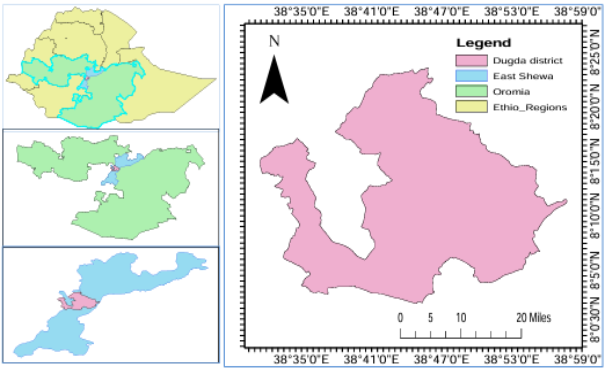
The study was conducted in Dugda District, East Shewa Zone of Oromia region, Ethiopia. It is located at the distance of about 130km away from the capital city, Addis Ababa, in south direction on the main road to Hawassa. The study area is part of the central rift valley of the country. Dugda is bordered on the Southeast by Hora-Dambal, on the South by Adami Tullu Jido Kombolcha District, on the West by the Southern Nations, Nationalities and Peoples Region, on the Northwest by the Southwest Shewa Zone, on the north by the Awash River. Dugda district has latitude of 8° 09' 60.00" N and a longitude of 38° 49' 59.99" E with an elevation of 1636 meters above sea level. Dugda district has a climate with bimodal rainfall and a mean annual temperature of around 25°C. The district receives an average annual rainfall of 750 mm, with a minimum of 22°C and a maximum of 28°C. Soil types include Vertic Cambisols, Luvic Phaeozems, Lithosols, and Fluvisols, with dark brown and sandy loam, clay loam, and clay soils being common . The vegetation is characterized by Acacia-Commiphora woodland with dominant species like Acacia tortilis and Balanites aegyptiaca.
3.2. Vermicompost Preparation and Analysis
Vermicompost was prepared from Animal manure, and Haricot bean straw at Adami Tulu Agricultural research center. Ratio of 50% Animal manure and 50% Haricot bean straw were combined on weight based as a feeding material for vermiworms. Compost samples were taken and analyzed to evaluate its quality in terms of total nitrogen content to calculate the compost and chemical fertilizer equivalency. Accordingly, total Nitrogen content of vermicompost was 2% on average. Therefore, 23 quintal vermicompost can provide 46kg Nitrogen which is equivalent to 100kg UREA fertilizer.
Figure 1. Location Map of Dugda district in East Shewa Zone, Oromia.
3.3. Experimental Design and Treatments
The experiment has five treatments with three replications on plot size of 3m * 4m arranged in RCBD design. Boset Tef variety, which is the most commonly used by the farmers in the area, was used to evaluate the treatments. Recommended chemical fertilizer was applied based on site specific crop response P-calibration study for Tef production in the district. According to the report, optimum-N, P-critical, and P-requirement factor for Tef was 46 kg, 13, and 3.65 respectively.
Treatment Arrangements
1) Recommended NP
2) 100%Equiv. Vermicompost +Recommended Phosphorous
3) 75%Equiv. Vermicompost +25%N+ Recommended Phosphorous
4) 50%Equiv. Vermicompost +50%N+ Recommended Phosphorous
5) 25%Equiv. Vermicompost +75%N+ Recommended Phosphorous
3.4. Data Collection
Soil samples were collected to the depth of 20cm before planting and after harvesting to evaluate the effect of compost on soil chemical properties. Yield and yield components data were also collected after harvesting from all plots. Economic importance of integrated soil fertility management was also collected.
3.5. Data Analysis
The collected data was interred to the Microsoft excel and analyzed using SAS 9.0 software version. Soil and compost samples were analyzed for physical and chemical properties following analytical standards. The economic analysis was done using partial budget analysis model developed by CIMMYT (1998) to recommend the economically important combination of organic and inorganic fertilizer.
4. Results and Discussion
4.1. Effects of Integrated Application of VC and NP on Grain Yield and Yield Components of Tef
The effects of integrated application of VC and NP on the yield and yield components of tef are summarized in Table 1. The results clearly show that there were no significant differences (P≥ 0.05) among the treatments in terms of grain yield (Table 1). Similarly, the average values for plant height, panicle length, and harvest index also showed no significant differences (P≥ 0.05) across treatments. In contrast, total biomass yield exhibited significant differences (P≤ 0.05) between treatments. Notably, treatment four, where compost replaced 50% of the nitrogen fertilizer, recorded the highest grain yield of 1750.33 kg/ha, followed by treatment five, which involved applying vermicompost at 25% equivalent Nitrogen.
Maize yield was significantly increased when vermicompost was used to partially substitute nitrogen fertilizer. Additionally, research by and demonstrated enhanced tef grain yields through the combined use of organic and inorganic fertilizers, attributing the improvement to vermicompost’s ability to supply macro and micronutrients, thereby boosting nutrient use efficiency and grain development. Furthermore, discussed how nutrient use efficiency can be enhanced by integrating organic and inorganic soil amendments. Similar observations were made by , who found that applying 4 t ha-1 of vermicompost alongside inorganic fertilizer increased wheat grain yield.
Moreover, it was evident that biomass yields consistently increased with higher levels of combined fertilizer applications in most treatments. suggested that this trend might be due to vermicompost providing adequate and balanced nutrients throughout the crop’s growth period, resulting in favorable improvements in yield-related traits.
Table 1. Combined Effects of VC and NP on yield and yield components of Tef.

No.

Treatment

Grain yield kg ha-1

Total BM kg ha-1

Av. HI (%)

PH (cm)

PL (cm)

1

Recommended NP

1720.00

6546.67a

26.37

79.53

28.13

2

100%Equiv. VC+RP

1686.67

5913.33b

28.72

80.00

31.40

3

75%Equiv.VC+25%N+RP

1722.00

6246.67ab

27.55

80.20

31.47

4

50%Equiv.VC+50%N+RP

1750.33

6350.00ab

27.60

81.67

30.13

5

25%Equiv.VC+75%N+RP

1736.67

6540.00a

26.66

80.33

31.40

CV (%)

10.28

8.58

11.38

6.79

10.72

LSD (0.05)

185.75

554

3.27

4.74

3.33

P-value

0.63

0.012

0.08

0.77

0.14

BM=biomass, HI= harvest index, PH=Plant height, PL= Panicle length, VC=vermicompost
Effects of VC, NPS and Cropping Seasons on Grain yield and Yield components of Tef
The analysis of variance (ANOVA) across three years revealed that the variation in cropping seasons did not significantly impact grain yield (P≥ 0.05). However, within the three-year period, treatment 4, which involved a combination of 50% vermicompost and 50% recommended Nitrogen application, produced the highest grain yield (1966.67 kg ha-1) in 2023.
The biomass yield was not significantly influenced by the combined effects of treatments and cropping seasons, except in 2022 when biomass yield exhibited significant differences based on the application of different treatments. Again, treatment four, using 50% vermicompost and 50% recommended nitrogen, resulted in the highest biomass yield (6783.33 kg ha-1), particularly in the 2023 cropping season (Table 2).
Table 2. Effect of VC, NPS and Cropping Seasons on Grain and Biomass Yield of Tef.

No.

Treatments

Grain yield in kg ha-1

Total BM kg ha-1

2022

2023

2024

2022

2023

2024

1.

Recommended NP

1733.33

1700.00

1733.33

6433.33ab

6583.33

6020.00

2.

100%Equiv. VC+RP

1683.33

1783.33

1500.00

5683.33c

6333.33

5533.33

3.

75%Equiv.VC+25%N+RP

1650.00

1866.67

1566.67

6183.33abc

6583.33

5700.00

4.

50%Equiv.VC+50%N+RP

1650.00

1966.67

1633.33

6050.00bc

6783.33

6033.33

5.

25%Equiv.VC+75%N+RP

1683.33

1808.33

1700.00

6683.33a

6416.67

6300.00

CV (%)

9.81

7.45

10.80

6.97

8.25

9.09

LSD 0.05

279.60

237.89

495

729.00

911.60

1480

P-value

0.90

0.14

0.92

0.002

0.79

0.14

The combined effects of treatments and cropping seasons did not have a significant impact on panicle length, plant height, or harvesting index (P≥ 0.05). The highest measurements for these traits 34.00 cm for panicle length, 83.17 cm for plant height, and 29.77% for harvesting index were recorded in the 2023 cropping season under the treatment combining 50% vermicompost equivalent with 50% of the recommended nitrogen. This outcome is likely attributed to better monitoring and management of the experimental sites during 2023, as opposed to 2024, when security issues hindered proper site supervision. Overall, the 2023 experiment proceeded without the challenges encountered in other cropping seasons.
Table 3. Effect of VC, NPS and Cropping Seasons on Plant height, Panicle length and Harvest index.

Treatments

HI (%)

Plant height (cm)

Panicle length (cm)

2022

2023

2024

2022

2023

2024

2022

2023

2024

Recommended NP

27.01

25.95

25.92

78.83

79.00

82.00

29.33

27.00

28.00

100%Equiv. VC+RP

29.11

28.20

27.68

82.33

77.67

80.00

30.17

31.50

33.67

75%Equiv.VC+25%N+RP

26.71

28.41

27.53

82.17

79.33

78.00

31.83

31.33

31.00

50%Equiv.VC+50%N+RP

27.33

29.77

27.10

81.33

83.17

79.33

28.83

34.00

31.00

25%Equiv.VC+75%N+RP

24.83

28.36

26.93

79.50

79.33

84.00

31.50

31.67

30.67

CV (%)

10.29

10.40

14.31

6.99

5.02

6.84

11.32

10.17

12.11

LSD (0.05)

5.73

5.11

10.95

8.22

6.78

14.83

5.94

5.20

9.76

P-value

0.160

0.63

0.45

0.61

0.21

0.70

0.917

0.06

0.76

Residual Effect of vermicompost and on soil properties
4.2. Effect of Vermicompost on Soil pH
Soil pH serves as a valuable indicator of a soil’s suitability for plant growth, with most crops thriving best in a pH range of 6.0 to 7.5 (USDA NRCS guideline, 2013). Soil pH levels that are either too high or too low can cause nutrient deficiencies reduce microbial activity, decrease crop yields, and negatively impact soil health.
In the current study, vermicompost application did not significantly influence soil pH (P≥ 0.05) although numerical variations were observed among treatments. The highest pH value (6.42) was found in plots treated with a 50% equivalent dose of vermicompost, while the lowest pH (6.17) occurred in plots receiving a recommended NP alone (Table 4). Likewise, no significant differences were detected between soil pH measured before planting and after harvest, but post-harvest pH values showed a slight upward trend compared to initial measurements across all experimental plots (Table 4). This increase is likely due to the relatively high levels of exchangeable calcium and magnesium present in vermicompost . These results are consistent with findings by , who demonstrated that vermicompost application enhances overall soil physico-chemical properties and reduces exchangeable acidity, thereby promoting the availability of alkaline nutrients such as calcium, magnesium, and potassium.
4.3. Effect of Vermicompost on Soil Cation Exchange Capacity (CEC)
Cation exchange capacity (CEC) represents the total negative charges in soil that attract and hold plant nutrient cations such as calcium (Ca²⁺), magnesium (Mg²⁺), and potassium (K⁺). It is an important soil property that indicates the soil’s ability to supply these essential nutrients to plants. The CEC was found to be significantly (P ≤ 0.05) affected by the application rates of vermicompost (VC), as shown in Table 4. Specifically, CEC increased slightly with higher rates of vermicompost. The highest CEC value (20.43 cmol(+)kg-1) was recorded in plots treated with the maximum vermicompost dose (100% equivalent), while the lowest CEC (9.25 cmol(+)kg-1) was observed from initial soil sample analysis. This increase is likely due to the humic acids present in vermicompost, which bind nutrient cations .
Furthermore, post-harvest CEC levels in vermicompost-treated plots were significantly greater than those in the control plots and the initial soil samples. Similar research by Arancon et al. (2006) demonstrated that vermicompost application enhances soil organic matter and CEC, thereby improving nutrient availability and promoting plant growth. Additionally, reported that vermicompost not only increases soil CEC but also boosts microbial activity and improves soil structure, all of which contribute to better crop growth and yield.
4.4. Effect of Vermicompost on Soil Organic Carbon (SOC)
Soil organic carbon (SOC) content was significantly affected (P≤0.05) by the application of varying rates of vermicompost (Table 4). SOC showed a clear increasing trend as the amount of vermicompost applied increased. The highest SOC level (3.24%) was recorded in plots receiving the maximum vermicompost dose (100% equivalent), whereas the lowest SOC (1.21%) was observed in plots treated solely with NP fertilizer. Additionally, SOC levels in the soil before planting and in untreated plots were significantly lower than those in plots treated with different vermicompost rates (Table 4). This increase is primarily due to vermicompost’s high organic matter content, which directly enhances soil organic carbon.
The organic matter in vermicompost includes stable compounds such as humic acids, which play a crucial role in sustaining long-term soil fertility and carbon retention. Similar studies have shown that vermicompost boosts microbial biomass and enzymatic activity in soils, which promotes the stabilization of organic matter and results in higher SOC levels Vermicompost also helps retain soil carbon by slowing the mineralization of organic matter, as its complex organic compounds reduce decomposition rates, leading to SOC accumulation. Furthermore, vermicompost application leads to greater SOC compared to chemical fertilizers, thanks to its ability to increase organic matter and enhance soil microbial activity . Overall, vermicompost significantly improves SOC by adding organic matter and stimulating microbial processes, thereby enhancing soil structure and fertility .
Table 4. Mean comparisons of post-harvest and initial Soil chemical properties.

Treatment description

Soil pH

SOC (%)

CEC (cmol(+) kg-1)

Av.P in ppm

TN (%)

Recommended NP

6.17

1.21d

10.90d

14.03d

0.19c

100%Equiv. VC+RP

6.81

3.24a

20.43a

24.11a

0.3oa

75%Equiv.VC+25%N+RP

6.59

2.28b

17.03b

20.78b

0.29a

50%Equiv.VC+50%N+RP

6.42

1.92c

16.22b

18.20c

0.22b

25%Equiv.VC+75%N+RP

6.35

1.67c

12.71c

16.60c

0.18cd

Initial soil analysis

6.10

1.27d

9.25d

13.68d

0.17d

CV (%)

2.90

13.80

8.80

10.40

11.90

LSD (0.05)

0.67

0.29

1.65

2.20

0.02

Significance

NS

**

**

**

**

4.5. Effect of Vermicompost on Total Nitrogen (TN)
The post-harvest total nitrogen (TN) content of the soil was significantly (P≤0.05) affected by the application of varying rates of vermicompost (Table 4). TN content increased progressively with higher vermicompost rates. The highest TN value (0.29%) was recorded in plots treated with the maximum dose (100% equivalent) of vermicompost, while the lowest TN (0.17%) was observed in initial soil sample analysis. Additionally, soil TN levels before planting and in untreated plots were significantly lower than those in plots treated with different vermicompost rates (Table 4).
Consistent with these findings, previous research has shown that vermicompost application enhances soil nitrogen content, which is linked to improved strawberry yields (Raza S. et al., 2023). This improvement is attributed to the increased organic matter in vermicompost, which contains nitrogen in organic forms. These forms are gradually mineralized into plant-available nitrogen (NH₄⁺ and NO₃⁻) by soil microorganisms. Vermicompost benefits soil TN by boosting organic matter, stimulating microbial activity, and supplying nitrogen steadily through mineralization . Its use supports sustainable agriculture by enhancing soil fertility and promoting plant growth without the negative environmental effects often associated with chemical fertilizers.
4.6. Effect of Vermicompost on Available Phosphorous (Av.P)
Vermicompost, produced through the decomposition of organic matter by earthworms, has a notable impact on soil health and fertility, particularly in enhancing the availability of phosphorus (P). The post-harvest soil phosphorus levels were significantly influenced (P≤ 0.05) by varying rates of vermicompost application, as shown in Table 4. An increasing trend in available phosphorus was observed with higher vermicompost rates. The highest phosphorus concentration (24.11ppm) was recorded in plots receiving the maximum vermicompost dose (100% equivalent), whereas the lowest level (14.03 ppm) was found in plots treated solely with NP fertilizer. Furthermore, phosphorus availability before planting and in untreated plots was considerably lower compared to those treated with different vermicompost rates (Table 4).
Similar studies have demonstrated that vermicompost enhances soil phosphorus availability because earthworms decompose organic matter and transform it into nutrient-rich humus. The microbial communities present in vermicompost play a vital role in mineralizing organic phosphorus compounds, converting them into plant-accessible forms. Additionally, research by reports that vermicompost application significantly improves soil phosphorus availability, which in turn promotes better plant growth and increased grain yields.
4.7. Partial Budget Analysis
Partial budget analysis was conducted to assess the integrated use of vermicompost and NP fertilizers in tef production. As shown in Table 5, the economic evaluation revealed that the highest net income (202,540.00 ETB) was achieved with Treatment 4, where the recommended NP fertilizer rate was combined with 50% vermicompost. This was closely followed by the treatment involving 75% vermicompost plus 25% nitrogen and the recommended phosphorus fertilizer, which resulted in a net income of 200,640.00 ETB.
Table 5. Partial budget analysis using CIMMYT (1998).

Treatments

N kg ha-1 (Urea)

P2O5 kg ha-1 (DAP

VC kun ha-1

TVC (ETB)

GY kg ha-1

Gross benefit (ETB)

Net benefit (ETB)

Recommended NP

150

100

0.00

10500

1720.00

206400

195,900

100% Equiv.. V.C +R. P

0.00

100

34.50

4500

1686.67

202400

197,900

75% Equiv.. V.C+25%N+R. P

34.5

100

25.87

6000

1722.00

206640

200,640

50% Equiv.. V.C+50%N+R. P

75

100

17.25

7500

1750.33

210039

202,540

25% Equiv.. V.C+75%N+R. P

112.5

100

8.625

9000

1736.67

208400

199,400

5. Conclusion and Recommendations
Integrated Soil Fertility Management (ISFM) plays a vital role in sustainable land management. The study revealed that combining vermicompost with chemical fertilizers enhances soil nutrient content and increases crop yields. The highest economically optimal tef grain yield was achieved by applying 50% vermiequivalent along with the recommended dose of P2O5 (46 kg ha-1). Analysis of soil samples after harvest showed that major soil nutrients were significantly higher in plots treated with varying levels of vermicompost compared to the initial soil status and plots without vermicompost application.
Therefore, adopting ISFM not only improves tef grain yield but also has a beneficial residual effect on soil health. In conclusion, the combined application of 50% vermi-equivalent Nitrogen (equivalent to 17.25 quintals of vermicompost), 75 kgha-1 urea, and 100 kgha-1 DAP fertilizer is economically viable and recommended for enhancing tef production and soil fertility in the study area.
Abbreviations

R. P

Recommended Phosphorous

V. C

Vermicompost

TVC

Total Variable Cost

VC

Variable Cost

GY

Grain Yield

Acknowledgments
First and foremost, we express our heartfelt gratitude to God for guiding us and granting success throughout every phase of this research. We are also deeply thankful to the FSRP project under the Oromia Agricultural Research Institute for their financial support, as well as to the Adami Tulu Agricultural Research Center (ATARC) for providing all the essential facilities needed to carry out this study. We sincerely appreciate Mr. Tesfaye Gemechu, FSRP project leader at ATARC, for his close monitoring and strong guidance. Lastly, the authors acknowledge the technical assistants, Abdo Oshe, Gebremikael Adera, Jemal Qure, and Qasim Barissa, for their unwavering dedication and hard work from land preparation to harvesting and data collection.
Author Contributions
Kasahun Kitila Hunde: Conceptualization, Data curation, Investigation, Methodology
Mekonnen Workineh Lindi: Data curation, Formal Analysis, Methodology
Conflicts of Interest
No conflicts of interest on this paper for publications.
References
[1] Abebe, W., & Ronda, F. (2014). Rheological and textural properties of tef [Eragrostis tef (Zucc.) Trotter] grain flour gels. Journal of Cereal Science, 60(1), 122-130.
[2] Aira, M., Monroy, F., & Domínguez, J. (2005). Ageing effects on nitrogen dynamics and enzyme activities in casts of Aporrectodea caliginosa (Lumbricidae). Pedobiologia, 49(5), 467-473.
[3] Assefa, K., Yu, J. K., Zeid, M., Belay, G., Tefera, H., & Sorrells, M. E. (2011). Breeding tef [Eragrostis tef (Zucc.) trotter]: conventional and molecular approaches. Plant breeding, 130(1), 1-9.
[4] Ayoola, O. T. (2006). Effects of fertilizer treatments on soil chemical properties and crop yields in a cassava-based cropping system. J. Appl. Sci. Res., 2, 1112-1116.
[5] Bekele, A., Lemma, W., & Samuel, F. (2021). Soil survey and characterization of soil of argo-gedilala sub watershed in dugda district, central rift valley of Ethiopia. Journal of Soil Science and Environmental Management, 12(3), 94-106.
[6] Dejene, K., Dereje, A., & Daniel, G. (2011). Synergistic effects of combined application of organic and inorganic fertilizers on the yield and yield components of tef (Eragrostis tef (Zucc.) Trotter) under terminal drought at Adiha, Northern Ethiopia. Journal of the Drylands, 3(1).
[7] Devi, K. N., Singh, M. S., Singh, N. G., & Athokpam, H. S. (2011). Effect of integrated nutrient management on growth and yield of wheat (Triticum aestivum L.). Journal of Crop and Weed, 7(2), 23-27.
[8] Domínguez, J., Aira, M., & Gómez-Brandón, M. (2010). Vermicomposting: earthworms enhance the work of microbes. Microbes at work: from wastes to resources, 93-114.
[9] Fernandez-Luqueno et al. (2010). Vermicompost as a soil supplement to improve growth, yield and quality of greenhouse tomatoes. Journal of Plant Nutrition, 33(10), 1510-1523.
[10] Getachew, A. and Y. Chilot. 2009. Integrated Nutrient Management in Faba Bean and Wheat on Nitisols of central Ethiopian Highlands. Research Report No. 72. Ethiopian Institute of Agricultural Research (EIAR), Addis Ababa, Ethiopia, pp. 24.
[11] Kasahun Kitila and Mekonnen, 2023. Evaluation of Compost Integrated with Chemical Fertilizer for better production of wheat in Shashemene District of West Arsi Zone, Oromia, AJAR, 2023; 4: 43.
[12] Lim, S. L., Wu, T. Y., Lim, P. N., & Shak, K. P. Y. (2015). The use of vermicompost in organic farming: overview, effects on soil and economics. Journal of the Science of Food and Agriculture, 95(6), 1143-1156.
[13] Mahajan, G. R., Pandey, R. N., Datta, S. C., Kumar, D., Sahoo, R. N., & Parsad, R. (2014). Fertilizer nitrogen, phosphorus and sulphur prescription for aromatic hybrid rice (Oryza sativa L.) using targeted yield approach. Proceedings of the National Academy of Sciences, India Section B: Biological Sciences, 84, 537-547.
[14] Merga, M., & Alemu Dabi, A. D. (2019). Performance Evaluation of Tef [Eragrostis tef (Zucc.) Trotter] Genotypes for the Non-traditionally Tef Growing Area, Western Ethiopia. American Journal of Bioscience and Bioengineering, 7(5), 65-70.
[15] Pedra F, Plaza C, Garcia-Gill JC, Polo, A. Effects of municipal waste compost and sewage sludge on proton binding behavior of humic acids from Portuguese sandy and clay loam soils. Bio resource Technology. 2008; 99: 2141-2147.
[16] Raza, S. T., Zhu, B., Yao, Z., Wu, J., Chen, Z., Ali, Z., & Tang, J. L. (2023). Impacts of vermicompost application on crop yield, ammonia volatilization and greenhouse gases emission on upland in Southwest China. Science of the Total Environment, 860, 160479.
[17] Theunissen, J., Ndakidemi, P. A., & Laubscher, C. P. (2010). Potential of vermicompost produced from plant waste on the growth and nutrient status in vegetable production. International Journal of the Physical Sciences, 5(13), 1964-1973.
[18] Tufa, A. (2023). Vermicompost and NPSZnB fertilizer levels on Tef (Zea mays L.) growth, yield component, and yield at Guto Gida, western Ethiopia. International Journal of Agronomy, 2023(1), 7123826.
[19] Vanlauwe, B., Kihara, J., Chivenge, P., Pypers, P., Coe, R., & Six, J. (2011). Agronomic use efficiency of N fertilizer in maize-based systems in sub-Saharan Africa within the context of integrated soil fertility management. Plant and soil, 339, 35-50.
[20] Wakene, N., Kefyalew, N., Friesen, D. K., Ransom, J. and Abebe, Y., 2001. Determination of optimum farmyard manure and NP fertilizers for Tef on farmers’ fields. pp. 387-393. In: Seventh Eastern and Southern Africa Regional Tef Conference.
Cite This Article
  • APA Style

    Hunde, K. K., Lindi, M. W. (2026). Evaluation of Vermicompost Integrated with Chemical Fertilizer on Yield and Yield Components of Tef in Dugda District of East Shoa Zone, Oromia. American Journal of Bioscience and Bioengineering, 14(2), 14-21. https://doi.org/10.11648/j.bio.20261402.11

    Copy | Download

    ACS Style

    Hunde, K. K.; Lindi, M. W. Evaluation of Vermicompost Integrated with Chemical Fertilizer on Yield and Yield Components of Tef in Dugda District of East Shoa Zone, Oromia. Am. J. BioSci. Bioeng. 2026, 14(2), 14-21. doi: 10.11648/j.bio.20261402.11

    Copy | Download

    AMA Style

    Hunde KK, Lindi MW. Evaluation of Vermicompost Integrated with Chemical Fertilizer on Yield and Yield Components of Tef in Dugda District of East Shoa Zone, Oromia. Am J BioSci Bioeng. 2026;14(2):14-21. doi: 10.11648/j.bio.20261402.11

    Copy | Download

  • @article{10.11648/j.bio.20261402.11,
      author = {Kasahun Kitila Hunde and Mekonnen Workineh Lindi},
      title = {Evaluation of Vermicompost Integrated with Chemical Fertilizer on Yield and Yield Components of Tef in Dugda District of East Shoa Zone, Oromia},
      journal = {American Journal of Bioscience and Bioengineering},
      volume = {14},
      number = {2},
      pages = {14-21},
      doi = {10.11648/j.bio.20261402.11},
      url = {https://doi.org/10.11648/j.bio.20261402.11},
      eprint = {https://article.sciencepublishinggroup.com/pdf/10.11648.j.bio.20261402.11},
      abstract = {The Integrated Soil Fertility Management (ISFM) is to maintain soil health and crop production. A study was carried out in East Shewa Zone, Dugda District, on farmers’ fields to evaluate the combined effects of vermicompost (organic fertilizer) and NPS (inorganic fertilizer) on soil chemical properties and Tef production. Integrated soil fertility management, involving the use of both organic and inorganic fertilizers, aims to sustain soil fertility and enhance crop yields. Although analysis of variance revealed no significant differences (p≥ 0.05) in Tef grain yield, panicle length, plant height, and harvest index among treatments, the highest grain yield of Tef (1750.33 kg ha-1) was recorded in the treatment where 50% of the Nitrogen requirement was supplied through vermicompost. Composite soil samples collected before fertilizer application and after harvest were analyzed to assess the residual effects of vermicompost on soil physicochemical properties. Results showed that soil pH was not significantly influenced (p≥ 0.05) by vermicompost application. However, soil organic carbon (SOC), cation exchange capacity (CEC), available phosphorus (P), and total nitrogen (TN) significantly improved (P≤0.05) with vermicompost use. Initial soil tests indicated low levels of SOC, CEC, available P, and TN, highlighting the positive residual impact of vermicompost on soil fertility. A partial budget analysis identified the economically optimal treatment as the one combining 50% vermicompost with NPS fertilizer, yielding the highest net benefit of 202,540 Birr per hectare. Therefore, the study concludes that integrating 50% vermicompost (1.725 t/ha) with 46 kg ha-1 P2O5 (100kgDAP) fertilizer enhances Tef productivity and soil fertility in the study area and similar agro-ecological zones.},
     year = {2026}
    }
    

    Copy | Download

  • TY  - JOUR
    T1  - Evaluation of Vermicompost Integrated with Chemical Fertilizer on Yield and Yield Components of Tef in Dugda District of East Shoa Zone, Oromia
    AU  - Kasahun Kitila Hunde
    AU  - Mekonnen Workineh Lindi
    Y1  - 2026/06/27
    PY  - 2026
    N1  - https://doi.org/10.11648/j.bio.20261402.11
    DO  - 10.11648/j.bio.20261402.11
    T2  - American Journal of Bioscience and Bioengineering
    JF  - American Journal of Bioscience and Bioengineering
    JO  - American Journal of Bioscience and Bioengineering
    SP  - 14
    EP  - 21
    PB  - Science Publishing Group
    SN  - 2328-5893
    UR  - https://doi.org/10.11648/j.bio.20261402.11
    AB  - The Integrated Soil Fertility Management (ISFM) is to maintain soil health and crop production. A study was carried out in East Shewa Zone, Dugda District, on farmers’ fields to evaluate the combined effects of vermicompost (organic fertilizer) and NPS (inorganic fertilizer) on soil chemical properties and Tef production. Integrated soil fertility management, involving the use of both organic and inorganic fertilizers, aims to sustain soil fertility and enhance crop yields. Although analysis of variance revealed no significant differences (p≥ 0.05) in Tef grain yield, panicle length, plant height, and harvest index among treatments, the highest grain yield of Tef (1750.33 kg ha-1) was recorded in the treatment where 50% of the Nitrogen requirement was supplied through vermicompost. Composite soil samples collected before fertilizer application and after harvest were analyzed to assess the residual effects of vermicompost on soil physicochemical properties. Results showed that soil pH was not significantly influenced (p≥ 0.05) by vermicompost application. However, soil organic carbon (SOC), cation exchange capacity (CEC), available phosphorus (P), and total nitrogen (TN) significantly improved (P≤0.05) with vermicompost use. Initial soil tests indicated low levels of SOC, CEC, available P, and TN, highlighting the positive residual impact of vermicompost on soil fertility. A partial budget analysis identified the economically optimal treatment as the one combining 50% vermicompost with NPS fertilizer, yielding the highest net benefit of 202,540 Birr per hectare. Therefore, the study concludes that integrating 50% vermicompost (1.725 t/ha) with 46 kg ha-1 P2O5 (100kgDAP) fertilizer enhances Tef productivity and soil fertility in the study area and similar agro-ecological zones.
    VL  - 14
    IS  - 2
    ER  - 

    Copy | Download

Author Information
  • Abstract
  • Keywords
  • Document Sections

    1. 1. Introduction
    2. 2. Objectives
    3. 3. Materials and Methods
    4. 4. Results and Discussion
    5. 5. Conclusion and Recommendations
    Show Full Outline
  • Abbreviations
  • Acknowledgments
  • Author Contributions
  • Conflicts of Interest
  • References
  • Cite This Article
  • Author Information