
The objective of this study is to characterize the family poultry production system and to identify certain management constraints that could undermine farm operations and hinder their sustainable development in the Ouaddaï Province of eastern Chad. Random and retrospective cross-sectional surveys conducted in 40 family farms. Socioeconomic characteristics revealed farms managed equally by men and women (50% each), with 92.5% of the farms managed by married parents. Family poultry farming is a secondary activity, a form of adaptation, as the farmers were originally engaged in agriculture and gardening (31.9%) and the condiment trade (22.8%). These poultry farmers provided rudimentary sheds made of straw and wood (31.9%) and banco (22.8%). Investments in chicken housing are very low (4.5%). In 50% of farms, free-range chickens receive a handful of millet or red sorghum, millet bran and about a third of a liter of water as a supplement to their feed. According to the poultry farmers surveyed, diseases (58.3%), animal and theft (37%), and feed costs (4.7%) appear to be the main constraints faced by producers, leading to mortality. 90% of family farms impacted by the lack of chicken vaccination practices. 52.5% of poultry farmers have resorted to using traditional medicine and local ethno-veterinary knowledge. Furthermore, 53.4% of sales were of chickens at a unit price of 2,809 FCFA, and 46.6% of egg sales at 125 FCFA. 20% of the chickens and 14% of the eggs are intended for family consumption. Whatever, family poultry farming faces several constraints, yet most poultry-farming families report being satisfied with their net monthly profit margins of 15,350 FCFA. This indicates that local chicken production plays a significant socioeconomic role. It is therefore undeniable that improvements in management and health systems could help improve performance and revenue for the development of sustainable family poultry farming in this Sahelian Province of Chad.
| Published in | American Journal of Bioscience and Bioengineering (Volume 14, Issue 2) |
| DOI | 10.11648/j.bio.20261402.12 |
| Page(s) | 22-31 |
| Creative Commons |
This is an Open Access article, distributed under the terms of the Creative Commons Attribution 4.0 International License (http://creativecommons.org/licenses/by/4.0/), which permits unrestricted use, distribution and reproduction in any medium or format, provided the original work is properly cited. |
| Copyright |
Copyright © The Author(s), 2026. Published by Science Publishing Group |
Socioeconomic Characteristics, Constraints of Family Poultry Farming, Ouddai Province, Eastern Chad
Main ethnic groups of producers (%) | Number (n= 40) | Percentage (%) |
|---|---|---|
Ouaddaians | 22 | 55 |
Arabs: Bani Halba, Djatné | 10 | 25 |
Other ethnic groups: Dadjo, Zakhawa, Moundang, Mimi, Khouchta, Foulbé and Hadjaraï | 8 | 20 |
Marital status (%) | ||
Married | 37 | 92.5 |
Widowed | 2 | 5 |
Single | 1 | 2.5 |
Length of Producer Experience (years) | 3.6 ± 0.30 | |
Average Age of Local Chicken Producer (years) | 36 ± 0.82 | |
Education level (%) | ||
French primary education | 18 | 40.9 |
Arabic primary education | 20 | 54.5 |
Higher level | 2 | 4.6 |
Professions of origin | Number (n= 40) | Percentage (%) |
|---|---|---|
Agriculture/Market gardening | 13 | 31,9 |
Condiment trade | 9 | 22,8 |
Catering | 4 | 9,2 |
Carpentry | 5 | 13,5 |
Méchanics | 1 | 10,1 |
Buthery | 3 | 7 |
Housewife | 1 | 1 |
Assistant to the local chief | 4 | 4,5 |
Parameter | Number (n=40) | Percentage (%) |
|---|---|---|
Total number of chickens Average number of chickens Length of experience (years) | n=1,260 30 ± 38 (max: 219; min: 3) 3.5± 0.4 (max: ; min: 3) | 100 |
Productivity of local hens Average weight of the breeding rooster (g) Average weight of a laying hen (g) Age at first laying (months) Number of broods (year) Number of eggs per clutch (year) Outbreak rate (%) Embryonic mortality rates (%) | 1,630 ± 0.07 (max: 1,656; min: 1610) 1,265g±0.06 (max: 1,300; min: 1230) 6.2±0.20 3 ± 1.1 12.41 ± 0.24 (max: 15; min: 9) | 82 18 |
Items | Unit | Quantity | Constant unitprice (FCFA) | ValUE (FCFA) | P.100 |
|---|---|---|---|---|---|
Total Products (TP) | 299 349 | 100 | |||
Chickens sold | Unit | 45 | 2809 | 126 405 | 53.40 |
Eggs sold | Unit | 882 | 125 | 110 250 | 46.60 |
Home-consumed chickens | Unit | 16 | 2809 | 44 944 | 20 |
Home-consumed eggs | Unit | 142 | 125 | 17 750 | 14 |
Cost of mortality | Year | 19 | 2809 | 53371 | 23.75 |
Total eggs produced Total hens produced | Unit | 1024 | 125 | 128 000 | 100 |
Total hens produced | Unit | 80 | 2809 | 224 720 | 100 |
Watering | Year | 8200 | 7 | ||
Feeding | Month | 12 | 3600 | 43200 | 37,5 |
Vaccinations/Veterinary Care | Année | 1 | 500 | 0,5 | |
Variable Costs (VC) | 107700 | 93,5 | |||
Provisions (2% VC) | 2154 | 2 | |||
Depreciation | 5285 | 4,5 | |||
Fixed Costs (FC) | 7439 | 6,5 | |||
Total Costs | 115139 | 100 | |||
Annual Gross Margin (FCFA) | 184210 | ||||
Monthly Net Margin (FCFA) | 15350 | ||||
FAO | Food and Agriculture Organization of the United Nations |
AVSF | Agronomists and Veterinarians Without Borders |
CNRD | National Research Center for Development |
CTA | Technical Centre for Agricultural Cooperation |
NISES | National Institute of Statistics and Economic |
NRSC | National Research Support Centre |
| [1] | Abdou I and Bell JG (1992). Village poultry dynamics in the Keita region of Niger. In village poultry production in Africa, proceedings of in international workshop held in Rabat. Morocco, 17-11 May 1992, pp. 6-11. |
| [2] | Adoum JB (2021). Morphological and zootechnical characterization of the local chicken (Gallus gallus) in the city of Abeche. Bachelor’s thesis; Higher National Institute of Sciences and Technic of Abeche (INSTA), 41p. |
| [3] | Akouango F, Bandtaba P, Ngokaka C (2010). Weight gain and productivity of the local chicken Gallus domesticus in farm breeding in Congo. Anim. Genet. Resour, 46: 61-65. |
| [4] | Alloui N., Sassia S. (2015). Socio-economic study of local poultry farms in the Aurès region (Algeria). Eleventh Poultry and Foie Gras Waterfowl Research Days, Tours, 25 et 26 mars 2015, pp. 909-912. |
| [5] | AVSF (Agronomists and Veterinarians Without Borders), 2011. Development of village poultry farming in West Africa. Twenty years of experience in Togo, Mali and Senegal: assessment and perspectives. Cloitre Printers – 29800 Saint Thonan, 126. |
| [6] | Ban-Bo B. A, Kepkiba B., Nadjilem D. and Walbang Ossoga G (2023). Prevalence and risk factors associated with Newcastle disease virus in village chickens in rural Chad. Am. J. of Innov. Res. and Appl. Sci., 17(5): 1-6. |
| [7] | Bechir Fizani T., (2005). Productivity of the native chicken in the traditional farming system in the urban area of Abéché. Bachelor’s thesis; Higher National Institute of Sciences and Technic of Abeche (INSTA), Abéché, 38 p. |
| [8] | BIT (International Labour Office) (2019). Economic diversification of the rural economy: Decent work in the rural economy, policy guidance notes, first edition (2019). |
| [9] | Brou GKG, Adou CFD, Kouassi KD and Diomande D (2020). Technical analysis of traditional chicken farming in rural areas of the Dimbokro Department in Côte d'Ivoire. African Agronomy 32(2): 121-134. |
| [10] | Buza JJ and Mwamuhehe, HA (2001). Country report: Tanzania. ACIAR proceedings Nº 103 (Alders, R. G. and Spradbrow, P. B., Eds.), Canberra (Australia), pp. 38-42. |
| [11] | CTA (Technical Centre for Agricultural Cooperation) (2004). Rural poultry farming. Rural radio program. Post bus 380, 6700 AJ Wageningen, Netherlands, 26p. |
| [12] | Damiba D (2005). Results and impacts of the use of poultry as tools for development and income mobilization in the Boulgou province. Ministry of Agriculture, Water Resources and Fisheries: Ouagadougou, 12 p. |
| [13] | Dassidi N, Tellah M, Adoum IY, Borso AJ, Onagbessan O Kokou T and Logten YM (2023). Morpholigical and zootechnical Characterisation of the local chicken in the urban area of Abéché Int. J. Poult. Sci., 22(1): 5-11 |
| [14] | Dupont N (2024-2025). Potential to feed poultry from local resources availabe during the dry season in the Borgou and Alibori departments of Benin. Bachelors thesis of bioingenieer in agricultural sciences, 2024-2025, Gembloux agro-bio tech. URI/URL: |
| [15] | Ebwa J, Mosola F, Mozenga JC, Ebwa J, Mobunda J, Willy Bondoumbe G (2020). Prevalence of avian influenza in traditional poultry farming in Yangambi, DRC (Democratic Republic of Congo). Rev. Mar. Sci. Agron. Vét. 8(4): 441-444. |
| [16] | Ebwa J, Monzenga JC, Mosala F, Rutakaza N (2019). Traditional poultry farming in the city of Kissangani, Tshopo Province in the DRC Congo. Rv. Mar. Sci. Agron. Vét., 7: 463-467. |
| [17] | Etienne L, Kouhana S, Brahima S, Xavier R, Boniface K, Issaka YAK & Valentine YGC (2021). Characteristics of the local chicken farming system in two agro-ecological zones, the forested south and the savannah center of Côte d'Ivoire. Européen Scientific Journal, ESJ, Vol 17(40), 240p. |
| [18] | Fall AK, Dieng A, Samba ANS, Diallo A (2016). Urban family poultry farming in Senegal: characterization and socio-economic role in the municipality of Thiès. REV. CAMES, VOL. 04 (2), 2016, 11p. |
| [19] | FAO (Food and Agriculture Organization of the United Nations), (2014). Development of family poultry farming - Challenges, opportunities and constraints. FAO Animal Production and Health Working Paper No. 12. Rome. |
| [20] | FAO (Food and Agriculture Organization of the United Nations), (2004). Family Poultry Production. – Rome, 134p. |
| [21] | FAO (Food and Agriculture Organization of the United Nations) (1984). Animal genetic resource conservation by management, databanks and training. Animal Production and Health. Rome, Italy. 44(1) (1984): 89-99. |
| [22] | Gbaguidi LM (2001). Study of the poultry sector in Benin: current situation and development prospects. Thèsis Méd. Vét: Dakar, 16, (2001), 32 p. |
| [23] | Guèye EF (2000). The role of family poultry in poverty alleviation, food security and the promotion of gender equality in rural Africa. Outlook on Agriculture. 29(2): 129-136. |
| [24] | Halima HM (2007). Phenotypic and genetic characterization of indigeneous chicken population in Northwest Ethiopia. PhD Thesis., University of the Free State, Bloemfontein, South Africa, 176 p. |
| [25] | Hassaballah K, Zeuh V, Assadi M, Mopate LY (2023). Pratiques de l’élevage traditionnel des poulets indigènes au Journal of Applied Biosciences Vol, 188: 19860 – 19867. |
| [26] | Issa YA (2012). Production practices, constraints and performance in family poultry farming in Chad. In: Family poultry farming in Chad: production, marketing, consumption and prospects for improvement. Veterinary Medicine Thesis, EISMV, Dakar, (25), 168 p. |
| [27] | Ministry of Aeronautical Development and National Meteorology (MADNM) (2017). Mission report to monitor the end of the 2017/2018 agropastoral campaign in Northeast Chad, 19p. |
| [28] |
Missohou A, Dièye PN and Talaki E (2002). Rural poultry production and productivity. In: southern Senegal 2002.
http://www.lrrd.org/lrrd14/2/miss142.htm (page consultée le 28 novembre 2024). |
| [29] | Mopate Logtene Y and Awa DN (2009). Poultry systems in the savannah zone of centra Africa: zootecnical performance and socio-economic importance, 11 p. |
| [30] | Nahimana G, Missohou A, Ayssiwede SB, Cissé P, Butore J, Touré A (2017). Improving chick survival and zootechnical performance of the local chicken breed under village conditions in Senegal. Rev. Elev. Med. Vet. Pays Trop., 70 (1): 3-8 |
| [31] | Nahimana G (2016). Contribution to the improvement of production systems, chick survival, and the strengthening of competitiveness in family poultry farming in the PDESOC intervention zone: Eastern Senegal and Upper Casamance (regions of Kédougou, Tambacounda, and Kolda). PhD thesis: Dakar, (No. 226), UCAD (ED-SEV), 134p. |
| [32] | (NISES) National Institute of Statistics and Economic Studies (2009). Second general census of population and housing. Ministry of the Economy and Planning, 89p. |
| [33] | NRSC (National Research Support Centre) (2021). Reference map of the Ouaddaï Province. |
| [34] | Ouedraogo B Zoundi JS and Sawadogo L (2017). Characteristics of poultry farming in the Sahelian zone of Burkina Faso. Rev. Ivoir. Sci. Technol., 30: 263-280. |
| [35] | Saliou F (2022). Characterization and management of poultry farming in rural areas of the Kolda region (Senegal). Journal of Advanced Research in Science and Technology, 8(2): 68-80. |
| [36] | Sikangueng Mbouga FC (2011). Study of the marketing of local chicken in Senegal: Actors, markets, circuits and transport systems on the Louga-Dakar axis. Master's thesis, 'EISMV, (16), 44 p. |
| [37] | Sylla M, Traoré B, Sidibé S, Keita S, Diallo FC, Koné B, Ballo A, Sangaré M and Koné NG (2003). Epidemiology of Newcastle disease in rural Mali. Infectious Pathology Communication, Revue Élev. Méd. vét. Pays trop., 2003, 56 (1-2): 7-12. |
| [38] | Tshishi M, Tshibangou I, Moula N (2021). Characterization of local chicken populations (Gallus gallus domesticus) and identification of breeding systems in Haut-Katanga (case of the territories of Kapushi, Kassenga and Sakania). |
| [39] | Yaméogo, C. R. and Konkobo, C. (2003) study of the soumbala sector in the provinces of Nahouri and Sissili. CERYA Burkina Faso, Ouagadougou, 39 p. |
APA Style
Algom, O. B., Adoum, I. Y. (2026). Local Family Poultry Production System and the Main Constraints to Its Sustainable Development in the Ouaddaï Province in Eastern Chad. American Journal of Bioscience and Bioengineering, 14(2), 22-31. https://doi.org/10.11648/j.bio.20261402.12
ACS Style
Algom, O. B.; Adoum, I. Y. Local Family Poultry Production System and the Main Constraints to Its Sustainable Development in the Ouaddaï Province in Eastern Chad. Am. J. BioSci. Bioeng. 2026, 14(2), 22-31. doi: 10.11648/j.bio.20261402.12
@article{10.11648/j.bio.20261402.12,
  author = {Oumar Bada Algom and Issa Youssouf Adoum},
  title = {Local Family Poultry Production System and the Main Constraints to Its Sustainable Development in the Ouaddaï Province in Eastern Chad},
  journal = {American Journal of Bioscience and Bioengineering},
  volume = {14},
  number = {2},
  pages = {22-31},
  doi = {10.11648/j.bio.20261402.12},
  url = {https://doi.org/10.11648/j.bio.20261402.12},
  eprint = {https://article.sciencepublishinggroup.com/pdf/10.11648.j.bio.20261402.12},
  abstract = {The objective of this study is to characterize the family poultry production system and to identify certain management constraints that could undermine farm operations and hinder their sustainable development in the Ouaddaï Province of eastern Chad. Random and retrospective cross-sectional surveys conducted in 40 family farms. Socioeconomic characteristics revealed farms managed equally by men and women (50% each), with 92.5% of the farms managed by married parents. Family poultry farming is a secondary activity, a form of adaptation, as the farmers were originally engaged in agriculture and gardening (31.9%) and the condiment trade (22.8%). These poultry farmers provided rudimentary sheds made of straw and wood (31.9%) and banco (22.8%). Investments in chicken housing are very low (4.5%). In 50% of farms, free-range chickens receive a handful of millet or red sorghum, millet bran and about a third of a liter of water as a supplement to their feed. According to the poultry farmers surveyed, diseases (58.3%), animal and theft (37%), and feed costs (4.7%) appear to be the main constraints faced by producers, leading to mortality. 90% of family farms impacted by the lack of chicken vaccination practices. 52.5% of poultry farmers have resorted to using traditional medicine and local ethno-veterinary knowledge. Furthermore, 53.4% of sales were of chickens at a unit price of 2,809 FCFA, and 46.6% of egg sales at 125 FCFA. 20% of the chickens and 14% of the eggs are intended for family consumption. Whatever, family poultry farming faces several constraints, yet most poultry-farming families report being satisfied with their net monthly profit margins of 15,350 FCFA. This indicates that local chicken production plays a significant socioeconomic role. It is therefore undeniable that improvements in management and health systems could help improve performance and revenue for the development of sustainable family poultry farming in this Sahelian Province of Chad.},
 year = {2026}
}
TY  - JOUR
T1  - Local Family Poultry Production System and the Main Constraints to Its Sustainable Development in the Ouaddaï Province in Eastern Chad
AU  - Oumar Bada Algom
AU  - Issa Youssouf Adoum
Y1  - 2026/06/29
PY  - 2026
N1  - https://doi.org/10.11648/j.bio.20261402.12
DO  - 10.11648/j.bio.20261402.12
T2  - American Journal of Bioscience and Bioengineering
JF  - American Journal of Bioscience and Bioengineering
JO  - American Journal of Bioscience and Bioengineering
SP  - 22
EP  - 31
PB  - Science Publishing Group
SN  - 2328-5893
UR  - https://doi.org/10.11648/j.bio.20261402.12
AB  - The objective of this study is to characterize the family poultry production system and to identify certain management constraints that could undermine farm operations and hinder their sustainable development in the Ouaddaï Province of eastern Chad. Random and retrospective cross-sectional surveys conducted in 40 family farms. Socioeconomic characteristics revealed farms managed equally by men and women (50% each), with 92.5% of the farms managed by married parents. Family poultry farming is a secondary activity, a form of adaptation, as the farmers were originally engaged in agriculture and gardening (31.9%) and the condiment trade (22.8%). These poultry farmers provided rudimentary sheds made of straw and wood (31.9%) and banco (22.8%). Investments in chicken housing are very low (4.5%). In 50% of farms, free-range chickens receive a handful of millet or red sorghum, millet bran and about a third of a liter of water as a supplement to their feed. According to the poultry farmers surveyed, diseases (58.3%), animal and theft (37%), and feed costs (4.7%) appear to be the main constraints faced by producers, leading to mortality. 90% of family farms impacted by the lack of chicken vaccination practices. 52.5% of poultry farmers have resorted to using traditional medicine and local ethno-veterinary knowledge. Furthermore, 53.4% of sales were of chickens at a unit price of 2,809 FCFA, and 46.6% of egg sales at 125 FCFA. 20% of the chickens and 14% of the eggs are intended for family consumption. Whatever, family poultry farming faces several constraints, yet most poultry-farming families report being satisfied with their net monthly profit margins of 15,350 FCFA. This indicates that local chicken production plays a significant socioeconomic role. It is therefore undeniable that improvements in management and health systems could help improve performance and revenue for the development of sustainable family poultry farming in this Sahelian Province of Chad.
VL  - 14
IS  - 2
ER  -
Departement of Animal Science and Technology, Higher National Institute of Sciences and Techniques of Abéché, Abéché, Chad
Higher Teacher Training College of N'Djamena, N'Djamena, Chad
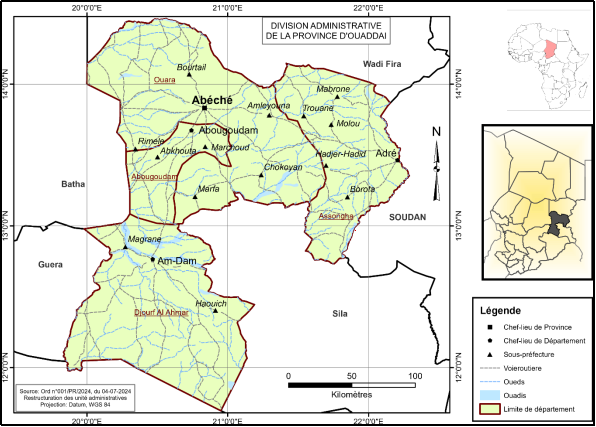
Figure 1. Map of Ouaddaï Province, Source: CNAR (2021); NRSC [33].
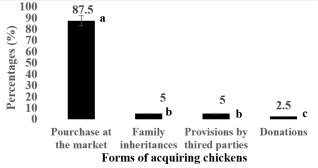
Figure 2. Origins of hens in the surveyed farms. Proportions with two different letters indicate a significant difference (ab; ac: P<0.05).
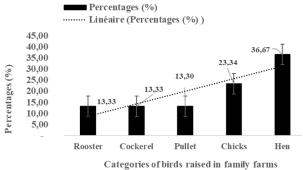
Figure 3. herd composition of an average flock on a farm.
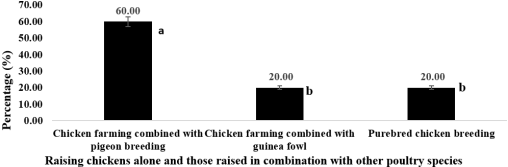
Figure 4.
Shows farms with only chickens, and farms with chickens raised alongside other poultry, such as guinea fowl and pigeons.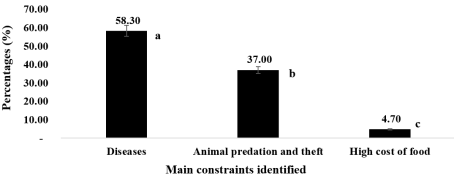
Figure 5. Main constraints of family chicken farming. Proportions with two different letters indicate a significant difference (ab; ac; bc: P<0.05).

Information



 Share This Article
 Twitter
 Linked In
 Facebook
 Copy
Copy Download