1. Introduction
The advancement of digital technologies drastically reshaped the landscape of knowledge creation, preservation, and effective dissemination. Within this evolving ecosystem, the emergence of Digital Humanities (DH) marks a critical intersection between computational methods and traditional humanities disciplines such as history, literature, linguistics, and cultural studies. Digital Humanities includes the activities, including digitization manuscripts heritage materials, computational text analysis, digital archiving, and interactive visualization of historical data. The applications of various modern technologies have opened new avenues for research, accessibility, and preservation of cultural heritage. While DH provides opportunities for democratizing access to knowledge, these possibilities remain unequal accessible to the different parts of the society. This unevenness is conceptualized as the digital divide. The digital divide goes beyond access to devices and internet connectivity. It is a layered phenomenon consisting of disparities in access, digital competencies, and the ability to meaningfully engage with digital resources. In a country like India, characterized by vast socio-economic diversity, linguistic plurality, and regional inequalities, the digital divide assumes a particularly complex form. Despite remarkable development in digital infrastructure and policy initiatives, a substantial portion of the population continues to remain on the margins of the digital ecosystem. Another important visible manifestation of this divide is the persistent rural-urban disparity. Urban regions have the facilities of stable internet connectivity, higher device penetration, and better opportunity to have e-services. In contrast, rural area often struggles with infrastructural deficiencies, including inconsistent electricity supply and limited broadband access. These constraints directly affect participation in digital platforms, including those related to education and cultural heritage.
However, infrastructural constraints alone do not fully explain the persistence of the digital divide. Socio-cultural determinants play an equally important role such as income, education level, caste affiliation, and gender significantly influence both access to and usage of digital technologies. The digital divide remains a major societal challenge even in technologically advanced environments
. The unequal access to digital technologies effects on education, knowledge creation and cultural participation, thereby limiting the provision of Digital Humanities initiatives in marginalized communities. India presents a unique context for studying the digital divide due to its socio-economic diversity, linguistic plurality, and uneven technological infrastructure. Socio-economic inequality, affordability issues, and digital literacy gaps continue to hinder inclusive participation in digital knowledge ecosystems. A sociological study examining India's digital society found that socio-economic inequality is the primary driver of the digital divide
| [2] | Laskar, M. H. Examining the emergence of digital society and the digital divide in India: A comparative evaluation between urban and rural areas. Frontiers in Sociology. 2023; 8:1145221. https://doi.org/10.3389/fsoc.2023.1145221 |
[2]
. The study depicts disparities between rural and urban populations, affluent urban areas, and under-resourced urban communities, and educated and less-educated populations. The study concluded that limited infrastructure, low-income levels, and educational disparities restrict access to digital platforms.
The COVID-19 pandemic further increased structural inequalities in digital access, particularly in developing countries like India. During this period, education, research, and cultural engagement shifted to digital platforms, thereby increasing disparities between digitally connected and disconnected populations. In this situation, the adaptation of new technologies is required to communicate with the digitally connected communities. Consequently, Indian Government and other non-government organisations have taken a lot of initiatives to provide the opportunity to access digital technologies. Indian has taken a significant step to integrate digital technology in all arear of activities through the initiatives such as Digital India, BharatNet, National Digital Library of India, and several Digital Humanity projects. Presently, internet access facilities in rural areas have developed remarkably, but technology literacy training are required so that digital humanities resources, digital archives, and online learning platforms can be accessible. AI application has opened a new area for addressing digital inequalities. AI-driven applications including NLP (Natural Language Processing) ML (Machine Learning), and computer vision technologies have the potential to enhance accessibility, automate digitization, and enable multilingual knowledge systems. Rashtrapati Bhavan, India, has developed a photo archive, and AI-based archival image management systems have been implemented. This archive housed an important collection of various official photographs. AI-based image processing and retrieval techniques, such as machine learning-based indexing, intelligent search techniques, and automated tagging capabilities, have been integrated to process and retrieve specific photos quickly. Another remarkable initiative taken by the Asiatic Society, Kolkata, and IIT Kharagpur is to calibrate and apply AI technologies for the digital preservation of ancient manuscripts. It will revive and provide the searchable manuscript information to the wider community. It will help to minimize the digital divide with respect to accessing manuscript heritage information to the community.
AI technologies have significantly improved metadata extraction, knowledge classification, and information retrieval in digital repositories
| [3] | Wang, C., Boerman, S. C., Kroon, A. C., Möller, J., & de Vreese, C. H. The artificial intelligence divide: Who is the most vulnerable? New Media & Society. 2025, 27(7), 3867–3889. https://doi.org/10.1177/14614448241232345 |
[3]
. Furthermore, generative AI technologies have expanded research possibilities in Digital Humanities by enabling automated translation, cultural analytics, and the digitization of historical manuscripts. Recent research highlights that large-scale AI models can assist in ancient book preservation, cultural heritage documentation, and multilingual knowledge dissemination, thereby enhancing accessibility for diverse populations
.
India has increasingly recognized the importance of AI-driven digital inclusion. The Government initiatives and institutional programs are focusing on integrating AI into education, research, and digital infrastructure. For instance, recent policy developments emphasize AI-based education and digital literacy as a part of national development strategies, reflecting growing recognition of AI's role in bridging digital inequalities. In addition, digital humanities initiatives such as digital libraries, open repositories, and cultural heritage digitization projects are adopting AI technologies to enhance accessibility among the community in different languages. These initiatives aim to democratize knowledge and promote inclusive participation in cultural heritage preservation.
Despite these developments, few challenges remain in minimising gaps of digital access in Digital Humanities, such as limited digital infrastructure in rural areas, a lack of multilingual AI tools, insufficient digital literacy, and limited funding and institutional support. Identifying these challenges needs an interdisciplinary approach to integrate technological innovation and development with community engagement and social inclusion policies. AI-driven services and applications help in increasing accessibility, enlightening digital literacy, and supporting collaborative knowledge creation.
This research article aims to discuss the role of AI-driven applications and services in minimising the unequal access of digital technologies in Digital Humanities from an Indian perspective. By analyzing recent literature and examining current initiatives, this study provides a complete overview of how AI technologies can promote inclusive digital transformation in society.
2. Literature Review
The digital divide became an important aspect in recent years, especially with the rapid expansion of Artificial Intelligence (AI), big data analytics, and digital infrastructures. Earlier studies defined the digital divide primarily as lack of equality in access to ICT (Information and Communication Technologies. However, contemporary research conceptualizes the digital divide as a multidimensional aspect that includes access, skills, usage, and outcomes.
Recent research emphasizes that the digital divide is no longer limited to infrastructure alone but includes inequalities in technological capability and digital engagement. India’s digital landscape indicates that digital inequality is strongly influenced by literacy levels, urbanization, educational acquirement, and socio-economic status. There are a number of regional inequalities, where certain states demonstrated advanced digital adoption while others lagged due to limited connectivity and educational infrastructure
| [5] | Sarkar, Avijit, Pick, James B, Somai, Priyanka. India’s Digital Divide: A Multivariate and Geospatial Analysis. In Proceedings of the TPRC2024 The Research Conference on Communications, Information and Internet Policy, McKinney, USA, August 2, 2024. https://ssrn.com/abstract=4914457 |
[5]
. So, the technological availability can not only ensure meaningful digital participation, especially in the context of digital humanities research and cultural manuscript preservation. Furthermore, AI technologies are increasingly shaping digital ecosystems, yet unequal access to AI-driven tools is creating a new form of inequality. A recent review published in 2026 highlights that AI applications provide substantial benefits for education and knowledge dissemination, but remain digital inequalities if access remains limited to technologically advanced communities. The study further identifies language barriers, algorithmic bias, and digital literacy gaps, which influence AI adoption and digital inclusion
.
In the Indian context, the digital divide further complicated by linguistic diversity. There are hundreds of languages and dialects in India, yet a large portion of digital content is in English and other dominant regional languages. Presently, AI-powered translation technologies demonstrate that tools such as multilingual Natural Language Processing (NLP) systems and translation platforms are playing a significant role in reducing linguistic barriers. The Government of India has implemented AI-powered technology to translate and preserve the manuscript heritage for the wider user community. These technologies enable digital access to cultural and educational content across multiple languages, thereby promoting inclusivity and reducing knowledge inequality
| [7] | Krishna, D., Gupta, V., Kumari, K., & Nidhi, K. Impact of AI-powered translation tools: Upholding Indian linguistic diversity. Journal of Digital Socio humanities. 2025, 2(2), 70–80. |
[7]
. Similarly, studies on multilingual AI systems highlight that language barriers remain an important obstacles in digital inclusion. Recent research on language technologies indicates that the underrepresentation of low resource languages in AI systems continues to restrict digital participation for many communities. Inclusive language technologies should prioritize linguistic diversity and equitable representation to avoid reproducing existing knowledge inequalities
| [15] | Bender, E. M., Gebru, T., McMillan-Major, A., & Shmitchell, S. On the dangers of stochastic parrots: Can language models be too big? In Proceedings of the 2024 ACM Conference on Fairness, Accountability, and Transparency, Canada, March 3-10, 2021. https://doi.org/10.1145/3442188.3445922 |
[15]
. Multilingual conversational AI systems can only enhance digital participation. The development of AI-driven multilingual systems, including speech recognition and conversational interfaces, has shown considerable improvement in user engagement and accessibility. Therefore, technologies can significantly reduce linguistic inequality in digital platforms
| [8] | Hazarika, B., Suneesh, A., Devadiga, P., Rajpoot, P. K., Suresh, A. B., & Hussain, A. I. Multilingual conversational AI for financial assistance: Bridging language barriers in Indian FinTech. In Proceedings of the 34th ACM International Conference on Information and Knowledge Management (CIKM ’25). Seoul, South Korea, 2025.
https://doi.org/10.48550/arXiv.2512.01439 |
[8]
. Recent studies emphasize that inclusive AI systems should be developed in collaboration with local communities with the culturally grounded knowledge frameworks. Such approaches can enhance the representation of indigenous and minority communities in digital environments and contribute to more equitable knowledge access
.
Digital Humanities research further emphasized the importance of multilingual accessibility. The present Digital Humanities study introduced an AI-based translation pipeline designed to improve semantic interoperability across languages. It enabled automated translation of knowledge organization systems and improved cross-lingual accessibility of cultural data. Such innovations highlight the transformative potential of AI in democratizing the resources
| [9] | Kraus, F., Blumenrohr, N., Tonne, D., & Streit, A. Mind the language gap in digital humanities: LLM-aided translation of SKOS thesauri. Anthology of Computers and the Humanities. 2025, 3, 883–904.
https://doi.org/10.63744/a98mEv2X4ugw |
[9]
. Recent DH scholarship has also explored the importance of generative AI to enhance access to cultural heritage collections through automated description, multilingual retrieval, and semantic enrichment. AI technologies are increasingly transforming the practices of the knowledge organization and expanding public involvement with digital cultural resources
| [14] | Frontoni, E., Paolanti, M., Migliorelli, L., Pietrini, R., & Asimakopoulos, S. Editorial: Artificial intelligence: the new frontier in digital humanities. Frontiers in Computer Science. 2024, 6. https://doi.org/10.3389/fcomp.2024.1529826 |
[14]
. Furthermore, linguistic challenges, socio-economic inequality remains a major challenges in digital divide. Studies examining digital education in India emphasize that disparities in income, educational background, and geographic location significantly affect digital participation. Rural communications often face limited internet connectivity and digital literacy. Since the COVID-19 the government has adopted several initiatives that have resulted in enormous changes in rural sectors to adopt and apply modern technologies. AI-driven platforms, if designed inclusively, can serve as influential applications for reducing social inequalities
| [10] | Lahiri, A. Sociological Implications of the Digital Divide: Exploring Access to Information and Social Inequality in the Age of Artificial Intelligence and Automation. International Journal of Multidisciplinary. 2024, 9(1), 156–167.
https://doi.org/10.31305/rrijm.2024.v09.n01.019 |
[10]
.
The application of AI in cultural preservation has expanded immensely in recent years. Digital humanities scholars emphasize that AI-driven technologies such as machine learning, computer vision, and deep learning can facilitate large-scale digitisation and restoration of cultural heritage materials. A recent initiative demonstrated how AI technologies were used to reconstruct an ancient manuscript using multispectral imaging and machine learning techniques. The project aimed to preserve deteriorated cultural materials and make them accessible to researchers and the wider communities. The application of artificial intelligence in cultural heritage institutions has also received increasing scholarly attention. Recent investigations demonstrate that AI-assisted cataloguing, metadata enrichment, digital preservation, and intelligent content discovery systems can significantly improve the accessibility and usability of cultural heritage resources. These developments enhance the discoverability of archival collections and support broader public engagement with cultural knowledge
| [17] | Munster, S., Maiwald, F., di Lenardo, I., Henriksson, J., et al. Artificial intelligence for digital heritage innovation: Setting up a R&D agenda for Europe. Heritage. 2024, 7(2).
https://doi.org/10.3390/heritage7020038 |
[17]
. Such initiatives illustrate the growing importance of modern technologies in cultural preservation and digital humanities. A recent study examining AI-powered digital platforms in India found that a multilingual AI system significantly improved access to government services and information among marginalized populations. The study demonstrated that AI-based platforms can minimise the knowledge gaps by providing accessible and personalized information in multiple formats
| [11] | Jain, A. S., Jaiswal, M., & Rathore, B. Bridging the digital divide: How generative AI-powered digital platforms enhance e-government service delivery. Science and Public Policy. Advance online publication. 2026.
https://doi.org/10.1093/scipol/scaf097 |
[11]
. Another important aspect of the digital humanities is the preservation of manuscripts of endangered languages using AI technologies. Research institutions in India are presently conducting research for developing AI-driven language preservation tools for endangered and tribal languages such as Adi-Vani, Bhashini, and BharatGen. These initiatives highlight the interdisciplinary nature of digital humanities and the application of AI in preserving cultural diversity
| [12] | Guha, A., Saha, S., Ballav, D., Mitra, S., & Chakraborty, H. Integrating linguistics and AI: Morphological analysis and corpus development of endangered Toto language of West Bengal. Waiguo Yuyan yu Wenhua Journal. 2025, 9(6), 1149–1171. https://arxiv.org/abs/2510.22629 |
[12]
. Cross-cultural accessibility of heritage resources should be available in digital humanities research. AI-driven writing tools and multilingual platforms are enabling researchers from various linguistic backgrounds to participate in global academic discourse. However, academic publishing in the English language continues to create barriers for non-native speakers, thereby reinforcing knowledge inequality
| [13] | Prakash, A., Aggarwal, S., Varghese, J. J., & Varghese, J. J. Writing without borders: AI and cross-cultural convergence in academic writing quality. Humanities and Social Sciences Communications. 2025, 2(1).
https://doi.org/10.1057/s41599-025-05484-6 |
[13]
. Recent study further suggests that the increasing adoption of AI across digital knowledge ecosystems raises important ethical concerns related to algorithmic bias, transparency, accountability, and equitable access to digital resources. In the context of cultural heritage and Digital Humanities, addressing these challenges is essential to ensure that AI-driven system promote inclusion rather than reproducing existing inequalities
| [18] | Tiribelli, S., Pansoni, S., Frontoni, E., & Giovanola, B. Ethics of artificial intelligence for cultural heritage: Opportunities and challenges. IEEE Transactions on Technology and Society. 2024, 5(3), https://doi.org/10.1109/TTS.2024.3432407 |
[18]
.
Policy initiatives in India are also trying in addressing the digital divide. The integration of AI education and digital literacy in school curricula has been proposed as a strategy to enhance technological accessibility. Recent policy developments indicate that AI and computational thinking will be introduced into school education, which may contribute to long-term digital inclusion and improved participation in digital humanities research. Similarly, global technology initiatives aimed at developing multilingual AI systems are expected to improve accessibility across diverse populations. Recent developments in multilingual AI research emphasize the importance of culturally adaptive technologies that cater to local needs. Such technologies have the potential to enhance digital participation and reduce inequalities in access to knowledge.
Collectively, current studies suggest that the digital divide in digital humanities is influenced by multiple factors, including infrastructure, language diversity, socio-economic inequality, and technological accessibility. AI-driven applications and services offer promising solutions to address these challenges by enhancing accessibility, automating digitization processes, and promoting multilingual engagement. However, achieving inclusive digital transformation needs a holistic approach to combine advance technology, policy intervention, and community engagement. The growing research between 2020 and 2026 highlights that AI technologies can significantly reduce digital inequalities in the digital humanities. However, successful implementation depends on addressing structural inequalities, improving digital literacy, and ensuring ethical AI deployment. These findings provide a deep understanding for further research into bridging the digital divide in the digital humanities through AI-driven applications and services.
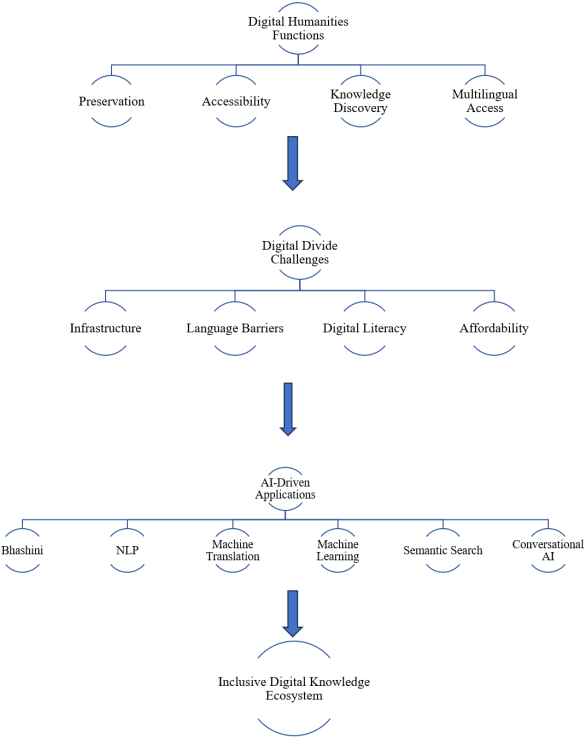
A conceptual framework for bridging the digital divide in Digital Humanities through AI-driven applications and services can be presented.
Figure 1. Conceptual framework linking AI → Digital Humanities → Digital Inclusion.
The framework illustrates how key challenges, including socio-economic inequality, linguistic diversity, digital literacy gaps, and infrastructural limitations, can be addressed through AI technologies such as machine translation, natural language processing, machine learning, speech recognition, and semantic search. These technologies support essential Digital Humanities functions, including digital preservation, multilingual access, knowledge organization, and cultural heritage dissemination. Ultimately, these interventions contribute to inclusive knowledge access, language preservation, digital inclusion, and the development of a sustainable and equitable digital humanities ecosystem.
5. Indian Case Studies
The Indian digital landscape offers a number of significant initiatives that illustrate both the possibilities and limitations of bridging the digital divide through technology. This section examines select case studies that are closely aligned with the objectives of Digital Humanities and demonstrate varying degrees of integration with AI-driven applications and services. The study analyses AI-driven applications and services within a broader socio-technical context, highlighting their contributions as well as their constraints.
5.1. National Digital Library of India (NDLI)
NDLI represents most ambitious efforts to create a unified digital knowledge repository in the country. Developed with the aim of providing equitable access to educational and scholarly resources, NDLI aggregates content from multiple institutions and disciplines, thereby functioning as a centralised platform for learners, researchers, and educators. This Digital Humanities project was developed by the Government of India, Ministry of Education. It is developed and maintained by IIT Kharagpur. Phase-1 of this project was started in 2015, and in 2016, the project was released with 5 million contents for the public. In 2025, NDLI releases more than 100 million contents in 39 various Indian languages. It has more than 6000 NDLI Clubs across the nation to collect and organise digital resources. It is free for the wider community to access the content. Furthermore, the initiatives like NDLI Club, Institutional Digital Repository (IDR) hosting service, Institutional Digital Library (IDL) Service, and Digital Preservation Centre (DPC) to promote sustainable digital inclusion.
NDLI is a flagship initiative of the Government of India to provide a free and open access knowledge repository of various disciplines such as school education, higher education, career development, research, patents and standards, judicial resources, cultural archives, and newspaper archives in different languages and levels of education. NDLI contains resources including books, articles, theses, audio-visual materials, and other learning content, sourced from various Indian and international institutions. The platform incorporates advanced search facilities that enables user to navigate vast collections of texts, manuscripts, and multimedia resources. Although these features are not always identified as AI-driven, many functionalities-such as personalized recommendations and metadata-based filtering are supported by underlying algorithmic processes that enhance user experience.
From the viewpoint of bridging the digital divide, NDLI makes a meaningful contribution by offering free access of resources. Online access to 100 million resources in 39 languages can quite effectively bridge the gap of the digital divide. Additionally, the initiatives like Assisted Digital Access, Internet Saathi Program, and YUVA AI for all, etc., have been made to include the rural areas to access Digital Humanities resources.
5.2. Shodhganga
Shodhganga, an initiative of the INFLIBNET (Information and Library Network) centre, serves as a national repository of doctoral theses and dissertations submitted to Indian universities. Its primary objective is to promote open access to academic research, thereby enhancing the visibility and impact of scholarly work produced within the country. Within the Digital Humanities landscape, Shodhganga serves as a valuable platform for expanding public access to scholarly research and academic knowledge. By digitizing and centralizing research outputs, it reduces the dependence on physical archives and institutional libraries. This is particularly beneficial for researchers and students from smaller institutions who may otherwise face difficulties in accessing scholarly materials. This project addresses the "outcome divide," that is, disparities in the benefits derived from digital access. By making research freely available, Shodhganga enables a wider audience to engage with academic knowledge, thereby fostering a more inclusive research ecosystem.
However, the platform’s engagement with AI technologies remains relatively limited. While basic search and indexing functions are available, there is significant scope for incorporating advanced AI-based features such as semantic search, automated summarization, and multilingual translation. Such enhancements could further improve accessibility, particularly for users who are not proficient in academic English or who lack advanced research skills.
5.3. IGNCA Kalasampada Digital Library
The Kalasampada Digital Library, developed by the Indira Gandhi National Centre for the Arts (IGNCA), represents a distinctive approach to digital cultural preservation. Unlike conventional digital libraries that primarily focus on textual content, Kalasampada integrates a wide range of multimedia resources, including manuscripts, photographs, audio recordings, and visual documentation of cultural practices. This initiative is particularly significant for Digital Humanities as it attempts to capture the richness and diversity of India's cultural heritage in machine-readable form. The platform allows users to engage with cultural materials in a more immersive and interactive manner. From a technological standpoint, Kalasampada reflects early efforts toward integrating digital tools for cultural informatics. While the explicit use of AI may not be fully implemented across all components, the platform lays the groundwork for future integration of technologies such as image recognition, metadata automation, and pattern analysis.
In view of the digital divide, Kalasampada contributes by preserving and disseminating cultural knowledge that might otherwise remain inaccessible. However, similar to other initiatives, its reach is influenced by issues of digital literacy and infrastructure. Moreover, its unique nature of content may limit its accessibility to general users unless proper ser-friendly interfaces and AI-assisted navigation tools are incorporated.
5.4. Digital India
The Digital India program is a flagship initiative of the Government of India launched in 2015. It launched with the objectives of transforming India into digital empowered society, the programme focuses on expanding digital infrastructure, knowledge economy, boosting e-governance, promoting digital literacy, and delivering public services through digital platforms. Under the guidance of MeitY (Ministry of Electronics and Information Technology), the program has transformed how citizens of India interact with the government and financial systems through several applications like Unified Payments Interface (UPI), AADHAAR (Unique Identification Authority of India), DigiLocker, MyGov, BharatNet, UMANG (Unified Mobile Application for New-age Governance), and e-Hospital.
From the perspective of this study, Digital India is essential not only as a policy initiative but also as catalyst for the advancement of Digital Humanities initiatives. By developing various applications and encouraging the implementation of advanced technologies, it presents the situations necessary for platforms like NDLI and Shodhganga to function effectively. The programme also highlights the challenges inherent in large-scale digital transformation. While substantial development was initiated in expanding internet facilities and online services, few disparities remain across regions and social groups.
Table 1. Indian AI initiatives and case studies.
Initiative/Project | Organization | AI Technology Used | Digital Divide Challenge Addressed | Contribution to Digital Humanities |
Bhashini | Ministry of Electronics and Information Technology (MeitY), Government of India | AI-based machine translation, speech recognition, NLP | Linguistic barriers and multilingual access | Enables access to digital content in multiple Indian languages and promotes linguistic inclusion |
National Digital Library of India (NDLI) | IIT Kharagpur, Ministry of Education | AI-enabled search, recommendation systems, metadata management | Educational and knowledge access inequality | Facilitates equitable access to educational and cultural resources |
Shodhganga | INFLIBNET Centre | Metadata harvesting, semantic indexing, AI-assisted retrieval | Research accessibility gap | Provides open access to Indian theses and dissertations |
IGNCA Kalasampada Digital Library | Indira Gandhi National Centre for the Arts | Digital archiving, image processing, metadata enrichment | Cultural heritage accessibility gap | Enhances access to archival and cultural resources |
Digital India | Government of India | Interoperable matrix of software | Transforming India into digital empowered society | Promoting digital literacy, and delivering public services through digital platforms |
Table 1 illustrates the significant role of AI-driven initiatives in addressing various dimensions of the digital divide in India. The case studies demonstrate that technologies such as natural language processing, machine translation, speech recognition, machine learning, and digital preservation tools are being effectively utilized to enhance multilingual access, digital literacy, cultural heritage preservation, and citizen participation. These initiatives collectively contribute to the development of a more inclusive digital knowledge ecosystem by improving access to information and digital services for diverse linguistic, socio-economic, and geographically dispersed communities.
5.5. AI for E-Governance
The Government of India is aggressively integrating AI into the e-governance framework under the program "AI for All" to improve and simplify service delivery, improve transparency, and minimise the digital divide.
5.5.1. Service Delivery
Furthermore, some key initiatives have been taken in early 2026 such as “AI stack” for providing accessible computer power at subsidised rates to research via the National Supercomputing Mission AIRAWAT (AI Research Analytics, and Knowledge Dissemination), national language translation platform (Bhashini) that provide real-time AI-driven translation in multiple Indian languages for government services and documentation, e-Courts Project Phase III based on ML, and NLP into the judicial system for legal translation, scheduling, and case document scanning, Digital Public Infrastructure (DPI) for linking AI with Aadhaar, Digilocker, and UPI for intelligent identity verification and secure transaction monitoring, SabhaSaar and eGramSwaraj for local governance activities, such as automatically transcribing and summarising Gram Sabha meetings in rural areas for better transparency, Utilizing AI for crop pest monitoring (Wadhwani AI) and applying AI tools for early disease monitoring under the Ayushman Bharat Digital Mission.
5.5.2. Bridging the Digital Divide
The "AIKosh" provides over 5,500 datasets and 251 AI models from 20+ sectors to researchers to reduce reliance on foreign-centric datasets, fostering locally relevant AI. The "FutureSkills" platform provides retraining for IT professionals in AI, ML, and Data Science to build a massive AI-skilled workforce. The mission "YUVA AI" offers a national AI literacy course in 11 languages, aimed at foundational AI proficiency for 1 core citizens, accessible via DIKSHA (Digital Infrastructure for Knowledge Sharing). The Common Service Centres (CSCs) and PM-WANI are combining AI-powered apps to provide digital services through 6.5 lakh CSCs and 4 lakh PM-WANI (Prime Minister Wi-Fi Access Network Interface) Wi-Fi hotspots, bringing digital tools to rural areas with minimal internet penetration. "Diksha Portal" provides personalized, adaptive learning content, breaking down educational access barriers in rural areas.
5.5.3. Digital Initiatives for DH
India Government has taken initiatives to address these DH challenges, such as breaking linguistic barriers for the language divide by using AI-driven tools "Bhashini and Anuvaadini" and "Gyan Bharatam and Adi Vaani" for democratization of access to knowledge. The AI-driven platform Bhashini and Anuvaadini provide real-time translation and voice-first solutions in 22 scheduled Indian languages. User can access academic content, government reports, and digital archives in their native tongues. Another AI-based platform, Gayan Bharatam and Adi Vanni, focus on digitizing tribal and endangered languages, ensuring that marginalized cultural assets are integrated into the national digital value chain.
5.5.4. Digital Preservation of Heritage
National Mission for Manuscripts (NMM) uses AI-powered Optical Character Recognition (OCR) and image restoration techniques to digitize millions of rare manuscripts in scripts like Grantha and Devanagari, making them searchable for researchers everywhere. Bharatiya Kriti Sampad is the Indian National Database of Manuscripts, developed by National Mission for Manuscripts (NMM), an initiative by the Ministry of Culture, Government of India. It preserves the manuscript heritage, encompassing diverse languages and subjects, and makes it available to the user communities. Objectives of this project are to preserve and safeguard the Indian manuscripts heritage by documentation and digitization, providing scholars and researchers with easy access to information about manuscripts, and promoting awareness about the richness of Indian manuscripts. Indian Culture Portal serves as a central repository for digitised artifacts and records, utilizing AI to organize vast datasets for public interest and education. The University of Delhi (DU) and Jawaharlal Nehru University both are collaboratively conducting research to archive local histories and deploy text mining on classical Sanskrit and Persian manuscripts. Digital South Asia Library was developed in collaboration with the University of Chicago and various institutions of South Asia. The institutes of India, Pakistan, Bangladesh, and Sri Lanka have participated in developing this project. The Indian institutes, such as the Indian Institute of Management Ahmedabad, the Indian Institute of Science, Bangaluru, Ramkrishna Mission Institute of Culture, and National Archive of India, are associated with this project. Its resources are freely available and mostly under Creative Commons licenses, but a few have copyright restrictions.
Project Madurai was developed and launched on 14th January 1998 on the occasion of Pongal day. The project focuses on digitizing the ancient and classic Tamil literature and making it available for use. It has digitised more than 1000 Tamil literary works available in PDF, HTML, Kindle, and EPUB (Electronic Publication) versions. It covers works from the early Sangam period to modern era authors of poetry, drama, prose, and various philosophical rare texts. From 1999, the project has used Tamil Script Code for Information Interchange (TSCII) to transcribe the text, and from 2004 it has used Unicode (UTF-8) for better compatibility. Tamil scholars, editors, and authors from different countries have jointly organized this project and made it available on the web. Furthermore, Project Cinemaazi is a digital archive of Indian cinema. It preserves the history of Indian films and other people associated with the cinema. This project covers old film posters, biographies, interviews, photographs, articles, and rare documents like magazines, manuscripts, books, and letters related to this domain. Cinemaazi opens a new area of research on Indian films. Cinema Memory Project (CMP) is another wing that preserves and digitises materials for future generations. It covers 35000 films in different languages, including regional languages and biographies of 2000 film personalities. It also contains 1026 items from Google Art and Culture collections. Another important initiative project, DHARTI (Digital Humanities Alliance for Research and Teaching Innovations), was initiated to promote digital practices in the humanities and social science sectors. It was started as Digital Humanities Alliance of India (DHAI), but later it was renamed as DHARTI in 2019. The purposes of these projects are to provide digital humanities projects in India, online and offline platforms to discuss and build upon the digital humanities projects, develop a research network, and promote Indian DH projects for global recognition. DHARTI organizes a seminar conference to promote the DH. In 2024, DHARTI organizes a conference on "Digital Subject/Invites in Global South" to bridge the application of modern technology and humanities and social science research. It encourages participation among the various subject areas like arts, visual arts, language, literature, sociology, computational studies, library studies, etc., to promote collaborative research.
5.5.5. Assisted Access in Rural Areas
Since many people lack the devices or literacy to explore Digital Humanities independently, the Government of India uses Assisted Digital Access, such as Common Service Centres (CSCs), and the Digital Mobile Library. Presently, 6.5 lakh centres are working as physical-digital interfaces. “Village Level Entrepreneurs” help rural citizens use digital platforms to access cultural educational resources they otherwise couldn’t reach. The Government of India collaborated with C-DAC (Centre for Development of Advanced Computing) to provide a Digital Mobile Library facility which brings digital literacy and library resources directly to underserved schools and communities.
5.5.6. Public Engagement
The e-KUMBH (Knowledge Unleashed in Multiple Bharatiya Languages) online portal, developed by the All India Council for Technical Education (AICTE), provides free access to technical education books and study materials in multiple regional Indian languages. It is developed in alignment with the National Education Policy (NEP) 2020 to promote education in a student’s mother tongue. Another important initiative, the Pradhanmuntri Sangrahalaya (Prime Ministers’ Museum) in New Delhi uses Augmented Reality (AR), Virtual Reality (VR), and AI with it dedicated “Anubhuti” Engagement Zone to turn historical exhibits into immersive, interactive experiences. Instead of just observing history, visitors can actively participate using these modern technologies.
The Government of India has taken some important initiatives to bridge the digital divide. The Internet Saathi program is a prominent digital literacy initiative launched in 2015 as a joint collaboration between Google India and the Tata Trusts. Its main objective is to bridge the severe digital gender divide in rural India by empowering village women to become digitally independent. The program follows the "Train the Trainer" model. Local women are selected through the local Non-Government Organisation (NGOs). They undergo hands-on training provided by Google on how to navigate smartphones, tablets, and the internet. Each trained “Sathi” is equipped with data-enabled smartphones or tablets, power banks, and a bicycle. A Saathi travels across a cluster of three neighboring villages for several months. She educates other women on how to access critical online resources, search for government services, monitor local weather updates, and understand digital payments. It was implemented across 20 Indian states, and when the program began in 2015, only 1 in 10 internet users in rural areas was female. Within a few years, that balance improved to 4 in 10.
BharatCares is one of India's leading social impact organizations and a Corporate Social Responsibility (CSR) project implementation agency. It was established to serve as a "social solutions bridge" that connects corporate funders, government agencies, and local innovators to design and execute scalable development programs for underserved communities across India. It provides a 90-hour virtual training program to equip final-year undergraduate and graduate students with employability, workplace, and life skills to make them market-ready. It aimed to increase practical of science, technology, engineering, and math (STEM) literacy in schools and provides digital labs, practical activities, and computational thinking workshops to spark interest in future tech fields.
5.5.7. Institutional Initiatives
The Centre of Indian Language Data (COIL-D) and IIT Patna have been engineering specialized ML models to process morphologically complex and highly localized low-resource languages. Their work focuses on building benchmarking frameworks to resolve data scarcity issues for minority dialects. Research teams at IIT Jodhpur have developed "Indic Photo OCR" to transcribe heavily damaged historical texts. They have also developed a model capable of cleaning, restoring, and cataloguing scripts in low-resource or ancient media like Sanskrit and Pali. Another important initiative taken by IIT Madras, namely AI4Bharat, is for democratizing speech recognition. They have developed the "IndicVoices" application that maps linguistic diversity across hundreds of districts, producing customizable, low-footprint speech-to-text models that can operate on standard mobile platforms for localised tribal dialects.
5.6. Critical Synthesis of Case Studies
The above-mentioned case studies illustrate the multifaceted nature of efforts to bridge the digital divide in India. The study reveal that although the digital platforms have significantly expanded access to knowledge and cultural resources, their impact is mediated by broader socio-economic and technological conditions. Concerns including digital literacy, language barriers, and developing of user interface play an important role in determining whether digital resources are effectively utilized. In this regard, AI-driven applications offer considerable potential. Technologies such as multilingual NLP systems, intelligent recommendation engines, and voice-based interfaces could significantly enhance the accessibility and usability of these platforms. Technological solutions must be designed and implemented in ways that are sensitive to the diverse needs of users. Without such considerations, there may be a problem that digital initiatives may inadvertently generate inequalities rather than alleviate them.
AI-driven applications play a critical role in reshaping access to knowledge and cultural heritage. Rather than viewing AI merely as a technological enhancement, it is more productive to understand it as an enabling mechanism that can address long-standing inequalities in the generation, dissemination, and consumption of humanities knowledge. One of the important contributions of AI in bridging the digital divide lies in enhancing accessibility to digital resources. AI-driven interfaces, however, are increasingly designed to be intuitive and user-friendly. Features such as voice-based search, conversational agents, and personalized recommendations allow users with minimal technological proficiency to engage more comfortably with digital platforms.
Another important area where AI is making an impact is multilingual accessibility. AI technologies, especially NLP, enable real-time translation, text summarization, and speech recognition across multiple languages. This allows users to access content in their native languages, thereby reducing linguistic exclusion. The number of projects in India is incorporating AI-driven technologies to overcome the language diversity. AI also contributes significantly to the digitization and preservation of cultural heritage, which is a core concern of Digital Humanities. AI-powered applications such as OCR, image enhancement algorithms, Hand written Text Recognition technology, and pattern recognition systems can automate and accelerate the digitization process. Machine learning algorithms can generate metadata automatically, and this improves the discoverability of resources and allows users to locate relevant information more easily, even if they lack advanced search skills. It also enables large-scale text analysis, data visualization, and pattern detection, allowing DH researchers to explore new questions and methodologies. By lowering the barriers to advanced analytical tools, AI democratizes research capabilities and allows a more diverse group of scholars to participate in knowledge generation.
Another important dimension of AI is in personalized learning and knowledge dissemination. AI technologies tailor content to the needs and preferences of individual users and researchers. This personalized approach is particularly beneficial in bridging the educational aspect of the digital divide, as it accommodates different learning paces and styles. AI is also facilitating inclusive user engagement through assistive technologies. AI-powered applications for speech conversation and image recognition enable more inclusive interaction with digital platforms. Cultural and historical resources can be accessed by the broader communities, including those with visual or hearing impairments, which also includes marginalised groups.
In addition, AI plays a role in bridging geographical disparities. AI-driven digital platforms can bring these resources directly to users, reducing the dependency on physical infrastructure. For example, virtual exhibitions, interactive archives, online discussion and sharing of thought allow users to explore cultural heritage from their own locations. While connectivity remains a challenge in some areas, the increasing availability of mobile internet and low-cost devices is gradually expanding. Despite these promising developments, it is vital to adopt a balanced perspective. The effectiveness of AI-based applications in bridging the digital divide depends on the process involved in their design, execution, and management. Issues such as algorithmic bias, data privacy, and unequal access to AI technologies can potentially reinforce existing inequalities.
Therefore, the application of AI in Digital Humanities should be understood within the broader socio-technical framework. Technological innovation must be accompanied by efforts to improve digital literacy, expand infrastructure, and ensure ethical governance. Community participation is also crucial, as limited knowledge and cultural contexts should inform the design of digital platforms.
Table 2. AI-Driven Initiatives for Bridging the Digital Divide in Digital Humanities and E-Governance in India.
Initiative/Project | Domain | AI Technology/Approach | Digital Divide Challenge Addressed | Key Contribution |
Bhashini | Multilingual Access & E-Governance | NLP, Speech Recognition, Machine Translation | Language barriers | Provides real-time translation and voice-based access to government services and digital content in multiple Indian languages |
Anuvadini | Education & Knowledge Access | AI Translation, NLP | Linguistic inequality | Enables access to academic and educational content in regional languages |
AIKosh | AI Research Infrastructure | AI Models and Open Datasets | Data inequality | Provides indigenous datasets and AI models for locally relevant research and innovation |
YUVA AI | AI Literacy | AI-based Learning Platform | Digital literacy gap | Offers AI literacy training in multiple Indian languages to promote digital inclusion |
FutureSkills | Skill Development | AI, Machine Learning, Data Science Training | Workforce skill gap | Enhances AI competency and employability among learners and professionals |
Common Service Centres (CSCs) | Rural Digital Inclusion | AI-enabled Service Delivery | Rural accessibility barriers | Provides assisted access to digital services through village-level centres |
PM-WANI | Connectivity Infrastructure | AI-enabled Digital Services | Internet accessibility gap | Expands digital access through public Wi-Fi networks in underserved areas |
DIKSHA Platform | Education | Adaptive Learning Systems | Educational inequality | Delivers personalized digital learning resources to diverse learners |
e-Courts Phase III | Judicial Governance | Machine Learning, NLP | Legal information accessibility | Improves legal translation, case management, and judicial transparency |
SabhaSaar & eGramSwaraj | Local Governance | Speech-to-Text, Summarization AI | Governance participation gap | Enhances transparency through automated transcription and summarization of Gram Sabha proceedings |
National Mission for Manuscripts (NMM) | Digital Preservation | OCR, Image Restoration, AI Indexing | Cultural heritage accessibility | Digitizes and preserves rare manuscripts for scholarly access |
Bharatiya Kriti Sampada | Manuscript Heritage | Digital Repository Technologies | Heritage knowledge gap | Facilitates discovery and access to manuscript collections |
Indian Culture Portal | Cultural Heritage | AI-based Metadata Organization | Information discovery barriers | Provides centralised access to digitised cultural resources |
Project Madurai | Literary Heritage | Digital Text Encoding & Preservation | Access to classical literature | Preserves and disseminates Tamil literary heritage in digital formats |
Cinemaazi & Cinema Memory Project | Film Heritage | Digital Archiving, Metadata Management | Cultural preservation challenges | Preserves Indian cinema history and related archival materials |
DHARTI | Digital Humanities Research | Digital Collaboration Platforms | Research participation gap | Promotes interdisciplinary Digital Humanities research and networking |
Internet Saathi | Digital Literacy | Community-Based Digital Training | Gender digital divide | Improves digital literacy among rural women through peer-learning models |
AI4Bharat (IndicVoices) | Language Technology | Speech Recognition, NLP | Low-resource language exclusion | Develops speech technologies for Indian and tribal languages |
COIL-D & IIT Patna | Language Preservation | Machine Learning Models | Minority language data scarcity | Creates AI resources for low-resource and endangered languages |
IIT Jodhpur Indic Photo OCR | Digital Archives | OCR and Image Enhancement | Access to damaged historical records | Restores and digitizes historical manuscripts and texts |
Table 2 demonstrates that India has adopted a comprehensive and multi-dimensional approach to bridging the digital divide through AI-driven applications and services across e-governance, education, cultural heritage preservation, language technology, and digital literacy. The initiatives collectively address major barriers to digital inclusion, including linguistic diversity, inadequate digital infrastructure, limited access to information, low levels of digital literacy, and the exclusion of marginalized communities. AI-powered platforms such as Bhashini, Anuvadini, AI4Bharat, and Indic Photo OCR facilitate multilingual access, language preservation, and knowledge discovery, while initiatives such as CSCs, PM-WANI, DIKSHA, YUVA AI, and FutureSkills enhance digital accessibility and capacity building. Similarly, projects including the National Mission for Manuscripts, Bharatiya Kriti Sampada, Project Madurai, and Cinemaazi demonstrate the growing role of AI in preserving and disseminating cultural heritage resources within the Digital Humanities domain. The table further indicates that the integration of AI into governance systems, such as e-Courts, SabhaSaar, and eGramSwaraj, has improved transparency, efficiency, and citizen engagement. Overall, these initiatives illustrate how AI can function as a transformative tool for promoting inclusive participation in digital knowledge ecosystems and reducing various dimensions of the digital divide in India.





 Share This Article
 Twitter
 Linked In
 Facebook

 Copy
 Download