Safety Evaluation of Selected Intersections Using Historical Crash Data and Surrogate Traffic Conflict Measures - the Case of Yeka Sub City Addis Ababa
Urban intersections are critical locations in road network where vehicular traffic and pedestrians interact. It results in substandard safety performance due to geometric deficiencies. Traditional safety evaluations depend on historical records solely which suffers systematic under reporting and provide are active frame work. This study used a reactive proactive approach by integrating historical crash data analysis with microscopic traffic simulations and surrogate safety measures (SSMs) to evaluate five high risk intersections in Yeka sub city Addis Ababa. Kotebe K/mihret, kotebe Zero hulet, Kotebe College, Abem and Kara junctions. Intersections were screened and prioritized using the equivalent property damage only (EPDO) scoring method. A microscopic simulation was developed using SUMO and trajectories were analyzed using the surrogate safety assessment model (SSAM) to capture time to collision (TTC) and post encroachment time (PET). Based on identified deficiencies engineering interventions are proposed following AACRA, ERA and AASHTO design standards. The post redesign SSAM evaluation revealed a 36.9% overall reduction in total traffic conflicts. This confirmed that integrating historical crashes with proactive surrogate measures creates a more robust framework for urban traffic safety management. This study concluded that for evaluating urban intersection safety, integrating historical crash analysis with surrogate conflict measures provide more comprehensive and reliable frame work than relying on historical crash records solely.
This is an Open Access article, distributed under the terms of the Creative Commons Attribution 4.0 International License (http://creativecommons.org/licenses/by/4.0/), which permits unrestricted use, distribution and reproduction in any medium or format, provided the original work is properly cited.
. Sub Saharan Africa experience disproportionately high traffic mortality rates despite low motorization levels
[9]
WHO, 2023; Sub-Saharan Africa Transport Policy Program [SSATP], 2021).
[9]
.
In developing countries traffic accident is a main concern of safety since safety management systems are limited. Developing countries have low motorization compared to developed countries but have higher traffic accidents and fatalities. If safety interventions are not implemented this will get worsen
[10]
Mahmud, S. M. S., Ferreira, L., Hoque, Md. S., & Tavassoli, A. (2018). Surrogate Measures for Traffic Safety Evaluation in Developing Countries: An Application Toward Sustainable Safety. Advances in Civil Engineering Materials, 7(3), 377–395.
. In Addis Ababa intersections act as prominent safety hazards due to heterogeneous traffic flows, dense pedestrian volumes and efficient geometric infrastructure
[4]
Addis Ababa Road Safety Report, 2023-24, 6-8.
[4]
.
Traditional screening of high-risk road sections relying solely on police crash records is limited by documentation error. Location inaccuracies and significant under reporting estimated 25-50% in developing nations. To overcome these uncertainties traffic engineering has shifted toward proactive surrogate safety measures (SSMs)
[6]
Vasconcelos, L., Neto, L., Seco, Á. M., & Silva, A. B. (2014). Validation of the Surrogate Safety Assessment Model for Assessment of Intersection Safety. Transportation Research Record: Journal of the Transportation Research Board, 2432(1), 1-9.
To rank hazardous locations accident, point weight method was applied as classifying fatal crashes, major injury crashes, minor injury crashes and property damage only crashes. This weight helps to rank and prioritize of risky intersections
[15]
Iqbal, A., Rehman, Z. u., Ali, S., Ullah, K., & Ghani, U. (2020). Road Traffic Accident Analysis and Identification of Black Spot Locations on Highway. Civil Engineering Journal, 6(12), 2448-2456.
Advanced crash data analysis using Adds Ababa police commission records of 8523 heavy vehicle crashes from July 2014-june 2017 by focusing on junction versus mid-block environments in urban setting to model injury severity by applying legit regression junction type was included as key variable of which 47.16% crashes occur at junctions
[14]
Tulu, G. S., Lisinge, R. T., & Wedajo, B. T. (2022). Heavy vehicle crashes in Addis Ababa: Relationship between contributing factors and severity of outcomes. Journal of Sustainable Development of Transport and Logistics, 7(2), 25–40.
a new surrogate safety indicator based on vehicle trajectories extracted from simulation, which were validated by comparing them with crash risks obtained from real-world crash data across various urban intersection scenarios
[13]
Astarita, V., Festa, D. C., Giofrè, V. P., & Guido, G. (2019). Surrogate safety measures from traffic simulation models a comparison of different models for intersection safety evaluation. Transportation research procedia, 37, 219-226.
[13]
.
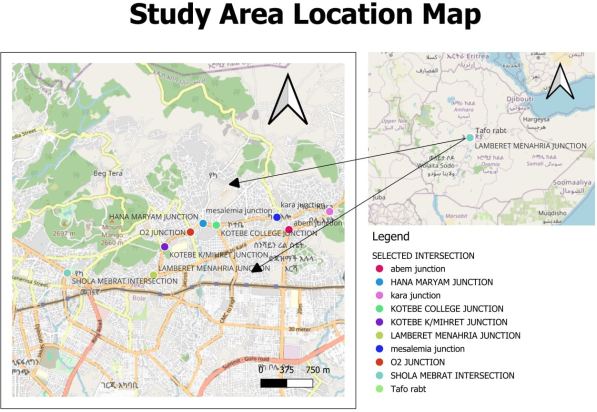
This study utilizes a hybrid methodology assessing intersection safety with historical crash mapping combined with micro simulated conflict tracking to guided geometric interventions in Yeka sub city Addis Ababa.
2. Materials and Methods
The research employees a balanced quantitative cross sectional design split into four main operational phases.
A five-year historical crash data from eleven initial intersections were compiled from Addis Ababa traffic police commission and relevant transport organizations. Intersections are prioritized based on injury severity, the equivalent property damage only (EPDO) scoring method was applied
[5]
Sharafeldin, M., Ksaibati, K., & Gerow, K. (2023). Frequency Analysis of Equivalent Property-Damage-Only (EPDO) Crashes at Intersections. Eng, 4(2), 1116–1126.
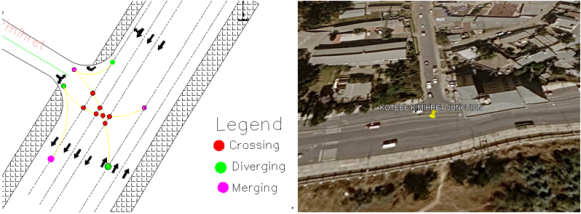
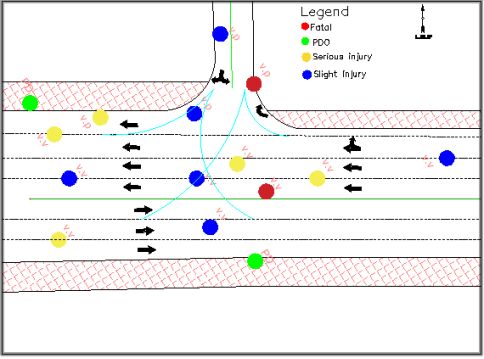
Figure 3. Kotebe k/mihret junction Crash data mapping and existing layout.
Real world dimensions, fillet turning radius. Longitudinal gradients and operational constraints were surveyed on site. Theoretical conflict. points (crossing, merging and pedestrian) were systematically mapped out with AUTOCAD/civil 3D.
2.2.3. Microscopic Traffic Simulation (SUMO%SSAM)
Peak hourly volume data (morning, mid-day and evening) were input into SUMO T to model individual vehicle trajectories. The trajectory data were imported to surrogate safety assessment model (SSAM) to isolate structural near miss conflicts based on defined critical thresholds. Time to collision TTC<1.5
[6]
Vasconcelos, L., Neto, L., Seco, Á. M., & Silva, A. B. (2014). Validation of the Surrogate Safety Assessment Model for Assessment of Intersection Safety. Transportation Research Record: Journal of the Transportation Research Board, 2432(1), 1-9.
Shangguan, Q., Keung, J., Fu, L., Samara, L., Wang, J., & Fu, T. (2024). Do Traffic Countermeasures Improve the Safety of Vulnerable Road Users at Signalized Intersections? A Combination of Case-Control and Cross-Sectional Studies Using Video-Based Traffic Conflicts. Transportation Research Record: Journal of the Transportation Research Board, 2678(1), 806–819.
Target engineering improvements made such as channelization, Channel Islands, widened turning radii, raised pedestrian medians and signal coordination.
3. Results and Discussion
3.1. Base Line Site Audits and EPDO Ranking
The preliminary data screening selected five primary junctions based on structural risk profiles. Field checks revealed severe structural flaws, including steep slopes (up to 12% at Abem and 10% at Kotebe Kidane Mihret), inadequate fillet radii 10m, non-functional traffic signals (Abem and Kara) and structural sight obstructions.
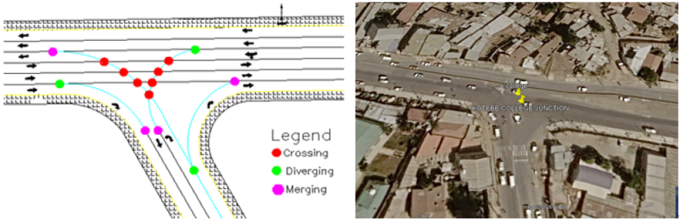
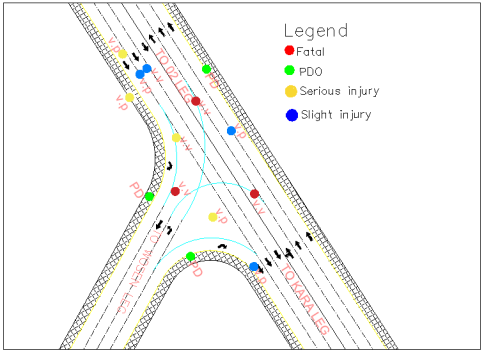
Figure 5. Crash data mapping kotebe college junction.
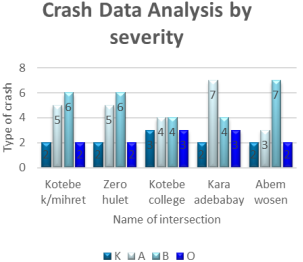
Note: Crash type mapping showed that vehicle-to-vehicle impacts predominated across most intersections, while Kotebe College exhibited the highest percentage of pedestrian strikes (43%) due to unprotected school zones.
The EPDO scoring allocated priorities based on historical severity index profiles, identifying Kotebe College Junction as the highest priority site for safety mitigation.
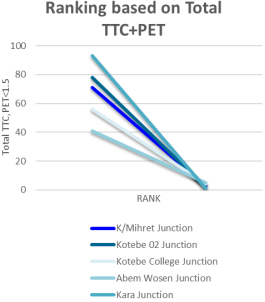
The base line simulation identified critical structural exposure across the road network. Kara junction exhibited the highest simulated operational hazard profile. yielding 340 total conflicts and highly critical safety concerns. The average TTC is 0.9 and average PET is 0.8.
Discrepancy Discussion: Kotebe college ranks highest in historical crash severity (EPDO) however Kara ranks first in projected operational numbers. This shows that historical crash records can underestimate risk at highly congested road networks confirming the value of proactive trajectory simulation
[8]
Zheng, L., Sayed, T., & Mannering, F. (2021). Modeling traffic conflicts for use in road safety analysis: A review of analytic methods and future directions.
Figure 7. Ranking of intersections by critical conflicts.
3.3. Post-Redesign Safety Performance Evaluation
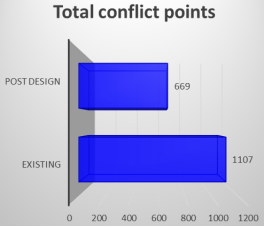
Engineering interventions were introduced based on the specific junction condition and level of severity and risk to structurally eliminate crossing conflicts, traffic management recommendations to protect vulnerable road users and to enhance over all safety of the intersections. The proposed improvements resulted in overall 36.9% reduction in total traffic conflicts of selected intersections.
Figure 8. Total simulated conflicts existing and post re-deign.
The localized conflict variations post redesign demonstrates improvements.
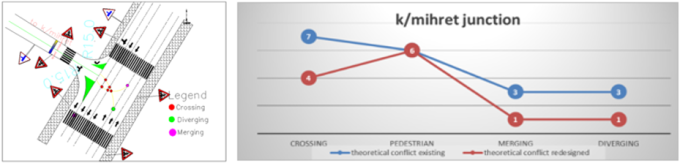
1) Kotebe k/mihret: total conflict dropped from 210 to 132 (TTC<1.5s reduced by 35.5%) by modifying turning radius to as standard 15 meters, segregating loading areas away from the intersection and providing pedestrian facilities.
2) Kotebe zero hulet: conflicts drooped from 185 to 106 by installing a raised physical median barrier, providing pedestrian refuge island and segregating conflicting u turns from market cross walk zones.
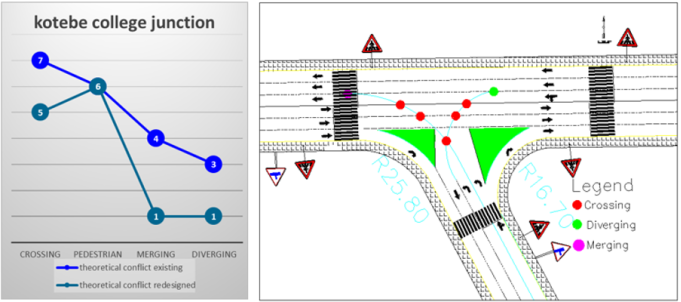
3) Kotebe college: conflicts decreased from 260 to 169 by providing channelization islands to organize turns and introducing protective pedestrian signage to safeguard wonderad school area.
4) Abem wosen: conflicts decreased from 112 to 98 through localized channelization and signal adjustments.
5) Kara junction: total conflicts dropped from 340 to 194 by implementing geometric modifications to mitigate sight distance limitations caused by adjacent retaining wall, separating cross walks from U turn zones and restoring signal functionality.
4. Discussion
Generally, the results demonstrate the surrogate safety measures provide valuable additional information for intersection safety assessment
[6]
Vasconcelos, L., Neto, L., Seco, Á. M., & Silva, A. B. (2014). Validation of the Surrogate Safety Assessment Model for Assessment of Intersection Safety. Transportation Research Record: Journal of the Transportation Research Board, 2432(1), 1-9.
. While EPDO reflects severity of historical crashes where as TTC and PET CAPTURE real time traffic interactions and potential future crash risks, the combined use of crash data and surrogate safety measures offers a more generalized understanding of intersection safety performance
The results indicate that kotebe college junction should be prioritized for safety enhancements due to its high crash severity whereas kara junction should receive proactive safety interventions because of higher conflict frequency and critical TTC and PET conditions. This study supports the use of surrogate safety measures rather than depend on crash data solely
[6]
Vasconcelos, L., Neto, L., Seco, Á. M., & Silva, A. B. (2014). Validation of the Surrogate Safety Assessment Model for Assessment of Intersection Safety. Transportation Research Record: Journal of the Transportation Research Board, 2432(1), 1-9.
1) Integrating frameworks: relying solely on historical crash records usually under represents systematic intersection hazards due to prevailing under reporting. Combining historical EPDO Indices with automated simulation provides a reliable method for evaluating urban road safety
[7]
Yang, D., Xie, K., Ozbay, K., & Yang, H. (2021). Fusing crash data and surrogate safety measures for safety assessment: Development of a structural equation model with conditional autoregressive spatial effect and random parameters. Accident Analysis & Prevention, 152, 105971.
2) Infrastructure deficiencies: intersection safety in yeka sub city is compromised by geometric and operational defects such as steep grade approaches., inadequate tuning radius and nonfunctional traffic signals.
3) Targeting Engineering action: implementing localized channelization islands, expanding substandard corner turning radii with minimum of 15m
. introducing raised pedestrians refuge medians and separating cross walk configurations from vehicle U-turn zones
[1]
American Association of State Highway and Transportation Officials (AASHTO). (2018). A Policy on Geometric Design of Highways and Streets (7th ed.). Washington, DC.
[1]
successfully reduced critical traffic conflicts by 36.9% in simulation.
4) Institutional next steps: The Addis Ababa traffic management agency and AACRA should adopt systematic, simulation-based network screening procedures and establish integrated digital database for crash data to support evidence-based safety interventions.
American Association of State Highway and Transportation Officials
TIA
Traffic Impact Assessment
AARTMA
Addis Ababa Road Traffic Management Agency
LMICS
Low- and Middle-income Countries
WHO
World Health Organization
WRI
World Resource Institute
EPDO
Equivalent Property Damage Only
SSAM
Surrogate Safety Assessment Model
TMA
Traffic Management Agency
Acknowledgments
The author would like to express my sincere gratitude to my advisor, Dr. Tefera Bahiru, for his invaluable guidance, continuous support, constructive criticism, and patience throughout the course of this research. His extensive knowledge and expertise in transportation engineering greatly enhanced the quality of this thesis and inspired me to approach the research with academic rigor and professionalism.
He would also like to extend my heartfelt appreciation to the Addis Ababa Traffic Police Commission for providing the historical crash data and to the Addis Ababa City Road and Transport Bureau and Traffic management agency for facilitating access to essential information required for this study.
To everyone who contributed, directly or indirectly, to the successful completion of this research, I extend my sincere appreciation.
Author Contributions
Endalkchew Zemene: Conceptualization, Data curation, Formal Analysis, Investigation, Methodology, Writing – original draft, Writing – review & editing
Data Availability Statement
The data supporting the findings of this research work has been reported in this manuscript.
Conflicts of Interest
The author declare no conflicts of interest.
References
[1]
American Association of State Highway and Transportation Officials (AASHTO). (2018). A Policy on Geometric Design of Highways and Streets (7th ed.). Washington, DC.
Sharafeldin, M., Ksaibati, K., & Gerow, K. (2023). Frequency Analysis of Equivalent Property-Damage-Only (EPDO) Crashes at Intersections. Eng, 4(2), 1116–1126.
Vasconcelos, L., Neto, L., Seco, Á. M., & Silva, A. B. (2014). Validation of the Surrogate Safety Assessment Model for Assessment of Intersection Safety. Transportation Research Record: Journal of the Transportation Research Board, 2432(1), 1-9.
Yang, D., Xie, K., Ozbay, K., & Yang, H. (2021). Fusing crash data and surrogate safety measures for safety assessment: Development of a structural equation model with conditional autoregressive spatial effect and random parameters. Accident Analysis & Prevention, 152, 105971.
Zheng, L., Sayed, T., & Mannering, F. (2021). Modeling traffic conflicts for use in road safety analysis: A review of analytic methods and future directions.
[9]
WHO, 2023; Sub-Saharan Africa Transport Policy Program [SSATP], 2021).
[10]
Mahmud, S. M. S., Ferreira, L., Hoque, Md. S., & Tavassoli, A. (2018). Surrogate Measures for Traffic Safety Evaluation in Developing Countries: An Application Toward Sustainable Safety. Advances in Civil Engineering Materials, 7(3), 377–395.
Shangguan, Q., Keung, J., Fu, L., Samara, L., Wang, J., & Fu, T. (2024). Do Traffic Countermeasures Improve the Safety of Vulnerable Road Users at Signalized Intersections? A Combination of Case-Control and Cross-Sectional Studies Using Video-Based Traffic Conflicts. Transportation Research Record: Journal of the Transportation Research Board, 2678(1), 806–819.
Astarita, V., Festa, D. C., Giofrè, V. P., & Guido, G. (2019). Surrogate safety measures from traffic simulation models a comparison of different models for intersection safety evaluation. Transportation research procedia, 37, 219-226.
[14]
Tulu, G. S., Lisinge, R. T., & Wedajo, B. T. (2022). Heavy vehicle crashes in Addis Ababa: Relationship between contributing factors and severity of outcomes. Journal of Sustainable Development of Transport and Logistics, 7(2), 25–40.
Iqbal, A., Rehman, Z. u., Ali, S., Ullah, K., & Ghani, U. (2020). Road Traffic Accident Analysis and Identification of Black Spot Locations on Highway. Civil Engineering Journal, 6(12), 2448-2456.
Zemene, E. (2026). Safety Evaluation of Selected Intersections Using Historical Crash Data and Surrogate Traffic Conflict Measures - the Case of Yeka Sub City Addis Ababa. American Journal of Traffic and Transportation Engineering, 11(4), 67-74. https://doi.org/10.11648/j.ajtte.20261104.12
Zemene, E. Safety Evaluation of Selected Intersections Using Historical Crash Data and Surrogate Traffic Conflict Measures - the Case of Yeka Sub City Addis Ababa. Am. J. Traffic Transp. Eng.2026, 11(4), 67-74. doi: 10.11648/j.ajtte.20261104.12
Zemene E. Safety Evaluation of Selected Intersections Using Historical Crash Data and Surrogate Traffic Conflict Measures - the Case of Yeka Sub City Addis Ababa. Am J Traffic Transp Eng. 2026;11(4):67-74. doi: 10.11648/j.ajtte.20261104.12
@article{10.11648/j.ajtte.20261104.12,
  author = {Endalkchew Zemene},
  title = {Safety Evaluation of Selected Intersections Using Historical Crash Data and Surrogate Traffic Conflict Measures - the Case of Yeka Sub City Addis Ababa},
  journal = {American Journal of Traffic and Transportation Engineering},
  volume = {11},
  number = {4},
  pages = {67-74},
  doi = {10.11648/j.ajtte.20261104.12},
  url = {https://doi.org/10.11648/j.ajtte.20261104.12},
  eprint = {https://article.sciencepublishinggroup.com/pdf/10.11648.j.ajtte.20261104.12},
  abstract = {Urban intersections are critical locations in road network where vehicular traffic and pedestrians interact. It results in substandard safety performance due to geometric deficiencies. Traditional safety evaluations depend on historical records solely which suffers systematic under reporting and provide are active frame work. This study used a reactive proactive approach by integrating historical crash data analysis with microscopic traffic simulations and surrogate safety measures (SSMs) to evaluate five high risk intersections in Yeka sub city Addis Ababa. Kotebe K/mihret, kotebe Zero hulet, Kotebe College, Abem and Kara junctions. Intersections were screened and prioritized using the equivalent property damage only (EPDO) scoring method. A microscopic simulation was developed using SUMO and trajectories were analyzed using the surrogate safety assessment model (SSAM) to capture time to collision (TTC) and post encroachment time (PET). Based on identified deficiencies engineering interventions are proposed following AACRA, ERA and AASHTO design standards. The post redesign SSAM evaluation revealed a 36.9% overall reduction in total traffic conflicts. This confirmed that integrating historical crashes with proactive surrogate measures creates a more robust framework for urban traffic safety management. This study concluded that for evaluating urban intersection safety, integrating historical crash analysis with surrogate conflict measures provide more comprehensive and reliable frame work than relying on historical crash records solely.},
 year = {2026}
}
TY  - JOUR
T1  - Safety Evaluation of Selected Intersections Using Historical Crash Data and Surrogate Traffic Conflict Measures - the Case of Yeka Sub City Addis Ababa
AU  - Endalkchew Zemene
Y1  - 2026/08/24
PY  - 2026
N1  - https://doi.org/10.11648/j.ajtte.20261104.12
DO  - 10.11648/j.ajtte.20261104.12
T2  - American Journal of Traffic and Transportation Engineering
JF  - American Journal of Traffic and Transportation Engineering
JO  - American Journal of Traffic and Transportation Engineering
SP  - 67
EP  - 74
PB  - Science Publishing Group
SN  - 2578-8604
UR  - https://doi.org/10.11648/j.ajtte.20261104.12
AB  - Urban intersections are critical locations in road network where vehicular traffic and pedestrians interact. It results in substandard safety performance due to geometric deficiencies. Traditional safety evaluations depend on historical records solely which suffers systematic under reporting and provide are active frame work. This study used a reactive proactive approach by integrating historical crash data analysis with microscopic traffic simulations and surrogate safety measures (SSMs) to evaluate five high risk intersections in Yeka sub city Addis Ababa. Kotebe K/mihret, kotebe Zero hulet, Kotebe College, Abem and Kara junctions. Intersections were screened and prioritized using the equivalent property damage only (EPDO) scoring method. A microscopic simulation was developed using SUMO and trajectories were analyzed using the surrogate safety assessment model (SSAM) to capture time to collision (TTC) and post encroachment time (PET). Based on identified deficiencies engineering interventions are proposed following AACRA, ERA and AASHTO design standards. The post redesign SSAM evaluation revealed a 36.9% overall reduction in total traffic conflicts. This confirmed that integrating historical crashes with proactive surrogate measures creates a more robust framework for urban traffic safety management. This study concluded that for evaluating urban intersection safety, integrating historical crash analysis with surrogate conflict measures provide more comprehensive and reliable frame work than relying on historical crash records solely.
VL  - 11
IS  - 4
ER  -
Department of Civil Engineering & College of Engineering, Addis Ababa Science and Technology University, Addis Ababa, Ethiopia
Biography:
Endalkchew Zemene is a Master’s graduate in civil Engineering (Road and Transport Engineering) from Addis Ababa Science and Technology university. He completed his BSc in civil Engineering from Jimma University in 2018. His research focuses on traffic safety evaluation of the road network specially on intersections by historical crash data and surrogate safety assessment measures. He recognized as a professional highway engineer by the Ethiopian construction authority. He currently serves as a highway engineer in stadia engineering works consultant plc.
Zemene, E. (2026). Safety Evaluation of Selected Intersections Using Historical Crash Data and Surrogate Traffic Conflict Measures - the Case of Yeka Sub City Addis Ababa. American Journal of Traffic and Transportation Engineering, 11(4), 67-74. https://doi.org/10.11648/j.ajtte.20261104.12
Zemene, E. Safety Evaluation of Selected Intersections Using Historical Crash Data and Surrogate Traffic Conflict Measures - the Case of Yeka Sub City Addis Ababa. Am. J. Traffic Transp. Eng.2026, 11(4), 67-74. doi: 10.11648/j.ajtte.20261104.12
Zemene E. Safety Evaluation of Selected Intersections Using Historical Crash Data and Surrogate Traffic Conflict Measures - the Case of Yeka Sub City Addis Ababa. Am J Traffic Transp Eng. 2026;11(4):67-74. doi: 10.11648/j.ajtte.20261104.12
@article{10.11648/j.ajtte.20261104.12,
  author = {Endalkchew Zemene},
  title = {Safety Evaluation of Selected Intersections Using Historical Crash Data and Surrogate Traffic Conflict Measures - the Case of Yeka Sub City Addis Ababa},
  journal = {American Journal of Traffic and Transportation Engineering},
  volume = {11},
  number = {4},
  pages = {67-74},
  doi = {10.11648/j.ajtte.20261104.12},
  url = {https://doi.org/10.11648/j.ajtte.20261104.12},
  eprint = {https://article.sciencepublishinggroup.com/pdf/10.11648.j.ajtte.20261104.12},
  abstract = {Urban intersections are critical locations in road network where vehicular traffic and pedestrians interact. It results in substandard safety performance due to geometric deficiencies. Traditional safety evaluations depend on historical records solely which suffers systematic under reporting and provide are active frame work. This study used a reactive proactive approach by integrating historical crash data analysis with microscopic traffic simulations and surrogate safety measures (SSMs) to evaluate five high risk intersections in Yeka sub city Addis Ababa. Kotebe K/mihret, kotebe Zero hulet, Kotebe College, Abem and Kara junctions. Intersections were screened and prioritized using the equivalent property damage only (EPDO) scoring method. A microscopic simulation was developed using SUMO and trajectories were analyzed using the surrogate safety assessment model (SSAM) to capture time to collision (TTC) and post encroachment time (PET). Based on identified deficiencies engineering interventions are proposed following AACRA, ERA and AASHTO design standards. The post redesign SSAM evaluation revealed a 36.9% overall reduction in total traffic conflicts. This confirmed that integrating historical crashes with proactive surrogate measures creates a more robust framework for urban traffic safety management. This study concluded that for evaluating urban intersection safety, integrating historical crash analysis with surrogate conflict measures provide more comprehensive and reliable frame work than relying on historical crash records solely.},
 year = {2026}
}
TY  - JOUR
T1  - Safety Evaluation of Selected Intersections Using Historical Crash Data and Surrogate Traffic Conflict Measures - the Case of Yeka Sub City Addis Ababa
AU  - Endalkchew Zemene
Y1  - 2026/08/24
PY  - 2026
N1  - https://doi.org/10.11648/j.ajtte.20261104.12
DO  - 10.11648/j.ajtte.20261104.12
T2  - American Journal of Traffic and Transportation Engineering
JF  - American Journal of Traffic and Transportation Engineering
JO  - American Journal of Traffic and Transportation Engineering
SP  - 67
EP  - 74
PB  - Science Publishing Group
SN  - 2578-8604
UR  - https://doi.org/10.11648/j.ajtte.20261104.12
AB  - Urban intersections are critical locations in road network where vehicular traffic and pedestrians interact. It results in substandard safety performance due to geometric deficiencies. Traditional safety evaluations depend on historical records solely which suffers systematic under reporting and provide are active frame work. This study used a reactive proactive approach by integrating historical crash data analysis with microscopic traffic simulations and surrogate safety measures (SSMs) to evaluate five high risk intersections in Yeka sub city Addis Ababa. Kotebe K/mihret, kotebe Zero hulet, Kotebe College, Abem and Kara junctions. Intersections were screened and prioritized using the equivalent property damage only (EPDO) scoring method. A microscopic simulation was developed using SUMO and trajectories were analyzed using the surrogate safety assessment model (SSAM) to capture time to collision (TTC) and post encroachment time (PET). Based on identified deficiencies engineering interventions are proposed following AACRA, ERA and AASHTO design standards. The post redesign SSAM evaluation revealed a 36.9% overall reduction in total traffic conflicts. This confirmed that integrating historical crashes with proactive surrogate measures creates a more robust framework for urban traffic safety management. This study concluded that for evaluating urban intersection safety, integrating historical crash analysis with surrogate conflict measures provide more comprehensive and reliable frame work than relying on historical crash records solely.
VL  - 11
IS  - 4
ER  -





 Share This Article
 Twitter
 Linked In
 Facebook
 Copy
Copy Download