1. Introduction
Environmental issues connected with traditional petroleum-based polymers have motivated scientists to search for substitutes that are sustainable and biodegradable at the same time. Polyethylene, polystyrene, and polyester are among commonly utilized polymers, but they are expensive. Being non-biodegradable, extracted from non-renewable sources, and causing long-lasting environmental contamination and disruption of ecosystem balance, these polymers raise concerns. Thus, there emerged an interest to natural biopolymers which are renewable, generally toxicologically neutral, biodegradable, and affordable, and can be used for numerous applications
| [1] | Ates, Mehmet, et al. “Recent Advances in Starch-Based Nanocomposites for Sustainable Packaging Applications.” Carbohydrate Polymers, vol. 275, 2021, article 118712.
https://doi.org/10.1016/j.carbpol.2021.118712 |
| [2] | Sirelkhatim, Amna, et al. “Zinc Oxide Nanoparticles: Advances in Antibacterial Mechanisms and Biomedical Applications.” Nano-Micro Letters, vol. 12, no. 1, 2020, pp. 1-25.
https://doi.org/10.1007/s40820-020-00440-z |
[1, 2]
.
Starch-containing materials, in particular, attracted much attention due to their abundance and high potential in film-forming ability. Tapioca starch, derived from the root of cassava plant, represents a promising material, since it is abundant, cheap, and eco-friendly. Besides, it is degraded in both soil and aqueous solutions, and has found its applications in food packaging, biomedical devices, and other areas, including preparation of biodegradable films
| [3] | Kumar, Anil, et al. “ZnO Nanoparticle-Reinforced Biopolymer Films for Food Packaging Applications.” Food Packaging and Shelf Life, vol. 34, 2022, article 100948.
https://doi.org/10.1016/j.fpsl.2022.100948 |
| [4] | Pelissari, Franciele M., et al. “Cassava Starch-Based Nanocomposite Films: Recent Developments and Applications.” International Journal of Biological Macromolecules, vol. 189, 2021, pp. 813-826. https://doi.org/10.1016/j.ijbiomac.2021.08.122 |
[3, 4]
. However, there are certain disadvantages of starch-containing materials. First, such polymer composites exhibit low mechanical properties, high hygroscopicity, poor thermal stability, and lack functionality. These facts should be taken into account, because they prevent from wide use of the material
| [5] | Sharma, Deepak, et al. “ZnO Nanocomposite Films for Sustainable Packaging Applications.” Journal of Materials Science, vol. 54, 2019, pp. 11215-11232.
https://doi.org/10.1007/s10853-019-03456-2 |
| [6] | Tang, Xiaozhen, et al. “Functional Properties of ZnO Reinforced Starch-Based Films: A Review.” Food Hydrocolloids, vol. 128, 2022, article 107576.
https://doi.org/10.1016/j.foodhyd.2022.107576 |
[5, 6]
.
A possible solution to these problems is to incorporate nanosized fillers into the polymer matrix. Such an approach has been highly efficient. Among other fillers, zinc oxide nanoparticles are of special interest since they offer a combination of interesting physical and chemical properties including a broad band gap (≈ 3.37 eV), high exciton binding energy, high optical transparency, high UV absorbance, and intrinsic antibacterial effects
| [7] | Nguyen, Thi H., et al. “Green Synthesis and Characterization of ZnO Nanoparticles for Environmental Applications.” Materials Chemistry and Physics, vol. 278, 2022, article 125667. https://doi.org/10.1016/j.matchemphys.2021.125667 |
| [8] | Klug, Harold P., and Leroy E. Alexander. X-Ray Diffraction Procedures: For Polycrystalline and Amorphous Materials. 2nd ed., Wiley, 1974. |
[7, 8]
. All these properties make ZnO nanoparticles promising materials for improving biodegradable polymers' properties as well as providing additional functionalities, such as UV protection, photocatalytic activity, optical sensing and even antimicrobial action.
By incorporating ZnO nanoparticles into starch matrix, one can achieve significant improvements in terms of structural integrity, thermal stability and acquire novel optical/functional properties such as photoluminescence.
| [9] | Cullity, B. D., and S. R. Stock. Elements of X-Ray Diffraction. 3rd ed., Prentice Hall, 2001. |
[9]
Interactions between ZnO nanoparticles and the polymer matrix could influence the material's crystallinity, morphology and electronic structure. Effects like strain-induced and quantum size effects would take place
.
However, more still needs to be known about the subject matter
| [11] | Kołodziejczak-Radzimska, Agnieszka, and Teofil Jesionowski. “Zinc Oxide—From Synthesis to Application: A Review.” Materials, vol. 14, no. 24, 2021, article 7602.
https://doi.org/10.3390/ma14247602 |
[11]
. Previous researchers have investigated starch-based nanocomposites; nonetheless, there is an obvious demand for sustainable and scalable fabrication processes. Additionally, it would be worthwhile to explore the effects of incorporating nanoparticles on specific properties such as morphology, crystallite size, and band gap for tapioca-based materials
| [12] | Singh, Avtar, et al. “Biomedical and Environmental Applications of ZnO Nanoparticles: A Recent Review.” Materials Science and Engineering C, vol. 136, 2022, article 112675. https://doi.org/10.1016/j.msec.2022.112675 |
[12]
.
Whereas much research exists regarding starch nanocomposites enhanced with ZnO nanoparticles, almost all the work carried out deals with either corn starch, potato starch, or polymer matrices. Little research has been conducted regarding tapioca starch as an environmentally degradable matrix material for ZnO nanoparticles prepared using environmentally friendly methods. In addition, the effects of incorporating ZnO nanoparticles into tapioca materials in terms of structural strain, morphology change, and optical bandgap tuning are still unclear. Thus, an investigation of such nanocomposites is required to ascertain their usefulness as functional materials.
Although several studies have reported ZnO-reinforced starch-based nanocomposites, the available literature primarily focuses on the synthesis and basic characterization of these materials. Comparatively less attention has been given to establishing a clear relationship between crystal structure, particle morphology, molecular interactions, and optical behaviour in hydrothermally prepared ZnO/tapioca starch systems. In addition, variations in synthesis conditions often influence the structural evolution of ZnO nanoparticles, making it necessary to systematically investigate their effect on the properties of biodegradable starch-based nanocomposite films
| [13] | Wang, Zhong Lin. “ZnO Nanostructures: Growth, Properties and Applications.” Journal of Physics: Condensed Matter, vol. 16, no. 25, 2004, pp. R829-R858.
https://doi.org/10.1088/0953-8984/16/25/R01 |
| [14] | Li, Yan, et al. “Hydrogel-Based Nanocomposites for Biomedical and Packaging Applications.” Advanced Functional Materials, vol. 33, no. 12, 2023, article 2211576.
https://doi.org/10.1002/adfm.202211576 |
| [15] | Chen, Xiaoyu, et al. “Optical and Structural Properties of ZnO Nanostructures for Photonic Applications.” Applied Physics Reviews, vol. 10, no. 1, 2023, article 011302.
https://doi.org/10.1063/5.0123456 |
| [16] | Varshni, Y. P. “Temperature Dependence of the Energy Gap in Semiconductors.” Physica, vol. 34, 1967, pp. 149-154.
https://doi.org/10.1016/0031-8914(67)90062-6 |
| [17] | Janotti, Anderson, and Chris G. Van de Walle. “Fundamentals of Zinc Oxide as a Semiconductor.” Reports on Progress in Physics, vol. 72, no. 12, 2009, article 126501.
https://doi.org/10.1088/0034-4885/72/12/126501 |
| [18] | Özgür, Ümit, et al. “A Comprehensive Review of ZnO Materials and Devices.” Journal of Applied Physics, vol. 98, no. 4, 2005, article 041301. https://doi.org/10.1063/1.1992666 |
| [19] | Thakur, Vijay Kumar, et al. “Biopolymer-Based Sustainable Films and Coatings for Packaging Applications.” Carbohydrate Polymers, vol. 307, 2023, article 120613.
https://doi.org/10.1016/j.carbpol.2023.120613 |
| [20] | Kaur, Maninder, et al. “FTIR Investigation of Starch-Based Nanocomposites Reinforced with Metal Oxide Nanoparticles.” Spectrochimica Acta Part A: Molecular and Biomolecular Spectroscopy, vol. 267, 2022, article 120560.
https://doi.org/10.1016/j.saa.2021.120560 |
[13-20]
In this work, flexible films composed of zinc oxide (ZnO) and tapioca are produced via a facile, sustainable method called solution casting, with the aid of a chemical process. The films undergo characterization using X-ray diffraction (XRD), field emission scanning electron microscopy (FESEM), Fourier transform infrared spectroscopy (FTIR), UV-Visible spectroscopy, and photoluminescence (PL). The objective of this research is two-fold: first, to determine the influence of ZnO incorporation on the structural, morphological, and optical properties of tapioca films; secondly, to evaluate the feasibility of using the films for sustainable packaging materials, optoelectronics, and photocatalysis
| [13] | Wang, Zhong Lin. “ZnO Nanostructures: Growth, Properties and Applications.” Journal of Physics: Condensed Matter, vol. 16, no. 25, 2004, pp. R829-R858.
https://doi.org/10.1088/0953-8984/16/25/R01 |
| [14] | Li, Yan, et al. “Hydrogel-Based Nanocomposites for Biomedical and Packaging Applications.” Advanced Functional Materials, vol. 33, no. 12, 2023, article 2211576.
https://doi.org/10.1002/adfm.202211576 |
| [15] | Chen, Xiaoyu, et al. “Optical and Structural Properties of ZnO Nanostructures for Photonic Applications.” Applied Physics Reviews, vol. 10, no. 1, 2023, article 011302.
https://doi.org/10.1063/5.0123456 |
| [16] | Varshni, Y. P. “Temperature Dependence of the Energy Gap in Semiconductors.” Physica, vol. 34, 1967, pp. 149-154.
https://doi.org/10.1016/0031-8914(67)90062-6 |
| [17] | Janotti, Anderson, and Chris G. Van de Walle. “Fundamentals of Zinc Oxide as a Semiconductor.” Reports on Progress in Physics, vol. 72, no. 12, 2009, article 126501.
https://doi.org/10.1088/0034-4885/72/12/126501 |
| [18] | Özgür, Ümit, et al. “A Comprehensive Review of ZnO Materials and Devices.” Journal of Applied Physics, vol. 98, no. 4, 2005, article 041301. https://doi.org/10.1063/1.1992666 |
| [19] | Thakur, Vijay Kumar, et al. “Biopolymer-Based Sustainable Films and Coatings for Packaging Applications.” Carbohydrate Polymers, vol. 307, 2023, article 120613.
https://doi.org/10.1016/j.carbpol.2023.120613 |
| [20] | Kaur, Maninder, et al. “FTIR Investigation of Starch-Based Nanocomposites Reinforced with Metal Oxide Nanoparticles.” Spectrochimica Acta Part A: Molecular and Biomolecular Spectroscopy, vol. 267, 2022, article 120560.
https://doi.org/10.1016/j.saa.2021.120560 |
| [21] | Sharma, D., et al. “Advanced ZnO Nanocomposite Packaging Materials: Structure, Performance and Applications.” Journal of Materials Science, vol. 58, no. 14, 2023, pp. 10321-10345. https://doi.org/10.1007/s10853-023-08421-4 |
| [22] | Kumar, Surendra, et al. “Photoluminescence Properties of ZnO Nanostructures: Recent Progress and Applications.” Ceramics International, vol. 49, no. 4, 2023, pp. 5678-5694.
https://doi.org/10.1016/j.ceramint.2022.10.178 |
| [23] | Bala, R. mohapatra, et al. “Low cost hydrothermal synthesis of optically important graphene /zinc oxide nanocomposites”. journal of ovonic research (2022), Vol. 18, No. 2, P291-299: impact factor1.56S. |
[13-23]
.
2. Experimental Procedure
2.1. Materials
All aqueous solutions were prepared using freshly produced deionized water. Glassware used during synthesis was thoroughly cleaned, rinsed with deionized water, and dried prior to use to minimize contamination. All chemicals were used as received without further purification. Analytical-grade tapioca starch, zinc acetate dihydrate (Zn(CH3COO)2·2H2O), aqueous ammonia (NH4OH), and deionized water were used as starting materials for the synthesis of ZnO/tapioca nanocomposite films. All chemicals were utilized without further purification. Tapioca starch served as the biodegradable polymer matrix, while zinc acetate was employed as the precursor for ZnO nanoparticle synthesis.
2.2. Synthesis of ZnO Nanoparticles
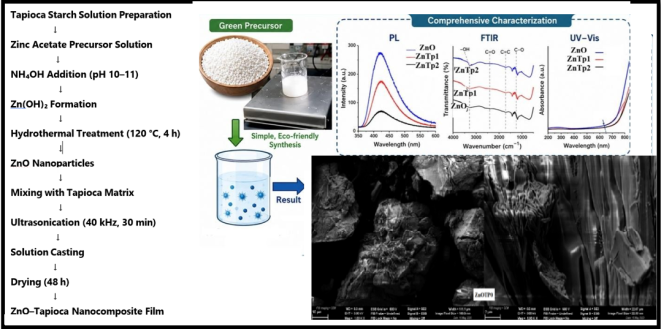
ZnO nanoparticles were synthesized through a hydrothermal method. Initially, zinc acetate dihydrate was dissolved in deionized water to prepare precursor solutions of different concentrations (0.01 M, 0.02 M, and 0.03 M). The solutions were continuously stirred at 600 rpm until complete dissolution. Subsequently, aqueous ammonia was added dropwise until the solution pH reached approximately 10-11, resulting in the formation of a white Zn(OH)2 precipitate. The resulting suspension was transferred into a Teflon-lined stainless-steel autoclave and maintained at 120°C for 4 h. During hydrothermal treatment, zinc hydroxide was converted into highly crystalline ZnO nanoparticles according to
After natural cooling to room temperature, the obtained ZnO nanoparticles were washed repeatedly with deionized water and ethanol to remove residual impurities and then dried before further use.
2.3. Fabrication of ZnO/Tapioca Nanocomposite Films
A biodegradable tapioca solution was prepared by dissolving 3 g of tapioca starch in 60 mL of deionized water. The mixture was heated to 100°C under continuous magnetic stirring for approximately 3 h until complete gelatinization produced a homogeneous and transparent viscous solution.
Hydrothermally synthesized ZnO nanoparticles of different concentrations were gradually incorporated into the gelatinized tapioca solution under continuous stirring for 1 h to ensure uniform dispersion. The suspension was subsequently ultrasonicated at 40 kHz for 30 min to minimize nanoparticle agglomeration and enhance interfacial interaction between ZnO nanoparticles and the starch matrix.
The homogeneous suspension was cast onto clean glass molds and dried under ambient conditions for 48 h, yielding flexible, transparent ZnO/tapioca nanocomposite films. Samples containing different ZnO concentrations were designated as ZnTp1 and ZnTp2, while pure ZnO nanoparticles were used as the reference material.
All films were prepared under identical drying conditions to minimize batch-to-batch variations during solvent evaporation. The prepared films were carefully peeled from the glass substrate and stored in sealed polyethylene pouches at room temperature until characterization.
2.4. Schematic Representation of the Synthesis Process
Figure 1. Schematic illustration of the synthesis procedure for ZnO-tapioca nanocomposite films via hydrothermal-assisted solution casting.
2.5. Characterization Techniques
The characterization techniques were selected to establish correlations between the crystal structure, morphology, molecular interactions, and optical properties of the prepared nanocomposite films. Each characterization was performed using specimens prepared under identical processing conditions to ensure consistency in the comparative analysis.
The crystal structure and phase purity of the synthesized samples were investigated using X-ray diffraction (XRD) with Cu-Kα radiation (λ = 1.5406 Å). The average crystallite size was calculated using the Debye-Scherrer equation, while lattice strain was evaluated through the Williamson-Hall method.
The surface morphology and particle distribution of the nanocomposite films were examined using field-emission scanning electron microscopy (FESEM). Average particle sizes were estimated by measuring more than fifty individual particles using image analysis software.
The chemical structure and molecular interactions between ZnO nanoparticles and the tapioca matrix were analyzed by Fourier transform infrared (FTIR) spectroscopy within the spectral range of 4000-400 cm⁻1.
Optical absorption characteristics were investigated using UV-Visible spectroscopy, and the optical band-gap energy was determined from Tauc plots based on the absorption spectra.
The defect-related emission behavior and charge carrier recombination characteristics of the prepared nanocomposite films were evaluated using photoluminescence (PL) spectroscopy at room temperature.
3. Results and Discussion
3.1. X-ray Diffraction (XRD) Analysis
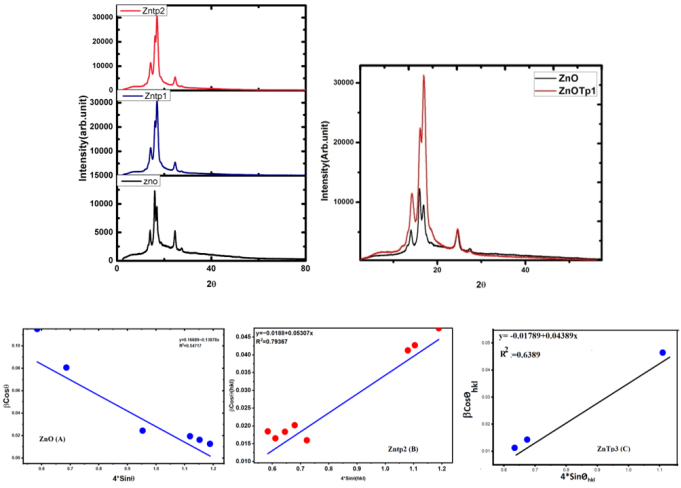
The diffraction peaks observed at 2θ values of approximately 31.8°, 34.4°, and 36.3° correspond to the (100), (002), and (101) crystallographic planes of hexagonal wurtzite ZnO, which are in good agreement with the standard JCPDS card No. 36-1451
| [23] | Bala, R. mohapatra, et al. “Low cost hydrothermal synthesis of optically important graphene /zinc oxide nanocomposites”. journal of ovonic research (2022), Vol. 18, No. 2, P291-299: impact factor1.56S. |
[23]
. No additional diffraction peaks corresponding to secondary crystalline phases or impurity compounds were observed, confirming the phase purity of the hydrothermally synthesized ZnO nanoparticles. The absence of impurity peaks further indicates that the incorporation of ZnO into the tapioca starch matrix did not induce the formation of any detectable crystalline by-products or undesirable phases within the detection limit of the XRD technique.
The characteristic diffraction peaks of ZnO were retained in both ZnTp1 and ZnTp2 nanocomposite films, indicating that the crystal structure of ZnO remained unchanged after incorporation into the biodegradable polymer matrix. However, a gradual decrease in peak intensity accompanied by slight peak broadening was observed with increasing tapioca content. This behaviour is attributed to the reduction in crystallite size and the presence of lattice strain arising from the interaction between ZnO nanoparticles and the surrounding starch matrix. The polymer chains act as a physical barrier during crystal growth, restricting the growth of ZnO crystallites without altering their crystal phase.
The average crystallite size calculated using the Debye-Scherrer equation decreased from 60 nm for pristine ZnO to 39 nm and 33 nm for ZnTp1 and ZnTp2, respectively. The Williamson-Hall analysis further indicated the presence of compressive lattice strain in the nanocomposite films. These results suggest that both crystallite size reduction and lattice strain contributed to the observed peak broadening. Similar trends have also been reflected in the FESEM analysis, where smaller particle dimensions were observed for the nanocomposite films compared with pristine ZnO, indicating good agreement between the structural and morphological characterization.
Figure 2 depicts the X-ray diffractograms of the ZnO-nanocomposites film of tapioca. The peaks characteristic to tapioca are mainly noted below 10° (2θ), together with other two peaks at the higher diffraction angle. Although the position of the peaks is generally similar for all samples, the intensity of the peaks is varying with respect to increase in ZnO content.
The introduction of ZnO causes emergence of new peaks, which proves that ZnO nanoparticles are successfully included into the tapioca matrix. The peaks at 15.60°, 22.70°, and 34.60° correspond to the peaks of crystalline cellulose contained in the starch structure. A shifting of peaks towards low 2θ value is also noted, thus demonstrating lattice strain in the composite material
| [14] | Li, Yan, et al. “Hydrogel-Based Nanocomposites for Biomedical and Packaging Applications.” Advanced Functional Materials, vol. 33, no. 12, 2023, article 2211576.
https://doi.org/10.1002/adfm.202211576 |
| [15] | Chen, Xiaoyu, et al. “Optical and Structural Properties of ZnO Nanostructures for Photonic Applications.” Applied Physics Reviews, vol. 10, no. 1, 2023, article 011302.
https://doi.org/10.1063/5.0123456 |
[14, 15]
.
The crystallite size was determined from the Debye-Scherrer equation:
Average size (Dp) = (0.94 * λ) / (β Χ Cosθ)
The mean crystallite sizes of pure ZnO nanoparticles have been determined to be ~60 nm. These values decrease when the percentage of tapioca increases, becoming 39 nm for ZnTp1 and 33 nm for ZnTp2. Such a trend could be explained by the confinement effect caused by polymers that restrict the development of crystallites.
Furthermore, Williamson-Hall (W-H) diagrams show evidence of lattice strain in the samples. In particular, negative slopes are found for ZnTp1 and ZnTp2, demonstrating lattice compression. Lattice strain causes the shrinking of crystallites. Additionally, the narrowing of diffraction peaks confirms internal lattice stresses. These diffraction peaks for angles of 31.8°, 34.4°, and 36.3° correspond to the crystal planes (100), (002), and (101) of the hexagonal-wurtzite structured ZnO, which are in close accordance with the JCPDS card No. 36-1451. No peaks were detected for any.
Figure 2. X-ray diffraction patterns of pristine ZnO, ZnTp1, and ZnTp2 nanocomposite films together with the corresponding Williamson-Hall plots used for crystallite size and lattice strain analysis.
Table 1. XRD structural parameters of ZnO and tapioca starch-based ZnO nanocomposite films, including FWHM, crystallite size (D), and Williamson-Hall fitting parameters (slope and intercept).
Sample | FWHM | D size (nm) | Intercept | Slope |
ZnO | 0.14 | 60 | 0.166 | 0.138 |
ZnTp1 | 0.215 | 39 | -0.0188 | -0.05306 |
ZnTp2 | 0.255 | 33 | -0.0179 | -0.04389 |
Overall, the XRD results confirm the formation of polycrystalline ZnO within the tapioca matrix, with reduced crystallite size driven by strain and confinement effects.
3.2. FESEM (Morphological Analysis)
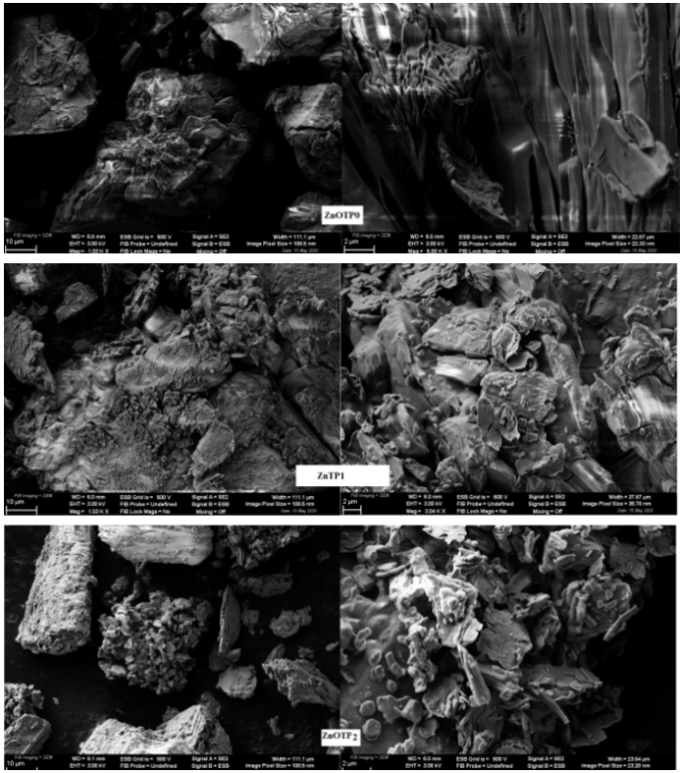
Figure 3. FESEM micrographs of (a) pristine ZnO, (b) ZnTp1, and (c) ZnTp2 nanocomposite films illustrating the effect of tapioca starch on particle morphology, agglomeration, and nanoparticle dispersion.
The FESEM micrographs of pristine ZnO, ZnTp1, and ZnTp2 nanocomposite films are presented in
Figure 3. A noticeable change in surface morphology is observed after the incorporation of tapioca starch into the ZnO system.
The pristine ZnO sample (
Figure 3a) exhibits densely packed particles with a relatively rough surface. The particles appear highly agglomerated, forming irregular clusters of different sizes. Such agglomeration is commonly observed in hydrothermally synthesized ZnO nanoparticles because of their high surface energy, which promotes particle-to-particle interaction during drying.
After the addition of tapioca starch (
Figure 3b), the surface morphology changes considerably. The ZnTp1 sample shows a reduction in large agglomerates, and the ZnO particles appear to be more uniformly distributed within the starch matrix. The polymer network acts as a supporting medium that separates neighbouring particles and suppresses excessive aggregation during film formation. Consequently, the surface becomes comparatively more compact and homogeneous than that of pristine ZnO.
A further increase in the tapioca content (
Figure 3c) results in a more continuous and compact microstructure. The particles remain well dispersed throughout the polymer matrix, while the number of large agglomerated regions decreases. Although some localized particle clusters are still present, the overall morphology suggests improved compatibility between ZnO nanoparticles and the biodegradable starch matrix.
The average particle sizes estimated from the FESEM micrographs were 62 ± 5 nm for pristine ZnO, 41 ± 4 nm for ZnTp1, and 34 ± 3 nm for ZnTp2. The gradual reduction in particle size agrees well with the crystallite size trend obtained from XRD analysis, indicating that the starch matrix restricts particle growth during the synthesis and film formation process. It should be noted that the particle size measured from FESEM is slightly larger than the crystallite size obtained from XRD because individual particles observed in FESEM may consist of one or more crystalline domains.
Overall, the FESEM observations demonstrate that the incorporation of tapioca starch improves the dispersion of ZnO nanoparticles and modifies the surface morphology without introducing any visible phase separation. These morphological changes are consistent with the structural information obtained from XRD and the molecular interactions identified by FTIR analysis. The gradual reduction in particle size observed from FESEM analysis is consistent with the crystallite size trend obtained from XRD measurements, indicating good agreement between the structural and morphological characterization techniques.
In summary, FESEM results support XRD findings in revealing that particle size reduction and strain effects affect both crystalline and morphological properties.
3.3. FTIR Analysis
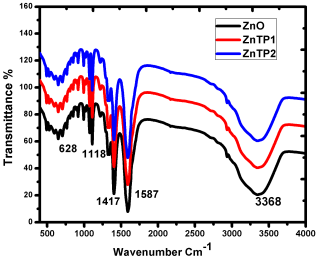
Figure 4. FTIR spectra of pristine ZnO, tapioca starch, ZnTp1, and ZnTp2 nanocomposite films showing the characteristic functional groups and molecular interactions between ZnO nanoparticles and the starch matrix.
The FTIR spectra of pristine ZnO and ZnO/tapioca nanocomposite films are presented in
Figure 4. The spectra provide valuable information regarding the molecular interactions between ZnO nanoparticles and the tapioca starch matrix.
A broad absorption band observed in the region of 3280-3295 cm⁻1 is assigned to the stretching vibration of hydroxyl (-OH) groups present in starch together with adsorbed moisture. The presence of this broad band in all samples confirms the hydrophilic nature of the starch matrix. A slight variation in its intensity after ZnO incorporation suggests the existence of hydrogen-bonding interactions between ZnO nanoparticles and the hydroxyl groups of tapioca starch.
The absorption bands appearing near 1600 cm⁻1 are attributed to the bending vibration of adsorbed water molecules together with the skeletal vibration of the starch backbone. The bands observed in the 1500-1400 cm⁻1 region correspond to C-H deformation and C-OH bending vibrations of the polysaccharide structure. The peaks between 1295 and 1045 cm⁻1 are assigned to C-O and C-O-C stretching vibrations, which are characteristic of the glycosidic linkages present in starch. These bands remain clearly visible in all nanocomposite films, indicating that the fundamental molecular structure of tapioca starch is preserved after the incorporation of ZnO nanoparticles.
The characteristic absorption band observed in the low wavenumber region around 539-353 cm⁻1 corresponds to the Zn-O stretching vibration, confirming the presence of ZnO within the polymer matrix. No additional absorption bands associated with new chemical species were detected after composite formation. This observation indicates that ZnO nanoparticles are physically incorporated into the starch matrix without the formation of new covalent bonds. The interaction between the inorganic filler and the polymer is therefore predominantly governed by hydrogen bonding and intermolecular interactions.
Overall, the FTIR results demonstrate that the incorporation of ZnO does not alter the chemical structure of tapioca starch. Instead, the polymer matrix provides an effective host for the uniform dispersion of ZnO nanoparticles while preserving the characteristic functional groups of both constituents. These observations are in good agreement with the XRD and FESEM analyses, which also indicate successful incorporation of ZnO into the biodegradable starch matrix without the formation of secondary phases.
Table 2. Assignment of characteristic FTIR absorption bands observed in ZnO, ZnTP1, and ZnTP2 nanocomposite films with their corresponding functional groups and vibrational modes.
Wavenumber (cm⁻1) | Functional Group / Bond | Vibrational Assignment | Interpretation |
~3368 | -OH | O-H stretching vibration | Broad absorption band due to hydroxyl groups of tapioca starch and adsorbed moisture; indicates extensive hydrogen bonding within the polymer matrix. |
~1595 | Starch polymer | Skeletal vibration / H-O-H bending | Characteristic vibration of the starch polymer network and absorbed water molecules. |
~1417 | C-H / Starch polymer | C-H bending vibration | Characteristic vibration associated with the starch polymer backbone. |
~1118 | C-O | C-O stretching vibration | Represents alcohol functional groups present in the anhydroglucose units of tapioca starch. |
~1052 | C-O-H | C-O-H stretching vibration | Confirms the presence of hydroxyl-containing glucose units in the starch structure. |
~1015 | C-O-C | Glycosidic linkage stretching | Corresponds to the glycosidic (ether) linkage of the anhydroglucose units, confirming the integrity of the starch polymer chain. |
~628 | Zn-O | Zn-O stretching vibration | Characteristic absorption of ZnO nanoparticles, confirming their successful incorporation into the tapioca starch matrix. |
3.4. UV-Visible Spectroscopy
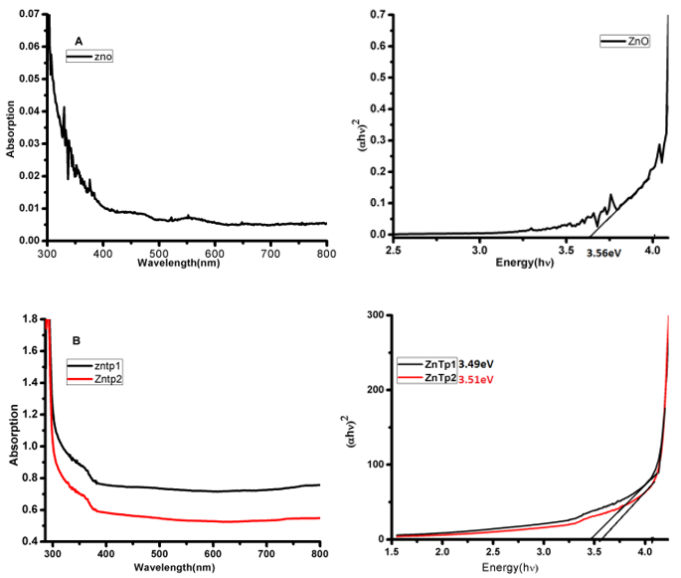
Figure 5. (a) UV-Visible absorption spectra and (b) Tauc plots of pristine ZnO, ZnTp1, and ZnTp2 nanocomposite films used for the determination of the optical band gap.
The optical absorption spectra of pristine ZnO and ZnO/tapioca nanocomposite films are shown in
Figure 5a. All samples exhibit strong absorption in the ultraviolet region, which is a characteristic feature of ZnO owing to its wide direct band gap. The incorporation of tapioca starch did not alter the fundamental absorption behaviour of ZnO; however, slight variations in the absorption edge and absorption intensity were observed after composite formation.
The optical band gap of the prepared samples was determined using the Tauc relation for a direct allowed transition by plotting ((alpha hv)2) versus photon energy (hv), as illustrated in
Figure 5b. The calculated band-gap values were 3.56 eV for pristine ZnO, 3.52 eV for ZnTp1, and 3.49 eV for ZnTp2. The gradual decrease in band-gap energy with increasing tapioca content suggests that the polymer matrix influences the local electronic environment of ZnO nanoparticles. This behaviour may be associated with interfacial interactions between ZnO and the hydroxyl-rich starch matrix together with defect-related localized energy states that facilitate a slight narrowing of the optical band gap.
The observed reduction in band-gap energy is relatively small, indicating that the intrinsic semiconductor nature of ZnO is preserved after incorporation into the biodegradable polymer matrix. The retention of the wide band gap confirms that the crystal structure of ZnO remains largely unaffected, which is also supported by the XRD analysis.
The enhanced absorption observed in the ultraviolet region, together with the slight band-gap reduction, demonstrates that the incorporation of ZnO modifies the optical response of the starch matrix without causing any structural degradation of the nanoparticles. These observations are consistent with the FTIR results, which indicate predominantly physical interactions between ZnO and tapioca starch, and with the FESEM analysis showing improved nanoparticle dispersion.
The present optical characterization provides evidence of changes in the absorption behaviour of the prepared nanocomposite films. However, electrical conductivity, charge transport, device fabrication, and application-specific performance were not investigated in this study. Therefore, the optical results should be interpreted as fundamental material characteristics rather than direct evidence of optoelectronic performance
.
3.5. Photoluminescence (PL) Studies
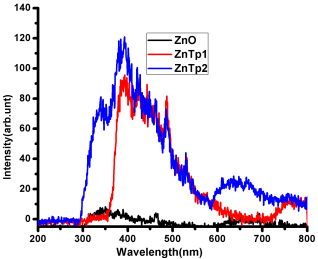
Figure 6. Room-temperature photoluminescence spectra of pristine ZnO, ZnTp1, and ZnTp2 nanocomposite films showing near-band-edge and defect-related visible emissions.
The room-temperature photoluminescence (PL) spectra of pristine ZnO and ZnO/tapioca nanocomposite films are presented in
Figure 6. The spectra exhibit the characteristic emission behaviour of ZnO, consisting of a near-band-edge (NBE) ultraviolet emission together with a broad visible emission associated with intrinsic defect states.
The ultraviolet emission originates from the radiative recombination of free excitons, whereas the broad visible emission is generally attributed to intrinsic defects such as oxygen vacancies, zinc interstitials, oxygen interstitials, and surface-related defect states. The presence of both emission regions indicates that the synthesized ZnO nanoparticles possess good crystallinity together with a moderate concentration of lattice defects.
Following the incorporation of ZnO into the tapioca starch matrix, noticeable changes in the PL intensity were observed. Compared with pristine ZnO, the nanocomposite films exhibited a modified emission profile, indicating that the local environment surrounding the ZnO nanoparticles was influenced by the starch matrix. Such behaviour may arise from interfacial interactions between ZnO nanoparticles and the hydroxyl-rich polymer network, which can alter the recombination behaviour of photogenerated charge carriers.
The changes in PL intensity do not necessarily indicate an improvement or deterioration in optical performance but rather reflect variations in the recombination probability of electron-hole pairs and the distribution of defect states within the nanocomposite. Since no time-resolved photoluminescence or charge-carrier lifetime measurements were performed in the present study, the observed variations are interpreted only in terms of changes in the emission characteristics of the prepared films.
The PL results are consistent with the XRD, FESEM, FTIR, and UV-Visible analyses, confirming that the incorporation of tapioca starch modifies the structural environment and optical response of ZnO while preserving its crystalline phase. The combined characterization demonstrates that the polymer matrix influences nanoparticle dispersion and defect-related optical behaviour without inducing any detectable secondary crystalline phases
| [21] | Sharma, D., et al. “Advanced ZnO Nanocomposite Packaging Materials: Structure, Performance and Applications.” Journal of Materials Science, vol. 58, no. 14, 2023, pp. 10321-10345. https://doi.org/10.1007/s10853-023-08421-4 |
| [22] | Kumar, Surendra, et al. “Photoluminescence Properties of ZnO Nanostructures: Recent Progress and Applications.” Ceramics International, vol. 49, no. 4, 2023, pp. 5678-5694.
https://doi.org/10.1016/j.ceramint.2022.10.178 |
| [23] | Bala, R. mohapatra, et al. “Low cost hydrothermal synthesis of optically important graphene /zinc oxide nanocomposites”. journal of ovonic research (2022), Vol. 18, No. 2, P291-299: impact factor1.56S. |
[21-23]
.
4. Conclusions
In the present study, ZnO/tapioca starch nanocomposite films were successfully fabricated through hydrothermal synthesis followed by a solution-casting technique. The structural, morphological, chemical, and optical characteristics of the prepared films were systematically investigated using XRD, FESEM, FTIR, UV-Visible spectroscopy, and photoluminescence analysis.
XRD analysis confirmed the formation of phase-pure hexagonal wurtzite ZnO, while a gradual reduction in crystallite size from 60 nm for pristine ZnO to 39 nm and 33 nm for ZnTp1 and ZnTp2, respectively, indicated that the tapioca starch matrix restricted crystal growth during composite formation. FESEM observations revealed improved nanoparticle dispersion and reduced agglomeration after incorporation of ZnO into the biodegradable polymer matrix. FTIR analysis confirmed the coexistence of ZnO and tapioca starch without the formation of new chemical bonds, suggesting that the interaction between the two constituents is predominantly governed by hydrogen bonding and other physical interactions. UV-Visible spectroscopy demonstrated a slight decrease in the optical band gap from 3.56 to 3.49 eV, indicating that the starch matrix influenced the optical response of ZnO without altering its fundamental semiconductor characteristics. The PL spectra further revealed changes in the emission behaviour associated with defect-related states after incorporation into the polymer matrix.
The combined results demonstrate that hydrothermal synthesis provides an effective route for preparing ZnO/tapioca starch nanocomposite films with modified structural and optical properties while preserving the crystalline phase of ZnO. The observed improvements are attributed to the interaction between ZnO nanoparticles and the starch matrix, which influences particle growth, dispersion, and optical behaviour.
The present investigation is limited to the synthesis and physicochemical characterization of the prepared nanocomposite films. Mechanical strength, thermal stability, barrier performance, electrical properties, photocatalytic activity, sensing capability, and device-level performance were not evaluated in the current study. Therefore, further investigations are required before these materials can be considered for specific technological applications. The findings reported here provide a fundamental understanding of the structure-property relationship in ZnO/tapioca starch nanocomposites and establish a basis for future application-oriented studies.





 Share This Article
 Twitter
 Linked In
 Facebook
 Copy
Copy Download