
ZrFe2−xBixO5 (x = 0, 0.25, 0.50, 0.75, 1.00) nanoparticles were synthesized using Sol-gel auto-combustion method and their structural, morphological, magnetic, and frequency-dependent electrical properties were systematically characterized at room temperature. X-ray diffraction analysis confirms single phase monoclinic C2/c formation for every composition, the principal interplanar spacing increases linearly from 2.9503 Å to 3.0034 Å, crystallite size decreases from 32.1 to 16.7 nm, and dislocation density grows nearly four times as x advances to unity. Scanning electron microscopy reveals a progressive transition from large, irregularly agglomerated grains to a finer, more densely packed nanoparticulate microstructure. All M-H loops measured over ±10 kOe identify soft ferromagnetic, multi-domain behavior (S < 0.5 throughout); saturation magnetization plummets from 16.46 to 1.67 emu g−1 while the coercive field rises from 102.24 to 182.22 G. Impedance measurements (100 Hz - 10 MHz) show that bulk resistance increases ten times over the substitution range, Nyquist plots fit to a two element equivalent circuit of two CPE-resistor pairs in series, and the extracted grain and grain-boundary resistances rise monotonically with x, establishing that Bi3+ incorporation progressively depletes the Fe3+/Fe2+ charge carrier pool. The dielectric constant follows Maxwell-Wagner-Sillars behavior and decreases with both frequency and Bi content, while AC conductivity spectra display a characteristic dual-peak pattern attributed to space-charge polarization at grain boundaries at low frequency and grain-interior Fe hopping at high frequency, both peaks diminishes with increasing Bi content. The correlated structure-property picture presented here establishes the Bi-substituted ZrFe2O5 system as a candidate for compositionally tunable soft-magnetic and dielectric applications.
| Published in | American Journal of Nanosciences (Volume 10, Issue 2) |
| DOI | 10.11648/j.ajn.20261002.12 |
| Page(s) | 52-63 |
| Creative Commons |
This is an Open Access article, distributed under the terms of the Creative Commons Attribution 4.0 International License (http://creativecommons.org/licenses/by/4.0/), which permits unrestricted use, distribution and reproduction in any medium or format, provided the original work is properly cited. |
| Copyright |
Copyright © The Author(s), 2026. Published by Science Publishing Group |
ZrFe2−xBixO5, AB2O5, Sol-gel Auto-combustion, Soft Ferromagnetism, Non Debye Relaxation, Maxwell-Wagner Polarization, Complex AC Conductivity
Composition (x) | 2θ (°) | Interplanar Spacing d (Å) | Crystalline Size D (nm) | Micro-Strain (W-H) ε (10−3) | Dislocation Density (1013 m−2) |
|---|---|---|---|---|---|
0 | 30.27 | 2.9503 | 32.1 | 0.93 | 3.08 |
0.25 | 30.13 | 2.9636 | 27.5 | 1.14 | 4.20 |
0.50 | 29.99 | 2.9768 | 23.8 | 1.36 | 5.59 |
0.75 | 29.86 | 2.9901 | 20.1 | 1.58 | 7.83 |
1.00 | 29.72 | 3.0034 | 16.7 | 1.81 | 11.34 |
Composition (x) | Atomic% | |||
|---|---|---|---|---|
Zr | Fe | Bi | O | |
0 | 10.54 ± 0.6 | 23.02 ± 1.04 | 0 | 66.44 ± 3.05 |
0.25 | 10.58 ± 0.7 | 20.12 ± 0.8 | 3.04 ± 0.3 | 66.26 ± 3.08 |
0.50 | 10.56 ± 0.5 | 17.27 ± 0.6 | 5.77 ± 0.5 | 66.40 ± 3.02 |
0.75 | 10.59 ± 0.8 | 14.35 ± 0.3 | 8.86 ± 0.6 | 66.20 ± 3.11 |
1.00 | 10.53 ± 0.6 | 11.53 ± 0.3 | 11.01 ± 0.7 | 66.93 ± 3.15 |
Composition (x) | Saturation Magnetiszaton (emu g−1) | Remanent Magnetization (emu g−1) | Coercive Field (Gauss) | Squareness Ratio | Magnetic Moment |
|---|---|---|---|---|---|
0 | 16.46 | 2.71 | 102.24 | 0.1646 | 0.834 |
0.25 | 9.17 | 1.88 | 106.23 | 0.2050 | 0.527 |
0.50 | 8.78 | 1.56 | 125.20 | 0.1777 | 0.565 |
0.75 | 4.35 | 0.85 | 133.10 | 0.1954 | 0.310 |
1.00 | 1.67 | 0.42 | 182.22 | 0.2515 | 0.130 |
Composition x | Grain Resistance Rg (Ω) | Grain CPE Qg (F) | Grain CPE Phase Exponent ng | Grain Boundary Resistance Rgb (Ω) | Grain Boundary CPE Qgb (F) | Gran Boundary CPE Phase Exponent ngb | Chi Square Value χ2 |
|---|---|---|---|---|---|---|---|
0 | 6.03×10⁵ | 3.55×10⁻¹¹ | 0.9079 | 1.28×10⁶ | 2.02×10⁻⁷ | 0.3912 | 6.63× 10⁻⁴ |
0.25 | 1.78×10⁶ | 1.43×10⁻¹⁰ | 0.7907 | 4.37×10⁶ | 2.61×10⁻⁹ | 0.7711 | 6.32× 10⁻³ |
0.50 | 3.24×10⁶ | 3.87×10⁻¹⁰ | 0.7600 | 6.48×10⁶ | 1.93×10⁻¹⁰ | 0.7923 | 1.15× 10⁻² |
0.75 | 5.16×10⁶ | 6.94×10⁻¹⁰ | 0.7441 | 9.37×10⁶ | 1.14×10⁻¹⁰ | 0.8136 | 1.82× 10⁻² |
1.00 | 7.82×10⁶ | 1.12×10⁻⁹ | 0.7218 | 1.36×10⁷ | 6.87×10⁻¹¹ | 0.8312 | 2.55× 10⁻² |
XRD | X-Ray Diffraction |
PXRDD | Powder X-Ray Diffraction |
SEM | Scanning Electron Microscopy |
EDAX | Energy Dispersive X-ray Analysis |
VSM | Vibrating Sample Magnetometer |
AC | Alternating Current |
CPE | Constant Phase Element |
MWS | Maxwell–Wagner–Sillars |
W-H | Williamson–Hall |
| [1] | Thapa, A.; Sharma, B. A review on novel low-dimensional materials based magnetic tunnel junctions: opportunities, challenges, and applications. Adv. Mater. Technol. 2025, e00133. |
| [2] | Spaldin, N. A.; Cheong, S. W.; Ramesh, R. Multiferroics: past, present, and future. Phys. Today 2010, 63, 38-43. |
| [3] | Han Yamin et al. Transition metal oxides: a new frontier in spintronics driven by novel quantum states and efficient charge-spin interconversion. Front. Mater. 2024, 11. |
| [4] | Bhattacharya, A.; May, S. J. Magnetic oxide heterostructures. Annu. Rev. Mater. Res. 2014, 44, 65-90. |
| [5] | Gao, X. M. et al. Characterisation of Fe2TiO5 nanocrystallites synthesised via homogeneous precipitation. Mater. Res. Innov. 2013, 19, 1-6. |
| [6] | Mahmoud, M. H. H. et al. Physicochemical properties of pseudobrookite Fe2TiO5 synthesized from ilmenite ore. Physicochem. Probl. Miner. Process. 2019, 55, 290-300. |
| [7] | Lennie, A. R.; Knight, K. S.; Henderson, C. M. B. Cation ordering in MgTi2O5 (karrooite). Am. Mineral. 2007, 92, 1165-1180. |
| [8] | Dondi, M. et al. Pseudobrookite ceramic pigments: crystal structural, optical and technological properties. Solid State Sci. 2007, 9, 362-369. |
| [9] | Lumpkin, G.; Aughterson, R. Perspectives on pyrochlores, defect fluorites, and related compounds. Front. Chem. 2021, 9, 778140. |
| [10] | Newman, R. et al. Synthesis and structure of novel A2BO5 compounds. MRS Adv. 2018, 3, 1117-1122. |
| [11] | The authors. Structural, morphological, magnetic, and electrical properties of ZrFe2−xNixO5 nanoparticles (x = 0-0.05) synthesized via sol-gel auto-combustion. Next Mater. 2026, 11, 101606. |
| [12] | Shahid, S. et al. Characterization of newly synthesized ZrFe2O5 nanomaterial and its photocatalytic properties under visible light. J. Nanomater. 2013, 2013, 517643. |
| [13] | Chakma, S.; Moholkar, V. S. Sonochemical synthesis of mesoporous ZrFe2O5 and its application for degradation of recalcitrant pollutants. RSC Adv. 2015, 5, 53529-53542. |
| [14] | Mallan, K. P.; Jain, A.; Kalainathan, S. Preparation and magnetic properties of nano size zirconium ferrite particles using coprecipitation method. Int. J. ChemTech Res. 2014, 6, 2187-2189. |
| [15] | Abdellahi, M. et al. Introducing ZrFe2O5 nanopowders for hyperthermia applications. Chin. J. Phys. 2018, 56, 880-885. |
| [16] | Khosravi, B. et al. Design and development of a magnetic ZrFe2O4 nanostructure and its catalytic activities. J. Iran. Chem. Soc. 2020, 17. |
| [17] | Kaur, N. et al. Impact of titanium doping on structural, optical, magnetic and photocatalytic properties of ZrFe2O4 nanoparticles. J. Solid State Chem. 2025, 350, 125471. |
| [18] | Shannon, R. D. Revised effective ionic radii and systematic studies of interatomic distances in halides and chalcogenides. Acta Crystallogr. A 1976, 32, 751-767. |
| [19] | Seshadri, R.; Hill, N. A. Visualizing the role of Bi 6s lone pairs in the off-center distortion in ferromagnetic BiMnO3. Chem. Mater. 2001, 13, 2892-2899. |
| [20] | Roostaei, S. et al. Sol-gel auto-combustion synthesis of a novel ternary magnetic-recyclable ZnFe2O4/ZnO/CeO2 nano-photocatalyst. Appl. Water Sci. 2025. |
| [21] | Niu, B. et al. Sol-gel autocombustion synthesis of nanocrystalline high-entropy alloys. Sci. Rep. 2017, 7, 3421. |
| [22] | Pratheek et al. Design and development of a first order reversal curve measurement enabled variable temperature vibrating sample magnetometer. Phys. Scr. 2024, 99, 085932. |
| [23] | Rodríguez-Carvajal, J. Recent advances in magnetic structure determination by neutron powder diffraction. Phys. B Condens. Matter 1993, 192, 55-69. |
| [24] | Momma, K.; Izumi, F. VESTA 3 for three-dimensional visualization of crystal, volumetric and morphology data. J. Appl. Crystallogr. 2011, 44, 1272-1276. |
| [25] | Vegard, L. The constitution of mixed crystals and the space filling of atoms. Z. Physik 5, 17–26 (1921). |
| [26] | Denton, A. R.; Ashcroft, N. W. Vegard’s law. Phys. Rev. A 1991, 43, 3161-3164. |
| [27] | Bragg, W. H.; Bragg, W. L. The reflection of X-rays by crystals. Proc. R. Soc. Lond. A 1913, 88, 428-438. |
| [28] | Patterson, A. L. The Scherrer formula for X-ray particle size determination. Phys. Rev. 1939, 56, 978-982. |
| [29] | Cullity, B. D.; Stock, S. R. Elements of X-ray Diffraction, 3rd ed.; Pearson: Upper Saddle River, NJ, 2001. |
| [30] | Williamson, G. K.; Hall, W. H. X-ray line broadening from filed aluminium and wolfram. Acta Metall. 1953, 1, 22-31. |
| [31] | Williamson, G. K.; Smallman, R. E. Dislocation densities in some annealed and cold-worked metals from X-ray Debye-Scherrer measurements. Philos. Mag. 1956, 1, 34-46. |
| [32] | Goldstein, J. I. et al. Scanning Electron Microscopy and X-ray Microanalysis, 4th ed.; Springer: New York, 2018. |
| [33] | Novikov, V. (2000). On Zener pinning in 3-D polycrystals. Scripta Materialia - SCRIPTA MATER. 42. 439-443. |
| [34] | Yujie Yang et al. The effect of Bi substitution on the microstructure and magnetic properties of the Sr0.4Ba0.3La0.3Fe12−xBixO19 hexagonal ferrites J. Magn. Magn. Mater. 2017, 422, 209-215. |
| [35] | Stoner, E. C.; Wohlfarth, E. P. A mechanism of magnetic hysteresis in heterogeneous alloys. Philos. Trans. R. Soc. Lond. A 1948, 240, 599-642. |
| [36] | Coey, J. M. D. Magnetism and Magnetic Materials; Cambridge University Press: Cambridge, UK, 2010. |
| [37] | Cullity, B. D.; Graham, C. D. Introduction to Magnetic Materials, 2nd ed.; Wiley-IEEE Press: Hoboken, NJ, 2009. |
| [38] | Ahmad, I. et al. Effects of Ni doping on the structural properties and collapse of magnetic ordering in NdFe1−xNixO3. Chin. Phys. B 2016, 25, 028101. |
| [39] | Joshi, S.; Kumar, M. Effect of Ni2+ substitution on structural, magnetic, dielectric and optical properties of mixed spinel CoFe2O4. Ceram. Int. 2016, 42, 18154-18165. |
| [40] | Warsi, M. F. et al. New LiNi0.5PrxFe2−xO4 nanocrystallites. Ceram. Int. 2017, 43, 14807-14812. |
| [41] | Gilani, Z. A. et al. New LiCo0.5PrxFe2−xO4 nanoferrites for high density storage application. Ceram. Int. 2018, 44, 1881-1885. |
| [42] | Sheikh, F. A. et al. Effects of bismuth on structural and dielectric properties of cobalt-cadmium spinel ferrites. Chin. Phys. B 2019, 28, 088701. |
| [43] | Desai, S. S. et al. Influence of Zn-Zr substitution on crystal chemistry and magnetic properties of CoFe2O4. Phys. B Condens. Matter 2020, 596, 412400. |
| [44] | Amalthi, P.; Vijaya, J. J. Influence of Ni2+ doping in structural, magnetic and optical properties of MnFe2O4. Mater. Today: Proc. 2021. |
| [45] | Koops, C. G. On the dispersion of resistivity and dielectric constant of some semiconductors at audio frequencies. Phys. Rev. 1951, 83, 121-124. |
| [46] | Wagner, KW (1913), On the theory of imperfect dielectrics. Ann. Phys., 345: 817-855. |
| [47] | Vaithyanathan, V. et al. Evolution of grain boundary conduction with increasing temperature in pure and Ti-doped Co ferrite materials. J. Appl. Phys. 2015, 118, 114102. |
| [48] | Jonscher, A. K. The ‘universal’ dielectric response. Nature 1977, 267, 673-679. |
| [49] | Sinclair, D. C.; West, A. R. Impedance and modulus spectroscopy of semiconducting BaTiO3 showing positive temperature coefficient of resistance. J. Appl. Phys. 1989, 66, 3850-3856. |
| [50] | Srinivas, K.; Sarah, P.; Suryanarayana, S. V. Impedance spectroscopy study of polycrystalline Bi6Fe2Ti3O18. Bull. Mater. Sci. 2003, 26, 247-253. |
| [51] | Adamczyk-Habrajska, M. et al. Impedance spectroscopy of Fe and La-doped BaTiO3 ceramics. Crystals 2024, 14, 131. |
| [52] | Sheikh, F. A. et al. Dielectrically modified Dy3+ substituted nickel-cobalt ferrites for high frequency devices. Phys. B Condens. Matter 2023, 652, 414656. |
| [53] | Naik, J. et al. Synthesis and characterization of multifunctional ZnBr2/PVA polymer dielectrics. J. Adv. Dielectr. 2016, 06, 1650028. |
| [54] | Batoo, K. M. et al. Study of dielectric and AC impedance properties of Ti-doped Mn ferrites. Curr. Appl. Phys. 2009, 9, 1072-1078. |
| [55] | Verwey, E. J.; Haayman, P. W.; Romeijn, F. C. Physical properties and cation arrangement of oxides with spinel structures II: Electronic conductivity. J. Chem. Phys. 1947, 15, 181-187. |
| [56] | Nyathani, M. et al. Crystal chemistry, magnetic and dielectric properties of nickel-doped strontium ferrites. Biointerface Res. Appl. Chem. 2022, 12, 929-939. |
| [57] | Halder, S. et al. Structural, dielectric and electrical characteristics of lead-free electro-ceramic Bi(Ni2/3Ta1/3)O3. Eng. Sci. Technol. Int. J. 2018, 22. |
| [58] | Malik, R. A. et al. Grain size effects on dielectric, ferroelectric, and piezoelectric properties of modified bismuth sodium titanate ceramics. J. Eur. Ceram. Soc. 2019, 39, 1693-1701. |
| [59] | Priyadharsini, R. et al. Impact of nickel substitution on structural, dielectric, magnetic, and electrochemical properties of copper ferrite nanostructures. J. Colloid Interface Sci. 2024, 653, 917-929. |
| [60] | Rehman, F. et al. Grains and grain boundaries contribution to dielectric relaxations and conduction of Bi5Ti3FeO15 ceramics. J. Appl. Phys. 2015, 118, 214101. |
APA Style
Manage, A., Hegde, B. G., Matteppanavar, S. (2026). Structural, Morphological, Magnetic, and Electrical Properties of ZrFe2−xBixO5 Nanoparticles (x = 0, 0.25, 0.50, 0.75 and 1.00) Synthesized via Sol-gel Auto-Combustion. American Journal of Nanosciences, 10(2), 52-63. https://doi.org/10.11648/j.ajn.20261002.12
ACS Style
Manage, A.; Hegde, B. G.; Matteppanavar, S. Structural, Morphological, Magnetic, and Electrical Properties of ZrFe2−xBixO5 Nanoparticles (x = 0, 0.25, 0.50, 0.75 and 1.00) Synthesized via Sol-gel Auto-Combustion. Am. J. Nanosci. 2026, 10(2), 52-63. doi: 10.11648/j.ajn.20261002.12
@article{10.11648/j.ajn.20261002.12,
  author = {Avadhut Manage and Balachandra G. Hegde and Shidaling Matteppanavar},
  title = {Structural, Morphological, Magnetic, and Electrical Properties of ZrFe2−xBixO5 Nanoparticles (x = 0, 0.25, 0.50, 0.75 and 1.00) Synthesized via Sol-gel Auto-Combustion},
  journal = {American Journal of Nanosciences},
  volume = {10},
  number = {2},
  pages = {52-63},
  doi = {10.11648/j.ajn.20261002.12},
  url = {https://doi.org/10.11648/j.ajn.20261002.12},
  eprint = {https://article.sciencepublishinggroup.com/pdf/10.11648.j.ajn.20261002.12},
  abstract = {ZrFe2−xBixO5 (x = 0, 0.25, 0.50, 0.75, 1.00) nanoparticles were synthesized using Sol-gel auto-combustion method and their structural, morphological, magnetic, and frequency-dependent electrical properties were systematically characterized at room temperature. X-ray diffraction analysis confirms single phase monoclinic C2/c formation for every composition, the principal interplanar spacing increases linearly from 2.9503 Å to 3.0034 Å, crystallite size decreases from 32.1 to 16.7 nm, and dislocation density grows nearly four times as x advances to unity. Scanning electron microscopy reveals a progressive transition from large, irregularly agglomerated grains to a finer, more densely packed nanoparticulate microstructure. All M-H loops measured over ±10 kOe identify soft ferromagnetic, multi-domain behavior (S −1 while the coercive field rises from 102.24 to 182.22 G. Impedance measurements (100 Hz - 10 MHz) show that bulk resistance increases ten times over the substitution range, Nyquist plots fit to a two element equivalent circuit of two CPE-resistor pairs in series, and the extracted grain and grain-boundary resistances rise monotonically with x, establishing that Bi3+ incorporation progressively depletes the Fe3+/Fe2+ charge carrier pool. The dielectric constant follows Maxwell-Wagner-Sillars behavior and decreases with both frequency and Bi content, while AC conductivity spectra display a characteristic dual-peak pattern attributed to space-charge polarization at grain boundaries at low frequency and grain-interior Fe hopping at high frequency, both peaks diminishes with increasing Bi content. The correlated structure-property picture presented here establishes the Bi-substituted ZrFe2O5 system as a candidate for compositionally tunable soft-magnetic and dielectric applications.},
 year = {2026}
}
TY  - JOUR
T1  - Structural, Morphological, Magnetic, and Electrical Properties of ZrFe2−xBixO5 Nanoparticles (x = 0, 0.25, 0.50, 0.75 and 1.00) Synthesized via Sol-gel Auto-Combustion
AU  - Avadhut Manage
AU  - Balachandra G. Hegde
AU  - Shidaling Matteppanavar
Y1  - 2026/06/26
PY  - 2026
N1  - https://doi.org/10.11648/j.ajn.20261002.12
DO  - 10.11648/j.ajn.20261002.12
T2  - American Journal of Nanosciences
JF  - American Journal of Nanosciences
JO  - American Journal of Nanosciences
SP  - 52
EP  - 63
PB  - Science Publishing Group
SN  - 2575-4858
UR  - https://doi.org/10.11648/j.ajn.20261002.12
AB  - ZrFe2−xBixO5 (x = 0, 0.25, 0.50, 0.75, 1.00) nanoparticles were synthesized using Sol-gel auto-combustion method and their structural, morphological, magnetic, and frequency-dependent electrical properties were systematically characterized at room temperature. X-ray diffraction analysis confirms single phase monoclinic C2/c formation for every composition, the principal interplanar spacing increases linearly from 2.9503 Å to 3.0034 Å, crystallite size decreases from 32.1 to 16.7 nm, and dislocation density grows nearly four times as x advances to unity. Scanning electron microscopy reveals a progressive transition from large, irregularly agglomerated grains to a finer, more densely packed nanoparticulate microstructure. All M-H loops measured over ±10 kOe identify soft ferromagnetic, multi-domain behavior (S −1 while the coercive field rises from 102.24 to 182.22 G. Impedance measurements (100 Hz - 10 MHz) show that bulk resistance increases ten times over the substitution range, Nyquist plots fit to a two element equivalent circuit of two CPE-resistor pairs in series, and the extracted grain and grain-boundary resistances rise monotonically with x, establishing that Bi3+ incorporation progressively depletes the Fe3+/Fe2+ charge carrier pool. The dielectric constant follows Maxwell-Wagner-Sillars behavior and decreases with both frequency and Bi content, while AC conductivity spectra display a characteristic dual-peak pattern attributed to space-charge polarization at grain boundaries at low frequency and grain-interior Fe hopping at high frequency, both peaks diminishes with increasing Bi content. The correlated structure-property picture presented here establishes the Bi-substituted ZrFe2O5 system as a candidate for compositionally tunable soft-magnetic and dielectric applications.
VL  - 10
IS  - 2
ER  -
Department of Physics, Rani Channamma University, Belagavi, India
Department of Physics, Rani Channamma University, Belagavi, India
Department of Physics, KLE Society’s Basavaprabhu Kore Arts Science and Commerce College, Chikodi, India
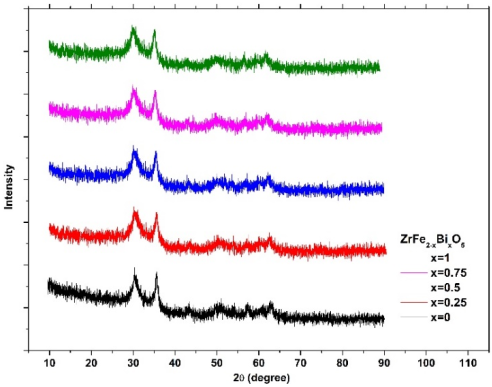
Figure 1. Room temperature PXRD patterns of ZrFe2−xBixO5 compositions.
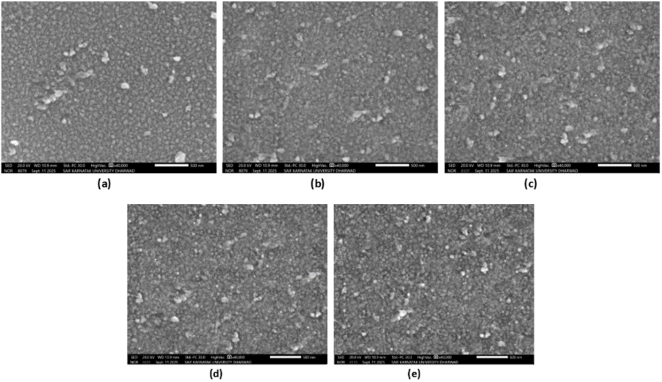
Figure 2. SEM images of ZrFe2−xBixO5 at (a) x = 0, (b) 0.25, (c) 0.50, (d) 0.75, (e) 1.00.
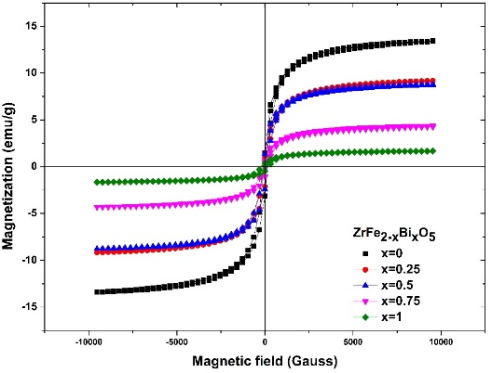
Figure 3. Room-temperature M-H loops of ZrFe2−xBixO5 compositions.
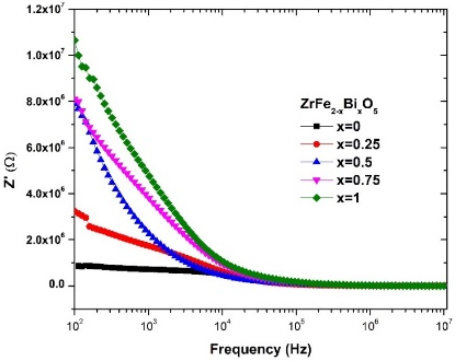
Figure 4. Real part of impedance Z′ versus frequency for ZrFe2−xBixO5 compositions.
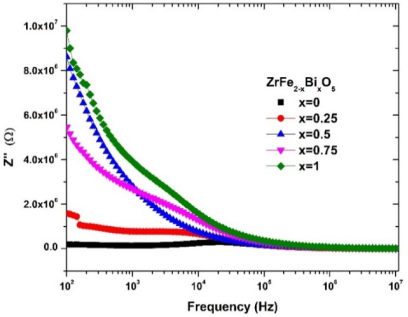
Figure 5. Imaginary part of impedance Z′′ versus frequency for ZrFe2−xBixO5 compositions.
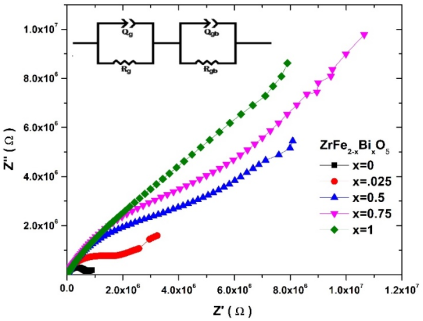
Figure 6. Nyquist plots (Z″ vs Z′) for ZrFe2−xBixO5 compositions with equivalent circuit.
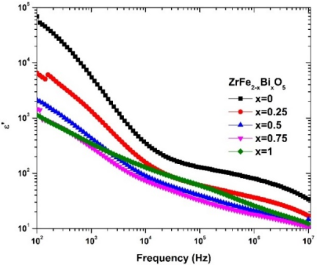
Figure 7. Dielectric constant ε′ vs frequency of ZrFe2−xBixO5 compositions.
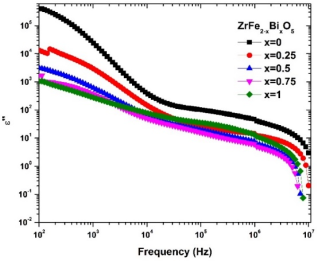
Figure 8. Loss tangent tanδ vs frequency of ZrFe2−xBixO5 compositions.
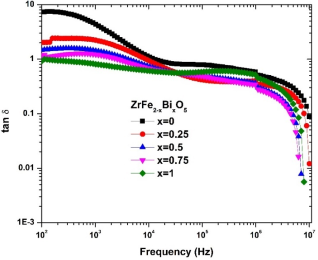
Figure 9. Dielectric loss ε′′ vs frequency of ZrFe2−xBixO5 compositions.
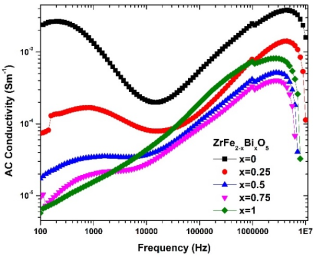
Figure 10. AC Conductivity vs frequency of ZrFe2−xBixO5 compositions.

Information



 Share This Article
 Twitter
 Linked In
 Facebook
 Copy
Copy Download