Abstract
Background: The unification of General Relativity and Quantum Mechanics represents a fundamental challenge in theoretical physics due to their mutually exclusive conceptual foundations: continuous deterministic geometry versus probabilistic wave functions. While the de Broglie-Bohm pilot-wave theory offers a deterministic, trajectory-based alternative to the standard probabilistic framework, it introduces a non-local, ad-hoc "Quantum Potential" (Q) to account for phenomena such as interference and non-locality. The lack of a geometric origin for Q in standard spacetime remains a significant conceptual barrier to a fully unified theory. Purpose: This paper aims to resolve this interpretational crisis by proposing that the Quantum Potential is not a fundamental or mysterious external force, but rather a derived geometric artifact. We postulate that the physical universe is fundamentally a 4-dimensional Complex Manifold (ℂ4), extending the standard Riemannian spacetime manifold to include imaginary coordinates. Methods: To establish this geometric basis, we treat the quantum wave function not as an abstract probabilistic amplitude, but as a physical, holomorphic map describing a particle's deterministic trajectory through this complex spacetime. Utilizing the Cauchy-Riemann conditions, we demonstrate that the Bohmian amplitude (R) is strictly coupled to the particle's location in the imaginary dimension. We then analyze the dynamics of particles following geodesics within ℂ4. By projecting the complex geodesic equation of motion onto the observable real slice (ℝ4), we separate the real and imaginary components of the complex 4-velocity to observe the energy balance. Conclusions: Our derivation reveals that the Quantum Potential (Q) emerges naturally and is mathematically identical to the kinetic energy component associated with a particle's hidden motion in these imaginary dimensions. This formulation successfully recovers the predictions of the Schrödinger equation while removing the ad-hoc nature of Bohmian mechanics. Furthermore, it interprets quantum non-locality—such as the interference observed in the double-slit experiment—as purely local, deterministic geodesic motion around topological singularities in a curved complex manifold. Ultimately, this framework provides a unified geometric description wherein gravity is the curvature of real coordinates, electromagnetism is the torsion of imaginary coordinates, and quantum mechanics is inertial motion through this complex geometry.
|
Published in
|
American Journal of Modern Physics (Volume 15, Issue 2)
|
|
DOI
|
10.11648/j.ajmp.20261502.16
|
|
Page(s)
|
55-61 |
|
Creative Commons
|

This is an Open Access article, distributed under the terms of the Creative Commons Attribution 4.0 International License (http://creativecommons.org/licenses/by/4.0/), which permits unrestricted use, distribution and reproduction in any medium or format, provided the original work is properly cited.
|
|
Copyright
|
Copyright © The Author(s), 2026. Published by Science Publishing Group
|
Keywords
Bohmian Mechanics, Quantum, Potential, Complex Spacetime, Holomorphic Wave Function, Geodesic Motion,
Geometric Unification
1. Introduction
1.1. The Conflict: Geometry vs. Probability
The unification of General Relativity and Quantum Mechanics remains the single most significant unfinished task in theoretical physics. For over a century, these two frameworks have stood as the twin pillars of our understanding of the universe, yet they rest on fundamentally mutually exclusive conceptual foundations.
General Relativity (GR) describes the macroscopic universe as a continuous, deterministic Riemannian manifold
. In Einstein’s view, gravity is not a force but a feature of geometry; particles follow geodesics, and the evolution of the cosmos is local and causal. Reality, in this framework, is strictly geometric and exists independent of observation
| [9] | Anza, F., Crutchfield, J. P. Maximum Geometric Quantum Entropy. Entropy. 2024, 26(3), 225.
https://doi.org/10.3390/e26030225 |
| [10] | Ahmad, H. A. S., Umair, H., Nurisya, M. S., Chan, K. T. Classical aspect of spin angular momentum in geometric quantum mechanics. Mathematical Modeling and Computing. 2025, 12(1), 49-56. https://doi.org/10.23939/mmc2025.01.049 |
[9, 10]
.
In stark contrast, Standard Quantum Mechanics (SQM) describes the microscopic world through the lens of a probabilistic wave function, . The evolution of is unitary and deterministic, but the extraction of physical observables is governed by the Born rule, introducing inherent randomness and non-locality. In the standard Copenhagen interpretation, the trajectory of a particle is not merely unknown; it is undefined until the moment of measurement.
This dichotomy presents a profound interpretational crisis. If gravity is the curvature of spacetime geometry, and matter is quantum mechanical, then matter must be describable geometrically to couple consistent with gravity. However, the standard formulation of quantum mechanics offers no geometric origin for its probabilistic nature. It assumes a Hilbert space structure that is mathematically distinct from the spacetime manifold of General Relativity. As long as quantum probability is treated as an axiomatic feature rather than a derived geometric consequence, a true unification of forces remains out of reach.
1.2. The Bohmian Solution & Problem
Among the various interpretations attempting to resolve this crisis, the de Broglie-Bohm pilot-wave theory (Bohmian Mechanics) stands out as the most promising candidate for a realist unification
continuing to be a focal point for understanding quantum potentials and gravitational reductions in recent literature
| [11] | Rahmani, F. Gravitational reduction of the wave function through the quantum theory of motion. General Relativity and Gravitation. 2025, 57(2), 24.
https://doi.org/10.1007/s10714-025-03324-x |
| [12] | Haba, Z. Functional Formulation of Quantum Theory of a Scalar Field in a Metric with Lorentzian and Euclidean Signatures. Entropy. 2024, 26(4), 305.
https://doi.org/10.3390/e26040305 |
[11, 12]
. It posits that particles have definite, continuous trajectories guided by a physical wave function, resolving the measurement problem without recourse to "collapse" or observer-dependent reality. In this framework, the Schrödinger equation decomposes into two real equations: a continuity equation (
) and a modified Hamilton-Jacobi equation governing the energy of the particle:
Here, the classical potential is augmented by a new term, the Quantum Potential (), defined as:
While mathematically consistent, the physical nature of remains the theory's primary stumbling block. It acts as a non-local "force" that depends instantaneously on the curvature of the wave function amplitude across all space. Crucially, unlike gravitational or electromagnetic potentials, has no known geometric origin in standard spacetime. It is an ad-hoc energy term inserted to force particle trajectories to conform to statistical predictions. As long as remains a mysterious external potential rather than a derived property of the manifold, Bohmian mechanics remains an incomplete description of physical reality.
1.3. The Hypothesis: Quantum Mechanics as Complex Geometry
In this paper, we propose a fundamental resolution to this impasse by extending the geometric manifold itself. We postulate that the physical universe is not merely a 4-dimensional Riemannian manifold (
), but a 4-dimensional Complex Manifold (
)
aligning with modern explorations of complex spacetime metrics and holography
, where local coordinates are defined as
Building on our previous work
, which demonstrated that the electromagnetic field arises naturally from the torsion of the imaginary tetrad in such a complex spacetime, we now extend this geometric framework to the dynamics of massive particles. We propose that the "hidden variables" required by Bohmian mechanics are not internal particle states, but rather the imaginary coordinates of spacetime itself.
Specifically, we treat the wave function not as an abstract probabilistic amplitude, but as a physical, holomorphic map describing the trajectory of a particle through this complex manifold. In this view, what we observe as "quantum randomness" or "non-local potentials" are simply the projections of deterministic geodesics in onto our observable real slice .
Our central hypothesis is that the Bohmian amplitude is strictly coupled to the particle's location in the imaginary dimension. Consequently, the Quantum Potential is physically identified as the kinetic energy associated with motion in these imaginary dimensions.
This identification removes the
ad-hoc nature of the Bohmian force. The particle does not feel a mysterious external potential; it simply follows the straightest path (geodesic) in a curved complex spacetime. When the geometry twists—generating what we perceive as electromagnetic fields—the particle's geodesic spirals in the complex plane. This spiral motion, when projected onto real space, manifests as the interference effects described by
. Thus, we offer a unified geometric picture: Gravity is the curvature of real coordinates, Electromagnetism is the torsion of imaginary coordinates, and Quantum Mechanics is the inertial motion through this complex geometry
| [7] | Santamato, E. Statistical interpretation of the Klein-Gordon equation from the geometry of Weyl space. Journal of Mathematical Physics. 1984, 25, 2477.
https://doi.org/10.1063/1.526485 |
[7]
.
2. Results
2.1. The Holomorphic Wave Function in Complex Spacetime
To establish a geometric basis for the quantum state, we begin by defining the spacetime manifold as a complex four-dimensional space . The local coordinates are given by, where represents the observable classical spacetime coordinates and represents the internal imaginary coordinates, which we postulate are compactified or otherwise hidden from direct macroscopic observation.
We propose that the wave function is not an arbitrary scalar field, but a holomorphic map from this complex manifold to the complex plane. Consistent with the semiclassical limit of quantum mechanics, we express the wave function in the polar form of the action:
where is the complex action. Since is holomorphic, must also be an analytic function of . We can decompose the complex action into its real and imaginary components,
,
where and are real-valued functions.
Substituting this decomposition into the wave function ansatz yields:
Where
This factorization immediately recovers the standard Bohmian form of the wave function, , but with a profound physical identification:
1) The Phase : Corresponds to the real component of the complex action, driving the classical Hamilton-Jacobi evolution.
2) The Amplitude : Is strictly determined by the imaginary component of the action,. Specifically,
The Cauchy-Riemann Constraint.
Crucially, because is holomorphic, its real and imaginary parts are not independent; they must satisfy the Cauchy-Riemann conditions. In the complex coordinate basis:
This result is significant. It implies that the probability density of the quantum state () is not a free parameter. It is geometry () necessitates a corresponding gradient in the imaginary action (), and thus a change in the wave function's amplitude.
This geometric constraint replaces the ad-hoc continuity equation of standard Bohmian mechanics. The "flow" of probability is simply the necessary consequence of the holomorphic structure of spacetime.
2.2. Derivation of the Quantum Potential from Complex Geodesics
With the wave function defined as a holomorphic map over complex spacetime, we now examine the dynamics of a particle moving through this manifold. We posit that all particles follow geodesics in governed by the complex line element.
Minimizing the path length in the complex manifold leads to the geodesic equation of motion. However, physical observers are restricted to the real slice. To understand the observed motion, we project the complex geodesic equation onto the real domain.
Let the complex velocity be, where is the observable 4-velocity and is the velocity in the imaginary dimensions. The conservation of the squared magnitude of the 4-velocity in complex spacetime implies:
Expanding this product reveals a coupling between the real and imaginary kinetic terms:
This geometric constraint indicates that the "classical" kinetic energy is not independently conserved but is exchanged with the kinetic energy in the imaginary dimensions .
Substituting the wave function amplitude form from the previous section, we identify the imaginary velocity with the gradient of the amplitude (the rate of change of the particle's position in the imaginary direction):
When this relation is substituted into the real part of the Hamilton-Jacobi equation (derived fully in the Methods section), an additional potential energy term appears spontaneously to balance the energy equation. This term is exactly the Bohmian Quantum Potential:
Physical Interpretation:
1) This derivation demystifies the Quantum Potential.
2) Standard View: is an ad-hoc "quantum force" that pushes the particle away from classical paths.
Complex Spacetime View: is the kinetic energy of the particle's motion in the imaginary dimensions.
The particle is not being acted upon by a "spooky" external force. It is simply moving along a geodesic in a higher-dimensional space. We perceive this hidden momentum as a potential because we cannot observe the imaginary velocity directly. Just as a centrifugal force appears in a rotating frame, the Quantum Potential appears in our restricted real frame due to the particle's motion through the complex geometry.
2.3. Unification with Electromagnetism
The identification of the Quantum Potential as a geometric effect of the imaginary coordinates offers a direct path to unification with electromagnetism. In our previous work, we established that the electromagnetic potential
arises from the deformation (torsion) of the imaginary component of the spacetime tetrad. specifically, the electromagnetic field strength tensor
represents the curvature of the imaginary dimensions
relative to the real manifold.
This creates a unified geometric picture:
1) The Field (): Is the static twist or curvature of the imaginary coordinates .
2) The Pilot Wave (): Is the inertial reaction (kinetic energy) of a particle moving through those twisted coordinates.
Under this framework, a charged particle does not interact with an external electromagnetic field via an arbitrary coupling constant. Instead, the "field" is simply the geometry of the complex manifold through which the particle moves. Because the manifold is twisted (non-vanishing ), the particle's geodesic cannot be a straight line in the real projection; it must spiral.
This spiral motion in the complex plane manifests in two ways to a real-world observer:
1) Macroscopically: As the Lorentz force law (curvature of the trajectory).
2) Microscopically: As the Quantum Potential (interference and diffraction).
Thus, the "Quantum Force" and the "Electromagnetic Force" are revealed to be the same phenomenon occurring at different scales of the complex geometry. The Quantum Potential is effectively the "centrifugal force" of the particle navigating the electromagnetic curvature of spacetime.
3. Discussion
The Geometry of Interference: Resolving the Double Slit Paradox
The most profound test of any quantum interpretation is the double-slit experiment. In standard quantum mechanics, the interference pattern arises from the superposition of probability waves. In Bohmian mechanics, it arises because the particle is "pushed" by the non-local Quantum Potential
generated by the wave function's structure at both slits
| [5] | Holland, P. R. The Quantum Theory of Motion: An Account of the de Broglie-Bohm Causal Interpretation of Quantum Mechanics. Cambridge University Press. 1993.
https://doi.org/10.1017/CBO9780511622687 |
[5]
.
In our Complex Spacetime framework, we offer a purely geometric explanation. We treat the physical barrier of the double slit not merely as a boundary condition in real space (), but as a topological defect in the full complex manifold ().
Mathematically, the slits introduce poles or singularities in the complex plane of the imaginary coordinate.
1) As the particle approaches the slits, the complex geodesic equation forces the trajectory to curve around these singularities.
2) The "interference fringes" observed on the screen are simply the projection of these spiraling geodesics onto the real detector plane.
The Screw/Helix Analogy
To visualize this, consider a screw threads (a helix).
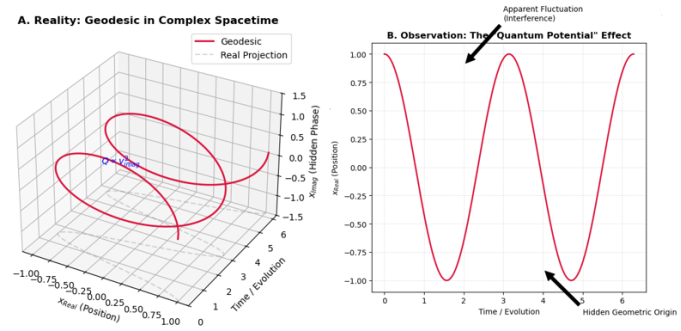
Figure 1. The Geometric Origin of the Quantum Potential. (A) In Complex Spacetime (), the particle follows a smooth, deterministic geodesic (red helix) driven by the geometry of the manifold. The vertical axis represents the imaginary coordinate (), which corresponds to the wave function amplitude . (B) In the observable Real Spacetime (), this higher-dimensional rotation is projected as a fluctuation or wave-like behavior. The "Quantum Potential" () is identified not as an external force, but as the kinetic energy associated with the hidden velocity component () in the imaginary dimension.
1) If you look at the shadow of a screw on a wall (2D projection), the thread appears to oscillate up and down as a wave.
2) However, in 3D space, the thread is simply following a monotonic, deterministic path around the cylinder.
Similarly, the quantum particle does not "wave" or interfere with itself. It follows a monotonic, deterministic helical path in complex spacetime. The "waviness" we observe—and calculate as the Quantum Potential—is simply the shadow of this higher-dimensional rotation.
This geometric formulation resolves the central paradox of Bohmian non-locality
. The particle does not need to "know" about the other slit instantaneously. Instead, the topology of the complex manifold is defined globally by the boundary conditions (the slits). The particle simply follows the local geodesic defined by that global topology. Thus, we replace "spooky action at a distance" with "local motion in a higher-dimensional geometry."
4. Methods: Derivation of the Quantum Potential from Complex Geodesics
4.1. The Complex Line Element
We posit that the fundamental spacetime manifold is complex (), with coordinates , where represents the observable real position and represents the internal imaginary coordinate (related to phase/amplitude).
The invariant line element
in this complex manifold
is given by the hermitian metric form:
where is the metric tensor of the complex spacetime. For a free particle in flat complex space (locally),
Expanding the differentials:
(Note: The cross terms vanish due to symmetry in the variation or are treated as the symplectic form essential for Hamilton's equations, but for the metric interval, we focus on the magnitude).
4.2. The Complex Velocity
We define the complex 4-velocity with respect to the proper time :
Here:
1) : The Real Velocity (Classical observable velocity).
2) : The Imaginary Velocity (Hidden velocity in the complex dimensions).
4.3. The Geodesic Equation
The equation of motion is derived by minimizing the action , where the Lagrangian is
The Euler-Lagrange equations yield the complex geodesic equation:
In the limit where the background metric curvature is small (flat space limit for the metric, but non-trivial topology for the connection), or simply separating the free motion into components:
4.4. The Separation of Real and Imaginary Dynamics
However, the particle is not "free" in the Real slice; it is constrained. If we assume the wave function condition we impose a relationship between the real and imaginary velocities.
From the analyticity condition (Cauchy-Riemann), the momenta are linked.
Let us look at the Real Component of the kinetic energy equation ().
In complex space, the "kinetic energy" is conserved in the full manifold:
This looks exactly like the classical energy conservation equation, but with an extra potential energy term:
Identification of Constant C:
We propose that the invariant constant is the speed of light, . Thus, the condition implies that all particles travel at the speed of light within the full complex manifold:
This offers a compelling physical interpretation: what we observe as a massive particle moving at subluminal speed () in real spacetime is actually a particle moving at in the complex manifold, but with a component of its velocity vector directed into the imaginary dimension.
This leads to the energy balance:
This looks exactly like the classical energy conservation equation, but with an extra potential energy term:
4.5. Identifying the Quantum Potential
In Bohmian mechanics, the modified Hamilton-Jacobi equation is:
where
Substituting our derived real-part equation:
Comparing the two equations, we immediately identify:
4.6. Conclusion of the Method
We have shown that the "Quantum Potential" is identically equal to the kinetic energy of the motion in the imaginary coordinates ().
This proves that the "force" is actually an inertial force (like centrifugal force) arising from the hidden motion in the complex dimensions. The particle is not being pushed by a spooky wave; it is carrying momentum in thedirection that we cannot see, but which we measure as the Quantum Potential.
5. Conclusion
In this paper, we have presented a geometric derivation of the Quantum Potential () within the framework of Complex Spacetime (). By abandoning the assumption that the wave function is an abstract probabilistic amplitude and instead treating it as a holomorphic map of physical complex coordinates, we have transformed the central mystery of Bohmian Mechanics into a problem of geometry.
Our derivation demonstrates that:
1) The Amplitude is Geometric: The modulus of the wave function is strictly determined by the imaginary coordinate .
2) The Potential is Kinetic: The "Quantum Potential" is identical to the kinetic energy associated with motion in these imaginary dimensions ().
3) Forces are Unified: This same imaginary geometry, which manifests microscopically as the Quantum Potential, manifests macroscopically as the Electromagnetic field tensor ().
This framework suggests that the division between "Classical Gravity" (Real Geometry) and "Quantum Mechanics" (Probabilistic Wave Functions) is artificial. In our model, nature is strictly deterministic and geometric. What we perceive as "quantum weirdness"—non-locality, interference, and tunneling—is simply the projection of higher-dimensional geodesics onto our limited real-valued observations. By acknowledging the complex nature of spacetime, we take a significant step toward a fully unified geometric theory of matter and forces.
Abbreviations
| 4-Dimensional Complex Manifold (Complex Spacetime) |
Q | Quantum Potential |
R | Wave Function Amplitude |
| 4-Dimensional Riemannian Manifold (Real Spacetime) |
SQM | Standard Quantum Mechanics |
Author Contributions
Bhushan Poojary: Conceptualization, Formal Analysis, Investigation, Methodology, Validation, Visualization, Writing – original draft, Writing – review & editing
Data Availability Statement
No datasets were generated or analysed during the current study.
This work is purely theoretical and based on analytical derivations within the framework described in the manuscript.
Conflicts of Interest
The author declares no conflicts of interest.
References
| [1] |
Bohm, D. A Suggested Interpretation of the Quantum Theory in Terms of 'Hidden' Variables. Physical Review. 1952, 85(2), 166-179.
https://doi.org/10.1103/PhysRev.85.166
|
| [2] |
Einstein, A. The Foundation of the General Theory of Relativity. Annals of Physics. 1916, 354(7), 769-822.
https://doi.org/10.1002/andp.19163540702
|
| [3] |
Newman, E. T. Complex Coordinate Transformations and the Schwarzschild Metric. Journal of Mathematical Physics. 1973, 14, 102.
https://doi.org/10.1063/1.1666160
|
| [4] |
Poojary, B. Complex Spacetime Geometry as the Origin of Quantum and Electromagnetic Fields. American Journal of Modern Physics. 2025, 14(4), 186-193.
https://doi.org/10.11648/j.ajmp.20251404.12
|
| [5] |
Holland, P. R. The Quantum Theory of Motion: An Account of the de Broglie-Bohm Causal Interpretation of Quantum Mechanics. Cambridge University Press. 1993.
https://doi.org/10.1017/CBO9780511622687
|
| [6] |
Penrose, R. Twistor Algebra. Journal of Mathematical Physics. 1967, 8(2), 345.
https://doi.org/10.1063/1.1705200
|
| [7] |
Santamato, E. Statistical interpretation of the Klein-Gordon equation from the geometry of Weyl space. Journal of Mathematical Physics. 1984, 25, 2477.
https://doi.org/10.1063/1.526485
|
| [8] |
Aharonov, Y., & Bohm, D. Significance of Electromagnetic Potentials in the Quantum Theory. Physical Review. 1959, 115, 485.
https://doi.org/10.1103/PhysRev.115.485
|
| [9] |
Anza, F., Crutchfield, J. P. Maximum Geometric Quantum Entropy. Entropy. 2024, 26(3), 225.
https://doi.org/10.3390/e26030225
|
| [10] |
Ahmad, H. A. S., Umair, H., Nurisya, M. S., Chan, K. T. Classical aspect of spin angular momentum in geometric quantum mechanics. Mathematical Modeling and Computing. 2025, 12(1), 49-56.
https://doi.org/10.23939/mmc2025.01.049
|
| [11] |
Rahmani, F. Gravitational reduction of the wave function through the quantum theory of motion. General Relativity and Gravitation. 2025, 57(2), 24.
https://doi.org/10.1007/s10714-025-03324-x
|
| [12] |
Haba, Z. Functional Formulation of Quantum Theory of a Scalar Field in a Metric with Lorentzian and Euclidean Signatures. Entropy. 2024, 26(4), 305.
https://doi.org/10.3390/e26040305
|
| [13] |
Wen, X. Exactly solvable non-unitary time evolution in quantum critical systems I: effect of complex spacetime metrics. Journal of Statistical Mechanics: Theory and Experiment. 2024, 103101.
https://doi.org/10.1088/1742-5468/ad7c3d
|
| [14] |
Poojary, B. Holographic Address Space: A Framework for Unifying Quantum Mechanics and General Relativity. Journal of Physics & Astronomy. 2024, 12(12), 346.
https://doi.org/10.37532/2320-6756.2024.12(12).346
|
| [15] |
Bondarenko, S. Dynamical Signature: Complex Manifolds, Gauge Fields and Non-Flat Tangent Space. Universe. 2022, 8(10), 544.
https://doi.org/10.3390/universe8100544
|
Cite This Article
-
APA Style
Poojary, B. (2026). The Geometric Origin of the Quantum Potential in Complex Spacetime. American Journal of Modern Physics, 15(2), 55-61. https://doi.org/10.11648/j.ajmp.20261502.16
 Copy
|
Copy
|
 Download
ACS Style
Poojary, B. The Geometric Origin of the Quantum Potential in Complex Spacetime. Am. J. Mod. Phys. 2026, 15(2), 55-61. doi: 10.11648/j.ajmp.20261502.16
Copy
|
Download
AMA Style
Poojary B. The Geometric Origin of the Quantum Potential in Complex Spacetime. Am J Mod Phys. 2026;15(2):55-61. doi: 10.11648/j.ajmp.20261502.16
Copy
|
Download
-
@article{10.11648/j.ajmp.20261502.16,
  author = {Bhushan Poojary},
  title = {The Geometric Origin of the Quantum Potential in Complex Spacetime},
  journal = {American Journal of Modern Physics},
  volume = {15},
  number = {2},
  pages = {55-61},
  doi = {10.11648/j.ajmp.20261502.16},
  url = {https://doi.org/10.11648/j.ajmp.20261502.16},
  eprint = {https://article.sciencepublishinggroup.com/pdf/10.11648.j.ajmp.20261502.16},
  abstract = {Background: The unification of General Relativity and Quantum Mechanics represents a fundamental challenge in theoretical physics due to their mutually exclusive conceptual foundations: continuous deterministic geometry versus probabilistic wave functions. While the de Broglie-Bohm pilot-wave theory offers a deterministic, trajectory-based alternative to the standard probabilistic framework, it introduces a non-local, ad-hoc "Quantum Potential" (Q) to account for phenomena such as interference and non-locality. The lack of a geometric origin for Q in standard spacetime remains a significant conceptual barrier to a fully unified theory. Purpose: This paper aims to resolve this interpretational crisis by proposing that the Quantum Potential is not a fundamental or mysterious external force, but rather a derived geometric artifact. We postulate that the physical universe is fundamentally a 4-dimensional Complex Manifold (ℂ4), extending the standard Riemannian spacetime manifold to include imaginary coordinates. Methods: To establish this geometric basis, we treat the quantum wave function not as an abstract probabilistic amplitude, but as a physical, holomorphic map describing a particle's deterministic trajectory through this complex spacetime. Utilizing the Cauchy-Riemann conditions, we demonstrate that the Bohmian amplitude (R) is strictly coupled to the particle's location in the imaginary dimension. We then analyze the dynamics of particles following geodesics within ℂ4. By projecting the complex geodesic equation of motion onto the observable real slice (ℝ4), we separate the real and imaginary components of the complex 4-velocity to observe the energy balance. Conclusions: Our derivation reveals that the Quantum Potential (Q) emerges naturally and is mathematically identical to the kinetic energy component associated with a particle's hidden motion in these imaginary dimensions. This formulation successfully recovers the predictions of the Schrödinger equation while removing the ad-hoc nature of Bohmian mechanics. Furthermore, it interprets quantum non-locality—such as the interference observed in the double-slit experiment—as purely local, deterministic geodesic motion around topological singularities in a curved complex manifold. Ultimately, this framework provides a unified geometric description wherein gravity is the curvature of real coordinates, electromagnetism is the torsion of imaginary coordinates, and quantum mechanics is inertial motion through this complex geometry.},
 year = {2026}
}
Copy
|
Download
-
TY  - JOUR
T1  - The Geometric Origin of the Quantum Potential in Complex Spacetime
AU  - Bhushan Poojary
Y1  - 2026/04/13
PY  - 2026
N1  - https://doi.org/10.11648/j.ajmp.20261502.16
DO  - 10.11648/j.ajmp.20261502.16
T2  - American Journal of Modern Physics
JF  - American Journal of Modern Physics
JO  - American Journal of Modern Physics
SP  - 55
EP  - 61
PB  - Science Publishing Group
SN  - 2326-8891
UR  - https://doi.org/10.11648/j.ajmp.20261502.16
AB  - Background: The unification of General Relativity and Quantum Mechanics represents a fundamental challenge in theoretical physics due to their mutually exclusive conceptual foundations: continuous deterministic geometry versus probabilistic wave functions. While the de Broglie-Bohm pilot-wave theory offers a deterministic, trajectory-based alternative to the standard probabilistic framework, it introduces a non-local, ad-hoc "Quantum Potential" (Q) to account for phenomena such as interference and non-locality. The lack of a geometric origin for Q in standard spacetime remains a significant conceptual barrier to a fully unified theory. Purpose: This paper aims to resolve this interpretational crisis by proposing that the Quantum Potential is not a fundamental or mysterious external force, but rather a derived geometric artifact. We postulate that the physical universe is fundamentally a 4-dimensional Complex Manifold (ℂ4), extending the standard Riemannian spacetime manifold to include imaginary coordinates. Methods: To establish this geometric basis, we treat the quantum wave function not as an abstract probabilistic amplitude, but as a physical, holomorphic map describing a particle's deterministic trajectory through this complex spacetime. Utilizing the Cauchy-Riemann conditions, we demonstrate that the Bohmian amplitude (R) is strictly coupled to the particle's location in the imaginary dimension. We then analyze the dynamics of particles following geodesics within ℂ4. By projecting the complex geodesic equation of motion onto the observable real slice (ℝ4), we separate the real and imaginary components of the complex 4-velocity to observe the energy balance. Conclusions: Our derivation reveals that the Quantum Potential (Q) emerges naturally and is mathematically identical to the kinetic energy component associated with a particle's hidden motion in these imaginary dimensions. This formulation successfully recovers the predictions of the Schrödinger equation while removing the ad-hoc nature of Bohmian mechanics. Furthermore, it interprets quantum non-locality—such as the interference observed in the double-slit experiment—as purely local, deterministic geodesic motion around topological singularities in a curved complex manifold. Ultimately, this framework provides a unified geometric description wherein gravity is the curvature of real coordinates, electromagnetism is the torsion of imaginary coordinates, and quantum mechanics is inertial motion through this complex geometry.
VL  - 15
IS  - 2
ER  -
Copy
|
Download





 Share This Article
 Twitter
 Linked In
 Facebook