
The growing demand for efficient energy storage for renewable systems requires low-cost, high-performance electrode materials. Supercapacitors offer fast charge-discharge but suffer from low energy density. Biomass-derived porous carbon is a sustainable alternative to commercial activated carbon. This study aims to synthesize hierarchical N,O-doped porous carbon from Ziziphus spina-christi fruit waste in order to evaluate the effect of alkali agent and activation time on porosity and supercapacitor performance. The carbon was prepared via carbonization at 600°C followed by chemical activation with KOH or NaOH at 800°C for 2 h and 3 h. The materials were characterized by FE-SEM, XRD, Raman, and N2 adsorption-desorption. The electrochemical tests were conducted in 3-electrode system. The optimized ZSCFC-3h-KOH exhibited a high specific surface area of 917.5 m2 g-1, a hierarchical micro-mesoporous structure, and an ID/IG ratio of 0.98. In a 3-electrode system, it delivered a specific capacitance of 231.6 F g-1 at 1 A g-1 with an IR drop of only 0.03 V. The electrode showed excellent stability, retaining 94.3% of its capacitance after 10,000 cycles at 5 A g-1. Z. spina-christi fruit waste is a viable, sustainable precursor for high-capacitance supercapacitor electrodes. KOH activation for 3 h is optimal for creating accessible pore networks for ion storage.
| Published in | American Journal of Modern Energy (Volume 12, Issue 3) |
| DOI | 10.11648/j.ajme.20261203.11 |
| Page(s) | 42-48 |
| Creative Commons |
This is an Open Access article, distributed under the terms of the Creative Commons Attribution 4.0 International License (http://creativecommons.org/licenses/by/4.0/), which permits unrestricted use, distribution and reproduction in any medium or format, provided the original work is properly cited. |
| Copyright |
Copyright © The Author(s), 2026. Published by Science Publishing Group |
Ziziphus Spina-christi, Biomass-derived Carbon, KOH Activation, Porous Carbon, Specific Capacity
Sample | SBET (m2 g-1) | d (nm) |
|---|---|---|
ZSCFC-3h-KOH | 917.5 | 3.68 |
ZSCFC-2h-KOH | 789.21 | 3.12 |
ZSCFC-3h-NaOH | 696.18 | 2.91 |
ZSCFC-2h-NaOH | 674.55 | 3.02 |
BET | Brunauer-Emmett-Teller |
BJH | Barrett-Joyner-Halenda |
CV | Cyclic Voltammetry |
DFT | Density Functional Theory |
EIS | Electrochemical Impedance Spectroscopy |
FE-SEM | Field-Emission Scanning Electron Microscopy |
GCD | Galvanostatic Charge-Discharge |
PVDF | Polyvinylidene Fluoride |
RHA | Rice Husk Ash |
TEM | Transmission Electron Microscopy |
XRD | X-ray Diffraction |
| [1] | Y. Li, Q. Lu, J. Yang, W. He, Delignified wood for thermal energy storage with high efficient photo-thermal conversion efficiency, Journal of Energy Storage, 80 (2024) 110235. |
| [2] | K. Sharma, S. Grover, P. Kadyan, S. Sharma, N. Kumar, R. K. Sharma, Synergistic effect of nitrogen and oxygen self-doping in bio-waste derived activated carbon for supercapacitor applications, Journal of Physics and Chemistry of Solids, (2025) 113471. |
| [3] | N. M. Manousakis, P. S. Karagiannopoulos, G. J. Tsekouras, F. D. Kanellos, Integration of renewable energy and electric vehicles in power systems: a review, Processes, 11 (2023) 1544. |
| [4] | J. Wang, S. Kaskel, KOH activation of carbon-based materials for energy storage, Journal of materials chemistry, 22 (2012) 23710-23725. |
| [5] | E. C. Edwards, A. Holcombe, S. Brown, E. Ransley, M. Hann, D. Greaves, Evolution of floating offshore wind platforms: A review of at-sea devices, Renewable and Sustainable Energy Reviews, 183 (2023) 113416. |
| [6] | M. D. Ahmed, K. M. Maraz, Revolutionizing energy storage: Overcoming challenges and unleashing the potential of next generation Lithium-ion battery technology, Materials Engineering Research, 5 (2023) 265-278. |
| [7] | D. Wang, Y. Hu, Z. Cui, P. Yang, Z. Du, Y. Hou, P. Yang, J. Rao, C. Wang, Y. Zhang, Sulfur vacancy regulation and multipolarization of NixCo1S nanowires-decorated biotemplated structures to promote microwave absorption, Journal of Colloid and Interface Science, 646 (2023) 991-1001. |
| [8] | W. Song, M. Yuan, K. Wang, X. Lian, H. Niu, Flexible N, S-co-doped hollow porous carbon film for high-rate and long-cycle supercapacitors, Chemical Engineering Journal, 516 (2025) 163970. |
| [9] | Y. Zhao, J. Mu, Y. Wang, Y. Liu, H. Wang, H. Song, Preparation of hierarchical porous carbon through one-step KOH activation of coconut shell biomass for high-performance supercapacitor, Journal of Materials Science: Materials in Electronics, 34 (2023) 527. |
| [10] | R. Chakraborty, K. Vilya, M. Pradhan, A. K. Nayak, Recent advancement of biomass-derived porous carbon based materials for energy and environmental remediation applications, Journal of Materials Chemistry A, 10 (2022) 6965-7005. |
| [11] | A. Khan, A. Patra, D. Chaira, D. A. Babu, B. Majumdar, Study of microstructure, thermodynamic and powder properties of nano Y2O3, TiO2, ZrO2 dispersed W-Ni-Nb-Mo-Zr alloys, Materials Chemistry and Physics, 311 (2024) 128567. |
| [12] | S. Joseph, G. Saianand, M. R. Benzigar, K. Ramadass, G. Singh, A. I. Gopalan, J. H. Yang, T. Mori, A. a. H. Al‐Muhtaseb, J. Yi, Recent advances in functionalized nanoporous carbons derived from waste resources and their applications in energy and environment, Advanced Sustainable Systems, 5 (2021) 2000169. |
| [13] | T. Manimekala, R. Sivasubramanian, M. A. Dar, G. Dharmalingam, Crafting the architecture of biomass-derived activated carbon via electrochemical insights for supercapacitors: a review, RSC advances, 15 (2025) 2490-2522. |
| [14] | T. Khandaker, T. Islam, A. Nandi, M. A. A. M. Anik, M. S. Hossain, M. K. Hasan, M. S. Hossain, Biomass-derived carbon materials for sustainable energy applications: a comprehensive review, Sustainable Energy & Fuels, 9 (2025) 693-723. |
| [15] | M. A. Abubakera, H. A. Hamouda, L. Chena, L. Dinga, S. Y. Zhua, L. W. Fua, J. Zhanga, Characterization of chemical structure of water-soluble polysaccharides from Sudanese Ziziphus spina christi fruits, Eurasian Chem. Commun, 3(2021): 200-209. |
| [16] | R. Fennouh, O. Benturki, A. Mokhati, A. Benturki, B. Belhamdi, M. Trari, Preparation and characterization of highly mesoporous activated carbon from Ziziphus Spina-Christi for tartrazine adsorption from a simulated effluent, Biomass Conversion and Biorefinery, 14 (2024) 16171-16187. |
| [17] | G. Simoes dos Reis, C. Mayandi Subramaniyam, A. D. Cárdenas, S. H. Larsson, M. Thyrel, U. Lassi, F. Garcia-Alvarado, Facile synthesis of sustainable activated biochars with different pore structures as efficient additive-carbon-free anodes for lithium-and sodium-ion batteries, ACS omega, 7 (2022) 42570-42581. |
| [18] | E. Valsami-Jones, G. Chen, Abstracts of the 5th International Online Conference on Nanomaterials, in, MDPI, 2026. |
| [19] | A. M. H. Putri, B. F. Ramadhoni, Yuliusman, M. A. M. Yuzir, Y. Muharam, Activated carbon from tea twig waste via low-temperature KOH activation for efficient CO2 capture: Development mesoporous structures under mild conditions, Adsorption Science & Technology, 43 (2025) 02636174251383610. |
| [20] | A. Ramadan, H. A. Hamouda, X. Zhu, J. Ding, H. Pei, N. Liu, R. Guo, Z. Mo, Fabrication of Co2Mn3O8@ NiMnLDH nanocomposite array on nickel foam for oxygen evaluation reaction, Inorganic Chemistry Communications, 152 (2023) 110670. |
| [21] | H. A. Hamouda, S. Cui, X. Dai, L. Xiao, X. Xie, H. Peng, G. Ma, Synthesis of porous carbon material based on biomass derived from hibiscus sabdariffa fruits as active electrodes for high-performance symmetric supercapacitors, RSC advances, 11 (2021) 354-363. |
APA Style
Hamouda, H. A., Salim, I. A., Adam, A. A. M., Musa, T. A., Fadul, E. O. (2026). Sustainable Porous Carbon from Ziziphus Fruit Waste for High Specific Capacity Electrode Materials. American Journal of Modern Energy, 12(3), 42-48. https://doi.org/10.11648/j.ajme.20261203.11
ACS Style
Hamouda, H. A.; Salim, I. A.; Adam, A. A. M.; Musa, T. A.; Fadul, E. O. Sustainable Porous Carbon from Ziziphus Fruit Waste for High Specific Capacity Electrode Materials. Am. J. Mod. Energy 2026, 12(3), 42-48. doi: 10.11648/j.ajme.20261203.11
@article{10.11648/j.ajme.20261203.11,
  author = {Hamouda Adam Hamouda and Inaam Ali Salim and Abdelwahab Abuelgasim Mohammed Adam and Taysir Abdrhman Musa and Elsadig Omer Fadul},
  title = {Sustainable Porous Carbon from Ziziphus Fruit Waste for High Specific Capacity Electrode Materials},
  journal = {American Journal of Modern Energy},
  volume = {12},
  number = {3},
  pages = {42-48},
  doi = {10.11648/j.ajme.20261203.11},
  url = {https://doi.org/10.11648/j.ajme.20261203.11},
  eprint = {https://article.sciencepublishinggroup.com/pdf/10.11648.j.ajme.20261203.11},
  abstract = {The growing demand for efficient energy storage for renewable systems requires low-cost, high-performance electrode materials. Supercapacitors offer fast charge-discharge but suffer from low energy density. Biomass-derived porous carbon is a sustainable alternative to commercial activated carbon. This study aims to synthesize hierarchical N,O-doped porous carbon from Ziziphus spina-christi fruit waste in order to evaluate the effect of alkali agent and activation time on porosity and supercapacitor performance. The carbon was prepared via carbonization at 600°C followed by chemical activation with KOH or NaOH at 800°C for 2 h and 3 h. The materials were characterized by FE-SEM, XRD, Raman, and N2 adsorption-desorption. The electrochemical tests were conducted in 3-electrode system. The optimized ZSCFC-3h-KOH exhibited a high specific surface area of 917.5 m2 g-1, a hierarchical micro-mesoporous structure, and an ID/IG ratio of 0.98. In a 3-electrode system, it delivered a specific capacitance of 231.6 F g-1 at 1 A g-1 with an IR drop of only 0.03 V. The electrode showed excellent stability, retaining 94.3% of its capacitance after 10,000 cycles at 5 A g-1. Z. spina-christi fruit waste is a viable, sustainable precursor for high-capacitance supercapacitor electrodes. KOH activation for 3 h is optimal for creating accessible pore networks for ion storage.},
 year = {2026}
}
TY  - JOUR
T1  - Sustainable Porous Carbon from Ziziphus Fruit Waste for High Specific Capacity Electrode Materials
AU  - Hamouda Adam Hamouda
AU  - Inaam Ali Salim
AU  - Abdelwahab Abuelgasim Mohammed Adam
AU  - Taysir Abdrhman Musa
AU  - Elsadig Omer Fadul
Y1  - 2026/07/24
PY  - 2026
N1  - https://doi.org/10.11648/j.ajme.20261203.11
DO  - 10.11648/j.ajme.20261203.11
T2  - American Journal of Modern Energy
JF  - American Journal of Modern Energy
JO  - American Journal of Modern Energy
SP  - 42
EP  - 48
PB  - Science Publishing Group
SN  - 2575-3797
UR  - https://doi.org/10.11648/j.ajme.20261203.11
AB  - The growing demand for efficient energy storage for renewable systems requires low-cost, high-performance electrode materials. Supercapacitors offer fast charge-discharge but suffer from low energy density. Biomass-derived porous carbon is a sustainable alternative to commercial activated carbon. This study aims to synthesize hierarchical N,O-doped porous carbon from Ziziphus spina-christi fruit waste in order to evaluate the effect of alkali agent and activation time on porosity and supercapacitor performance. The carbon was prepared via carbonization at 600°C followed by chemical activation with KOH or NaOH at 800°C for 2 h and 3 h. The materials were characterized by FE-SEM, XRD, Raman, and N2 adsorption-desorption. The electrochemical tests were conducted in 3-electrode system. The optimized ZSCFC-3h-KOH exhibited a high specific surface area of 917.5 m2 g-1, a hierarchical micro-mesoporous structure, and an ID/IG ratio of 0.98. In a 3-electrode system, it delivered a specific capacitance of 231.6 F g-1 at 1 A g-1 with an IR drop of only 0.03 V. The electrode showed excellent stability, retaining 94.3% of its capacitance after 10,000 cycles at 5 A g-1. Z. spina-christi fruit waste is a viable, sustainable precursor for high-capacitance supercapacitor electrodes. KOH activation for 3 h is optimal for creating accessible pore networks for ion storage.
VL  - 12
IS  - 3
ER  -
Department of Chemistry, University of Kordofan, El Obeid, Sudan
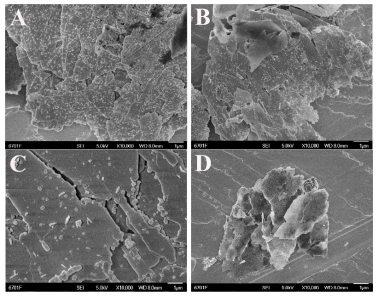
Figure 1. FE-SEM images of (A) ZSCFC-3h-KOH; (B) ZSCFC-2h-KOH; (C) ZSCFC-3h-NaOH; and (D) ZSCFC-2h-NaOH.
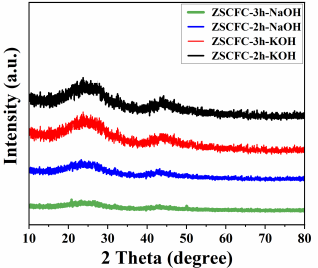
Figure 2. XRD patterns of ZSCFC-3h-KOH; ZSCFC-2h-KOH; ZSCFC-3h-NaOH; and ZSCFC-2h-NaOH.
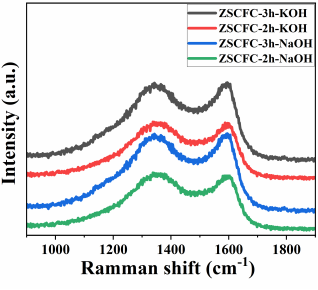
Figure 3. Raman spectrum of ZSCFC-3h-KOH; ZSCFC-2h-KOH; ZSCFC-3h-NaOH; and ZSCFC-2h-NaOH.
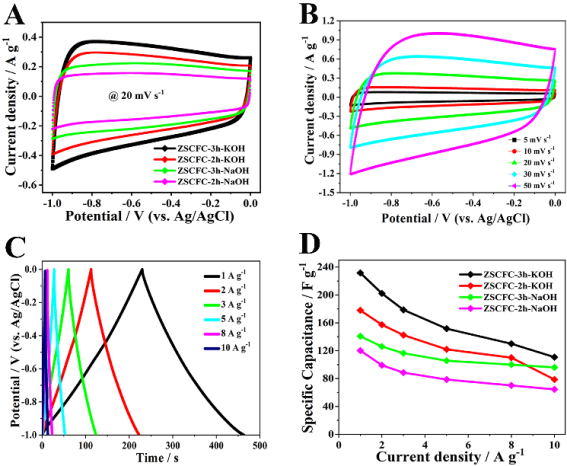
Figure 4. (A) CV curves of ZSCFC-3h-KOH; ZSCFC-2h-KOH; ZSCFC-3h-NaOH; and ZSCFC-2h-NaOH at 20 mV/s; (B) CV curves of ZSCFC-3h-KOH; (C) curves of the GCD curves of ZSCFC-3h-KOH at different current densities; (D) Specific capacities of the ZSCFC-3h-KOH; ZSCFC-2h-KOH; ZSCFC-3h-NaOH; and ZSCFC-2h-NaOH electrodes at different current densities.
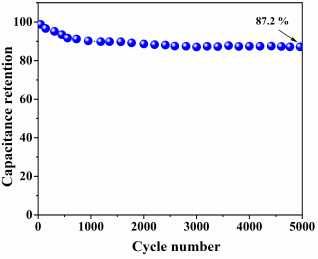
Figure 5. Capacitance retention of ZSCFC-3h-KOH electrode over 5000 cycles.

Information


 Share This Article
 Twitter
 Linked In
 Facebook
 Copy
Copy Download