Abstract
Major Depressive Disorder (MDD) is a prevalent, refractory neuropsychiatric disorder manifested by sustained depressed mood, anhedonia, cognitive dysfunction, sleep disturbance, and markedly elevated suicidal risk, imposing heavy burdens on individuals, families and public health systems worldwide. Clinically available conventional antidepressants generally suffer from a delayed therapeutic onset of several weeks, frequent unwanted adverse reactions, and unsatisfactory therapeutic response or even treatment resistance in a considerable proportion of patients. Given these clinical bottlenecks, it remains an urgent unmet clinical demand to explore safe, multi-targeted natural agents with favorable druggability for MDD intervention. Hesperetin, an aglycone flavonoid abundant in citrus fruits, exerts multiple biological effects including anti-inflammation, antioxidation, neurotrophy and neuroprotection, which have been supported by accumulating preclinical investigations. This narrative review collates eligible preclinical studies that validate the antidepressant-like effects of hesperetin, dissects its underlying core molecular signaling cascades associated with antidepressant actions, addresses major methodological limitations in existing relevant research, and highlights prospective research priorities for further translation. Notably, most available preclinical evidence is obtained exclusively from male rodents, which may limit the generalizability of these findings to female subjects, a critical gap given well-documented sex disparities in MDD incidence and pathophysiology. Collectively, this work aims to summarize current mechanistic insights, provide a solid theoretical basis, and facilitate the translational development of hesperetin as a lead compound for novel, safer antidepressant candidates.
Keywords
BDNF, Depression, Hesperetin, Neuroinflammation, Nrf2, Natural Product, Oxidative Stress
1. Introduction
According to the World Health Organization, depression, clinically known as major depressive disorder (MDD), is the leading cause of disability worldwide. It affects more than 280 million people worldwide, and the incidence rate of adolescents and the elderly is also rising
| [1] | World Health Organization. Mental health action plan 2013-2030. Geneva: WHO Press; 2013. |
[1]
. The pathogenesis of depression is multifactorial, involving abnormal neuroinflammation, excessive brain oxidative stress, insufficient neurotrophic support, interruption of monoamine neurotransmission, and impaired hypothalamic pituitary adrenal (HPA) axis function
. Current first-line antidepressants, such as selective serotonin reuptake inhibitors (SSRIs), take 2-4 weeks to take effect and often cause adverse reactions, including gastrointestinal discomfort, sexual dysfunction, and cognitive impairment. Nearly 30% of patients experience refractory depression
| [4] | Makvandi AA, Khalili M, Roghani M, et al. Hesperetin ameliorates electroconvulsive therapy-induced memory impairment through regulation of hippocampal BDNF and oxidative stress. J Chem Neuroanat. 2021; 117: 102001.
https://doi.org/10.1016/j.jchemneu.2021.102001 |
[4]
. Therefore, the development of low toxicity natural multi-target neuroprotective agents has become a hot topic in the research and development of neuropsychiatric medicine.
Hesperetin (3′, 5, 7-trihydroxy-4′-methoxyflavanone) is a bioactive glycoside metabolite of hesperidin, widely distributed in orange, lemon, and grapefruit peels
| [5] | Parhiz H, Roohbakhsh A, Soltani F, et al. Antioxidant and anti-inflammatory properties of the citrus flavonoids hesperidin and hesperetin: an updated review of their molecular mechanisms and experimental models. Phytother Res. 2015; 29(3): 323-331.
https://doi.org/10.1002/ptr.5256 |
[5]
. Unlike hesperidin, hesperetin has higher lipophilicity and better blood-brain barrier permeability, laying the foundation for its pharmacological activity in the central nervous system (CNS)
| [6] | Yang H, Wang YJ, Xu S, et al. Hesperetin, a Promising Treatment Option for Diabetes and Related Complications: A Literature Review. J Agric Food Chem. 2022; 70(28): 8582-8592.
https://doi.org/10.1021/acs.jafc.2c03257 |
[6]
. Existing preclinical studies have confirmed that hesperetin has a wide range of neuroprotective effects on neurodegenerative diseases (Alzheimer's disease, Parkinson's disease), demyelinating diseases, and brain injury
| [7] | Jo SH, Kim ME, Cho JH, et al. Hesperetin inhibits neuroinflammation on microglia by suppressing inflammatory cytokines and MAPK pathways. Arch Pharm Res. 2019; 42(8): 695-703. https://doi.org/10.1007/s12272-019-01174-5 |
| [8] | Baradaran S, Moghaddam AH, Ghasemi-Kasman M. Hesperetin reduces myelin damage and ameliorates glial activation in lysolecithin-induced focal demyelination model of rat optic chiasm. Life Sci. 2018; 207: 471-479.
https://doi.org/10.1016/j.lfs.2018.07.001 |
| [9] | Kiasalari Z, Khalili M, Baluchnejadmojarad T, et al. Protective Effect of Oral Hesperetin Against Unilateral Striatal 6-Hydroxydopamine Damage in the Rat. Neurochem Res. 2016; 41(5): 1065-1072. https://doi.org/10.1007/s11064-015-1796-6 |
[7-9]
. Recent animal experiments have further revealed its effective antidepressant and anti anxiety effects in a variety of depression models
| [10] | Donato F, de Gomes MG, Goes AT, et al. Hesperidin exerts antidepressant-like effects in acute and chronic treatments in mice: possible role of l-arginine-NO-cGMP pathway and BDNF levels. Brain Res Bull. 2014; 104: 19-26.
https://doi.org/10.1016/j.brainresbull.2014.03.004 |
| [11] | Zhu X, Zhang YM, Zhang MY, et al. Hesperetin ameliorates diabetes-associated anxiety and depression-like behaviors in rats via activating Nrf2/ARE pathway. Metab Brain Dis. 2021; 36(7): 1969-1983.
https://doi.org/10.1007/s11011-021-00785-6 |
| [12] | Lai MC, Liu WY, Liou SS, et al. The Citrus Flavonoid Hesperetin Encounters Diabetes-Mediated Alzheimer-Type Neuropathologic Changes through Relieving Advanced Glycation End-Products Inducing Endoplasmic Reticulum Stress. Nutrients. 2022; 14(4): 745. https://doi.org/10.3390/nu14040745 |
[10-12]
. Multiple signal axes coordinate the mood improvement function of hesperetin, including inhibiting neuroinflammation, activating antioxidant defense, increasing brain-derived neurotrophic factor (BDNF) and ameliorating depression associated with diabetic encephalopathy.
Literature retrieval was performed in three electronic databases: PubMed, Web of Science, and Scopus. The core search terms included “hesperetin”, “depression”, “major depressive disorder”, “antidepressant”, “oxidative stress”, “neuroinflammation”, and “neuroprotection”. The search period was set from database inception to October 2025. Original preclinical studies published in English were included, while reviews, case reports, conference abstracts, and non-English articles were excluded. This is a narrative review; a full Preferred Reporting Items for Systematic Reviews and Meta-Analyses (PRISMA)-guided systematic screening process was not implemented. We synthesized the published cell experiments in vitro and animal studies in vivo on the antidepressant properties of hesperetin. We reviewed the behavioral effects of hesperetin in different depression models, analyzed the core molecular mechanisms related to hesperetin and emotion regulation, analyzed the bottlenecks restricting its clinical transformation, and proposed prospective research strategies to promote the development of hesperetin for anti-depression.
2. Preclinical Behavioral Evidence of Hesperetin Against Depression
Forced swimming test (FST), sucrose preference test (SPT, pleasure disorder detection), Y-maze test (spatial working memory assessment), open field test (OFT) and elevated plus maze (EPM, comorbidity of anxiety and depression) were the criteria for evaluating depression like phenotype. So far, the antidepressant activity of hesperetin has been verified in three classical animal models of depression, including reserpine induced depression rats, streptozotocin (STZ) diabetic depression rats and electroconvulsive therapy (ECT) induced depression cognitive impairment rats.
2.1. Reserpine-induced Depression Model
Reserpine mimics the pathogenesis of monoamine deficiency in clinical depression by inhibiting vesicular monoamine transporter 2 (VMAT2)-mediated vesicular monoamine storage and consequently depleting monoamines
| [13] | Antkiewicz-Michaluk L, Wąsik A, Możdżeń E, et al. Antidepressant-like effect of tetrahydroisoquinoline amines in the animal model of depressive disorder induced by repeated administration of a low dose of reserpine: behavioral and neurochemical studies in the rat. Neurotox Res. 2014; 26(1): 85-98.
https://doi.org/10.1007/s12640-013-9454-8 |
[13]
. In a study, Alizadeh Makvandi et al. established a rat model of reserpine depression and divided the animals into reserpine group, single hesperetin (10/20 mg/kg) group, ECT single treatment group and ECT combined with hesperetin group
| [4] | Makvandi AA, Khalili M, Roghani M, et al. Hesperetin ameliorates electroconvulsive therapy-induced memory impairment through regulation of hippocampal BDNF and oxidative stress. J Chem Neuroanat. 2021; 117: 102001.
https://doi.org/10.1016/j.jchemneu.2021.102001 |
[4]
. Behavioral results showed that reserpine treatment significantly prolonged the immobility time of FST, reduced the sucrose preference rate of SPT, and reduced the Y-maze alternation rate, showing typical depression and cognitive impairment. Oral hesperetin (20mg/kg daily) could significantly reverse all depressive behavior abnormalities. More importantly, the combination of hesperetin and ECT not only enhanced the antidepressant efficacy, but also reduced the memory loss caused by ECT, which is an important side effect of ECT
| [4] | Makvandi AA, Khalili M, Roghani M, et al. Hesperetin ameliorates electroconvulsive therapy-induced memory impairment through regulation of hippocampal BDNF and oxidative stress. J Chem Neuroanat. 2021; 117: 102001.
https://doi.org/10.1016/j.jchemneu.2021.102001 |
[4]
. Histological examination of hippocampal cornu ammonis 1 (CA1) region showed that hesperetin could significantly reduce the neuronal apoptosis and morphological damage induced by reserpine and ECT, providing morphological basis for its neuroprotective and emotional stability effects
| [4] | Makvandi AA, Khalili M, Roghani M, et al. Hesperetin ameliorates electroconvulsive therapy-induced memory impairment through regulation of hippocampal BDNF and oxidative stress. J Chem Neuroanat. 2021; 117: 102001.
https://doi.org/10.1016/j.jchemneu.2021.102001 |
[4]
.
2.2. STZ-Induced Diabetic Depression Model
Type 1 and type 2 diabetes are highly comorbid with anxiety and depression, which is called diabetic encephalopathy related affective disorder. Persistent hyperglycemia can lead to advanced glycation end products (AGEs) accumulation, oxidative burst in the brain and excessive activation of glial cells, leading to depressive behavior
. Zhu et al established STZ diabetic SD rats and administered hesperetin 50 mg/kg and 150 mg/kg via gavage for 10 weeks
| [11] | Zhu X, Zhang YM, Zhang MY, et al. Hesperetin ameliorates diabetes-associated anxiety and depression-like behaviors in rats via activating Nrf2/ARE pathway. Metab Brain Dis. 2021; 36(7): 1969-1983.
https://doi.org/10.1007/s11011-021-00785-6 |
[11]
. Behavioral tests showed that diabetic rats showed obvious symptoms of depression and anxiety: the immobility time of FST was prolonged, the residence time in the central area of OFT was shortened, and the number of EPM open arm entries was reduced. Chronic hesperetin intervention can improve all depression like behaviors in a dose-dependent manner, and the treatment effect of 150 mg/kg group is the best
| [11] | Zhu X, Zhang YM, Zhang MY, et al. Hesperetin ameliorates diabetes-associated anxiety and depression-like behaviors in rats via activating Nrf2/ARE pathway. Metab Brain Dis. 2021; 36(7): 1969-1983.
https://doi.org/10.1007/s11011-021-00785-6 |
[11]
. Further cell verification using high glucose cultured SH-SY5Y human neural cells confirmed that hesperetin could directly save the neuron death caused by high glucose, which partly explained the antidepressant effect of hesperetin on diabetic depression
| [11] | Zhu X, Zhang YM, Zhang MY, et al. Hesperetin ameliorates diabetes-associated anxiety and depression-like behaviors in rats via activating Nrf2/ARE pathway. Metab Brain Dis. 2021; 36(7): 1969-1983.
https://doi.org/10.1007/s11011-021-00785-6 |
[11]
.
2.3. Other Depression-related Comorbidity Models
In 6-hydroxydopamine (6-OHDA)-induced early Parkinson's disease (PD) rats, oral administration of hesperetin (50 mg/kg) can reduce motor dysfunction, reduce astrocyte overactivation (reduce Glial fibrillary acidic protein (GFAP) expression), and improve depressive motor symptoms
| [9] | Kiasalari Z, Khalili M, Baluchnejadmojarad T, et al. Protective Effect of Oral Hesperetin Against Unilateral Striatal 6-Hydroxydopamine Damage in the Rat. Neurochem Res. 2016; 41(5): 1065-1072. https://doi.org/10.1007/s11064-015-1796-6 |
[9]
. Lysolecithin induced cross optic demyelination rat model also confirmed that hesperetin inhibited the activation of astrocytes and microglia in CNS lesions, and indirectly alleviated mood disorders caused by demyelination
| [8] | Baradaran S, Moghaddam AH, Ghasemi-Kasman M. Hesperetin reduces myelin damage and ameliorates glial activation in lysolecithin-induced focal demyelination model of rat optic chiasm. Life Sci. 2018; 207: 471-479.
https://doi.org/10.1016/j.lfs.2018.07.001 |
[8]
. In conclusion, preclinical behavioral data consistently support that hesperetin plays a broad-spectrum antidepressant and anti-anxiety role in the model of multiple pathogenic depression, independent of a single disease trigger factor. A summary of preclinical studies on hesperetinand its glycoside hesperidin in depression-relevant models was shown in
Table 1.
Table 1. Summary of preclinical studies on hesperetin and its glycoside hesperidin in depression-relevant models.
Study (reference) | Compound | Model / induction | Species, strain, sex, n | Dose | Route | Duration | Behavioural outcomes | Key molecular findings |
Alizadeh Makvandi et al., 2021 | [4] | Makvandi AA, Khalili M, Roghani M, et al. Hesperetin ameliorates electroconvulsive therapy-induced memory impairment through regulation of hippocampal BDNF and oxidative stress. J Chem Neuroanat. 2021; 117: 102001.
https://doi.org/10.1016/j.jchemneu.2021.102001 |
[4] | HES | Reserpine-induced depression (0.2 mg/kg i.p., 14 d) ± ECT | Male Wistar rats (230-250 g), n = 10/group | 10, 20 mg/kg | Oral gavage | 7 d (days 15-21) | FST immobility ↓; SPT sucrose preference ↑; OFT line crossings ↑; EPM open-arm entry ↑ | Prefrontal cortex: BDNF ↑, MDA ↓, SOD ↑, GSH ↑; Nissl staining: neuronal loss ↓ |
Zhu et al., 2021 | [11] | Zhu X, Zhang YM, Zhang MY, et al. Hesperetin ameliorates diabetes-associated anxiety and depression-like behaviors in rats via activating Nrf2/ARE pathway. Metab Brain Dis. 2021; 36(7): 1969-1983.
https://doi.org/10.1007/s11011-021-00785-6 |
[11] | HES | STZ-induced diabetes (diabetic encephalopathy) | Sprague-Dawley rats | 50, 150 mg/kg | Intragastric | 10 wk | FST immobility ↓; OFT centre time ↑; EPM open-arm entry ↑ (dose-dependent; 150 mg/kg greatest) | p-Nrf2 and nuclear Nrf2 ↑; Glo-1 and γ-GCS ↑; AGE ↓; TNF-α ↓, IL-1β ↓; BDNF ↑; in SH-SY5Y, Nrf2 activation via PKC ↑ / GSK-3β ↓ |
Kiasalari et al., 2016 | [9] | Kiasalari Z, Khalili M, Baluchnejadmojarad T, et al. Protective Effect of Oral Hesperetin Against Unilateral Striatal 6-Hydroxydopamine Damage in the Rat. Neurochem Res. 2016; 41(5): 1065-1072. https://doi.org/10.1007/s11064-015-1796-6 |
[9] | HES | Unilateral intrastriatal 6-OHDA (early Parkinson’s disease model) | Male Wistar rats | 50 mg/kg (5 and 15 mg/kg also screened) | Oral | 1 wk after lesioning | Contralateral rotations ↓; narrow-beam crossing time ↓ (motor asymmetry improved) | GFAP ↓, MDA ↓, GSH ↑, CAT ↑, Bcl-2 ↑; DNA fragmentation ↓ |
Baradaran et al., 2018 | [8] | Baradaran S, Moghaddam AH, Ghasemi-Kasman M. Hesperetin reduces myelin damage and ameliorates glial activation in lysolecithin-induced focal demyelination model of rat optic chiasm. Life Sci. 2018; 207: 471-479.
https://doi.org/10.1016/j.lfs.2018.07.001 |
[8] | HES | Lysolecithin (1%, 2 µL) focal demyelination of the optic chiasm | Male Wistar rats | 20 mg/kg | Oral | 14 or 21 d after lesioning | VEP latency ↓ and amplitude ↑; myelin area ↑ (no depression-specific test) | GFAP ↓ and Iba-1 ↓ (astrocyte and microglial activation); myelin damage ↓ |
Jo et al., 2019 | [7] | Jo SH, Kim ME, Cho JH, et al. Hesperetin inhibits neuroinflammation on microglia by suppressing inflammatory cytokines and MAPK pathways. Arch Pharm Res. 2019; 42(8): 695-703. https://doi.org/10.1007/s12272-019-01174-5 |
[7] | HES | LPS-stimulated BV-2 microglia; LPS-challenged mouse brain | BV-2 cells; C57BL/6 mice | NR (in vitro concentration) | In vitro (+ in vivo arm) | 24 h | n.a. (no behavioural testing) | NO/iNOS ↓; IL-1β, IL-6, TNF-α ↓; p-ERK1/2 ↓, p-p38 MAPK ↓; p65 NF-κB ↓; Iba-1+ and GFAP+ cells ↓ |
Lai et al., 2022 | [12] | Lai MC, Liu WY, Liou SS, et al. The Citrus Flavonoid Hesperetin Encounters Diabetes-Mediated Alzheimer-Type Neuropathologic Changes through Relieving Advanced Glycation End-Products Inducing Endoplasmic Reticulum Stress. Nutrients. 2022; 14(4): 745. https://doi.org/10.3390/nu14040745 |
[12] | HES | AGEs (200 µg/mL)-stimulated SH-SY5Y neuroblastoma cells | SH-SY5Y cells | 40 µmol/L | In vitro | Pretreatment | n.a. (no behavioural testing) | Cell viability ↑; GRP78 ↓, CHOP ↓, p-PERK ↓ (ER stress ↓); AGE-RAGE signalling ↓ |
Ren et al., 2016 | HES | LPS-stimulated macrophages (non-CNS model) | Murine macrophages | NR | In vitro | — | n.a. (mechanistic support only) | Nrf2/HO-1 ↑; NF-κB/p65 ↓; ROS ↓ |
Donato et al., 2014 | [10] | Donato F, de Gomes MG, Goes AT, et al. Hesperidin exerts antidepressant-like effects in acute and chronic treatments in mice: possible role of l-arginine-NO-cGMP pathway and BDNF levels. Brain Res Bull. 2014; 104: 19-26.
https://doi.org/10.1016/j.brainresbull.2014.03.004 |
[10] | HSD and HES | Naive mice, tail suspension test | Male Swiss mice | 0.1, 0.3, 1 mg/kg | i.p. | Acute and chronic dosing | TST immobility ↓; no change in OFT locomotor activity | Hippocampal NOx ↓; BDNF ↑; L-arginine-NO-cGMP pathway |
Souza et al., 2013 | [20] | Souza LC, de Gomes MG, Goes AT, et al. Evidence for the involvement of the serotonergic 5-HT (1A) receptors in the antidepressant-like effect caused by hesperidin in mice. Prog Neuropsychopharmacol Biol Psychiatry. 2013; 40: 103-109.
https://doi.org/10.1016/j.pnpbp.2012.09.003 |
[20] | HSD | Naive mice, forced swimming test | Male Swiss mice | NR† | i.p. | Acute | FST immobility ↓ | 5-HT1A-receptor-dependent effect (reversed by WAY-100635) |
Borges Filho et al., 2013 | [21] | Filho CB, Del Fabbro L, de Gomes MG, et al. Kappa-opioid receptors mediate the antidepressant-like activity of hesperidin in the mouse forced swimming test. Eur J Pharmacol. 2013; 698(1-3): 286-291.
https://doi.org/10.1016/j.ejphar.2012.11.003 |
[21] | HSD | Naive mice, forced swimming test | Male Swiss mice | NR† (0.01 mg/kg sub-effective) | i.p. | Acute | FST immobility ↓ | κ-opioid-receptor-dependent effect (reversed by nor-BNI) |
HES, hesperetin (aglycone); HSD, hesperidin (hesperetin-7-O-rutinoside); STZ, streptozotocin; 6-OHDA, 6-hydroxydopamine; ECT, electroconvulsive therapy; LPS, lipopolysaccharide; AGE, advanced glycation end product; RAGE, receptor for AGE; FST, forced swimming test; TST, tail suspension test; SPT, sucrose preference test; OFT, open field test; EPM, elevated plus maze; NORT, novel object recognition test; VEP, visual evoked potential; BDNF, brain-derived neurotrophic factor; GFAP, glial fibrillary acidic protein; Iba-1, ionised calcium-binding adapter molecule 1; MDA, malondialdehyde; SOD, superoxide dismutase; CAT, catalase; GRx, glutathione reductase; GSH, glutathione; NOx, nitrate/nitrite; Glo-1, glyoxalase 1; γ-GCS, γ-glutamylcysteine synthetase; i.p., intraperitoneal; NR, not reported; n.a., not applicable; ↑, increased/activated; ↓, decreased/inhibited.
3. Core Molecular Mechanisms Underlying Anti-Depressive Effects of Hesperetin
Current mechanism studies have identified four major interrelated signal axes mediating the antidepressant activity of hesperetin. It can inhibit microglia dependent neuroinflammation, activate nuclear factor erythroid 2-related factor 2/antioxidant response element (Nrf2/ARE) antioxidant pathway, up regulate BDNF/cyclic adenosine monophosphate response element-binding protein (CREB) neurotrophic signaling pathway in hippocampus, and enhance glyoxalase 1 (GLO-1) to block AGEs neurotoxicity.
3.1. Suppression of Microglia-Mediated Neuroinflammation
Chronic neuroinflammation is the central driver of depression pathology. Over activated microglia secrete a large number of pro-inflammatory cytokines (interleukin-1β (IL-1β), interleukin-6 (IL-6), and tumor necrosis facto-α (TNF-α)) and nitric oxide (NO), which cause neuronal damage, synaptic loss and emotional disorder
. Hesperetin exerts potent anti-microglial activation effects verified in BV-2 murine microglia and primary rodent microglia
| [7] | Jo SH, Kim ME, Cho JH, et al. Hesperetin inhibits neuroinflammation on microglia by suppressing inflammatory cytokines and MAPK pathways. Arch Pharm Res. 2019; 42(8): 695-703. https://doi.org/10.1007/s12272-019-01174-5 |
[7]
. In LPS stimulated BV-2 microglia, hesperetin inhibited inducible nitric oxide synthase (iNOS) expression and NO release in a dose-dependent manner, and significantly decreased the mRNA and protein levels of IL-1 β, IL-6 and TNF-α
| [7] | Jo SH, Kim ME, Cho JH, et al. Hesperetin inhibits neuroinflammation on microglia by suppressing inflammatory cytokines and MAPK pathways. Arch Pharm Res. 2019; 42(8): 695-703. https://doi.org/10.1007/s12272-019-01174-5 |
[7]
. In terms of mechanism, hesperetin blocks two upstream inflammatory signal cascades:
1) Mitogen-activated protein kinase (MAPK) pathway inhibition: hesperetin inhibits phosphorylation of Extracellular signal‑regulated kinase 1/2 (ERK1/2) and p38 MAPK, which are key upstream signals of inflammation gene transcription in microglia
| [7] | Jo SH, Kim ME, Cho JH, et al. Hesperetin inhibits neuroinflammation on microglia by suppressing inflammatory cytokines and MAPK pathways. Arch Pharm Res. 2019; 42(8): 695-703. https://doi.org/10.1007/s12272-019-01174-5 |
[7]
.
2) Nuclear factor kappa-B (NF-κB) signaling blockade: hesperetin reduces p65 NF-κB phosphorylation and nuclear translocation, and inhibits the transcription of a variety of pro-inflammatory mediators
.
In vivo immunohistochemical results of mouse hippocampus stimulated by LPS showed that hesperetin reduced the number of positive cells of microglia marker Iba1 and astrocyte marker GFAP, which proved that hesperetin inhibited the over activation of microglia and astrocytes in brain tissue
| [7] | Jo SH, Kim ME, Cho JH, et al. Hesperetin inhibits neuroinflammation on microglia by suppressing inflammatory cytokines and MAPK pathways. Arch Pharm Res. 2019; 42(8): 695-703. https://doi.org/10.1007/s12272-019-01174-5 |
[7]
. In diabetic rats with depression, hesperetin can also reduce the levels of TNF-α and IL-1 β in brain tissue, reduce neuroinflammation, and is the key intermediate link to alleviate depressive behavior
| [11] | Zhu X, Zhang YM, Zhang MY, et al. Hesperetin ameliorates diabetes-associated anxiety and depression-like behaviors in rats via activating Nrf2/ARE pathway. Metab Brain Dis. 2021; 36(7): 1969-1983.
https://doi.org/10.1007/s11011-021-00785-6 |
[11]
.
3.2. Activation of Nrf2/ARE Antioxidant Signaling Pathway
Excessive accumulation of reactive oxygen species (ROS) and impaired endogenous antioxidant defense lead to lipid peroxidation, mitochondrial damage and neuronal apoptosis in depressed brain tissue
| [16] | Uttara B, Singh AV, Zamboni P, et al. Oxidative stress and neurodegenerative diseases: a review of upstream and downstream antioxidant therapeutic options. Curr Neuropharmacol. 2009; 7(1): 65-74. https://doi.org/10.2174/157015909787602823 |
[16]
. Nrf2/ARE pathway is the main regulatory axis of cell antioxidant response. Under oxidative stress, Nrf2 dissociates from Kelch-like ECH-associated protein 1 (Keap1), transports to the nucleus and combines with antioxidant response element (ARE), up regulating the expression of downstream antioxidant proteins Glutathione (GSH), Superoxide dismutase (SOD), catalase and Glo-1
| [17] | Yao W, Lin S, Su J, et al. Activation of BDNF by transcription factor Nrf2 contributes to antidepressant-like actions in rodents. Transl Psychiatry. 2021; 11(1): 140.
https://doi.org/10.1038/s41398-021-01261-6 |
[17]
. Hesperetin acts as a powerful Nrf2 activator in neuronal and glial cells
| [11] | Zhu X, Zhang YM, Zhang MY, et al. Hesperetin ameliorates diabetes-associated anxiety and depression-like behaviors in rats via activating Nrf2/ARE pathway. Metab Brain Dis. 2021; 36(7): 1969-1983.
https://doi.org/10.1007/s11011-021-00785-6 |
[11]
. In STZ diabetic rats, hesperetin increased the expression of cytoplasmic phosphorylated Nrf2 and nuclear Nrf2 protein, and then increased the transcription and translation of γ-glutamylcysteine synthetase (γ- GCS) and Glo-1 in cerebral cortex and hippocampus
| [11] | Zhu X, Zhang YM, Zhang MY, et al. Hesperetin ameliorates diabetes-associated anxiety and depression-like behaviors in rats via activating Nrf2/ARE pathway. Metab Brain Dis. 2021; 36(7): 1969-1983.
https://doi.org/10.1007/s11011-021-00785-6 |
[11]
. Cell experiments using high glucose SH-SY5Y neurons further demonstrated that hesperetin mediated Nrf2 activation was dependent on protein kinase C (PKC) activation and glycogen synthase kinase-3β (GSK‑3β) inhibition. Blocking PKC or activating GSK-3 β completely blocks hesperetin induced Nrf2 nuclear translocation and antioxidant protein upregulation
| [11] | Zhu X, Zhang YM, Zhang MY, et al. Hesperetin ameliorates diabetes-associated anxiety and depression-like behaviors in rats via activating Nrf2/ARE pathway. Metab Brain Dis. 2021; 36(7): 1969-1983.
https://doi.org/10.1007/s11011-021-00785-6 |
[11]
. Biochemical tests in reserpine depressed rats confirmed that hesperetin could significantly reduce the lipid peroxidation marker MDA in hippocampus, restore the levels of SOD and GSH, and reverse the oxidative damage in depressed brain tissue
| [4] | Makvandi AA, Khalili M, Roghani M, et al. Hesperetin ameliorates electroconvulsive therapy-induced memory impairment through regulation of hippocampal BDNF and oxidative stress. J Chem Neuroanat. 2021; 117: 102001.
https://doi.org/10.1016/j.jchemneu.2021.102001 |
[4]
. The antioxidant function of hesperetin and its anti-inflammatory activity work together to protect neurons from stress injury and improve depression phenotype.
3.3. Upregulation of Hippocampal BDNF/CREB Signaling
BDNF is the most important neurotrophic factor regulating hippocampal neurogenesis, synaptic plasticity and memory function. The concentration of BDNF in hippocampus of depression patients and depression animal models decreased significantly. Antidepressants usually exert therapeutic effects by up regulating BDNF expression
| [18] | Ikram M, Muhammad T, Rehman SU, et al. Hesperetin Confers Neuroprotection by Regulating Nrf2/TLR4/NF-κB Signaling in an Aβ Mouse Model. Mol Neurobiol. 2019; 56(9): 6293-6309. https://doi.org/10.1007/s12035-019-1512-7 |
[18]
. CREB is the key transcription factor controlling BDNF synthesis
| [4] | Makvandi AA, Khalili M, Roghani M, et al. Hesperetin ameliorates electroconvulsive therapy-induced memory impairment through regulation of hippocampal BDNF and oxidative stress. J Chem Neuroanat. 2021; 117: 102001.
https://doi.org/10.1016/j.jchemneu.2021.102001 |
[4]
. In reserpine induced depression rats, high-dose hesperetin (20 mg/kg) significantly increased BDNF protein and mRNA levels in hippocampus, while single ECT or hesperetin treatment only slightly increased BDNF levels
| [4] | Makvandi AA, Khalili M, Roghani M, et al. Hesperetin ameliorates electroconvulsive therapy-induced memory impairment through regulation of hippocampal BDNF and oxidative stress. J Chem Neuroanat. 2021; 117: 102001.
https://doi.org/10.1016/j.jchemneu.2021.102001 |
[4]
. Nissl staining showed that hesperetin could reduce the death of pyramidal neurons in CA1 region, which may be related to the anti-apoptotic effect mediated by BDNF
| [4] | Makvandi AA, Khalili M, Roghani M, et al. Hesperetin ameliorates electroconvulsive therapy-induced memory impairment through regulation of hippocampal BDNF and oxidative stress. J Chem Neuroanat. 2021; 117: 102001.
https://doi.org/10.1016/j.jchemneu.2021.102001 |
[4]
. In diabetic depression model, hesperetin also reverses hyperglycemia induced BDNF downregulation and restores synaptic function in chronic hyperglycemia injury
| [11] | Zhu X, Zhang YM, Zhang MY, et al. Hesperetin ameliorates diabetes-associated anxiety and depression-like behaviors in rats via activating Nrf2/ARE pathway. Metab Brain Dis. 2021; 36(7): 1969-1983.
https://doi.org/10.1007/s11011-021-00785-6 |
[11]
. The interaction between Nrf2 and BDNF signaling pathway partly explains this phenomenon: Nrf2 activation can promote the expression of BDNF at the transcriptional level
| [17] | Yao W, Lin S, Su J, et al. Activation of BDNF by transcription factor Nrf2 contributes to antidepressant-like actions in rodents. Transl Psychiatry. 2021; 11(1): 140.
https://doi.org/10.1038/s41398-021-01261-6 |
[17]
, and form a positive neuroprotective feedback loop under the intervention of hesperetin.
3.4. Enhancement of Glyoxalase 1 (Glo-1) to Eliminate AGEs Toxicity
AGEs continue to accumulate in the brain of diabetic patients, bind RAGE receptors, trigger ROS overproduction and neuroinflammation, and aggravate anxiety and depression like behaviors
. Glo-1 is the rate limiting enzyme of glyoxalase system, which is responsible for detoxifying methylglyoxal (AGE precursor) and reducing AGE deposition
| [11] | Zhu X, Zhang YM, Zhang MY, et al. Hesperetin ameliorates diabetes-associated anxiety and depression-like behaviors in rats via activating Nrf2/ARE pathway. Metab Brain Dis. 2021; 36(7): 1969-1983.
https://doi.org/10.1007/s11011-021-00785-6 |
[11]
. The expression of Glo-1 mRNA and protein in the brain of STZ diabetic rats treated with hesperetin was significantly increased, and the accumulation of AGE in hippocampal neurons was decreased
| [11] | Zhu X, Zhang YM, Zhang MY, et al. Hesperetin ameliorates diabetes-associated anxiety and depression-like behaviors in rats via activating Nrf2/ARE pathway. Metab Brain Dis. 2021; 36(7): 1969-1983.
https://doi.org/10.1007/s11011-021-00785-6 |
[11]
. In vitro SH-SY5Y cell experiment confirmed that hesperetin concentration dependently enhanced the activity of Glo-1 enzyme, increased the content of GSH in cells, and alleviated high glucose induced neuronal damage
| [11] | Zhu X, Zhang YM, Zhang MY, et al. Hesperetin ameliorates diabetes-associated anxiety and depression-like behaviors in rats via activating Nrf2/ARE pathway. Metab Brain Dis. 2021; 36(7): 1969-1983.
https://doi.org/10.1007/s11011-021-00785-6 |
[11]
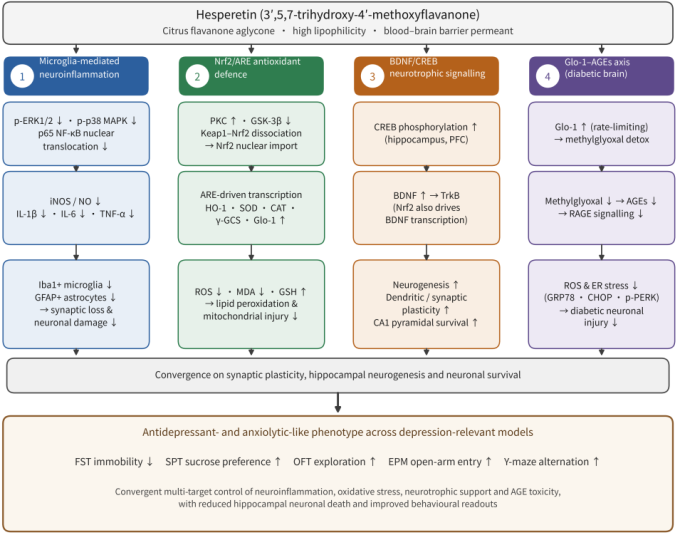
. Signalling axes underlying the antidepressant-like action of hesperetin were shown in
Figure 1.
Hesperetin acts on four interrelated axes. (1) Microglia-mediated neuroinflammation: hesperetin suppresses phosphorylation of ERK1/2 and p38 MAPK and the nuclear translocation of p65 NF-κB, lowering iNOS/NO and the pro-inflammatory cytokines IL-1β, IL-6 and TNF-α, with reduced Iba-1+ microgliosis and GFAP+ astrogliosis. (2) Nrf2/ARE antioxidant defence: through PKC activation and GSK-3β inhibition, hesperetin promotes Keap1-Nrf2 dissociation and nuclear Nrf2 accumulation, driving ARE-dependent transcription of HO-1, SOD, CAT, γ-GCS and Glo-1 and reducing ROS, MDA and lipid peroxidation. (3) BDNF/CREB neurotrophic signalling: hesperetin increases CREB phosphorylation and hippocampal/prefrontal BDNF, promoting TrkB signalling, neurogenesis, synaptic plasticity and CA1 pyramidal neuron survival; Nrf2 activation can in turn transactivate BDNF, forming a positive neuroprotective loop. (4) Glo-1/AGE axis: hesperetin up-regulates the rate-limiting enzyme Glo-1, accelerating methylglyoxal detoxification and lowering AGE formation and RAGE-dependent ROS generation and endoplasmic reticulum stress. The four axes converge on synaptic and neuronal integrity and translate into the antidepressant- and anxiolytic-like phenotype documented across reserpine, streptozotocin-diabetic, 6-OHDA, LPS and demyelination models.
Figure 1. Four convergent signalling axes underlying the antidepressant-like action of hesperetin.
Abbreviations: AGE, advanced glycation end product; ARE, antioxidant response element; BDNF, brain-derived neurotrophic factor; CAT, catalase; CREB, cAMP response element-binding protein; ERK, extracellular signal-regulated kinase; Glo-1, glyoxalase 1; γ-GCS, γ-glutamylcysteine synthetase; GSK-3β, glycogen synthase kinase-3β; GSH, glutathione; HO-1, haem oxygenase-1; Iba-1, ionised calcium-binding adapter molecule 1; IL, interleukin; iNOS, inducible nitric oxide synthase; Keap1, Kelch-like ECH-associated protein 1; MAPK, mitogen-activated protein kinase; MDA, malondialdehyde; NF-κB, nuclear factor kappa-B; Nrf2, nuclear factor erythroid 2-related factor 2; PKC, protein kinase C; ROS, reactive oxygen species; SOD, superoxide dismutase; TNF-α, tumour necrosis factor-α; TrkB, tropomyosin receptor kinase B.
4. Limitations of Current Research and Barriers to Clinical Transformation
Although there are abundant preclinical data on hesperetin in the treatment of depression, several key obstacles limit its application in the treatment of clinical depression.
4.1. Low Oral Bioavailability
Hesperetin is a fat-soluble flavonoid with poor water solubility. After oral administration, it undergoes extensive first pass metabolism in intestinal epithelial cells, mainly forming glucuronic acid and sulfate conjugates. Human pharmacokinetic studies showed that the peak plasma concentration of 135 mg hesperetin was only 825 ng/ml, and the elimination half-life was short (~3.05 h)
| [6] | Yang H, Wang YJ, Xu S, et al. Hesperetin, a Promising Treatment Option for Diabetes and Related Complications: A Literature Review. J Agric Food Chem. 2022; 70(28): 8582-8592.
https://doi.org/10.1021/acs.jafc.2c03257 |
[6]
. The low blood concentration limits the exposure of CNS and reduces the in vivo efficacy of low oral doses. Nano-preparation (nano hesperetin) has been proved to improve the solubility and brain distribution of Alzheimer’s disease (AD) animal model, but the nano carrier system for the treatment of depression is still lack of sufficient exploration
| [6] | Yang H, Wang YJ, Xu S, et al. Hesperetin, a Promising Treatment Option for Diabetes and Related Complications: A Literature Review. J Agric Food Chem. 2022; 70(28): 8582-8592.
https://doi.org/10.1021/acs.jafc.2c03257 |
[6]
. Pharmacokinetic parameters of hesperetin were shown in
Table 2.
Table 2.
Pharmacokinetic parameters of orally administered hesperetin in humans, as reported in Yang et al. (2022) | [6] | Yang H, Wang YJ, Xu S, et al. Hesperetin, a Promising Treatment Option for Diabetes and Related Complications: A Literature Review. J Agric Food Chem. 2022; 70(28): 8582-8592.
https://doi.org/10.1021/acs.jafc.2c03257 |
Compound / matrix | Hesperetin, human plasma |
Dose and route | 135 mg, single oral dose |
Cmax | 825 ng/mL (≈2.73 µmol/L) |
Tmax | Not reported in | [6] | Yang H, Wang YJ, Xu S, et al. Hesperetin, a Promising Treatment Option for Diabetes and Related Complications: A Literature Review. J Agric Food Chem. 2022; 70(28): 8582-8592.
https://doi.org/10.1021/acs.jafc.2c03257 |
[6] |
AUC | Not reported in | [6] | Yang H, Wang YJ, Xu S, et al. Hesperetin, a Promising Treatment Option for Diabetes and Related Complications: A Literature Review. J Agric Food Chem. 2022; 70(28): 8582-8592.
https://doi.org/10.1021/acs.jafc.2c03257 |
[6] |
t1/2 | ≈3.05 h |
Interpretation | Peak concentration in the high-nanomolar range with a terminal half-life of about 3 h indicates low systemic exposure and rapid elimination, consistent with extensive first-pass glucuronidation and sulfation in enterocytes and liver |
Cmax, peak plasma concentration; Tmax, time to peak plasma concentration; AUC, area under the plasma concentration-time curve; t1/2, terminal elimination half-life. Only parameters reported in reference
| [6] | Yang H, Wang YJ, Xu S, et al. Hesperetin, a Promising Treatment Option for Diabetes and Related Complications: A Literature Review. J Agric Food Chem. 2022; 70(28): 8582-8592.
https://doi.org/10.1021/acs.jafc.2c03257 |
[6]
are listed; cells that the source does not report are marked accordingly rather than being filled from other studies. Formulation-based exposure data (for example the hesperetin-piperine cocrystal and nano-hesperetin) derive from other sources and are therefore discussed in Sections 4.1 and 5.1 rather than tabulated here.
4.2. Lack of Standardized Clinical Trials
The existing anti-depression studies of hesperetin are limited to in vitro cell and rodent in vivo experiments. No randomized, double-blind, placebo-controlled human clinical trials have been reported. The effective human equivalent dose converted from animal models (50-150 mg/kg rodent dose is equivalent to about 390-490 mg per day for 60 kg adults) lacks human pharmacodynamics and safety verification
| [6] | Yang H, Wang YJ, Xu S, et al. Hesperetin, a Promising Treatment Option for Diabetes and Related Complications: A Literature Review. J Agric Food Chem. 2022; 70(28): 8582-8592.
https://doi.org/10.1021/acs.jafc.2c03257 |
[6]
. The human equivalent dose was calculated using the body surface area normalization method, the standard approach for interspecies dose extrapolation
. On this basis, rodent doses of 50-150 mg/kg correspond to an estimated 390-490 mg/day for a 60-kg adult. This calculation is only a rough extrapolation. It does not account for interspecies differences in absorption, bioavailability, metabolism, tissue distribution, and elimination of hesperetin, so it cannot be regarded as a safe or effective clinical dose. In addition, the long-term oral safety of hesperetin in patients with depression has not been confirmed, although the short-term animal toxicity test showed that there was no liver or kidney toxicity at the therapeutic dose.
4.3. Single Animal Model Limitations
At present, reserpine and STZ diabetic depressive rodents are mainly used in the research, while the classic chronic unpredictable mild stress (CUMS) depression model, maternal separation depression model and other core depression animal models are rarely used to verify the efficacy of hesperetin. The pathogenicity difference between different depression models may lead to incomplete understanding of its universal antidepressant mechanism. In addition, most studies only used male rodents, ignoring the gender differences in the incidence of depression and drug reactions, reducing the comprehensiveness of the experimental data.
4.4. Unclear Monoamine Regulatory Mechanisms
A small number of flavonoid studies report hesperidin (hesperetin glycoside) modulates 5-HT1A and κ-opioid receptors to regulate monoamine levels
| [20] | Souza LC, de Gomes MG, Goes AT, et al. Evidence for the involvement of the serotonergic 5-HT (1A) receptors in the antidepressant-like effect caused by hesperidin in mice. Prog Neuropsychopharmacol Biol Psychiatry. 2013; 40: 103-109.
https://doi.org/10.1016/j.pnpbp.2012.09.003 |
| [21] | Filho CB, Del Fabbro L, de Gomes MG, et al. Kappa-opioid receptors mediate the antidepressant-like activity of hesperidin in the mouse forced swimming test. Eur J Pharmacol. 2013; 698(1-3): 286-291.
https://doi.org/10.1016/j.ejphar.2012.11.003 |
[20, 21]
. However, there is little direct evidence that hesperetin regulates serotonin, dopamine and norepinephrine transporters or synthetases in depressed brain tissues. Whether monoamine signaling is involved in the antidepressant network of hesperetin needs further study.
5. Future Research Perspectives
5.1. Optimize Drug Delivery Systems to Improve Bioavailability
Develop nano-emulsions, liposomes, nanocrystals and prodrug derivatives of hesperetin to improve water solubility, intestinal absorption and blood-brain barrier permeability. Nano hesperetin should be detected in a variety of depression models, and the behavioral efficacy of nano hesperetin and free hesperetin should be compared, so as to lay the foundation for the development of oral antidepressant preparations.
5.2. Expand Preclinical Model Verification
The intervention experiment of hesperetin should be carried out on CUMS, maternal separation and lipopolysaccharide induced neuroinflammatory depression model. Including female rodents, to explore the gender differences in treatment response. At the same time, in vitro experiments of primary human neurons and microglia will be carried out to make the experimental results of rodents closer to the pathological conditions of human beings.
6. Conclusion
Hesperetin is a natural citrus flavonoid compound, which shows antidepressant and anti-anxiety effects in a variety of animal models of preclinical depression through multi-target synergy mechanism: inhibiting microglia mediated neuroinflammation, activating Nrf2/are antioxidant defense axis, up regulating BDNF neurotrophic signal pathway in hippocampus, increasing Glo-1 and blocking AGEs related neurotoxicity. Its low natural toxicity and multi-channel regulation make it a potential antidepressant component. However, most relevant studies were performed exclusively in male rodents, potentially limiting the generalizability of the findings across sexes and major challenges such as low oral bioavailability, lack of clinical trial data and incomplete model validation limit its clinical translation. Hesperetin may serve as a promising candidate for developing novel antidepressants, though its therapeutic potential remains to be validated in clinical trials.
Abbreviations
AD | Alzheimer’s Disease |
AGE | Advanced Glycation Endproduct |
ARE | Antioxidant Response Elemen |
BDNF | Brain-Derived Neurotrophic Factor |
CNS | Central Nervous System |
CA1 | Cornu Ammonis 1 |
CREB | Cyclic Adenosine Monophosphate Response Element-Binding Protein |
CUMS | Chronic Unpredictable Mild Stress |
ECT | Electroconvulsive Therapy |
EPM | Elevated Plus Maze |
ERK1/2 | Extracellular Signal‑regulated Kinase 1/2 |
FST | Forced Swimming Test |
GFAP | Glial Fibrillary Acidic Protein |
GSK‑3β | Glycogen Synthase Kinase-3β |
GLO-1 | Glyoxalase 1 |
GSH | Glutathione |
HPA | Hypothalamic Pituitary Adrenal |
IL-1β | Interleukin-1β |
IL-6 | Interleukin-6 |
iNOS | Inducible Nitric Oxide Synthase |
Keap1 | Kelch-like ECH-associated Protein 1 |
MAPK | Mitogen-Activated Protein Kinase |
MDD | Major Depressive Disorder |
NO | Nitric Oxide |
NF-κB | Nuclear Factor Kappa-B |
Nrf2 | Nuclear Factor Erythroid 2-Related Factor 2 |
OFT | Open Field Test |
PD | Parkinson's Disease |
PKC | Protein Kinase C |
PRISMA | Preferred Reporting Items for Systematic Reviews and Meta-Analyses |
ROS | Reactive Oxygen Species |
SOD | Superoxide Dismutase |
SPT | Sucrose Preference Test |
SSRI | Selective Serotonin Reuptake Inhibitor |
STZ | Streptozotocin |
TNF-α | Tumor Necrosis Facto-α |
VMAT2 | Vesicular Monoamine Transporter 2 |
6-OHDA | 6-hydroxydopamine |
γ- GCS | Γ-glutamylcysteine Synthetase |
Acknowledgments
The authors acknowledge all original researchers whose published literatures on hesperetin for this review.
Author Contributions
Jia Li: Conceptualization, Data curation, Formal Analysis, Writing – original draft
Yi Luo: Funding acquisition, Project administration, Supervision, Validation, Writing – review & editing
Funding
This work was supported by Union Research Fund Project of Department of Science and Technology of Hubei Province (2026AFC0585).
Conflicts of Interest
The authors declare no conflicts of interest.
References
| [1] |
World Health Organization. Mental health action plan 2013-2030. Geneva: WHO Press; 2013.
|
| [2] |
Miller AH, Raison CL. The role of inflammation in depression: from evolutionary imperative to modern treatment target. Nat Rev Immunol. 2016; 16(1): 22-34.
https://doi.org/10.1038/nri.2015.5
|
| [3] |
Duman RS. Neurotrophic factors and regulation of mood: role of exercise, diet and metabolism. Neurobiol Aging. 2005; 26(Suppl 1): 88-93.
https://doi.org/10.1016/j.neurobiolaging.2005.08.018
|
| [4] |
Makvandi AA, Khalili M, Roghani M, et al. Hesperetin ameliorates electroconvulsive therapy-induced memory impairment through regulation of hippocampal BDNF and oxidative stress. J Chem Neuroanat. 2021; 117: 102001.
https://doi.org/10.1016/j.jchemneu.2021.102001
|
| [5] |
Parhiz H, Roohbakhsh A, Soltani F, et al. Antioxidant and anti-inflammatory properties of the citrus flavonoids hesperidin and hesperetin: an updated review of their molecular mechanisms and experimental models. Phytother Res. 2015; 29(3): 323-331.
https://doi.org/10.1002/ptr.5256
|
| [6] |
Yang H, Wang YJ, Xu S, et al. Hesperetin, a Promising Treatment Option for Diabetes and Related Complications: A Literature Review. J Agric Food Chem. 2022; 70(28): 8582-8592.
https://doi.org/10.1021/acs.jafc.2c03257
|
| [7] |
Jo SH, Kim ME, Cho JH, et al. Hesperetin inhibits neuroinflammation on microglia by suppressing inflammatory cytokines and MAPK pathways. Arch Pharm Res. 2019; 42(8): 695-703.
https://doi.org/10.1007/s12272-019-01174-5
|
| [8] |
Baradaran S, Moghaddam AH, Ghasemi-Kasman M. Hesperetin reduces myelin damage and ameliorates glial activation in lysolecithin-induced focal demyelination model of rat optic chiasm. Life Sci. 2018; 207: 471-479.
https://doi.org/10.1016/j.lfs.2018.07.001
|
| [9] |
Kiasalari Z, Khalili M, Baluchnejadmojarad T, et al. Protective Effect of Oral Hesperetin Against Unilateral Striatal 6-Hydroxydopamine Damage in the Rat. Neurochem Res. 2016; 41(5): 1065-1072.
https://doi.org/10.1007/s11064-015-1796-6
|
| [10] |
Donato F, de Gomes MG, Goes AT, et al. Hesperidin exerts antidepressant-like effects in acute and chronic treatments in mice: possible role of l-arginine-NO-cGMP pathway and BDNF levels. Brain Res Bull. 2014; 104: 19-26.
https://doi.org/10.1016/j.brainresbull.2014.03.004
|
| [11] |
Zhu X, Zhang YM, Zhang MY, et al. Hesperetin ameliorates diabetes-associated anxiety and depression-like behaviors in rats via activating Nrf2/ARE pathway. Metab Brain Dis. 2021; 36(7): 1969-1983.
https://doi.org/10.1007/s11011-021-00785-6
|
| [12] |
Lai MC, Liu WY, Liou SS, et al. The Citrus Flavonoid Hesperetin Encounters Diabetes-Mediated Alzheimer-Type Neuropathologic Changes through Relieving Advanced Glycation End-Products Inducing Endoplasmic Reticulum Stress. Nutrients. 2022; 14(4): 745.
https://doi.org/10.3390/nu14040745
|
| [13] |
Antkiewicz-Michaluk L, Wąsik A, Możdżeń E, et al. Antidepressant-like effect of tetrahydroisoquinoline amines in the animal model of depressive disorder induced by repeated administration of a low dose of reserpine: behavioral and neurochemical studies in the rat. Neurotox Res. 2014; 26(1): 85-98.
https://doi.org/10.1007/s12640-013-9454-8
|
| [14] |
Chen YJ, Tang ZZ, Du L, et al. A novel compound AB-38b improves diabetes-associated cognitive decline in mice via activation of Nrf2/ARE pathway. Brain Res Bull. 2019; 150: 160-167.
https://doi.org/10.1016/j.brainresbull.2019.05.010
|
| [15] |
Ren H, Hao J, Liu T, et al. Hesperetin suppresses inflammatory responses via Nrf2/HO-1 and NF-κB pathways in macrophages. Inflammation. 2016; 39(3): 964-973.
https://doi.org/10.1007/s10753-016-0311-9
|
| [16] |
Uttara B, Singh AV, Zamboni P, et al. Oxidative stress and neurodegenerative diseases: a review of upstream and downstream antioxidant therapeutic options. Curr Neuropharmacol. 2009; 7(1): 65-74.
https://doi.org/10.2174/157015909787602823
|
| [17] |
Yao W, Lin S, Su J, et al. Activation of BDNF by transcription factor Nrf2 contributes to antidepressant-like actions in rodents. Transl Psychiatry. 2021; 11(1): 140.
https://doi.org/10.1038/s41398-021-01261-6
|
| [18] |
Ikram M, Muhammad T, Rehman SU, et al. Hesperetin Confers Neuroprotection by Regulating Nrf2/TLR4/NF-κB Signaling in an Aβ Mouse Model. Mol Neurobiol. 2019; 56(9): 6293-6309.
https://doi.org/10.1007/s12035-019-1512-7
|
| [19] |
Reagan-Shaw S, Nihal M, Ahmad N. Dose translation from animal to human studies revisited. The FASEB Journal, 2008; 22(3): 659-661.
https://doi.org/10.1096/fj.07-9574LSF
|
| [20] |
Souza LC, de Gomes MG, Goes AT, et al. Evidence for the involvement of the serotonergic 5-HT (1A) receptors in the antidepressant-like effect caused by hesperidin in mice. Prog Neuropsychopharmacol Biol Psychiatry. 2013; 40: 103-109.
https://doi.org/10.1016/j.pnpbp.2012.09.003
|
| [21] |
Filho CB, Del Fabbro L, de Gomes MG, et al. Kappa-opioid receptors mediate the antidepressant-like activity of hesperidin in the mouse forced swimming test. Eur J Pharmacol. 2013; 698(1-3): 286-291.
https://doi.org/10.1016/j.ejphar.2012.11.003
|
Cite This Article
-
-
@article{10.11648/j.ajlm.20261105.12,
  author = {Jia Li and Yi Luo},
  title = {Hesperetin, a Potential Medication for Treating Depression},
  journal = {American Journal of Laboratory Medicine},
  volume = {11},
  number = {5},
  pages = {104-112},
  doi = {10.11648/j.ajlm.20261105.12},
  url = {https://doi.org/10.11648/j.ajlm.20261105.12},
  eprint = {https://article.sciencepublishinggroup.com/pdf/10.11648.j.ajlm.20261105.12},
  abstract = {Major Depressive Disorder (MDD) is a prevalent, refractory neuropsychiatric disorder manifested by sustained depressed mood, anhedonia, cognitive dysfunction, sleep disturbance, and markedly elevated suicidal risk, imposing heavy burdens on individuals, families and public health systems worldwide. Clinically available conventional antidepressants generally suffer from a delayed therapeutic onset of several weeks, frequent unwanted adverse reactions, and unsatisfactory therapeutic response or even treatment resistance in a considerable proportion of patients. Given these clinical bottlenecks, it remains an urgent unmet clinical demand to explore safe, multi-targeted natural agents with favorable druggability for MDD intervention. Hesperetin, an aglycone flavonoid abundant in citrus fruits, exerts multiple biological effects including anti-inflammation, antioxidation, neurotrophy and neuroprotection, which have been supported by accumulating preclinical investigations. This narrative review collates eligible preclinical studies that validate the antidepressant-like effects of hesperetin, dissects its underlying core molecular signaling cascades associated with antidepressant actions, addresses major methodological limitations in existing relevant research, and highlights prospective research priorities for further translation. Notably, most available preclinical evidence is obtained exclusively from male rodents, which may limit the generalizability of these findings to female subjects, a critical gap given well-documented sex disparities in MDD incidence and pathophysiology. Collectively, this work aims to summarize current mechanistic insights, provide a solid theoretical basis, and facilitate the translational development of hesperetin as a lead compound for novel, safer antidepressant candidates.},
 year = {2026}
}
 Copy
|
 Download
-
TY  - JOUR
T1  - Hesperetin, a Potential Medication for Treating Depression
AU  - Jia Li
AU  - Yi Luo
Y1  - 2026/11/27
PY  - 2026
N1  - https://doi.org/10.11648/j.ajlm.20261105.12
DO  - 10.11648/j.ajlm.20261105.12
T2  - American Journal of Laboratory Medicine
JF  - American Journal of Laboratory Medicine
JO  - American Journal of Laboratory Medicine
SP  - 104
EP  - 112
PB  - Science Publishing Group
SN  - 2575-386X
UR  - https://doi.org/10.11648/j.ajlm.20261105.12
AB  - Major Depressive Disorder (MDD) is a prevalent, refractory neuropsychiatric disorder manifested by sustained depressed mood, anhedonia, cognitive dysfunction, sleep disturbance, and markedly elevated suicidal risk, imposing heavy burdens on individuals, families and public health systems worldwide. Clinically available conventional antidepressants generally suffer from a delayed therapeutic onset of several weeks, frequent unwanted adverse reactions, and unsatisfactory therapeutic response or even treatment resistance in a considerable proportion of patients. Given these clinical bottlenecks, it remains an urgent unmet clinical demand to explore safe, multi-targeted natural agents with favorable druggability for MDD intervention. Hesperetin, an aglycone flavonoid abundant in citrus fruits, exerts multiple biological effects including anti-inflammation, antioxidation, neurotrophy and neuroprotection, which have been supported by accumulating preclinical investigations. This narrative review collates eligible preclinical studies that validate the antidepressant-like effects of hesperetin, dissects its underlying core molecular signaling cascades associated with antidepressant actions, addresses major methodological limitations in existing relevant research, and highlights prospective research priorities for further translation. Notably, most available preclinical evidence is obtained exclusively from male rodents, which may limit the generalizability of these findings to female subjects, a critical gap given well-documented sex disparities in MDD incidence and pathophysiology. Collectively, this work aims to summarize current mechanistic insights, provide a solid theoretical basis, and facilitate the translational development of hesperetin as a lead compound for novel, safer antidepressant candidates.
VL  - 11
IS  - 5
ER  -
Copy
|
Download





 Share This Article
 Twitter
 Linked In
 Facebook