
Biological catalysts foster less adiabatic the transformations of substrates into products and in thereof providing suitable physiologic condition that lower the activation energy. Prevailing environmental physiologic conditions impounds on the microbial physiology necessitating the stability of their respective producing proteins. In the present study, three stress marker enzymes were produced from a hydrocarbonoclastic bacteria isolated from a crude polluted soil using standard microbiology and biochemical techniques respectively. Petroleum hydrocarbon polluted soil from Atali Rivers state from which the bacteria strain was produced showed the following physicochemical properties: pH of 5.44, Soil from Atalia showed electrical conductance of 190(uS/cm) respectively while the control experiment showed conductance of 145(uS/cm). Dissolved mineral contents were found in the following order: SO4>NO3>P>N while heavy metals of Hg, As and Cd were found at below detectable limit range (BDL) in both the contaminated and non contaminated soils. Strains of Pseudomonas were isolated using standard microbiology and biochemical techniques respectively. Submerged fermentation technique was employed for the respective hydrolytic enzymes production. Lipase, urease and peroxidase production showed optimum production day(s) on day 7, 14 and 7of the 21 days incubation study respectively. Peak activity of the enzymes (Lipase, urease and peroxidase respectively) were recorded at 72, 75.67 and 69.32 μmole/min. in the presence of p-NPP, O-dianisidine and urea respectively. Extracellular enzymes: lipase, urease and peroxidase from Pseudomonas sp. showed optimum production at pH 7.5, 7.5 and 4.0 respectively. The study has shown with empirical the kinetic cycles of three catalytic quality marker enzymes from crude oil contaminated soil and their wide range catalytic stability suitable for an ecological remediation.
| Published in | American Journal of Biological and Environmental Statistics (Volume 12, Issue 4) |
| DOI | 10.11648/j.ajbes.20261204.11 |
| Page(s) | 70-77 |
| Creative Commons |
This is an Open Access article, distributed under the terms of the Creative Commons Attribution 4.0 International License (http://creativecommons.org/licenses/by/4.0/), which permits unrestricted use, distribution and reproduction in any medium or format, provided the original work is properly cited. |
| Copyright |
Copyright © The Author(s), 2026. Published by Science Publishing Group |
Petroleum Hydrocarbon, Biological Catalyst, Atali, Rivers
Physicochemical parameters | Control | Soil sample1Atalia |
|---|---|---|
pH | 6.79±0.02c | 5.44±0.012c |
Moisture contents (%) | 11.09±0.02c | 12.34±0.015c |
Electrical conductance(µS/cm) | 145±0.018c | 190±0.014b |
Total organic carbon (%) | 1.02±0.014c | 0.72±0.018a |
Total organic matter content (%) | 13.00±0.03c | 11.41±0.05c |
Total Sulphate(mg/kg) | 1.12±0.016c | 9.622±0.03c |
Total Nitrate(mg/kg) | 4.212±0.02c | 3.12±0.025c |
Total Phosphate(mg/kg) | 6.121±0.014bc | 7.02±0.039c |
Coliformcounts | Control | Atali | H-C Bacteria |
|---|---|---|---|
Total Viable Counts (10-2) | 2.7 x 10⁵ | 4.5 x 10⁷ | 2.65 x 10³ |
Total Coliform Counts (10-2) | 0.6 x 10² | 1.2 x 10³ |
BDL | Belwo Detectable Limit |
mM | Mili Mole |
μmol/min | Micro Mole Per Min |
CFU/ml | Coliform Unit Per MiliLitre |
Km | Michealis Menten |
Vmax | Constant Velocity Maximal |
| [1] | Abdel-Shafy H. and Mansour, M. (2018). Solid waste issue: Sources, composition, disposal, recycling, and valorization. Egyptian Journal of Petroleum, 27(4): 1275-1290. |
| [2] | Abdullah, A., Salamatinia, B., Mootabadi, H. and Bhatia, S. (2019). CurrentstatusandpoliciesonbiodieselindustryinMalaysiaasthe world’s leading producer of palm oil. Energy Policy, 37(12): 5440-5448. |
| [3] | Abolemonaen, M., Hatem, B. and Jeannette, B. (2011). Three dimensional structure of Aradposis Thaliana lipase predicted by homology modeling method. Evolutionary Bioinformatics, 7: 99-105. |
| [4] | Adewale, I. O and Adekunle, A. T (2018). Biochemical properties of peroxidase from white and red cultivars of Kola nut (Cola nitida). Biocatalyst and Agricultural Biotechnology. 14: 1-9. |
| [5] | Agency for Toxic Substance Development and Disease Registry (ATSDR)(2009). Documentary on toxicological profile of total petroleum hydrocarbon contaminations. Agency for toxic substance and disease registry, division of toxicology and toxicology in formationbranch, Atlanta Georgia. |
| [6] | Agency of Toxic Substances and Disease Registry (ATSDR) (2010). Public Health Statements: Used mineral based crankcase oil. ATSDR. Atlanta Georgia. |
| [7] | Ajanaku, L. (2007). Battling with Darkness. TELL (Special Edition). May 21, pp: 31-33. |
| [8] | Oparaji EH, Nweze EJ, Agbo KU, Arinzechukwu EO, Anosike JC and Arazu AV. (2017). |
| [9] | Estimations of Polycyclic Aliphatic Hydrocarbon and Total Petroleum Hydrocarbon in Aquatic Faunas Found in Foccardos Terminal River in Port Harcourt, Rivers State. Journal of Environmental & Analytical Toxicology, 7: 6. |
| [10] | Alobaidy, A., Abid, H. and Maulood B. (2010). Application of water quality index for assessment of Dokanlake ecosystem, Kurdistan region, Iraq. Journal of Water Resources, 2: 792. |
| [11] | Al-sayed, H., Mahasneh, A. and Al-Saad, J. (1994). Variations of Trace Metal Ions Concentrations in Sea Water and Pearl Oyster Pinctadaradiate From Bahrain (Arabian Gulf). Marine pollution bulletin, 28: 370-374. |
| [12] | Oparaji, EH., Okwuenu, PC, Onosakponome, I., Eze, S. O. O and Chilaka FC. (2022). Purification and enzymatic properties of β-galactosidase from L.bacillus acidophilus from dairy industrial waste water. Journal of enzyme engineering, Vol. 1: 16-38. |
| [13] | Callot, H. and Ocampo, R. (2009). Wetland and water pollution. Boston Collection on Environmental Affairs and Law Reviews, 23: 885-919. |
| [14] | Chen, Z., Ngo, H. and Guo, W. (2013). A critical review on the end uses of recycled water. Critical Review on Environmental Science and Technology, 43: 1446-1516. |
| [15] | Chiemchaisri, C., Juanga, J. and Visvanathan, C. (2007). Municipal solid waste management in Thailand and disposal emission inventory. Environmental Monitoring and Assessment, 135: 13-20. |
| [16] | Ezenwelu Chijioke Obinna, Ilechukwu Cyril Chijioke, Iloanya Lauretta Eberechukwu, Onwah Joy, Chigbo Malachy Chidiebere and Oparaji Emeka Henry (2024). Spectra Analysis of Endocrine Related Compounds and Heavy Metals in Petroleum Hydrocarbon Impacted Soil. American Journal of Environmental Science and Engineering.. 2(1): 22-34. |
| [17] | Chukwu, M. andAdams, E. (2016). Effect of Generato r(Exhaust) Fumes on the Growth and Development of Lycopersicumesculentus(Tomato). Journal of Applied Environmental Science and Management, 20(2): 335-340. |
| [18] | Casciello, C., Tonin, F and Berini, F (2017) A valuable peroxidase activity from the novel species Nonomuraeagerenzanensis growing on alkali lignin. Biotechnology Representative. 13: 49-57. |
| [19] | Douglas, D. and Bremner, E. (1971). A rapid method of evaluating different compounds as inhibitors of urease activity in soil. Soil Biology and Biochemistry, 3: 309-315. |
| [20] | Ejedegba O., Onyeneke, E. and Oviasogie, P. (2007). Characterisation of lipase isolated from coconut seed under different nutrient conditions. African Journal of Biotechnology, 6: 723-727. |
| [21] | Emsley, J. (2011). Nature's Building Blocks. Oxford University Press. |
| [22] | Environmental protection agency (EPA)(2008). Report on integrating management of watershed and coastalline. USA environmental protectionunit. 7thEdn. WashingtonDC. |
| [23] | EPA Method 8270D (2010)(SW-846)Semi volatile Organic Compounds by Gas Chromatography/mass Spectrometry(GC/MS), Revision4. |
| [24] | Evanko, C. and Dzombak, A. (1997). "Remediation of Metals-Contaminated Soils and Ground water". Technology Evaluation Report (Pittsburgh PA: Ground-water Remediation Technologies Center). TE97-0-1. |
| [25] | Evanko, C. and Dzombak, A. (2017). Remediation of Metals-Contaminated Soils and Ground water. Technology Evaluation Report (Pittsburgh PA: Ground-water Remediation Technologies Center). TE97-0-1. |
| [26] | Eze, S. O. O., Chilaka, F. C., Nwanguma, B. C. (2012). Studies on Thermodynamics and Kinetics of Thermo-Inactivation of Some Quality-Related Enzymes in WhiteYam (Dioscorearotundata). Journal of Thermodynamic and Catalysis, 1: 104. |
| [27] | Ezemoye, N and Ezemoye E. (2005). Polychlorinated biphenyls(PCBs)levels and distributions in Ethiope and Benin Rivers of the Niger Delta, Nigeria: surface water and sediment. International Journal of Environmental Studies, 62(5): 491-504. |
| [28] | Ezenwelu, C., Aribodor, O., Ezeonyejiaku, C., Okafor, S. and Oparaji, E. (2022). Assessment of physicochemical properties and microbial loading index of soil samples from mgbuka market, Anambra state. Journal of Environmental Pollution and Management, 12: 134-176. |
| [29] | Ezeonu, M., Okafor, J. and Ogbonna, J. (2013). Laboratory Exercises in Microbiology. 1st Edn. Ephrata Publishing and Printing Company, Nsukka. Pp100-117. |
| [30] | Gertler, C., Gerdts, G., Timmis, K., Yakimov, M. and Golyshin, P. (2009). Populations of heavy fuel oil-degrading marine microbial community in presence of sorbent materials. Journal of Applied Microbiology, 107: 590-605. |
| [31] | Haluk, E., Khawar. S. S., Julia. M., Tim. C., Ricardo, C. (2012). Kinetic and thermodynamic characterization of the functional properties of a hybrid versatile peroxidase using isothermal titration calorimetry: Insight into manganese peroxidase activation and lignin peroxidase inhibition. Biochimie, 94: 1221-1231. |
| [32] | Harvey, J., Handley, K. and Taylor, P. (2017). "Identification of the Sources of Metal (Lead) Contamination in Drinking Waters in North-EasternTasmaniaUsingLeadIsotopicCompositions". Environmental Science and Pollution Research, 22: 12276-12288. |
| [33] | Karak T., Bhagat, R. and Bhattacharyya, P. (2012). Municipal solid waste generation, composition, and management: The world scenario. Critical Reviews in Environmental Science and Technology. 42: 1509-1630. |
| [34] | Kiyouta, H., Higashi, E., Koitke, T and Oritani, T. (2011). Lipasecatalysedpreparationofbothenantiomersofmethyljasmonatetetrahedron. Asymmetry, 12: 1035-1038. |
| [35] | Ladero, M., Ruiz, G., Pessela, B., Vian, A., Santos, A. and Garcia-Ochoa, F. (2006). Thermal and pH inactivation of an immobilized thermo stable βgalactosidase from Thermus sp.strainT2: Comparison to the free enzyme. Biochemical Engineering Journal, 31: 14-24. |
| [36] | Lee, K. (2018). Earthworms. Their Ecology and Relationships with Soils and Land Use; Academic Press: Orlando, FL, USA. |
| [37] | Lowry, O., Roseburg, N., Farr, A. and Randall, R. (1951). Protein measurement with Folin-Phenol reagents. Journal of Biological Chemistry, 93:265-275. |
| [38] | Markou, G., Chatzipavlidis, I. and Georgakakis, D. (2016). Cultivation of arthrospira (Spirulina) platens is in olive-oil mill waste water treated with sodium hypochlorite. Bioresources Technology, 112: 234-241. |
| [39] | Miao, K., Cortazar, E., Bartolome, L. and Arrasate, S. (2001). Distribution and bioaccumulation of PAHs in the UNESCO protected natural reserve of Urdaibai, Bay of Biscay. Chemosphere, 72(10): 1467-1474. |
| [40] | Morris, R. (1952). Determination of Iron in water in presence of heavy metals. Analytical Chemistry, 24(8): 1376-1378. |
| [41] | Narodoslawsky, M. and Krotscheck, C. (2015). The sustainable process index(SPI): Evaluating processes according to environmental compatibility. Journal of Hazardous Materials. 41: 383-397. |
| [42] | Nduka, J. and Orisakwe, O. (2007). Effect of effluents from Warri refinery petroleum company WRPC on water and soil qualities of contagious host and impacted on communities of Delta state, Nigeria. The Open Environmental Pollution and Toxicological Journal, 1(1): 11-17. |
| [43] | Nogale, B., Lanfranconi, M., Pina-Villalonga, J. and Bosch, R. (2011). Anthropogenic Perturbation in Marine Microbial Communities. FEMS microbial rev., 35: 275-298. |
| [44] | Nweke, C. andOkpokwasili, G., 2004. Effects of bioremediation treatments on bacterial populations of soil at different depths. Nigeria Journal of Microbiology, 18: 363-372. |
| [45] | Predicpt, L., de Cassia Pereira e Silva, M., van Elsas J. and Seldin, L. (2011). EPA Method 8270D (SW-846) Semi volatile Organic Compounds by Gas Chromatography/mass Spectrometry (GC/MS), Revision 4. |
| [46] | Shoemaker, G., Juers, D., Coombs, J., Matthews, B. and Craig, D. (2013). Crystallization of β-galactosidase does not reduce the range of activity of individual molecules. Biochemistry, 42: 1707-1710. |
APA Style
Chukwudi, A. U. A., Obinna, E. C., Chidiebere, C. M., Izuchukwu, U. O., Chijioke, I. C., et al. (2026). Co-Kinetic Assessment of Tri-Catalytic Activity of Peroxidase, Urease and Lipase Produced from Hydrocarbonoclastic Bacteria. American Journal of Biological and Environmental Statistics, 12(4), 70-77. https://doi.org/10.11648/j.ajbes.20261204.11
ACS Style
Chukwudi, A. U. A.; Obinna, E. C.; Chidiebere, C. M.; Izuchukwu, U. O.; Chijioke, I. C., et al. Co-Kinetic Assessment of Tri-Catalytic Activity of Peroxidase, Urease and Lipase Produced from Hydrocarbonoclastic Bacteria. Am. J. Biol. Environ. Stat. 2026, 12(4), 70-77. doi: 10.11648/j.ajbes.20261204.11
AMA Style
Chukwudi AUA, Obinna EC, Chidiebere CM, Izuchukwu UO, Chijioke IC, et al. Co-Kinetic Assessment of Tri-Catalytic Activity of Peroxidase, Urease and Lipase Produced from Hydrocarbonoclastic Bacteria. Am J Biol Environ Stat. 2026;12(4):70-77. doi: 10.11648/j.ajbes.20261204.11
@article{10.11648/j.ajbes.20261204.11,
  author = {Azubuike Umeh Aninachukwu Chukwudi and Ezenwelu Chijioke Obinna and Chigbo Malachy Chidiebere and Udemezue Onyeka Izuchukwu and Ilechukwu Cyril Chijioke and Oparaji Emeka Henry},
  title = {Co-Kinetic Assessment of Tri-Catalytic Activity of Peroxidase, Urease and Lipase Produced from Hydrocarbonoclastic Bacteria},
  journal = {American Journal of Biological and Environmental Statistics},
  volume = {12},
  number = {4},
  pages = {70-77},
  doi = {10.11648/j.ajbes.20261204.11},
  url = {https://doi.org/10.11648/j.ajbes.20261204.11},
  eprint = {https://article.sciencepublishinggroup.com/pdf/10.11648.j.ajbes.20261204.11},
  abstract = {Biological catalysts foster less adiabatic the transformations of substrates into products and in thereof providing suitable physiologic condition that lower the activation energy. Prevailing environmental physiologic conditions impounds on the microbial physiology necessitating the stability of their respective producing proteins. In the present study, three stress marker enzymes were produced from a hydrocarbonoclastic bacteria isolated from a crude polluted soil using standard microbiology and biochemical techniques respectively. Petroleum hydrocarbon polluted soil from Atali Rivers state from which the bacteria strain was produced showed the following physicochemical properties: pH of 5.44, Soil from Atalia showed electrical conductance of 190(uS/cm) respectively while the control experiment showed conductance of 145(uS/cm). Dissolved mineral contents were found in the following order: SO4>NO3>P>N while heavy metals of Hg, As and Cd were found at below detectable limit range (BDL) in both the contaminated and non contaminated soils. Strains of Pseudomonas were isolated using standard microbiology and biochemical techniques respectively. Submerged fermentation technique was employed for the respective hydrolytic enzymes production. Lipase, urease and peroxidase production showed optimum production day(s) on day 7, 14 and 7of the 21 days incubation study respectively. Peak activity of the enzymes (Lipase, urease and peroxidase respectively) were recorded at 72, 75.67 and 69.32 μmole/min. in the presence of p-NPP, O-dianisidine and urea respectively. Extracellular enzymes: lipase, urease and peroxidase from Pseudomonas sp. showed optimum production at pH 7.5, 7.5 and 4.0 respectively. The study has shown with empirical the kinetic cycles of three catalytic quality marker enzymes from crude oil contaminated soil and their wide range catalytic stability suitable for an ecological remediation.},
 year = {2026}
}
TY  - JOUR
T1  - Co-Kinetic Assessment of Tri-Catalytic Activity of Peroxidase, Urease and Lipase Produced from Hydrocarbonoclastic Bacteria
AU  - Azubuike Umeh Aninachukwu Chukwudi
AU  - Ezenwelu Chijioke Obinna
AU  - Chigbo Malachy Chidiebere
AU  - Udemezue Onyeka Izuchukwu
AU  - Ilechukwu Cyril Chijioke
AU  - Oparaji Emeka Henry
Y1  - 2026/11/06
PY  - 2026
N1  - https://doi.org/10.11648/j.ajbes.20261204.11
DO  - 10.11648/j.ajbes.20261204.11
T2  - American Journal of Biological and Environmental Statistics
JF  - American Journal of Biological and Environmental Statistics
JO  - American Journal of Biological and Environmental Statistics
SP  - 70
EP  - 77
PB  - Science Publishing Group
SN  - 2471-979X
UR  - https://doi.org/10.11648/j.ajbes.20261204.11
AB  - Biological catalysts foster less adiabatic the transformations of substrates into products and in thereof providing suitable physiologic condition that lower the activation energy. Prevailing environmental physiologic conditions impounds on the microbial physiology necessitating the stability of their respective producing proteins. In the present study, three stress marker enzymes were produced from a hydrocarbonoclastic bacteria isolated from a crude polluted soil using standard microbiology and biochemical techniques respectively. Petroleum hydrocarbon polluted soil from Atali Rivers state from which the bacteria strain was produced showed the following physicochemical properties: pH of 5.44, Soil from Atalia showed electrical conductance of 190(uS/cm) respectively while the control experiment showed conductance of 145(uS/cm). Dissolved mineral contents were found in the following order: SO4>NO3>P>N while heavy metals of Hg, As and Cd were found at below detectable limit range (BDL) in both the contaminated and non contaminated soils. Strains of Pseudomonas were isolated using standard microbiology and biochemical techniques respectively. Submerged fermentation technique was employed for the respective hydrolytic enzymes production. Lipase, urease and peroxidase production showed optimum production day(s) on day 7, 14 and 7of the 21 days incubation study respectively. Peak activity of the enzymes (Lipase, urease and peroxidase respectively) were recorded at 72, 75.67 and 69.32 μmole/min. in the presence of p-NPP, O-dianisidine and urea respectively. Extracellular enzymes: lipase, urease and peroxidase from Pseudomonas sp. showed optimum production at pH 7.5, 7.5 and 4.0 respectively. The study has shown with empirical the kinetic cycles of three catalytic quality marker enzymes from crude oil contaminated soil and their wide range catalytic stability suitable for an ecological remediation.
VL  - 12
IS  - 4
ER  -
Department of Applied Biochemistry, NnamdiAzikiwe University, Awka, Nigeria
Department of Applied Biochemistry, State University of Medical and Applied Sciences, Igbo-Eno, Nigeria
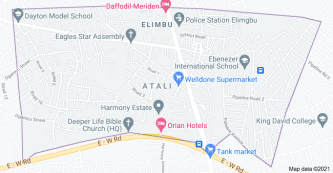
Figure 1. Map of Atali oil bunkering site in Rivers state, Nigeria.
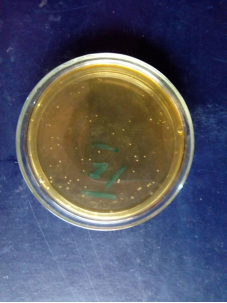
Figure 2. Pure colonies of strains of Pseudomonas sp.on nutrient media plate.
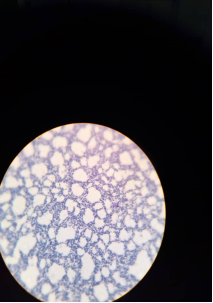
Figure 3. THe micrograph of the bacteria (Pseudomonas sp) suspensions under an objective magnification of x40.
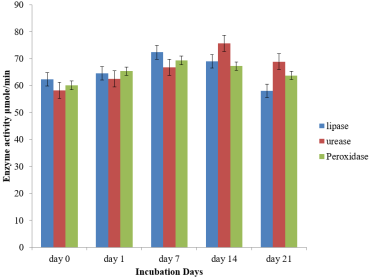
Figure 4. EFfect of incubation days on stress responsive enzyme production from strain of Pseudomonas sp.
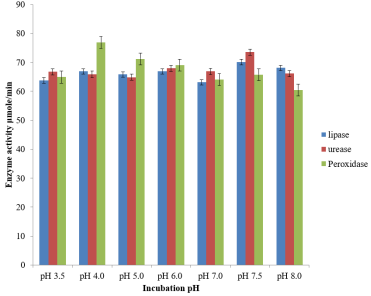
Figure 5. Ffect of incubation pH on stress responsive enzyme production from strain of Pseudomonas sp.

Information



 Share This Article
 Twitter
 Linked In
 Facebook

 Copy
 Download