Abstract
Background: Characterising the clinical profile, reporting pathway and management of adverse events following immunization (AEFIs) is essential for strengthening vaccine safety surveillance. This analysis focuses exclusively on severe non-fatal cases reported following administration of the novel oral polio vaccine type 2 (nOPV2) in Benin. Methods: A retrospective descriptive case series, embedded within a national case-control investigation, was conducted throughtout Benin from August to November 2025. This analysis included 510 serious non-fatal AEFI cases with usable clinical, reporting and management data; 49 fatal cases under seperate investigation were excluded. Results: The mean age was 25.2 months, and 52.5% of the children were boys. High fever (84.9%), diarrhoea (22.0%), and seizures (17.5%) were the most frequently reported manifestations, with a mean time to onset of 4.2 days. Management included rehydration or infusion (88.0%), antipyretics (87.0%), antibiotics (59.0%), blood transfusions (35.0%), and anticonvulsants (9.0%). The reporting outcome was documented for 494 of 510 cases (96.9%); among these, 493 received immediate care or referral (99.8%). Conclusion: The clinical profile was dominated by fever, diarrhoea, and seizures, with management was mainly symptomatic. The health system generaly responded rapidly after an alert, although the delay before caregiver reporting remained variable. No causal relationship between vaccination and reported events can be established from this descriptive analysis.
|
Published in
|
World Journal of Public Health (Volume 11, Issue 3)
|
|
DOI
|
10.11648/j.wjph.20261103.19
|
|
Page(s)
|
304-309 |
|
Creative Commons
|

This is an Open Access article, distributed under the terms of the Creative Commons Attribution 4.0 International License (http://creativecommons.org/licenses/by/4.0/), which permits unrestricted use, distribution and reproduction in any medium or format, provided the original work is properly cited.
|
|
Copyright
|
Copyright © The Author(s), 2026. Published by Science Publishing Group
|
Keywords
nOPV2, Serious AEFIs, Clinical Profile, Reporting Pathway, Management, Benin
1. Introduction
Vaccine safety surveillance systems should not only count reported events; they should also document clinical presentation, time to symptoms onset, reporting pathways, and the response provided by health services. This information is especially important during mass vaccination campaigns, when medical events may occur after vaccination without necessarily being caused by the vaccine.
Outbreaks of circulating vaccine-derived poliovirus type 2 have led to the global rollout of the novel oral polio vaccine type 2 (nOPV2)
| [1] | Wilkinson, A. L., Zaman, K., Hoque, M. Immunogenicity of novel oral poliovirus vaccine type 2 administered concomitantly with bivalent oral poliovirus vaccine: an open-label, non-inferiority, randomised, controlled trial. Lancet Infect Dis. 2023; 23(9): 1062‑71.
https://doi.org/10.1016/S1473-3099(23)00139-1 |
[1]
. Clinical trials and surveillance studies conducted in Africa have generally reported a favorable safety profile, while emphasizing the need for rigorous invstigation of serious events and complete clinical documentation
| [2] | Thomas, F., Abiri, O., Kallon, J. Adverse Events Following Immunization with Novel Oral Polio Vaccine Type 2, and the Experience and Challenges of Reporting in Sierra Leone. Drug Heathc Patient Saf. 2024; 16: 61‑73.
https://doi.org/10.2147/DHPS.S466039 |
| [3] | Abbott, S. L., Etapelong, S. G., Gidado, S. Implementing a robust adverse event of special interest surveillance for novel oral polio vaccine type 2 rollout, Nigeria, March-July 2021. Pan Afr Med J. 2023; 45(Suppl 2): 6.
https://doi.org/10.11604/pamj.supp.2023.45.2.40228 |
| [4] | Bashorun, A. O., Kotei, L., Jawla, O. Tolerability, safety, and immunogenicity of the novel oral polio vaccine type 2 in children aged 6 weeks to 59 months in an outbreak response campaign in The Gambia: an observational cohort study. Lancet Infect Dis. 2024; 24(4): 417‑26.
https://doi.org/10.1016/S1473-3099(23)00631-X |
| [5] | Longley, A. T., Nsubuga, F., Gilani, Z. Safety of nOPV2 administered during a supplementary immunisation activity in Uganda, 2022: data triangulation from a prospective cohort event monitoring programme and vaccine safety surveillance reports. Lancet Glob Health. 2025; 13(7): e1213‑e1220.
https://doi.org/10.1016/S2214-109X(25)00110-X |
[2-5]
.
Available African studies have mainly examined vaccine tolerability, adverse events of special interest, or challenges in reporting. National evidence that jointly describes clinical manifestations, reporting delays, and management remains scare in Francophone West Africa. Benin’s experience adds evidence from a nationwide investigation covering all twelve departments and provides and opportunity to examine the pathway from caregiver recognition to health-system response.
Accordingly, this study aimed to describe the clinical profile, reporting pathway, and management of serious non-fatal AEFIs reported after nOPV2 administration among children aged 0-5 years in Benin. A separate analysis from the same national investigation examined factors associated with serious AEFIs; the present analysis did not use controls or case-controls comparaisons.
2. Materials and Methods
2.1. Study Design and Data Source
This was a retrospective descriptive cases series embedded within a national investigation conducted in the twelve departments of Benin from August to November 2025. The general investigation protocol included a case-control component, but the present analysis use only data from serious non-fatal AEFI cases.
2.2. Case Identification and Eligibility Criteria
Serious AEFI cases is initially identified from the national vaccine pharmacovigilance database following the 2025 nOPV2 campaign. Notifications were verified using the standardised national AEFI notification and investigation forms used by the Beninese surveillance system, together with available consultation and hospital records. A serious AEFI was defined as any medical event occurring after immunization that resulted in death, was life-threatening, required hospitalisation or prolonged an existing hospital stay, or caused persistent or significant disabiliity
| [6] | World Health Organization. User manual for the revised WHO classification. 2nd ed. Geneva, Switzerland: WHO press; 2019. p. 44. |
[6]
.
Children were eligible if they were aged 0-5 years, had received nOPV2 during the 2025 campaign, had a documented serious non-fatal AEFI, lived in one of the study departments, and had parental or guardian consent. Children were excluded when the caregiver could not be interviewed, the reported event could not be verified, or consent was refused. Of the 569 serious reports, 49 deaths were under separate investigation and were excluded from this analysis. Of the remaining 520 serious non-fatal cases, 510 had usable data, while 10 were lost to follow-up.
2.3. Data Collection and Quality Assurance
Data were collected through individual interviews with parents or guardians and documentary review using a standardised questionnaire and extraction grid. Information was obtained from the electronic national database, paper notification and investigation forms, and available medical and hospital records. Field investigators had training in public health, community health, social sciences, or health sciences and worked under field supervision. Information from the different sources was cross-checked to improve completeness and internal consistency.
2.4. Study Variables
Clinical variables included reported symptoms, time from vaccination to symptom onset, length of stay, and treatments received. Reporting variables included the time from symptom onset to caregiver reporting, the recipients of the report, the responses provided, and the interval between reporting and medical management. Several symptoms, treatments or recipients could be reported for the same child.
2.5. Statistical Analysis
The data were analysed using Stata. Categorical variables were described using frequencies and percentages, and quantitative using means, medians, and ranges when available. Analyses were based on available data for each variable; missing observations were not imputed and the relevant denominators and reported. This was a descriptive analysis, and no inferential tests or confidence intervals were calculated.
2.6. Ethical Considerations
Ethical approval was obtained from the National Ethics Committee for Health Research (CNERS), together with the authorisation from the Ministry of Health. Informed consent was obtained from parents and guardians. Data were anonymised and stored securely.
3. Results
3.1. General Characteristics of the Cases
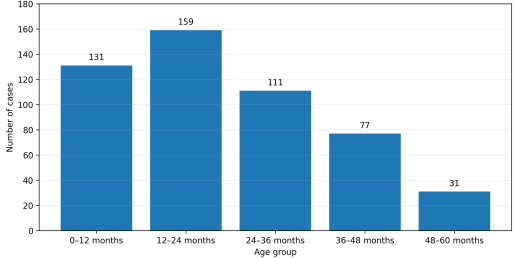
The overall incidence of serious AEFIs was 1.34 per 10,000 vaccinated children. The mean age of the 510 cases was 25.2 months ± 15.0 months, with a range of 1 to 60 months. Children under 24 months of age (
Figure 1) accounted for 56.9% of cases (290/510). A slight predominance of boys was observed with a sex ratio of 1.11 (268 boys versus 242 girls).
Figure 1. Distribution of cases by age group.
3.2. Clinical Profile of Cases
The mean time to symptom onset was 4.2 days. The mean onset time were 3.5 days among children aged 0-12 months, 4.8 days among those aged 12-24 months, 4.2 days among those aged 24-36 months, 4.1 days among those aged 36-48 months, and 4.3 days among those aged 48-60 months.
The symptoms observed (
Table 1) were dominated by high fever (> 39°C) present in 84.9% of cases. Diarrhoea was the second most common symptom (22.0%), with a decreasing frequency with age (30.0% in 0-12 months compared to 10.0% in 48-60 months). Seizures affected 17.5% of cases, with a proportionally higher frequency beyond 24 months (26.0% in 24-36 months and 32.0% in 48-60 months). Two rare but clinically significant signs deserved special attention: flaccid paralysis (1.4% or 7 cases) and anaphylactic shock (0.6% or 3 cases). Complete virological findings and diagnostic validation were unavailable for this analysis.
Table 1. Symptoms observed in serious non-fatal AEFI cases (n=510).
Symptoms | Frequency (n) | % |
High fever (>39°C) | 433 | 84,9% |
Diarrhea | 112 | 22.0% |
Seizures | 89 | 17,5% |
Allergic reactions | 76 | 14,9% |
Disorders of consciousness | 39 | 7,7% |
Acute flaccid paralysis | 7 | 1,4% |
Anaphylactic shock | 3 | 0,6% |
3.3. Management of Serious AEFIs
The mean length of hospital stay was 5.2 days (median: 4 days), with the ranges of 0-53 days; a value of zero days represented short-term observation lasting a few hours. Management (
Table 2) was mainly based on rehydration or infusion (88.0%), antipyretics (87.0%), antibiotics (59.0%), blood transfusion (35.0%), and anticonvulsants (9.0%). The available data did not allow systematic determination of the clinical or laboratory indications for these treatments.
Table 2. Treatments Received by Serious non-fatals AEFI Cases (n=510).
Treatment | Workforce (n) | % |
Rehydration / Infusion | 449 | 88,0% |
Antipyretics | 442 | 87,0% |
Antibiotics | 303 | 59,0% |
Blood transfusion | 181 | 35,0% |
Anticonvulsants | 46 | 9,0% |
3.4. Reporting Pathway and Health-System Response
The mean time from symptom onset to parental reporting was 2.4 days (median: 1 day), with a maximum of 31 days. The majority of reports were sent first to a health worker (364 cases), community helth relays (165 cases), family or neighbours (105 cases) and the village or neighbourhood leaders (4 cases). More than one recipient could be reported for the same child.
A reporting outcome was documented for 494 of the 510 enrolled (96.9%). Among this 494 cases, 378 received immediate attention, 115 were referred to a health facility, and one had no documented followed up. Thus, 493 of 494 reports with a documented outcome results in an action (99.8%). The mean interval between reporting and effective medical management was 0.12 days, or approximately 3 hours (median: 0 days). These findings are summarised in
Table 3.
Table 3. Reporting Channel Performance Indicators (n=510).
Indicator | Value |
Average time to report by parents | 2.4 days (median: 1 day) |
Documented reporting | 96,9% |
Maximum reporting time | 31 days |
Response rate after reporting | 99,8% |
Immediate care | 378/494 (76,5%) |
Referral to a health facility | 115/494 (23,3%) |
Average time to care | 3 hours (median: 0 days) |
Average length of hospital stay | 5.2 days (median: 4 days) |
4. Discussion
This nationwide analysis describes the clinical profile, reporting pathway, and management of serious non-fatal AEFIs reported after nOPV2 administration in Benin. The findings should be interpreted as a description of reported events rather than as evidence that the vaccine caused the observed clinical conditions.
4.1. Clinical Profile
High fever, diarrhea and seizures dominated the clinical profile. Fever and seizures are compatible with several possible explanations, including a febrile response after vaccination or intercurrent infection. However, the descriptive data, mean onset time of 4.2 days, and incomplete diagnostic information do not permit attribuation to the vaccine or to an alternative disease. An individual causality assessment is still necessary.
The frequency of seizures (17.5%), including a proportion 32.0% in the 48-60 month age group, is compatible with the age distribution of febrile seizures, which commonly occur between 6 months and 5 years
| [7] | Sawires, R., Buttery, J., Fahey, M. A Review of Febrile Seizures: Recent Advances in Understanding of Febrile Seizure Pathophysiology and Commonly Implicated Viral Triggers. Paediatric Front. 2021; 9: 801321.
https://doi.org/10.3389/fped.2021.801321 |
| [8] | Leung, A. K., Hon, K. L., Leung, T. N. Febrile seizures: an overview. Drugs Context. 2018; 7: 212536.
https://doi.org/10.7573/dic.212536 |
| [9] | Sokol, D. K., Demyer, W. E., Edwards-Brown, M. From swelling to sclerosis: acute change in mesial hippocampus after prolonged febrile seizure. Seizure. 2003; 12(4): 237‑40.
https://doi.org/10.1016/s1059-1311(02)00195-4 |
| [10] | Chungath, M., Shorvon, S. The mortality and morbidity of febrile seizures. Nat Clin Pract Neurol. 2008; 4(11): 610‑21.
https://doi.org/10.1038/ncpneuro0922 |
[7-10]
. Febrile seizures occurring after vaccination are generally clinically similar to febrile seizures of others causes
. Seven events were reported as acute flaccid paralysis and were investigated according to the national protocol; however, virological and genotyping results were not available in this analysis. The three events reported as suspected anaphylaxis also required standardised diagnostic validation, which was unavailable.
4.2. Management
Management was dominated by rehydration or infusion (88.0%) and antipyretics (87.0%), which are the first-line treatments in accordance with WHO recommendations for the management of febrile children in Africa
| [16] | Kiguli, S., Maitland, K., George, E. C. Anaemia and blood transfusion in African children presenting to hospital with severe febrile illness. BMC Med. 2015; 13: 21.
https://doi.org/10.1186/s12916-014-0246-7 |
[16]
. Antibiotics were administered to 59.0% of cases, which may reflect empirical treatment in the context of severe febrile illness and initial diagnostic uncertainty
| [12] | Fink, G., D'Acremont, V., Leslie, H. H. Antibiotic exposure among children younger than 5 years in low-income and middle-income countries: a cross-sectional study of nationally representative facility-based and household-based surveys. Lancet Infect Dis. 2020; 20(2): 179‑87.
https://doi.org/10.1016/S1473-3099(19)30572-9 |
| [13] | Hossain, M. S., Islam, M. F., Arka, P. B. Antibiotic prescription from qualified sources for children with fever/cough: cross-sectional study from 59 low- and middle-income countries. EClinicalMedicine. 2023; 61: 102055.
https://doi.org/10.1016/j.eclinm.2023.102055 |
| [14] | Tesema, G. A., Biney, G. K., Wang, V. Q. Antibiotic prescription sources and use among under-5 children with fever/cough in sub-Saharan Africa. Int Health. 2025; 17(1): 94‑104. https://doi.org/10.1093/inthealth/ihae026 |
| [15] | Adedeji, W. A. The treasure called antibiotics. Ann Ib, Postgrad Med. 2016; 14(2): 56‑7. |
[12-15]
. Blood transfusion was administered to 35.0% of children. Severe anaemia is frequent indication for transfusion among African with severe febrile illness and may have several causes, including malaria
| [16] | Kiguli, S., Maitland, K., George, E. C. Anaemia and blood transfusion in African children presenting to hospital with severe febrile illness. BMC Med. 2015; 13: 21.
https://doi.org/10.1186/s12916-014-0246-7 |
| [17] | Bate, I. Approaches to treating malarial anaemia. Vox Sang. 2004; 87 Suppl 2: 96‑100.
https://doi.org/10.1111/j.1741-6892.2004.00462.x |
| [18] | Meremikwu, M., Smith, H. J. Blood transfusion for treating malarial anaemia. Cochrane Database Syst Rev. 2000; 1999(2): CD001475. https://doi.org/10.1002/14651858.CD001475 |
| [19] | van den Hombergh, J., Dalderop, E., Smit, Y. Does iron therapy benefit children with severe malaria-associated anaemia? A clinical trial with 12 weeks supplementation of oral iron in young children from the Turiani Division, Tanzania. J Trop Pediatr. 1996; 42(4): 220‑7.
https://doi.org/10.1093/tropej/42.4.220 |
| [20] | Bojang, K. A., Palmer, A., Boele van Hensbroek, M. Management of severe malarial anaemia in Gambian children. Trans R Soc Trop Med Hyg. 1997; 91(5): 557‑61.
https://doi.org/10.1016/s0035-9203(97)90025-0 |
[16-20]
; however, the absence of laboraty confirmation and treatment indications in this dataset prevents determination of the underlying cause. The observed length of stay describes healthcare utilisation but cannot, by itself, establish clinical prognosis.
4.3. Reporting Pathway
The reporting circuit was generally responsive after an alert; 493 of 494 reports with a documented outcome resulted in immediate care of referral, and the mean interval from reporting to medical management was approximately 3 hours. The main point of fragility was the delay in reporting by parents (2.4 days on average) which could reach 31 days for some cases. This result suggests a need to strengthen parents' information on the warning signs, the methods of reporting and the importance of early recourse. They also highlight the need for complete standardised forms, continued training and supervision of health workers and community relays, active follow-up of serious reports, and timely clinical and causality assessment. Similar evaluations in Sub-Sahara Africa have identified training, supervision, and awareness as importants components of AEFI surveillance performance
| [21] | Laryea, E. B., Frimpong, J. A., Noora, C. L. Evaluation of the adverse events following immunization surveillance system, Ghana, 2019. PLoS One. 2022; 17(3): e0264697.
https://doi.org/10.1371/journal.pone.0264697 |
| [22] | Watyaba, B., Chimoyi, L., Knezevic, I. Knowledge and reporting of adverse events following childhood immunization (AEFI) among health workers and caregivers at Mengo Hospital (2021), Kampala, Uganda: A mixed-methods study. PLOS Glob Public Health. 2025; 5(7): e0004827.
https://doi.org/10.1371/journal.pgph.0004827 |
[21, 22]
.
The study’s strengths include its national scope, the use of several documentary sources, and the joint description of the clinical manifestations, management, and the alert pathway. Several limitations should be considered. First, the detailed analysis excluded 49 fatals cases under separate investigation and 10 non-fatals cases lost to follow-up. This may have introduced selection bias, limites the representativeness of the findings for all serious AEFIs, and prevent characterisation of the most severe outcomes. Second, some information relied on caregiver recall and was therefore susceptible to recall biais. Third, diagnostises, laboratory findings, and treatment indications were incompletely documented. Finally, the descriptive designs did not allow assessment of causality between nOPV2 administration and the reported events.
5. Conclusion
Serious non-fatal AEFIs reported after nOPV2 administration in Benin were mainly characterised by high fever, diarrhea, and seizures. Management was primarily symptomatic, and the health system responded rapidly once and alerte was received, whereas the delay before parent reporting reamined variable. Many reported clinical presentations are also consistent with common childhood illnesses occuring after vaccination; however, causality cannot be etablished from this descriptive analysis.
6. Related Analysis Statement
The source data were also used for a separate case-control analysis of factors associated with the occurrence of serious AEFIs. This manuscript focuses exclusively on the clinical profile, the reporting pathway and the management of enrolled serious cases.
Abbreviations
CNERS | National Research Ethics Committee |
nOPV2 | Novel Oral Polio Vaccine Type 2 |
AEFI | Post–Immunization Adverse Event |
WHO | World Health Organization |
Author Contributions
Setondji Geraud Romeo Padonou: Conceptualization, Formal Analysis, Investigation, Methodology, Supervision, Validation, Writing – original draft, Writing – review & editing
Angela Sasse: Conceptualization, Formal Analysis, Investigation, Methodology, Supervision, Validation, Writing – original draft, Writing – review & editing
Jennifer Olofindji: Investigation, Supervision, Writing – original draft
Landry Kaucley: Investigation, Supervision, Writing – original draft
Badirou Aguemon: Conceptualization, Supervision, Validation, Writing – review & editing
Conflicts of Interest
The authors declare no conflicts of interest.
References
| [1] |
Wilkinson, A. L., Zaman, K., Hoque, M. Immunogenicity of novel oral poliovirus vaccine type 2 administered concomitantly with bivalent oral poliovirus vaccine: an open-label, non-inferiority, randomised, controlled trial. Lancet Infect Dis. 2023; 23(9): 1062‑71.
https://doi.org/10.1016/S1473-3099(23)00139-1
|
| [2] |
Thomas, F., Abiri, O., Kallon, J. Adverse Events Following Immunization with Novel Oral Polio Vaccine Type 2, and the Experience and Challenges of Reporting in Sierra Leone. Drug Heathc Patient Saf. 2024; 16: 61‑73.
https://doi.org/10.2147/DHPS.S466039
|
| [3] |
Abbott, S. L., Etapelong, S. G., Gidado, S. Implementing a robust adverse event of special interest surveillance for novel oral polio vaccine type 2 rollout, Nigeria, March-July 2021. Pan Afr Med J. 2023; 45(Suppl 2): 6.
https://doi.org/10.11604/pamj.supp.2023.45.2.40228
|
| [4] |
Bashorun, A. O., Kotei, L., Jawla, O. Tolerability, safety, and immunogenicity of the novel oral polio vaccine type 2 in children aged 6 weeks to 59 months in an outbreak response campaign in The Gambia: an observational cohort study. Lancet Infect Dis. 2024; 24(4): 417‑26.
https://doi.org/10.1016/S1473-3099(23)00631-X
|
| [5] |
Longley, A. T., Nsubuga, F., Gilani, Z. Safety of nOPV2 administered during a supplementary immunisation activity in Uganda, 2022: data triangulation from a prospective cohort event monitoring programme and vaccine safety surveillance reports. Lancet Glob Health. 2025; 13(7): e1213‑e1220.
https://doi.org/10.1016/S2214-109X(25)00110-X
|
| [6] |
World Health Organization. User manual for the revised WHO classification. 2nd ed. Geneva, Switzerland: WHO press; 2019. p. 44.
|
| [7] |
Sawires, R., Buttery, J., Fahey, M. A Review of Febrile Seizures: Recent Advances in Understanding of Febrile Seizure Pathophysiology and Commonly Implicated Viral Triggers. Paediatric Front. 2021; 9: 801321.
https://doi.org/10.3389/fped.2021.801321
|
| [8] |
Leung, A. K., Hon, K. L., Leung, T. N. Febrile seizures: an overview. Drugs Context. 2018; 7: 212536.
https://doi.org/10.7573/dic.212536
|
| [9] |
Sokol, D. K., Demyer, W. E., Edwards-Brown, M. From swelling to sclerosis: acute change in mesial hippocampus after prolonged febrile seizure. Seizure. 2003; 12(4): 237‑40.
https://doi.org/10.1016/s1059-1311(02)00195-4
|
| [10] |
Chungath, M., Shorvon, S. The mortality and morbidity of febrile seizures. Nat Clin Pract Neurol. 2008; 4(11): 610‑21.
https://doi.org/10.1038/ncpneuro0922
|
| [11] |
Principi, N., Esposito, S. Vaccines and febrile seizures. Expert Rev Vaccines. 2013; 12(8): 885‑92.
https://doi.org/10.1586/14760584.2013.814781
|
| [12] |
Fink, G., D'Acremont, V., Leslie, H. H. Antibiotic exposure among children younger than 5 years in low-income and middle-income countries: a cross-sectional study of nationally representative facility-based and household-based surveys. Lancet Infect Dis. 2020; 20(2): 179‑87.
https://doi.org/10.1016/S1473-3099(19)30572-9
|
| [13] |
Hossain, M. S., Islam, M. F., Arka, P. B. Antibiotic prescription from qualified sources for children with fever/cough: cross-sectional study from 59 low- and middle-income countries. EClinicalMedicine. 2023; 61: 102055.
https://doi.org/10.1016/j.eclinm.2023.102055
|
| [14] |
Tesema, G. A., Biney, G. K., Wang, V. Q. Antibiotic prescription sources and use among under-5 children with fever/cough in sub-Saharan Africa. Int Health. 2025; 17(1): 94‑104.
https://doi.org/10.1093/inthealth/ihae026
|
| [15] |
Adedeji, W. A. The treasure called antibiotics. Ann Ib, Postgrad Med. 2016; 14(2): 56‑7.
|
| [16] |
Kiguli, S., Maitland, K., George, E. C. Anaemia and blood transfusion in African children presenting to hospital with severe febrile illness. BMC Med. 2015; 13: 21.
https://doi.org/10.1186/s12916-014-0246-7
|
| [17] |
Bate, I. Approaches to treating malarial anaemia. Vox Sang. 2004; 87 Suppl 2: 96‑100.
https://doi.org/10.1111/j.1741-6892.2004.00462.x
|
| [18] |
Meremikwu, M., Smith, H. J. Blood transfusion for treating malarial anaemia. Cochrane Database Syst Rev. 2000; 1999(2): CD001475.
https://doi.org/10.1002/14651858.CD001475
|
| [19] |
van den Hombergh, J., Dalderop, E., Smit, Y. Does iron therapy benefit children with severe malaria-associated anaemia? A clinical trial with 12 weeks supplementation of oral iron in young children from the Turiani Division, Tanzania. J Trop Pediatr. 1996; 42(4): 220‑7.
https://doi.org/10.1093/tropej/42.4.220
|
| [20] |
Bojang, K. A., Palmer, A., Boele van Hensbroek, M. Management of severe malarial anaemia in Gambian children. Trans R Soc Trop Med Hyg. 1997; 91(5): 557‑61.
https://doi.org/10.1016/s0035-9203(97)90025-0
|
| [21] |
Laryea, E. B., Frimpong, J. A., Noora, C. L. Evaluation of the adverse events following immunization surveillance system, Ghana, 2019. PLoS One. 2022; 17(3): e0264697.
https://doi.org/10.1371/journal.pone.0264697
|
| [22] |
Watyaba, B., Chimoyi, L., Knezevic, I. Knowledge and reporting of adverse events following childhood immunization (AEFI) among health workers and caregivers at Mengo Hospital (2021), Kampala, Uganda: A mixed-methods study. PLOS Glob Public Health. 2025; 5(7): e0004827.
https://doi.org/10.1371/journal.pgph.0004827
|
Cite This Article
-
APA Style
Padonou, S. G. R., Sasse, A., Olofindji, J., Kaucley, L., Aguemon, B. (2026). Clinical Profile, Reporting Pathway and Management of Serious Adverse Events Following Administration of nOPV2 in Children Aged 0-5 Years in Benin. World Journal of Public Health, 11(3), 304-309. https://doi.org/10.11648/j.wjph.20261103.19
 Copy
|
Copy
|
 Download
ACS Style
Padonou, S. G. R.; Sasse, A.; Olofindji, J.; Kaucley, L.; Aguemon, B. Clinical Profile, Reporting Pathway and Management of Serious Adverse Events Following Administration of nOPV2 in Children Aged 0-5 Years in Benin. World J. Public Health 2026, 11(3), 304-309. doi: 10.11648/j.wjph.20261103.19
Copy
|
Download
AMA Style
Padonou SGR, Sasse A, Olofindji J, Kaucley L, Aguemon B. Clinical Profile, Reporting Pathway and Management of Serious Adverse Events Following Administration of nOPV2 in Children Aged 0-5 Years in Benin. World J Public Health. 2026;11(3):304-309. doi: 10.11648/j.wjph.20261103.19
Copy
|
Download
-
@article{10.11648/j.wjph.20261103.19,
  author = {Setondji Geraud Romeo Padonou and Angela Sasse and Jennifer Olofindji and Landry Kaucley and Badirou Aguemon},
  title = {Clinical Profile, Reporting Pathway and Management of Serious Adverse Events Following Administration of nOPV2 in Children Aged 0-5 Years in Benin},
  journal = {World Journal of Public Health},
  volume = {11},
  number = {3},
  pages = {304-309},
  doi = {10.11648/j.wjph.20261103.19},
  url = {https://doi.org/10.11648/j.wjph.20261103.19},
  eprint = {https://article.sciencepublishinggroup.com/pdf/10.11648.j.wjph.20261103.19},
  abstract = {Background: Characterising the clinical profile, reporting pathway and management of adverse events following immunization (AEFIs) is essential for strengthening vaccine safety surveillance. This analysis focuses exclusively on severe non-fatal cases reported following administration of the novel oral polio vaccine type 2 (nOPV2) in Benin. Methods: A retrospective descriptive case series, embedded within a national case-control investigation, was conducted throughtout Benin from August to November 2025. This analysis included 510 serious non-fatal AEFI cases with usable clinical, reporting and management data; 49 fatal cases under seperate investigation were excluded. Results: The mean age was 25.2 months, and 52.5% of the children were boys. High fever (84.9%), diarrhoea (22.0%), and seizures (17.5%) were the most frequently reported manifestations, with a mean time to onset of 4.2 days. Management included rehydration or infusion (88.0%), antipyretics (87.0%), antibiotics (59.0%), blood transfusions (35.0%), and anticonvulsants (9.0%). The reporting outcome was documented for 494 of 510 cases (96.9%); among these, 493 received immediate care or referral (99.8%). Conclusion: The clinical profile was dominated by fever, diarrhoea, and seizures, with management was mainly symptomatic. The health system generaly responded rapidly after an alert, although the delay before caregiver reporting remained variable. No causal relationship between vaccination and reported events can be established from this descriptive analysis.},
 year = {2026}
}
Copy
|
Download
-
TY  - JOUR
T1  - Clinical Profile, Reporting Pathway and Management of Serious Adverse Events Following Administration of nOPV2 in Children Aged 0-5 Years in Benin
AU  - Setondji Geraud Romeo Padonou
AU  - Angela Sasse
AU  - Jennifer Olofindji
AU  - Landry Kaucley
AU  - Badirou Aguemon
Y1  - 2026/08/22
PY  - 2026
N1  - https://doi.org/10.11648/j.wjph.20261103.19
DO  - 10.11648/j.wjph.20261103.19
T2  - World Journal of Public Health
JF  - World Journal of Public Health
JO  - World Journal of Public Health
SP  - 304
EP  - 309
PB  - Science Publishing Group
SN  - 2637-6059
UR  - https://doi.org/10.11648/j.wjph.20261103.19
AB  - Background: Characterising the clinical profile, reporting pathway and management of adverse events following immunization (AEFIs) is essential for strengthening vaccine safety surveillance. This analysis focuses exclusively on severe non-fatal cases reported following administration of the novel oral polio vaccine type 2 (nOPV2) in Benin. Methods: A retrospective descriptive case series, embedded within a national case-control investigation, was conducted throughtout Benin from August to November 2025. This analysis included 510 serious non-fatal AEFI cases with usable clinical, reporting and management data; 49 fatal cases under seperate investigation were excluded. Results: The mean age was 25.2 months, and 52.5% of the children were boys. High fever (84.9%), diarrhoea (22.0%), and seizures (17.5%) were the most frequently reported manifestations, with a mean time to onset of 4.2 days. Management included rehydration or infusion (88.0%), antipyretics (87.0%), antibiotics (59.0%), blood transfusions (35.0%), and anticonvulsants (9.0%). The reporting outcome was documented for 494 of 510 cases (96.9%); among these, 493 received immediate care or referral (99.8%). Conclusion: The clinical profile was dominated by fever, diarrhoea, and seizures, with management was mainly symptomatic. The health system generaly responded rapidly after an alert, although the delay before caregiver reporting remained variable. No causal relationship between vaccination and reported events can be established from this descriptive analysis.
VL  - 11
IS  - 3
ER  -
Copy
|
Download





 Share This Article
 Twitter
 Linked In
 Facebook