
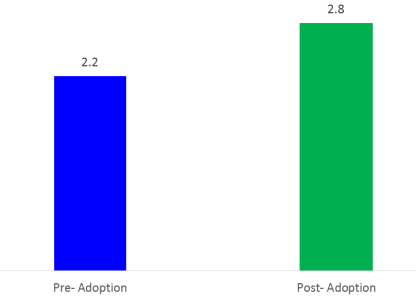
The adoption of Electronic Health Records (EHRs) has been promoted globally as a strategy for improving healthcare delivery, yet challenges persist in Nigeria’s public health facilities, particularly during the transition from paper-based to electronic systems. This study therefore investigated how the adoption of EHRs influences Health Information Management (HIM) practices in Tertiary Healthcare Facilities in Kogi State, Nigeria. The study was a facility-based cross-sectional study conducted among 327 healthcare workers across major professional categories. Data were collected using a structured, self-administered questionnaire. A stratified random sampling technique was used to select participants to ensure adequate precision across staff groups. Differences in Health Information Management practices before and after EHR adoption were examined using paired sample t-test and Wilcoxon Signed-Rank test. The results show that 30.31% of respondents were aged between 25-29 years old, 67.70% were female, 22.12% held an MSc degree, and 23.01% had more than 20 years of work experience. The mean overall HIM performance score improved from 3.55 ± 0.76 before EHR implementation to 4.54 ± 0.50 after implementation, with a mean difference of –0.99 (CI: –1.09 to –0.90). The mean overall accessibility score before implementation was 2.17±0.86, increasing to 2.83±0.98 after implementation. Patient records were more easily accessible to authorized personnel after EHR adoption, with mean scores increasing from 1.813 ± 1.169 before adoption to 2.801 ± 1.449 after adoption. The difference was statistically significant (Z = -8.2, p < 0.001) and the effect size was large (r = 0.45). Timely retrieval of historical patient data for clinical decision-making improved, with mean scores rising from 2.147 ± 1.259 to 3.119 ± 1.330. The study demonstrates that although healthcare professionals recognise substantial improvements in data management, accessibility, and service delivery following EHR adoption, structural and capacity-related constraints continue to hinder optimal utilisation. Strengthening digital infrastructure, expanding ICT training, and ensuring sustained technical support are essential for maximising EHR benefits and advancing digital health implementation in Nigeria.
| Published in | World Journal of Public Health (Volume 11, Issue 2) |
| DOI | 10.11648/j.wjph.20261102.13 |
| Page(s) | 118-127 |
| Creative Commons |
This is an Open Access article, distributed under the terms of the Creative Commons Attribution 4.0 International License (http://creativecommons.org/licenses/by/4.0/), which permits unrestricted use, distribution and reproduction in any medium or format, provided the original work is properly cited. |
| Copyright |
Copyright © The Author(s), 2026. Published by Science Publishing Group |
Health Information Management Practice, Tertiary Healthcare Facilities, Nigeria
Variables | Frequency | Percentage (%) |
|---|---|---|
Age (years) | ||
Less than 25 | 105 | 23.23 |
25–29 | 137 | 30.31 |
30–34 | 133 | 29.42 |
35–39 | 52 | 11.50 |
40–44 | 13 | 2.88 |
45–49 | 6 | 1.33 |
50 and above | 6 | 1.33 |
Sex | ||
Female | 306 | 67.70 |
Male | 146 | 32.30 |
Religion | ||
Christianity | 258 | 57.08 |
Islam | 194 | 42.92 |
Marital Status | ||
Married | 348 | 76.99 |
Unmarried | 104 | 23.01 |
Highest Professional Qualification | ||
Certificate | 1 | 0.22 |
Diploma (ND/HND) | 74 | 16.37 |
Registered Nurse (RN) | 9 | 1.99 |
Registered Midwife (RM) | 6 | 1.33 |
Bachelor’s Degree | 258 | 57.08 |
Master’s Degree | 100 | 22.12 |
Doctorate Degree (PhD) | 4 | 0.88 |
Monthly Income (₦) | ||
Below ₦70,000 | 73 | 16.15 |
₦71,000 ₦100,000 | 10 | 2.21 |
₦101,000 ₦130,000 | 42 | 9.29 |
Above ₦131,000 | 327 | 72.35 |
Professional Cadre | ||
Medical Doctor | 60 | 13.27 |
Nurse/Midwife | 200 | 44.25 |
Health Information/Records Officer | 105 | 23.23 |
Others | 87 | 19.25 |
Current Employment Status | ||
Permanent | 327 | 72.35 |
Contract | 15 | 3.32 |
Temporary | 110 | 24.34 |
Years of Professional Experience | ||
Less than 5 years | 94 | 20.80 |
5–9 years | 74 | 16.37 |
10–14 years | 86 | 19.03 |
15–19 years | 94 | 20.80 |
20 years and above | 104 | 23.01 |
Years Using Hospital Registration System | ||
Less than 1 year | 82 | 18.14 |
1–3 years | 86 | 19.03 |
4–6 years | 63 | 13.94 |
More than 6 years | 221 | 48.89 |
Years of Experience in Current Hospital | ||
Less than 5 years | 130 | 28.76 |
5–9 years | 81 | 17.92 |
10–14 years | 62 | 13.72 |
15 years and above | 179 | 39.60 |
Primary Unit/Department | ||
Accident and Emergency | 30 | 6.64 |
Clinics | 51 | 11.28 |
Medical Records | 193 | 42.70 |
Nursing Station/Ward | 75 | 16.59 |
Outpatient Department (OPD) | 103 | 22.79 |
Characteristics | Strongly Agree | Agree | Neutral | Disagree | Strongly Disagree |
|---|---|---|---|---|---|
Efficiency of manual HIM processes | 71 (21.71%) | 171 (52.29%) | 15 (4.59%) | 57 (17.43%) | 13 (3.98%) |
Accuracy of manual medical records | 33 (10.09%) | 172 (52.60%) | 32 (9.79%) | 80 (24.46%) | 10 (3.06%) |
Quick retrieval using manual records | 41 (12.54%) | 127 (38.84%) | 27 (8.26%) | 103 (31.50%) | 29 (8.87%) |
Manual system was error-prone | 121 (37.00%) | 166 (50.76%) | 15 (4.59%) | 22 (6.73%) | 3 (0.92%) |
Communication under manual system were efficient | 46 (14.07%) | 140 (42.81%) | 28 (8.56%) | 95 (29.05%) | 18 (5.50%) |
Characteristics | Strongly Agree | Agree | Neutral | Disagree | Strongly Disagree |
|---|---|---|---|---|---|
Electronic health information management system has significantly improved the efficiency of our operations. | 201 (61.47%) | 113 (34.56%) | 6 (1.83%) | 7 (2.14%) | 0 (0.00%) |
EHR adoption has resulted in more accurate and reliable patient records compared to the manual system | 217 (66.36%) | 100 (30.58%) | 4 (1.22%) | 3 (0.92%) | 3 (0.92%) |
Electronic health records system has improved communication and collaboration among healthcare providers | 180 (55.05%) | 134 (40.98%) | 3 (0.92%) | 10 (3.06%) | 0 (0.00%) |
Electronic health records system allows for quick and seamless data entry and retrieval processes | 200 (61.16%) | 117 (35.78%) | 7 (2.14%) | 3 (0.92%) | 0 (0.00%) |
Electronic health records system has reduced the occurrence of errors and discrepancies in patient data | 187 (57.19%) | 121 (37.00%) | 13 (3.98%) | 6 (1.83%) | 0 (0.00%) |
Measure | Before Implementation Mean ± SD | After Implementation Mean ± SD | Mean Difference (Before – After) | 95% CI of Difference | t-value (df=326) | p-value |
|---|---|---|---|---|---|---|
Overall performance score | 3.55 ± 0.76 | 4.54 ± 0.50 | –0.99 | –1.09 to –0.90 | –20.30 | <0.001 |
Measure | Before Implementation Mean ± SD | After Implementation Mean ± SD | Mean Difference (Before – After) | 95% CI of Difference | t-value (df=326) | p-value |
|---|---|---|---|---|---|---|
performance score | 2.17± 0.86 | 2.83± 0.98 | –0. 66 | –1. 78 to –0. 54 | – 10.59 | 0.00 |
Characteristics | Before Mean (SD) | After Mean (SD) | Z | p | r |
|---|---|---|---|---|---|
Patient records were easily accessible to authorized personnel before the adoption of HER | 1.813 (1.169) | 2.801 (1.449) | -8.2 | <0.001 | 0.45 |
The manual system facilitated timely retrieval of historical patient data for clinical decision-making. | 2.147 (1.259) | 3.119 (1.330) | -7.6 | <0.001 | 0.42 |
Patient records were prone to loss or misplacement in the manual system | 2.602 (1.497) | 3.043 (1.405) | -4.3 | <0.001 | 0.24 |
It was challenging to locate specific patient information within the manual record-keeping system. | 2.116 (1.358) | 2.899 (1.390) | -6.9 | <0.001 | 0.38 |
The manual system hindered the seamless exchange of health information between healthcare providers. | 2.162 (1.337) | 2.272 (0.948) | -1.7 | 0.089 | 0.09 |
EHR | EHR Electronic Health Record |
HIM | Health Information Management |
KSSH | Kogi State Specialist Hospital |
FTHL | Federal Teaching Hospital Lokoja |
ICT | Information and Communication Technology |
OPD | Outpatient Department |
| [1] | Adane, K., Gizaw, A., & Kibret, G. D. (2019). The role of electronic medical records in improving healthcare quality: A systematic review. Journal of Healthcare Engineering, 2019, 1–8. |
| [2] | Adedeji, A. A., Atoyebi, O. A., & Adeoye, O. O. (2022). Digital transformation and workforce adaptability in Nigerian healthcare settings. Journal of Health Informatics in Africa, 9(1), 45–56. |
| [3] | Adebayo, C. O., & Kolawole, M. A. (2021). Adoption and utilization of electronic health records in Nigerian tertiary hospitals. Nigerian Journal of Health Information Management, 10(3), 122–136. |
| [4] | World Health Organization. (2022). Electronic health records: Definition and benefits. |
| [5] | Adebayo, C. O., & Oyetunde, O. (2024). Workflow redesign and electronic documentation: Lessons from Nigerian teaching hospitals. Health Informatics Journal, 30(1), 55–67. |
| [6] | Adedoyin, F., & Lawal, T. (2017). Manual record management and challenges in Nigerian hospitals. Nigerian Health Information Management Review, 9(2), 33–45. |
| [7] | Adeyemi, T., Ogunbiyi, R., & Afolabi, S. (2022). System efficiency and user experience in EHR-enabled facilities. Nigerian Journal of Clinical Informatics, 4(1), 60–72. |
| [8] | Adeyeye, K. (2024). Policy implementation challenges of the National Health ICT Framework in Nigeria. Nigerian Health Policy Review, 11(1), 23–37. |
| [9] | Chukwu, U., Okoro, T., & Adedeji, S. (2021). Comparative study of manual and electronic medical records in Nigeria. West African Journal of Medical Informatics, 12(2), 101–114. |
| [10] | Federal Ministry of Health. (2020). National Health Management Information System policy document. Abuja, Nigeria. |
| [11] | Kolodzey, L., Smith, J., & Howard, F. (2019). Evaluating EHR outcomes post-implementation. Health Informatics Journal, 25(4), 1200–1213. |
| [12] | Mackenzie, A., & Greenhalgh, T. (2021). Data migration in digital transformation. Journal of Health Services Research & Policy, 26(3), 210–218. |
| [13] | Ayamolowo, S. (2023). Governance and accountability in digital health systems in Nigeria. African Journal of Health Policy and Management, 5(2), 33–49. |
| [14] | Babalola, S., Olorunsaiye, C., & Amoo, E. (2019). Challenges in accessing skilled healthcare services in rural Nigeria. International Journal of Health Planning and Management, 34(1), e572–e583. |
| [15] | Adewumi, O., & Ismail, Z. (2021). Manual record management practices in Nigerian public hospitals. African Journal of Health Systems, 13(2), 77–89. |
| [16] | Tsegaye, A., Woldemariam, S., & Bariagaber, H. (2020). Performance of manual medical records. BMC Medical Informatics and Decision Making, 20(1), 1–10. |
| [17] | Njoroge, M., Kihara, A., & Mwangi, J. (2020). Communication practices in Kenyan hospitals. African Journal of Health Systems Research, 12(1), 54–63. |
| [18] | Nwaobasi, K., Uzochukwu, I., & Chinedu, P. (2023). Ensuring data quality during EHR migration. Nigerian Journal of Medical Informatics, 8(3), 54–68. |
| [19] | Obi, C., Eze, B., & Nwatu, C. (2018). Paper-based medical record challenges. Nigerian Journal of Clinical Practice, 21(3), 327–333. |
| [20] | Chansa, M., & Chileshe, M. (2019). Workflow improvements after EHR introduction. Health Services Insights, 12, 1–9. |
| [21] | Oladipo, T., Yusuf, O., & Alhassan, M. (2020). Ageing workforce challenges. Nigerian Journal of Hospital Management, 34(2), 67–79. |
| [22] | Eze, A., Nwankwo, C., & Anaba, I. (2021). Financial barriers to EHR implementation. African Health Economics Journal, 10(4), 99–113. |
| [23] | Asante, R., Opuni, F., & Tetteh, J. (2022). Digital readiness among young health professionals in Ghana. Health Informatics Journal, 28(4), 1–12. |
| [24] | Moyo, F., & Mhlongo, S. (2023). EHR adoption and documentation accuracy in South Africa. South African Journal of Health Informatics, 12(1), 22–34. |
| [25] | Mboera, L., Ipuge, Y., & Rumisha, S. (2020). Documentation practices in Tanzanian hospitals. BMC Health Services Research, 20(1), 1–12. |
| [26] | World Health Organization. (2023). Data protection and patient confidentiality. Geneva: WHO. |
| [27] | Ojo, A., & Popoola, S. (2015). Management of paper medical records. Journal of Hospital Administration, 4(2), 67–79. |
| [28] | Palabindala, V., Pamarthy, A., & Jonnalagadda, N. R. (2016). Adoption of electronic health records and barriers. Journal of Community Hospital Internal Medicine Perspectives, 6(5), 1–8. |
| [29] | Babatope, T., Akinyemi, A., & Olaniyan, M. (2024). Governance, policy, and EHR sustainability in Nigerian tertiary hospitals. Journal of Global Health Informatics, 6(1), 15–29. |
| [30] | Federal Ministry of Health/NHMIS. (2023). Health information governance guidelines. Abuja, Nigeria. |
| [31] | World Health Organization. (2016). Health information systems for decision-making in Nigeria. Geneva: WHO. |
APA Style
Adebayo, C. O., Raimi, O., Uduak, P., Wegbom, A. I., Mcfubara, K. G. (2026). Comparative Assessment of Health Information Management Efficiency Before and After Electronic Health Records Adoption in Tertiary Healthcare Facilities in Kogi State, Nigeria. World Journal of Public Health, 11(2), 118-127. https://doi.org/10.11648/j.wjph.20261102.13
ACS Style
Adebayo, C. O.; Raimi, O.; Uduak, P.; Wegbom, A. I.; Mcfubara, K. G. Comparative Assessment of Health Information Management Efficiency Before and After Electronic Health Records Adoption in Tertiary Healthcare Facilities in Kogi State, Nigeria. World J. Public Health 2026, 11(2), 118-127. doi: 10.11648/j.wjph.20261102.13
AMA Style
Adebayo CO, Raimi O, Uduak P, Wegbom AI, Mcfubara KG. Comparative Assessment of Health Information Management Efficiency Before and After Electronic Health Records Adoption in Tertiary Healthcare Facilities in Kogi State, Nigeria. World J Public Health. 2026;11(2):118-127. doi: 10.11648/j.wjph.20261102.13
@article{10.11648/j.wjph.20261102.13,
  author = {Caleb Oloruntoba Adebayo and Olatunde Raimi and Peter Uduak and Anthony Ike Wegbom and Kalada G Mcfubara},
  title = {Comparative Assessment of Health Information Management Efficiency Before and After Electronic Health Records Adoption in Tertiary Healthcare Facilities in Kogi State, Nigeria},
  journal = {World Journal of Public Health},
  volume = {11},
  number = {2},
  pages = {118-127},
  doi = {10.11648/j.wjph.20261102.13},
  url = {https://doi.org/10.11648/j.wjph.20261102.13},
  eprint = {https://article.sciencepublishinggroup.com/pdf/10.11648.j.wjph.20261102.13},
  abstract = {The adoption of Electronic Health Records (EHRs) has been promoted globally as a strategy for improving healthcare delivery, yet challenges persist in Nigeria’s public health facilities, particularly during the transition from paper-based to electronic systems. This study therefore investigated how the adoption of EHRs influences Health Information Management (HIM) practices in Tertiary Healthcare Facilities in Kogi State, Nigeria. The study was a facility-based cross-sectional study conducted among 327 healthcare workers across major professional categories. Data were collected using a structured, self-administered questionnaire. A stratified random sampling technique was used to select participants to ensure adequate precision across staff groups. Differences in Health Information Management practices before and after EHR adoption were examined using paired sample t-test and Wilcoxon Signed-Rank test. The results show that 30.31% of respondents were aged between 25-29 years old, 67.70% were female, 22.12% held an MSc degree, and 23.01% had more than 20 years of work experience. The mean overall HIM performance score improved from 3.55 ± 0.76 before EHR implementation to 4.54 ± 0.50 after implementation, with a mean difference of –0.99 (CI: –1.09 to –0.90). The mean overall accessibility score before implementation was 2.17±0.86, increasing to 2.83±0.98 after implementation. Patient records were more easily accessible to authorized personnel after EHR adoption, with mean scores increasing from 1.813 ± 1.169 before adoption to 2.801 ± 1.449 after adoption. The difference was statistically significant (Z = -8.2, p < 0.001) and the effect size was large (r = 0.45). Timely retrieval of historical patient data for clinical decision-making improved, with mean scores rising from 2.147 ± 1.259 to 3.119 ± 1.330. The study demonstrates that although healthcare professionals recognise substantial improvements in data management, accessibility, and service delivery following EHR adoption, structural and capacity-related constraints continue to hinder optimal utilisation. Strengthening digital infrastructure, expanding ICT training, and ensuring sustained technical support are essential for maximising EHR benefits and advancing digital health implementation in Nigeria.},
 year = {2026}
}
TY  - JOUR
T1  - Comparative Assessment of Health Information Management Efficiency Before and After Electronic Health Records Adoption in Tertiary Healthcare Facilities in Kogi State, Nigeria
AU  - Caleb Oloruntoba Adebayo
AU  - Olatunde Raimi
AU  - Peter Uduak
AU  - Anthony Ike Wegbom
AU  - Kalada G Mcfubara
Y1  - 2026/03/27
PY  - 2026
N1  - https://doi.org/10.11648/j.wjph.20261102.13
DO  - 10.11648/j.wjph.20261102.13
T2  - World Journal of Public Health
JF  - World Journal of Public Health
JO  - World Journal of Public Health
SP  - 118
EP  - 127
PB  - Science Publishing Group
SN  - 2637-6059
UR  - https://doi.org/10.11648/j.wjph.20261102.13
AB  - The adoption of Electronic Health Records (EHRs) has been promoted globally as a strategy for improving healthcare delivery, yet challenges persist in Nigeria’s public health facilities, particularly during the transition from paper-based to electronic systems. This study therefore investigated how the adoption of EHRs influences Health Information Management (HIM) practices in Tertiary Healthcare Facilities in Kogi State, Nigeria. The study was a facility-based cross-sectional study conducted among 327 healthcare workers across major professional categories. Data were collected using a structured, self-administered questionnaire. A stratified random sampling technique was used to select participants to ensure adequate precision across staff groups. Differences in Health Information Management practices before and after EHR adoption were examined using paired sample t-test and Wilcoxon Signed-Rank test. The results show that 30.31% of respondents were aged between 25-29 years old, 67.70% were female, 22.12% held an MSc degree, and 23.01% had more than 20 years of work experience. The mean overall HIM performance score improved from 3.55 ± 0.76 before EHR implementation to 4.54 ± 0.50 after implementation, with a mean difference of –0.99 (CI: –1.09 to –0.90). The mean overall accessibility score before implementation was 2.17±0.86, increasing to 2.83±0.98 after implementation. Patient records were more easily accessible to authorized personnel after EHR adoption, with mean scores increasing from 1.813 ± 1.169 before adoption to 2.801 ± 1.449 after adoption. The difference was statistically significant (Z = -8.2, p < 0.001) and the effect size was large (r = 0.45). Timely retrieval of historical patient data for clinical decision-making improved, with mean scores rising from 2.147 ± 1.259 to 3.119 ± 1.330. The study demonstrates that although healthcare professionals recognise substantial improvements in data management, accessibility, and service delivery following EHR adoption, structural and capacity-related constraints continue to hinder optimal utilisation. Strengthening digital infrastructure, expanding ICT training, and ensuring sustained technical support are essential for maximising EHR benefits and advancing digital health implementation in Nigeria.
VL  - 11
IS  - 2
ER  -
Department of Public Health Sciences, Rivers State University, Port Harcourt, Nigeria
Department of Public Health Sciences, Rivers State University, Port Harcourt, Nigeria
Department of Public Health Sciences, Rivers State University, Port Harcourt, Nigeria

Information



 Share This Article
 Twitter
 Linked In
 Facebook
 Copy
Copy Download