Introduction: Unmonitored pregnancies increase the occurrence of maternal and fetal complications. This study aimed to evaluate the complications of unmonitored pregnancies at the Diema Reference Health Center (CSRef). Methods: This was a retrospective cross-sectional data collection study for all cases of unmonitored pregnancies recorded in the maternity ward of the Diema CSRef from February 1, 2021, to April 31, 2022. The study focused on the records of women who gave birth but did not receive prenatal care (ANC) during their pregnancy. The sample size was 263. Data were entered into KoboToolbox and analyzed using SPSS. The survey forms were coded to ensure anonymity. Results: The proportion of unmonitored pregnancies was 20.4%. Maternal complications were dominated by hemorrhages (57.6%), fetal distress (13.3%), malaria (9.4%), hypertension with its complications (9.4%), and anemia (23%). Fetal mortality was 47%. Regarding fetal complications, the poor Apgar score was 34.4%, including 18.4% stillbirths. Prematurity was 60%, low birth weight 4%, macrosomia 3%, malformations 2%, and neonatal infections 3%. Fetal mortality was 47%. Conclusion: Unmonitored pregnancies represent approximately one-fifth of deliveries in Diema. Maternal complications were primarily hemorrhages, acute fetal distress, malaria, hypertension, and its complications. The fetal prognosis was dominated by prematurity and stillbirths. These complications can be avoided by regular monitoring of prenatal care.
This is an Open Access article, distributed under the terms of the Creative Commons Attribution 4.0 International License (http://creativecommons.org/licenses/by/4.0/), which permits unrestricted use, distribution and reproduction in any medium or format, provided the original work is properly cited.
Pregnancy is a natural and physiological event that does not always proceed normally, leading to morbidity and mortality that can nevertheless be avoided
[1]
Pascal NM, Pascal BM. Explanatory factors for low utilization of antenatal care services by pregnant women in the Katoyi health area of the Karisimbi health zone in the Democratic Republic of Congo. Humanit Nat Sci J. 2025; 6(11): 734-44.
[1]
. Prenatal consultations during pregnancy are crucial and aim to detect and treat complications if they are discovered
[2]
Rafamatanantsoa JF, Randriamifidy ZDJC, Mirai-mila B, Ramontalambo TJ, Rakotoarison R, Raobela L, et al. Factors associated with the number of antenatal consultations in the Faratsiho district, Madagascar. Rev Afr Médecine Santé Publique. 1 Feb 2024; 7(1): 272-84.
[2]
. They should be systematically offered at the time of pregnancy confirmation
[3]
Viaud M, Lelong N, Ray CL. Factors associated with not having an early prenatal interview, data from the 2021 National Perinatal Survey. Public Health. 6 Oct 2025; 37(3): 49-59.
[3]
.
Unmonitored pregnancies refer to experiencing a pregnancy without the assistance of a healthcare professional
[4]
Ahmad Tajuddin NAN, Suhaimi J, Ramdzan SN, Malek KA, Ismail IA, Shamsuddin NH, et al. Why women chose unassisted home birth in Malaysia: a qualitative study. BMC Pregnancy Childbirth. 19 May 2020; 20(1): 309.
[4]
. Under normal circumstances and throughout the pregnancy, prenatal monitoring is necessary to ensure the smooth progress of this period and for psychological well-being, in which the early prenatal consultation or individual interview in the 4th month is an essential moment
[3]
Viaud M, Lelong N, Ray CL. Factors associated with not having an early prenatal interview, data from the 2021 National Perinatal Survey. Public Health. 6 Oct 2025; 37(3): 49-59.
[3]
.
According to World Health Organization (WHO) estimates, and due to complications, 287,000 maternal deaths occurred worldwide in 2020, representing one death every two minutes
[5]
World Health Organization (WHO). According to the WHO, many pregnancy complications go undetected and untreated. [cited 3 Jan 2026]. Available at:
. Prenatal care is often insufficient in both quality and quantity in developing countries. Furthermore, according to the latest WHO recommendations, and to reduce maternal and fetal complications that lead to death, women should have at least eight contacts in order to reduce risks and ensure a good prognosis for both patients and their fetuses
[7]
Madoue GB, Lhagadang F, Saleh A, Gnimindang A. Quality of prenatal care for patients admitted to the delivery room at the maternity ward of the Mother and Child University Hospital of N’Djamena. Kisangani MedEn Ligne. 2023; 615-20.
[7]
.
In Africa, 65% of births are attended by skilled health personnel; this is the lowest rate in the world and well below the target of 90% for 2030, according to the Atlas of African Health Statistics in 2022
[8]
World Health Organization. Progress made by Africa in reducing maternal and infant mortality is regressing, according to a WHO report. 2022 [cited 12 Feb 2023]. Available at:
In Mali, according to the Demographic and Health Survey (EDSM) In 2018, the maternal mortality rate was estimated at 325 maternal deaths per 100,000 live births, and the neonatal mortality rate was estimated at 101 deaths per 1,000 live births
[9]
Planning and Statistics Unit, Health-Social Development and Family Promotion Sector (CPS/SS-DS-PF), National Institute of Statistics (INSTAT). Demographic and Health Survey 2018. Rockville, Maryland, USA; 2018. 643 p.
[9]
. According to the same source, unmonitored pregnancies accounted for 19.3%. These were observed primarily among women with few children, single women, and women of low socioeconomic status
[9]
Planning and Statistics Unit, Health-Social Development and Family Promotion Sector (CPS/SS-DS-PF), National Institute of Statistics (INSTAT). Demographic and Health Survey 2018. Rockville, Maryland, USA; 2018. 643 p.
[9]
.
To date, no study has been carried out on the maternal-fetal complications of pregnancies not monitored in the reference health center (CSRef ) of Diema, hence the interest of our study whose objective is to evaluate the maternal -fetal complications of pregnancies not monitored at the CSRef of Diema between February 1, 2021 and April 31, 2022.
2. Materials and Methods
2.1. Study Setting
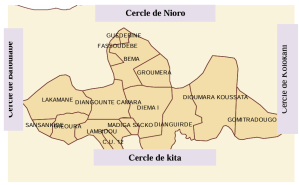
This study was conducted in the maternity unit of the Diema Reference Health Center. Located in Kayes region in Mali, Diema health district has 23 community health centers and one reference health center which receive referenced patients from them. It covers an area of 12,360 km² with a population of 299,350 inhabitants in 2020, for a density of 22 inhabitants/km².
Figure 1. Health Map of the District of Diema of 2025.
2.2. Study Type and Period
This was a cross-sectional study with retrospective data collection from February 1st, 2021 to April 31st, 2022.
2.3. Study Population and Simple Size
The study focused on the records of women who gave birth at the maternity ward of the Diema CSRef and who did not receive prenatal care during their pregnancy. The sample size was calculated using Schwartz's formula. This sample size was 263 participants.
2.4. Data Collection and Analysis
Review of birth registers and medical records (partogram; birth record). The data were collected through Kobotoolbox and analyzed on SPSS version 20. The calculation of Pearson's chi-squared test, Fisher's test and the probability (p) with the alpha risk set at 5%.
2.5. Ethical Considerations
To conduct this study, we obtained approval from the administrative authorities of the Diema Regional Health Center (CSRef Diema). Confidentiality regarding access to and protection of personal data was guaranteed, and access to personally identifiable information about participants was strictly limited to the investigators. The survey forms were coded.
3. Results
3.1. Frequency of Pregnancy Unmonitored
During the study period, the proportion of pregnancies not monitored was 20.4% among all birth (255/1251).
3.2. Sociodemographic, Clinic Characteristics
Women aged 26 to 35 in childbirth represented 34.5% of our sample. 95.7% of them were married. Women were transferred from other healthcare facilities (46.7%). Hypertension was present in 7.5% of cases among the women who had given birth. Severe anemia was present in 17% of cases, and the mean hemoglobin level was 9.46 ± 2.76 g/dl. Participants arrived with a ruptured amniotic sac in 35% of cases. Fetal distress was the indication for cesarean section in 18% (Table 1).
Table 1. Distribution of women not followed up according to clinical and paraclinical characteristics at the Diema Reference Health Center from February 2021 to April 2022.
Water pocket
n
%
Admission mode
It came of its own accord
91
35.37
Refer
45
17.6
Evacuate
119
46.7
Medical history
HTA
19
7.5
Diabetes
2
0.8
Asthma
1
0.4
Sickle cell disease
1
0.4
None
221
86.7
Others*
11
4.3
Hemoglobin level (g/dl)
11-15
110
43.0
7-10
102
40.0
2-6
43
17
State of the amniotic sac
Broken
88
35
Intact
167
65
Delivery route
Low
177
69
High
78
31
Indication for cesarean section
Dynamic dystocia
5
2
Mechanical dystocia
15
6
Acute fetal distress
45
18
Maternal pathology*
13
5
3.3. Maternal Complications and Prognosis
The most common obstetric complications were hemorrhage (54.1%), followed by fetal distress (12.1%) and malaria (9.4%). The most frequent complications during labor were, in order, hemorrhage (57.6%), fetal distress (13.3%), and hypertension with its complications (9.4%). Postpartum complications were predominantly 51%, compared to 49% for uncomplicated postpartum recovery. There was one death following an abortion, and 13 patients were transferred to a university hospital for more specialized care. (See Table 2).
Table 2. Distribution of women not followed up according to complications at the Diema Referral Health Center from February 2021 to April 2022.
Complications
n
%
Obstetric complication at admission
Hemorrhage
138
54.1
Hypertension and its complications
17
6.8
Acute fetal distress
31
12.1
Malaria
24
9.4
Others*
14
5.5
None
31
12.1
Complication during labor
Hemorrhage
147
57.6
Hypertension and its complications
24
9.4
Malaria
24
9.4
Acute fetal distress
34
13.3
Others*
17
6.7
None
9
3.5
Postpartum Complications
Not complicated
125
49
Complicated
130
51
Postpartum period
Hemorrhage
20
7.8
Hypertension and its complications
23
9.02
Malaria
24
9.4
Anemia
60
23.5
Other complications
3
1.2
Not complicated
125
49.01
The course of the pregnancy
Release
219
85.9
Refer to a university hospital
22
8.6
Evacuate to a university hospital
13
5.1
Die
1
0.4
Release
219
85.9
3.4. Fetal Complications and Prognosis
The 34.4% of newborns had a poor Apgar score, including 18.4% stillbirths, 13.7% morbid pregnancies, and 2.3% apparent deaths. The abortion rate was 28.2%. Prematurity was present in 152 newborns (60%); low birth weight in 4%, macrosomia in 3%, malformations in 2%, and neonatal infections in 3%. Fetal mortality was 47%. (see Table 3).
Table 3. Distribution of women not receiving follow-up care at the Diema Reference Health Center (CSRef) from February 2021 to April 2022 according to fetal complications.
n
%
Fetal prognosis
Stillborn
47
18.4
Apparent death
6
2.3
Morbid
35
13.7
Good score
95
37.2
Abortion
72
28.2
Type of fetal morbidity
Prematurity
153
60
Hypotrophy
10
4
Macrosomia
8
3
Malformations
5
2
Neonatal infections
8
3
No complications
71
28
Newborn prognosis
Alive
136
53
Deceased *
119
47
4. Discussion
4.1. Limitationsof the Study
This was a retrospective study, meaning the medical records, only covers women who gave birth at the Diema Reference Health Center. Women who did not attend this center (home births, births in other facilities) are not included. In addition to other variables such as malnutrition, certain undiagnosed infections, and extreme multiparity, which may be associated with both lack of follow-up care and complications, these factors are not controlled for and are not recorded in the medical records.
During our 15-month study period, we recorded 1251 births, including 255 cases of unmonitored pregnancies, representing a frequency of 20.4%. However, this proportion of women without prenatal care is slightly higher compared to the national average of 19.3% in 2018
[1]
Pascal NM, Pascal BM. Explanatory factors for low utilization of antenatal care services by pregnant women in the Katoyi health area of the Karisimbi health zone in the Democratic Republic of Congo. Humanit Nat Sci J. 2025; 6(11): 734-44.
[1]
. According to a study by Viaud. M et al., in 2021 the proportion of women who reported not having prenatal care was 59.5%
[2]
Rafamatanantsoa JF, Randriamifidy ZDJC, Mirai-mila B, Ramontalambo TJ, Rakotoarison R, Raobela L, et al. Factors associated with the number of antenatal consultations in the Faratsiho district, Madagascar. Rev Afr Médecine Santé Publique. 1 Feb 2024; 7(1): 272-84.
[2]
.
4.2. Sociodemographic Characteristics
Women aged 26 to 35 represented 34.5% in our study. In contrast, Diallo FB et al. reported in 2021 that patients in the 15-24 age group represented 41.20%
[3]
Viaud M, Lelong N, Ray CL. Factors associated with not having an early prenatal interview, data from the 2021 National Perinatal Survey. Public Health. 6 Oct 2025; 37(3): 49-59.
[3]
. Our results show that a significant proportion of women giving birth were adolescents. This could be explained by early marriage among adolescent girls. In the Malian context, it is believed that at this age it is easy to educate a young girl, ensure she remains a virgin, and adhere to religious precepts
[4]
Ahmad Tajuddin NAN, Suhaimi J, Ramdzan SN, Malek KA, Ismail IA, Shamsuddin NH, et al. Why women chose unassisted home birth in Malaysia: a qualitative study. BMC Pregnancy Childbirth. 19 May 2020; 20(1): 309.
[4]
. Married women represented 96.1% of the women in our study. This result was comparable to that of Madoue GB in Chad in 2023, who found 99% of women giving birth to be married
[5]
World Health Organization (WHO). According to the WHO, many pregnancy complications go undetected and untreated. [cited 3 Jan 2026]. Available at:
. This could be explained by the increased frequency of early marriage in semi-urban areas, which is one of the factors responsible for obstetric complications during childbirth.
4.3. Clinical and Paraclinical Characteristics
In our study, evacuated women were the majority at 46.7%. A study conducted by Diallo FB et al
[10]
Diallo FB. Obstetric evacuations in delivery rooms at a second-level referral hospital in Guinea. J SAGO Gynecology – Obstetrics Health Reprod. 25 Sep 2025 [cited 3 Jan 2026]; 26(3). Available from:
. in Guinea in 2021 recorded 352 cases of obstetric evacuations out of a total of 2097 consultations, representing a frequency of 16.7%. In contrast, Guindo S et al
[11]
Guindo S, Pamateck S, Guindo I, Samake MF, Keita M, Kone D, et al. Management of pregnant women referred/evacuated for obstetric reasons at the Kalaban-koro Reference Health Center. Mali Med. 1 Oct 2024; 39(4): 22.
[11]
., in Mali in 2024, found 96.7%, their focus being primarily women referred or evacuated. The high proportion in our study could be explained by neglect or a lack of awareness of the symptoms of pregnancy-related complications. Among our women, 7.5% had a history of hypertension. This result is higher than that reported by Traore M
[12]
Traore M. Study of unmonitored pregnancies at the Kalaban-koro Reference Health Center [Medical Thesis]. [Bamako]: University of Sciences, Techniques and Technologies of Bamako; 2019.
[12]
, who found 5% in 2018 at the CSRef of Kalaban Coro. This proportion, although not too high, could be explained by poor adherence to hypertension treatment and the lack of follow-up of prenatal care.
During the vaginal examination, the amniotic sac had ruptured in 35% of cases and the amniotic fluid was stained in 4%. Since amniotic fluid is a marker of fetal well-being, regular prenatal care visits help reduce fluid-related abnormalities. During childbirth, 69% of patients delivered vaginally and 31% by cesarean section. Cesarean delivery was more common among patients with one or two prior contacts, at 23% respectively, in the Madoue GB
[7]
Madoue GB, Lhagadang F, Saleh A, Gnimindang A. Quality of prenatal care for patients admitted to the delivery room at the maternity ward of the Mother and Child University Hospital of N’Djamena. Kisangani MedEn Ligne. 2023; 615-20.
[7]
study in Chad in 2023. In the Diallo FB et al
[10]
Diallo FB. Obstetric evacuations in delivery rooms at a second-level referral hospital in Guinea. J SAGO Gynecology – Obstetrics Health Reprod. 25 Sep 2025 [cited 3 Jan 2026]; 26(3). Available from:
. study in 2021, cesarean section was the most frequent mode of delivery among referred patients, at 58.8%. This high proportion of cesarean sections in our study is likely due to various pregnancy and labor complications (primarily hypertension and its associated complications), which are nevertheless preventable with good prenatal care.
4.4. Maternal Complications and Prognosis
Lack of prenatal care is a significant risk factor that can expose pregnant women to numerous complications. In this study, the most frequent complications during labor were, in order: hemorrhage (57.6%), fetal distress (13.3%), malaria (9.4%), and hypertension with its complications (9.4%). According to the results of Spingler et al
[13]
Spingler T, Sonek J, Hoopmann M, Prodan N, Abele H, Kagan KO. Complication rate after termination of pregnancy for fetal defects. Ultrasound Obstet Gy-necol. July 2023; 62(1): 88-93.
[13]
. in 2023, complications appeared during the first, second, and third trimesters, respectively, with proportions of 6.0%, 27.0%, and 27.8%. Sanogo A
[14]
A S, Mr D, S S, A S, N S, H C, et al. Management of High Blood Pressure Associated with Pregnancy in Kalaban Coro (Mali): Health Res Afr. 27 Feb 2025 [cited 4 Jan 2026]; 3(3). Available from:
in Mali found, in 2025, 14% of preeclampsia and 13.3% of placental abruption complications. Postpartum complications occurred in 51% of cases, including anemia (23.5%), hypertension and its complications (9.4%), malaria (9.4%), and postpartum hemorrhage (7.8%). The increased frequency of anemia and malaria could be explained by the absence of ANC visits during which iron supplementation and SP intake are applied, hypertension being the leading risk factor for maternal and fetal morbidity and mortality worldwide, regular ANC monitoring combined with ongoing training of health workers helps prevent complications related to this disease.
During our survey, 5.1% of patients were transferred to the Gabriel Touré University Hospital Center (CHU) or the Point G Hospital for better care. We recorded one (1) post- abortion death (0.4%), which occurred in the context of septicemia. In contrast, the study by Diallo FB et al.
[10]
Diallo FB. Obstetric evacuations in delivery rooms at a second-level referral hospital in Guinea. J SAGO Gynecology – Obstetrics Health Reprod. 25 Sep 2025 [cited 3 Jan 2026]; 26(3). Available from:
, in Guinea in 2021 recorded 10 maternal deaths, representing a case fatality rate of 2.84%. For the study by Sanogo A et al
[14]
A S, Mr D, S S, A S, N S, H C, et al. Management of High Blood Pressure Associated with Pregnancy in Kalaban Coro (Mali): Health Res Afr. 27 Feb 2025 [cited 4 Jan 2026]; 3(3). Available from:
. in Mali in 2025, the major fetal complications were acute fetal distress (14.7%) and intrauterine fetal death (10.7%). The causes of death were dominated by hemorrhages (60.0%), followed by hypertension and its complications (40.0%).
4.5. Fetal Complications and Prognosis
In our study, 18.4% of newborns were stillborn; after delivery, 152 newborns (60%) were premature and 4% were low birth weight. According to the second Demographic and Health Survey of the Democratic Republic of Congo in 2013 (According to the DHS-DRC II (2013-2014) and the Sixth Demographic and Health Survey in Mali (EDSM-VI) in 2018, the majority of unmonitored pregnancies result in a high rate of prematurity with a poor Apgar score
[15]
Ministry of Planning and Monitoring the Implementation of the Modernity Revolution in the DRC. Second Demographic and Health Survey (DHS-DRC II 2013-2014). 2nd ed. Rockville, Maryland, USA; 2014. 678 p. Available from:
Diallo FB. Obstetric evacuations in delivery rooms at a second-level referral hospital in Guinea. J SAGO Gynecology – Obstetrics Health Reprod. 25 Sep 2025 [cited 3 Jan 2026]; 26(3). Available from:
, prematurity was found in 9.09% of cases, and 11.36% of newborns presented with fetal asphyxia. Ongoing training for healthcare workers and regular prenatal care for women contribute to reducing prematurity and peri-neonatal complications.
5. Conclusion
This study demonstrates that unmonitored pregnancies are frequent and represent approximately one fifth of deliveries at the Diema Reference Health Center. Maternal complications were primarily dominated by hemorrhages, accounting for half of all cases, followed by acute fetal distress, malaria, and hypertension with its complications. The fetal prognosis was marked by prematurity and stillbirths. This underscores the crucial importance of prenatal care during pregnancy to prevent or minimize these complications.
Abbreviations
ANC
Prenatal Care
WHO
World Health Organization
EDSM
Demographic and Health Survey-Mali
CSRef
Reference Health Center
CHU
University Hospital Center
Acknowledgments
We thank all healthcare workers of Diema’ Reference health center. We also thank participants for their participation.
Author Contributions
Nouhoum Telly: Conceptualization, Data curation, Formal analysis, Methodology, Software, Validation, Visualization, Writing – original draft
All materials and data used in this study are available from the corresponding author upon reasonable request.
Conflicts of Interest
The authors declare no conflicts of interest.
References
[1]
Pascal NM, Pascal BM. Explanatory factors for low utilization of antenatal care services by pregnant women in the Katoyi health area of the Karisimbi health zone in the Democratic Republic of Congo. Humanit Nat Sci J. 2025; 6(11): 734-44.
[2]
Rafamatanantsoa JF, Randriamifidy ZDJC, Mirai-mila B, Ramontalambo TJ, Rakotoarison R, Raobela L, et al. Factors associated with the number of antenatal consultations in the Faratsiho district, Madagascar. Rev Afr Médecine Santé Publique. 1 Feb 2024; 7(1): 272-84.
[3]
Viaud M, Lelong N, Ray CL. Factors associated with not having an early prenatal interview, data from the 2021 National Perinatal Survey. Public Health. 6 Oct 2025; 37(3): 49-59.
[4]
Ahmad Tajuddin NAN, Suhaimi J, Ramdzan SN, Malek KA, Ismail IA, Shamsuddin NH, et al. Why women chose unassisted home birth in Malaysia: a qualitative study. BMC Pregnancy Childbirth. 19 May 2020; 20(1): 309.
[5]
World Health Organization (WHO). According to the WHO, many pregnancy complications go undetected and untreated. [cited 3 Jan 2026]. Available at:
Madoue GB, Lhagadang F, Saleh A, Gnimindang A. Quality of prenatal care for patients admitted to the delivery room at the maternity ward of the Mother and Child University Hospital of N’Djamena. Kisangani MedEn Ligne. 2023; 615-20.
[8]
World Health Organization. Progress made by Africa in reducing maternal and infant mortality is regressing, according to a WHO report. 2022 [cited 12 Feb 2023]. Available at:
Planning and Statistics Unit, Health-Social Development and Family Promotion Sector (CPS/SS-DS-PF), National Institute of Statistics (INSTAT). Demographic and Health Survey 2018. Rockville, Maryland, USA; 2018. 643 p.
[10]
Diallo FB. Obstetric evacuations in delivery rooms at a second-level referral hospital in Guinea. J SAGO Gynecology – Obstetrics Health Reprod. 25 Sep 2025 [cited 3 Jan 2026]; 26(3). Available from:
Guindo S, Pamateck S, Guindo I, Samake MF, Keita M, Kone D, et al. Management of pregnant women referred/evacuated for obstetric reasons at the Kalaban-koro Reference Health Center. Mali Med. 1 Oct 2024; 39(4): 22.
[12]
Traore M. Study of unmonitored pregnancies at the Kalaban-koro Reference Health Center [Medical Thesis]. [Bamako]: University of Sciences, Techniques and Technologies of Bamako; 2019.
[13]
Spingler T, Sonek J, Hoopmann M, Prodan N, Abele H, Kagan KO. Complication rate after termination of pregnancy for fetal defects. Ultrasound Obstet Gy-necol. July 2023; 62(1): 88-93.
[14]
A S, Mr D, S S, A S, N S, H C, et al. Management of High Blood Pressure Associated with Pregnancy in Kalaban Coro (Mali): Health Res Afr. 27 Feb 2025 [cited 4 Jan 2026]; 3(3). Available from:
Ministry of Planning and Monitoring the Implementation of the Modernity Revolution in the DRC. Second Demographic and Health Survey (DHS-DRC II 2013-2014). 2nd ed. Rockville, Maryland, USA; 2014. 678 p. Available from:
Telly, N., Sangho, O., Dolo, H., Maguiraga, S., Sogodogo, A., et al. (2026). Maternal and Fetal Complications of Pregnancies Not Monitored at the Diéma Reference Health Center in Mali in 2023. World Journal of Public Health, 11(1), 36-42. https://doi.org/10.11648/j.wjph.20261101.15
Telly, N.; Sangho, O.; Dolo, H.; Maguiraga, S.; Sogodogo, A., et al. Maternal and Fetal Complications of Pregnancies Not Monitored at the Diéma Reference Health Center in Mali in 2023. World J. Public Health2026, 11(1), 36-42. doi: 10.11648/j.wjph.20261101.15
Telly N, Sangho O, Dolo H, Maguiraga S, Sogodogo A, et al. Maternal and Fetal Complications of Pregnancies Not Monitored at the Diéma Reference Health Center in Mali in 2023. World J Public Health. 2026;11(1):36-42. doi: 10.11648/j.wjph.20261101.15
@article{10.11648/j.wjph.20261101.15,
  author = {Nouhoum Telly and Oumar Sangho and Housseini Dolo and Soya Maguiraga and Abou Sogodogo and Zakaria Keita and Birma Apho Ly and Souleymane Sekou Diarra and Salia Keita and Cheick Abou Coulibaly and Abdoul Salam Diarra and Hamdoun Sangho},
  title = {Maternal and Fetal Complications of Pregnancies Not Monitored at the Diéma Reference Health Center in Mali in 2023},
  journal = {World Journal of Public Health},
  volume = {11},
  number = {1},
  pages = {36-42},
  doi = {10.11648/j.wjph.20261101.15},
  url = {https://doi.org/10.11648/j.wjph.20261101.15},
  eprint = {https://article.sciencepublishinggroup.com/pdf/10.11648.j.wjph.20261101.15},
  abstract = {Introduction: Unmonitored pregnancies increase the occurrence of maternal and fetal complications. This study aimed to evaluate the complications of unmonitored pregnancies at the Diema Reference Health Center (CSRef). Methods: This was a retrospective cross-sectional data collection study for all cases of unmonitored pregnancies recorded in the maternity ward of the Diema CSRef from February 1, 2021, to April 31, 2022. The study focused on the records of women who gave birth but did not receive prenatal care (ANC) during their pregnancy. The sample size was 263. Data were entered into KoboToolbox and analyzed using SPSS. The survey forms were coded to ensure anonymity. Results: The proportion of unmonitored pregnancies was 20.4%. Maternal complications were dominated by hemorrhages (57.6%), fetal distress (13.3%), malaria (9.4%), hypertension with its complications (9.4%), and anemia (23%). Fetal mortality was 47%. Regarding fetal complications, the poor Apgar score was 34.4%, including 18.4% stillbirths. Prematurity was 60%, low birth weight 4%, macrosomia 3%, malformations 2%, and neonatal infections 3%. Fetal mortality was 47%. Conclusion: Unmonitored pregnancies represent approximately one-fifth of deliveries in Diema. Maternal complications were primarily hemorrhages, acute fetal distress, malaria, hypertension, and its complications. The fetal prognosis was dominated by prematurity and stillbirths. These complications can be avoided by regular monitoring of prenatal care.},
 year = {2026}
}
TY  - JOUR
T1  - Maternal and Fetal Complications of Pregnancies Not Monitored at the Diéma Reference Health Center in Mali in 2023
AU  - Nouhoum Telly
AU  - Oumar Sangho
AU  - Housseini Dolo
AU  - Soya Maguiraga
AU  - Abou Sogodogo
AU  - Zakaria Keita
AU  - Birma Apho Ly
AU  - Souleymane Sekou Diarra
AU  - Salia Keita
AU  - Cheick Abou Coulibaly
AU  - Abdoul Salam Diarra
AU  - Hamdoun Sangho
Y1  - 2026/02/14
PY  - 2026
N1  - https://doi.org/10.11648/j.wjph.20261101.15
DO  - 10.11648/j.wjph.20261101.15
T2  - World Journal of Public Health
JF  - World Journal of Public Health
JO  - World Journal of Public Health
SP  - 36
EP  - 42
PB  - Science Publishing Group
SN  - 2637-6059
UR  - https://doi.org/10.11648/j.wjph.20261101.15
AB  - Introduction: Unmonitored pregnancies increase the occurrence of maternal and fetal complications. This study aimed to evaluate the complications of unmonitored pregnancies at the Diema Reference Health Center (CSRef). Methods: This was a retrospective cross-sectional data collection study for all cases of unmonitored pregnancies recorded in the maternity ward of the Diema CSRef from February 1, 2021, to April 31, 2022. The study focused on the records of women who gave birth but did not receive prenatal care (ANC) during their pregnancy. The sample size was 263. Data were entered into KoboToolbox and analyzed using SPSS. The survey forms were coded to ensure anonymity. Results: The proportion of unmonitored pregnancies was 20.4%. Maternal complications were dominated by hemorrhages (57.6%), fetal distress (13.3%), malaria (9.4%), hypertension with its complications (9.4%), and anemia (23%). Fetal mortality was 47%. Regarding fetal complications, the poor Apgar score was 34.4%, including 18.4% stillbirths. Prematurity was 60%, low birth weight 4%, macrosomia 3%, malformations 2%, and neonatal infections 3%. Fetal mortality was 47%. Conclusion: Unmonitored pregnancies represent approximately one-fifth of deliveries in Diema. Maternal complications were primarily hemorrhages, acute fetal distress, malaria, hypertension, and its complications. The fetal prognosis was dominated by prematurity and stillbirths. These complications can be avoided by regular monitoring of prenatal care.
VL  - 11
IS  - 1
ER  -
Faculty of Medicine and Odontostomatology, University of Sciences, Techniques and Technologies of Bamako (USTTB), Bamako, Mali;Sectoral Unit for the Fight Against HIV/AIDS, Tuberculosis and Viral Hepatitis (CSLS-TBH), Ministry of Health and Social Development, Bamako, Mali
Telly, N., Sangho, O., Dolo, H., Maguiraga, S., Sogodogo, A., et al. (2026). Maternal and Fetal Complications of Pregnancies Not Monitored at the Diéma Reference Health Center in Mali in 2023. World Journal of Public Health, 11(1), 36-42. https://doi.org/10.11648/j.wjph.20261101.15
Telly, N.; Sangho, O.; Dolo, H.; Maguiraga, S.; Sogodogo, A., et al. Maternal and Fetal Complications of Pregnancies Not Monitored at the Diéma Reference Health Center in Mali in 2023. World J. Public Health2026, 11(1), 36-42. doi: 10.11648/j.wjph.20261101.15
Telly N, Sangho O, Dolo H, Maguiraga S, Sogodogo A, et al. Maternal and Fetal Complications of Pregnancies Not Monitored at the Diéma Reference Health Center in Mali in 2023. World J Public Health. 2026;11(1):36-42. doi: 10.11648/j.wjph.20261101.15
@article{10.11648/j.wjph.20261101.15,
  author = {Nouhoum Telly and Oumar Sangho and Housseini Dolo and Soya Maguiraga and Abou Sogodogo and Zakaria Keita and Birma Apho Ly and Souleymane Sekou Diarra and Salia Keita and Cheick Abou Coulibaly and Abdoul Salam Diarra and Hamdoun Sangho},
  title = {Maternal and Fetal Complications of Pregnancies Not Monitored at the Diéma Reference Health Center in Mali in 2023},
  journal = {World Journal of Public Health},
  volume = {11},
  number = {1},
  pages = {36-42},
  doi = {10.11648/j.wjph.20261101.15},
  url = {https://doi.org/10.11648/j.wjph.20261101.15},
  eprint = {https://article.sciencepublishinggroup.com/pdf/10.11648.j.wjph.20261101.15},
  abstract = {Introduction: Unmonitored pregnancies increase the occurrence of maternal and fetal complications. This study aimed to evaluate the complications of unmonitored pregnancies at the Diema Reference Health Center (CSRef). Methods: This was a retrospective cross-sectional data collection study for all cases of unmonitored pregnancies recorded in the maternity ward of the Diema CSRef from February 1, 2021, to April 31, 2022. The study focused on the records of women who gave birth but did not receive prenatal care (ANC) during their pregnancy. The sample size was 263. Data were entered into KoboToolbox and analyzed using SPSS. The survey forms were coded to ensure anonymity. Results: The proportion of unmonitored pregnancies was 20.4%. Maternal complications were dominated by hemorrhages (57.6%), fetal distress (13.3%), malaria (9.4%), hypertension with its complications (9.4%), and anemia (23%). Fetal mortality was 47%. Regarding fetal complications, the poor Apgar score was 34.4%, including 18.4% stillbirths. Prematurity was 60%, low birth weight 4%, macrosomia 3%, malformations 2%, and neonatal infections 3%. Fetal mortality was 47%. Conclusion: Unmonitored pregnancies represent approximately one-fifth of deliveries in Diema. Maternal complications were primarily hemorrhages, acute fetal distress, malaria, hypertension, and its complications. The fetal prognosis was dominated by prematurity and stillbirths. These complications can be avoided by regular monitoring of prenatal care.},
 year = {2026}
}
TY  - JOUR
T1  - Maternal and Fetal Complications of Pregnancies Not Monitored at the Diéma Reference Health Center in Mali in 2023
AU  - Nouhoum Telly
AU  - Oumar Sangho
AU  - Housseini Dolo
AU  - Soya Maguiraga
AU  - Abou Sogodogo
AU  - Zakaria Keita
AU  - Birma Apho Ly
AU  - Souleymane Sekou Diarra
AU  - Salia Keita
AU  - Cheick Abou Coulibaly
AU  - Abdoul Salam Diarra
AU  - Hamdoun Sangho
Y1  - 2026/02/14
PY  - 2026
N1  - https://doi.org/10.11648/j.wjph.20261101.15
DO  - 10.11648/j.wjph.20261101.15
T2  - World Journal of Public Health
JF  - World Journal of Public Health
JO  - World Journal of Public Health
SP  - 36
EP  - 42
PB  - Science Publishing Group
SN  - 2637-6059
UR  - https://doi.org/10.11648/j.wjph.20261101.15
AB  - Introduction: Unmonitored pregnancies increase the occurrence of maternal and fetal complications. This study aimed to evaluate the complications of unmonitored pregnancies at the Diema Reference Health Center (CSRef). Methods: This was a retrospective cross-sectional data collection study for all cases of unmonitored pregnancies recorded in the maternity ward of the Diema CSRef from February 1, 2021, to April 31, 2022. The study focused on the records of women who gave birth but did not receive prenatal care (ANC) during their pregnancy. The sample size was 263. Data were entered into KoboToolbox and analyzed using SPSS. The survey forms were coded to ensure anonymity. Results: The proportion of unmonitored pregnancies was 20.4%. Maternal complications were dominated by hemorrhages (57.6%), fetal distress (13.3%), malaria (9.4%), hypertension with its complications (9.4%), and anemia (23%). Fetal mortality was 47%. Regarding fetal complications, the poor Apgar score was 34.4%, including 18.4% stillbirths. Prematurity was 60%, low birth weight 4%, macrosomia 3%, malformations 2%, and neonatal infections 3%. Fetal mortality was 47%. Conclusion: Unmonitored pregnancies represent approximately one-fifth of deliveries in Diema. Maternal complications were primarily hemorrhages, acute fetal distress, malaria, hypertension, and its complications. The fetal prognosis was dominated by prematurity and stillbirths. These complications can be avoided by regular monitoring of prenatal care.
VL  - 11
IS  - 1
ER  -

 ,
Oumar Sangho
,
Oumar Sangho


 Share This Article
 Twitter
 Linked In
 Facebook
 Copy
Copy Download