Background: Dermatofibrosarcoma protuberans (DFSP) is a rare, locally aggressive cutaneous soft-tissue sarcoma characterized by low metastatic potential. However, rare fibrosarcomatous transformation (FS-DFSP) significantly increases the risk of systemic spread; although metastases—particularly pulmonary ones—are infrequent compared to other skin tumors, they have been sporadically described in the medical literature. Objective: This report documents a rare clinical case of extensive intrathoracic dissemination secondary to advanced metastatic progression in an elderly patient with a long-standing history of recurrent DFSP managed in a resource-constrained setting and the first documented primary pulmonary metastasis in the Gambia. Methods: We conducted a retrospective clinical analysis of an 81-year-old male presenting with severe, progressive dyspnea following a 14-year history of recurrent, histologically confirmed DFSP across the limbs and torso. The evaluation involved a comprehensive clinical examination, review of historical dermatological records, and detailed thoracic imaging to establish the extent of visceral involvement. Results: Clinical and radiological evaluations revealed massive intrathoracic tumor burden consistent with pulmonary and pleural metastases originating from the transformed cutaneous sarcoma. Despite the indolent initial presentation of DFSP, the development of late-stage visceral dissemination underscores the aggressive biological potential of the tumor over extended timelines. Managing this complex presentation was further compounded by limited local diagnostic and therapeutic resources. Conclusion: This case highlights the critical necessity for long-term clinical vigilance regarding indolent dermatological conditions, outlines the diagnostic challenges in linking chronic skin lesions to visceral metastasis, and emphasizes the urgent need for improved diagnostic pathways, heightened surveillance, and multidisciplinary care models to effectively manage complex soft-tissue sarcomas in resource-limited environments.
This is an Open Access article, distributed under the terms of the Creative Commons Attribution 4.0 International License (http://creativecommons.org/licenses/by/4.0/), which permits unrestricted use, distribution and reproduction in any medium or format, provided the original work is properly cited.
Dermatofibrosarcoma Protuberans, Rare Diseases, Cancer, West Africa, Gambia
1. Introduction
Dermatofibrosarcoma protuberans (DFSP) is an uncommon dermal soft tissue sarcoma, representing approximately 0.1% of all malignancies and about 1% of soft tissue sarcomas, with a global incidence estimated between 1 and 5 cases per million persons-years
[1]
World Health Organization. (2024). Classification of tumours of soft tissue and bone (5th ed.). WHO Press.
[2]
Kreicher, K. L., Kurlander, D. E., Gittleman, H., Barnholtz-Sloan, J. S., & Bordeaux, J. S. (2016). Dermatofibrosarcoma protuberans: A population-based analysis of incidence, recurrence, and survival. Dermatologic Surgery, 42(Suppl 1), S13–S19.
National Comprehensive Cancer Network. (2025). Clinical practice guidelines in oncology: Soft tissue sarcoma. NCCN.
[1-3]
. Notable demographic disparities exist, with incidence reported to be 1.14 times higher in women than in men, and nearly two times higher in Black individuals compared to White individuals, while long term outcomes remain excellent, reflected in a 10-year relative survival rate of 99.1%. Despite this favorable prognosis, specific factors—including advanced age, male sex, black race, and tumors arising on the limbs or head rather than the trunk—are associated with increased all-cause mortality. DFSP is classically indolent and slow growing but highly infiltrative locally, with a strong propensity for recurrence after inadequate excision, whereas distant metastasis is historically rare, occurring in fewer than 5% of cases; when it does occur, the lungs represent the undisputed primary site of involvement, particularly in the context of fibrosarcomatous transformation (FS DFSP), the aggressive histologic variant most strongly linked to metastatic spread. Although DFSP is well documented globally, published accounts of advanced thoracic dissemination remain virtually nonexistent in West African medical literature. A retrospective series of 69 cases is the largest African series published to date; it explicitly confirms the scarcity of reports in the region, with fibrosarcomatous transformation in 4.3% of cases and no documented cases of metastasis.
[4]
Orphanet Report Series. (2025). Prevalence and incidence of rare diseases: Bibliographic data (ORPHA: 211). Orphanet.
[5]
Alqalam, K. A., et al. (2026). Diagnostic and therapeutic challenges of dermatofibrosarcoma protuberans (DFSP): Insights from Libyan medical practitioners. Alqalam Journal of Medical and Applied Sciences, 9(1), 149-154.
Ogun GO, Ezenkwa US, Ayandipo OO. Dermatofibrosarcoma protuberance in a black African cohort-a clinicopathologic study. Ecancermedicalscience. 2020 Aug 7; 14: 1086.
, underscoring the rarity and clinical significance of such presentations in this region.
2. Case Presentation
2.1. Patient History and Clinical Presentation
An 81-year-old Gambian male presented to the medical clinic with a chief complaint of progressive shortness of breath and difficulty breathing. The dyspnea developed gradually over several months but experienced a severe, debilitating exacerbation over the preceding 3 weeks. The patient's past medical history was significant for multi-focal, disseminated cutaneous tumors distributed across his chest, back, and extremities. The primary lesion emerged approximately 14 years prior and was surgically; however, no histopathological feedback or formal diagnosis was provided to the patient at that time. Over the subsequent years, multiple new cutaneous nodules emerged, exhibiting an extremely slow, indolent growth pattern. A diagnostic biopsy performed just one year ago and formally established a diagnosis of dermatofibrosarcoma protuberans.
2.1.1. Dermatology Clinical Report
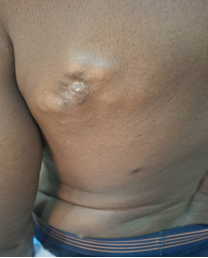
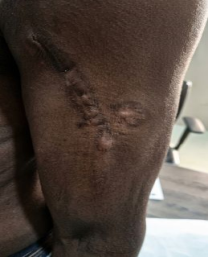
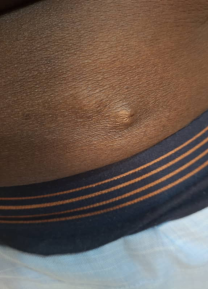
The patient presents with multiple firm, painless cutaneous and subcutaneous tumors distributed across both upper extremities; notable is an approximately 7 cm scar on the arm—resulting from a prior excision 14 years ago—showing small nodular lesions suggestive of tumor recurrence. Lesions with a multinodular or plaque-like morphology are observed on the anterior chest wall, posterior trunk, and lower limbs; these lack ulceration or signs of inflammation and are characterized by marked central retraction, dimpling, and cicatricial atrophy, with raised, indurated peripheral borders and pigmentation ranging from skin-colored to hyperpigmented. The presence of morphologically identical, highly indurated nodular masses on both the anterior and posterior chest walls—exhibiting deep epidermal puckering, central depression, and marked dermal fixation—strongly suggests a single, deeply infiltrative pathological process rather than independent lesions, raising the suspicion of transaxial or transthoracic extension. The symmetry, architectural distortion, multinodularity, and deep fixation are highly characteristic of an aggressive mesenchymal neoplasm; key differential diagnoses include deeply invasive dermatofibrosarcoma protuberans (DFSP) or its fibrosarcomatous variant, malignant fibrous histiocytoma (or undifferentiated pleomorphic sarcoma), and aggressive deep fibromatosis (desmoid-type). Figures 1-3.
Inspection revealed globally reduced chest expansion, which was profoundly marked on the left hemithorax. Palpation exposed a marked increase in tactile vocal fremitus ipsilateral. Upon auscultation, vesicular breath sounds were completely absent throughout the left lung field, accompanied by scattered, low-pitched expiratory wheezes in right lung.
2.2. Diagnostic Imaging
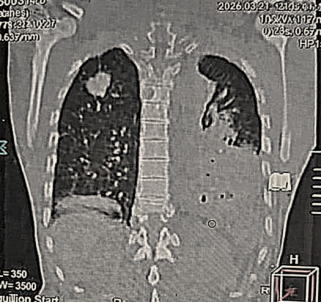
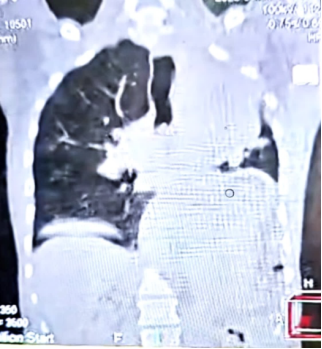
Advanced thoracic imaging, including Computed Tomography (CT), delineated an intrathoracic tumor progression (Figure 4 and Figure 5).
1) Left Hemithorax: A massive, homogeneous, space-occupying intrathoracic soft-tissue mass filled the entirety of the left thoracic cavity, resulting in atelectasis of the left lung parenchyma.
2) Mediastinal Shift: The extensive tumor volume exerted a severe mass effect, causing a massive rightward shifting of vital mediastinal structures, including the heart, trachea, and great vessels.
3) Contralateral Lung: Advanced dissemination confirmed by the presence of well-defined, metastatic pulmonary nodules within the partially compressed right lung fields.
2.3. Histopathological Report
Department of Pathology and Laboratory Medicine at the EFSTH (Hosp No: 11345084; Lab No FNAB: 24.12.375). Fine Needle Aspiration Cytology (FNAC) of the subcutaneous nodules showed cellular smears composed of atypical spindle-to-polygonal mesenchymal cells with hyperchromatic nuclei and scanty cytoplasm. The pathological features were interpreted as an intermediate-grade mesenchymal neoplasm consistent with a recurrence of DFSP.
3. Result
The clinical and radiological findings confirmed a rare presentation of advanced metastatic DFSP with extensive intrathoracic involvement. The histopathological confirmation of DFSP recurrence, coupled with the massive intrathoracic mass effect and pulmonary nodules, establishes this as a case of metastatic progression likely secondary to fibrosarcomatous transformation.
4. Discussion
The primary diagnostic challenge of dermatofibrosarcoma protuberans with fibrosarcomatous transformation (DFSP-FS) stems from its initial indolent growth, which often leads to misdiagnosis as benign lesions like lipomas or keloids. Clinically and pathologically, confirming DFSP-FS requires a rigorous differential diagnosis to rule out spindle-cell entities such as aggressive fibromatosis, undifferentiated pleomorphic sarcoma (malignant fibrous histiocytoma), conventional fibrosarcoma, and sarcomatoid carcinoma. This differentiation is successfully achieved by recognizing classic DFSP architecture, confirming specific immunohistochemical profiles (such as CD34 expression versus beta-catenin or cytokeratins), and identifying the historical progression from a long-standing cutaneous nodule to an advanced, aggressive neoplasm. Unfortunately, certain biomolecular and immunohistochemical techniques are unavailable in the country—a situation that highlights the need to raise awareness of this issue.
This case underscores an essential educational breach in general clinical practice: The difficulty less experienced physicians face in connecting seemingly localized dermatological conditions with severe, internal visceral organ affection
[6]
Ogun GO, Ezenkwa US, Ayandipo OO. Dermatofibrosarcoma protuberance in a black African cohort-a clinicopathologic study. Ecancermedicalscience. 2020 Aug 7; 14: 1086.
. As the first documented report of this advanced manifestation in West Africa, this case highlights a critical health equity gap. Confirming the COL1A1-PDGFB fusion gene via FISH or RT-PCR is required to predict targeted treatment success
[9]
Bordeaux, J., et al. (2025). Dermatofibrosarcoma protuberans, version 1.2025, NCCN clinical practice guidelines in oncology. Journal of the National Comprehensive Cancer Network, 23(1), e250001.
Stacchiotti, S., Astolfi, A., Gronchi, A., et al. (2021). Evolution in the diagnosis and management of dermatofibrosarcoma protuberans: A sarcoma community consensus statement. Novel Oncology Perspectives, 13(2), 145-152.
[11]
Mendenhall, W. M., & Indelicato, D. J. (2022). Management of advanced and metastatic soft-tissue sarcomas. Journal of Clinical Oncology, 40(12), 1345-1354.
Regarding treatment, because DFSP infiltrates deeply with tentacle-like projections, complete surgical removal using wide local excision or Mohs micrographic surgery is the gold standard to prevent high recurrence rates. Locally advanced tumors involving complex structures, multidisciplinary approach is needed incorporating neoadjuvant targeted therapy like imatinib, radical resections, and advanced reconstructive flap options
[13]
Mahfouz, Y., et al. (2026). Forehead dermatofibrosarcoma protuberans treated exclusively with full-thickness skin grafting: A unique case report and review of the literature. Journal of Cosmetic and Laser Therapy, 28(1), 1–6.
Sun L, Pinho M, Brazão C, Frade J, de Sousa D, de Vasconcelos P, Soares-de-Almeida L, Filipe P. Clinicopathologic features and treatment outcomes of dermatofibrosarcoma protuberans: a 25-year retrospective study. An Bras Dermatol. 2025 Nov-Dec; 100(6): 501213.
Zhang, H., et al. (2026a). Management of locally-advanced dermatofibrosarcoma protuberans: Four cases report. Journal of Surgical Case Reports, 10, 12975224.
[13-15]
. Either molecular diagnostics nor targeted TKI therapies like Imatinib are accessible or affordable in The Gambia. This passage highlights striking intraregional disparities in oncologic care across West Africa, contrasting a recent case in Ghana where a patient achieved complete remission from metastatic DFSP using palliative imatinib mesylate
[16]
Kpatsi, S., Daniels, J., Kyei, K. A., & Vanderpuye, V. (2025). Successful treatment of metastatic dermatofibrosarcoma protuberans of the breast to the lungs with imatinib mesylate: a case report. ecancermedicalscience, 19, Article 1912.
. This gap demonstrates that the barriers to effective soft-tissue sarcoma management stem not only from broad global inequities, but also from the uneven distribution of healthcare infrastructure between neighboring countries. Consequently, the text emphasizes the urgent necessity for coordinated tertiary referral networks and subsidized access to targeted therapies throughout the subregion.
5. Conclusion
This represents the first reported case of advanced metastatic DFSP presenting with massive intrathoracic extension and structural mediastinal shift in West Africa. The case provides a stark lesson on the dangers of diagnostic oversight stemming from the tumor's deceptive, slow growth and the clinical difficulty of linking skin lesions to internal organ pathology.
6. Recommendations
Addressing these diagnostic gaps and mitigating therapeutic resource disparities are essential to improving outcomes for rare soft-tissue malignancies in resource-constrained settings. Future efforts should prioritize the integration of multidisciplinary care models and the development of sustainable pathways for advanced diagnostic validation and targeted therapy access.
Hector O. Victoria Barzaga: Data curation, Formal Analysis, Validation, Conceptualization
Jennifer Shallop: Resources, Project administration, Conceptualization
Momodu Kabir Manneh: Data curation, Writing – original draft, Investigation
Syeda Qurat-ul-Ain Hasan: Data curation, Writing – original draft, Investigation
Al-Heri Bulus Mika: Data curation, Writing – original draft, Investigation
Conflicts of Interest
The authors declare no conflicts of interest.
References
[1]
World Health Organization. (2024). Classification of tumours of soft tissue and bone (5th ed.). WHO Press.
[2]
Kreicher, K. L., Kurlander, D. E., Gittleman, H., Barnholtz-Sloan, J. S., & Bordeaux, J. S. (2016). Dermatofibrosarcoma protuberans: A population-based analysis of incidence, recurrence, and survival. Dermatologic Surgery, 42(Suppl 1), S13–S19.
National Comprehensive Cancer Network. (2025). Clinical practice guidelines in oncology: Soft tissue sarcoma. NCCN.
[4]
Orphanet Report Series. (2025). Prevalence and incidence of rare diseases: Bibliographic data (ORPHA: 211). Orphanet.
[5]
Alqalam, K. A., et al. (2026). Diagnostic and therapeutic challenges of dermatofibrosarcoma protuberans (DFSP): Insights from Libyan medical practitioners. Alqalam Journal of Medical and Applied Sciences, 9(1), 149-154.
Ogun GO, Ezenkwa US, Ayandipo OO. Dermatofibrosarcoma protuberance in a black African cohort-a clinicopathologic study. Ecancermedicalscience. 2020 Aug 7; 14: 1086.
Bordeaux, J., et al. (2025). Dermatofibrosarcoma protuberans, version 1.2025, NCCN clinical practice guidelines in oncology. Journal of the National Comprehensive Cancer Network, 23(1), e250001.
Stacchiotti, S., Astolfi, A., Gronchi, A., et al. (2021). Evolution in the diagnosis and management of dermatofibrosarcoma protuberans: A sarcoma community consensus statement. Novel Oncology Perspectives, 13(2), 145-152.
[11]
Mendenhall, W. M., & Indelicato, D. J. (2022). Management of advanced and metastatic soft-tissue sarcomas. Journal of Clinical Oncology, 40(12), 1345-1354.
Mahfouz, Y., et al. (2026). Forehead dermatofibrosarcoma protuberans treated exclusively with full-thickness skin grafting: A unique case report and review of the literature. Journal of Cosmetic and Laser Therapy, 28(1), 1–6.
Sun L, Pinho M, Brazão C, Frade J, de Sousa D, de Vasconcelos P, Soares-de-Almeida L, Filipe P. Clinicopathologic features and treatment outcomes of dermatofibrosarcoma protuberans: a 25-year retrospective study. An Bras Dermatol. 2025 Nov-Dec; 100(6): 501213.
Zhang, H., et al. (2026a). Management of locally-advanced dermatofibrosarcoma protuberans: Four cases report. Journal of Surgical Case Reports, 10, 12975224.
[16]
Kpatsi, S., Daniels, J., Kyei, K. A., & Vanderpuye, V. (2025). Successful treatment of metastatic dermatofibrosarcoma protuberans of the breast to the lungs with imatinib mesylate: a case report. ecancermedicalscience, 19, Article 1912.
Cabrera, A. R., Barzaga, H. O. V., Shallop, J., Manneh, M. K., Hasan, S. Q., et al. (2026). A Rare Documented Case of Advanced Metastatic Dermatofibrosarcoma Protuberans (DFSP) with Extensive Intrathoracic Dissemination. World Journal of Medical Case Reports, 7(2), 29-33. https://doi.org/10.11648/j.wjmcr.20260702.12
Cabrera, A. R.; Barzaga, H. O. V.; Shallop, J.; Manneh, M. K.; Hasan, S. Q., et al. A Rare Documented Case of Advanced Metastatic Dermatofibrosarcoma Protuberans (DFSP) with Extensive Intrathoracic Dissemination. World J. Med. Case Rep.2026, 7(2), 29-33. doi: 10.11648/j.wjmcr.20260702.12
Cabrera AR, Barzaga HOV, Shallop J, Manneh MK, Hasan SQ, et al. A Rare Documented Case of Advanced Metastatic Dermatofibrosarcoma Protuberans (DFSP) with Extensive Intrathoracic Dissemination. World J Med Case Rep. 2026;7(2):29-33. doi: 10.11648/j.wjmcr.20260702.12
@article{10.11648/j.wjmcr.20260702.12,
  author = {Asmell Ramos Cabrera and Hector O. Victoria Barzaga and Jennifer Shallop and Momodu Kabir Manneh and Syeda Qurat-ul-Ain Hasan and Al-Heri Bulus Mika},
  title = {A Rare Documented Case of Advanced Metastatic Dermatofibrosarcoma Protuberans (DFSP) with Extensive Intrathoracic Dissemination},
  journal = {World Journal of Medical Case Reports},
  volume = {7},
  number = {2},
  pages = {29-33},
  doi = {10.11648/j.wjmcr.20260702.12},
  url = {https://doi.org/10.11648/j.wjmcr.20260702.12},
  eprint = {https://article.sciencepublishinggroup.com/pdf/10.11648.j.wjmcr.20260702.12},
  abstract = {Background: Dermatofibrosarcoma protuberans (DFSP) is a rare, locally aggressive cutaneous soft-tissue sarcoma characterized by low metastatic potential. However, rare fibrosarcomatous transformation (FS-DFSP) significantly increases the risk of systemic spread; although metastases—particularly pulmonary ones—are infrequent compared to other skin tumors, they have been sporadically described in the medical literature. Objective: This report documents a rare clinical case of extensive intrathoracic dissemination secondary to advanced metastatic progression in an elderly patient with a long-standing history of recurrent DFSP managed in a resource-constrained setting and the first documented primary pulmonary metastasis in the Gambia. Methods: We conducted a retrospective clinical analysis of an 81-year-old male presenting with severe, progressive dyspnea following a 14-year history of recurrent, histologically confirmed DFSP across the limbs and torso. The evaluation involved a comprehensive clinical examination, review of historical dermatological records, and detailed thoracic imaging to establish the extent of visceral involvement. Results: Clinical and radiological evaluations revealed massive intrathoracic tumor burden consistent with pulmonary and pleural metastases originating from the transformed cutaneous sarcoma. Despite the indolent initial presentation of DFSP, the development of late-stage visceral dissemination underscores the aggressive biological potential of the tumor over extended timelines. Managing this complex presentation was further compounded by limited local diagnostic and therapeutic resources. Conclusion: This case highlights the critical necessity for long-term clinical vigilance regarding indolent dermatological conditions, outlines the diagnostic challenges in linking chronic skin lesions to visceral metastasis, and emphasizes the urgent need for improved diagnostic pathways, heightened surveillance, and multidisciplinary care models to effectively manage complex soft-tissue sarcomas in resource-limited environments.},
 year = {2026}
}
TY  - JOUR
T1  - A Rare Documented Case of Advanced Metastatic Dermatofibrosarcoma Protuberans (DFSP) with Extensive Intrathoracic Dissemination
AU  - Asmell Ramos Cabrera
AU  - Hector O. Victoria Barzaga
AU  - Jennifer Shallop
AU  - Momodu Kabir Manneh
AU  - Syeda Qurat-ul-Ain Hasan
AU  - Al-Heri Bulus Mika
Y1  - 2026/08/27
PY  - 2026
N1  - https://doi.org/10.11648/j.wjmcr.20260702.12
DO  - 10.11648/j.wjmcr.20260702.12
T2  - World Journal of Medical Case Reports
JF  - World Journal of Medical Case Reports
JO  - World Journal of Medical Case Reports
SP  - 29
EP  - 33
PB  - Science Publishing Group
SN  - 2994-726X
UR  - https://doi.org/10.11648/j.wjmcr.20260702.12
AB  - Background: Dermatofibrosarcoma protuberans (DFSP) is a rare, locally aggressive cutaneous soft-tissue sarcoma characterized by low metastatic potential. However, rare fibrosarcomatous transformation (FS-DFSP) significantly increases the risk of systemic spread; although metastases—particularly pulmonary ones—are infrequent compared to other skin tumors, they have been sporadically described in the medical literature. Objective: This report documents a rare clinical case of extensive intrathoracic dissemination secondary to advanced metastatic progression in an elderly patient with a long-standing history of recurrent DFSP managed in a resource-constrained setting and the first documented primary pulmonary metastasis in the Gambia. Methods: We conducted a retrospective clinical analysis of an 81-year-old male presenting with severe, progressive dyspnea following a 14-year history of recurrent, histologically confirmed DFSP across the limbs and torso. The evaluation involved a comprehensive clinical examination, review of historical dermatological records, and detailed thoracic imaging to establish the extent of visceral involvement. Results: Clinical and radiological evaluations revealed massive intrathoracic tumor burden consistent with pulmonary and pleural metastases originating from the transformed cutaneous sarcoma. Despite the indolent initial presentation of DFSP, the development of late-stage visceral dissemination underscores the aggressive biological potential of the tumor over extended timelines. Managing this complex presentation was further compounded by limited local diagnostic and therapeutic resources. Conclusion: This case highlights the critical necessity for long-term clinical vigilance regarding indolent dermatological conditions, outlines the diagnostic challenges in linking chronic skin lesions to visceral metastasis, and emphasizes the urgent need for improved diagnostic pathways, heightened surveillance, and multidisciplinary care models to effectively manage complex soft-tissue sarcomas in resource-limited environments.
VL  - 7
IS  - 2
ER  -
Department of Internal Medicine, Edward Francis Small Teaching Hospital, Banjul, The Gambia; Department of Internal Medicine, American International University West Africa, Banjul, The Gambia
Cabrera, A. R., Barzaga, H. O. V., Shallop, J., Manneh, M. K., Hasan, S. Q., et al. (2026). A Rare Documented Case of Advanced Metastatic Dermatofibrosarcoma Protuberans (DFSP) with Extensive Intrathoracic Dissemination. World Journal of Medical Case Reports, 7(2), 29-33. https://doi.org/10.11648/j.wjmcr.20260702.12
Cabrera, A. R.; Barzaga, H. O. V.; Shallop, J.; Manneh, M. K.; Hasan, S. Q., et al. A Rare Documented Case of Advanced Metastatic Dermatofibrosarcoma Protuberans (DFSP) with Extensive Intrathoracic Dissemination. World J. Med. Case Rep.2026, 7(2), 29-33. doi: 10.11648/j.wjmcr.20260702.12
Cabrera AR, Barzaga HOV, Shallop J, Manneh MK, Hasan SQ, et al. A Rare Documented Case of Advanced Metastatic Dermatofibrosarcoma Protuberans (DFSP) with Extensive Intrathoracic Dissemination. World J Med Case Rep. 2026;7(2):29-33. doi: 10.11648/j.wjmcr.20260702.12
@article{10.11648/j.wjmcr.20260702.12,
  author = {Asmell Ramos Cabrera and Hector O. Victoria Barzaga and Jennifer Shallop and Momodu Kabir Manneh and Syeda Qurat-ul-Ain Hasan and Al-Heri Bulus Mika},
  title = {A Rare Documented Case of Advanced Metastatic Dermatofibrosarcoma Protuberans (DFSP) with Extensive Intrathoracic Dissemination},
  journal = {World Journal of Medical Case Reports},
  volume = {7},
  number = {2},
  pages = {29-33},
  doi = {10.11648/j.wjmcr.20260702.12},
  url = {https://doi.org/10.11648/j.wjmcr.20260702.12},
  eprint = {https://article.sciencepublishinggroup.com/pdf/10.11648.j.wjmcr.20260702.12},
  abstract = {Background: Dermatofibrosarcoma protuberans (DFSP) is a rare, locally aggressive cutaneous soft-tissue sarcoma characterized by low metastatic potential. However, rare fibrosarcomatous transformation (FS-DFSP) significantly increases the risk of systemic spread; although metastases—particularly pulmonary ones—are infrequent compared to other skin tumors, they have been sporadically described in the medical literature. Objective: This report documents a rare clinical case of extensive intrathoracic dissemination secondary to advanced metastatic progression in an elderly patient with a long-standing history of recurrent DFSP managed in a resource-constrained setting and the first documented primary pulmonary metastasis in the Gambia. Methods: We conducted a retrospective clinical analysis of an 81-year-old male presenting with severe, progressive dyspnea following a 14-year history of recurrent, histologically confirmed DFSP across the limbs and torso. The evaluation involved a comprehensive clinical examination, review of historical dermatological records, and detailed thoracic imaging to establish the extent of visceral involvement. Results: Clinical and radiological evaluations revealed massive intrathoracic tumor burden consistent with pulmonary and pleural metastases originating from the transformed cutaneous sarcoma. Despite the indolent initial presentation of DFSP, the development of late-stage visceral dissemination underscores the aggressive biological potential of the tumor over extended timelines. Managing this complex presentation was further compounded by limited local diagnostic and therapeutic resources. Conclusion: This case highlights the critical necessity for long-term clinical vigilance regarding indolent dermatological conditions, outlines the diagnostic challenges in linking chronic skin lesions to visceral metastasis, and emphasizes the urgent need for improved diagnostic pathways, heightened surveillance, and multidisciplinary care models to effectively manage complex soft-tissue sarcomas in resource-limited environments.},
 year = {2026}
}
TY  - JOUR
T1  - A Rare Documented Case of Advanced Metastatic Dermatofibrosarcoma Protuberans (DFSP) with Extensive Intrathoracic Dissemination
AU  - Asmell Ramos Cabrera
AU  - Hector O. Victoria Barzaga
AU  - Jennifer Shallop
AU  - Momodu Kabir Manneh
AU  - Syeda Qurat-ul-Ain Hasan
AU  - Al-Heri Bulus Mika
Y1  - 2026/08/27
PY  - 2026
N1  - https://doi.org/10.11648/j.wjmcr.20260702.12
DO  - 10.11648/j.wjmcr.20260702.12
T2  - World Journal of Medical Case Reports
JF  - World Journal of Medical Case Reports
JO  - World Journal of Medical Case Reports
SP  - 29
EP  - 33
PB  - Science Publishing Group
SN  - 2994-726X
UR  - https://doi.org/10.11648/j.wjmcr.20260702.12
AB  - Background: Dermatofibrosarcoma protuberans (DFSP) is a rare, locally aggressive cutaneous soft-tissue sarcoma characterized by low metastatic potential. However, rare fibrosarcomatous transformation (FS-DFSP) significantly increases the risk of systemic spread; although metastases—particularly pulmonary ones—are infrequent compared to other skin tumors, they have been sporadically described in the medical literature. Objective: This report documents a rare clinical case of extensive intrathoracic dissemination secondary to advanced metastatic progression in an elderly patient with a long-standing history of recurrent DFSP managed in a resource-constrained setting and the first documented primary pulmonary metastasis in the Gambia. Methods: We conducted a retrospective clinical analysis of an 81-year-old male presenting with severe, progressive dyspnea following a 14-year history of recurrent, histologically confirmed DFSP across the limbs and torso. The evaluation involved a comprehensive clinical examination, review of historical dermatological records, and detailed thoracic imaging to establish the extent of visceral involvement. Results: Clinical and radiological evaluations revealed massive intrathoracic tumor burden consistent with pulmonary and pleural metastases originating from the transformed cutaneous sarcoma. Despite the indolent initial presentation of DFSP, the development of late-stage visceral dissemination underscores the aggressive biological potential of the tumor over extended timelines. Managing this complex presentation was further compounded by limited local diagnostic and therapeutic resources. Conclusion: This case highlights the critical necessity for long-term clinical vigilance regarding indolent dermatological conditions, outlines the diagnostic challenges in linking chronic skin lesions to visceral metastasis, and emphasizes the urgent need for improved diagnostic pathways, heightened surveillance, and multidisciplinary care models to effectively manage complex soft-tissue sarcomas in resource-limited environments.
VL  - 7
IS  - 2
ER  -





 Share This Article
 Twitter
 Linked In
 Facebook
 Copy
Copy Download