Abstract
The integration of artificial intelligence (AI) in higher education offers new opportunities to enhance accessibility and inclusivity, particularly in teacher education programmes that prepare future educators to serve diverse learners. Although prior research has examined AI in libraries, Universal Design for Learning (UDL), and inclusive teacher education, limited studies explore their intersection within academic library contexts. This paper introduces the AI-Enabled Inclusive Library Services (AILS) Framework, a conceptual model designed to support accessibility and inclusivity in teacher education libraries. Grounded in UDL principles, international disability rights frameworks such as the UN Convention on the Rights of Persons with Disabilities, and global inclusive education policies, the framework positions libraries as both service providers and experiential learning environments for pre-service teachers. The AILS framework comprises seven interconnected components: foundational principles, contextual stakeholders, AI capabilities, library services and touchpoints, institutional capacity and governance, outcomes and evaluation, and feedback and adaptation. By incorporating AI technologies such as natural language processing, text-to-speech systems, recommender algorithms, and multilingual tools, the framework addresses barriers faced by students with disabilities and diverse learning backgrounds. Beyond improving resource accessibility, AILS models inclusive pedagogical practices for future educators and aligns with Sustainable Development Goals 4 and 10. The framework offers a globally adaptable approach for developing inclusive, AI-enabled library services in higher education.
|
Published in
|
Teacher Education and Curriculum Studies (Volume 11, Issue 2)
|
|
DOI
|
10.11648/j.tecs.20261102.13
|
|
Page(s)
|
63-78 |
|
Creative Commons
|

This is an Open Access article, distributed under the terms of the Creative Commons Attribution 4.0 International License (http://creativecommons.org/licenses/by/4.0/), which permits unrestricted use, distribution and reproduction in any medium or format, provided the original work is properly cited.
|
|
Copyright
|
Copyright © The Author(s), 2026. Published by Science Publishing Group
|
Keywords
Artificial Intelligence (AI), Library Services, Teacher Education, Accessibility, Inclusivity, Universal Design for Learning,
Inclusive Pedagogy
1. Introduction
The digital transformation of higher education has fundamentally reshaped how academic libraries serve their communities, particularly in teacher education institutions where future educators must be equipped with both technological competencies and inclusive pedagogical practices. As artificial intelligence (AI) continues to permeate educational landscapes, academic libraries find themselves at a critical juncture where they can leverage these emerging technologies to enhance accessibility and inclusivity while simultaneously serving as exemplars of best practice for prospective teachers
| [37] | Tan, X., Cheng, G., & Ling, M. H. (2025). Artificial intelligence in teaching and teacher professional development: A systematic review. Computers and Education: Artificial Intelligence, 8, Article 100355.
https://doi.org/10.1016/j.caeai.2024.100355 |
[37]
. This convergence presents unprecedented opportunities to address longstanding barriers that have historically limited equitable access to educational resources for students with diverse learning needs and disabilities.
The integration of AI technologies in library services represents more than a mere technological upgrade; it embodies a paradigmatic shift towards creating truly inclusive learning environments that can adapt to the diverse needs of all users
| [29] | Mosha, N. F. (2025). The role of artificial intelligence tools in enhancing accessibility and usability of electronic resources in academic libraries. Library Management, 46(1–2), 132–157.
https://doi.org/10.1108/LM-08-2024-0088 |
[29]
. In teacher education contexts, this transformation carries additional significance as these institutions are charged with preparing educators who will shape the next generation of learners. The libraries within such institutions must therefore function not only as resource repositories but as living laboratories where inclusive technology integration is modelled, tested, and refined for future educational practitioners
.
Recent research has demonstrated the substantial potential of AI-powered tools to address accessibility challenges that have persisted in traditional library services. Natural language processing (NLP) systems can provide intuitive search capabilities for users with varying technological literacies, while text-to-speech and speech-to-text technologies can break down barriers for users with visual or auditory impairments
| [22] | Khanuja, S., Ruder, S., & Talukdar, P. (2023). Evaluating the diversity, equity, and inclusion of NLP technology: A case study for Indian languages. In Findings of the Association for Computational Linguistics: EACL 2023 (pp. 1763–1777). Association for Computational Linguistics. https://doi.org/10.18653/v1/2023.findings-eacl.131 |
[22]
. Computer vision algorithms can automatically generate alternative text descriptions for images and documents, and recommender systems can personalise resource discovery based on individual learning preferences and accessibility requirements
| [14] | Han, X., & Dou, X. (2025). User recommendation method integrating hierarchical graph attention network with multimodal knowledge graph. Frontiers in Neurorobotics, 19, Article 1587973. https://doi.org/10.3389/fnbot.2025.1587973 |
[14]
.
However, the mere adoption of AI technologies does not guarantee inclusive outcomes. As highlighted by recent systematic reviews, there exists a critical gap in addressing the full spectrum of disabilities and learning differences through AI-enabled services
| [6] | Chemnad, K., & Othman, A. (2024). Digital accessibility in the era of artificial intelligence: A bibliometric analysis and systematic review. Frontiers in Artificial Intelligence, 7, Article 1349668. https://doi.org/10.3389/frai.2024.1349668 |
[6]
. Many current implementations focus predominantly on visual impairments while neglecting the needs of users with speech and hearing impairments, autism spectrum disorders, neurological conditions, and motor disabilities
| [27] | Melo-López, V.-A., Basantes-Andrade, A., Gudiño-Mejía, C.-B., & Hernández-Martínez, E. (2025). The impact of artificial intelligence on inclusive education: A systematic review. Education Sciences, 15(5), Article 539.
https://doi.org/10.3390/educsci15050539 |
[27]
. This limitation underscores the necessity for comprehensive frameworks that can guide the development and implementation of truly inclusive AI-enabled library services.
The concept of inclusive education has evolved from a peripheral concern to a central tenet of global educational policy, underpinned by international frameworks such as the United Nations Convention on the Rights of Persons with Disabilities (2006) and reflected in Sustainable Development Goal 4's commitment to ensuring "inclusive and equitable quality education"
| [40] | UNESCO. (2020). Inclusion and education: All means all [Global Education Monitoring Report]. UNESCO. |
[40]
. This shift demands that teacher education institutions not merely teach about inclusion theoretically but demonstrate it practically through their own service provision and learning environments.
The teacher education context adds another layer of complexity and opportunity to this challenge. Pre-service teachers require not only access to inclusive resources but also exposure to inclusive technologies as part of their professional preparation. They must understand how AI can be ethically and effectively integrated into educational practice while being mindful of potential biases and limitations
| [43] | Zhang, J., & Zhang, Z. (2024). AI in teacher education: Unlocking new dimensions in teaching support, inclusive learning, and digital literacy. Journal of Computer Assisted Learning, 40(4), 1871–1885. https://doi.org/10.1111/jcal.12988 |
[43]
. Libraries in teacher education institutions are uniquely positioned to provide this dual function: serving immediate accessibility needs while demonstrating best practices in inclusive technology integration.
Contemporary frameworks such as Universal Design for Learning (UDL) and Web Content Accessibility Guidelines (WCAG) provide foundational principles for inclusive design, yet these frameworks were developed before the current wave of AI capabilities emerged
| [33] | Rose, D. H., Harbour, W. A., Johnston, C. S., Daley, S. G., & Abarbanell, L. (2006). Universal design for learning in postsecondary education: Reflections on principles and their applications. Journal of Postsecondary Education and Disability, 19(2), 135–151. |
[33]
. There is an urgent need for new conceptual models that can effectively integrate these established accessibility principles with the capabilities and challenges presented by AI technologies. Such frameworks must address not only technical implementation but also ethical considerations, user participation, continuous improvement processes, and sustainable institutional support structures.
The significance of developing comprehensive AI-enabled inclusive library services extends beyond immediate accessibility improvements. These services can serve as catalysts for broader institutional transformation, promoting a culture of inclusion that permeates all aspects of teacher education programmes
| [30] | Navas-Bonilla, C. R., Guerra-Arango, J. A., Oviedo-Guado, D. A., & Murillo-Noriega, D. E. (2025). Inclusive education through technology: A systematic review of types, tools and characteristics. Frontiers in Education, 10, Article 1527851.
https://doi.org/10.3389/feduc.2025.1527851 |
[30]
. When pre-service teachers experience well-designed inclusive technologies during their preparation, they are more likely to advocate for and implement similar approaches in their future classrooms, creating a multiplier effect that can benefit countless students.
This paper addresses these critical needs by proposing the AI-Enabled Inclusive Library Services (AILS) Framework, a conceptual framework that integrates artificial intelligence capabilities with accessibility principles within teacher education library contexts. The framework integrates established accessibility principles with emerging AI capabilities while addressing implementation challenges related to institutional capacity, ethical governance, and sustainable evaluation processes. By focusing on teacher education institutions, this research contributes to both library and information science scholarship and teacher education research, offering practical guidance for institutions seeking to enhance their inclusive service provision.
The framework is grounded in recent empirical evidence while acknowledging the rapidly evolving nature of AI technologies and their applications in educational contexts. It emphasises the importance of user-centred design, continuous feedback mechanisms, and ethical considerations in the development and deployment of AI-enabled services. Moreover, it recognises that successful implementation requires not only technical solutions but also institutional commitment, professional development opportunities, and sustained support for ongoing innovation and improvement.
Through this comprehensive approach, the AILS Framework aims to support teacher education institutions in creating library services that are not only accessible and inclusive but also serve as powerful learning environments where future educators can develop the knowledge, skills, and dispositions necessary to promote equity and inclusion in their own professional practice. This research thus contributes to the broader goal of preparing teachers who are equipped to serve all learners effectively in an increasingly diverse and technologically mediated educational landscape.
2. Need and Significance
While the growing integration of artificial intelligence (AI) in higher education has been widely discussed, its systematic application within academic library services to support inclusive teacher education remains underexplored. Existing research largely addresses AI in libraries, inclusive pedagogy, and teacher education as separate domains, with limited attention to their intersection in practice.
In teacher education contexts, this gap is particularly significant. Pre-service teachers must not only access inclusive learning resources but also develop the capacity to engage with and implement inclusive technologies in their future classrooms. However, academic library services—despite being central to teaching and learning—are not always designed to accommodate diverse learner needs. Students with visual, auditory, or cognitive impairments continue to face barriers in accessing essential academic materials, limiting both equitable participation and professional preparedness.
Artificial intelligence offers significant potential to address these challenges through adaptive content delivery, real-time translation, assistive technologies, and personalised learning support. As highlighted by
, AI-driven assistive tools can enhance inclusion for learners with diverse needs, while
emphasises the growing importance of AI literacy in teacher preparation, extending beyond technical competence to include ethical and pedagogical understanding.
Against this backdrop, there is a clear need for a structured conceptual approach that integrates AI capabilities with accessibility principles within teacher education library environments. This study addresses this gap by proposing the AI-Enabled Inclusive Library Services (AILS) Framework, which provides a systematic foundation for designing inclusive, AI-supported library services. By doing so, the study contributes to advancing equitable access, strengthening inclusive pedagogical preparation, and supporting the development of future educators capable of implementing inclusive technologies in practice.
3. Objectives
The overarching aim of this research is to develop a comprehensive conceptual framework that guides the integration of artificial intelligence technologies in academic library services to enhance accessibility and inclusivity within teacher education contexts. This research addresses the critical need for systematic approaches to AI implementation that prioritise equitable access while preparing future educators to utilise inclusive technologies effectively in their professional practice. The specific objectives are designed to advance both theoretical understanding and practical application of AI-enabled inclusive library services.
The objectives of this paper are:
1) To explore how AI can enhance accessibility and inclusivity in academic libraries.
2) To contextualise these possibilities within teacher education institutions.
3) To propose a conceptual framework (AILS) for integrating AI-enabled inclusive practices in library services.
4) To identify outcomes and evaluation mechanisms for inclusive library practices.
4. Literature Review
The intersection of artificial intelligence, library services, and accessibility represents an emerging field of scholarly inquiry with significant implications for educational equity and inclusion. This literature review examines current research across three interconnected domains: AI applications in library services, accessibility frameworks in higher education, and the specific context of teacher education. The review synthesises findings from recent empirical studies while identifying gaps that justify the proposed conceptual framework.
AI Applications in Library Services
Recent systematic reviews have demonstrated the transformative potential of AI technologies in enhancing library operations and user experiences.
| [6] | Chemnad, K., & Othman, A. (2024). Digital accessibility in the era of artificial intelligence: A bibliometric analysis and systematic review. Frontiers in Artificial Intelligence, 7, Article 1349668. https://doi.org/10.3389/frai.2024.1349668 |
[6]
conducted a comprehensive bibliometric analysis covering 3,706 articles from 2018 to 2023, focusing on AI applications for digital accessibility. Their findings reveal significant growth in AI-powered solutions designed to support users with disabilities, including natural language processing systems for improved information retrieval, computer vision technologies for automatic text recognition, and machine learning algorithms for personalised content recommendations.
The integration of AI in library services extends beyond accessibility to encompass broader operational improvements.
| [15] | Harisanty, D., Anna, N. E. V., Putri, T. E., Firdaus, A. A., & Azizi, N. A. N. (2025). Is adopting artificial intelligence in libraries urgency or a buzzword? A systematic literature review. Journal of Librarianship and Information Science, 57(1), 89–106. https://doi.org/10.1177/09610006241245678 |
[15]
examined the implementation of AI in libraries from 2011 to 2020, revealing that while adoption has been gradual, libraries that have embraced AI technologies report enhanced efficiency in cataloguing, improved user satisfaction through chatbot services, and more effective resource management through predictive analytics. Contemporary research by
| [19] | Jyoti, & Kumar, P. (2024). Reshaping the library landscape: Exploring the integration of artificial intelligence in libraries. IP Indian Journal of Library Science and Information Technology, 9(1), 29–36. https://doi.org/10.18231/j.ijlsit.2024.005 |
[19]
highlights how AI-powered software can help visually impaired people navigate digital interfaces and convert text to speech, while predictive analytics support more effective collection management.
AI technologies such as natural language processing and conversational chatbots are increasingly used in academic libraries to support user interaction and information discovery
| [17] | Islam, M. N., Ahmad, S., Aqil, M., & Saky, S. A. T. M. (2025). Application of artificial intelligence in academic libraries: A bibliometric analysis and knowledge mapping. Discover Artificial Intelligence, 5(1). https://doi.org/10.1007/s44163-025-00295-9 |
[17]
. These systems have proven particularly valuable during the COVID-19 pandemic when traditional face-to-face reference services were limited, suggesting their continued relevance in hybrid service delivery models.
However, the literature also reveals significant challenges in AI implementation. Many libraries continue to face challenges related to technical expertise, infrastructure, and ethical considerations when implementing artificial intelligence systems
| [26] | Martínez Concha, K., Palacios Zenteno, F., & Tello Alfaro, J. (2024). Use of artificial intelligence in libraries: A systematic review, 2019–2023. South African Journal of Libraries and Information Science, 90(2). https://doi.org/10.7553/90-2-2387 |
[26]
. Their research emphasises the need for comprehensive frameworks that can guide responsible AI adoption while ensuring equitable outcomes for all users.
Accessibility Frameworks in Higher Education
The theoretical foundations for accessible design in educational contexts are well-established through frameworks such as Universal Design for Learning (UDL) and Web Content Accessibility Guidelines (WCAG). Universal design principles have long been recognised as a foundational approach for creating inclusive learning environments in higher education
| [3] | Burgstahler, S., & Cory, R. (2008). Universal design in higher education: From principles to practice. Harvard Education Press. |
[3]
. Earlier versions of the Universal Design for Learning framework also emphasised the importance of providing multiple means of engagement, representation, and action and expression to address learner variability
| [4] | CAST. (2018). Universal design for learning guidelines version 2.2. CAST. |
[4]
. Recent research explores the convergence of UDL principles and AI technologies, demonstrating how this intersection serves as a transformative force in shaping inclusive education. Their work highlights how AI can support the three core UDL principles: multiple means of engagement, representation, and action and expression
| [34] | Saborío-Taylor, S., & Rojas-Ramírez, F. (2024). Universal design for learning and artificial intelligence in the digital era: Fostering inclusion and autonomous learning. International Journal of Professional Development, Learners and Learning, 6(2), Article 2408. https://doi.org/10.30935/ijpdll/14694 |
[34]
.
The release of UDL Guidelines 3.0 in July 2024 represents a significant milestone in addressing critical barriers to inclusive education. These updated guidelines specifically acknowledge the role of emerging technologies, including AI, in supporting learner variability. The new framework emphasises the importance of flexible learning environments that can adapt to individual needs while maintaining high expectations for all learners.
Research on AI-enhanced UDL implementation has shown promising results in higher education contexts.
explored whether UDL principles could be combined with AI to create more inclusive pedagogy for students with disabilities, finding that AI-based interventions in graduate-level courses significantly improved accessibility outcomes. Their study with 37 students demonstrated how AI tools could automatically generate captions, provide real-time translation services, and offer personalised learning pathways based on individual accessibility needs.
Study
| [13] | Goldman, S. R., Taylor, J., Carreon, A., & Smith, S. J. (2024). Using AI to support special education teacher workload. Journal of Special Education Technology, 39(3), 434–447.
https://doi.org/10.1177/01626434241257240 |
[13]
examined AI applications in special education teacher preparation, noting that while general-purpose AI tools such as Copilot and ChatGPT offer lesson planning capabilities, they lack the pedagogical specificity required for inclusive education contexts. This finding underscores the need for specialised AI applications that are grounded in established accessibility principles and tailored specifically for educational use.
The Web Content Accessibility Guidelines (WCAG) provide technical standards for digital accessibility, with WCAG 2.1 serving as the current international benchmark
. Earlier iterations of WCAG, particularly WCAG 2.1, established foundational principles for accessible web design by defining requirements for perceivable, operable, understandable, and robust digital content
| [42] | World Wide Web Consortium. (2018). Web content accessibility guidelines (WCAG) 2.1. W3C. |
[42]
. However, recent research suggests that current WCAG compliance alone is insufficient to address the full spectrum of accessibility needs in AI-enhanced environments. Recent studies suggest that WCAG compliance alone may not fully address the dynamic accessibility challenges emerging in AI-enhanced environments.
AI and Teacher Education
The teacher education context adds unique dimensions to the implementation of AI-enabled inclusive library services. Pre-service teachers require both access to inclusive resources and exposure to inclusive technologies as part of their professional preparation. Recent research
| [7] | Chiu, T. K., & Sanusi, I. T. (2024). Define, foster, and assess student and teacher AI literacy and competency for all: Current status and future research direction. Computers and Education Open, 7, Article 100182.
https://doi.org/10.1016/j.caeo.2024.100182 |
[7]
examined AI integration in teacher education programmes, finding that exposure to well-designed AI tools during preparation programmes significantly influences teachers' future adoption of inclusive technologies. Complementing this perspective, synthesis studies indicate that artificial intelligence is increasingly transforming teacher education through adaptive instructional design, personalised learning pathways, and data-informed assessment practices
| [28] | Meylani, R. (2024). Artificial intelligence in the education of teachers: A qualitative synthesis of the cutting-edge research literature. Journal of Computer and Education Research, 12(24), 600–637. https://doi.org/10.18009/jcer.1477709 |
[28]
.
Current research reveals a significant gap in frameworks that guide teachers and learning designers in creating inclusive learning opportunities tailored for AI education. While UDL provides general guidelines for inclusive design, specific guidance for AI-enhanced educational environments remains limited. This gap is particularly problematic in teacher education, where future educators must understand both the potential and limitations of AI technologies.
The literature reveals several key challenges in preparing teachers for AI-enhanced inclusive education. First, many teacher education programmes lack comprehensive AI literacy components, leaving graduates unprepared to evaluate, ethically implement, or critically engage with AI tools
| [2] | Arkorful, V., Arthur, F., Boateng, E., et al. (2025). Exploring artificial intelligence literacy among basic school teachers in Ghana. Discover Education, 4, Article 250.
https://doi.org/10.1007/s44217-025-00630-3 |
| [9] | Daher, R. (2025). Integrating AI literacy into teacher education: A critical perspective paper. Discover Artificial Intelligence, 5, Article 217. https://doi.org/10.1007/s44163-025-00475-7 |
[2, 9]
. This need is also reflected in global frameworks such as the UNESCO ICT Competency Framework for Teachers, which emphasises the integration of digital technologies into pedagogy, curriculum design, and professional development
.
Second, ethical concerns surrounding artificial intelligence—including algorithmic bias, transparency, and responsible governance—have become central topics in discussions of AI adoption in education
| [11] | Dwivedi, Y. K., et al. (2023). So what if ChatGPT wrote it? Multidisciplinary perspectives on opportunities, challenges and implications of generative conversational AI. International Journal of Information Management, 71, Article 102642.
https://doi.org/10.1016/j.ijinfomgt.2023.102642 |
[11]
.
Third, practical experience with AI-enabled accessibility tools remains limited in many teacher education programmes.
Recent empirical studies have begun to address these challenges through innovative programme designs.
| [7] | Chiu, T. K., & Sanusi, I. T. (2024). Define, foster, and assess student and teacher AI literacy and competency for all: Current status and future research direction. Computers and Education Open, 7, Article 100182.
https://doi.org/10.1016/j.caeo.2024.100182 |
[7]
emphasise the importance of integrating direct instruction with case-based discussions in AI-related professional development to enhance teacher AI literacy.
Similarly, a systematic review by
| [25] | Ma, M., Ng, D. T. K., Liu, Z., & Wong, G. K. (2025). Fostering responsible AI literacy: A systematic review of K-12 AI ethics education. Computers and Education: Artificial Intelligence, 8, Article 100422. https://doi.org/10.1016/j.caeai.2025.100422 |
[25]
analyses 68 peer-reviewed publications to map the research landscape of K-12 AI ethics education, highlighting the need for comprehensive ethical training.
These studies underscore the necessity of equipping educators with the knowledge and skills to effectively integrate AI technologies into inclusive educational practices. By addressing both the technical and ethical dimensions of AI, teacher education programmes can better prepare future educators to navigate the complexities of AI in diverse classroom settings.
Libraries as Living Laboratories
Academic libraries are increasingly viewed as environments where emerging technologies can be explored, tested, and refined within authentic educational contexts. Scholars have described libraries as “living laboratories” for innovation in information services, digital learning, and technological experimentation
| [10] | Dempsey, L. (2023). The library as platform. Library Trends, 71(3), 371–386. |
| [23] | Lewis, D. W. (2023). Reimagining the academic library. Rowman & Littlefield. |
[10, 23]
. Within this perspective, libraries function not only as repositories of knowledge but also as dynamic platforms where new technologies and service models can be evaluated in real-world academic settings.
In the context of teacher education institutions, this role becomes particularly significant. Libraries can provide spaces where emerging technologies such as artificial intelligence, adaptive learning systems, and assistive technologies are implemented and assessed within authentic learning environments.
| [20] | Kalbande, D., Yuvaraj, M., Verma, M. S., Suradkar, P., & Chavan, S. (2024). Exploring the integration of artificial intelligence in academic libraries: A study on librarians' perspectives in India. Open Information Science, 8(1), Article 20240006. https://doi.org/10.1515/opis-2024-0006 |
[20]
highlight the potential of academic libraries to integrate AI tools that enhance accessibility and inclusivity for diverse users. By leveraging their technological infrastructure and commitment to equitable information access, libraries can support the development and refinement of inclusive digital services.
Such “living laboratory” environments also encourage collaboration among librarians, faculty members, students, and pre-service teachers. Through these collaborative interactions, participants can explore the practical applications of emerging technologies, evaluate their accessibility implications, and develop more inclusive approaches to information services. This process not only benefits library users but also generates valuable insights that can inform broader institutional efforts to implement inclusive technologies within educational environments.
Furthermore, the living laboratory approach enables libraries to engage in iterative experimentation and evaluation. Recent case studies suggest that academic libraries can serve as sites for action research, where pre-service teachers collaborate with librarians and users with disabilities to refine AI-enabled services and assess their impact on accessibility and user experience
. Such collaborative initiatives enhance service quality while simultaneously providing meaningful experiential learning opportunities for future educators.
However, the literature also highlights several challenges in realising the full potential of libraries as innovation laboratories. Many institutions face challenges related to funding, technical expertise, and infrastructure when implementing AI-enabled services
| [15] | Harisanty, D., Anna, N. E. V., Putri, T. E., Firdaus, A. A., & Azizi, N. A. N. (2025). Is adopting artificial intelligence in libraries urgency or a buzzword? A systematic literature review. Journal of Librarianship and Information Science, 57(1), 89–106. https://doi.org/10.1177/09610006241245678 |
| [26] | Martínez Concha, K., Palacios Zenteno, F., & Tello Alfaro, J. (2024). Use of artificial intelligence in libraries: A systematic review, 2019–2023. South African Journal of Libraries and Information Science, 90(2). https://doi.org/10.7553/90-2-2387 |
[15, 26]
. In addition, collaboration between library professionals and teacher education faculty is not always systematically established, which may limit opportunities for integrated learning experiences. These challenges underscore the importance of developing structured frameworks that guide the responsible and inclusive implementation of artificial intelligence in academic library services.
These challenges highlight the need for structured conceptual approaches that guide the responsible integration of artificial intelligence within academic library environments. While existing literature recognises the potential of libraries as spaces for technological experimentation and inclusive innovation, there remains a lack of comprehensive frameworks that systematically integrate AI capabilities, accessibility principles, and teacher education contexts. To address this gap, the present study proposes the AI-Enabled Inclusive Library Services (AILS) Framework, which conceptualises how academic libraries in teacher education institutions can implement AI technologies in ways that promote accessibility, inclusivity, and pedagogical engagement.
Research Gaps and Theoretical Contributions
Despite growing interest in AI applications for accessibility and inclusion, several significant gaps remain in the literature. First, most existing research focuses on technical implementation rather than pedagogical integration, leaving questions about educational effectiveness largely unanswered. Second, studies rarely examine the specific needs and contexts of teacher education institutions, despite their unique role in preparing future educators. Third, comprehensive frameworks that integrate AI capabilities with established accessibility principles remain limited.
The literature also reveals a lack of longitudinal studies examining the sustained impact of AI-enabled inclusive services. Most current research relies on short-term evaluations or proof-of-concept implementations, providing limited insight into long-term effectiveness or user satisfaction. Additionally, studies rarely examine the broader institutional changes required to support AI adoption, focusing instead on technical features and immediate outcomes.
User participation in AI design and evaluation represents another significant gap in current research. While the importance of involving users with disabilities in accessibility research is well-established, studies of AI-enabled library services rarely incorporate meaningful user participation throughout the design process. This limitation raises questions about the real-world effectiveness and user acceptance of proposed solutions.
Synthesis and Implications
The reviewed literature demonstrates significant potential for AI technologies to enhance accessibility and inclusion in library services, particularly within teacher education contexts. However, successful implementation requires more than technological adoption; it demands comprehensive frameworks that integrate technical capabilities with pedagogical principles, user needs, and institutional contexts.
The convergence of AI technologies and established accessibility frameworks offers promising pathways for creating more inclusive educational environments. However, the literature reveals that current approaches often lack the specificity and comprehensiveness needed for effective implementation in teacher education contexts. This gap justifies the development of specialized frameworks that can guide institutions in creating AI-enabled inclusive library services that serve both immediate accessibility needs and broader educational objectives.
The emerging concept of libraries as living laboratories represents a particularly promising direction for future research and practice. This approach recognises libraries' unique potential to serve as sites where inclusive technologies are not only implemented but also continuously refined through user feedback and collaborative evaluation. For teacher education institutions, this laboratory function offers valuable opportunities to prepare future educators who are equipped to implement inclusive technologies effectively in their own practice.
5. Methodology
This study adopts a conceptual research design based on a structured synthesis of interdisciplinary literature on artificial intelligence in academic libraries, inclusive education frameworks, and teacher education. Conceptual research is appropriate for developing theoretical frameworks that integrate emerging technological developments with established pedagogical and accessibility principles.
Relevant scholarly literature published primarily between 2020 and 2025 was identified through major academic databases including Scopus, Web of Science, ERIC, and Google Scholar. Search keywords included “AI in libraries,” “inclusive digital libraries,” “Universal Design for Learning,” “AI accessibility,” and “AI in teacher education.”
The literature selection process followed a structured screening approach. Initially, relevant studies were identified using keyword-based searches across selected databases. These studies were screened based on inclusion criteria including: (1) relevance to artificial intelligence applications in academic libraries, (2) focus on accessibility or inclusive education frameworks, and (3) relevance to teacher education or higher education contexts. Duplicate and non-relevant studies were excluded. The remaining studies were analysed using thematic analysis, which involved coding recurring concepts, grouping them into categories, and synthesising them into broader themes. The analysis was organised across three interrelated domains: AI applications in academic libraries, accessibility frameworks in higher education, and AI integration within teacher education contexts. Through this thematic synthesis, recurring research gaps were identified, particularly the absence of conceptual models that integrate AI technologies, accessibility standards, and teacher education library environments.
Drawing on insights from this interdisciplinary analysis, the AI-Enabled Inclusive Library Services (AILS) Framework was developed as a conceptual model integrating technological capabilities, pedagogical principles, institutional governance, and continuous feedback mechanisms. The framework is intended to provide a theoretical foundation for future empirical research and practical implementation in academic libraries.
6. Conceptual Framework: The AILS Model
The AI-Enabled Inclusive Library Services (AILS) Framework represents a comprehensive theoretical model designed to guide the strategic integration of artificial intelligence technologies in academic library services within teacher education contexts. This framework synthesizes established accessibility principles with emerging AI capabilities while addressing the unique requirements and opportunities present in teacher preparation programmes. The AILS Framework adopts a multi-layered approach that recognises the complex interplay between technical possibilities, pedagogical requirements, ethical considerations, and institutional contexts that characterise effective AI implementation.
Theoretical Foundations and Framework Architecture
The AILS Framework is grounded in three foundational theoretical perspectives that collectively inform its structure and application. First, Universal Design for Learning (UDL) provides the pedagogical foundation, emphasizing the importance of designing learning environments that are accessible and effective for all learners from the outset rather than requiring retrofitted accommodations
. Recent research demonstrates that Universal Design for Learning (UDL), an essential framework for enhancing accessibility, helps teachers design inclusive instruction, with contemporary applications increasingly incorporating AI technologies to enhance flexibility and responsiveness to learner variability.
Second, the Web Content Accessibility Guidelines (WCAG) provides technical standards that ensure digital resources are perceivable, operable, understandable, and robust for users with diverse abilities. The current WCAG 2.2 framework provides 13 guidelines organised under 4 principles: perceivable, operable, understandable, and robust, with success criteria at three levels that determine compliance and accessibility effectiveness
.
Third, ethical AI frameworks provide governance principles that ensure the responsible development and deployment of AI technologies in educational contexts. These frameworks emphasise transparency, fairness, accountability, and user empowerment as core principles that must guide AI implementation decisions
| [35] | Singapore Infocomm Media Development Authority. (2024). Model AI governance framework 2024.
https://www.imda.gov.sg |
[35]
.
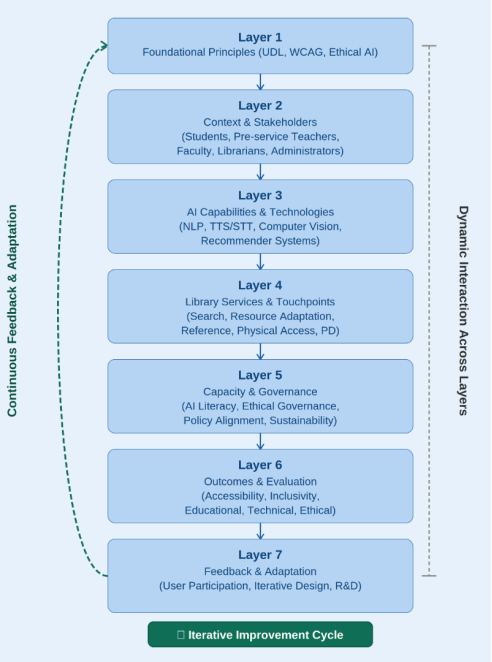
The AILS Framework integrates accessibility principles, artificial intelligence capabilities, institutional governance, and evaluation mechanisms within a unified conceptual structure organised into a seven-layer architecture. This architecture addresses the full spectrum of considerations necessary for successful AI implementation in teacher education library contexts. The overall structure and components of the AI-Enabled Inclusive Library Services (AILS) Framework are illustrated in
Figure 1.
Figure 1. AI-Enabled Inclusive Library Services (AILS) Framework (Layered Model with Dynamic Interaction and Feedback Loop).
The figure illustrates the seven-layer architecture of the AILS framework, highlighting dynamic interactions across layers and a continuous feedback loop that supports iterative improvement and adaptive implementation of inclusive AI-enabled library services.
AI-Enabled Inclusive Library Services (AILS) Framework
The AILS framework illustrates a seven-layer conceptual architecture for integrating artificial intelligence within teacher education library environments while maintaining accessibility and inclusive design principles. The layers represent interconnected dimensions of implementation: foundational principles, governance and policy structures, AI technological capabilities, accessibility and inclusive design standards, service delivery and user engagement, capacity building and professional development, and evaluation and continuous improvement. The framework emphasises dynamic interaction among layers, where policy, technological infrastructure, pedagogical practices, and evaluation processes operate in a continuous feedback cycle to support responsible and inclusive AI-enabled library services.
Layer 1: Foundational Principles
The foundational layer establishes the normative principles that guide all aspects of AI implementation within the AILS Framework. This layer draws upon established accessibility frameworks while incorporating emerging principles specific to AI governance and ethical implementation. The UDL Guidelines 3.0, released in July 2024, provide updated guidance that specifically acknowledges the role of AI technologies in supporting learner variability and removing barriers to learning
.
The foundational principles include universal accessibility, which ensures that AI-enabled services are designed to be usable by individuals with diverse abilities and characteristics. This principle extends beyond compliance with technical standards to encompass user empowerment, cultural responsiveness, and linguistic diversity. Recent research emphasises that Universal Design for Learning (UDL) provides guidelines for making learning more inclusive across disciplines, with AI technologies offering unprecedented opportunities to personalise and adapt learning experiences in real time
| [36] | Song, Y., Weisberg, L. R., Zhang, S., Tian, X., Boyer, K. E., & Israel, M. (2024). A framework for inclusive AI learning design for diverse learners. Computers and Education: Artificial Intelligence, 6, Article 100212.
https://doi.org/10.1016/j.caeai.2024.100212 |
[36]
.
Ethical AI implementation constitutes another core principle, emphasizing transparency in algorithmic decision-making, user privacy protection, and bias mitigation strategies. Accessibility research highlights the importance of designing digital systems that are perceivable, operable, understandable, and robust for diverse users, particularly individuals with disabilities
| [21] | Kelly, B., Sloan, D., Brown, S., Seale, J., Lauke, P., Ball, S., & Smith, S. (2009). Accessibility 2.0: Next steps for web accessibility. Journal of Access Services, 6(1–2), 265–294.
https://doi.org/10.1080/15367960802301028 |
[21]
.
User-centred design represents the third foundational principle, ensuring that AI systems are developed with meaningful input from diverse stakeholders, particularly individuals with disabilities who are often marginalized in technology design processes. This principle emphasises participatory design methodologies that engage users throughout the development lifecycle rather than limiting input to final evaluation phases.
Layer 2: Context and Stakeholders
The second layer addresses the specific contextual factors and stakeholder ecosystem that characterise teacher education institutions. This layer recognises that successful AI implementation requires a deep understanding of institutional culture, user needs, and the unique mission of teacher preparation programmes.
The primary stakeholder groups include pre-service teachers who require both access to inclusive resources and exposure to inclusive technologies as part of their professional preparation. Research demonstrates that teacher candidates' experiences with inclusive technologies during their preparation significantly influence their future classroom practices, creating multiplier effects that extend far beyond immediate library service improvements
| [43] | Zhang, J., & Zhang, Z. (2024). AI in teacher education: Unlocking new dimensions in teaching support, inclusive learning, and digital literacy. Journal of Computer Assisted Learning, 40(4), 1871–1885. https://doi.org/10.1111/jcal.12988 |
[43]
.
Students with disabilities represent another critical stakeholder group, bringing diverse perspectives and needs that must inform AI system design and implementation. Contemporary research emphasises that meaningful participation of users with disabilities in AI development processes is essential for creating truly inclusive systems rather than solutions that inadvertently perpetuate existing barriers
.
Faculty members and supervising practitioners contribute pedagogical expertise and understanding of curriculum requirements that must inform AI implementation decisions. Their involvement ensures that AI-enabled library services align with programme objectives and support effective teaching and learning processes.
Library professionals serve as both service providers and educational partners, requiring specialized knowledge and skills to effectively implement and maintain AI-enabled inclusive services. Recent research reveals significant gaps in AI literacy among library professionals, highlighting the need for comprehensive professional development programmes that address both technical and ethical dimensions of AI implementation
| [24] | Lo, L. S. (2024). Evaluating AI literacy in academic libraries: A survey study with a focus on U.S. employees. College & Research Libraries, 85(5), 635–661.
https://doi.org/10.5860/crl.85.5.635 |
[24]
.
Institutional administrators and policymakers shape the governance structures and resource allocation decisions that determine the sustainability and scope of AI implementation efforts. Their engagement is essential for ensuring that AI initiatives align with institutional priorities and receive adequate long-term support.
Layer 3: AI Capabilities and Technologies
The third layer examines the specific AI technologies and capabilities that can enhance accessibility and inclusivity in library services. This layer emphasises evidence-based applications that demonstrate measurable improvements in user outcomes while maintaining alignment with foundational principles.
Natural Language Processing (NLP) technologies offer significant potential for improving information discovery and user support services. Contemporary NLP applications can provide conversational interfaces that reduce barriers for users with varying technological literacies, offer real-time translation services for multilingual populations, and generate personalised content recommendations based on individual learning preferences and accessibility requirements.
Computer vision technologies can automatically generate alternative text descriptions for images and visual content, extract text from scanned documents, and provide real-time visual assistance for users with visual impairments. Recent advances in computer vision have demonstrated significant improvements in accuracy and reliability, making these technologies increasingly viable for large-scale implementation.
Text-to-speech and speech-to-text technologies provide essential accessibility features while supporting diverse learning preferences and communication needs. Contemporary systems offer improved naturalness and accuracy, with emerging capabilities for emotional expression and multilingual support that enhance user experience and engagement.
Recommender systems can personalise resource discovery based on individual accessibility requirements, learning objectives, and usage patterns. These systems can identify relevant resources while considering factors such as format accessibility, reading level, and content structure to support diverse learning needs effectively.
Automated metadata enrichment technologies can enhance resource discovery by generating descriptive tags, identifying accessibility features, and creating structured summaries that improve search ability and usability for all users.
Within teacher education libraries, these AI capabilities can support specialised services that address the pedagogical needs of pre-service teachers. For example, intelligent discovery systems can assist users in locating teaching resources aligned with curriculum standards, while AI-powered recommendation systems may suggest inclusive teaching materials or accessible learning resources. Similarly, conversational AI tools can provide multilingual research assistance and guidance on inclusive instructional strategies. By integrating these capabilities into library services, teacher education institutions can support both information access and the development of inclusive pedagogical practices among future educators.
Layer 4: Library Services and Touchpoints
The fourth layer addresses how AI capabilities can be integrated into specific library services and user interaction points. This layer emphasises seamless integration that enhances rather than replaces human expertise while providing multiple pathways for users to access resources and support.
Discovery services represent a primary application area where AI technologies can significantly enhance user experience. AI-powered search systems can understand natural language queries, provide contextual recommendations, and adapt results based on individual accessibility requirements and learning objectives. These systems can also identify potential barriers in resources and suggest alternatives that better meet user needs.
Resource adaptation services utilise AI technologies to automatically generate accessible formats, create simplified summaries, and provide personalised navigation assistance. These services ensure that all users can access content in formats that meet their individual needs while maintaining academic rigor and content integrity.
Reference and instruction services can be enhanced through AI-powered chatbots that provide 24/7 support, while human librarians focus on complex queries and relationship building. AI systems can handle routine inquiries, guide users through databases and resources, and escalate complex questions to appropriate human experts.
Physical access services can incorporate AI technologies for navigation assistance, automated accessibility checks, and personalised environmental controls that support diverse user needs in physical library spaces.
Professional development services can utilise AI technologies to create personalised learning pathways for pre-service teachers, provide real-time feedback on inclusive teaching practices, and facilitate connections between users with similar interests or challenges.
Layer 5: Capacity and Governance
The fifth layer addresses the institutional capacity and governance structures necessary for successful AI implementation. This layer recognises that effective AI deployment requires more than technical solutions; it demands comprehensive approaches to change management, professional development, and sustainable resource allocation.
AI literacy programmes must be developed for all stakeholder groups, providing the knowledge and skills necessary to understand, evaluate, and effectively utilise AI technologies. Recent research reveals significant gaps in AI literacy among educational professionals, emphasizing the need for systematic professional development approaches
| [24] | Lo, L. S. (2024). Evaluating AI literacy in academic libraries: A survey study with a focus on U.S. employees. College & Research Libraries, 85(5), 635–661.
https://doi.org/10.5860/crl.85.5.635 |
[24]
.
Ethical governance frameworks must establish clear principles, procedures, and accountability mechanisms for AI development and deployment. These frameworks should address issues such as algorithmic transparency, bias mitigation, user privacy protection, and meaningful user participation in design processes. These principles require concrete operational mechanisms to ensure effective implementation in practice.
To operationalise ethical AI within academic library environments, institutions must establish clear governance mechanisms and implementation guidelines. First, bias mitigation should be ensured through the use of diverse and representative datasets, along with regular auditing of algorithmic outputs to detect discriminatory patterns. Second, transparency mechanisms should be implemented by providing users with clear explanations of how AI systems generate recommendations and decisions. Third, data privacy must be safeguarded through informed consent, data minimisation practices, and compliance with relevant data protection regulations. Fourth, accountability structures should be established, wherein librarians and institutional authorities oversee AI system performance and address potential ethical concerns. These operational measures ensure that AI-enabled library services remain aligned with principles of fairness, inclusivity, and user trust.
Policy alignment ensures that AI implementation efforts support institutional priorities and comply with relevant legal and regulatory requirements. This includes alignment with disability rights legislation, data protection requirements, and educational standards that govern teacher preparation programmes.
Resource sustainability encompasses both financial and human resources necessary for long-term AI implementation success. This includes consideration of initial development costs, ongoing maintenance requirements, professional development investments, and evaluation activities.
Layer 6: Outcomes and Evaluation
The sixth layer establishes comprehensive evaluation frameworks that assess AI implementation effectiveness across multiple dimensions. This multi-faceted approach recognises that successful AI deployment must demonstrate benefits for individual users while contributing to broader institutional and societal objectives.
Accessibility outcomes focus on measurable improvements in access to information and services for users with disabilities. These outcomes include compliance with established standards such as WCAG 2.2, reduced barriers to resource discovery and usage, and enhanced user satisfaction among individuals with diverse accessibility needs.
Inclusivity outcomes examine broader impacts on user engagement, learning outcomes, and institutional culture. These outcomes encompass increased participation among underrepresented populations, improved user confidence in accessing and utilising library resources, and an enhanced sense of belonging among diverse user groups.
Educational outcomes specifically address the impact of AI-enabled library services on teacher preparation objectives. These outcomes include pre-service teachers' understanding of inclusive design principles, confidence in implementing inclusive technologies, and readiness to create equitable learning environments in their future classrooms.
Technical performance outcomes assess the reliability, efficiency, and effectiveness of AI systems themselves. These outcomes include system uptime, response accuracy, user error rates, and integration effectiveness with existing library systems and workflows.
Ethical compliance outcomes evaluate adherence to established principles for responsible AI implementation. These outcomes include algorithmic fairness assessments, bias detection and mitigation effectiveness, user privacy protection measures, and transparency in decision-making processes.
While these outcome dimensions provide a conceptual basis for evaluation, their effective implementation requires clearly defined and measurable indicators. To ensure systematic assessment of AI-enabled inclusive library services, specific and measurable indicators should be incorporated. Accessibility outcomes may be evaluated through metrics such as compliance with WCAG standards, percentage of resources available in accessible formats, and task completion rates among users with disabilities. Inclusivity can be assessed through user engagement levels across diverse groups, frequency of use of assistive technologies, and user satisfaction surveys. Educational outcomes may include pre-service teachers’ competence in using inclusive technologies, measured through performance assessments and reflective practices. Technical performance indicators include system accuracy, response time, and reliability of AI tools. Ethical compliance can be evaluated through periodic audits of algorithmic bias, transparency reports, and data privacy adherence. These key performance indicators provide a structured mechanism for continuous monitoring and improvement.
Layer 7: Feedback and Adaptation
The seventh layer establishes mechanisms for continuous improvement and adaptation based on user feedback, technological developments, and changing institutional needs. This layer recognises that AI technologies evolve rapidly, requiring systematic approaches to monitoring, evaluation, and refinement.
User participation mechanisms ensure that diverse stakeholders have meaningful opportunities to provide input on AI system performance and suggest improvements. These mechanisms include regular feedback surveys, focus groups, usability testing sessions, and co-design workshops that engage users as partners in ongoing development efforts. Iterative design processes establish systematic approaches to incorporating user feedback and technological advances into AI system improvements. These processes include regular review cycles, version control procedures, and change management protocols that ensure improvements enhance rather than disrupt existing services.
Research and development activities maintain connections with emerging scholarship and technological developments that may inform future enhancements. These activities include participation in professional networks, collaboration with technology partners, and engagement with research initiatives that advance understanding of AI applications in educational contexts.
The AILS framework operates as a dynamic and iterative model rather than a linear sequence. While the layers are presented hierarchically for conceptual clarity, they are interconnected through continuous interactions and feedback mechanisms. In particular, the feedback and adaptation layer facilitates ongoing refinement across all preceding layers, enabling the framework to evolve in response to user needs, technological advancements, and institutional contexts.
Table 1. Summary of the AI-Enabled Inclusive Library Services (AILS) Framework.
Layer | Core Focus | Key Components | Relevance for Teacher Education Libraries |
Layer 1: Foundational Principles | Ethical and inclusive foundation for AI adoption | Universal Design for Learning (UDL), Web Content Accessibility Guidelines (WCAG), Ethical AI principles | Ensures that AI implementation in libraries aligns with accessibility, inclusivity, and responsible technology use. |
Layer 2: Context & Stakeholders | Identification of the institutional context and key stakeholders involved in AI-enabled library services | Students, pre-service teachers, faculty members, librarians, administrators | Recognises the diverse stakeholders involved in teacher education libraries and ensures that AI services address their needs. |
Layer 3: AI Capabilities & Technologies | Technological infrastructure enabling AI services | Natural Language Processing (NLP), Text-to-Speech/Speech-to-Text (TTS/STT), Computer Vision, Recommender Systems | Enables intelligent discovery systems, accessibility tools, and personalised learning support within library environments. |
Layer 4: Library Services & Touchpoints | Application of AI technologies within library services and user interaction points | Search systems, resource adaptation, reference services, physical access, professional development support | Enhances the delivery of inclusive and adaptive library services that support teacher education and learning. |
Layer 5: Capacity & Governance | Institutional readiness, governance structures, and capacity building for AI implementation | AI literacy, ethical governance, policy alignment, sustainability strategies | Supports responsible implementation of AI technologies through training, governance frameworks, and institutional policy alignment. |
Layer 6: Outcomes & Evaluation | Assessment of the effectiveness and impact of AI-enabled library services | Accessibility outcomes, inclusivity, educational effectiveness, technical performance, ethical compliance | Ensures that AI-enabled library services contribute to inclusive learning and improved information access. |
Layer 7: Feedback & Adaptation | Monitoring and refining AI services | User participation, iterative design, research and development (R&D) | Enables libraries to refine AI-enabled services based on user feedback and evolving technological developments. |
Inter-Layer Relationships and Feedback Mechanisms in the AILS Framework
While the seven layers of the AILS framework are presented as distinct conceptual components, their effectiveness depends on the dynamic interactions between them. Foundational principles and governance structures guide the ethical deployment of AI technologies, ensuring that accessibility and inclusivity remain central to system design. In turn, AI capabilities enable the development of adaptive services such as intelligent discovery systems, multilingual assistance, and accessibility-enhanced interfaces. These services operate within the service delivery layer, where librarians and educators facilitate user engagement and learning experiences. Continuous evaluation mechanisms provide feedback on system performance, user satisfaction, and accessibility outcomes, allowing institutions to refine technological tools, policy frameworks, and professional development strategies. Through this iterative feedback loop, the framework emphasises that AI-enabled library services must evolve through ongoing assessment, stakeholder participation, and institutional learning.
Integration and Implementation Considerations
The AILS Framework emphasises that successful implementation requires careful attention to the interactions between layers rather than treating them as discrete components. The framework recognises that technological capabilities must align with user needs, institutional capacity, and ethical principles to achieve meaningful and sustainable outcomes.
Implementation should follow a phased approach that begins with pilot projects addressing specific user needs and gradually expands to encompass broader institutional transformation. This approach allows institutions to build capacity, learn from experience, and refine approaches based on evidence rather than attempting comprehensive implementation without adequate preparation.
The framework also emphasises the importance of external partnerships and collaboration in successful AI implementation. Few institutions possess all the technical expertise, financial resources, and user insights necessary for comprehensive AI deployment, making strategic partnerships essential for effective implementation.
Finally, the AILS Framework recognises that successful AI implementation in teacher education libraries requires ongoing commitment to learning, adaptation, and improvement. The rapidly evolving nature of AI technologies and the complex needs of diverse user populations demand flexible approaches that can evolve with changing circumstances while maintaining fidelity to foundational principles of accessibility, inclusion, and educational excellence.
7. Discussion
The development of the AI-Enabled Inclusive Library Services (AILS) Framework represents a significant theoretical and practical contribution to the intersection of artificial intelligence, accessibility, and teacher education. This comprehensive framework addresses critical gaps in current approaches to AI implementation while providing actionable guidance for institutions seeking to enhance their inclusive service provision. The discussion examines the framework's key contributions, implementation challenges, theoretical implications, and potential for broader application beyond teacher education contexts.
With reference to Objective 1, the framework demonstrates how artificial intelligence enhances accessibility and inclusivity through adaptive and user-centred library services. AI technologies such as natural language processing, speech-to-text and text-to-speech systems, and recommender algorithms reduce barriers associated with traditional information access and enable personalised engagement with resources. These capabilities support users with diverse abilities and learning preferences, thereby promoting equitable participation within academic library environments. Furthermore, the integration of these technologies within academic libraries extends beyond service delivery to support inclusive pedagogical practices. By functioning as “living laboratories,” libraries provide pre-service teachers with opportunities to interact with inclusive technologies in authentic contexts, thereby strengthening their preparedness to implement such practices in their future classrooms.
Theoretical Contributions and Innovations
The AILS framework also complements and extends several existing frameworks addressing artificial intelligence and digital transformation in education. For instance, the UNESCO AI competency frameworks focus primarily on developing teachers’ knowledge and ethical awareness regarding AI integration in education
. Similarly, strategic guidance developed by Jisc emphasises institutional governance, data management, and responsible AI adoption across higher education systems
| [18] | Jisc. (2023). Artificial intelligence in tertiary education: From strategy to implementation. https://www.jisc.ac.uk |
[18]
. Frameworks on technology-enabled learning emphasise the importance of digital learning ecosystems, open educational resources, and flexible, learner-centred approaches in promoting inclusive education
| [8] | Commonwealth of Learning. (2020). Technology-enabled learning: Policy brief. https://www.col.org |
[8]
, however, they provide limited attention to the specific role of academic libraries in inclusive technology implementation.
The AILS framework contributes to this evolving discourse by explicitly positioning teacher education libraries as sites where AI technologies, accessibility standards, and pedagogical practices intersect.
While existing international frameworks provide valuable guidance on artificial intelligence integration in education, they largely focus on policy development, digital competencies, or institutional governance structures. For example, UNESCO’s AI and education frameworks primarily address ethical principles and teacher competencies, while Jisc’s strategic guidance emphasises institutional readiness, data governance, and responsible AI adoption in higher education systems. In contrast, the AILS framework contributes a more service-oriented and context-specific perspective by conceptualising academic libraries as operational environments where AI-enabled accessibility and inclusive learning practices can be implemented and evaluated. By explicitly integrating accessibility standards, AI capabilities, and teacher education contexts, the AILS framework extends existing models and highlights the role of academic libraries as critical infrastructures supporting inclusive digital transformation.
The AILS Framework makes several significant theoretical contributions to the emerging field of AI-enabled educational services. First, it synthesizes established accessibility principles with emerging AI capabilities, addressing a critical gap identified in recent literature. While existing frameworks such as UDL and WCAG provide foundational guidance for inclusive design, they were developed before the current wave of AI technologies emerged and, therefore, lack specific guidance for AI implementation contexts
| [36] | Song, Y., Weisberg, L. R., Zhang, S., Tian, X., Boyer, K. E., & Israel, M. (2024). A framework for inclusive AI learning design for diverse learners. Computers and Education: Artificial Intelligence, 6, Article 100212.
https://doi.org/10.1016/j.caeai.2024.100212 |
[36]
.
The seven-layer architecture of the AILS Framework offers a novel approach to conceptualising AI implementation that addresses technical, pedagogical, ethical, and institutional dimensions simultaneously. This comprehensive approach recognises that successful AI integration requires more than technological adoption; it demands systematic attention to user needs, ethical considerations, institutional capacity, and continuous improvement processes. Contemporary research supports this multi-dimensional approach, with studies demonstrating that AI implementations focusing solely on technical capabilities often fail to achieve meaningful educational outcomes
| [31] | Reina Marín, Y., Cruz Caro, O., Maicelo Rubio, Y. D., Alva Tuesta, J. N., Sánchez Bardales, E., Carrasco Rituay, A. M., & Chávez Santos, R. (2025). Artificial intelligence as a teaching tool in university education. Frontiers in Education, 10, Article 1578451. https://doi.org/10.3389/feduc.2025.1578451 |
[31]
.
The framework's emphasis on teacher education contexts represents another significant theoretical contribution. By recognising the unique characteristics and requirements of teacher preparation programmes, the AILS Framework addresses a specific gap in current AI implementation guidance. Research demonstrates that teacher candidates' experiences with inclusive technologies during their preparation significantly influence their future classroom practices, creating multiplier effects that extend far beyond immediate service improvements
| [43] | Zhang, J., & Zhang, Z. (2024). AI in teacher education: Unlocking new dimensions in teaching support, inclusive learning, and digital literacy. Journal of Computer Assisted Learning, 40(4), 1871–1885. https://doi.org/10.1111/jcal.12988 |
[43]
.
To enhance the practical applicability of the proposed framework, a pilot implementation scenario is conceptualised within a teacher education institution. In this scenario, an academic library integrates AI-enabled tools aligned with the AILS framework. For example, natural language processing-based discovery systems allow users to conduct searches using conversational queries, improving accessibility for users with limited technical expertise. Text-to-speech and speech-to-text tools support students with visual and auditory impairments, while multilingual AI tools assist learners from diverse linguistic backgrounds. Additionally, recommender systems personalise resource suggestions based on user preferences and accessibility needs. Librarians play a critical role in mediating these technologies, ensuring ethical use and user support. This pilot model demonstrates how the AILS framework can be operationalised in real-world contexts, providing a scalable pathway for institutions seeking to implement inclusive AI-enabled library services.
Implementation Challenges and Practical Considerations
The development and implementation of AI-enabled inclusive library services face significant challenges that must be carefully addressed to ensure successful outcomes. Recent systematic reviews reveal that insufficient funding, lack of skilled professionals, and limited budget were identified as major challenges to implementing AI in academic libraries. These financial and human resource constraints represent fundamental barriers that institutions must address through strategic planning and resource allocation.
Technical challenges encompass both infrastructure requirements and integration complexities. Many libraries lack the technological infrastructure necessary for comprehensive AI implementation, including adequate computing resources, network capacity, and data management systems. Furthermore, integration with existing library systems often proves more complex than anticipated, requiring significant technical expertise and careful change management processes.
Staff development represents another critical implementation challenge. The integration of AI technologies requires library professionals to develop new competencies encompassing both technical understanding and ethical considerations. Recent research reveals significant gaps in AI literacy among library professionals, emphasising the need for comprehensive professional development programmes
| [24] | Lo, L. S. (2024). Evaluating AI literacy in academic libraries: A survey study with a focus on U.S. employees. College & Research Libraries, 85(5), 635–661.
https://doi.org/10.5860/crl.85.5.635 |
[24]
.
These programmes must address not only technical skills but also critical evaluation capabilities, ethical considerations, and user engagement strategies.
User acceptance and engagement present additional challenges that must be addressed through careful design and implementation processes. From widening digital divides to compromising privacy and reducing human interaction, these technologies pose significant challenges to the traditional library mission. Institutions must balance technological innovation with preservation of core library values, ensuring that AI enhancement does not inadvertently create new barriers or reduce the human connections that characterise effective library services.
Implications for Teacher Education and Inclusive Practice
The AILS Framework has significant implications for teacher education programmes and the broader preparation of inclusive educators. Contemporary research demonstrates that AI has transformed traditional models toward personalised and adaptive data-driven approaches and has become a driver of innovation, transforming pedagogy, administration, student outcomes, and educational inclusion. These transformations create both opportunities and responsibilities for teacher education programmes.
The framework's emphasis on libraries as living laboratories offers particular promise for enhancing teacher preparation. By providing authentic contexts where pre-service teachers can observe, interact with, and critically evaluate AI-enabled inclusive services, libraries can contribute meaningfully to professional preparation objectives. This experiential learning approach aligns with contemporary understanding of effective teacher education, which emphasises the importance of connecting theoretical knowledge with practical application. The framework’s design as an iterative improvement cycle highlights the importance of continuous evaluation, feedback integration, and adaptive refinement in ensuring the long-term effectiveness of AI-enabled inclusive library services.
Furthermore, the framework addresses critical needs in preparing teachers for AI-enhanced educational environments. Educators worldwide report needing to adapt their instructional strategies to accommodate AI capabilities, redesigning assignments and assessment methods to promote critical thinking in an AI-enhanced environment. The AILS Framework provides structured approaches for exposing pre-service teachers to these considerations while developing their capacity for critical evaluation and ethical implementation.
In relation to Objective 4, the study highlights the importance of structured evaluation mechanisms for assessing the effectiveness of AI-enabled inclusive library services. The AILS framework adopts a multi-dimensional evaluation approach that includes accessibility outcomes, inclusivity measures, educational effectiveness, technical performance, and ethical compliance. By incorporating measurable indicators such as WCAG compliance, user engagement levels, task completion rates, system reliability, and algorithmic transparency, the framework enables systematic monitoring and continuous improvement of services. This evaluation-oriented approach ensures that AI implementation remains aligned with inclusive education goals and institutional accountability requirements. These evaluation mechanisms not only support service improvement but also contribute to evidence-based decision-making in academic libraries, enabling institutions to assess the long-term impact of AI-enabled inclusive practices.
The multiplier effect potential represents a significant implication for educational equity more broadly. When teacher education programmes successfully model inclusive AI implementation and prepare graduates who understand these approaches, the impact extends to countless students in future classrooms. This creates opportunities for addressing systemic inequities while building capacity for continued innovation and improvement.
Methodological Reflections and Limitations
The development of the AILS Framework relied primarily on conceptual analysis and literature synthesis, representing both strengths and limitations of this research approach. The comprehensive integration of diverse theoretical perspectives and empirical findings provides a robust foundation for the framework, while identifying areas requiring further empirical validation.
The rapid pace of AI development presents ongoing challenges for framework development and validation. Technologies and capabilities continue to evolve rapidly, potentially outpacing research and evaluation efforts. This reality emphasises the importance of the framework's emphasis on continuous adaptation and improvement processes.
Additionally, the framework's focus on teacher education contexts, while providing necessary specificity, may limit its immediate applicability to other settings. Future research should examine how the framework can be adapted for different institutional contexts while maintaining its core contributions.
8. Conclusion
The AI-Enabled Inclusive Library Services (AILS) Framework provides an integrative conceptual approach for understanding how AI technologies can support accessibility and inclusivity within teacher education library environments. By situating AI-enabled accessibility within the operational and pedagogical functions of teacher education libraries, the AILS framework extends existing AI and educational technology models and highlights the role of libraries as critical sites for inclusive digital innovation.
This research addresses important gaps in current understanding while providing conceptual guidance for institutions seeking to leverage AI capabilities responsibly and effectively. The AILS framework contributes to emerging scholarship by proposing a conceptual synthesis that integrates artificial intelligence technologies with established accessibility principles within teacher education library environments. In doing so, the framework builds upon existing approaches to inclusive learning design, such as Universal Design for Learning and accessibility standards such as the Web Content Accessibility Guidelines developed by the World Wide Web Consortium. Rather than presenting an entirely new paradigm, the framework adapts and contextualises these principles within the evolving landscape of AI-enabled library services.
The framework's seven-layer architecture addresses the full spectrum of considerations necessary for successful implementation, from foundational principles through evaluation and continuous improvement processes. By combining accessibility standards, AI-enabled service design, and teacher education needs within a single conceptual structure, the framework provides a structured perspective for understanding how inclusive AI-powered library systems may be developed and implemented.
The research also contributes to broader discussions about responsible AI implementation in educational settings. By prioritising user empowerment, ethical considerations, and participatory design approaches, the framework offers a model for AI development that supports inclusive learning environments rather than focusing solely on technological efficiency or institutional convenience.
Furthermore, the research highlights the potential of academic libraries to serve as living laboratories for inclusive technology integration. This conceptualisation recognises libraries' distinctive position within educational institutions while emphasising their capacity to contribute meaningfully to teacher preparation objectives and the development of inclusive digital learning ecosystems.
The study also addresses the objectives outlined at the beginning of the research. First, it examined how artificial intelligence technologies can enhance accessibility and inclusivity in academic library services through tools such as natural language processing, recommender systems, and assistive technologies. Second, it contextualised these possibilities within teacher education institutions by emphasising the role of libraries as learning environments where pre-service teachers can observe and engage with inclusive technologies. Third, the research proposed the AI-Enabled Inclusive Library Services (AILS) Framework as a conceptual model integrating accessibility standards, AI capabilities, and institutional governance considerations. Finally, the study identified potential outcomes and evaluation mechanisms, including accessibility improvements, inclusive learning engagement, and institutional capacity development. Together, these contributions provide a conceptual foundation for future empirical research and practical implementation of AI-enabled inclusive library services.
Implications for Practice and Policy
The AILS Framework offers immediate practical guidance for institutions seeking to enhance their inclusive service provision through AI implementation. The framework's emphasis on systematic planning, stakeholder engagement, and continuous improvement provides a roadmap for responsible innovation that balances technological possibilities with user needs and institutional contexts.
Policy implications encompass both institutional and broader regulatory considerations. Institutions implementing AI-enabled services must develop comprehensive governance frameworks that address ethical considerations, privacy protection, and user rights. Broader policy discussions should consider how AI implementation in educational contexts can be guided by principles of equity and inclusion rather than market-driven efficiency metrics alone.
The research also has implications for professional development and capacity building within the library profession. The framework's implementation requirements highlight the need for comprehensive AI literacy programmes that prepare library professionals to understand, evaluate, and implement AI technologies responsibly.
Future Research Directions
Several critical research directions emerge from this conceptual development work. First, empirical validation of the AILS Framework through case study implementations will be essential for refining and improving its practical applicability. Such studies should examine both implementation processes and outcomes across multiple institutional contexts and stakeholder groups.
Longitudinal research examining the sustained impact of AI-enabled inclusive library services on both immediate users and teacher education outcomes represents another critical research direction. Current literature lacks a comprehensive understanding of how exposure to inclusive AI technologies during teacher preparation influences future classroom practice and student outcomes.
Comparative research examining different approaches to AI implementation in educational contexts could provide valuable insights into the relative effectiveness of various strategies and frameworks. Such research should consider both technical performance metrics and broader measures of educational equity and inclusion.
Investigation of user perspectives and experiences represents another essential research direction. While the framework emphasises user participation and empowerment, empirical research examining how different stakeholder groups experience AI-enabled services will be crucial for continued improvement and refinement.
Finally, research examining the scalability and transferability of the framework to other educational contexts and settings will be important for maximising its potential impact. Such research should consider both opportunities and limitations in adapting the framework for different institutional types, user populations, and technological contexts.
Abbreviations
AI | Artificial Intelligence |
UDL | Universal Design for Learning |
UN | United Nations |
AILS | AI-Enabled Inclusive Library Services |
SDGs | Sustainable Development Goals |
NLP | Natural Language Processing |
WCAG | Web Content Accessibility Guidelines |
TTS | Text-to-Speech |
STT | Speech-to-Text |
R&D | Research and Development |
UNESCO | United Nations Educational, Scientific and Cultural Organization |
Author Contributions
Eesha Sharma: Conceptualization, Resources, Writing – original draft
Adit Gupta: Data curation, Methodology, Writing – review & editing
Conflicts of Interest
The authors declare no conflicts of interest.
References
| [1] |
Akgun, S., & Greenhow, C. (2022). Artificial intelligence in education: Addressing ethical challenges in K-12 settings. AI and Ethics, 2, 431–440.
https://doi.org/10.1007/s43681-021-00096-7
|
| [2] |
Arkorful, V., Arthur, F., Boateng, E., et al. (2025). Exploring artificial intelligence literacy among basic school teachers in Ghana. Discover Education, 4, Article 250.
https://doi.org/10.1007/s44217-025-00630-3
|
| [3] |
Burgstahler, S., & Cory, R. (2008). Universal design in higher education: From principles to practice. Harvard Education Press.
|
| [4] |
CAST. (2018). Universal design for learning guidelines version 2.2. CAST.
|
| [5] |
CAST. (2024). Universal design for learning guidelines version 3.0. CAST.
http://udlguidelines.cast.org
|
| [6] |
Chemnad, K., & Othman, A. (2024). Digital accessibility in the era of artificial intelligence: A bibliometric analysis and systematic review. Frontiers in Artificial Intelligence, 7, Article 1349668.
https://doi.org/10.3389/frai.2024.1349668
|
| [7] |
Chiu, T. K., & Sanusi, I. T. (2024). Define, foster, and assess student and teacher AI literacy and competency for all: Current status and future research direction. Computers and Education Open, 7, Article 100182.
https://doi.org/10.1016/j.caeo.2024.100182
|
| [8] |
Commonwealth of Learning. (2020). Technology-enabled learning: Policy brief.
https://www.col.org
|
| [9] |
Daher, R. (2025). Integrating AI literacy into teacher education: A critical perspective paper. Discover Artificial Intelligence, 5, Article 217.
https://doi.org/10.1007/s44163-025-00475-7
|
| [10] |
Dempsey, L. (2023). The library as platform. Library Trends, 71(3), 371–386.
|
| [11] |
Dwivedi, Y. K., et al. (2023). So what if ChatGPT wrote it? Multidisciplinary perspectives on opportunities, challenges and implications of generative conversational AI. International Journal of Information Management, 71, Article 102642.
https://doi.org/10.1016/j.ijinfomgt.2023.102642
|
| [12] |
Fitas, R. (2025). Inclusive education with AI: Supporting special needs and tackling language barriers. AI and Ethics.
https://doi.org/10.1007/s43681-025-00824-3
|
| [13] |
Goldman, S. R., Taylor, J., Carreon, A., & Smith, S. J. (2024). Using AI to support special education teacher workload. Journal of Special Education Technology, 39(3), 434–447.
https://doi.org/10.1177/01626434241257240
|
| [14] |
Han, X., & Dou, X. (2025). User recommendation method integrating hierarchical graph attention network with multimodal knowledge graph. Frontiers in Neurorobotics, 19, Article 1587973.
https://doi.org/10.3389/fnbot.2025.1587973
|
| [15] |
Harisanty, D., Anna, N. E. V., Putri, T. E., Firdaus, A. A., & Azizi, N. A. N. (2025). Is adopting artificial intelligence in libraries urgency or a buzzword? A systematic literature review. Journal of Librarianship and Information Science, 57(1), 89–106.
https://doi.org/10.1177/09610006241245678
|
| [16] |
Hyatt, S. E., & Owenz, M. B. (2024). Using universal design for learning and artificial intelligence to support students with disabilities. College Teaching.
https://doi.org/10.1080/87567555.2024.2313468
|
| [17] |
Islam, M. N., Ahmad, S., Aqil, M., & Saky, S. A. T. M. (2025). Application of artificial intelligence in academic libraries: A bibliometric analysis and knowledge mapping. Discover Artificial Intelligence, 5(1).
https://doi.org/10.1007/s44163-025-00295-9
|
| [18] |
Jisc. (2023). Artificial intelligence in tertiary education: From strategy to implementation.
https://www.jisc.ac.uk
|
| [19] |
Jyoti, & Kumar, P. (2024). Reshaping the library landscape: Exploring the integration of artificial intelligence in libraries. IP Indian Journal of Library Science and Information Technology, 9(1), 29–36.
https://doi.org/10.18231/j.ijlsit.2024.005
|
| [20] |
Kalbande, D., Yuvaraj, M., Verma, M. S., Suradkar, P., & Chavan, S. (2024). Exploring the integration of artificial intelligence in academic libraries: A study on librarians' perspectives in India. Open Information Science, 8(1), Article 20240006.
https://doi.org/10.1515/opis-2024-0006
|
| [21] |
Kelly, B., Sloan, D., Brown, S., Seale, J., Lauke, P., Ball, S., & Smith, S. (2009). Accessibility 2.0: Next steps for web accessibility. Journal of Access Services, 6(1–2), 265–294.
https://doi.org/10.1080/15367960802301028
|
| [22] |
Khanuja, S., Ruder, S., & Talukdar, P. (2023). Evaluating the diversity, equity, and inclusion of NLP technology: A case study for Indian languages. In Findings of the Association for Computational Linguistics: EACL 2023 (pp. 1763–1777). Association for Computational Linguistics.
https://doi.org/10.18653/v1/2023.findings-eacl.131
|
| [23] |
Lewis, D. W. (2023). Reimagining the academic library. Rowman & Littlefield.
|
| [24] |
Lo, L. S. (2024). Evaluating AI literacy in academic libraries: A survey study with a focus on U.S. employees. College & Research Libraries, 85(5), 635–661.
https://doi.org/10.5860/crl.85.5.635
|
| [25] |
Ma, M., Ng, D. T. K., Liu, Z., & Wong, G. K. (2025). Fostering responsible AI literacy: A systematic review of K-12 AI ethics education. Computers and Education: Artificial Intelligence, 8, Article 100422.
https://doi.org/10.1016/j.caeai.2025.100422
|
| [26] |
Martínez Concha, K., Palacios Zenteno, F., & Tello Alfaro, J. (2024). Use of artificial intelligence in libraries: A systematic review, 2019–2023. South African Journal of Libraries and Information Science, 90(2).
https://doi.org/10.7553/90-2-2387
|
| [27] |
Melo-López, V.-A., Basantes-Andrade, A., Gudiño-Mejía, C.-B., & Hernández-Martínez, E. (2025). The impact of artificial intelligence on inclusive education: A systematic review. Education Sciences, 15(5), Article 539.
https://doi.org/10.3390/educsci15050539
|
| [28] |
Meylani, R. (2024). Artificial intelligence in the education of teachers: A qualitative synthesis of the cutting-edge research literature. Journal of Computer and Education Research, 12(24), 600–637.
https://doi.org/10.18009/jcer.1477709
|
| [29] |
Mosha, N. F. (2025). The role of artificial intelligence tools in enhancing accessibility and usability of electronic resources in academic libraries. Library Management, 46(1–2), 132–157.
https://doi.org/10.1108/LM-08-2024-0088
|
| [30] |
Navas-Bonilla, C. R., Guerra-Arango, J. A., Oviedo-Guado, D. A., & Murillo-Noriega, D. E. (2025). Inclusive education through technology: A systematic review of types, tools and characteristics. Frontiers in Education, 10, Article 1527851.
https://doi.org/10.3389/feduc.2025.1527851
|
| [31] |
Reina Marín, Y., Cruz Caro, O., Maicelo Rubio, Y. D., Alva Tuesta, J. N., Sánchez Bardales, E., Carrasco Rituay, A. M., & Chávez Santos, R. (2025). Artificial intelligence as a teaching tool in university education. Frontiers in Education, 10, Article 1578451.
https://doi.org/10.3389/feduc.2025.1578451
|
| [32] |
Romero, M. (2024). Collaborative design of artificial intelligence-enhanced learning activities. arXiv.
https://doi.org/10.48550/arXiv.2407.06660
|
| [33] |
Rose, D. H., Harbour, W. A., Johnston, C. S., Daley, S. G., & Abarbanell, L. (2006). Universal design for learning in postsecondary education: Reflections on principles and their applications. Journal of Postsecondary Education and Disability, 19(2), 135–151.
|
| [34] |
Saborío-Taylor, S., & Rojas-Ramírez, F. (2024). Universal design for learning and artificial intelligence in the digital era: Fostering inclusion and autonomous learning. International Journal of Professional Development, Learners and Learning, 6(2), Article 2408.
https://doi.org/10.30935/ijpdll/14694
|
| [35] |
Singapore Infocomm Media Development Authority. (2024). Model AI governance framework 2024.
https://www.imda.gov.sg
|
| [36] |
Song, Y., Weisberg, L. R., Zhang, S., Tian, X., Boyer, K. E., & Israel, M. (2024). A framework for inclusive AI learning design for diverse learners. Computers and Education: Artificial Intelligence, 6, Article 100212.
https://doi.org/10.1016/j.caeai.2024.100212
|
| [37] |
Tan, X., Cheng, G., & Ling, M. H. (2025). Artificial intelligence in teaching and teacher professional development: A systematic review. Computers and Education: Artificial Intelligence, 8, Article 100355.
https://doi.org/10.1016/j.caeai.2024.100355
|
| [38] |
UNESCO. (2018). UNESCO ICT competency framework for teachers (Version 3).
https://unesdoc.unesco.org
|
| [39] |
UNESCO. (2019). Artificial intelligence in education: Guidance for policy-makers.
https://unesdoc.unesco.org
|
| [40] |
UNESCO. (2020). Inclusion and education: All means all [Global Education Monitoring Report]. UNESCO.
|
| [41] |
W3C. (2024). WCAG 2 overview. Web Accessibility Initiative.
https://www.w3.org/WAI/standards-guidelines/wcag/
|
| [42] |
World Wide Web Consortium. (2018). Web content accessibility guidelines (WCAG) 2.1. W3C.
|
| [43] |
Zhang, J., & Zhang, Z. (2024). AI in teacher education: Unlocking new dimensions in teaching support, inclusive learning, and digital literacy. Journal of Computer Assisted Learning, 40(4), 1871–1885.
https://doi.org/10.1111/jcal.12988
|
Cite This Article
-
APA Style
Sharma, E., Gupta, A. (2026). AI-Enabled Inclusive Library Services (AILS) Framework: Enhancing Accessibility and Inclusivity in Teacher Education. Teacher Education and Curriculum Studies, 11(2), 63-78. https://doi.org/10.11648/j.tecs.20261102.13
 Copy
|
Copy
|
 Download
ACS Style
Sharma, E.; Gupta, A. AI-Enabled Inclusive Library Services (AILS) Framework: Enhancing Accessibility and Inclusivity in Teacher Education. Teach. Educ. Curric. Stud. 2026, 11(2), 63-78. doi: 10.11648/j.tecs.20261102.13
Copy
|
Download
AMA Style
Sharma E, Gupta A. AI-Enabled Inclusive Library Services (AILS) Framework: Enhancing Accessibility and Inclusivity in Teacher Education. Teach Educ Curric Stud. 2026;11(2):63-78. doi: 10.11648/j.tecs.20261102.13
Copy
|
Download
-
@article{10.11648/j.tecs.20261102.13,
  author = {Eesha Sharma and Adit Gupta},
  title = {AI-Enabled Inclusive Library Services (AILS) Framework: Enhancing Accessibility and Inclusivity in Teacher Education},
  journal = {Teacher Education and Curriculum Studies},
  volume = {11},
  number = {2},
  pages = {63-78},
  doi = {10.11648/j.tecs.20261102.13},
  url = {https://doi.org/10.11648/j.tecs.20261102.13},
  eprint = {https://article.sciencepublishinggroup.com/pdf/10.11648.j.tecs.20261102.13},
  abstract = {The integration of artificial intelligence (AI) in higher education offers new opportunities to enhance accessibility and inclusivity, particularly in teacher education programmes that prepare future educators to serve diverse learners. Although prior research has examined AI in libraries, Universal Design for Learning (UDL), and inclusive teacher education, limited studies explore their intersection within academic library contexts. This paper introduces the AI-Enabled Inclusive Library Services (AILS) Framework, a conceptual model designed to support accessibility and inclusivity in teacher education libraries. Grounded in UDL principles, international disability rights frameworks such as the UN Convention on the Rights of Persons with Disabilities, and global inclusive education policies, the framework positions libraries as both service providers and experiential learning environments for pre-service teachers. The AILS framework comprises seven interconnected components: foundational principles, contextual stakeholders, AI capabilities, library services and touchpoints, institutional capacity and governance, outcomes and evaluation, and feedback and adaptation. By incorporating AI technologies such as natural language processing, text-to-speech systems, recommender algorithms, and multilingual tools, the framework addresses barriers faced by students with disabilities and diverse learning backgrounds. Beyond improving resource accessibility, AILS models inclusive pedagogical practices for future educators and aligns with Sustainable Development Goals 4 and 10. The framework offers a globally adaptable approach for developing inclusive, AI-enabled library services in higher education.},
 year = {2026}
}
Copy
|
Download
-
TY  - JOUR
T1  - AI-Enabled Inclusive Library Services (AILS) Framework: Enhancing Accessibility and Inclusivity in Teacher Education
AU  - Eesha Sharma
AU  - Adit Gupta
Y1  - 2026/04/25
PY  - 2026
N1  - https://doi.org/10.11648/j.tecs.20261102.13
DO  - 10.11648/j.tecs.20261102.13
T2  - Teacher Education and Curriculum Studies
JF  - Teacher Education and Curriculum Studies
JO  - Teacher Education and Curriculum Studies
SP  - 63
EP  - 78
PB  - Science Publishing Group
SN  - 2575-4971
UR  - https://doi.org/10.11648/j.tecs.20261102.13
AB  - The integration of artificial intelligence (AI) in higher education offers new opportunities to enhance accessibility and inclusivity, particularly in teacher education programmes that prepare future educators to serve diverse learners. Although prior research has examined AI in libraries, Universal Design for Learning (UDL), and inclusive teacher education, limited studies explore their intersection within academic library contexts. This paper introduces the AI-Enabled Inclusive Library Services (AILS) Framework, a conceptual model designed to support accessibility and inclusivity in teacher education libraries. Grounded in UDL principles, international disability rights frameworks such as the UN Convention on the Rights of Persons with Disabilities, and global inclusive education policies, the framework positions libraries as both service providers and experiential learning environments for pre-service teachers. The AILS framework comprises seven interconnected components: foundational principles, contextual stakeholders, AI capabilities, library services and touchpoints, institutional capacity and governance, outcomes and evaluation, and feedback and adaptation. By incorporating AI technologies such as natural language processing, text-to-speech systems, recommender algorithms, and multilingual tools, the framework addresses barriers faced by students with disabilities and diverse learning backgrounds. Beyond improving resource accessibility, AILS models inclusive pedagogical practices for future educators and aligns with Sustainable Development Goals 4 and 10. The framework offers a globally adaptable approach for developing inclusive, AI-enabled library services in higher education.
VL  - 11
IS  - 2
ER  -
Copy
|
Download





 Share This Article
 Twitter
 Linked In
 Facebook