Research Article | | Peer-Reviewed

Sustainable Food Systems for Astronauts and Associated Risks in Long-Duration Space Missions: A Narrative Review

Received: 28 July 2026     Accepted: 13 August 2026     Published: 27 August 2026
Views:       Downloads:
Abstract

The success of Long-duration human space missions depends not only on advanced spacecraft engineering and life-support technologies but also on resilient food systems that can sustain astronauts’ health and performance throughout the mission. As space agencies prepare for permanent lunar habitats and crewed missions to Mars, food systems have become a critical component of mission success. Future exploration-class missions are expected to last three to five years, during which resupply of food from Earth will be limited or unavailable. Consequently, conventional pre-packaged foods must evolve into sustainable, integrated systems that ensure nutritional adequacy, food safety, and psychological well-being under resource-constrained environments. This narrative review synthesises current evidence on the evolution of space food technologies, shelf-life limitations, nutrient stability, and the effects of microgravity and space radiation on food quality. It further examines emerging preservation strategies, including active and intelligent packaging, microencapsulation, controlled-environment agriculture, precision fermentation, and bioregenerative life-support systems, as sustainable solutions for future deep-space missions. The review also highlights the major risks associated with prolonged food storage, including nutrient degradation, microbial contamination, and reduced sensory quality. It discusses innovative technologies such as artificial intelligence, synthetic biology, and 3D food printing that may improve the resilience of food systems. Collectively, these advances provide a framework for developing safe, nutritious, and sustainable food systems that support long-duration human exploration while offering valuable applications for terrestrial food security and climate-resilient agriculture.

Published in Science Discovery Food (Volume 1, Issue 3)
DOI 10.11648/j.sdf.20260103.13
Page(s) 117-127
Creative Commons

This is an Open Access article, distributed under the terms of the Creative Commons Attribution 4.0 International License (http://creativecommons.org/licenses/by/4.0/), which permits unrestricted use, distribution and reproduction in any medium or format, provided the original work is properly cited.

Copyright

Copyright © The Author(s), 2026. Published by Science Publishing Group

Keywords

Space Food Systems, Shelf Life, Nutrient Stability, Sustainable Food Systems, Astronaut Nutrition, Food Preservation, Long-duration Space Missions, Food Safety

1. Introduction
Human space exploration is evolving from short-duration Low-Earth orbit (LEO) missions to long-duration missions to the Moon, Mars, and potentially further. Unlike missions to the International Space Station (ISS), where cargo resupply is routine, future exploration missions will be undertaken with limited or no logistics support, making sustainable food systems critical to mission success . In addition to providing energy, space food must maintain its nutritional value, microbial safety, sensory acceptance, and operational integrity over missions lasting three to five years .
Long-duration spaceflight is associated with microgravity, ionising radiation, confinement, disrupted circadian rhythms, and prolonged isolation. These factors exacerbate and accelerate physiological changes such as bone demineralisation, skeletal muscle atrophy, immune system dysfunction, oxidation stress, and cardiovascular deconditioning . Therefore, nutritionally adequate and stable food systems are essential for maintaining crew health, cognitive performance, operational proficiency, and psychological well-being on long-duration missions .
Current space food systems consist primarily of shelf-stable foods preserved through processes such as thermostabilisation, freeze-drying, irradiation, dehydration, and packaging under modified atmosphere. While each of these processes guarantees food safety, they can't fully prevent the progressive degradation of nutrients during prolonged storage. Significant losses of vitamins C, B1, B6, folate, vitamin E, and essential fatty acids were observed during prolonged storage; this raises concern about the nutritional adequacy of foods for exploration-class missions . Existing National aeronautics and space administration (NASA) food systems are generally designed to maintain acceptable quality for approximately 18-24 months, which is insufficient for missions expected to exceed 1,000 days .
To overcome these issues, researchers have developed several regenerative food systems, including controlled-environment agriculture, hydroponics, precision fermentation, and cellular agriculture and bioregenerative life support systems. These technologies are designed to produce fresh food and recycle water, CO2, nutrients and organic waste, reducing dependence on mission resupply requirements and increasing mission sustainability . Active packaging, nanotechnologies, biosensors and artificial intelligence are promising approaches and are being investigated to increase shelf-life stability, improve food safety, and provide autonomy in managing food production and distribution during deep space missions. These technologies also have beneficial applications to other sectors such as climate-resilient agriculture, disaster management and global food security.
1.1. Background
Space food systems are defined as systems that are capable of producing, processing, preserving, packaging, storing, transferring, preparing, and consuming food and disposing of waste to provide an astronaut with a nutritionally adequate diet in space while optimising resource efficiency . Space food has come a long way since simple semi-liquid meal formulations were first used on the Mercury and Gemini missions, to the diverse menus containing thermostabilised, freeze-dried, irradiated and rehydratable foods used today to support longer missions and encourage consumption . Yet, existing systems are highly dependent on Earth-based supplies and can, therefore, not fulfil the demands of long-term space missions requiring operational independence.
The unique characteristics of space affect food quality and stability. Microgravity alters fluid dynamics, heat transfer, microbial populations and plant development, while galactic cosmic radiation accelerates the oxidation of lipids, vitamins, pigments, and secondary metabolites . Future missions therefore require integrated food systems. Both long-term preservation and space-based production methods for fresh, nutritionally adequate food.
Methods are currently being developed to enhance nutrient retention and extend shelf-life during prolonged space storage through active or intelligent packaging, oxygen scavenging, antibacterial coatings, natural antioxidants and nanocomposite materials as barriers . Concurrently, space-based production systems such as hydroponic and controlled environment methods, precision fermentation and bioregenerative life support systems are being investigated as sustainable solutions to provide adequate fresh food and recycle atmospheric gases, water and organic waste.
1.2. Methodology
This narrative review was conducted to systematically collate evidence on sustainable food systems for long-duration human space exploration. Literature searches were performed across multiple databases (PubMed, Web of Science, ScienceDirect, Google Scholar) using keyword combinations such as "space food systems", "space nutrition", "food preservation", "shelf life", "nutrient stability", "food safety", "controlled environment agriculture", "bioregenerative life support systems", "Mars mission" and "long-duration spaceflight". The study focused primarily on peer-reviewed articles published between 2016 and 2026, supplemented by older seminal works for historical and scientific context.
Selected literature evaluated space food, nutrition, preservation, safety, packaging, and life support technologies, excluding non-English, incomplete, or non-spaceflight studies. The synthesised findings highlight key advancements, research priorities and knowledge gaps for building resilient, sustainable food systems for crewed missions to the Moon, Mars, and beyond.
2. Evolution of Space Food Technologies
The evolution of space food technology reflects the intricate nature of sustaining long-duration human spaceflight, with emphasis on astronaut health, mission performance, and sustainability. While early space missions focused on delivering an adequate calorie supply and preventing microbial contamination, current food systems are based on the preservation of nutritional quality, sensory acceptability, operational efficiency and sustainability throughout long-duration mission contexts .
During the Mercury & Gemini programs (1961-1966), astronauts were fed semi-liquid products stored in aluminium tubes, dehydrated powders, and bite-sized compacted foods which minimise crumb generation and support consumption in microgravity environments. Despite limitations in variety, sensory palatability, and nutritional density, the provisions proved adequate for short-duration missions lasting hours to days; however, these commodities could not support long-term human habitability in space .
The Apollo era (1968-1972) achieved advancements in space nutrition. Thermostabilisation, freeze-drying, vacuum packaging and rehydratable food preparations led to increased menu variety, safety, and acceptability. Enhanced food packaging improved safety and durability, and allowed for more balanced nutrient profiles over increasing mission durations . These products displayed that food quality has an impact on human health, morale, and operational performance.
The advent of long-duration Skylab, Space Shuttle and ISS missions necessitated greater precision in the supply of nutrients, enhanced menu options and improved preservation technologies to minimise nutrient degradation over prolonged-duration missions. Commercial sterilisation, irradiation, freeze-drying, intermediate moisture foods, and modified atmosphere packaging became the norm. These methods offered safe and hygienic products and reduced mass, weight and space requirements for foods . However, with prolonged storage, some heat- and oxygen-labile nutrients were found to degrade over time; notably Vitamins C, B1, B6, folate and various antioxidants .
Current ISS food systems use a combination of thermostabilized, freeze-dried, irradiated, natural state and chilled foods to ensure optimal nutritional support throughout the 1-year mission. Nonetheless, reliance on frequent resupply of cargo from Earth means these systems do not fulfil the needs of a long-term mission to Mars or the Moon .
To fulfil future needs in exploration, a transition from conventional food preservation to regenerative and self-sustaining food systems has been a major research theme. Controlled environment agriculture (CEA), hydroponics, aeroponics, aquaponics, precision fermentation, cellular agriculture, and bioregenerative life-support systems (BLSS), among others, are integral to supporting future long-duration missions . In addition to being a constant source of fresh food, integrated BLSS, which consist of crop cultivation and food and water recycling systems, support reduction in terrestrial resource usage and allow for maximum resource recycling within the life support system.
Recent food engineering advancements have further enhanced the capability of food systems for space flight. 3-D food printing has expanded personalised nutrition through precise ingredient measurement, material utilisation, and reduced waste. Synthetic biology and gene editing allow for the production of crops optimised for future mission conditions, including but not limited to nutrient density and stress tolerance . Production of proteins, vitamins, and functional food ingredients using precision fermentation will provide an alternative, resource-efficient source of essential nutrients.
Food packaging technologies have evolved in parallel with food production systems, expanding capabilities by actively participating to increase shelf life and quality monitoring throughout mission duration. Oxygen scavenging agents, antimicrobial compounds and nanocoated barriers and biosensors will further optimise fresh food and other consumable product shelf life. Additionally, artificial intelligence is taking on a prominent role in autonomous management of food resources, nutrient planning, crop cultivation and predictive quality management within integrated life-support systems .
In summary, a strong trend in the evolution of food systems for space has been a paradigm shift from short-duration survival considerations to sustainable, regenerative, and life-support integrated food systems aimed at supporting long-term exploration of deep space. Future food systems will increasingly rely on advanced preservation techniques, smart and responsive food packaging, artificial intelligence and autonomous production to ensure the provision of safe, healthy, and sustainable food diets in missions beyond Earth orbit.
3. Shelf Life of Space Foods
Shelf life is a critical determinant of food system reliability during long-duration space missions, as astronauts depend on foods that must remain safe, nutritious, and acceptable throughout extended storage. Unlike terrestrial food systems, where products can be replenished regularly, future lunar and Martian missions will require foods capable of maintaining their quality for three to five years without significant deterioration . Consequently, shelf life encompasses not only microbiological safety but also the preservation of nutritional value, physicochemical stability, sensory quality, and packaging integrity.
The deterioration of stored space foods results from complex chemical, physical, and biological processes that continue even after preservation. Lipid oxidation remains one of the principal causes of quality loss, particularly in foods containing unsaturated fatty acids, producing off-flavours and reducing the availability of essential fatty acids . Proteins may undergo denaturation, oxidation, and Maillard reactions, reducing digestibility and functional quality, while carbohydrates experience structural changes that alter texture and palatability during prolonged storage .
Micronutrients are especially vulnerable to degradation. Vitamins C, B1, B6, folate, and vitamin E progressively decline during long-term storage owing to oxidation, heat exposure, and residual moisture, potentially compromising immune function, antioxidant defence, energy metabolism, and bone health . These nutrient losses are of particular concern because astronauts already experience physiological changes associated with microgravity and space radiation that increase nutritional requirements during exploration missions.
The space environment further accelerates food deterioration. Galactic cosmic radiation and solar particle events generate reactive oxygen species that promote oxidation of lipids, vitamins, pigments, and other bioactive compounds while microgravity alters heat transfer, moisture migration, and microbial behaviour, potentially influencing food stability and safety . Although spacecraft maintain relatively controlled cabin environments, repeated temperature fluctuations during manufacturing, launch, storage, and planetary operations may further accelerate chemical degradation and reduce shelf life.
Packaging plays a central role in preserving food quality during prolonged missions. Modern multilayer barrier materials protect foods against oxygen, moisture, light, and microbial contamination; however, prolonged exposure to radiation, vibration, and mechanical stress may gradually reduce packaging performance . Consequently, active and intelligent packaging systems incorporating oxygen scavengers, antimicrobial coatings, moisture regulators, nanocomposite barriers, and biosensors are being developed to improve product stability and enable real-time monitoring of food quality throughout extended missions .
To meet the demands of future deep-space exploration, shelf-life management must extend beyond conventional preservation approaches. Advances in food processing, antioxidant fortification, microencapsulation, intelligent packaging, controlled storage systems, and regenerative food production offer promising strategies for maintaining nutritional quality and reducing dependence on Earth-based resupply. Continued research integrating food science, biotechnology, materials engineering, and aerospace medicine will be essential for the development of resilient food systems capable of supporting safe, nutritious, and sustainable human exploration beyond Low-Earth orbit.
4. Nutrient Stability in Stored Space Foods
Maintaining nutrient stability throughout prolonged storage is fundamental to ensuring the nutritional adequacy of space food systems. During long-duration missions, foods may remain in storage for several years before consumption, allowing chemical and biochemical reactions to progressively reduce nutritional quality despite adequate microbiological safety . Factors including oxygen, moisture, temperature, radiation, packaging integrity, and storage duration influence the stability of essential nutrients, making nutrient preservation a major challenge for future exploration-class missions .
4.1. Stability of Macronutrients
Macronutrients generally exhibit greater storage stability than micronutrients; however, they remain susceptible to gradual deterioration. Proteins may undergo oxidation, denaturation, and Maillard reactions that reduce digestibility and biological value, potentially affecting muscle maintenance and immune function . Lipids, particularly those rich in polyunsaturated fatty acids, are highly vulnerable to oxidative rancidity, resulting in the loss of essential fatty acids and the formation of undesirable oxidation products . Although carbohydrates are comparatively stable, prolonged storage can alter starch structure and texture, reducing palatability and rehydration properties. Preserving macronutrient integrity is therefore essential for maintaining energy supply and physiological performance throughout extended missions.
4.2. Stability of Micronutrients
Micronutrients represent the most vulnerable components of stored space foods. Vitamins C, B1, B6, folate, and vitamin E progressively degrade through oxidation, thermal exposure, and residual moisture, reducing their physiological availability during prolonged storage . These losses are particularly concerning because astronauts experience increased oxidative stress, immune dysregulation, and accelerated bone and muscle loss under microgravity and radiation exposure. Although minerals such as calcium, iron, magnesium, and zinc remain chemically stable, their physiological effectiveness depends on adequate preservation of interacting nutrients, particularly vitamin D, which is essential for maintaining bone metabolism during long-duration missions. Continuous monitoring of micronutrient stability remains critical for preventing nutritional deficiencies that may compromise astronaut health and mission performance .
4.3. Bioactive Compounds and Functional Foods
Increasing attention has been directed toward bioactive compounds and functional foods as nutritional countermeasures against spaceflight-induced physiological stress. Polyphenols, carotenoids, flavonoids, probiotics, prebiotics, and bioactive peptides possess antioxidant, anti-inflammatory, antimicrobial, and immunomodulatory properties that may reduce oxidative damage, support immune function, preserve cardiovascular health, and maintain cognitive performance during prolonged missions . However, many of these compounds are sensitive to oxidation, light, and temperature, leading to gradual reductions in biological activity during storage. Preserving these functional ingredients is therefore essential for maximising their protective benefits in future space food systems .
4.4. Strategies for Improving Nutrient Stability
Multiple preservation strategies are being developed to minimise nutrient degradation during long-duration storage. Microencapsulation protects sensitive nutrients such as vitamins, omega-3 fatty acids, and probiotics from oxygen and moisture, while natural antioxidants including tocopherols, carotenoids, and plant polyphenols inhibit oxidative deterioration . Advances in active and intelligent packaging, incorporating oxygen scavengers, antimicrobial coatings, moisture regulators, and freshness sensors, further enhance food stability and permit real-time quality monitoring. In parallel, controlled-environment agriculture and biofortified crops can provide fresh foods rich in vitamins and antioxidants, compensating for unavoidable nutrient losses in stored products. Collectively, these innovations provide an integrated approach for maintaining nutritional quality and improving the resilience of sustainable food systems designed for future lunar and Martian exploration. Table 1 summarises the various nutrients, their stability, causative agents and physiological consequences on astronauts.
Table 1. Stability of Major Nutrients during Long-Term Space Food Storage.

Nutrient

Stability

Principal Causes of Degradation

Physiological Consequences

Citations

Protein

Moderate

Oxidation, denaturation, Maillard reactions

Reduced muscle maintenance and immune function

Carbohydrates

High

Retrogradation and browning reactions

Reduced sensory quality and digestibility

Lipids

Low

Oxidative rancidity

Loss of essential fatty acids and increased oxidative stress

Vitamin C

Very Low

Oxidation, heat, radiation

Impaired immunity and antioxidant defence

Vitamin E

Low

Lipid oxidation

Increased membrane damage

Vitamin B1

Moderate

Thermal degradation

Reduced energy metabolism

Folate

Moderate

Oxidation

Impaired DNA synthesis

Vitamin D

High

Minimal storage degradation

Bone health dependent on dietary intake

Calcium

High

Stable

Bone mineralization

5. Influence of Microgravity and Space Radiation on Food Quality
Maintaining food quality during long-duration space missions is challenging because foods are exposed to environmental conditions that differ markedly from those on Earth. Microgravity, galactic cosmic radiation, solar particle events, prolonged storage, temperature fluctuations, and confined spacecraft environments collectively influence the nutritional, physicochemical, microbiological, and sensory properties of foods . These changes may reduce food quality, compromise astronaut health, and threaten mission success, making effective preservation strategies essential for future lunar and Martian expeditions.
5.1. Effects of the Space Environment on Food Quality and Nutritional Stability
Microgravity alters fluid dynamics, heat transfer, moisture migration, and plant physiology, affecting food processing, storage, texture, and crop productivity . Simultaneously, space radiation generates reactive oxygen species that accelerate the oxidation of lipids, vitamins, pigments, and other bioactive compounds, leading to nutrient losses and sensory deterioration . These environmental stressors collectively reduce the nutritional quality and shelf life of stored foods, highlighting the need for improved preservation technologies.
5.2. Temperature Fluctuations and Storage Conditions
Although spacecraft maintain relatively stable cabin temperatures, foods experience thermal variations during processing, launch, transportation, storage, and planetary operations. Elevated temperatures accelerate lipid oxidation, vitamin degradation, Maillard reactions, and flavour deterioration, while prolonged storage further compounds nutrient losses . Consequently, temperature control and appropriate packaging remain critical for preserving food quality during exploration-class missions.
5.3. Microbial Behaviour and Food Safety
Food safety remains a priority because medical intervention during deep-space missions is limited. Microgravity influences microbial growth, biofilm formation, stress responses, and gene expression, potentially increasing resistance to environmental stressors . Fresh foods produced through controlled-environment agriculture may also introduce contamination risks if sanitation is inadequate. Continuous microbial monitoring, effective sterilisation, and strict hygiene protocols are therefore essential components of future space food systems.
5.4. Packaging Performance Under Space Conditions
Packaging provides the primary barrier against oxygen, moisture, radiation, and microbial contamination. However, prolonged exposure to vibration, thermal cycling, and radiation may reduce package integrity and barrier performance. Active and intelligent packaging technologies incorporating oxygen scavengers, antimicrobial coatings, nanocomposite barriers, and biosensors offer promising solutions for extending shelf life and enabling real-time assessment of food quality during autonomous missions .
5.5. Sensory Quality and Crew Acceptance
The long-term success of space food systems depends not only on nutritional adequacy but also on astronaut acceptance. Prolonged storage, altered taste perception associated with microgravity, and menu monotony may reduce appetite and energy intake, increasing the risk of weight loss and impaired performance . Future food systems should therefore prioritise menu diversity, culturally familiar meals, personalised nutrition, and the inclusion of fresh foods to enhance dietary adherence and psychological well-being during extended missions.
6. Sustainable Food Systems for Long-Duration Space Missions
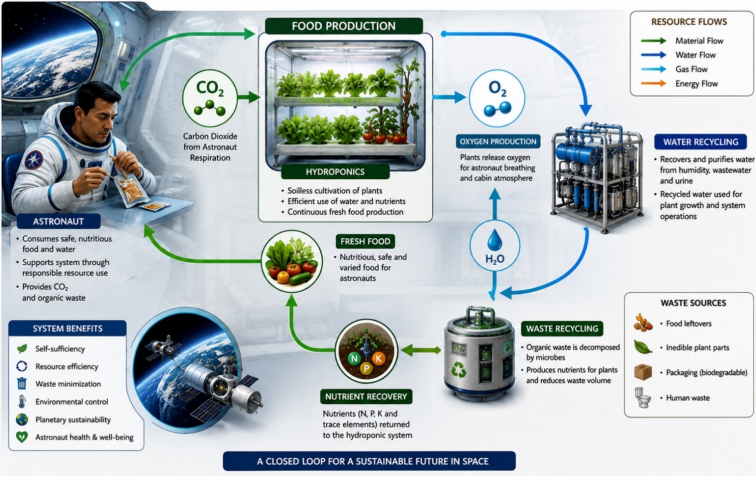
Sustainable food systems are essential for future human exploration beyond low-Earth orbit, where continuous resupply from Earth is impractical. Unlike conventional space food systems that rely largely on pre-packaged foods, future missions to the Moon and Mars require integrated, closed-loop systems capable of producing, preserving, recycling, and efficiently utilising resources while ensuring food safety and nutritional adequacy . These systems combine food production with water recovery, carbon dioxide utilisation, oxygen generation, and waste recycling to enhance mission sustainability and crew health, as shown in Figure 1.
6.1. Bioregenerative Life-Support Systems (BLSS)
Bioregenerative Life-Support Systems (BLSS) integrate plants, algae, fungi, and microorganisms to regenerate oxygen recycle water and nutrients, remove carbon dioxide, and produce edible biomass. Beyond food production, BLSS contribute to environmental control and waste recycling, supporting self-sustaining habitats for long-duration missions. Space-based experiments, including NASA's Veggie and Advanced Plant Habitat programmes, have demonstrated the feasibility of cultivating crops in microgravity. Further optimisation is required before large-scale deployment on the Moon and Mars .
6.2. Controlled-Environment Agriculture (CEA)
Controlled-environment agriculture (CEA) enables crop production by regulating temperature, humidity, lighting, atmospheric composition, and nutrient delivery independent of external environmental conditions. Technologies such as hydroponics, aeroponics, and aquaponics maximise water and nutrient efficiency while minimising resource consumption. Hydroponics remains the most mature system for space applications, whereas aeroponics offers enhanced nutrient uptake and water conservation. Aquaponics provides an integrated recycling approach but requires further research to overcome the technical challenges associated with reduced-gravity environments .
6.3. Alternative Food Production Technologies
Future exploration missions will require additional sources of high-quality protein beyond conventional crop production. Precision fermentation uses engineered microorganisms to produce proteins, vitamins, and enzymes with minimal resource requirements, while cellular agriculture offers the potential to produce cultured meat without livestock. In addition, edible microorganisms such as Spirulina, Chlorella, and selected fungi provide nutrient-dense biomass, rapid growth, and compatibility with closed-loop life-support systems, making them promising components of sustainable space nutrition .
6.4. Circular Resource Utilisation
Efficient resource recycling is fundamental to sustainable extraterrestrial food production. Water recovered from humidity, wastewater, and urine, together with recycled nutrients from organic waste, supports continuous crop production while plants regenerate oxygen and utilise carbon dioxide. Artificial intelligence is expected to optimise nutrient management, crop monitoring, waste recycling, and harvest scheduling, thereby improving overall system efficiency and resilience .
6.5. Nutritional and Psychological Benefits of Fresh Food Production
Fresh foods produced onboard provide vitamins, antioxidants, dietary fibre, and other bioactive compounds that decline during prolonged storage of processed foods. Equally important, cultivating plants has been shown to reduce stress, improve mood, strengthen crew cohesion, and enhance psychological well-being during extended missions. Consequently, integrating fresh food production into future space habitats offers both nutritional and behavioural benefits that support astronaut health and long-term mission success .
Figure 1. Closed-loop Sustainable Food System for Long-Duration Space Missions.
7. Risks Associated with Shelf Life and Nutrient Instability in Long-Duration Space Missions
Ensuring a stable and nutritionally adequate food supply is fundamental to the success of long-duration human space exploration. Although considerable advancements have been achieved in food preservation technologies, packaging materials, and sustainable food production systems discussed earlier, the deterioration of food quality during prolonged storage continues to present significant risks to astronauts’ health and mission success. These risks extend beyond simple nutrient losses and encompass physiological impairment, microbial contamination, psychological stress, operational inefficiencies, and increased mission costs. Because future lunar and Martian expeditions will operate with little or no opportunity for food resupply, even relatively small declines in food quality may accumulate over time, producing substantial consequences for crew performance and survival .
Risk assessment within space food systems therefore requires a holistic approach integrating nutrition, food microbiology, toxicology, aerospace medicine, engineering, psychology, and systems biology. Understanding these interconnected risks is essential for designing resilient food systems that support exploration-class missions lasting several years. Table 2 highlights major risks associated with shelf life and stability of nutrients.
Table 2. Major Risks Associated with Shelf Life and Nutrient Instability .

Risk Category

Primary Cause

Potential Consequences

Mitigation Strategy

Nutritional

Vitamin degradation

Micronutrient deficiency

Fortification, encapsulation

Physiological

Poor nutrient availability

Bone loss, muscle atrophy

Functional foods, dietary optimization

Food Safety

Microbial contamination

Food borne illness

Sterilization and biosensors

Chemical

Lipid oxidation

Toxic metabolites, flavour deterioration

Antioxidants and improved packaging

Psychological

Menu fatigue

Reduced food intake

Fresh food production and menu diversity

Operational

Food system failure

Reduced mission reliability

Redundant preservation systems

Agricultural

Crop production failure

Food shortages

Multiple food production platforms

8. Emerging Technologies to Improve Space Food Systems
Emerging technologies are reshaping the future of space food systems by integrating advanced biotechnology, artificial intelligence, materials science, precision agriculture, and digital health. Innovations such as 3D food printing, nanotechnology, synthetic biology, precision fermentation, cellular agriculture, gene-edited crops, and intelligent packaging have the potential to overcome current limitations in food preservation, nutrient stability, and sustainability, as seen in Table 3. While many of these technologies remain under development, their successful integration into future exploration missions could enable autonomous, resilient, and nutritionally optimised food systems capable of supporting permanent human habitation beyond Earth .
Table 3. Emerging Technologies Transforming Future Space Food Systems .

Technology

Major Application

Expected Benefits

Current Challenges

3D Food Printing

Personalized meals

Menu diversity and reduced waste

Ingredient stability

Nanotechnology

Preservation and packaging

Extended shelf life

Safety evaluation

Artificial Intelligence

Food management

Autonomous decision-making

Data integration

Synthetic Biology

Engineered crops and microbes

Enhanced nutrition

Biosafety concerns

Precision Fermentation

Protein and vitamin production

Resource efficiency

Scale-up challenges

Cellular Agriculture

Cultured meat

Sustainable protein

High production costs

Gene Editing

Improved crop performance

Increased productivity

Regulatory issues

Smart Packaging

Food quality monitoring

Real-time safety assessment

Sensor durability

Omics Technologies

Precision nutrition

Personalized dietary interventions

Complex data interpretation

9. Conclusion
Sustainable food systems are indispensable for the success of future long-duration human space missions. As exploration expands beyond low-Earth orbit to the Moon and Mars, reliance on conventional pre-packaged foods alone will no longer meet astronauts' nutritional, operational, and psychological needs. This review demonstrates that integrating advanced food preservation technologies with controlled-environment agriculture, bioregenerative life-support systems, intelligent packaging, precision fermentation, and artificial intelligence offers a practical pathway toward resilient and self-sustaining space food systems. However, important challenges remain, particularly in ensuring long-term nutrient stability, mitigating the combined effects of microgravity and space radiation on food quality, and validating these technologies under actual deep-space conditions. Addressing these gaps will require multidisciplinary collaboration among food scientists, engineers, biotechnologists, and aerospace researchers. Beyond supporting space exploration, many of these innovations have significant potential to improve food preservation, resource-efficient agriculture, and global food security, highlighting the broader societal value of research in sustainable space nutrition.
Abbreviations

LEO

Low-Earth Orbit

ISS

International Space System

NASA

National Aeronautics and Space Administration

CEA

Controlled Environment Agriculture

BLSS

Bioregenerative Life-Support Systems

Author Contributions
Solomon Jonathan Hussaini: Conceptualization, Methodology, Writing – original draft
Hadiza Haruna Abdulrasheed: Conceptualization, Supervision, Validation
Asenetu Iye Ibrahim: Conceptualization, Data curation
Jennifer Chinemerem Mbah: Conceptualization, Visualization
Mariya Akilu: Investigation, Writing – review & editing
Jeffree Ogbevire Leleji: Project administration, Validation
Kabiru Nuhu Umar: Data curation, Software, Validation, Writing– review & editing
Conflicts of Interest
The authors declare no conflicts of interest.
References
[1] Watkins, P., Hughes, J., Gamage, T. V., Knoerzer, K., Ferlazzo, M. L., &Banati, R. B. (2022). Long-term food stability for extended space missions: A review. Life Sciences in Space Research, 32, 79-95.
[2] Tang, H., Rising, H. H., Majji, M., & Brown, R. D. (2021). Long-Term Space Nutrition: A Scoping Review. Nutrients, 14(1), 194.
[3] Dakkumadugula, A., Pankaj, L., Alqahtani, A. S., Ullah, R., Ercisli, S., &Murugan, R. (2023). Space nutrition and the biochemical changes caused in astronauts' health due to space flight: A review. Food Chemistry: X, 20, 100875.
[4] Kim, G., Park, Y., Lim, Y. K., Lee, J. W., Kang, D., Lee, D. K., Lee, J. H., Song, M. S., & Lee, B. H. (2026). Understanding Spaceflight-Induced Oxidative Stress and the Critical Role of Diet and Microbiome. Antioxidants, 15(5), 534.
[5] Sonali, L., Drisya Raj, M. P., Pavithra, R., Kanimozhi, N. V., Suneetha, C., Roopa Shri, B., & Sukumar, M. (2025). Functional foods for astronauts: Enhancing health and performance in microgravity and extreme environments. Space Habitation, 1(1), 100005.
[6] Cooper, M., Perchonok, M., & Douglas, G. L. (2017). Initial assessment of the nutritional quality of the space food system over three years of ambient storage. NPJ Microgravity, 3, 17.
[7] Gharby, S., Asbbane, A., Nid Ahmed, M., Gagour, J., Hallouch, O., Oubannin, S., Bijla, L., Goh, K. W., Bouyahya, A., &Ibourki, M. (2025). Vegetable oil oxidation: Mechanisms, impacts on quality, and approaches to enhance shelf life. Food Chemistry: X, 28, 102541.
[8] Kumar, L., & Gaikwad, K. K. (2023). Advanced food packaging systems for space exploration missions. Life Sciences in Space Research, 37, 7-14.
[9] Liu, H., Yao, Z., Fu, Y., & Feng, J. (2021). Review of research into bioregenerative life support system(s) which can support humans living in space. Life Sciences in Space Research, 31, 113-120.
[10] Marshall Porterfield, D., Tulodziecki, D., Wheeler, R., Davis Cross, M. K., Monje, O., Rothschild, L. J., Barker, R. J., Schwertz, H., Collicott, S., & Dutta, S. (2025). Critical investments in bioregenerative life support systems for bioastronautics and sustainable lunar exploration. NPJ Microgravity, 11, 57.
[11] Pandith, J. A., Neekhra, S., Ahmad, S., & Sheikh, R. A. (2023). Recent developments in space food for exploration missions: A review. Life Sciences in Space Research, 36, 123-134.
[12] Perchonok, M., &Bourland, C. (2002). NASA food systems: Past, present, and future. Nutrition, 18(10), 913-920.
[13] Subaratinam, R., Kavya, V., S, Y., & S, I. (2026). Evolution of space food: Historical development, preservation techniques, packaging advances, and future innovations for sustained astronaut nutrition. International Journal of Home Science, 12(1), 161-168.
[14] Lee, J. A., Brecht, J. K., Castro-Wallace, S., Donovan, F. M., Hogan, J. A., Liu, T., Massa, G. D., Parra, M., Sargent, S. A., Settles, A. M., Singh, N. K., Justiniano, Y.-A. V., &Venkateswaran, K. (2021). Microbial Food Safety in Space Production Systems.
[15] Jamshidi-Kia, F., HosseinzadehSamani, B., Sanches Silva, A., &Lorigooini, Z. (2026). A Systematic Review on Natural Compounds and Emerging Technologies for Sustainable Active and Intelligent Food Packaging. Journal of Food Processing and Preservation, 2026(1), 2467822.
[16] Chand, K., Sharma, A., &Kanaujia, S. P. (2026). Smart shelf life: A real-time intelligent packaging framework for enhancing food freshness and reducing waste. Journal of Food Science and Technology.
[17] Lane, H. W., &Feeback, D. L. (2002). History of nutrition in space flight: Overview. Nutrition, 18(10), 797-804.
[18] Douglas, G. L., Zwart, S. R., & Smith, S. M. (2020). Space Food for Thought: Challenges and Considerations for Food and Nutrition on Exploration Missions. The Journal of Nutrition, 150(9), 2242-2244.
[19] Singh, S., Negi, T., Sagar, N. A., Kumar, Y., Kaur, S., Thakur, R., Verma, K., Sirohi, R., &Tarafdar, A. (2024). Advances in space food processing: From farm to outer space. Food Bioscience, 61, 104893.
[20] Verma, K., Duhan, P., Pal, D., Verma, P., & Bansal, P. (2025). Precision fermentation for the next generation of food ingredients: Opportunities and challenges. Future Foods, 12, 100750.
[21] Mokhtari, M., Reinsch, S. S., Barcenilla, B. B., Ziyaei, K., & Barker, R. J. (2025). Space-driven ROS in cells: A hidden danger to astronaut health and food safety. NPJ Microgravity, 11, 52.
[22] Zhao, M. (2024). Food systems for long-term spaceflight: Understanding the role of non-nutrient polyphenols in astronauts’ health. Heliyon, 10(19), e37452.
[23] Douglas, G. L., & Barr, Y. R. (2018, February). Long-Term Stability of Spaceflight Food for Multi-Year Exploration Missions. InDeep Space Gateway Concept Science Workshop (Vol. 2063, p. 3049).
[24] Ayala, A., Muñoz, M. F., & Argüelles, S. (2014). Lipid Peroxidation: Production, Metabolism, and Signalling Mechanisms of Malondialdehyde and 4-Hydroxy-2-Nonenal. Oxidative Medicine and Cellular Longevity, 2014, 360438.
[25] Feszterová, M., Kowalska, M., &Mišiaková, M. (2023). Stability of Vitamin C Content in Plant and Vegetable Juices under Different Storing Conditions. Applied Sciences, 13(19), 10640.
[26] Ebhohimen, I. E., Okanlawon, T. S., Osagie, A. O., &Izevbigie, O. N. (2021). Vitamin E in Human Health and Oxidative Stress Related Diseases. In Vitamin E in Health and Disease—Interactions, Diseases and Health Aspects. IntechOpen.
[27] Guo, Y., Wang, F., Yang, T., Li, S., Dong, J., Fan, Y., Zhang, Z., Zhao, X., &Hou, H. (2024). Enhancement of vitamin B stability with the protection of whey protein and their interaction mechanisms. Food Chemistry, 460, 140521.
[28] Goulette, T. R., Zhou, J., Dixon, W. R., Normand, M. D., Peleg, M., McClements, D. J., Decker, E., & Xiao, H. (2020). Kinetic parameters of thiamine degradation in NASA spaceflight foods determined by the endpoints method for long-term storage. Food Chemistry, 302, 125365.
[29] Wright, H. C., Fountain, L., Moschopoulos, A., Ryan, A. J., Daniell, T. J., Cullen, D. C., Shaughnessy, B., & Cameron, D. D. (2023). Space-controlled environment agriculture offers pathways to improve the sustainability of controlled environmental agriculture on Earth. Nature Food, 4(8), 648-653.
[30] Eilam, Y., Khattib, H., Pintel, N., &Avni, D. (2023). Microalgae—Sustainable Source for Alternative Proteins and Functional Ingredients Promoting Gut and Liver Health. Global Challenges, 7(5), 2200177.
[31] Rai, N., Pavankumar, T. L. L., Ghotra, B., Dhillon, S., Juneja, V., Amaly, N., & Pandey, P. (2025). Essential recycling and repurposing of food waste for environment and sustainability. Frontiers in Sustainable Food Systems, 9.
[32] Landon, L. B., Begerowski, S. R., Roma, P. G., Whiting, S. E., Bell, S. T., & Massa, G. D. (2025). Sustaining the Merry Space farmer with pick-and-eat crop production. NPJ Microgravity, 11, 72.
[33] Douglas, G. L., Wheeler, R. M., &Fritsche, R. F. (2021). Sustaining Astronauts: Resource Limitations, Technology Needs, and Parallels between Spaceflight Food Systems and those on Earth. Sustainability, 13(16), 9424.
Cite This Article
  • APA Style

    Hussaini, S. J., Abdulrasheed, H. H., Ibrahim, A. I., Mbah, J. C., Akilu, M., et al. (2026). Sustainable Food Systems for Astronauts and Associated Risks in Long-Duration Space Missions: A Narrative Review. Science Discovery Food, 1(3), 117-127. https://doi.org/10.11648/j.sdf.20260103.13

    Copy | Download

    ACS Style

    Hussaini, S. J.; Abdulrasheed, H. H.; Ibrahim, A. I.; Mbah, J. C.; Akilu, M., et al. Sustainable Food Systems for Astronauts and Associated Risks in Long-Duration Space Missions: A Narrative Review. Sci. Discov. Food 2026, 1(3), 117-127. doi: 10.11648/j.sdf.20260103.13

    Copy | Download

    AMA Style

    Hussaini SJ, Abdulrasheed HH, Ibrahim AI, Mbah JC, Akilu M, et al. Sustainable Food Systems for Astronauts and Associated Risks in Long-Duration Space Missions: A Narrative Review. Sci Discov Food. 2026;1(3):117-127. doi: 10.11648/j.sdf.20260103.13

    Copy | Download

  • @article{10.11648/j.sdf.20260103.13,
      author = {Solomon Jonathan Hussaini and Hadiza Haruna Abdulrasheed and Asenetu Iye Ibrahim and Jennifer Chinemerem Mbah and Mariya Akilu and Jeffree Ogbevire Leleji and Kabiru Nuhu Umar},
      title = {Sustainable Food Systems for Astronauts and Associated Risks in Long-Duration Space Missions: A Narrative Review},
      journal = {Science Discovery Food},
      volume = {1},
      number = {3},
      pages = {117-127},
      doi = {10.11648/j.sdf.20260103.13},
      url = {https://doi.org/10.11648/j.sdf.20260103.13},
      eprint = {https://article.sciencepublishinggroup.com/pdf/10.11648.j.sdf.20260103.13},
      abstract = {The success of Long-duration human space missions depends not only on advanced spacecraft engineering and life-support technologies but also on resilient food systems that can sustain astronauts’ health and performance throughout the mission. As space agencies prepare for permanent lunar habitats and crewed missions to Mars, food systems have become a critical component of mission success. Future exploration-class missions are expected to last three to five years, during which resupply of food from Earth will be limited or unavailable. Consequently, conventional pre-packaged foods must evolve into sustainable, integrated systems that ensure nutritional adequacy, food safety, and psychological well-being under resource-constrained environments. This narrative review synthesises current evidence on the evolution of space food technologies, shelf-life limitations, nutrient stability, and the effects of microgravity and space radiation on food quality. It further examines emerging preservation strategies, including active and intelligent packaging, microencapsulation, controlled-environment agriculture, precision fermentation, and bioregenerative life-support systems, as sustainable solutions for future deep-space missions. The review also highlights the major risks associated with prolonged food storage, including nutrient degradation, microbial contamination, and reduced sensory quality. It discusses innovative technologies such as artificial intelligence, synthetic biology, and 3D food printing that may improve the resilience of food systems. Collectively, these advances provide a framework for developing safe, nutritious, and sustainable food systems that support long-duration human exploration while offering valuable applications for terrestrial food security and climate-resilient agriculture.},
     year = {2026}
    }
    

    Copy | Download

  • TY  - JOUR
    T1  - Sustainable Food Systems for Astronauts and Associated Risks in Long-Duration Space Missions: A Narrative Review
    AU  - Solomon Jonathan Hussaini
    AU  - Hadiza Haruna Abdulrasheed
    AU  - Asenetu Iye Ibrahim
    AU  - Jennifer Chinemerem Mbah
    AU  - Mariya Akilu
    AU  - Jeffree Ogbevire Leleji
    AU  - Kabiru Nuhu Umar
    Y1  - 2026/08/27
    PY  - 2026
    N1  - https://doi.org/10.11648/j.sdf.20260103.13
    DO  - 10.11648/j.sdf.20260103.13
    T2  - Science Discovery Food
    JF  - Science Discovery Food
    JO  - Science Discovery Food
    SP  - 117
    EP  - 127
    PB  - Science Publishing Group
    SN  - 3143-6781
    UR  - https://doi.org/10.11648/j.sdf.20260103.13
    AB  - The success of Long-duration human space missions depends not only on advanced spacecraft engineering and life-support technologies but also on resilient food systems that can sustain astronauts’ health and performance throughout the mission. As space agencies prepare for permanent lunar habitats and crewed missions to Mars, food systems have become a critical component of mission success. Future exploration-class missions are expected to last three to five years, during which resupply of food from Earth will be limited or unavailable. Consequently, conventional pre-packaged foods must evolve into sustainable, integrated systems that ensure nutritional adequacy, food safety, and psychological well-being under resource-constrained environments. This narrative review synthesises current evidence on the evolution of space food technologies, shelf-life limitations, nutrient stability, and the effects of microgravity and space radiation on food quality. It further examines emerging preservation strategies, including active and intelligent packaging, microencapsulation, controlled-environment agriculture, precision fermentation, and bioregenerative life-support systems, as sustainable solutions for future deep-space missions. The review also highlights the major risks associated with prolonged food storage, including nutrient degradation, microbial contamination, and reduced sensory quality. It discusses innovative technologies such as artificial intelligence, synthetic biology, and 3D food printing that may improve the resilience of food systems. Collectively, these advances provide a framework for developing safe, nutritious, and sustainable food systems that support long-duration human exploration while offering valuable applications for terrestrial food security and climate-resilient agriculture.
    VL  - 1
    IS  - 3
    ER  - 

    Copy | Download

Author Information
  • Physical and Life Sciences Department, National Space Research and Development Agency, Abuja, Nigeria

    Research Fields: Space Life Sciences, Nutrition Biochemistry, Public Health Nutrition, Food Safety and Quality, Space Biology

  • Physical and Life Sciences Department, National Space Research and Development Agency, Abuja, Nigeria

    Research Fields: Food Science and Nutrition, Food Processing and Technology, Space Health and Human Physiology, Space Food Product Development, Environmental Health and Space Habitability

  • Physical and Life Sciences Department, National Space Research and Development Agency, Abuja, Nigeria

    Research Fields: Space Life Science, Space Nutrition, Environmental Biotechnology, Astronaut Health, Human Physiology

  • Physical and Life Sciences Department, National Space Research and Development Agency, Abuja, Nigeria

    Research Fields: Gut Microbiome, Food Microbiology, Probiotics and Prebiotics, Microbial Biotechnology, Public Health Nutrition

  • Physical and Life Sciences Department, National Space Research and Development Agency, Abuja, Nigeria

    Research Fields: Space Life Science, Space Biochemistry, Public Health and Epidemiology, Space Human Physiology and Health, Space Nutrition and Food Development

  • Physical and Life Sciences Department, National Space Research and Development Agency, Abuja, Nigeria

    Research Fields: Radiation Biology, Space Nutrition, Space Physiology, Astrobiology, Life Sciences

  • Centre for Space Innovation and Development, National Space Research and Development Agency, Abuja, Nigeria

    Research Fields: Energy Studies, Mechatronics, Remote sensing/GIS, Space mechanical engineering, Engineering and space systems