
With the growing need for clean energy, it is critical to efficiently utilize renewable energy sources, and green hydrogen is one of the potential sources that can help achieve sustainability goals. This study emphasizes the importance of solar photovoltaic systems for producing green hydrogen through water electrolysis as a long-term solution to environmental and economic concerns. The research focuses on enhancing the performance of these systems in order to enhance green hydrogen production, as electrolysis efficiency is determined by the quality of the energy derived from solar panels. The research examines the connection between photovoltaic electrolysis and water technologies, with an emphasis on the tilt angle of solar panels and its impact on efficiency. The study found that proton exchange membrane electrolysis is most suited for direct integration with renewable energy sources, hence increasing the efficiency of the hydrogen production process. The findings also revealed that maximizing the fixed tilt angle of solar panels is critical in striking a balance between cost and efficacies, making this design a viable alternative for future projects. The study concluded that the appropriate tilt angle (30 degrees) is crucial for increasing solar energy absorption and productivity. The study also investigated electrolysis techniques, and the findings revealed that proton exchange membrane electrolysis is most suited for direct integration with renewable energy sources. The optimization of the fixed tilt angle strikes a compromise between cost and efficacy, making this design appropriate for future applications. Variables like as row spacing and photovoltaic module size were calculated in order to build an optimal system suitable for the NEOM climate. The study sheds light on how to improve green hydrogen production with solar photovoltaic systems, opening up new avenues for research and development in this field.
| Published in | Research and Innovation (Volume 2, Issue 2) |
| DOI | 10.11648/j.ri.20260202.20 |
| Page(s) | 203-213 |
| Creative Commons |
This is an Open Access article, distributed under the terms of the Creative Commons Attribution 4.0 International License (http://creativecommons.org/licenses/by/4.0/), which permits unrestricted use, distribution and reproduction in any medium or format, provided the original work is properly cited. |
| Copyright |
Copyright © The Author(s), 2026. Published by Science Publishing Group |
Photovoltaic (PV), Panels, Electrolysis, System Design, Green Hydrogen, Tilt Angle, PVsyst Software
Solar Radiation | Intensity |
|---|---|
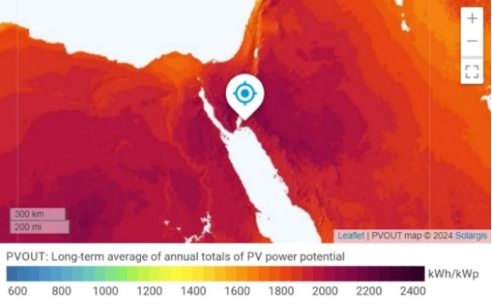
Specific photovoltic power output PVOUT | 1927.6 kWh/ kWp |
Direct Normal Irradiation DNI | 2503.9 kWh/ m2 |
Global Horizontal Irradiation GHI | 2255.9 kWh/ m2 |
Diffuse Horizontal Irradiation DIF | 642.4 kWh/ m2 |
Module | LR5-66HPH-490MG2 |
|---|---|
Electrical Characteristics at STC | 1.5 AM, 1000 W/m2, 25C |
Max power | 490 Wp |
Short circuit current | 13.74 |
Open circuit voltage | 45.25 |
Module efficiency | 20.9 |
Dimensions | 2073* 1133*35mm |
Max System voltage | DC1500V |
Max series fuse rating | 25A |
Module | ABB Central Inverter | |
|---|---|---|
Input | DC Voltage range, MPP (UDC, MPP) | 525-825 |
Max DC Voltage | 1100 Volt | |
Max DC Current | 1710 Ampere | |
Number of protected DC inputs | 8 -20 (+/-) | |
Output | Nominal Power | 875 kW |
Max output power | 1050 kW | |
Nominal AC current | 1445 A | |
Nominal output voltage | 350 V | |
Efficiency | 98.7% | |
Month | Optimum Tilt angle (α) | Altitude angle (β) | Solar deflation angle (δ) | day |
|---|---|---|---|---|
Jan | 49.43 | 40.57 | -21.1 | 1 |
Feb | 44.73 | 45.27 | -16.4 | 32 |
Mar | 35.33 | 54.67 | -7 | 60 |
Apr | 24.35 | 65.65 | 3.98 | 91 |
May | 14.33 | 75.67 | 14 | 121 |
June | 6.53 | 83.47 | 21.8 | 152 |
July | 5.43 | 84.57 | 22.9 | 182 |
Aug | 11.93 | 78.07 | 16.4 | 213 |
Sep | 21.33 | 68.67 | 7 | 244 |
Oct | 31.83 | 58.17 | -3.5 | 274 |
Nov | 36.73 | 53.27 | -8.4 | 305 |
Dec | 49.43 | 40.57 | -21.1 | 335 |
Simulated Tilt angle | GHI on Collector plane | E Grid (Mwh) | E Array (Mwh) | Losses |
|---|---|---|---|---|
50° | 2390 | 10042596 | 10235692 | -5.5% |
40° | 2492 | 10449382 | 10649652 | -1.5% |
30° | 2530 | 10602177 | 10804946 | 0.0% |
20° | 2504 | 10502060 | 10702536 | -1.0% |
10° | 2414 | 10149079 | 10342535 | -4.6% |
0° | 2261 | 9534519 | 9716613 | -10.6% |
GlobHor (kWh/m2) | DiffHor (kWh/m2) | T_Amb (C) | Globlnc (kWh/m2) | GlobEff (kWh/m2) | EArray (kWh) | E_ Grid (kWh) | PR ratio | |
|---|---|---|---|---|---|---|---|---|
January | 130.7 | 25.19 | 17.53 | 198.2 | 196.1 | 885876 | 869152 | 0.877 |
February | 146.3 | 28.17 | 19.05 | 197.0 | 194.9 | 865252 | 848957 | 0.862 |
March | 199.4 | 38.75 | 22.30 | 233.1 | 230.2 | 1004410 | 985098 | 0.845 |
April | 216.5 | 54.60 | 25.45 | 221.9 | 218.4 | 948657 | 930486 | 0.839 |
May | 236.5 | 68.45 | 29.51 | 217.7 | 213.5 | 923049 | 905660 | 0.832 |
June | 249.7 | 47.74 | 31.96 | 216.4 | 211.7 | 903513 | 886663 | 0.820 |
July | 246.4 | 57.86 | 33.51 | 219.4 | 214.5 | 911750 | 894840 | 0.816 |
August | 227.7 | 59.66 | 33.69 | 223.2 | 219.0 | 925413 | 908186 | 0.814 |
September | 195.0 | 49.09 | 31.07 | 216.3 | 213.0 | 906891 | 890372 | 0.823 |
October | 162.6 | 46.43 | 28.08 | 205.0 | 202.3 | 876984 | 860921 | 0.840 |
November | 131.0 | 29.08 | 23.37 | 189.4 | 187.6 | 828508 | 812662 | 0.858 |
December | 118.9 | 25.03 | 19.39 | 184.9 | 183.1 | 824644 | 809182 | 0.875 |
Year | 2260.6 | 530.06 | 26.28 | 2522.5 | 2484.2 | 10804946 | 10602177 | 0.841 |
Item | Value (unit) |
|---|---|
Generated Emission | KgCO2 |
Modules | 8562692 |
Inverter | 2455 |
Support | 505641 |
Total | 9070.79 t CO2 |
Replaced emission | |
Total | 236322.5 t CO2 |
Life Time | 30 years |
Grid Lifecycle Emissions | 743 g CO2/kWh |
PV | Photovoltaic |
RE | Renewable Energy |
PEM | Proton Exchange Membrane |
CO₂ | Carbon Dioxide |
MW | Megawatt |
kW | Kilowatt |
kWh | Kilowatt-hour |
kWp | Kilowatt-peak |
MWh | Megawatt-hour |
Wp | Watt-peak |
DC | Direct Current |
AC | Alternating Current |
MPPT | Maximum Power Point Tracking |
STC | Standard Test Conditions |
PR | Performance Ratio |
Pnom | Nominal Power |
Voc | Open Circuit Voltage |
Vmpp | Voltage at Maximum Power Point |
Isc | Short Circuit Current |
DNI | Direct Normal Irradiation |
GHI | Global Horizontal Irradiation |
DIF | Diffuse Horizontal Irradiation |
PVOUT | Photovoltaic Power Output |
NSRDB | National Solar Radiation Database |
L_mod | Module Length (or Module-related Parameter in Spacing Equation) |
η | Efficiency |
V | Voltage |
H₂ | Hydrogen |
O₂ | Oxygen |
TPC | Temperature Power Coefficient |
Tamb | Ambient Temperature |
Tnom | Nominal Temperature |
TSTC | Standard Test Condition Temperature |
EGrid | Energy Delivered to Grid |
Glob.inc | Global Incident Irradiance |
WACC | Weighted Average Cost of Capital |
| [1] | Jaradat, M., Alsotary, O., Juaidi, A., Albatayneh, A., Alzoubi, A., Gorjian, S. (2022). Potential of producing green hydrogen in Jordan. Energies, 15(23), 9039. |
| [2] | Shboul, B., Zayed, M. E., Tariq, R., Ashraf, W. M., Odat, A. S., Rehman, S., Krzywanski, J. (2024). New hybrid photovoltaic-fuel cell system for green hydrogen and power production: Performance optimization assisted with Gaussian process regression method. International Journal of Hydrogen Energy, 59, 1214–1229. |
| [3] | Al-Sharafi, A., Al-Buraiki, A. S., Al-Sulaiman, F., Antar, M. A. (2024). Hydrogen refueling stations powered by hybrid PV/wind renewable energy systems: Techno-socio-economic assessment. Energy Conversion and Management: X, 22, 100584. |
| [4] | Florez, J., AlAbbad, M., Vazquez-Sanchez, H., Morales, M. G., Sarathy, S. M. (2024). Optimizing islanded green ammonia and hydrogen production and export from Saudi Arabia. International Journal of Hydrogen Energy, 56, 959–972. |
| [5] | Hussam, W. K., Abdul-Niby, M., Sheard, G. J. (2024). Techno-economic analysis and optimization of hydrogen production from renewable hybrid energy systems: Shagaya renewable power plant–Kuwait. International Journal of Hydrogen Energy, 58, 56–68. |
| [6] | AlZahrani, A. A., Zamfirescu, C., El-Emam, R. S. (2024). Analysis of a Solar-Assisted Crude Oil Refinery System with On-site Green Hydrogen Generation: A Case Study. Arabian Journal for Science and Engineering. |
| [7] | Zghaibeh, M., Okonkwo, P. C., Belgacem, I. B., Beitelmal, W. H., Mansir, I. B. (2022). Analytical model for a techno-economic assessment of green hydrogen production in photovoltaic power station case study Salalah city–Oman. International Journal of Hydrogen Energy, 47(31), 14171–14179. |
| [8] | Al-Sharafi, A., Sahin, A. Z., Ayar, T., Yilbas, B. S. (2017). Techno-economic analysis and optimization of solar and wind energy systems for power generation and hydrogen production in Saudi Arabia. Renewable and Sustainable Energy Reviews, 69, 33–49. |
| [9] | Alturki, A. A. (2022). Optimal design for a hybrid microgrid-hydrogen storage facility in Saudi Arabia. Energy, Sustainability and Society, 12(1), 24. |
| [10] | Rajeh, M. (2022). Techno-Economic Study for Adding Hydrogen Storage to the Photovoltaic Plant in Neom City. PhD dissertation, Effat University. |
| [11] | Zghaibeh, M., Belgacem, I. B., Baloch, M. H., Chauhdary, S. T., Kumar, L., Arıcı, M. (2024). Optimization of green hydrogen production in hydroelectric-photovoltaic grid connected power station. International Journal of Hydrogen Energy, 52, 440–453. |
| [12] | Hassan, Q., Abdulrahman, I. S., Salman, H. M., Olapade, O. T., Jaszczur, M. (2023). Techno-economic assessment of green hydrogen production by an off-grid photovoltaic energy system. Energies, 16(2), 744. |
| [13] | Okonkwo, P. C., Belgacem, I. B., Zghaibeh, M., Tlili, I. (2022). Optimal sizing of photovoltaic systems based green hydrogen refueling stations case study Oman. International Journal of Hydrogen Energy, 47(75), 31964–31973. |
| [14] | Hai, T., Ali, M. A., Dhahad, H. A., Alizadeh, A. A., Sharma, A., Almojil, S. F., Wang, D. (2023). Optimal design and transient simulation next to environmental consideration of net-zero energy buildings with green hydrogen production and energy storage system. Fuel, 336, 127126. |
| [15] | Balabel, A., Alrehaili, M. S., Alharbi, A. O., Mohammed, M., Alharbi, H. (2023). Potential of solar hydrogen production by water electrolysis in the NEOM green city of Saudi Arabia. World Journal of Advanced Engineering Technology and Sciences, 8(1), 029–052. |
| [16] | Shaher, A., Alqahtani, S., Garada, A., Cipcigan, L. (2023). Rooftop solar photovoltaic in Saudi Arabia to supply electricity demand in localised urban areas: A study of the City of Abha. Energies, 16(11), 4310. |
| [17] | Singgih, D. P., Prabowo, A. R., Arifin, Z. (2022). Investigation of thermal collector nanofluids to increase the efficiency of photovoltaic solar cells. International Journal of Heat and Technology, 40(2), 208–214. |
| [18] | Victoria, M., Haegel, N., Peters, I. M., Sinton, R., Jäger-Waldau, A., del Cañizo, C., Breyer, C., Stocks, M., Blakers, A., Kaizuka, I., Komoto, K. (2021). Solar photovoltaics is ready to power a sustainable future. Joule, 5(5), 1041–1056. |
| [19] | Adeoye, A. O., Quadri, R. O., Lawal, O. S. (2023). Biomass waste pyrolysis in the context of Nigeria's oil and gas industry: An overview. International Journal of Ambient Energy. |
| [20] | Ismail, T. M., Ramzy, K., Elnaghi, B. E., Abelwhab, M. N., El-Salam, M. R. (2019). Using MATLAB to model and simulate a photovoltaic system to produce hydrogen. Energy Conversion and Management, 194, 167–182. |
| [21] | Hassan, Q., Sameen, A. Z., Salman, H. M., Jaszczur, M., Al-Hitmi, M., Alghoul, M. (2023). Energy futures and green hydrogen production: Is Saudi Arabia trend? Results in Engineering, 18, 101165. |
| [22] | Mamun, M. A. A., Islam, M. M., Hasanuzzaman, M., Selvaraj, J. (2022). Effect of tilt angle on the performance and electrical parameters of a PV module: Comparative indoor and outdoor experimental investigation. Energy and Built Environment, 3(3), 278–290. |
| [23] | Jacobson, M. Z., Jadhav, V. (2018). World estimates of PV optimal tilt angles and ratios of sunlight incident upon tilted and tracked PV panels relative to horizontal panels. Solar Energy, 169, 55–66. |
APA Style
Alghamdi, M. (2026). Design and Simulation of a Photovoltaic Power Plant for Green Hydrogen Production in Saudi Arabia. Research and Innovation, 2(2), 203-213. https://doi.org/10.11648/j.ri.20260202.20
ACS Style
Alghamdi, M. Design and Simulation of a Photovoltaic Power Plant for Green Hydrogen Production in Saudi Arabia. Res. Innovation 2026, 2(2), 203-213. doi: 10.11648/j.ri.20260202.20
@article{10.11648/j.ri.20260202.20,
  author = {Mohammed Alghamdi},
  title = {Design and Simulation of a Photovoltaic Power Plant for Green Hydrogen Production in Saudi Arabia},
  journal = {Research and Innovation},
  volume = {2},
  number = {2},
  pages = {203-213},
  doi = {10.11648/j.ri.20260202.20},
  url = {https://doi.org/10.11648/j.ri.20260202.20},
  eprint = {https://article.sciencepublishinggroup.com/pdf/10.11648.j.ri.20260202.20},
  abstract = {With the growing need for clean energy, it is critical to efficiently utilize renewable energy sources, and green hydrogen is one of the potential sources that can help achieve sustainability goals. This study emphasizes the importance of solar photovoltaic systems for producing green hydrogen through water electrolysis as a long-term solution to environmental and economic concerns. The research focuses on enhancing the performance of these systems in order to enhance green hydrogen production, as electrolysis efficiency is determined by the quality of the energy derived from solar panels. The research examines the connection between photovoltaic electrolysis and water technologies, with an emphasis on the tilt angle of solar panels and its impact on efficiency. The study found that proton exchange membrane electrolysis is most suited for direct integration with renewable energy sources, hence increasing the efficiency of the hydrogen production process. The findings also revealed that maximizing the fixed tilt angle of solar panels is critical in striking a balance between cost and efficacies, making this design a viable alternative for future projects. The study concluded that the appropriate tilt angle (30 degrees) is crucial for increasing solar energy absorption and productivity. The study also investigated electrolysis techniques, and the findings revealed that proton exchange membrane electrolysis is most suited for direct integration with renewable energy sources. The optimization of the fixed tilt angle strikes a compromise between cost and efficacy, making this design appropriate for future applications. Variables like as row spacing and photovoltaic module size were calculated in order to build an optimal system suitable for the NEOM climate. The study sheds light on how to improve green hydrogen production with solar photovoltaic systems, opening up new avenues for research and development in this field.},
 year = {2026}
}
TY  - JOUR
T1  - Design and Simulation of a Photovoltaic Power Plant for Green Hydrogen Production in Saudi Arabia
AU  - Mohammed Alghamdi
Y1  - 2026/04/25
PY  - 2026
N1  - https://doi.org/10.11648/j.ri.20260202.20
DO  - 10.11648/j.ri.20260202.20
T2  - Research and Innovation
JF  - Research and Innovation
JO  - Research and Innovation
SP  - 203
EP  - 213
PB  - Science Publishing Group
SN  - 3070-6297
UR  - https://doi.org/10.11648/j.ri.20260202.20
AB  - With the growing need for clean energy, it is critical to efficiently utilize renewable energy sources, and green hydrogen is one of the potential sources that can help achieve sustainability goals. This study emphasizes the importance of solar photovoltaic systems for producing green hydrogen through water electrolysis as a long-term solution to environmental and economic concerns. The research focuses on enhancing the performance of these systems in order to enhance green hydrogen production, as electrolysis efficiency is determined by the quality of the energy derived from solar panels. The research examines the connection between photovoltaic electrolysis and water technologies, with an emphasis on the tilt angle of solar panels and its impact on efficiency. The study found that proton exchange membrane electrolysis is most suited for direct integration with renewable energy sources, hence increasing the efficiency of the hydrogen production process. The findings also revealed that maximizing the fixed tilt angle of solar panels is critical in striking a balance between cost and efficacies, making this design a viable alternative for future projects. The study concluded that the appropriate tilt angle (30 degrees) is crucial for increasing solar energy absorption and productivity. The study also investigated electrolysis techniques, and the findings revealed that proton exchange membrane electrolysis is most suited for direct integration with renewable energy sources. The optimization of the fixed tilt angle strikes a compromise between cost and efficacy, making this design appropriate for future applications. Variables like as row spacing and photovoltaic module size were calculated in order to build an optimal system suitable for the NEOM climate. The study sheds light on how to improve green hydrogen production with solar photovoltaic systems, opening up new avenues for research and development in this field.
VL  - 2
IS  - 2
ER  -
Carbon Management Technologies, King Abdulaziz City for Science and Technologies (KACST), Riyadh, Saudi Arabia
Research Fields: Solar Energy, Hydrogen Production, Renewable Energy Systems, Decarbonization Technologies, Energy Engineering, Carbon Capture, Utilization, and Storage (CCUS).

Information



 Share This Article
 Twitter
 Linked In
 Facebook
 Copy
Copy Download