1. Introduction
Currently, massive multiple-input multiple-output (mMIMO) technology has received considerable attention in technological news, public domains, and mobile communication systems, particularly because of its ability to address the increasingly challenging requirements of modern communication networks
| [8] | Kola-Jnr, A., Ibikunle, F., Olamide, A., Unaegbu, B., Joshua, O., & Collins, A. (2024). Review of channel measurements and modeling for successful 5G system deployments. International Journal of Wireless Communications and Mobile Computing, 11(2), 31-38.
https://doi.org/10.11648/j.wcmc.20241102.12 |
| [9] | Li, N., Gao, Y., Xu, K., Guo, M., Sha, N., Wang, X., & Wang, G. (2023). Spatial sparsity-based pilot attack detection and transmission countermeasure for cell-free massive MIMO system. IEEE Systems Journal, 17(2), 2065-2076.
https://doi.org/10.1109/jsyst.2022.3188279 |
| [11] | Manasa, B., & Venugopal P. (2022). A systematic literature review on channel estimation in MIMO-OFDM system: Performance analysis and future direction. Journal of Optical Communications, 45(3), 589-614.
https://doi.org/10.1515/joc-2022-0033 |
[8, 9, 11]
. This high-tech digital technology employs a great deal of antennas at the base stations, significantly improving and enhancing beamforming capabilities and capacities. Consequently, it enhances both the spectral and power consumption economies, increases the data throughput performance, and boosts the overall cell capacity. Moreover, massive MIMO systems can support numerous customers, making them a powerful solution to the ever-increasing demand for mobile networks
| [3] | Björnson, E., Hoydis, J., & Sanguinetti, L. (2017). Massive MIMO networks: Spectral, energy, and hardware efficiency. Foundations and Trends® in Signal Processing, 11(3-4), 154-655. https://doi.org/10.1561/2000000093 |
| [8] | Kola-Jnr, A., Ibikunle, F., Olamide, A., Unaegbu, B., Joshua, O., & Collins, A. (2024). Review of channel measurements and modeling for successful 5G system deployments. International Journal of Wireless Communications and Mobile Computing, 11(2), 31-38.
https://doi.org/10.11648/j.wcmc.20241102.12 |
[3, 8]
.
A definite or notable advantage of massive MIMO communication designs is their ability to reduce mutual or two-way interference, suppress thermal noise, and nullify small-scale fading distributions. However, precise Channel State Information (CSI) is paramount for fully exploiting and leveraging these benefits. This requires dynamic modeling or simulations, such as transmitting designated pilots or known sequences, followed by the estimation of statistical channel coefficients from the received signals using appropriate algorithms. Pilots or known signals, which must typically be orthogonal, introduce complexity when supporting a large number of antennas at both ends, thereby complicating their practical implementation
| [7] | Kaur, H., Khosla, M., & Sarin, R. (2018). Channel estimation in MIMO-OFDM system: A review. 2018 Second International Conference on Electronics, Communication and Aerospace Technology (ICECA), 63, 974-980.
https://doi.org/10.1109/iceca.2018.8474747 |
[7]
.
For optimal characteristics, the size of the channel coherence block is a known constraint or limiting factor that restricts the number of available orthogonal pilot signals during receiver design. Consequently, during dynamic simulations, pilot signals must be reused across nearby cells, causing pilot contamination that can severely degrade and affect the performance of massive multiple-input multiple-output (MIMO) communication networks
| [3] | Björnson, E., Hoydis, J., & Sanguinetti, L. (2017). Massive MIMO networks: Spectral, energy, and hardware efficiency. Foundations and Trends® in Signal Processing, 11(3-4), 154-655. https://doi.org/10.1561/2000000093 |
[3]
. Researchers have been motivated to perform tasks with the aim of solving these problems. Methods such as compressed sensing (CS) have been adopted with the aim of reducing the number of necessary pilots, whereas blind estimation techniques also seek to eliminate pilot contamination
| [12] | Marzetta, T. L., Larsson, E. G., Yang, H., & Ngo, H. Q. (2016). Fundamentals of massive MIMO.
https://doi.org/10.1017/cbo9781316799895 |
| [13] | Minango, J., & De Almeida, C. (2018). Low complexity zero forcing detector based on Newton-Schultz iterative algorithm for massive MIMO systems. IEEE Transactions on Vehicular Technology, 67(12), 11759-11766.
https://doi.org/10.1109/tvt.2018.2874811 |
| [16] | Riadi, A., Boulouird, M., & Hassani, M. M. (2019). Performance of Massive-MIMO OFDM system with M-QAM modulation based on LS channel estimation. 2019 International Conference on Advanced Systems and Emergent Technologies (IC_ASET).
https://doi.org/10.1109/aset.2019.8870991 |
[12, 13, 16]
.
Nevertheless, many of these approaches have been crippled with several limitations and setbacks, defined by their increased computational complexity and underperformance compared to conventional pilot-assisted methods. For instance,
| [10] | Lopez-Perez, D., De Domenico, A., Piovesan, N., Xinli, G., Bao, H., Qitao, S., & Debbah, M. (2022). A survey on 5G radio access network energy efficiency: Massive MIMO, lean carrier design, sleep modes, and machine learning. IEEE Communications Surveys & Tutorials, 24(1), 653-697.
https://doi.org/10.1109/comst.2022.3142532 |
[10]
proposed a superimposed channel estimation method that combined a low-power pilot signal with the data signal at the transmitter for the estimation at the receiver. Although this is a great leap in the right direction, critics argue that this method suffers from inefficient power consumption during training and worsens intercell interference, often referred to as cross-contamination
| [2] | Alappatt, V., & Joe Prathap, P. M. (2020). A hybrid approach using ant colony optimization and binary particle swarm optimization (ACO: BPSO) for energy efficient multi-path routing in MANET. 2020 Advanced Computing and Communication Technologies for High Performance Applications (ACCTHPA).
https://doi.org/10.1109/accthpa49271.2020.9213196 |
[2]
.
When frequency-selective channels are present at dynamic mobility, orthogonal frequency-division multiplexing (OFDM) enhances system performance and spectrum utilization
| [20] | Shami, T. M., El-Saleh, A. A., Alswaitti, M., Al-Tashi, Q., Summakieh, M. A., & Mirjalili, S. (2022). Particle swarm optimization: A comprehensive survey. IEEE Access, 10, 10031-10061. https://doi.org/10.1109/access.2022.3142859 |
[20]
, which is significant. Researchers have recognized that massive MIMO-OFDM, a highly effective approach for increasing system capacity, is a promising technology for 5G networks
| [11] | Manasa, B., & Venugopal P. (2022). A systematic literature review on channel estimation in MIMO-OFDM system: Performance analysis and future direction. Journal of Optical Communications, 45(3), 589-614.
https://doi.org/10.1515/joc-2022-0033 |
| [15] | Quan, Z., Luo, J., Zhang, H., & Jiang, L. (2023). Efficient massive MIMO detection for M-QAM symbols. Entropy, 25(3), 391. https://doi.org/10.3390/e25030391 |
| [16] | Riadi, A., Boulouird, M., & Hassani, M. M. (2019). Performance of Massive-MIMO OFDM system with M-QAM modulation based on LS channel estimation. 2019 International Conference on Advanced Systems and Emergent Technologies (IC_ASET).
https://doi.org/10.1109/aset.2019.8870991 |
[11, 15, 16]
. The OFDM in this segment of the design ensures that the symbol duration exceeds the channel impulse response (CIR) of the system. The low-frequency region focuses on the channel coefficient components, whereas the entire time domain addresses the noise and interference
| [1] | Agiwal, M., Roy, A., & Saxena, N. (2016). Next generation 5G wireless networks: A comprehensive survey. IEEE Communications Surveys & Tutorials, 18(3), 1617-1655.
https://doi.org/10.1109/comst.2016.2532458 |
| [7] | Kaur, H., Khosla, M., & Sarin, R. (2018). Channel estimation in MIMO-OFDM system: A review. 2018 Second International Conference on Electronics, Communication and Aerospace Technology (ICECA), 63, 974-980.
https://doi.org/10.1109/iceca.2018.8474747 |
[1, 7]
.
Building on the above introduction, this paper aims to tackle the problem of pilot contamination and other problems related to noise and interference in Massive MIMO communication networks by applying Particle Swarm Optimization (PSO) and Maximum Likelihood Estimation (MLE) techniques. These advanced methodologies seek to improve the accuracy and efficiency of Channel State Information (CSI) estimation, leading to an improved system QoS performance.
The next section, Section II, discusses literature review. It looks at works done on some detection algorithms.
2. Literature Review
To achieve optimal performance in OFDM, MIMO, and massive MIMO systems, all possible combinations of the transmit symbol vectors must be thoroughly investigated. In principle, the ideal is determined by selecting a random symbol vector that maximizes the a posteriori probability. This technique is known as the maximum a posteriori (MAP) detection algorithm. When the transmit symbols have equal probabilities, we typically refer to this algorithm as Maximum Likelihood (ML). Machine learning (ML) exhibits exponential computational complexity when considering a scalable increasing number of users, with the modulation order serving as the base
| [17] | Raviteja, P., Narasimhan, T. L., & Chockalingam, A. (2014). Detection in large-scale multiuser SM-MIMO systems: Algorithms and performance. 2014 IEEE 79th Vehicular Technology Conference (VTC Spring), 3, 1-5.
https://doi.org/10.1109/vtcspring.2014.7022877 |
[17]
. This impracticality arises in massive multiple-input, multiple-output (MIMO) systems. Another type of detector is the sphere decoder (SD), which achieves a performance comparable to that of the ML algorithm
| [5] | Dai, L., Gao, X., Su, X., Han, S., I, C., & Wang, Z. (2015). Low-complexity soft-output signal detection based on Gauss–Seidel method for uplink multiuser large-scale MIMO systems. IEEE Transactions on Vehicular Technology, 64(10), 4839-4845. https://doi.org/10.1109/tvt.2014.2370106 |
[5]
.
However, only a small-scale multiple-input multiple-output (MIMO) distribution can utilize spatial division (SD). In recent times, in principles over the last 10 years, several different approaches or algorithms have been explored to develop low-cost or simple detection algorithms for OFDM, MIMO, and massive MIMO systems. These algorithms includes titles such as: A neighborhood search-based algorithm
| [4] | Challa, N. R., & Bagadi, K. (2018). Lattice reduction assisted likelihood ascent search algorithm for multiuser detection in massive MIMO system. 2018 15th IEEE India Council International Conference (INDICON), 31, 1-5.
https://doi.org/10.1109/indicon45594.2018.8987139 |
| [19] | Sah, A. K., & Chaturvedi, A. K. (2018). Sequential and global likelihood ascent search-based detection in large MIMO systems. IEEE Transactions on Communications, 66(2), 713-725. https://doi.org/10.1109/tcomm.2017.2761383 |
[4, 19]
, lattice reduction-based algorithm
| [22] | Ye, X., Zhang, A., Zheng, G., You, L., & Gao, X. (2018). Multicell multiuser massive MIMO channel estimation and MPSK signal block detection applying two-dimensional compressed sensing. EURASIP Journal on Wireless Communications and Networking, 2018(1).
https://doi.org/10.1186/s13638-018-1252-9 |
[22]
, sparsity-based MIMO algorithm method
| [9] | Li, N., Gao, Y., Xu, K., Guo, M., Sha, N., Wang, X., & Wang, G. (2023). Spatial sparsity-based pilot attack detection and transmission countermeasure for cell-free massive MIMO system. IEEE Systems Journal, 17(2), 2065-2076.
https://doi.org/10.1109/jsyst.2022.3188279 |
| [22] | Ye, X., Zhang, A., Zheng, G., You, L., & Gao, X. (2018). Multicell multiuser massive MIMO channel estimation and MPSK signal block detection applying two-dimensional compressed sensing. EURASIP Journal on Wireless Communications and Networking, 2018(1).
https://doi.org/10.1186/s13638-018-1252-9 |
[9, 22]
, Gibbs sampling-based algorithm
| [14] | Mheich, Z., Hemadeh, I. A., Liu, Z., & Xiao, P. (2020). Low-complexity expectation propagation detection for uplink MIMO-SCMA systems. 2020 International Conference on UK-China Emerging Technologies (UCET).
https://doi.org/10.1109/ucet51115.2020.9205364 |
| [18] | Sanada, Y. (2017). Gibbs sampling MIMO detection with maximum ratio combining. 2017 IEEE 28th Annual International Symposium on Personal, Indoor, and Mobile Radio Communications (PIMRC), 1-5.
https://doi.org/10.1109/pimrc.2017.8292198 |
| [21] | Yamazaki, K., & Sanada, Y. (2020). Forcible search with mixed Gibbs sampling massive MIMO detection. 2020 IEEE REGION 10 CONFERENCE (TENCON), 51, 292-296.
https://doi.org/10.1109/tencon50793.2020.9293738 |
[14, 18, 21]
, and interference-cancellation-based algorithm
| [6] | Datta, A., Mandloi, M., & Bhatia, V. (2018). Hybrid pseudo-stationary iterative detection algorithm for uplink massive MIMO systems. 2018 IEEE International Conference on Advanced Networks and Telecommunications Systems (ANTS), 1-6. https://doi.org/10.1109/ants.2018.8710096 |
[6]
were employed in this study.
These algorithmic detection rules
| [14] | Mheich, Z., Hemadeh, I. A., Liu, Z., & Xiao, P. (2020). Low-complexity expectation propagation detection for uplink MIMO-SCMA systems. 2020 International Conference on UK-China Emerging Technologies (UCET).
https://doi.org/10.1109/ucet51115.2020.9205364 |
| [19] | Sah, A. K., & Chaturvedi, A. K. (2018). Sequential and global likelihood ascent search-based detection in large MIMO systems. IEEE Transactions on Communications, 66(2), 713-725. https://doi.org/10.1109/tcomm.2017.2761383 |
[14, 19]
aim to address advanced computational dynamics while maintaining a good Bit Error Rate (BER) performance in both conventional and multiple-input multiple-output (MIMO) systems. However, owing to the complex limitations or drawbacks of computational expansion, the application of these algorithms to massive MIMO systems is infeasible. In wireless fading channels, excessive base stations (BS) at the receiver antennas exhibit a significant property, often referred to as channel hardening. Therefore, as the number or size of base stations (BS) at receiver antennas in a MIMO system increases to hundreds or thousands, channel hardening causes computation matrix columns to become nearly orthogonal. In these systems, linear algorithm methods such as Zero Forcing (ZF) and Minimum Mean Square Error (MMSE) are utilized because of their near-optimal detection in minimizing Bit Error Rates (BER), as noted by
| [13] | Minango, J., & De Almeida, C. (2018). Low complexity zero forcing detector based on Newton-Schultz iterative algorithm for massive MIMO systems. IEEE Transactions on Vehicular Technology, 67(12), 11759-11766.
https://doi.org/10.1109/tvt.2018.2874811 |
[13]
. This study established that the ZF and MMSE algorithms can significantly reduce the BER simulation performance if the customer and user rate requirements are met. However, in highly complex dimensional wireless environments requiring complex receiver designs, such as those seen in massive MIMO systems necessary for 5G and beyond, matrix inversion of the dimensional matrix requires high computing power, making it computationally intensive. This dynamic challenge led
| [16] | Riadi, A., Boulouird, M., & Hassani, M. M. (2019). Performance of Massive-MIMO OFDM system with M-QAM modulation based on LS channel estimation. 2019 International Conference on Advanced Systems and Emergent Technologies (IC_ASET).
https://doi.org/10.1109/aset.2019.8870991 |
[16]
to wrap up the inversion of the matrices of the linear detector algorithm, which becomes impracticable in large-scale moving mobility systems. Whether employing Zero Forcing or another detection method, such as MMSE, all MIMO systems rely on matrices, the complexity of which is tied to the number of users. In large MIMO systems, the matrices are more highly dimensional, and the combined computational complexity of inverting these large matrices hinders the computations. This leads to decreased processing speed, increased receiver design costs, and a significant increase in the physical size of the receiver. Hence, there is a need to synthesize a new detection technique that can achieve near-optimal BER performance and comparatively low computational complexity.
The next section, which is section III, considers the proposed methodology.
3. Proposed Methodology
Several techniques, such as Discrete Fourier Transform (DFT) and Least Square Estimation (LSE), have been used or adopted in the literature for channel estimation with varying performances for different QoS indices. This paper proposed PSO+MLE for channel estimation. It uses PSO+MLE for the channel estimation coefficients and fitness function to estimate the variance or measure of deviation based on updated coefficients.
Advantages of maximum likelihood hood over least square estimation
1. MLE is a method of parameter estimation and the best and most efficient estimator if the correct assumptions for the model are used. However, LSE is less efficient and assumes normality.
2. MLE is preferred because it has less variance than LSE.
Advantages of PSO
1. PSO offers derivative free solution.
2. Only few algorithm parameters is required.
3. It offers efficient global search algorithm.
4. Insensitive to scaling of design variables.
5. Implementation is simple to perform.
6. Offers parallelism for concurrent processing.
3.1. Model Design Layout
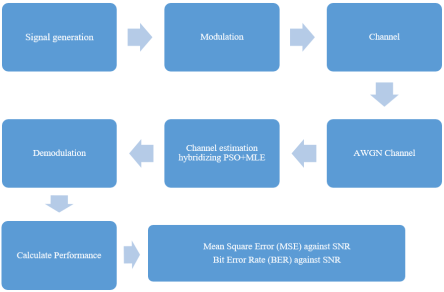
Figure 1 illustrates a unified system model.
Figure 1. Unified Hybrid Model.
3.2. System Modelling: MIMO System
Here are the transmitted and received signals distributions:
The noise associated with the system model is Additive White Gaussian Noise (AWGN). It is one of the most important tools used to examine the effect of noise on information theory.
Equation (
3) shows and describes how a multiple input multiple output (MIMO) system is mathematically formulated. It is composed of different computational signals and vectors. It comprises several parts, such as, denote noise vector (Nx1), H denote channel coefficient matrix (N × M), receive vector (Nx1), and transmit vector (Mx1). It is formulated according to
| [3] | Björnson, E., Hoydis, J., & Sanguinetti, L. (2017). Massive MIMO networks: Spectral, energy, and hardware efficiency. Foundations and Trends® in Signal Processing, 11(3-4), 154-655. https://doi.org/10.1561/2000000093 |
[3]
which describes the MIMO system shown in Equation.
4:(4)
Here (complex channel). In a sufficiently rich scattering dynamic environment for non-LOS communication, the channel is considered a Rayleigh channel with channel gain ( where are normally distributed independent random variables. Noise power for each noise component at each receiver antenna is given as:
The covariance mathematical representation of noise is given as:
The noise observed at each antenna is uncorrelated and has a uniform frequency distribution across the spatial domain. This type of noise is commonly known as spatial noise.
Special cases:
Case I: If m = 1, the MIMO system undergoes computation and reduced to SIMO (Single Input- Multiple Output). Mathematically, this is expressed as:
In matrix model, it can be written as:
(8)
Equation (
8) is alternatively referred to as a receive-diversity system.
Case II: If n = 1, the MIMO system undergoes another computation and is reduced to a multiple input-single output (MISO) system.
Mathematically, this is expressed as:
In matrix model, it can be written as:
(10)
Equation (
10) is commonly referred to as a transmit-diversity system.
3.3. System Modeling for Massive MIMO System
Massive-MIMO systems are classified as antenna technologies with multiple inputs and multiple outputs that can achieve higher transmission or data rates than conventional MIMO systems via spatial multiplexing. The detection of signals from individual antenna elements at the receiver plays a crucial role in the operation of massive MIMO systems.
| [3] | Björnson, E., Hoydis, J., & Sanguinetti, L. (2017). Massive MIMO networks: Spectral, energy, and hardware efficiency. Foundations and Trends® in Signal Processing, 11(3-4), 154-655. https://doi.org/10.1561/2000000093 |
[3]
in their work provided a mathematical description and schematical representation of the system model.
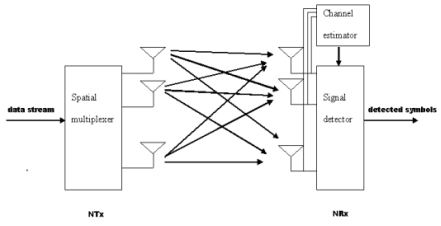
Assume a representation of N
R x N
T massive MIMO system depicted in
Figure 2.
Let denotes or represents a channel matrix and hji denotes channel gain or coefficient for the channel established by linking the j-th receive antenna to the i-th transmission antenna, where j = 1, 2, 3… NR and i = 1, 2, 3… NT. The multiplexed transmission signal gain is denoted by:
…(11)
Where si denotes the signal disseminated from the i-th transmitting antenna. The received data signal distribution is denoted by
where zj depicts the signal received at the j-th receiving antenna, nj represents the white Gaussian noise at the j-th receiving antenna, with a variance. The mathematical representation of signals the NR x NT massive-MIMO system is as follows:
(14)
Where and denotes the i-th column vector of the channel matrix H.
Figure 2. Massive MIMO System.
Table 1. Parameter Specification for Unified Model.
Parameter | Specification |
Number of Base station Antenna | 8 |
Length of Frame | 12ms |
Length of pilot | 36 |
pilot symbol | 3 dB |
SNR_db range | 0:2:20 |
Signal detection technique | PSO+MLE |
The next section, which is section IV, considers results and discussion.
4. Results and Discussion
Evaluation of the performance of the unified or hybrid model, as depicted in
Figure 1, the last part of the design involves employing specific metrics, such as Mean Square Error (MSE) and Bit Error Rate (BER), with emphasis on their relationship to the Signal-to-Noise Ratio (SNR).
(15)
Bit Error Rate (BER) is a fundamental benchmark or metrics in digital communication design. BER is defined by equation (
15).
Mean Squared Error (MSE), also another benchmark for simulating digital communication system. MSE is defined by equation (
16).
(16)
Where: is the predicted value, yi is the literal value, and n is the total number of the data points.
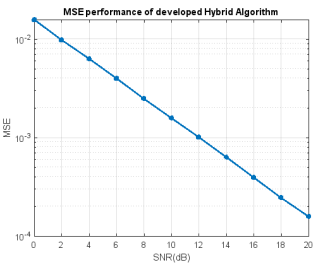
Figure 3. MSE in Semilog Against SNR in dB.
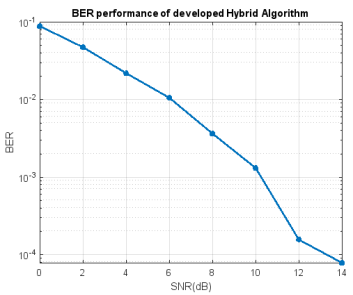
Figure 4. BER in Semilog Against SNR in dB.
For optimal system performance, it is crucial to maintain low MSE and BER values.
Figure 3 depicts the relationship between MSE and SNR.
Figure 4 illustrates the relationship between BER and SNR. The graphical representation in
Figures 3 and 4 visually illustrates the relationship between MSE and SNR and BER against SNR. The vertical axis in
Figure 3 represents the MSE values, while the horizontal axis represents the SNR values. The vertical axis in
Figure 4 represents the BER values, while the horizontal axis represents the SNR values. The simulation results in
Figure 3 illustrate a gradual decrease with increase in the MSE performance across various SNR levels. MSE appears high at lower SNR. When the SNR was set to 2, the MSE decreased with increasing SNR. Similarly, as SNR reached a value of 8, MSE showed a progressive decrease with increasing SNR. Moreover, as SNR reached a value of 18, MSE showed a progressive decrease with corresponding increase in SNR. Consequently, as shown in
Figure 4, when SNR was set to 2, the BER decreased with increasing SNR. Similarly, as the SNR reaches 8, the BER performance gradually decreases with increasing SNR. Furthermore, as the SNR reaches 10, the BER performance gradually decreases with increasing SNR. The simulation results in
Figures 3 and 4, respectively, show that these two estimators are highly efficient and accurate, respectively. Hence,
Figures 3 and 4 demonstrate that an increase in the SNR corresponds to a decrease in MSE and BER. As SNR increases, MSE and BER gradually decrease.
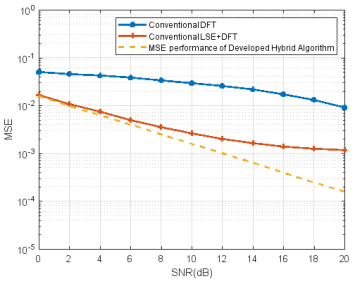
Figure 5. MSE in Semilog Against SNR in dB.
Figure 5 depicts a graph illustrating the performance of various channel estimator methods, namely DFT, LSE+DFT, and PSO+MLE, across a range of SNR values. The vertical axis of the graph represents the semi-logarithmic values of the Mean Squared Error (MSE), whereas the horizontal axis represents the Signal-to-Noise Ratio (SNR).
Figure 5 represents the various simulation results obtained using the three estimation techniques. The circle, plus, and dash symbols are used to visually represent the graph of the Discrete Fourier Transform (DFT), Least Squares Estimation (LSE) combined with the Discrete Fourier Transform (DFT) estimator, denoted as (LSE+DFT), and the proposed hybrid estimator, denoted as (PSO+MLE). These different symbols were chosen to visually distinguish the PSO + MLE method from the other elements in the graph, highlighting its role in the estimation. For example, when SNR =2, the proposed PSO + MLE estimation technique yielded an MSE of 0.0098, which is very low. Thus, gives a good MSE performance of the proposed estimation technique (PSO + MLE), which translates to an efficient technique compared to the other two conventional estimators (i.e., DFT and LSE+DFT), which yield a high MSE of 0.0459 and 0.0108, respectively. When SNR =10, the proposed PSO + MLE estimation technique yields an MSE of 0.0016, resulting in a much better MSE, which is better and more efficient than the other two estimators with DFT readings at MSE of 0.0295 and 0.026, respectively, translating into an inefficient estimation technique. When SNR =18, the proposed PSO+MLE estimation technique gives MSE= 0.0002, giving a good MSE which is more efficient than the other two estimators with DFT readings at MSE=0.0131 and LSE+DFT=0.0012.
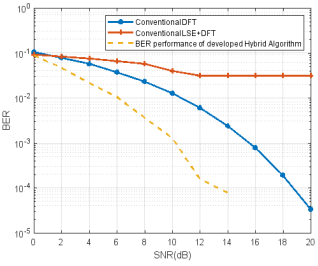
Figure 6. BER in Semilog Against SNR in dB.
Figure 6 displays a graph comparing the performance of various estimation techniques, specifically DFT, LSE+DFT, and PSO+ MLE, over a range of SNR values. The y-axis represents the BER, and the x-axis represents the SNR. The graph in
Figure 6 represents the different simulation results of the three estimation techniques. The circle, plus, and dash symbols are used to visually represent the graph of the Discrete Fourier Transform (DFT), Least Squares Estimation (LSE) combined with the Discrete Fourier Transform (DFT) estimator, denoted as (LSE+DFT), and the proposed hybrid estimator, denoted as (PSO+MLE). To achieve optimal system performance, it is crucial to maintain a low BER. For example, when SNR =2, the proposed PSO + MLE estimation technique yields a very low BER of 0.0467. Thus, gives a good BER for our proposed estimator (i.e., PSO + MLE), which shows a better and more efficient technique than the other two estimators (i.e., DFT and LSE + DFT) that give BER of 0.0786 and 0.0819, respectively, translating to an inefficient estimation technique. When SNR =10, the proposed PSO + MLE estimation technique yields a BER of 0.0013, resulting in a good BER, which is better and more efficient than the other two estimators with DFT readings at BER of 0.0125 and 0.0400, translating to an inefficient estimation technique. When SNR =14, the proposed PSO + MLE estimation technique yields a BER of 0.0001, giving a good BER that is more efficient and accurate than the other two estimators with DFT readings at BER=0.0024 and LSE + DFT =0.00310.





 Share This Article
 Twitter
 Linked In
 Facebook
 Copy
Copy Download