Abstract
This paper presents a formal mathematical theory of classical conditioning that reinterprets the fundamental principles of behavior, including acquisition, extinction, spontaneous recovery, stimulus generalization, stimulus discrimination, and higher-order conditioning, as a coherent system of symbolic equations. The aim is to bridge empirical psychology and quantitative modeling by expressing learning mechanisms in precise mathematical terms. Within this framework, unconditioned and conditioned stimuli are represented as variables whose interactions over time determine associative strength, learning rates, and the probability of conditioned responses. To demonstrate the structure and application of the model, a Pavlovian conditioning example is presented in which a neutral sound stimulus (bell) becomes associated with an unconditioned stimulus (food), resulting in the development of a conditioned response. The proposed equations describe the progressive accumulation of associative strength during acquisition, its reduction through extinction, and its partial restoration through spontaneous recovery, thereby capturing key experimental patterns observed in classical conditioning research. Furthermore, the model enables detailed examination of influential parameters such as stimulus intensity, reinforcement frequency, and temporal relationships between stimuli. Beyond behavioral psychology, the mathematical conditioning framework has broad interdisciplinary applicability. In neuroscience, it can contribute to modeling synaptic plasticity and reward prediction processes; in artificial intelligence, it can inform reinforcement learning algorithms and adaptive agent design; in education, it offers quantitative insights into habit formation and feedback-based learning; and in behavioral economics, it provides a basis for simulating consumer learning, preference development, and decision-making under uncertainty. By translating established behavioral principles into a scalable, predictive, and computationally rigorous framework, this work advances the integration of psychology with computational and systems sciences and contributes toward the development of unified theories of learning that are theoretically coherent, empirically grounded, and computationally efficient.
Keywords
Classical Conditioning, Extinction, Spontaneous Recovery, Stimulus Generalization, Stimulus Discrimination,
Higher-order Conditioning, Symbolic Formulas, Interdisciplinary Applications
1. Introduction
Classical conditioning, as first codified by Ivan Pavlov, remains one of the most enduring and fundamental principles of behavioral psychology. Classical conditioning explains the way a previously neutral stimulus (NS) will acquire the ability to provoke a conditioned response (CR) after repeated exposure to an unconditioned stimulus (US) that naturally provokes an unconditioned response (UR)
| [4] | Domjan, M. (2018). The principles of learning and behavior (7th ed.). Cengage Learning. |
| [8] | McLeod, S. (2018). Classical conditioning: How it works and how it can be applied. Simply Psychology. Retrieved from
https://www.simplypsychology.org/classical-conditioning.html |
| [10] | Pavlov, I. P. (1927). Conditioned reflexes: An investigation of the physiological activity of the cerebral cortex. Oxford University Press. |
[4, 8, 10]
. As shown in
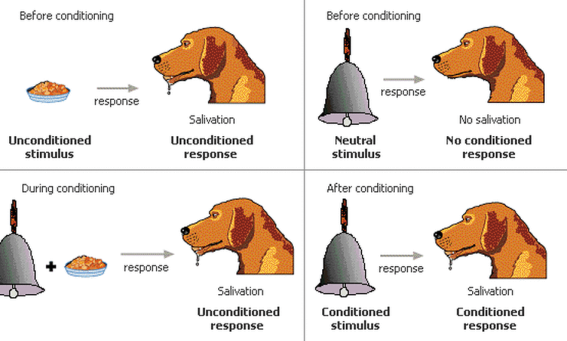
Figure 1, Pavlov's classic experiment demonstrates how a dog naturally salivates in response to food (US), but after repeated pairings of a bell (NS) with food, the bell alone becomes capable of eliciting salivation as a conditioned response (CR). By this mechanism, learning takes place as connections are made between environmental stimuli and behavioral responses, influencing adaptation patterns and response predictability across the board in all species
.
Traditional accounts of classical conditioning are essentially verbal and experimental, based on qualitative models, behavioral observation, and graphical representations of response curves. While such approaches are extremely valuable for empirical validation, they are often poor in formal consistency and predictive generality—qualities required for integration with quantitative sciences such as neuroscience, computer modeling, and artificial intelligence
| [14] | Shang, Q., & Lee, J. A. (2017). Logo effects on brand extension evaluations from a classical conditioning perspective. Frontiers in Psychology, 8, Article 883.
https://doi.org/10.3389/fpsyg.2017.00883 |
[14]
. With the drift of behavioral studies increasingly intersecting with data-driven fields, the need for a mathematically consistent description of conditioning is becoming increasingly apparent.
The sequence illustrated in
Figure 1 provides a simple example of the acquisition process that forms the foundation of the mathematical framework proposed in this paper. This paper proposes a mathematical symbolic system that explains the basic principles of classical conditioning— acquisition, extinction, spontaneous recovery, stimulus generalization, discrimination, and higher-order conditioning—in terms of a common set of readable, compact equations. Such symbol representations preserve the intuitive logic of Pavlovian learning while offering an organized lexicon to be computed, simulated, and analyzed theoretically.
The appeal of taking such a perspective is its cross-disciplinary potential. Mathematical models of conditioning can serve as interfaces between disciplines: in neuroscience, they can be used to model neural mechanisms of associative plasticity; in artificial intelligence, they can inform adaptive learning algorithms and reward systems; in education, they can shed light on how reinforcement and feedback condition learning behavior; and in behavioral economics, they can model consumer learning processes and habit formation.
Through the transformation of classical conditioning to a standard mathematical apparatus, this volume aims to enhance the intelligibility and usefulness of principles of behavior. It recycles conditioning from being solely a descriptive concept to a computationally tractable system—though one that unites theoretical wisdom, experimental findings, and models for prediction within the framework of a single symbolism.
2. Mathematical (Symbolic) Framework
The
symbolic framework developed in this paper mathematizes classical conditioning from descriptive psychology into a concise representational language. Rather than using algebraic or differential equations, the system utilizes intuitive symbols to convey the logical flow of conditioning processes. Each symbol has an equivalent behavioral operation or relationship: (CS) for the conditioned stimulus, (UCS) for the unconditioned stimulus, (CR) for the conditioned response, and (UCR) for the unconditioned response. Operators such as (+) for pairing, (→) for elicitation, (∬) for similarity, and (× n) for repetition across trials, together form a behavioral syntax that makes learning mechanisms more interpretable, communicable, and applicable across disciplines
| [4] | Domjan, M. (2018). The principles of learning and behavior (7th ed.). Cengage Learning. |
| [10] | Pavlov, I. P. (1927). Conditioned reflexes: An investigation of the physiological activity of the cerebral cortex. Oxford University Press. |
[4, 10]
.
The model axiomatizes five key principles of classical conditioning: Extinction (Ext.), Spontaneous Recovery (Sp. R), Stimulus Generalization (St. G), Stimulus Discrimination (St. D), and Higher-Order Conditioning (H.O. Cond.). Each process is stated in symbolic equations that capture its key sequence and behavioral outcome
. In Extinction, repeated presentation of the conditioned stimulus without the unconditioned stimulus gradually extinguishes the conditioned response
| [1] | Bouton, M. E. (2004). Context and behavioral processes in extinction. Learning & Memory, 11(5), 485–494.
https://doi.org/10.1101/lm.78804 |
| [10] | Pavlov, I. P. (1927). Conditioned reflexes: An investigation of the physiological activity of the cerebral cortex. Oxford University Press. |
[1, 10]
. This is axiomatized as
Ext. = (CS) × n – (UCS) → (No CR)
For example, a repeated ticking metronome (CS) ten times with no food (UCS) results in no salivation (No CR). The notation specifies that associative strength decreases with repetition without reinforcement and explains how responses are suppressed but not erased
.
Following extinction, Spontaneous Recovery occurs when a reinstated conditioned stimulus briefly restores the response
:
Ext. → Sp. R = (+CS) → (CR)
This demonstrates that learning is not lost but dormant—the conditioned association reappears following rest or context change
| [10] | Pavlov, I. P. (1927). Conditioned reflexes: An investigation of the physiological activity of the cerebral cortex. Oxford University Press. |
| [13] | Rescorla, R. A. (2004). Spontaneous recovery. Learning & Memory, 11(5), 501–509. https://doi.org/10.1101/lm.77504 |
[10, 13]
. Stimulus Generalization explains how responses generalize to stimuli that are like the original conditioned cue
:
St. G = (CS) + (∬CS) → (CR) …→ (No UCS)
This is to say that similar stimuli can elicit the same conditioned response even without reinforcement. Conversely, Stimulus Discrimination explains the learning process of distinguishing the true conditioned stimulus from similar but nonreinforced ones:
St. D = (CS) + (∬CS) → (CR) → (NoUCS) ×n → Discrimination.
Repeated non-reinforcement of similar cues sharpens the organism's selectivity, leading to precise behavioral discrimination
| [22] | Mackintosh, N. J. (1975). A theory of attention: Variations in the associability of stimuli with reinforcement. Psychological Review, 82(4), 276–298. https://doi.org/10.1037/h0076778 |
[22]
. Finally, Higher-Order Conditioning (H.O. Cond.) illustrates the chaining power of learning, where new cues acquire significance by association with already conditioned stimulus. It happens in two phases.
Stage 1:
Cond. = (CS1) + (NS2) → (UCR) ×n → (CS1) / (CS2) → (CR).
Here, a neutral stimulus (light) gains conditioning power from an established (metronome) stimulus.
Stage 2:
H. O. Cond. = (CS2) + (UCS3) → (CR) ×n → (CS3) – (CS2) → (CR)
A third cue (snapping fingers) inherits associative value from the light, ultimately coming to elicit salivation on its own. This notation depicts how learned associations propagate across connected representations
| [4] | Domjan, M. (2018). The principles of learning and behavior (7th ed.). Cengage Learning. |
| [10] | Pavlov, I. P. (1927). Conditioned reflexes: An investigation of the physiological activity of the cerebral cortex. Oxford University Press. |
[4, 10]
.
Taken together, these symbolic representations preserve the conceptual simplicity of Pavlovian conditioning while providing a formal, language-like system that is tractable to computational modeling and interdisciplinary use. By formalizing behavior in terms of formulaic expressions, researchers and practitioners can model, simulate, and teach the laws of learning with greater precision and cross-domain generality
| [24] | Rescorla, R. A., & Wagner, A. R. (1972). A theory of Pavlovian conditioning: Variations in the effectiveness of reinforcement and nonreinforcement. In A. H. Black & W. F. Prokasy (Eds.), Classical conditioning II: Current research and theory (pp. 64–99). Appleton-Century-Crofts. |
| [4] | Domjan, M. (2018). The principles of learning and behavior (7th ed.). Cengage Learning. |
[24, 4]
.
2.1. Stimulus Generalization
Stimulus generalization refers to the tendency for stimuli that resembles the original conditioned stimulus to evoke the same conditioned response
. Stimulus generalization enables organisms to respond similarly to stimulus that closely resemble the original conditioned stimulus, thereby promoting adaptive behavior in novel situations
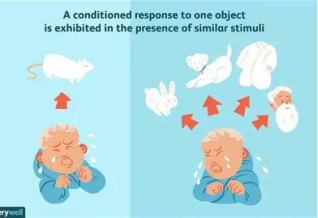
. Once a conditioned response has been established, organisms may respond not only to the exact conditioned stimulus but also to similar stimuli. A classic example is the Little Albert experiment conducted by Watson and Rayner (1920), in which a young child was conditioned to fear a white rat. After conditioning, Albert displayed fear responses not only to the white rat but also to other furry objects such as rabbits, dogs, fur coats, and similar stimuli. This phenomenon demonstrates that conditioned learning can extend beyond the original stimulus to a broader range of related stimuli, thereby increasing the adaptability of learned responses in novel situations
| [10] | Pavlov, I. P. (1927). Conditioned reflexes: An investigation of the physiological activity of the cerebral cortex. Oxford University Press. |
| [20] | Watson, J. B., & Rayner, R. (1920). Conditioned emotional reactions. Journal of Experimental Psychology, 3(1), 1–14.
https://doi.org/10.1037/h0069608 |
| [21] | Ghirlanda, S., & Enquist, M. (2003). A century of generalization. Animal Behaviour, 66(1), 15–36.
https://doi.org/10.1006/anbe.2003.2174 |
[10, 20, 21]
. As illustrated in
Figure 2, the conditioned fear response generalized from the white rat to other stimuli sharing similar characteristics.
Formula Representation:
Stimulus Generalization = (CS) + (∬CS)→(CR) ….→(NoUCS)
Example:St. G = (Metronome’s Ticking) + (Similar Ticking Sounds)→(Salivation) ….→(NO Food)Explanation:
Organisms transfer learned responses to similar stimuli without requiring the UCS.
2.2. Stimulus Discrimination
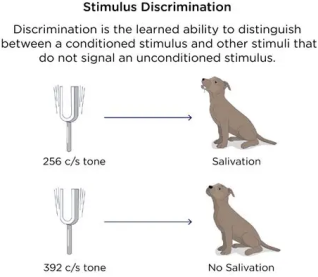
Stimulus discrimination refers to the learned ability to distinguish between the conditioned stimulus and other similar stimuli that does not signal the occurrence of the unconditioned stimulus. Unlike stimulus generalization, where responses spread to similar stimuli, discrimination involves responding selectively to the specific conditioned stimulus while withholding the conditioned response to other stimuli. Through repeated learning experiences, organisms learn which stimuli predict important outcomes and which do not. This process increases the accuracy and efficiency of behavior by preventing inappropriate responses to irrelevant stimuli
| [4] | Domjan, M. (2018). The principles of learning and behavior (7th ed.). Cengage Learning. |
| [10] | Pavlov, I. P. (1927). Conditioned reflexes: An investigation of the physiological activity of the cerebral cortex. Oxford University Press. |
| [22] | Mackintosh, N. J. (1975). A theory of attention: Variations in the associability of stimuli with reinforcement. Psychological Review, 82(4), 276–298. https://doi.org/10.1037/h0076778 |
[4, 10, 22]
.
Formula Representation:
Stimulus Discrimination = (CS) = (∬CS)→(CR)→(No UCS) x n→Discrimination
Example:
St. D = (Metronome’s Ticking) + (Similar Sounds)→(Salivation)→(No Food) x n→Discrimination
Explanation:
Through repeated trials, the subject learns to respond only to the true CS, not to similar ones.
2.3. Higer Order Conditioning
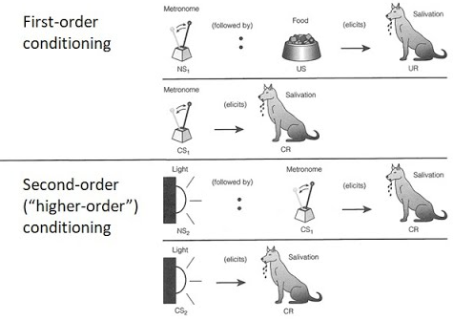
Higher-order conditioning, also known as second-order conditioning, occurs when a (NS) neutral stimulus becomes capable of eliciting a conditioned response through association with an already established conditioned stimulus rather than through direct pairing with an unconditioned stimulus. In a typical example, a metronome is first paired with food until the metronome alone produces salivation. Once the metronome has become a conditioned stimulus, a light can be repeatedly presented alongside the metronome. Eventually, the light itself acquires the ability to elicit salivation despite never being directly paired with food. This process illustrates the chaining capacity of associative learning, whereby conditioned stimuli can transfer their associative strength to new stimuli, expanding the network of learned associations
| [4] | Domjan, M. (2018). The principles of learning and behavior (7th ed.). Cengage Learning. |
| [10] | Pavlov, I. P. (1927). Conditioned reflexes: An investigation of the physiological activity of the cerebral cortex. Oxford University Press. |
[4, 10]
.
Figure 4 illustrates the progression from first-order conditioning to second-order conditioning, demonstrating how a new conditioned stimulus acquires associative strength through an existing conditioned stimulus.
2.3.1. Stage One
Formula Representation:
Conditioning = (NS2) + (CS1)→(UCR) x n→(CS₂)→(CR)
Explanation:
The neutral stimulus2 (Light) becomes a conditioned Stimulus after pairing.
Example:
Cond. = (Light) + (Metronome’s Ticking)→(Salivation) x n→(Light)→(Salivation)
2.3.2. Stage Two
Formula Representation:
Higher Order Conditioning = (CS2) + (UCS3)→(CR) × n→(CS3) — (CS2)→(CR)
Example:
H. O. Cond. = (Light) + (Snapping fingers) → (salivation) × n → (Snapping fingers) — (Light) → (Salivation)
Explanation:
Higher-order conditioning shows the chaining capacity of learning where new stimuli inherit conditioning power.
Figure 4. Stages of Higher Order Conditioning. Source: Dan Boyll, YouTube.
2.4. Extinction
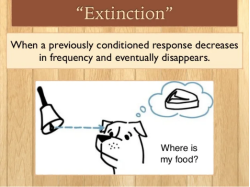
Extinction occurs when a conditioned stimulus is repeatedly presented without the unconditioned stimulus that originally established the association. As a result, the conditioned response gradually weakens and may eventually disappear. For example, if a tone that has been associated with food is repeatedly presented without the subsequent delivery of food, the salivation response elicited by the tone progressively declines. Importantly, extinction does not erase the original learning but represents new inhibitory learning
| [1] | Bouton, M. E. (2004). Context and behavioral processes in extinction. Learning & Memory, 11(5), 485–494.
https://doi.org/10.1101/lm.78804 |
| [9] | Myers, K. M., & Davis, M. (2007). Mechanisms of fear extinction. Molecular Psychiatry, 12(2), 120–150.
https://doi.org/10.1038/sj.mp.4001939 |
| [17] | Todd, T. P. (2013). Behavioral and neurobiological mechanisms of extinction in Pavlovian and instrumental learning. Frontiers in Psychology, 4, Article 224.
https://doi.org/10.3389/fpsyg.2013.00224 |
[1, 9, 17]
but rather reflects a reduction in the expression of the conditioned response due to new learning that the conditioned stimulus no longer predicts the unconditioned stimulus
| [1] | Bouton, M. E. (2004). Context and behavioral processes in extinction. Learning & Memory, 11(5), 485–494.
https://doi.org/10.1101/lm.78804 |
| [10] | Pavlov, I. P. (1927). Conditioned reflexes: An investigation of the physiological activity of the cerebral cortex. Oxford University Press. |
[1, 10]
. Extinction is generally regarded as new inhibitory learning that suppresses the conditioned response while leaving the original memory intact
As shown in
Figure 5, the strength of the conditioned response decreases over time when the conditioned stimulus is repeatedly presented without reinforcement.
Formula Representation:
Extinction = (CS) x n — (UCS)→(No CR)
Example:
Ext. = (Metronome’s ticking) x n — (Food)→(No Salivation)
Explanation:
By presenting the (CS) e.g. Ticking Sound, many times without the (UCS) e.g. food, the (CR) which is Salivation weakens and disappears.
Figure 5. Extinction of the conditioned response over repeats trails. Source: Sam Giorgia, Slideshare.net.
2.5. Spontaneous Recovery
Spontaneous recovery refers to the reappearance of a previously extinguished conditioned response after a period of rest or the passage of time. Following extinction, a conditioned response may appear to have disappeared; however, when the conditioned stimulus is presented again after a delay, a weaker version of the conditioned response often re-emerges. For example, a tone that no longer produces salivation after extinction may once again evoke salivation following a rest period. The occurrence of spontaneous recovery suggests that extinction suppresses rather than eliminates the original conditioned association, providing evidence that previously learned associations can remain stored and become observable under appropriate conditions
| [10] | Pavlov, I. P. (1927). Conditioned reflexes: An investigation of the physiological activity of the cerebral cortex. Oxford University Press. |
| [13] | Rescorla, R. A. (2004). Spontaneous recovery. Learning & Memory, 11(5), 501–509. https://doi.org/10.1101/lm.77504 |
[10, 13]
.
Formula Representation:
Extinction→Spontaneous Recovery = (+ Strong CS) ….→(CR)
Example:
Ext.→Sp. R = (Strong Metronome Sound) ….→(Weak Salivation)
Explanation:
The reappearance of the (CR) after rest indicates that Extinction is suppressed but does not erase conditioning.
Table 1. Key Principles, Symbols, and Illustrative Examples in Classical Conditioning Mathematics.
This table presents the symbolic framework used to represent classical conditioning processes in a compact mathematical notation. |
1. | ∬ (Similarity Principle) Similar, alike, or same → Responding to sounds ∬CS Indicates perceptual or functional similarity to the conditioned stimulus. |
2. | x n (Multiple Trials) Represents repeated learning exposures across trials. |
3. | (+) Pairing Principle (Light) + (Metronome) → CR Association formed through pairing of stimuli. |
4. | (→) Causal Flow (CS) → CR Indicates that a conditioned stimulus elicits a conditioned response. |
5. | (=) Outcome Equivalence Extinction ×10 – No UCS = No CR Represents the result of a process or learned outcome. |
6. | x (Repetition Operator) (CS) × 10 → CR Multiple pairings strengthen the conditioned response. |
7. | …… (Temporal Progression) Learning occurs gradually over time through repeated exposure. |
8. | – (Absence Operator) (CS) – (UCS) → No CR Removal of reinforcement leads to no conditioned response. |
9. | UCS (Unconditioned Stimulus) Food naturally causes salivation. |
10. | UCR (Unconditioned Response) Salivation in response to food. |
11. | CS (Conditioned Stimulus) A previously neutral stimulus (e.g., bell) after pairing with UCS. |
12. | CR (Conditioned Response) Salivation in response to the conditioned stimulus. |
13. | NS (Neutral Stimulus) Light before conditioning, which initially produces no response. |
14. | Higher-Order Conditioning (H-O Cond.) Light (CS2) + Metronome (CS1) → Salivation A neutral stimulus becomes conditioned by association with an already conditioned stimulus. |
3. Applications and Implications
The mathematical–symbolic framework of classical conditioning presented in this paper extends beyond theoretical representation. By transforming behavioral psychology into a structured symbolic language, it creates opportunities for cross disciplinary application, predictive modeling, and computational simulation. Each symbolic expression—such as 𝑬𝒙𝒕. = (𝑪𝑺) × n – (𝑼𝑪𝑺) → (𝑵𝒐𝑪𝑹) or 𝑯. 𝑶. 𝑪𝒐𝒏𝒅. = (𝑪𝑺2) + (𝑼𝑪𝑺3) → (𝑪𝑹) × n → (𝑪𝑺3) — (𝑪𝑺2) → (𝑪𝑹) can be interpreted not only as a psychological sequence but also as a computational rule, capable of integration into data-driven systems. Below are detailed applications across various fields:
3.1. Psychology, Behavioral Research and Education
Classical conditioning principles are also applied in classroom management, routine development, and the formation of positive learning environments through repeated associations between classroom stimuli and desirable behaviors
. Scenario: In a classroom setting, a teacher uses a bell sound (CS) to signal the end of a lesson. Over time, students begin to pack up their belongings (CR) upon hearing the bell, even before the teacher announces the end.
Problem: The conditioned response of students packing up prematurely can disrupt the flow of lessons and reduce instructional time
| [4] | Domjan, M. (2018). The principles of learning and behavior (7th ed.). Cengage Learning. |
| [10] | Pavlov, I. P. (1927). Conditioned reflexes: An investigation of the physiological activity of the cerebral cortex. Oxford University Press. |
[4, 10]
.
Application of Formulas: To address this, the teacher can apply the extinction formula:
Ext. = (Bell) × n — (Teacher’s Announcement) → (No Packing)
By repeatedly presenting the bell sound without the subsequent announcement, the conditioned response of packing up prematurely can be diminished. This approach is supported by principles of classical conditioning, where the absence of reinforcement leads to extinction of the conditioned behavior
| [4] | Domjan, M. (2018). The principles of learning and behavior (7th ed.). Cengage Learning. |
| [10] | Pavlov, I. P. (1927). Conditioned reflexes: An investigation of the physiological activity of the cerebral cortex. Oxford University Press. |
[4, 10]
.
3.2. Neuroscience
Scenario: A rat has been conditioned to associate a specific tone (CS) with a mild foot shock (UCS), leading to a fear response (CR) upon hearing the tone
.
Problem: Understanding how fear responses can be extinguished at the neural level is crucial for developing treatments for anxiety disorders.
Application of Formulas: The extinction process can be modeled as:
Ext. = (Tone) × n — (Foot Shock) → (No Fear Response). This formula suggests that by repeatedly presenting the tone without the foot shock, the neural pathways associated with the fear response can be weakened, leading to extinction. Research indicates that extinction involves changes within the amygdala and medial prefrontal cortex that regulate fear learning and extinction
| [6] | LeDoux, J. E. (2000). Emotion circuits in the brain. Annual Review of Neuroscience, 23(1), 155–184.
https://doi.org/10.1146/annurev.neuro.23.1.155 |
| [7] | Marek, R., & Schafe, G. E. (2013). The amygdala and medial prefrontal cortex in fear conditioning and extinction. Frontiers in Neuroscience, 7, Article 87.
https://doi.org/10.3389/fnins.2013.00087 |
| [12] | Quirk, G. J., & Mueller, D. (2008). Neural mechanisms of extinction learning and retrieval. Neuropsychopharmacology, 33(1), 56–72. https://doi.org/10.1038/sj.npp.1301555 |
[6, 7, 12]
.
3.3. Artificial Intelligence and Machine Learning
Scenario: An AI model is trained to recognize specific patterns in data, such as identifying fraudulent transactions based on certain features (CS)
.
Problem: The model begins to generalize its responses to similar but irrelevant patterns (∬CS), leading to false positives.
Application of Formulas: To refine the model's accuracy, the stimulus discrimination formula can be applied:
St. D. = (CS) + (No UCS) → (CR) × n → Discrimination.
By introducing negative examples (No UCS) and reinforcing correct classifications, the model can learn to distinguish between relevant and irrelevant patterns, improving its precision
.
3.4. Behavioral Economics
Beyond psychology, classical conditioning has been successfully applied in consumer behavior and marketing, where repeated pairing of logos and positive emotional stimuli can influence brand evaluations
| [14] | Shang, Q., & Lee, J. A. (2017). Logo effects on brand extension evaluations from a classical conditioning perspective. Frontiers in Psychology, 8, Article 883.
https://doi.org/10.3389/fpsyg.2017.00883 |
[14]
. Scenario: Consumers associate a specific brand logo (CS) with positive experiences, leading to a conditioned response of preference and trust (CR)
| [16] | Solomon, M. R. (2020). Consumer behavior: Buying, having, and being (13th ed.). Pearson. |
[16]
.
Problem: Over time, if the brand fails to deliver on its promises (No UCS), the conditioned response may weaken, leading to decreased consumer loyalty
| [16] | Solomon, M. R. (2020). Consumer behavior: Buying, having, and being (13th ed.). Pearson. |
[16]
.
Application of Formulas: The extinction formula can be applied:
Ext. = (Brand Logo) × 10— (Positive Experience) → (No Preference)
By understanding this process, companies can work to re-establish positive associations through consistent quality and customer satisfaction
| [16] | Solomon, M. R. (2020). Consumer behavior: Buying, having, and being (13th ed.). Pearson. |
[16]
.
3.5. Clinical Therapy
Scenario: A patient has developed a fear of elevators (CS) after a traumatic experience (UCS), leading to anxiety (CR) when approaching them
| [3] | Craske, M. G., Treanor, M., Conway, C. C., Zbozinek, T., & Vervliet, B. (2014). Maximizing exposure therapy: An inhibitory learning approach. Behaviour Research and Therapy, 58, 10–23. https://doi.org/10.1016/j.brat.2014.04.006 |
[3]
.
Problem: The conditioned fear response hampers the patient's daily functioning and quality of life.
Application of Formulas: Exposure therapy can be employed using the extinction formula:
Ext. = (Elevator) × 10 —(Traumatic Experience) → (No Anxiety)
By gradually exposing the patient to elevators without the traumatic experience, the conditioned fear response can be extinguished, alleviating anxiety
| [3] | Craske, M. G., Treanor, M., Conway, C. C., Zbozinek, T., & Vervliet, B. (2014). Maximizing exposure therapy: An inhibitory learning approach. Behaviour Research and Therapy, 58, 10–23. https://doi.org/10.1016/j.brat.2014.04.006 |
[3]
.
3.6. Animal Training
Scenario: A dog has been conditioned to associate the sound of a doorbell (CS) with the arrival of a stranger (UCS), leading to barking (CR)
| [2] | Chance, P. (2014). Learning and behavior (7th ed.). Cengage Learning. |
[2]
.
Problem: The dog barks excessively upon hearing the doorbell, regardless of the actual presence of a stranger.
Application of Formulas: The stimulus discrimination formula can be applied:
St.D. = (Doorbell) + (No Stranger) → (No Barking) × n→ Discrimination
By consistently reinforcing the absence of barking when no stranger is present, the dog can learn to discriminate between the doorbell's sound and the actual arrival of a stranger
| [2] | Chance, P. (2014). Learning and behavior (7th ed.). Cengage Learning. |
[2]
.
4. Discussion
The symbolic mathematical framework proposed in this paper represents an alternative way of describing classical conditioning by transforming well-established psychological principles into a standardized symbolic language. Rather than replacing existing theories of learning, the framework complements them by providing a structured notation that simplifies the representation of conditioning processes while preserving their theoretical meaning. The symbolic formulas demonstrate that behavioral sequences such as acquisition, extinction, spontaneous recovery, stimulus generalization, stimulus discrimination, and higher-order conditioning can be expressed in a concise and logically consistent manner
| [4] | Domjan, M. (2018). The principles of learning and behavior (7th ed.). Cengage Learning. |
| [10] | Pavlov, I. P. (1927). Conditioned reflexes: An investigation of the physiological activity of the cerebral cortex. Oxford University Press. |
[4, 10]
. Unlike traditional explanations that rely primarily on verbal descriptions and experimental observations, the present framework introduces a symbolic system that makes conditioning processes easier to visualize, communicate, and potentially simulate computationally. Like how mathematical notation provides a universal language for physics and chemistry, symbolic representations may offer behavioral science a standardized method for describing associative learning across different contexts. This may improve interdisciplinary communication between psychology, neuroscience, education, computer science, and artificial intelligence
| [1] | Bouton, M. E. (2004). Context and behavioral processes in extinction. Learning & Memory, 11(5), 485–494.
https://doi.org/10.1101/lm.78804 |
| [24] | Rescorla, R. A., & Wagner, A. R. (1972). A theory of Pavlovian conditioning: Variations in the effectiveness of reinforcement and nonreinforcement. In A. H. Black & W. F. Prokasy (Eds.), Classical conditioning II: Current research and theory (pp. 64–99). Appleton-Century-Crofts. |
[1, 24]
.
The framework also demonstrates that symbolic notation can capture the sequential nature of conditioning while maintaining conceptual simplicity. Each formula describes not only the behavioral relationship between stimuli and responses but also the progression of learning over repeated trials. Consequently, the proposed system has educational value because students and researchers can readily follow the logical development of conditioning without relying solely on lengthy textual explanations. Although empirical validation is still required, the framework provides a foundation for future computational models capable of predicting behavioral outcomes under different learning conditions
| [4] | Domjan, M. (2018). The principles of learning and behavior (7th ed.). Cengage Learning. |
| [23] | Pearce, J. M. (1987). A model for stimulus generalization in Pavlovian conditioning. Psychological Review, 94(1), 61–73.
https://doi.org/10.1037/0033-295X.94.1.61 |
[4, 23]
.
4.1. Why Are Symbolic Formulas Useful
Symbolic formulas provide a concise and standardized method of representing complex behavioral processes. Instead of describing conditioning through lengthy narrative explanations, symbolic notation summarizes the essential relationships between stimuli and responses in a logical and easily interpretable format. This approach improves clarity while reducing ambiguity in the communication of behavioral principles
| [4] | Domjan, M. (2018). The principles of learning and behavior (7th ed.). Cengage Learning. |
[4]
. The proposed notation also facilitates interdisciplinary application. Because symbolic languages are commonly used in mathematics, computer science, engineering, and physics, representing classical conditioning symbolically creates opportunities for integration with computational modelling, machine learning algorithms, and artificial intelligence systems. Researchers may use formulas as conceptual models when developing simulations of associative learning or adaptive behavioral systems
| [5] | Goodfellow, I., Bengio, Y., & Courville, A. (2016). Deep learning. MIT Press. Retrieved from https://www.deeplearningbook.org |
| [24] | Rescorla, R. A., & Wagner, A. R. (1972). A theory of Pavlovian conditioning: Variations in the effectiveness of reinforcement and nonreinforcement. In A. H. Black & W. F. Prokasy (Eds.), Classical conditioning II: Current research and theory (pp. 64–99). Appleton-Century-Crofts. |
[5, 24]
.
Furthermore, symbolic formulas provide educational advantages by simplifying instruction. Students can understand relationships between conditioned stimuli, unconditioned stimuli, and behavioral responses more efficiently when these relationships are represented visually through standardized symbols. The formulas therefore function not only as theoretical representations but also as teaching and learning tools that support conceptual understanding of behavioral psychology.
4.2. Strengths
The proposed symbolic framework possesses several notable strengths. First, it provides a standardized notation for representing the principal mechanisms of classical conditioning within a single coherent system. This consistency improves communication among researchers and educators while reducing reliance on lengthy verbal explanations. Second, the framework is intuitive and relatively easy to understand. The symbols correspond directly to familiar behavioral concepts, allowing readers without advanced mathematical backgrounds to interpret the formulas with minimal difficulty
| [4] | Domjan, M. (2018). The principles of learning and behavior (7th ed.). Cengage Learning. |
| [10] | Pavlov, I. P. (1927). Conditioned reflexes: An investigation of the physiological activity of the cerebral cortex. Oxford University Press. |
[4, 10]
. Third, the framework has broad interdisciplinary applicability. Symbolic language can be adapted for behavioral research, educational psychology, neuroscience, artificial intelligence, behavioral economics, and clinical psychology. Such flexibility increases its potential usefulness beyond traditional psychological research.
Finally, the symbolic approach provides a foundation for future computational modelling. Because behavioral processes are represented as logical sequences, the framework may serve as the basis for computer simulations, predictive algorithms, and intelligent learning systems capable of modelling associative behavior under different experimental conditions
.
4.3. Limitations
Despite its potential contributions, the proposed framework has several limitations. First, the symbolic formulas presented in this paper are conceptual representations rather than empirically validated mathematical models. Although they accurately describe established behavioral principles, their predictive accuracy has not yet been tested experimentally across different conditioning paradigms. Second, the framework simplifies learning processes that are often influenced by numerous biological, cognitive, emotional, and environmental variables. Factors such as attention, motivation, contextual learning, and individual differences are not explicitly represented within the current symbolic notation
| [1] | Bouton, M. E. (2004). Context and behavioral processes in extinction. Learning & Memory, 11(5), 485–494.
https://doi.org/10.1101/lm.78804 |
| [22] | Mackintosh, N. J. (1975). A theory of attention: Variations in the associability of stimuli with reinforcement. Psychological Review, 82(4), 276–298. https://doi.org/10.1037/h0076778 |
[1, 22]
. Third, the present model does not quantify associative strength using numerical parameters. Consequently, it cannot currently predict precise rates of learning, extinction, or recovery in the manner of quantitative models such as the Rescorla–Wagner model
| [24] | Rescorla, R. A., & Wagner, A. R. (1972). A theory of Pavlovian conditioning: Variations in the effectiveness of reinforcement and nonreinforcement. In A. H. Black & W. F. Prokasy (Eds.), Classical conditioning II: Current research and theory (pp. 64–99). Appleton-Century-Crofts. |
[24]
. Future developments may integrate numerical weighting systems with symbolic notation to improve predictive capability.
Finally, the applicability of the framework across different species, learning environments, and complex behavioral situations remains to be empirically investigated through experimental and computational studies.
4.4. Future Possibilities
The symbolic mathematical framework presented in this paper provides several opportunities for future research and development. Future studies should empirically evaluate the framework by comparing its predictions with behavioral data obtained from laboratory conditioning experiments. Such validation would determine the reliability and practical usefulness of the proposed symbolic notation. Further research may also integrate quantitative variables, including associative strength, reinforcement probability, stimulus intensity, temporal intervals, and learning rates, thereby extending the symbolic system into a more comprehensive mathematical model capable of generating behavioral predictions
| [24] | Rescorla, R. A., & Wagner, A. R. (1972). A theory of Pavlovian conditioning: Variations in the effectiveness of reinforcement and nonreinforcement. In A. H. Black & W. F. Prokasy (Eds.), Classical conditioning II: Current research and theory (pp. 64–99). Appleton-Century-Crofts. |
[24]
. Another promising direction involves incorporating the framework into artificial intelligence and machine learning systems. The symbolic rules may contribute to the development of adaptive algorithms that are learnt through associative principles like biological organisms
. In educational settings, future studies could investigate whether symbolic representations improve students' understanding of learning theories when compared with conventional teaching methods. Similarly, applications in neuroscience may explore relationships between the symbolic framework and neural mechanisms underlying synaptic plasticity, memory formation, and associative learning
. Overall, continued theoretical refinement and empirical validation may establish the proposed symbolic framework as a practical tool for research, teaching, computational modelling, and interdisciplinary applications involving learning and behavior.
5. Conclusion
By reformulating principles of classical conditioning in formal, formulaic notation, the book integrates the disciplines of psychology and mathematics, resulting in a consistent and integrated representational system. These symbolic representations provide precision and clarity in describing major behavioral processes, including extinction, spontaneous recovery, stimulus generalization, stimulus discrimination, and higher-order conditioning. Aside from theoretical elegance, the system has practical utility in a range of applications.
In education and psychology, the equations allow structured examination of learning sequences, reinforcement schedules, and behavioral outcomes, which benefits both instructional design and experimental replication. In neuroscience, they render behavioral phenomena into neural circuitry, facilitating conceptualization of synaptic plasticity, memory consolidation, and fear extinction mechanisms. In artificial intelligence and machine learning, the symbolic representations can guide the development of biologically inspired algorithms for the improvement of pattern recognition, adaptive learning, and decision-making systems. Behavioral economics is also benefited, as these equations provide a quantitative window into consumer behavior, preference formation, and the dynamics of reward-based learning. Applications in clinical therapy and animal training further speak to the scope of this framework, from exposure-based treatments to behavior shaping and discrimination learning. Together, this symbolic–mathematical framework provides a common language for interdisciplinary research that supports seamless integration among theory, empirical observation, and computational modeling. By formalizing learning processes, it allows researchers, practitioners, and educators to more accurately predict, simulate, and optimize behavior. Future research can extend these equations to more complex learning paradigms, dynamic environments, and hybrid cognitive-computational models, further solidifying the connection between human and machine learning, behavior science, and applied interventions.
6. Recommendations
Based on the findings and theoretical contributions of this study, the following recommendations are proposed:
Future research should empirically validate the proposed symbolic framework through controlled laboratory experiments involving acquisition, extinction, spontaneous recovery, stimulus generalization, stimulus discrimination, and higher-order conditioning. The symbolic formulas should be extended by incorporating quantitative variables such as associative strength, reinforcement probability, stimulus intensity, temporal intervals, and learning rates to improve predictive accuracy. Researchers in artificial intelligence and computational neuroscience are encouraged to explore the integration of the proposed symbolic notation into reinforcement learning algorithms, adaptive systems, and computational models of associative learning. Educational psychologists and curriculum developers should investigate the effectiveness of symbolic representations as instructional tools for improving students' understanding of classical conditioning and related learning theories. Future interdisciplinary collaborations between psychology, mathematics, neuroscience, education, computer science, and behavioral economics should further refine and expand the framework to accommodate more complex learning paradigms. Additional studies should evaluate the applicability of the symbolic framework across different species, age groups, cultural contexts, and real-world learning environments to determine its generalizability and practical value.
These recommendations may contribute to the continued development of a unified mathematical language for representing learning processes across multiple scientific disciplines.
Abbreviations
CR | Conditioned Response |
CS | Conditioned Stimulus |
Ext. | Extinction |
H.O. Cond. | Higher-Order Conditioning |
NS | Neutral Stimulus |
No CR | No Conditioned Response |
Sp. R. | Spontaneous Recovery |
St. D. | Stimulus Discrimination |
St. G. | Stimulus Generalization |
UCR | Unconditioned Response |
UCS | Unconditioned Stimulus |
Acknowledgments
The author sincerely thanks the Department of Early Childhood Education at the University of Zululand for providing an academic environment that encouraged independent research and scholarly development. Appreciation is also extended to the pioneers of learning theory, particularly Ivan P. Pavlov and subsequent researchers whose foundational work on classical conditioning made this theoretical contribution possible.
Author Contributions
Sanele Inathi Ndaba: Conceptualization, Methodology, Formal Analysis, Investigation, Validation, Visualization, Writing – original draft, Writing – review & editing, Project Administration.
Conflicts of Interest
The Author declares no conflict of interest.
Appendix
Table A1. Symbolic formulas developed in this study.
Principle | Symbolic Formula | Purpose |
Acquisition | (NS) + (UCS) × n → (CS) → (CR) | Formation of conditioned learning |
Extinction | (CS) × n – (UCS) → (No CR) | Weakening of conditioned response |
Spontaneous Recovery | Ext. → (+ Strong CS) → (Weak CR) | Reappearance of extinguished response |
Stimulus Generalization | (CS) + (∬CS) → (CR) | Similar stimuli produce the same response |
Stimulus Discrimination | (CS) + (∬CS) → (No UCS) × n → Discrimination | Learning to distinguish similar stimuli |
Higher-Order Conditioning (Stage 1) | (NS₂) + (CS₁) × n → (CS₂) → (CR) | New conditioned stimulus develops |
Higher-Order Conditioning (Stage 2) | (CS₂) + (NS₃) × n → (CS₃) → (CR) | Third stimulus acquires conditioning |
References
| [1] |
Bouton, M. E. (2004). Context and behavioral processes in extinction. Learning & Memory, 11(5), 485–494.
https://doi.org/10.1101/lm.78804
|
| [2] |
Chance, P. (2014). Learning and behavior (7th ed.). Cengage Learning.
|
| [3] |
Craske, M. G., Treanor, M., Conway, C. C., Zbozinek, T., & Vervliet, B. (2014). Maximizing exposure therapy: An inhibitory learning approach. Behaviour Research and Therapy, 58, 10–23.
https://doi.org/10.1016/j.brat.2014.04.006
|
| [4] |
Domjan, M. (2018). The principles of learning and behavior (7th ed.). Cengage Learning.
|
| [5] |
Goodfellow, I., Bengio, Y., & Courville, A. (2016). Deep learning. MIT Press. Retrieved from
https://www.deeplearningbook.org
|
| [6] |
LeDoux, J. E. (2000). Emotion circuits in the brain. Annual Review of Neuroscience, 23(1), 155–184.
https://doi.org/10.1146/annurev.neuro.23.1.155
|
| [7] |
Marek, R., & Schafe, G. E. (2013). The amygdala and medial prefrontal cortex in fear conditioning and extinction. Frontiers in Neuroscience, 7, Article 87.
https://doi.org/10.3389/fnins.2013.00087
|
| [8] |
McLeod, S. (2018). Classical conditioning: How it works and how it can be applied. Simply Psychology. Retrieved from
https://www.simplypsychology.org/classical-conditioning.html
|
| [9] |
Myers, K. M., & Davis, M. (2007). Mechanisms of fear extinction. Molecular Psychiatry, 12(2), 120–150.
https://doi.org/10.1038/sj.mp.4001939
|
| [10] |
Pavlov, I. P. (1927). Conditioned reflexes: An investigation of the physiological activity of the cerebral cortex. Oxford University Press.
|
| [11] |
PositivePsychology.com. (2021, October 15). Classical conditioning in the classroom: 4 examples. Retrieved from
https://positivepsychology.com/classical-conditioning-classroom-examples/
|
| [12] |
Quirk, G. J., & Mueller, D. (2008). Neural mechanisms of extinction learning and retrieval. Neuropsychopharmacology, 33(1), 56–72.
https://doi.org/10.1038/sj.npp.1301555
|
| [13] |
Rescorla, R. A. (2004). Spontaneous recovery. Learning & Memory, 11(5), 501–509.
https://doi.org/10.1101/lm.77504
|
| [14] |
Shang, Q., & Lee, J. A. (2017). Logo effects on brand extension evaluations from a classical conditioning perspective. Frontiers in Psychology, 8, Article 883.
https://doi.org/10.3389/fpsyg.2017.00883
|
| [15] |
Simply Psychology. (2025). Pavlov's dogs experiment & Pavlovian conditioning response. Retrieved from
https://www.simplypsychology.org/wp-content/uploads/pavlov2-e1698175375621.jpg
|
| [16] |
Solomon, M. R. (2020). Consumer behavior: Buying, having, and being (13th ed.). Pearson.
|
| [17] |
Todd, T. P. (2013). Behavioral and neurobiological mechanisms of extinction in Pavlovian and instrumental learning. Frontiers in Psychology, 4, Article 224.
https://doi.org/10.3389/fpsyg.2013.00224
|
| [18] |
Verywell Mind. (n.d.). Classical conditioning overview. Retrieved from
https://www.verywellmind.com/classical-conditioning-2794859
|
| [19] |
Verywell Mind. (n.d.). What is stimulus generalization in psychology? Retrieved from
https://www.verywellmind.com/what-is-stimulus-generalization-2795885
|
| [20] |
Watson, J. B., & Rayner, R. (1920). Conditioned emotional reactions. Journal of Experimental Psychology, 3(1), 1–14.
https://doi.org/10.1037/h0069608
|
| [21] |
Ghirlanda, S., & Enquist, M. (2003). A century of generalization. Animal Behaviour, 66(1), 15–36.
https://doi.org/10.1006/anbe.2003.2174
|
| [22] |
Mackintosh, N. J. (1975). A theory of attention: Variations in the associability of stimuli with reinforcement. Psychological Review, 82(4), 276–298.
https://doi.org/10.1037/h0076778
|
| [23] |
Pearce, J. M. (1987). A model for stimulus generalization in Pavlovian conditioning. Psychological Review, 94(1), 61–73.
https://doi.org/10.1037/0033-295X.94.1.61
|
| [24] |
Rescorla, R. A., & Wagner, A. R. (1972). A theory of Pavlovian conditioning: Variations in the effectiveness of reinforcement and nonreinforcement. In A. H. Black & W. F. Prokasy (Eds.), Classical conditioning II: Current research and theory (pp. 64–99). Appleton-Century-Crofts.
|
| [25] |
Jack Westin. (n.d.). Classical Conditioning. Retrieved 30 June 2026, from
https://jackwestin.com/mcat-books/behavioral-sciences/learning/introduction-to-associative-learning/classical-conditioning
|
Cite This Article
-
ACS Style
Ndaba, S. I. Classical Conditioning Formulas: Classical Mathematics of Conditioning: Extinction, Spontaneous Recovery, and Advanced Processes. Math. Lett. 2026, 12(2), 18-28. doi: 10.11648/j.ml.20261202.11
 Copy
|
Copy
|
 Download
AMA Style
Ndaba SI. Classical Conditioning Formulas: Classical Mathematics of Conditioning: Extinction, Spontaneous Recovery, and Advanced Processes. Math Lett. 2026;12(2):18-28. doi: 10.11648/j.ml.20261202.11
Copy
|
Download
-
@article{10.11648/j.ml.20261202.11,
  author = {Sanele Inathi Ndaba},
  title = {Classical Conditioning Formulas: Classical Mathematics of Conditioning: Extinction, Spontaneous Recovery, and Advanced Processes},
  journal = {Mathematics Letters},
  volume = {12},
  number = {2},
  pages = {18-28},
  doi = {10.11648/j.ml.20261202.11},
  url = {https://doi.org/10.11648/j.ml.20261202.11},
  eprint = {https://article.sciencepublishinggroup.com/pdf/10.11648.j.ml.20261202.11},
  abstract = {This paper presents a formal mathematical theory of classical conditioning that reinterprets the fundamental principles of behavior, including acquisition, extinction, spontaneous recovery, stimulus generalization, stimulus discrimination, and higher-order conditioning, as a coherent system of symbolic equations. The aim is to bridge empirical psychology and quantitative modeling by expressing learning mechanisms in precise mathematical terms. Within this framework, unconditioned and conditioned stimuli are represented as variables whose interactions over time determine associative strength, learning rates, and the probability of conditioned responses. To demonstrate the structure and application of the model, a Pavlovian conditioning example is presented in which a neutral sound stimulus (bell) becomes associated with an unconditioned stimulus (food), resulting in the development of a conditioned response. The proposed equations describe the progressive accumulation of associative strength during acquisition, its reduction through extinction, and its partial restoration through spontaneous recovery, thereby capturing key experimental patterns observed in classical conditioning research. Furthermore, the model enables detailed examination of influential parameters such as stimulus intensity, reinforcement frequency, and temporal relationships between stimuli. Beyond behavioral psychology, the mathematical conditioning framework has broad interdisciplinary applicability. In neuroscience, it can contribute to modeling synaptic plasticity and reward prediction processes; in artificial intelligence, it can inform reinforcement learning algorithms and adaptive agent design; in education, it offers quantitative insights into habit formation and feedback-based learning; and in behavioral economics, it provides a basis for simulating consumer learning, preference development, and decision-making under uncertainty. By translating established behavioral principles into a scalable, predictive, and computationally rigorous framework, this work advances the integration of psychology with computational and systems sciences and contributes toward the development of unified theories of learning that are theoretically coherent, empirically grounded, and computationally efficient.},
 year = {2026}
}
Copy
|
Download
-
TY  - JOUR
T1  - Classical Conditioning Formulas: Classical Mathematics of Conditioning: Extinction, Spontaneous Recovery, and Advanced Processes
AU  - Sanele Inathi Ndaba
Y1  - 2026/07/27
PY  - 2026
N1  - https://doi.org/10.11648/j.ml.20261202.11
DO  - 10.11648/j.ml.20261202.11
T2  - Mathematics Letters
JF  - Mathematics Letters
JO  - Mathematics Letters
SP  - 18
EP  - 28
PB  - Science Publishing Group
SN  - 2575-5056
UR  - https://doi.org/10.11648/j.ml.20261202.11
AB  - This paper presents a formal mathematical theory of classical conditioning that reinterprets the fundamental principles of behavior, including acquisition, extinction, spontaneous recovery, stimulus generalization, stimulus discrimination, and higher-order conditioning, as a coherent system of symbolic equations. The aim is to bridge empirical psychology and quantitative modeling by expressing learning mechanisms in precise mathematical terms. Within this framework, unconditioned and conditioned stimuli are represented as variables whose interactions over time determine associative strength, learning rates, and the probability of conditioned responses. To demonstrate the structure and application of the model, a Pavlovian conditioning example is presented in which a neutral sound stimulus (bell) becomes associated with an unconditioned stimulus (food), resulting in the development of a conditioned response. The proposed equations describe the progressive accumulation of associative strength during acquisition, its reduction through extinction, and its partial restoration through spontaneous recovery, thereby capturing key experimental patterns observed in classical conditioning research. Furthermore, the model enables detailed examination of influential parameters such as stimulus intensity, reinforcement frequency, and temporal relationships between stimuli. Beyond behavioral psychology, the mathematical conditioning framework has broad interdisciplinary applicability. In neuroscience, it can contribute to modeling synaptic plasticity and reward prediction processes; in artificial intelligence, it can inform reinforcement learning algorithms and adaptive agent design; in education, it offers quantitative insights into habit formation and feedback-based learning; and in behavioral economics, it provides a basis for simulating consumer learning, preference development, and decision-making under uncertainty. By translating established behavioral principles into a scalable, predictive, and computationally rigorous framework, this work advances the integration of psychology with computational and systems sciences and contributes toward the development of unified theories of learning that are theoretically coherent, empirically grounded, and computationally efficient.
VL  - 12
IS  - 2
ER  -
Copy
|
Download






 Share This Article
 Twitter
 Linked In
 Facebook