
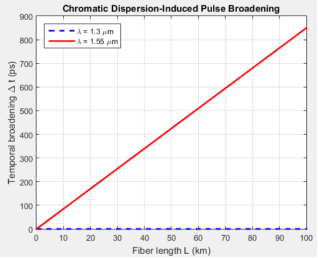
The rapid increase in data transmission requirements in modern optical communication systems has made chromatic dispersion a major limiting factor in optical fiber links. At high bit rates, even moderate dispersion can cause significant temporal broadening of optical pulses, leading to intersymbol interference and degradation of system performance. Chromatic dispersion originates from the wavelength dependence of the refractive index of the fiber material and from the waveguiding properties of the fiber, causing different spectral components of an optical signal to propagate at different group velocities. In this study, chromatic dispersion in silica-based optical fibers is investigated through analytical modeling using realistic physical and system parameters suitable for numerical simulation. The analysis considers single-mode optical fibers operating in the second and third telecommunication windows, centered at wavelengths of 1.3 µm and 1.55 µm, respectively. Typical fiber lengths ranging from 10 km to 100 km are considered, along with optical sources having spectral widths between 0.1 nm and 2 nm, representative of laser diodes and light-emitting diodes used in practical systems. The refractive index dispersion of silica is modeled using the Sellmeier equation, allowing the calculation of the group refractive index and its wavelength derivatives. Based on these parameters, the group delay and temporal pulse broadening are analytically derived as functions of wavelength, fiber length, and source spectral width. For standard single-mode fibers, the chromatic dispersion coefficient is assumed to be approximately 0 ps/(nm·km) near 1.3 µm and about 17 ps/(nm·km) at 1.55 µm, in agreement with widely reported experimental data. Numerical simulations are performed by injecting Gaussian optical pulses with initial temporal widths on the order of 50 ps to 200 ps and peak powers normalized to unity. The temporal evolution of the pulses is analyzed after propagation over different fiber lengths. The results are expected to show minimal pulse broadening around 1.3 µm, while a noticeable temporal spreading is observed at 1.55 µm, increasing linearly with both fiber length and source spectral width. The quantitative analysis presented in this work provides a clear framework for simulating and evaluating chromatic dispersion effects in optical fiber transmission systems. The chosen numerical parameters enable direct implementation in simulation tools and offer practical insight into the trade-off between low attenuation and dispersion in high-capacity optical communication networks.
| Published in | Journal of Photonic Materials and Technology (Volume 11, Issue 1) |
| DOI | 10.11648/j.jpmt.20261101.11 |
| Page(s) | 1-6 |
| Creative Commons |
This is an Open Access article, distributed under the terms of the Creative Commons Attribution 4.0 International License (http://creativecommons.org/licenses/by/4.0/), which permits unrestricted use, distribution and reproduction in any medium or format, provided the original work is properly cited. |
| Copyright |
Copyright © The Author(s), 2026. Published by Science Publishing Group |
Optical Fiber, Chromatic Dispersion, Wavelength, Group Velocity Dispersion, Numerical Simulation
Parameter | Values |
|---|---|
Fiber length | 10-100 km |
Central wavelength () | 1.3 µm, 1.55 µm |
Source spectral width () | 0.1-2 nm |
Initial pulse width | 50-200 ps |
Wavelength (µm) | Fiber length (km) | Source Δλ (nm) | Pulse broadening Δt (ps) |
|---|---|---|---|
1.3 | 50 | 0.5 | 0.05 |
1.3 | 100 | 0.5 | 0.1 |
1.55 | 50 | 0.5 | 0.425 |
1.55 | 100 | 0.5 | 0.85 |
1.55 | 50 | 1.0 | 0.85 |
1.55 | 50 | 2.0 | 1.7 |
CD | Chromatic Dispersion |
GVD | Group Velocity Dispersion |
LD | Laser Diode |
LED | Light Emitting Diode |
LP | Linearly Polarized mode |
MMF | Multi-Mode Fiber |
| Group Refractive Index |
PMD | Polarization Mode Dispersion |
SMF | Single-Mode Fiber |
| Phase Velocity |
| Group Velocity |
| Spectral Width |
| Temporal Broadening |
| Wavelength |
| [1] | G. P. Agrawal, Fiber-Optic Communication Systems, 4th ed., Wiley, New York, 2010. |
| [2] | G. Keiser, Optical Fiber Communications, 5th ed., McGraw-Hill, New York, 2013. |
| [3] | J. M. Senior and M. Y. Jamro, Optical Fiber Communications: Principles and Practice, 3rd ed., Pearson, 2009. |
| [4] | A. Ghatak and K. Thyagarajan, Introduction to Fiber Optics, Cambridge University Press, 1998. |
| [5] | E. Desurvire, Erbium-Doped Fiber Amplifiers, Wiley, 2002. |
| [6] | J. Hecht, Understanding Fiber Optics, 5th ed., Prentice Hall, 2006. |
| [7] | B. E. A. Saleh and M. C. Teich, Fundamentals of Photonics, 2nd ed., Wiley, 2007. |
| [8] | R. Ramaswami, K. N. Sivarajan, and G. H. Sasaki, Optical Networks: A Practical Perspective, 3rd ed., Morgan Kaufmann, 2010. |
| [9] | D. Marcuse, Theory of Dielectric Optical Waveguides, 2nd ed., Academic Press, 1991. |
| [10] | C. V. Raman and K. S. Krishnan, “A new type of secondary radiation,” Nature, vol. 121, pp. 501–502, 1928. |
| [11] | A. Yariv and P. Yeh, Photonics: Optical Electronics in Modern Communications, 6th ed., Oxford University Press, 2007. |
| [12] | ITU-T Recommendation G. 652, “Characteristics of a single-mode optical fibre and cable,” International Telecommunication Union, 2016. |
| [13] | E. Iannone et al., Nonlinear Optical Communication Networks, Wiley, 1998. |
| [14] | S. Kumar, Optical Fiber Communication, McGraw-Hill Education, 2014. |
| [15] | M. Born and E. Wolf, Principles of Optics, 7th ed., Cambridge University Press, 1999. |
APA Style
Erica, R. H. N., Andriamanalina, A. N. (2026). Chromatic Dispersion Modeling in Optical Fiber Transmission Systems. Journal of Photonic Materials and Technology, 11(1), 1-6. https://doi.org/10.11648/j.jpmt.20261101.11
ACS Style
Erica, R. H. N.; Andriamanalina, A. N. Chromatic Dispersion Modeling in Optical Fiber Transmission Systems. J. Photonic Mater. Technol. 2026, 11(1), 1-6. doi: 10.11648/j.jpmt.20261101.11
AMA Style
Erica RHN, Andriamanalina AN. Chromatic Dispersion Modeling in Optical Fiber Transmission Systems. J Photonic Mater Technol. 2026;11(1):1-6. doi: 10.11648/j.jpmt.20261101.11
@article{10.11648/j.jpmt.20261101.11,
  author = {Randriana Heritiana Nambinina Erica and Ando Nirina Andriamanalina},
  title = {Chromatic Dispersion Modeling in Optical Fiber Transmission Systems},
  journal = {Journal of Photonic Materials and Technology},
  volume = {11},
  number = {1},
  pages = {1-6},
  doi = {10.11648/j.jpmt.20261101.11},
  url = {https://doi.org/10.11648/j.jpmt.20261101.11},
  eprint = {https://article.sciencepublishinggroup.com/pdf/10.11648.j.jpmt.20261101.11},
  abstract = {The rapid increase in data transmission requirements in modern optical communication systems has made chromatic dispersion a major limiting factor in optical fiber links. At high bit rates, even moderate dispersion can cause significant temporal broadening of optical pulses, leading to intersymbol interference and degradation of system performance. Chromatic dispersion originates from the wavelength dependence of the refractive index of the fiber material and from the waveguiding properties of the fiber, causing different spectral components of an optical signal to propagate at different group velocities. In this study, chromatic dispersion in silica-based optical fibers is investigated through analytical modeling using realistic physical and system parameters suitable for numerical simulation. The analysis considers single-mode optical fibers operating in the second and third telecommunication windows, centered at wavelengths of 1.3 µm and 1.55 µm, respectively. Typical fiber lengths ranging from 10 km to 100 km are considered, along with optical sources having spectral widths between 0.1 nm and 2 nm, representative of laser diodes and light-emitting diodes used in practical systems. The refractive index dispersion of silica is modeled using the Sellmeier equation, allowing the calculation of the group refractive index and its wavelength derivatives. Based on these parameters, the group delay and temporal pulse broadening are analytically derived as functions of wavelength, fiber length, and source spectral width. For standard single-mode fibers, the chromatic dispersion coefficient is assumed to be approximately 0 ps/(nm·km) near 1.3 µm and about 17 ps/(nm·km) at 1.55 µm, in agreement with widely reported experimental data. Numerical simulations are performed by injecting Gaussian optical pulses with initial temporal widths on the order of 50 ps to 200 ps and peak powers normalized to unity. The temporal evolution of the pulses is analyzed after propagation over different fiber lengths. The results are expected to show minimal pulse broadening around 1.3 µm, while a noticeable temporal spreading is observed at 1.55 µm, increasing linearly with both fiber length and source spectral width. The quantitative analysis presented in this work provides a clear framework for simulating and evaluating chromatic dispersion effects in optical fiber transmission systems. The chosen numerical parameters enable direct implementation in simulation tools and offer practical insight into the trade-off between low attenuation and dispersion in high-capacity optical communication networks.},
 year = {2026}
}
TY  - JOUR
T1  - Chromatic Dispersion Modeling in Optical Fiber Transmission Systems
AU  - Randriana Heritiana Nambinina Erica
AU  - Ando Nirina Andriamanalina
Y1  - 2026/01/19
PY  - 2026
N1  - https://doi.org/10.11648/j.jpmt.20261101.11
DO  - 10.11648/j.jpmt.20261101.11
T2  - Journal of Photonic Materials and Technology
JF  - Journal of Photonic Materials and Technology
JO  - Journal of Photonic Materials and Technology
SP  - 1
EP  - 6
PB  - Science Publishing Group
SN  - 2469-8431
UR  - https://doi.org/10.11648/j.jpmt.20261101.11
AB  - The rapid increase in data transmission requirements in modern optical communication systems has made chromatic dispersion a major limiting factor in optical fiber links. At high bit rates, even moderate dispersion can cause significant temporal broadening of optical pulses, leading to intersymbol interference and degradation of system performance. Chromatic dispersion originates from the wavelength dependence of the refractive index of the fiber material and from the waveguiding properties of the fiber, causing different spectral components of an optical signal to propagate at different group velocities. In this study, chromatic dispersion in silica-based optical fibers is investigated through analytical modeling using realistic physical and system parameters suitable for numerical simulation. The analysis considers single-mode optical fibers operating in the second and third telecommunication windows, centered at wavelengths of 1.3 µm and 1.55 µm, respectively. Typical fiber lengths ranging from 10 km to 100 km are considered, along with optical sources having spectral widths between 0.1 nm and 2 nm, representative of laser diodes and light-emitting diodes used in practical systems. The refractive index dispersion of silica is modeled using the Sellmeier equation, allowing the calculation of the group refractive index and its wavelength derivatives. Based on these parameters, the group delay and temporal pulse broadening are analytically derived as functions of wavelength, fiber length, and source spectral width. For standard single-mode fibers, the chromatic dispersion coefficient is assumed to be approximately 0 ps/(nm·km) near 1.3 µm and about 17 ps/(nm·km) at 1.55 µm, in agreement with widely reported experimental data. Numerical simulations are performed by injecting Gaussian optical pulses with initial temporal widths on the order of 50 ps to 200 ps and peak powers normalized to unity. The temporal evolution of the pulses is analyzed after propagation over different fiber lengths. The results are expected to show minimal pulse broadening around 1.3 µm, while a noticeable temporal spreading is observed at 1.55 µm, increasing linearly with both fiber length and source spectral width. The quantitative analysis presented in this work provides a clear framework for simulating and evaluating chromatic dispersion effects in optical fiber transmission systems. The chosen numerical parameters enable direct implementation in simulation tools and offer practical insight into the trade-off between low attenuation and dispersion in high-capacity optical communication networks.
VL  - 11
IS  - 1
ER  -
Telecommunications, Doctoral School of Engineering Sciences and Innovation, Antananarivo, Madagascar
Biography: Randriana Heritiana Nambinina Erica is a lecturer and researcher at the University of Antananarivo and a faculty member at the ? HYPERLINK "https://www.google.com/search?q=Polytechnic+School+of+Antananarivo&sca_esv=7dade2f00a4d3607&sxsrf=AE3TifO0fPm5q8D3NIImEY-I7WbusNJQmA%3A1767193337941&source=hp&ei=-TpVaen2N6jw7M8Pn-PD2Qo&iflsig=AOw8s4IAAAAAaVVJCXmp1i-F11CmS68jd1eunWRC4hjY&ved=2ahUKEwjKibacjOiRAxWYUEEAHfBEDskQgK4QegQIARAB&uact=5&oq=%C3%89cole+Sup%C3%A9rieure+Polytechnique+d%E2%80%99Antananarivo+en+anglais&gs_lp=Egdnd3Mtd2l6IjzDiWNvbGUgU3Vww6lyaWV1cmUgUG9seXRlY2huaXF1ZSBk4oCZQW50YW5hbmFyaXZvIGVuIGFuZ2xhaXMyCBAAGIAEGKIEMgUQABjvBTIIEAAYgAQYogQyBRAAGO8FSKslUABY1CJwAXgAkAEAmAGAA6ABiiGqAQYyLTMuMTC4AQPIAQD4AQL4AQGYAg6gAuAhwgIHEAAYgAQYDcICBhAAGBYYHsICCBAAGBYYHhgKwgIHECEYChigAZgDAJIHCDEuMC4xLjEyoAeXR7IHBjItMS4xMrgH2iHCBwc0LjcuMi4xyAclgAgB&sclient=gws-wiz&mstk=AUtExfBzfx5-nvxt5oZOVOGrogzyZzm4guqe1Aisv2oTzXCFWTxkNOmjK5rutkjMuqUjowrGK4Z_ITUDUENCUW4etTQCQ22O5zakg1I4ENgLbpV0gebIzk40SbTFURkYMtahZi2G0lmkbVcm0wtYB4JQZdDYLjrD0UI_aTlLAoU0JYx5z0fl120GL3swNjwMGfBDlzm46GIqpC5waxqUv2-8WRxgMwYHGDWzGOjR2JRvsFPaHqRyM86cWPeeVW-XBeoWk6UB-wavMgWdauad68Uk-Lcf&csui=3" ?Polytechnic School of Antananarivo? (ESPA). He is also a doctoral candidate within the EDSTII doctoral school, specializing in telecommunications. His research focuses primarily on optical fiber technologies, including performance optimization, signal propagation, and applications in high-speed communication systems. He has contributed to several academic and applied research projects related to broadband network development and emerging communication infrastructures in Madagascar. His work reflects a strong commitment to advancing optical communication solutions adapted to local and regional technological needs. He actively participates in scientific activities through teaching, research supervision, and conference contributions.
Research Fields: Telecommunication, transmission, optical fiber, optical communication, Signal Processing.

Telecommunications, Doctoral School of Engineering Sciences and Innovation, Antananarivo, Madagascar
Research Fields: Telecommunications, Control Systems, Signal Processing.

Information



 Share This Article
 Twitter
 Linked In
 Facebook
 Copy
Copy Download