Research Article | | Peer-Reviewed

HPLC Analysis of Ascorbic Acid Content in Four Orange Varieties in Ghana

Received: 25 February 2026     Accepted: 13 March 2026     Published: 27 March 2026
Views:       Downloads:
Abstract

Oranges are one of Ghana's most popular citrus fruits and constitute an essential dietary source of ascorbic acid (vitamin C) and other phytochemicals that improve human health and well-being. In spite of their importance as nutrients and economic sources, only a limited number of studies have been conducted to compare the ascorbic acid content of local orange varieties in Ghana. This study aimed to evaluate the ascorbic acid content of four local orange varieties (i.e. Abofour, Water Grape, Mediterranean Sweet and Washintong) cultivated in Ghana. 15 fresh orange fruits from each variety totaling 60 orange fruits were obtained from the Plant Genetic Resources Research Institute (PGRRI) farm in Bunso in Eastern Region, Ghana. The orange juices were manually extracted and analyzed for their ascorbic acid content using High-Performance Liquid Chromatography (HPLC) method. The results showed the Washintong variety had the highest ascorbic acid content (4.49 mg/10 mL), followed by Abofour (4.31 mg/10 mL), Water Grape (4.28 mg/10 mL), and Mediterranean Sweet (3.70 mg/10 mL). The study analyzed the ascorbic acid content in four local orange varieties. The findings highlight the nutritional value of each orange variety as a dietary source of vitamin C. The results also provides scientific evidence for agricultural policy, nutrition education, and value-added strategies for the promotion of vitamin C rich orange fruits for consumers’ health in Ghana.

Published in Journal of Food and Nutrition Sciences (Volume 14, Issue 2)
DOI 10.11648/j.jfns.20261402.13
Page(s) 127-133
Creative Commons

This is an Open Access article, distributed under the terms of the Creative Commons Attribution 4.0 International License (http://creativecommons.org/licenses/by/4.0/), which permits unrestricted use, distribution and reproduction in any medium or format, provided the original work is properly cited.

Copyright

Copyright © The Author(s), 2026. Published by Science Publishing Group

Keywords

Abofour, Ascorbic Acid, Mediterranean Sweet, Orange Varieties, Washington, Water Grape

1. Introduction
Sweet oranges (Citrus sinensis) are among the most consumed fruits worldwide due to their desirable taste and exceptional nutritional profile. Oranges are known sources of high content of ascorbic acid (i.e. Vitamin C), minerals, complex array of health-promoting phytochemicals and dietary fibre . These phytochemicals including flavonoids, phenolic acids and coumarins are well documented across citrus species and contribute meaningfully to health-related bioactivities .
Ascorbic acid is known for its antioxidant properties which protects cells against oxidative molecules by neutralizing reactive oxygen species (ROS), halting the chain reaction of lipid peroxidation reducing potential cellular injury . Ascorbic acid exhibits a unique regenerative capacity because it reduces oxidative stress, and effectively restores the antioxidant activity of other crucial antioxidants within the body, such as alpha-tocopherol (vitamin E) which significantly enhances the body's overall antioxidant defense system . Ascorbic acid is essential for human health and is involved in many metabolic processes in the body such as protection against cancer, stimulates the immune system, and has many other important effects .
Orange production in Ghana is an essential input for agriculture and food and has developed economic and nutritional significance, particularly across Ghana’s Ashanti and Eastern regions . Ghana’s orange industry has expanded steadily in recent years. Numerous smallholder farmers are using more efficient farming practices like regular pruning, soil management, and grafting to improve yield and fruit quality. The warm and humid local climate contributes to the variety of sweet oranges such as Obuasi, Asuansi, Achiasi, Shama, and Nkwanta that are extensively cultivated; each unique to the specific towns where they are cultivated in the Eastern, Central, and Ashanti regions . Despite the fact that oranges are among the dominant fruits in Ghanaian markets, there is little information on the nutritional differences between locally grown varieties. Previous findings from other parts of the world have found that the content of vitamin C in oranges can vary according to the cultivar type, the method of fruit production, and post-harvest treatment . The present study aimed to analyze the ascorbic acid content in four different Ghanaian orange varieties. The outcome of the study will provide practical guidance for local farmers and consumers on which varieties deliver higher nutritional values, as well as information to health professionals looking for natural dietary sources of vitamin C that can be used for nutrition planning and public-health advice.
2. Materials and Method
2.1. Selection and Sampling of Orange Fruits
The fruits of four orange varieties namely Abofour, Water Grape, Mediterranean Sweet and Washington were collected from the Plant Genetic Resources Research Institute (PGRRI) farm located at Bunso in Ghana’s Eastern Region. These cultivars were selected because they are widely consumed in the Ghanaian market. Since all varieties undergo uniformity in soil management, irrigation and pest control, PGRRI retains all the orange varieties in uniform conditions. Using the institute also made sure the fruits were available in the harvest season and could be sampled at optimal maturity.
In the PGRRI orchard, the fruits of the four orange varieties were randomly sampled having in mind the genetic diversity of the farm population . Fifteen fruits were sampled for each orange variety type totaling a sample size of sixty (60) fruits. The orange fruits were harvested during the peak season in April 2025 to ensure uniform ripeness and maturity. Hand-picking and sorting were used to exclude physically injured or diseased fruits. All the orange varieties were picked and placed in a clean, well-ventilated labelled boxes to avoid mix-ups. The organoleptics of the selected orange varieties are presented in the Supplementary Information.
2.2. Extraction of Juice Sample from the Four Orange Varieties
Each orange fruit was thoroughly washed under running tap water to remove dust and surface contaminants. The fruits were then peeled and cut into halves using a clean stainless-steel knife. The juice from each fruit was manually squeezed with a hand juicer into pre-cleaned glass containers. The freshly extracted juice samples were immediately transferred into airtight amber bottles to minimize contact with air and light that could degrade vitamin C and other photosensitive phytochemicals. All the sample bottles were clearly labelled and stored in a refrigerator at 4°C until further use.
2.3. Determination of Ascorbic Acid Content Using HPLC
The ascorbic acid content of the orange varieties was determined as follows:
2.3.1. Preparation of Mobile Phase (0.05 M Monobasic Sodium Phosphate)
The mobile phase (0.05 M monobasic sodium phosphate) was prepared in accordance with the USP monograph on ascorbic acid oral quantification . A calculated 12.12 g of sodium dihydrogen phosphate anhydrous was accurately weighed and dissolved in 2 L of deionized water in a beaker using a magnetic stirrer to ensure complete dissolution. The pH of the solution was then adjusted to 2.5 using ortho-metaphosphoric acid, after which the prepared mobile phase was ready for use.
2.3.2. Preparation of Standard Ascorbic Acid Solution
About 0.02 g of pure ascorbic acid powder was accurately weighed into a 100 mL volumetric flask. 25 mL of the mobile phase was added, and the flask was swirled gently until the powder dissolved completely. The solution was then brought to volume with additional mobile phase to obtain a 0.2 mg/mL concentration. To ensure full dissolution and uniformity, the stoppered flask was sonicated for 25 minutes before use.
2.3.3. Preparation of Orange Juice Samples for the HPLC Analysis
10 mL of the freshly extracted juice from each of the four orange varieties was pipetted into separate 100 mL volumetric flasks. About 25 mL of the mobile phase was added and mixed gently to obtain a uniform solution. Each flask was then filled to the 100 mL mark with the mobile phase, labelled with the code for its variety, and fastened with a stopper. Before HPLC analysis, the samples were placed on an orbital shaker for 15 minutes to allow proper mixing.
2.3.4. HPLC Set-up for the Ascorbic Acid Quantification
Separate HPLC vials were loaded with the prepared juice samples, mobile-phase, diluent, and 0.2 mg/mL of standard ascorbic acid solution. The vials were inserted into the auto-sampler, and the chromatographic run was performed on a C18 reverse-phase column, using 0.05 M monobasic sodium-phosphate buffer applied as mobile phase. All instrument conditions were kept as follows: auto-sampler 5°C, column 10°C, flow rate 1.0 mL min⁻¹, injection volume 10 µL, UV detection at 220 nm. For the standard ascorbic acid solution, retention time, peak area and height were recorded first to verify the system suitability and checked by the percent relative standard deviation (%RSD) criterion. The corresponding peaks of juice samples were found, with their areas and heights recorded, using the same retention time as reference. The ascorbic acid concentration (Cs, mg/100 mL) in each of the samples was then calculated using the calibration formula.
%RSD=SDAMA×100
Where:
%RSD = Percent Relative Standard Deviation
SDA = Standard Deviation of Area for the standard ascorbic acid
MA = Mean Area of standard ascorbic acid
CSmg/10 mL=AsAstd×D.F×Cstd×Vs
Where:
Cs = Concentration of sample
As = Peak area of sample
Astd = Peak area of standard
D.F = Dilution factor
Cstd = Concentration of standard
Vs = Volume of sample
3. Results and Discussion
3.1. HPLC Analysis of Standard Ascorbic Acid
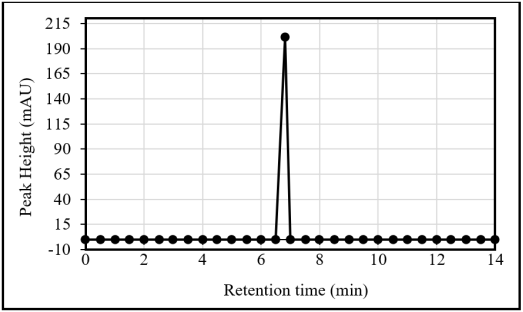
The standard ascorbic acid was analyzed by the HPLC method, and the results are presented and discussed. The standard ascorbic acid showed a distinct peak at an average retention time of 6.82 minutes, which was used to identify the ascorbic acid peaks in the orange juice samples. Table 1 presents the average chromatogram parameters, while Figure 1 presents the average chromatogram of the standard ascorbic acid.
From Table 1, the system suitability for HPLC was calculated using the percent Relative Standard Deviation (%RSD) formula to be 0.368%. The method was found to be highly reproducible, with good precision as the %RSD value was well below the reference value of ≤ 2% for an acceptable HPLC reproducibility value , confirming the robustness of the quantification.
Figure 1. Average chromatogram of standard ascorbic acid.
3.2. HPLC Analysis of Ascorbic Acid Content in the Orange Varieties
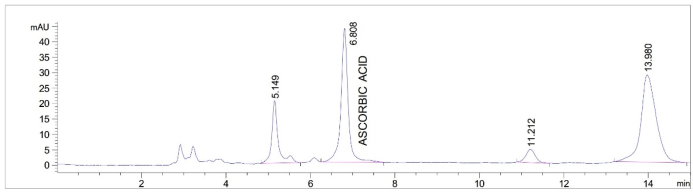
The four orange sample chromatograms presented in Figures 2-5 showed similar peaks approximately at the average retention time of 6.82 minutes, as observed for the standard ascorbic acid, confirming the presence of ascorbic acid. There were other unknown peaks in the chromatograms, indicating the presence of other phytochemical compounds that responded at the same wavelength as ascorbic acid.
The HPLC chromatogram parameters shown in Table 1 were used to calculate the ascorbic acid content in the four orange varieties. There were significant differences in the ascorbic acid content, with Washintong showing the highest (4.49 mg/100 mL), followed by Abofour (4.31 mg/100 mL), Water Grape (4.28 mg/100 mL), and Mediterranean Sweet (3.70 mg/100 mL). These concentrations are presented in Figure 6.
The highest concentration of vitamin C in Washintong could be accounted for by the genetically differentiated metabolic efficiency of vitamin C biosynthesis through the L-galactose pathway, combined with the efficient recycling of dehydroascorbic acid through enzymatic systems such as dehydroascorbate reductase . Environmental factors, including the amount of sunlight exposure, adequate temperature, and soil composition, might also influence the biosynthesis of ascorbic acid and limit its oxidative degradation .
Lower values in Mediterranean sweet might be due to genetic constraints in ascorbate accumulation or higher respiration during ripening, thereby increasing its oxidative breakdown . Post-harvest handling and storage temperatures of ascorbic acid instability are also known to worsen these varietal differences . A study by Ashiagbor and Atta-Eyison (2024) reported higher ascorbic acid content in three local orange varieties (Obuasi, 72.43 mg/100 mL; Ayensudo, 74.71 mg/100 mL; and Nkwanta, 74.32 mg/100 mL) under no storage condition using redox iodometric method . The differences in the ascorbic acid content in the present study and that of Ashiagbor and Atta-Eyison (2024) might be due to variations in maturity stage, regional variations in climate, temperature, rainfall patterns, amount of nitrogen fertilizers used in orange plant growth, and method of ascorbic acid determination .
Figure 2. Chromatogram of Abofour Orange variety.
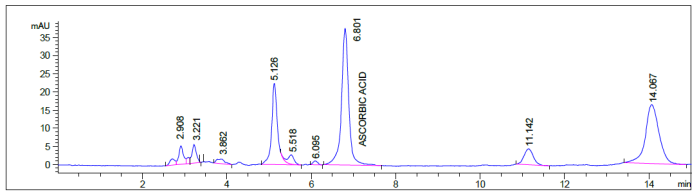
Figure 3. Chromatogram of Mediterranean Sweet Orange variety.
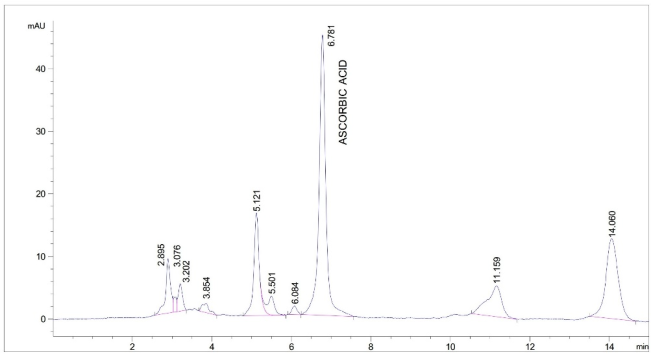
Figure 4. Chromatogram of Washintong Orange Variety.
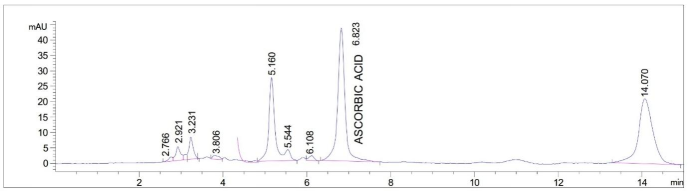
Figure 5. Chromatogram of Water Grape variety.
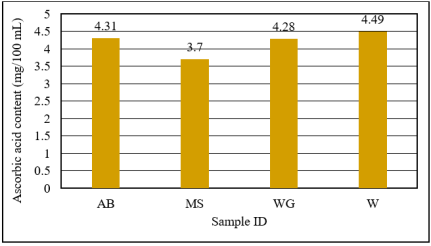
Table 1. Chromatogram parameters of standard ascorbic acid and orange juice samples.

Injection ID

Retention time (min)

Area (mAU*s)

Height (mAU)

Symmetry

Width (min)

Plates

Resolution

Selectivity

Concentration (mg/100 mL)

SAA

6.82

-

2424.06

201.39

1

0.16

9929.2

-

-

0.2

AB

6.81

-

522.16

43.41

0.95

0.16

9662

6.68

1.32

4.31

MS

6.80

-

448.65

37.62

0.99

0.16

10056

2.94

1.12

3.70

WG

6.82

-

518.16

43.24

0.95

0.16

10067

2.71

1.12

4.28

W

6.78

-

544.33

44.87

0.95

0.16

9609

2.74

1.11

4.49

SAA = standard ascorbic acid; AB = Abofour; MS = Mediterranean Sweet; WG = Water grape; W = Washintong
Figure 6. Ascorbic acid concentration in the Orange Varieties.

4. Conclusion
The study analyzed the ascorbic acid content in four orange varieties (namely Abofour, Mediterranean Sweet, Water Grape, and Washington) grown in Ghana using the HPLC method. The ascorbic acid content varied among the orange varieties, with Washington containing the highest ascorbic acid content and Mediterranean Sweet having the least ascorbic acid content. The outcome of the study guides local farmers and consumers on which orange variety delivers higher ascorbic acid, and provides information to dieticians and public health practitioners looking for natural dietary sources of vitamin C that can be used for nutrition planning and public-health advice. Future research will focus on determining the effects of storage conditions and identifying the unknown peaks shown on the HPLC chromatograms of the orange samples which responded at the same wavelength as the ascorbic acid.
Abbreviations

HPLC

High-Performance Liquid Chromatography

%RSD

Percent Relative Standard Deviation

PGRRI

Plant Genetic Resources Research Institute

ROS

Reactive Oxygen Species

USP

United States Pharmacopoeia

Acknowledgments
We extend our gratitude to Plant Genetic Research Resource Institute and Ernest Chemist Limited for their support in getting us the samples of the orange varieties. We also acknowledge the staff at Ernest Chemist for their support in the HPLC analysis.
Author Contributions
Tidakabi Pollard Tamonibi: Conceptualization, Investigation, Methodology, Data curation, Visualization, Formal Analysis, Writing - review & editing
Monica Winpiini Apiiga: Conceptualization, Investigation, Methodology, Data curation, Visualization, Formal Analysis, Writing-review & editing
Abdallah Yakubu: Project administration, Supervision, Resources, Data curation, Validation, Writing - original draft, Writing - review & editing
Conflicts of Interest
The authors declare no conflict of interest.
References
[1] Tütem, E., Sözgen Başkan, K., Karaman Ersoy, Ş., & Apak, R. (2020). Orange. In Nutritional composition and antioxidant properties of fruits and vegetables (pp. 353–376). Elsevier.
[2] Liu, S., Lou, Y., Li, Y., Zhang, J., Li, P., Yang, B., & Gu, Q. (2022). Review of phytochemical and nutritional characteristics and food applications of Citrus L. fruits. Frontiers in Nutrition, 9, 968604.
[3] Lv, X., Zhao, S., Ning, Z., Zeng, H., Shu, Y., Tao, O., Xiao, C., Lu, C., & Liu, Y. (2015). Citrus fruits as a treasure trove of active natural metabolites that potentially provide benefits for human health. Chemistry Central Journal, 9, 68.
[4] Saini, R. K., Ranjit, A., Sharma, K., Prasad, P., Shang, X., Gowda, K. G. M., & Keum, Y. S. (2022). Bioactive compounds of citrus fruits: A review of composition and health benefits of carotenoids, flavonoids, limonoids, and terpenes. Antioxidants, 11(2), 239.
[5] Xu, Y., He, P., He, B., & Chen, Z. (2025). Bioactive flavonoids metabolites in citrus species: Their potential health benefits and medical potentials. Frontiers in Pharmacology, 16, 1552171.
[6] Kaźmierczak-Barańska, J., Boguszewska, K., Adamus-Grabicka, A., & Karwowski, B. T. (2020). Two faces of vitamin C—Antioxidative and pro-oxidative agent. Nutrients, 12(5), 1501.
[7] Munteanu, I. G., & Apetrei, C. (2021). Analytical methods used in determining antioxidant activity: A review. International Journal of Molecular Sciences, 22(7), 3380.
[8] Abdullah, M., Jamil, R. T., & Attia, F. N. (2023). Vitamin C (Ascorbic Acid). StatPearls Publishing.
[9] Ofosu-Badu, K. G. (2022). Citrus production manual: Guide for citrus production from establishment of plantation to harvesting.
[10] Ashiagbor, E. A., & Atta-Eyison, A. A. (2024). Determination of ascorbic acid levels in oranges under different storage conditions using Redox iodometric method. World Journal of Advanced Research and Reviews, 22(1), 1169–1179.
[11] Fenech, M., Amaya, I., Valpuesta, V., & Botella, M. A. (2019). Vitamin C content in fruits: Biosynthesis and regulation. Frontiers in Plant Science, 9, 413553.
[12] Habibi, F., Ramezanian, A., Guillén, F., Castillo, S., Serrano, M., & Valero, D. (2020). Changes in bioactive compounds, antioxidant activity, and nutritional quality of blood orange cultivars at different storage temperatures. Antioxidants, 9(10), 1016.
[13] Lee, S. K., & Kader, A. A. (2000). Preharvest and postharvest factors influencing vitamin C content of horticultural crops. Postharvest Biology and Technology, 20(3), 207–220.
[14] Mello, P. A. (2021). Qualitative comparative analysis: An introduction to research design and application. Georgetown University Press.
[15] United States Pharmacopeia (2017). USP Monographs Dietary Supplement Monographs, Ascorbic Acid Oral Solution. USP-NF. Rockville, MD: United States Pharmacopeia.
[16] Dong, M.-B. (2020). Validation of stability-indicating HPLC methods for pharmaceuticals: Overview, methodologies, and case studies. LCGC North America, 38(12), 606–618. MJH Life Sciences.
[17] Bulley, S., & Laing, W. (2016). The regulation of ascorbate biosynthesis. Current Opinion in Plant Biology, 33, 15–22.
[18] Legua, P., Modica, G., Porras, I., Conesa, A., & Continella, A. (2022). Bioactive compounds, antioxidant activity and fruit quality evaluation of eleven blood orange cultivars. Journal of the Science of Food and Agriculture, 102(7), 2960–2971.
[19] Barros, M. P., Zacarías-Garcia, J., Rey, F., Zacarías, L., & Rodrigo, M. J. (2023). Antioxidant interactions between citrus fruit carotenoids and ascorbic acid in new models of animal cell membranes. Antioxidants, 12(9), 1733.
[20] Abeysuriya, H. I., Bulugahapitiya, V. P., & Jayatissa, L. P. (2024). Variation of vitamin C content and antioxidant capacities during the post-harvest storage of fresh fruits under different temperatures. Journal of Stored Products Research, 109, 102426.
[21] Modica, G., Legua, P., La Malfa, S., Gentile, A., & Continella, A. (2024). Qualitative traits and antioxidant properties of blood oranges are affected by the genotype and the climatic conditions. Foods, 13(19), Article 3137.
[22] Shrestha, N., Shrestha S., and Bhattarai A. (2016). Determination of ascorbic acid in different citrus fruits of Kathmandu Valley. Journal of Medical and Biological Science Research, 2(1), 9-14.
Cite This Article
  • APA Style

    Tamonibi, T. P., Apiiga, M. W., Yakubu, A. (2026). HPLC Analysis of Ascorbic Acid Content in Four Orange Varieties in Ghana. Journal of Food and Nutrition Sciences, 14(2), 127-133. https://doi.org/10.11648/j.jfns.20261402.13

    Copy | Download

    ACS Style

    Tamonibi, T. P.; Apiiga, M. W.; Yakubu, A. HPLC Analysis of Ascorbic Acid Content in Four Orange Varieties in Ghana. J. Food Nutr. Sci. 2026, 14(2), 127-133. doi: 10.11648/j.jfns.20261402.13

    Copy | Download

    AMA Style

    Tamonibi TP, Apiiga MW, Yakubu A. HPLC Analysis of Ascorbic Acid Content in Four Orange Varieties in Ghana. J Food Nutr Sci. 2026;14(2):127-133. doi: 10.11648/j.jfns.20261402.13

    Copy | Download

  • @article{10.11648/j.jfns.20261402.13,
      author = {Tidakabi Pollard Tamonibi and Monica Winpiini Apiiga and Abdallah Yakubu},
      title = {HPLC Analysis of Ascorbic Acid Content in Four Orange Varieties in Ghana},
      journal = {Journal of Food and Nutrition Sciences},
      volume = {14},
      number = {2},
      pages = {127-133},
      doi = {10.11648/j.jfns.20261402.13},
      url = {https://doi.org/10.11648/j.jfns.20261402.13},
      eprint = {https://article.sciencepublishinggroup.com/pdf/10.11648.j.jfns.20261402.13},
      abstract = {Oranges are one of Ghana's most popular citrus fruits and constitute an essential dietary source of ascorbic acid (vitamin C) and other phytochemicals that improve human health and well-being. In spite of their importance as nutrients and economic sources, only a limited number of studies have been conducted to compare the ascorbic acid content of local orange varieties in Ghana. This study aimed to evaluate the ascorbic acid content of four local orange varieties (i.e. Abofour, Water Grape, Mediterranean Sweet and Washintong) cultivated in Ghana. 15 fresh orange fruits from each variety totaling 60 orange fruits were obtained from the Plant Genetic Resources Research Institute (PGRRI) farm in Bunso in Eastern Region, Ghana. The orange juices were manually extracted and analyzed for their ascorbic acid content using High-Performance Liquid Chromatography (HPLC) method. The results showed the Washintong variety had the highest ascorbic acid content (4.49 mg/10 mL), followed by Abofour (4.31 mg/10 mL), Water Grape (4.28 mg/10 mL), and Mediterranean Sweet (3.70 mg/10 mL). The study analyzed the ascorbic acid content in four local orange varieties. The findings highlight the nutritional value of each orange variety as a dietary source of vitamin C. The results also provides scientific evidence for agricultural policy, nutrition education, and value-added strategies for the promotion of vitamin C rich orange fruits for consumers’ health in Ghana.},
     year = {2026}
    }
    

    Copy | Download

  • TY  - JOUR
    T1  - HPLC Analysis of Ascorbic Acid Content in Four Orange Varieties in Ghana
    AU  - Tidakabi Pollard Tamonibi
    AU  - Monica Winpiini Apiiga
    AU  - Abdallah Yakubu
    Y1  - 2026/03/27
    PY  - 2026
    N1  - https://doi.org/10.11648/j.jfns.20261402.13
    DO  - 10.11648/j.jfns.20261402.13
    T2  - Journal of Food and Nutrition Sciences
    JF  - Journal of Food and Nutrition Sciences
    JO  - Journal of Food and Nutrition Sciences
    SP  - 127
    EP  - 133
    PB  - Science Publishing Group
    SN  - 2330-7293
    UR  - https://doi.org/10.11648/j.jfns.20261402.13
    AB  - Oranges are one of Ghana's most popular citrus fruits and constitute an essential dietary source of ascorbic acid (vitamin C) and other phytochemicals that improve human health and well-being. In spite of their importance as nutrients and economic sources, only a limited number of studies have been conducted to compare the ascorbic acid content of local orange varieties in Ghana. This study aimed to evaluate the ascorbic acid content of four local orange varieties (i.e. Abofour, Water Grape, Mediterranean Sweet and Washintong) cultivated in Ghana. 15 fresh orange fruits from each variety totaling 60 orange fruits were obtained from the Plant Genetic Resources Research Institute (PGRRI) farm in Bunso in Eastern Region, Ghana. The orange juices were manually extracted and analyzed for their ascorbic acid content using High-Performance Liquid Chromatography (HPLC) method. The results showed the Washintong variety had the highest ascorbic acid content (4.49 mg/10 mL), followed by Abofour (4.31 mg/10 mL), Water Grape (4.28 mg/10 mL), and Mediterranean Sweet (3.70 mg/10 mL). The study analyzed the ascorbic acid content in four local orange varieties. The findings highlight the nutritional value of each orange variety as a dietary source of vitamin C. The results also provides scientific evidence for agricultural policy, nutrition education, and value-added strategies for the promotion of vitamin C rich orange fruits for consumers’ health in Ghana.
    VL  - 14
    IS  - 2
    ER  - 

    Copy | Download

Author Information